Apparently Elliot Rodger was mentally ill (sort of), but he’s still not a “madman”.

Because I saw someone on Tumblr say “Stop saying he wasn’t mentally ill, he had Asperger’s” and I just couldn’t anymore.

(Edited version.)

The problem is, the idea people have in mind when they say that someone who’s committed a shocking crime is a “madman” or must be “unbalanced” or “insane”— that idea has only the most tenuous possible connection to actual mental illness. The fact that Elliot Rodger’s parents’ attorney says he was diagnosed with Asperger’s does not indicate that the people who called him a madman/etc. were right.

Obviously, the actual list of symptoms of Asperger’s Syndrome has nothing in common with the popular idea of the bloodthirsty madman. Even the most negative stereotypes of Asperger’s wouldn’t lead you to expect a mass shooting. You wouldn’t expect an Asperger’s diagnosis to mean someone was totally out of touch with reality, or with basic ideas of right and wrong.

The knee-jerk reaction to violence of “no one sane could do that” has nothing to do with what Elliot Rodger was actually thinking, it has nothing to do with Asperger’s, and it doesn’t even have much to do with mental illnesses or cognitive disabilities in general.

When people say “madman” or “insane” in this context, they’re clearly not thinking of, for instance, people with ADHD, depression, panic attacks, phobias, eating disorders— even though it’s things like these that make up the majority of “mentally ill” people. And the evidence bears out what I’m sure any of the people saying these things would tell you: they’re not thinking of real people who’ve been treated by a psychologist at some point, because the “mentally ill” people they know in real life obviously aren’t mass murderers. Mental illness does not make people any more likely to commit violence— not even the scary-sounding things like schizophrenia. (I unfortunately can’t find the source I’ve seen for this before, and this one is kind of academic-sounding, but it seems like a good summary and includes a lot of references.) That strong identification of indiscriminate violence with “insanity” does not come from people’s real experiences of violent crime or of mental illness, because most “mentally ill” people don’t commit violent crimes and most violence is not committed by “mentally ill” people.

But people latch onto it because we want to be able to explain violence.

Particularly, we want to be able to explain it without feeling close to it. We want to dismiss it as something we and the people we care about could never do. And we don’t want to think too hard about the reality of violence or the reasons people might have for committing it— we don’t want to believe there could ever be a reason for mass murder that would make sense to anyone. So it’s easy to write off big, scary violent acts as things someone could only do if they don’t really have a functioning mind.

But it’s wrong.

It relies on an inaccurate and very damaging stereotype of what mental illness means. And it provides an excuse for people who know perfectly well that what they’re doing is wrong.

So, yes, apparently Elliot Rodger had Asperger’s. And you can call that being mentally ill, for a certain definition of it. But the person you’re thinking of when you call Elliot Rodger or anyone like him a “madman”, or “insane”, or “unhinged”— that person doesn’t exist, or at most is incredibly rare. When people with mental illnesses commit crimes, it’s for the same reasons “sane” people do. Don’t write off violence that has a reason as senseless “insanity”, and don’t stereotype mental illness as inevitably leading to violence.
Saying no to things you don’t want is self-care.

People shouldn’t pressure you to do things they know you don’t want, and usually in situations where this goes badly it’s all the fault of the person doing the asking, but. Listening to yourself in the first place, to figure out what you want, and at least trying to express it, is self-care.

Anybody who’s had to put up with something that really hurt them, for a really long time, can tell you that it is soul-destroying. It’s scary how possible it is to get used to things that seemed shockingly bad at first. Hell, many people who were abused from a young age will tell you that they genuinely believed the way they were treated was normal, that it was something everyone had to deal with. That the most difficult part of getting away from abuse is realizing that getting away is an option. It’s possible to get used to all sorts of things that you would expect no one could ever tolerate.

I think people do have an innate sense of what’s good for them and what’s harmful, but it is surprisingly easy to drown out, or dent out of shape.

So: that sense of what you want and what you don’t is something you need to take care of. If it doesn’t get respected, or at least noticed, it can die. It is a part of you that needs self-care.

It’s not so much “learning to say no” as it is learning to listen to that part of yourself and take it seriously.

WOO TRAUMA

I’ve always told Sparkly that she doesn’t have to worry about asking me for things re: sex, that I don’t feel pressured, that I won’t agree to anything I don’t actually want to do.  Turns out this is because if I try to tell myself I should compromise at all, my jerkbrain comes out with “You aren’t allowed to have bad days or moods or problems, especially not weird problems.  You should always be able to do that.  Or at the very least you should throw yourself at it and die trying, to prove that you really can’t do it.”

I didn’t think I had issues about sex, and I don’t, really.  And I don’t have issues about saying no.

But I have huge mountains of issues about saying “I can’t”, and about needing things that aren’t normal or that I “shouldn’t” need.

Nov 16. “A monster is someone who thinks it’s okay to be a monster.”

I said I understood what this was about.  (Edit: maybe I didn’t write about this?)  Captain Awkward is talking about abuse and personality disorders and The Gift of Fear again*, so I’m thinking about this again.

A monster is someone who thinks it’s okay to be a monster. (x)

They think what they’re doing isn’t actually wrong, or that it doesn’t matter, or that it’s wrong but something else justifies it– something along those lines.

The difference between someone who you might someday have a good relationship with, and someone you just want to avoid forever, is: can you get them into communication at all with the view of the world in which being a monster is not okay?

Many of them you can, honestly.  It’s just a few of them you can’t, either because they really want to be a monster and refuse to listen, or because they’re turned so sideways from reality that you can’t really communicate with them. 

It may be hard to guess at, and hard to get them to talk about (because part of it necessarily involves treating other people as things to control, not people who know things and might be right about them) but they do have a specific worldview, specific justifications.  [THEY ARE PEOPLE.]  I don’t envy the therapists whose job it is to try and untangle those things. 

* I almost asked myself whether I should try reading it again, but– no.  Just no.  I’m in a lot less nasty situation than I was then, but no. 

—–

Sorry this is so roundabout.  This was supposed to be a contribution to the whole mess about abuse and mental illness.  My point is that whether they are diagnosable with something isn’t really the issue.

Someone was talking about “12 Years a Slave”

and apparently something happens in it that’s pretty similar to what happened to Harriet Jacobs (I read Incidents in the Life of a Slave Girl in college.)  I still can’t believe that some of my classmates thought that she must have actually been raped, and not wanted to admit it.  As if living with the threat of it for years, having absolutely no legal recourse, no friends or family who could protect her, and the only person who could have protected her blamed her for catching the guy’s attention– as if that wouldn’t be traumatizing!

Did I ever tell y’all about the awfulness that happened in my intro physics class?

A quick search of my posts says I didn’t.

There was (augh discussion of why I feel weird applying “woman” to people my own age set aside for another time) a woman in my section who really struggled with the class.

And she was brave about it, by which I mean she asked a lot of questions.  She was willing to raise her hand and go, “Wait, back up to ____, I didn’t understand that.”  “Why is there a difference between ____ and ____?”

And there were three guys who sat in front of me who judged her so hard for that.  They would say things that went (quietcommenttoneighbormumblemumble)STUPID(mumblemumblemumble) about her.  When the professor asked if anyone had any questions, and she went to ask one, they tried to shout her down.

They treated her like she was so disgusting, for daring to need things explained more than once.  I don’t even know what to call it.  “Scorn” doesn’t sound awful enough.

It really made me angry.  Not least because I knew I could have been her, in a class on a different subject, if I actually opened my mouth.

And regardless, I got that kind of disgust in other situations, for not automatically knowing things/doing the right things.  “Why aren’t I allowed to do things that are strange but not bad?” was the endless refrain of my childhood, in schoolwork, in play, with adults, with my classmates, always.

And as much as I hate slow-paced classes (and I really, really hated them) I would never blame my classmates.  Because what I learned from the above is you NEVER judge people for not knowing things.


And this is why I was rude to someone on Tumblr about math yesterday.  Because I can’t see that kind of elitism, that “I know better than you, so I AM better than you” go past.  I could have been nicer about it, but I could have been ruder, too.  And there’s only so gentle and vulnerable I want to be when telling someone “You are expressing disgustingness about a group of people that includes me.”

Nov 7. Being a child- yes I know this is a stretch

I’m not completely sure about this, but it’s been in the back of my mind for a while, and a few days ago I saw something that reminded me of it, so:

The catalyst for this is a tumblr post discussing how messed-up it is to say things like “kids can’t understand rape/abuse/violence.”  Because some kids have had those things happen to them.

But I think it goes even further than that.

“I didn’t want to do Thing X, but I had to do it anyway” is part of a lot of kids’ lives, isn’t it?  It’s something kids know very well.  Of course, sometimes Thing X is completely necessary and there’s good reason to force them to do it.

We talk to kids about sexual abuse by telling them that only certain people should see them naked, or that nobody should touch their genitals except their parents or a doctor– things like that.  We don’t teach them about it from a consent point of view, mostly because we don’t think they should be saying yes to anything sexual until they’re older.  But I can’t help but think that we also can’t tell young children “no one should touch you without your permission, or threaten you or pressure you into giving permission” because young children don’t live in that world.  Young children get threatened, forced, and pressured into all sorts of things, all the time, by adults who have power over them which is all adults unless someone closer to them intervenes.  Kids don’t get to say no.  And we don’t want them to be able to say no.

And sometimes it turns out fine, and sometimes it doesn’t, but the underlying situation is still there.

I sort of think that kids get accustomed to this situation, the same way that adults do when they spend a long time in an abusive relationship.  They may not be able to articulate it and they may not think of it as wrong or bad, but they know how little power they have– that their ability to make choices is almost completely dependent on whether the adults around them feel like listening to them.  And partly they have some adults they trust to take care of them, but also they figure out ways to get what they want within that system.  They ask as sweetly as possible, or they ask over and over until you say yes, or they hedge and lie about exactly what they want it for, etc.  A lot of shitty kid behavior=how to make people give you what you want, when you can’t actually make them.

Of course there’s a difference between the average kid and a kid who’s been abused or neglected, but I think that in this aspect of it– not having power– it’s more a difference of degree.  There are other aspects of abuse that are absolutely different, though.

Age gaps (or: Sparkly watches trash TV.)

I am so fucking tired of people who get “dangerous power dynamic” and “grosses me out” confused.

Some of us are trying to talk about rape and they’re over there all “He’s twenty-eight and she’s forty? Eww!” Just fuck right off.

That’s not what it’s about.

It’s about how children and young adults don’t have the knowledge, experience and (for lack of a better word) mental maturity that older people do, nor the legal rights, nor the power over their own lives that making your own money and paying for your own home gives you.

None of this is a 100% definite guide to whether a relationship is okay or not. And when the younger person is over 25 or so it stops being a useful guide to even “possibly a problem”.

Some of these things are still factors for older people in some situations, and some of them aren’t factors for some younger people. It’s just that a person’s age is no longer even a slightly useful measure of whether they have a stable job, etc. once they’re older than the standard college age.

People who don’t understand that there’s a difference between fictional underage sex, or porn with young-looking adults, and porn of actual children being raped can also fuck right off. One of these things grosses you out; the other is photographic evidence of a terrible crime.

There may possibly be some argument to be made for the not-actually-a-crime ones being illegal too. I don’t know. If there were evidence that nobody sticks to just fiction/fantasy, I might be convinced. But my guess is that’s not true, and I really don’t like the idea of thinking or writing about committing a crime being illegal.

Today in ridiculous mental associations, and also in how not to deal with people hurting other people in your community

I am reading about this immensely fucked-up thing that happened to someone whose blog I follow (I decided against linking.  This is pretty much all for my own benefit, and I don’t want to complicate things or stress her out any more than she already is.) and thinking about chaperone proteins.

Most proteins are one molecule in the shape of a very long, thin chain, which folds or coils up into a compact shape.  The shape it folds into can make a big difference in what it does inside a living creature– some diseases are caused by misshapen proteins damaging the body.

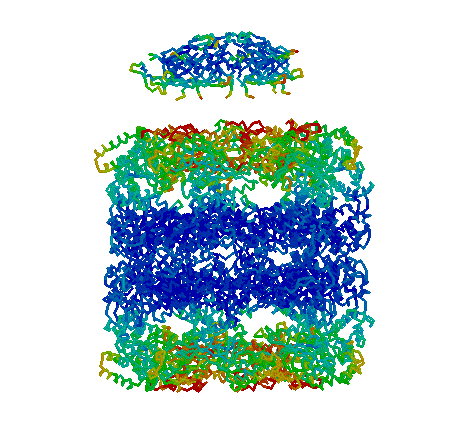
When everything is working correctly, chaperone proteins collect new proteins as they’re made and make sure they fold into the correct shape.  Most of them look basically like a big barrel:

Chaperonin
Image: A drawing of a chaperonin, showing the individual strands of the protein. This is actually several proteins stuck together to form rings, which are then stacked on top of each other into a long tube, with a different type of protein closing off one end.

(From here.)

The new baby protein gets drawn inside, and then the open end of the barrel closes.

Obviously this doesn’t work at all like the way that you would fold something with your hands.  The chaperone protein doesn’t physically touch or push the new protein around.  The environment inside it is just shaped in a way that encourages the new protein to come inside, and then to take a particular shape.  Parts of the new protein and the chaperone protein have positive and negative charges on them, which are attracted or repelled by each other, and other parts are affected by the same sort of forces that cause oil and water to separate instead of mixing together.  (That’s what that article means by “hydrophobic” areas of the protein– areas that don’t mix well with water.)

So, what the fuck does this have to do with what K is talking about?

This is not remotely a good metaphor at all, I know, because most people have never heard of any of what I just wrote.  But it’s what came to mind for me.

The chaperone protein is so huge, it comes out of nowhere and encloses the new protein in this completely new environment.  It doesn’t force the new protein to do anything, it doesn’t even actually touch it (even less than most microscopic things don’t really touch each other) but it puts it in a situation where its natural reactions will lead it to do what the chaperone protein needs it to do.

And that is like what happened to K– apart from the parts that were just blatantly cruel and awful, which, there were plenty of those.  But this is like what K talks about happening after, when people tried to talk to K about it and “problem-solve” and K coped by shutting down and doing what it seemed like they wanted her to do.  It may not have looked forceful or scary and it may not have been intentional but they created an environment that made K react that way.

——-

Okay thoughtful and explanatory part over.  Do people really not understand how poisonous that stuff is?  Someone is having a serious medical problem, and you deny and minimize and argue and refuse to acknowledge that you could or should do anything to help (even though you are literally directly causing the problem)?

That’s not a red flag, it’s a red signal flare being fired at close range at someone’s head.  It’s shockingly fucked-up and it’s also in itself harmful.

No one should have to argue and fight and prove that they are having a problem to have people respect a minor, polite request.  Nobody should talk about what is happening to their mind and body and have someone else claim to know better what’s going on and how bad it is.  That’s treating them as less than a full person.  That’s treating them like a child, except you shouldn’t even treat children that way.  If people had treated me that way as a kid, I would have spent God knows how long sitting around with a broken leg and a damaged tendon.

And just the absolutely blatant authority thing.  “Long-standing member of the organization,” ugh.

There’s just so much awfulness in all of it.  So much defensiveness and this huge smokescreen of “that’s not a real problem” and “we have a right to be here” and “but I’m important”.  I can only slightly imagine what it takes to make someone so defensive– to make someone believe that they can only have anything if they attack full-force and immediately when anyone questions it– that they throw out all that in response to something so trivial.

And all the “I can’t believe she’d do that”, “that doesn’t sound like her” etc. etc.  etc., in other words how smart abusers and people in powerful positions everywhere get away with things.  How do people not know that’s a bad sign?  If you ever find those words coming out of your mouth, stop and give it some serious thought.  Do you really want to accuse the person you’re talking to of lying, or of imagining things, rather than even consider that someone you think of as Good People could do something wrong?  (Hint: you need to fucking consider it.  At least long enough to try to get more information.)

And “you’re causing division in the community”, dear God, in other words how victims of every kind of harm are convinced not to report it.  If something like what’s being described actually happened, would you want people to report it and do something about it?  If so, then fucking don’t say this.  Saying “That person hurt me” is not causing a divison.  It’s pointing out the division that already happened so people can do something about it.  Like Captain Awkward says here, the person saying “please don’t do that” is not causing the conflict.  The conflict started when someone in your community did something that hurt someone else.

—–

This situation could be a textbook example of How Not to Deal with Conflict in Your Community, like I said.

—–

Sometimes I forget that people don’t know all this stuff and why it’s bad.  For future reference: this stuff– recognizing abuse, and manipulation, and gaslighting, and the dynamics that cover them up and let them continue–is the bedrock that I stand on.  It’s where I build my philosophy and my morality and my beliefs about how to live my life and deal with other people.  If you don’t have some idea about this stuff, we are going to have trouble talking to each other.  If all your ideas about power dynamics are at the population-demographics level, you need to take a hard look at some things.


Sparkly is watching a show about the cheerleaders for the Dallas Cowboys.

It’s about 1/3 cool dancing and gymnastics, and the other 2/3 could be a documentary about the power of society’s body standards and how it’s maintained.

So, first of all, everyone there– everyone who even tries out– is extremely fit and can rightly be described as an athlete.

But then they also have to live up to the highest possible standards for their appearance.  And the coaches’ attempts to impose both of those are a lesson in all kinds of things.

In this episode the coaches called aside a number of the cheerleaders to tell them that they need to lose weight.  They’re not anything remotely close to fat, but their stomachs look a tiny bit soft and jiggly instead of “flat and smooth and almost hollow” or “visible abs” which are the acceptable looks.  It’s not that much of a difference they’re asking for.  Like ten pounds or less.  But when you’re already very muscular, and you need to eat enough to get through strenuous exercise and stay healthy, I can only imagine it’d be pretty hard to find the sweet spot that actually lets you lose that weight.

They were crying when they left the coaches’ office.  Being so close to perfect doesn’t make it any less painful when those standards are enforced against you.

One of them this little tight angry scared comment about them being “the fatties on the team”.  And the coaches came down on her like a ton of bricks.  She is “toxic in the locker room”, “toxic to her teammates”, “bad attitude”.  And it might not even have occurred to me to examine that but clearly the coaches know it means something.  It’s a tiny bit of fighting back against body shaming.  She doesn’t really believe that fat isn’t a bad thing, you can tell from her tone (even this tiny speck of fat), but she’s saying it herself before someone else can say it to her.  And even that is too much rebellion for them.

It reminds me of this article about working in a warehouse.  Among many shitty things the author experienced, the workers were expected to meet extremely unrealistic speed standards.  And more than that, they were expected to play along.  If you said “I’m working as hard as I can already, I can’t meet these standards,” you got fired.  You had to always say that yes, you’d failed, and you’d try harder next time.

I think that the coaches here are creating a similar situation.  They want the cheerleaders to agree that their current weight is completely unacceptable, agree that they can make it acceptable, and accept responsibility for fixing it.

When the truth is that it’s only a problem by the pickiest standards imaginable, they probably haven’t done anything “wrong” to gain weight, and it’s hit or miss whether they’ll be able to lose it.

They rejected one new trainee because she had the wrong body type to look good in their uniform.

She auditioned, she got provisionally accepted, she did all this work, and then they photograph her in the uniform for the first time and it’s “her calves are huge, her legs look too short, she looks awful.”  She and the coaches both know it’s nothing she can fix.  Those calves are solid muscle.  But they still told her she’s too big, and she still cried about it.