Watch me tell the internet things I shouldn't tell my friends.
Tag: abuse
Abuse from the abuser’s point of view: “Yeah, hurting people is theoretically wrong, but I can hurt you because…”
(I’m special and above the normal rules so I can do whatever I want. You’re below normal people so hurting you doesn’t count. You could just decide not to feel hurt if you really wanted. It’s normal for a [spouse/parent/boss/etc] to hurt people they have power over. Somebody else hurt me so I’m entitled to spread it around. This will make you a better person or teach you a lesson. I just really want to so badly that you have to let me.)
Abuse from the abuse-ee’s point of view: “When someone hurts somebody, theoretically they should do something about it, but when you hurt me I can’t do anything about it because…”
(If I stand up for myself, you’ll just escalate. They taught me I have a moral obligation to stand by my [family/community member]. You control my access to money. This was a one-time mistake and now things will be good again. If I can just figure out the right thing to do, you’ll stop hurting me and it’ll be worth it. I physically can’t leave. This is normal and I shouldn’t expect anything else. I don’t have anyone else who supports me at all, so this is better than nothing. I deserve this.)
I am reading about this immensely fucked-up thing that happened to someone whose blog I follow (I decided against linking. This is pretty much all for my own benefit, and I don’t want to complicate things or stress her out any more than she already is.) and thinking about chaperone proteins.
Most proteins are one molecule in the shape of a very long, thin chain, which folds or coils up into a compact shape. The shape it folds into can make a big difference in what it does inside a living creature– some diseases are caused by misshapen proteins damaging the body.
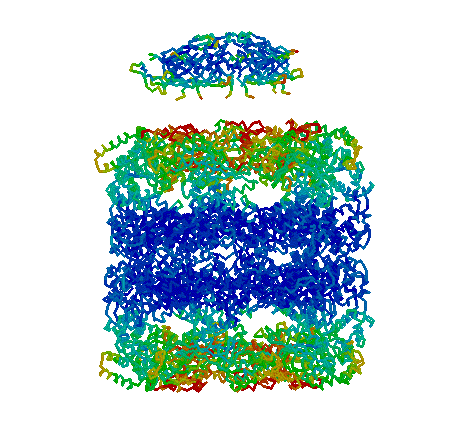
When everything is working correctly, chaperone proteins collect new proteins as they’re made and make sure they fold into the correct shape. Most of them look basically like a big barrel:
Image: A drawing of a chaperonin, showing the individual strands of the protein. This is actually several proteins stuck together to form rings, which are then stacked on top of each other into a long tube, with a different type of protein closing off one end.
The new baby protein gets drawn inside, and then the open end of the barrel closes.
Obviously this doesn’t work at all like the way that you would fold something with your hands. The chaperone protein doesn’t physically touch or push the new protein around. The environment inside it is just shaped in a way that encourages the new protein to come inside, and then to take a particular shape. Parts of the new protein and the chaperone protein have positive and negative charges on them, which are attracted or repelled by each other, and other parts are affected by the same sort of forces that cause oil and water to separate instead of mixing together. (That’s what that article means by “hydrophobic” areas of the protein– areas that don’t mix well with water.)
So, what the fuck does this have to do with what K is talking about?
This is not remotely a good metaphor at all, I know, because most people have never heard of any of what I just wrote. But it’s what came to mind for me.
The chaperone protein is so huge, it comes out of nowhere and encloses the new protein in this completely new environment. It doesn’t force the new protein to do anything, it doesn’t even actually touch it (even less than most microscopic things don’t really touch each other) but it puts it in a situation where its natural reactions will lead it to do what the chaperone protein needs it to do.
And that is like what happened to K– apart from the parts that were just blatantly cruel and awful, which, there were plenty of those. But this is like what K talks about happening after, when people tried to talk to K about it and “problem-solve” and K coped by shutting down and doing what it seemed like they wanted her to do. It may not have looked forceful or scary and it may not have been intentional but they created an environment that made K react that way.
——-
Okay thoughtful and explanatory part over. Do people really not understand how poisonous that stuff is? Someone is having a serious medical problem, and you deny and minimize and argue and refuse to acknowledge that you could or should do anything to help (even though you are literally directly causing the problem)?
That’s not a red flag, it’s a red signal flare being fired at close range at someone’s head. It’s shockingly fucked-up and it’s also in itself harmful.
No one should have to argue and fight and prove that they are having a problem to have people respect a minor, polite request. Nobody should talk about what is happening to their mind and body and have someone else claim to know better what’s going on and how bad it is. That’s treating them as less than a full person. That’s treating them like a child, except you shouldn’t even treat children that way. If people had treated me that way as a kid, I would have spent God knows how long sitting around with a broken leg and a damaged tendon.
And just the absolutely blatant authority thing. “Long-standing member of the organization,” ugh.
There’s just so much awfulness in all of it. So much defensiveness and this huge smokescreen of “that’s not a real problem” and “we have a right to be here” and “but I’m important”. I can only slightly imagine what it takes to make someone so defensive– to make someone believe that they can only have anything if they attack full-force and immediately when anyone questions it– that they throw out all that in response to something so trivial.
And all the “I can’t believe she’d do that”, “that doesn’t sound like her” etc. etc. etc., in other words how smart abusers and people in powerful positions everywhere get away with things. How do people not know that’s a bad sign? If you ever find those words coming out of your mouth, stop and give it some serious thought. Do you really want to accuse the person you’re talking to of lying, or of imagining things, rather than even consider that someone you think of as Good People could do something wrong? (Hint: you need to fucking consider it. At least long enough to try to get more information.)
And “you’re causing division in the community”, dear God, in other words how victims of every kind of harm are convinced not to report it. If something like what’s being described actually happened, would you want people to report it and do something about it? If so, then fucking don’t say this. Saying “That person hurt me” is not causing a divison. It’s pointing out the division that already happened so people can do something about it. Like Captain Awkward says here, the person saying “please don’t do that” is not causing the conflict. The conflict started when someone in your community did something that hurt someone else.
—–
This situation could be a textbook example of How Not to Deal with Conflict in Your Community, like I said.
—–
Sometimes I forget that people don’t know all this stuff and why it’s bad. For future reference: this stuff– recognizing abuse, and manipulation, and gaslighting, and the dynamics that cover them up and let them continue–is the bedrock that I stand on. It’s where I build my philosophy and my morality and my beliefs about how to live my life and deal with other people. If you don’t have some idea about this stuff, we are going to have trouble talking to each other. If all your ideas about power dynamics are at the population-demographics level, you need to take a hard look at some things.
Today I’m feeling pissed off at people who want to dehumanize people who’ve hurt them.
It’s easier and it makes you feel better and it’s wrong. I mean that both in the sense of “morally wrong” (although that’s just my opinion and I respect that people disagree about this) and “factually incorrect”.
Horrible hateful people are still people.
When someone close to you, who you know well, hurts you, it’s especially painful and hard to deal with because you know they are a person. You know that they have good (or at least neutral) things about them. (I thought I’d written about this before, but apparently I just paced around the house thinking about it. Oh well.) You have to deal with the dissonance of knowing that the person who hurt you is not a monster, but is inexplicably an actual person with skills and hobbies and insightful thoughts, who you agree with about some things, and who is somehow still capable of doing awful things.
Viewing a person who’s hurt you as just an example of An Ignorant Person, or A Stupid ___ist Person, can help you understand what’s going on, by seeing it as part of a pattern. It can help you recognize how you’re being hurt and reassure you that it’s legitimate to feel upset about what’s happening. And it can make you feel better to hate on and dismiss people who are hurtful and dismissive to you.
And sometimes I resent people who can get away with doing that. (Where by “get away with” I mean that it works for them inside their own head and in their life, and actually makes them feel better. Because I can’t do it.)

 Some Open Space