#ReadIndies and #JapaneseLiteratureChallenge: An Explosive Book

Murakami Ryu: From the Fatherland, with Love. Transl. Ralph McCarthy, Charles De Wolf, Ginny Tapley Takemori. Pushkin Press, 2013.

I ‘may’ have mentioned before that I used to love the dark, twisted tales of Murakami Ryu, and that I liked him more for his social and political commentary than the shock and gore elements he likes to pile on. So this chunky novel from 2005, which imagines a 2011 Japan in economic and political freefall, was bound to appeal, especially since it is set in Fukuoka, a city I intend to visit as soon as I can. (Murakami is from Kyushu and several of his books describe that tension between Tokyoites and those deemed to be ‘provincial’).

Murakami imagines a Japan where economic stagnation has led to the country becoming insignificant on the world stage. The US dollar has plummeted since the US committed to the War on Terror, and the new administration formed by Democrats is seeking to improve ties with Europe, China and Russia. (All of this sounded plausible back in 2005). So they are withdrawing their troops and increasing the price of grains that they are exporting to Japan – which leads to that country feeling abandoned. North Korea perceives Japan as ‘a dying elephant that lacked the will to heal itself’ and sees this as an opportunity to start a top-secret operation ‘From the Fatherland, with Love’, sending a small elite group of special forces to hold the residents of Fukuoka hostage. The North Korean government will officially call them a ‘rebel army’ faction and disown them… until they send more troops along and occupy Kyushu, making it independent from Japan, and thus trapping South Korea in the middle.

The Japanese central government is just as ineffective as they expected, and the local population is cowed by the terrorists but also angry at their own government for leaving them at their mercies. The only people to show any initiative are a band of frankly quite psychotic, violent young Japanese misfits who’ve found a home of sorts with an aging off-grid rebel. At first they rather admire the ruthless invading forces, but then they decide to fight them through their combined know-how of poisonous insects and reptiles, guns, explosives and boomerangs. But before we get to the final showdown, there are many, many pages of research notes which the author could not bear to throw away and therefore incorporated into the book. When those notes are about politics, I can sort of go along with it, but when there’s lots of detail about explosives or guns or army uniforms or torture methods, I really think that those could have been pruned and been all the more effective when used sparingly.

There is also a huge cast of characters, not all of whom are clearly enough differentiated or even necessary. (There is a glossary at the front of the more important characters, but… even that is so over-filled that it’s hard to keep track of them.) At some points, there were simply long lists of names and job titles of all the politicians who participated in an emergency meeting and I pitied the poor translators who had to possibly research every single name (which could be read in a number of ways in Japanese) to guess which one the author meant.

Yet in spite of these digressions (which I have to admit I frequently skimmed through), I raced through the novel: its blend of suspense, political commentary and sarcasm is exactly my cup of tea, although I no longer have the stomach for Murakami’s descriptions of violence (which in this book includes not just youth crime and fighting, but also North Korean army training methods and torture and an execution squad). As always, he offers an alternative picture of Japan which is so far removed from the currently highly popular theme park vision that most tourists want to see. His descriptions of homeless camps in Japan after a long period of economic downturn are certainly drawn from life (see also Yu Miri’s Tokyo Ueno Park).

…the homeless are the easiest people in the world to kill. Kids are scared of becoming failures themselves in later life, and the media reinforce the fear by depicting the homeless as shameful losers in a winner-take-all society, people who’ll never get back on their feet and will have to scrounge for leftover food, wearing dirty rags, smelling to high heaven and living in cardboard boxes till they day they die. After bank accounts were frozen and inflation had set in, the poor came to be scorned even more openly. Some kids probably reasoned that if it was all right to look down on the destitute, it must be all right to knock them around as well.

Homeless in Japan. Photo credit: Reannon Muth.

Although the book is very much rooted in its (fictionally dystopian) Japanese setting, there are parallels to other countries that are experiencing economic decline and problematic politics that feel all too relevant today.

The mayor and the KEF commander kept repeating the words ‘peace’ and ‘coexistence’. It was to coexist with the citizens of Fukuoka, and to bring true peace and prosperity to the city, that they had come from North Korea. They had not invaded Fukuoka and intended no harm to its citizens, but any individuals or organizations hostile to the project… would be punished. It was a transparently contrived rationale, which Yamagiwa felt he’d heard before. It wasn’t all that different from what the Americans had said after invading Afghanistan and Iraq, and in fact Saddam Hussein had made similar announcements after invading Kuwait. The Japanese military had probably said something of the sort while establishing their rule over Manchuria.

It’s good to see that Murakami’s hippie protest stance has not softened over the years. Most of his social critique is voiced by the rebellious youngsters, although they are considered (and indeed are) criminals, murderers, arsonists and so on. No one’s definition of normal, and yet they rattle off some of the best home truths:

Hino’s teachers, the attendants at the institution, and other adults had always trotted out, like a mantra, the proposition that nothing was more precious than human life. Great numbers of people were being killed every day in the continuing upheavals in the Middle East, and tens of thousands of children were dying of starvation in Sudan and Ethiopia and other African countries. But these authority figures never spoke about the preciousness of those lives – apparently only the lives in their immediate circle counted. What were children supposed to make of people like that telling them how to live?

The darkness of the subject matter is lightened by humour. Two scenes that come to mind are the North Korean soldiers attempting to make small talk or marvelling over the tissue packs being handed out for free by taxi drivers. This book won’t be to everyone’s taste, and it could certainly have done with some serious editing, but I enjoyed its craziness a lot more than I initially expected. Kudo points to Pushkin Press for translating such a mammoth work (as well as several other works by Murakami Ryu) and for the striking cover art.

Recent #ReadIndies Recommendations

As one half of a tiny indie publisher myself, I obviously appreciate and adore the #ReadIndies initiative for the month of February, launched and hosted by Kaggsy59 and LizzySiddal (I will call them by their Twitter handles, as this is how I got to know them, but please click through to their websites and you will instantly know whom I mean, and the interview with Will from Renard Press is especially eye-opening about the challenges that indie publishers face in today’s market – and as you might have seen recently, indie bookshops too).

So here are some books by indie publishers that I’ve recently read. No time, alas, for full-length reviews (except perhaps for the two French ones, which also fit in with my French February personal reading initiative), but they are all well worth your time!

Erasure by Percival Everett

If you thought Yellowface was a vicious satire of tokenism and hypocrisy in publishing, make room for this, which precedes it by several years. I laughed out loud at some of the scenes in this story of a highly erudite and sophisticated black writer who angrily pens a satirical take on people’s expectations of ‘black literature’, only to find that it achieves the success and brings him the money that have hitherto eluded him. I’m not entirely sure how this will work as a film, but I look forward to seeing the film adaptation, entitled American Fiction. Although this does not feel just American – I can’t help but see this across much of translated literature: if it’s Scandinavian, it’s gloomy; if it’s East European it’s about war and dictatorship and trauma; if it’s Japanese, it’s about cats and books and quirky, lonely personalities etc.

But this is more than just satire. The narrator Monk Ellison has never quite had a sense of belonging to a particular community because he lacked the vocabulary to fit into black culture, but would never truly be accepted into white culture because of the colour of his skin. There is a poignant parallel here to his mother losing her grasp of language as she slips into dementia. The moments of hilarity (the judging for a book award, or the meeting with a film producer had me giggling) and the truly awful extracts from the novel entitled (at first) ‘My Paphology’ are interspersed with thoughts about writing, language, and the search for meaning. Some are slightly pretentious at first, but gradually the narrator seems to move from living entirely inside his head to at least acknowledging the emotional child within him (and perhaps within every one of us).

Discretion by Faïza Guène, transl. Sarah Ardizzone

A portrait of a remarkable immigrant woman in Paris, alternating between her past during troubled times in Algeria and her present-day life, being insulted and ignored on the streets and in the offices of contemporary Paris. Her resigned way of looking at life comes up against her children’s more fierce demands for equality, the exasperation they feel at not really belonging anywhere. This fitted in well with my previous read Erasure.

This is narrated in third person and moves from one character to another, so it doesn’t quite have the immediacy and strong voice of Guene’s debut novel Kiffe Kiffe Demain, which is often used for A Level French over here. But, having wisened up now to the reductionism of a single voice claiming to represent a whole category of second-generation immigrant, perhaps the multiple different points of view give a fairer picture of the Bobigny estate on the outskirts of Paris and the lives of Algerian immigrants.

The Annual Banquet of the Gravediggers’ Guild by Mathias Enard, transl. Frank Wynne

I have two books by Enard in French sitting patiently on my shelves, but have been somewhat intimidated by his reputation of being extremely erudite and complex. In many ways, this book is not characteristic of his other work, but it might prove to be an easier way in, because it is very funny (if occasionally long-winded) and introduces us to a part of France that few of us care to visit or spend much time in, the much-vaunted ‘la France profonde’.

Predictably, I particularly enjoyed the first part, where a rather naive, pretentious anthropologist goes to study the ‘backward’ rural are in the Marais Poitevin, those marshlands in the west of France, between Poitiers, Niort (the capital of French paperwork) and La Rochelle. This is the region the author grew up in, but its national park status has been curtailed because of intensive agricultural encroachment – and this tension between farmers and the struggle for the environment appears in the book too, and in fact keeps the ending from becoming too saccharine. David, the anthropologist, is endearingly clueless, and it’s funny to read extracts from his diary and then see the same scenes through other people’s eyes, including the British expats to the village.

But the book is not a straightforward narration, and even the gravedigger’s banquet of the title (although it does seem interminable while reading all the speeches and lists of delicious foods in the somewhat baggy middle of the book) only occupies about 80 pages. What the book seeks to do is to give a social history of the region via its inhabitants, both human and animal, as each living creature is reincarnated and its past and future iterations are shown to us by the omniscient narrator. Naturally, this gives rise to humorous scenes such as the priest struggling with his carnal desires who gest reincarnated as a boar in heat, or the mosquito buzzing around Napoleon’s thigh, but there are also plenty of stories of quiet tragedy and loss of dignity.

I’ve always been an admirer of books that attempt to describe a rural society without looking down on it, and this book certainly conveys all the complexity and richness of every little corner of France and of its people.

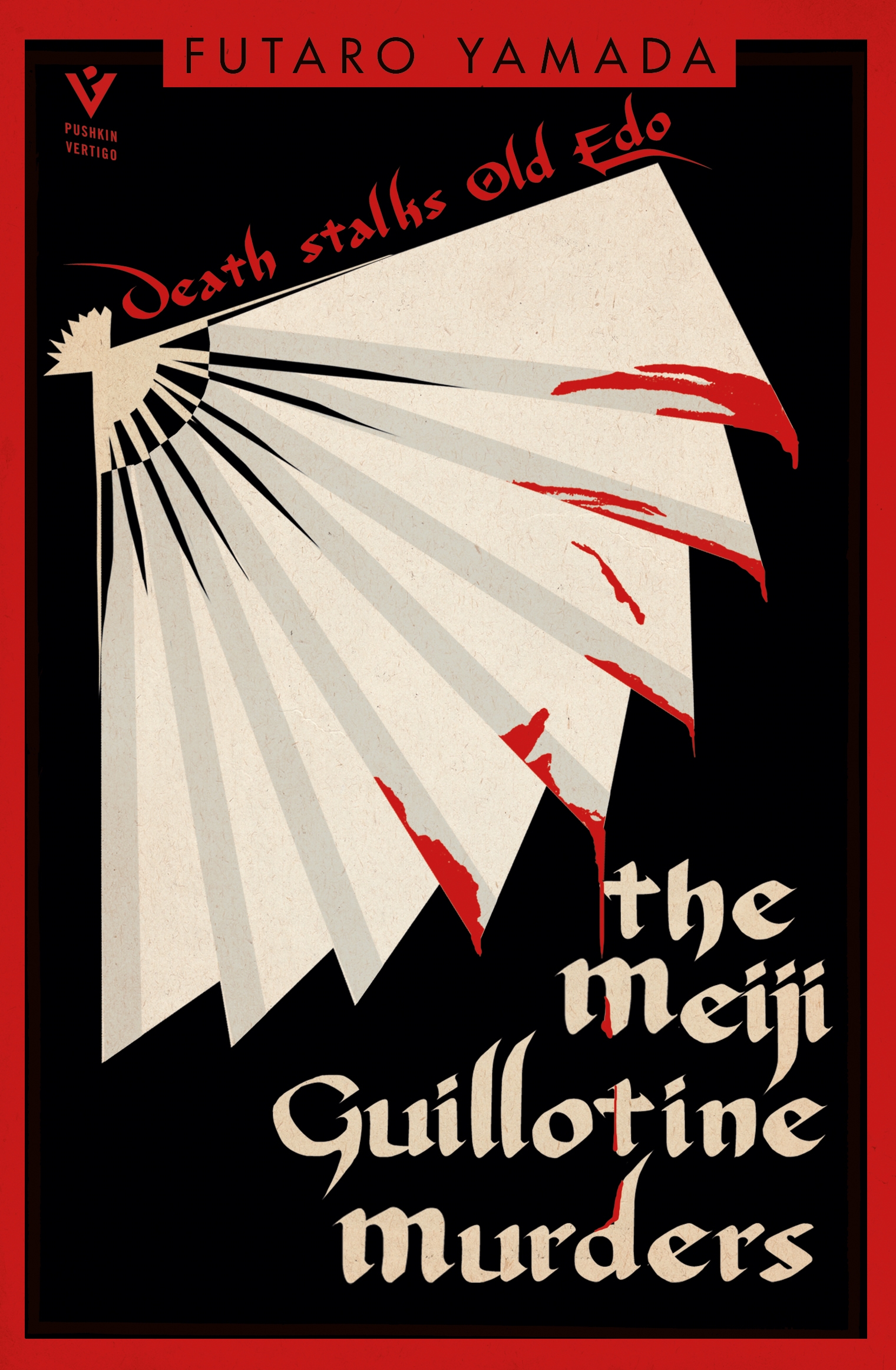
The Meiji Guillotine Murders by Yamada Fūtarō, transl. Bryan Karetnyk

This book has been translated and published off the back of the recent success of Japanese ‘locked room’ type puzzles and apparently impossible murder mysteries which nevertheless have a very logical explanation. It’s ironic that these books, written in Japan from the 1910s onwards in imitation of the British murder mysteries in particular, are now having such a renaissance in the very countries that previously dismissed this kind of writing as derivative nonsense.

However, this one is a little different, because it is historical fiction as well, set during the Meiji period, when the shogunate fell and the Emperor Meiji was restored to power in Japan (rather than just being the Shogun’s puppet) and the country opened up to foreign trade and influence. This did not happen as peacefully as it has been portrayed in some history books, and there was a period of fighting that amounted to a civil war, and a lot of new political and administrative structures which had to be rethought and set up from scratch. This book explores the new police force being set up, the corruption and factions within the new government, and introduces two detectives Kawaji (who was a real-life person and reformer of the police system) and Kaduki (a fictional character, who brought a French guillotine to Japan – presumably more reliable for beheading criminals than a sharp samurai katana?). They have to deal with corrupt policemen under their command and investigate a series of improbable and often far-fetched crimes. It is essentially a collection of connected short crime stories (best read in order).

I loved all the historical details and explanations, but I can see that someone might come in expecting this to be a very different kind of book, in which case they will be disappointed.

Girl in Tulips and Other Non-Communicable Family Diseases by Julianne DiNenna

This is a devastatingly beautiful poetry collection and the fact that I know the author and her family personally, and so know the whole tragic story behind it, should not deter you from the fact that this is moving, heartfelt poetry that will help anyone going through grief and loss, particularly loss of a child. There are so many warm, tender, loving memories, but the poet also captures the frustration and resentment, the bitter cry of a mother who wonders ‘why her, why us?’. The beauty is in the details, and I know I’ll be thinking of these poems for a long, long time. Just a word of caution: maybe don’t read them all in one go, as I did, as they can hit you in the chest. Best in small sips.

I’ll start off by saying that I think Jessica Moore really gets de Kerangal’s style, those long, dizzying sentences that start off in one direction and then spin around themselves and end up in a completely different place. So there is no particular reason why I didn’t read it in translation, but I happened to see this book on the shelves at the bookshop in Ferney this weekend and couldn’t resist. I have many of de Kerangal’s books on my shelves (I haven’t read all of them) – like Delphine de Vigan, she is a contemporary French writer that I will always read, even if they don’t always 100% hit the mark for me.

It’s a surprisingly tense little story of a chance encounter on the Transsiberian Express between two people who are both flawed (just like any one of us), can barely communicate with each other, respond unpredictably under pressure… and the stakes are high. Interestingly enough, this was initially a radio play on France Culture in 2010, after the journey the author herself made on the Transsiberian Express between Novosibirsk and Vladivostok, so there must have been more dialogue between the two main protagonists initially.

Once again, the author shows real compassion and insight into young people’s hearts, no matter how confused they might be. The short description of how Aliocha ends up unable to avoid conscription – because he has no wealthy parents bribing a doctor, no mother to join the Committee of Soldiers’ Mothers (a civil society group that has been strangely silent about the most recent war in Ukraine), no girlfriend to get pregnant – is economical in its word count yet so powerful in its detail. Yet, despite the pity we feel for Aliosha and his repeated failed attempts at running away, he is not an angel: having seen that intimidation and violence are the winners in the world he grew up in, he will make use of these (and of his impressive body size) to get his way with Helene, the French woman who happens to be travelling on the same train, or with the little boy who sees him at a critical juncture.

It’s a terse, short work, and we never find out too much about the characters’ past or future, but it has a sinister, heavy atmosphere hanging over it, although it was written before the current war. But then… haven’t Russian soldiers been involved in one war or another for so many years now?

Best Books Read in 2017 Yet to Be Translated

I’m lucky enough to be able to read books in a couple of languages other than English, but there is so much out there that doesn’t get translated and that I can’t read. Luckily, there are a few independent publishers who are exploring cultures which have hitherto been closed to me: Charco Press with Latin American literature, Istros Books (now merged with Peter Owen) with trans-Danubian countries and the Balkans, Pushkin Press with the Russians (and others), Strangers Press for Japanese literature (which I’d now struggle to read in the original – perhaps in a bilingual edition?) and Seagull Books for pretty much everything else, especially its African and Arabic lists.

For those books below, they fall into what my friend Emma from Book Around the Corner classifies as a ‘translation tragedy’ category – or ‘what a shame that this hasn’t been translated, what are you waiting for?’ So here are my favourite reads of 2017 which deserve to find a publisher in the English-speaking world soon:

Marcus Malte

Marcus Malte: Les harmoniques

Crime fiction with a difference, a strong musical element, a playful use of language and a way of blending farce and strong emotions which reminds me of Antti Tuomainen’s latest book. Malte is a poet with a plot. (France)

Bogdan Teodorescu: Spada

Slightly biased here because of the Romanian background, but this is a thought-provoking book about political intrigue, mass manipulation via the media and how easy it is to create a sense of ‘perfidious other’ at the national level. (Romania)

Thomas Willmann: Das finstere Tal

Socialist realism meets rural noir and brooding Western – a book that sounds grim in description but is rather splendid in execution, if slightly predictable. (Germany)

Alice Rivaz

Alice Rivaz: Sans alcool

An absolute pitch-perfect mastery of the inner and outer dialogues between couples or the self-delusion of individuals: poignant and unforgettable. (Switzerland)