Busy Weekend: Translation, CrimeFest, Eurovision and Elections

What a busy weekend I just had, the crowning delight of a busy yet happy week. During the week, I had the pleasure of organising and hosting the Indie Press Network Spring Showcase on two separate nights, one dedicated to literary fiction and poetry, the other to genre fiction and non-fiction. If you’ve missed these sessions, you can catch the recordings and slides on the Indie Press Network website, and you can also sign up to be regularly updated about forthcoming ARCs or blog tours. I always say that the most interesting and varied types of books are now predominantly coming from indie publishers, and I know I personally want to read several of the titles presented on those two nights.

In fact, I already read one on the train on the way to Bristol (and in my hotel room). I was there for the last-ever CrimeFest, where I had the pleasure of chairing a panel on crime fiction in translation and also seeing two of our Corylus Books authors, Icelandic author Solveig Palsdottir and Catalan author Teresa Solana on other panels. Here are some pictures that I took from those sessions.

Solveig on a panel about police procedurals in countries as different as Greece, Botswana, Scotland, Iceland and war-time Britain
Teresa on a panel with Michael Ridpath, Barbara Nadel and Emma Styles about the long shadows of past crimes
Our panel on the delights and challenges of translating crime fiction, maintaining good relationships with your translator, and how to steer clear of AI: with Peter Bush and Teresa Solana for the Catalan contingent, Solveig Palsdottir and Quentin Bates for the Icelandic contingent

On Saturday evening I also attended an event in the brilliant initiative Translated by, Bristol, launched by Polly Barton and two independent bookshops in Bristol, and got to see the translators of the shortlisted International Booker titles read from their books. I got my copies of Perfection and Under the Eye of the Big Bird signed by Sophie Hughes and Yoneda Asa respectively and gushed about how I look forward to being the cringey person who moves to Berlin to the first, and about how much I adore literature by Japanese women to the latter. I also found it funny that, when one person from the audience asked the perfectly justified question about how the translators dealt with the emotionally often gruelling aspects of these books, it was Sophie Hughes of all people who replied, saying that she thought Perfection was a bit sad. (However, I can’t help thinking that it must have been a nice break for her after translating Fernanda Melchor and the like.)

Poor quality picture, but it’s Polly Barton introducing the event. Seated, from left to right: Helen Stevenson (Small Boat), Yoneda Asa (Under the Eye of the Big Bird), Barbara Haveland (On the Calculation of Volume), Fiammetta Rocco, administrator of International Booker Prize, Deepa Bhasthi (Heart Lamp) and Sophie Hughes (Perfection)

Later that evening, I watched parts of the Eurovision Song Contest with a few blogger friends that I made at CrimeFest. It’s something that you can’t really take all that seriously unless you are drinking and partying with friends, but I realised once more that I support so many countries, simply because I either lived there or have good friends there. However, I may have a slight bias towards my childhood home, Austria, who presented a very intricate and different song with a countertenor and black-and-white effects… and won! I also thought the German song (my future home) was a banger (which is exactly what the title ‘Baller’ hints at), even though it didn’t score that highly. The Icelandic song was pure fun too, they were outrageously robbed!

Sunday marked a return to serious matters: a very close-run election for Romania’s president (a president is a much more significant political position in Romania than in other countries, closer to France and US style). Phew, happy to say that the far-right candidate did not win, although the voting patterns of the Romanian diaspora in Europe were rather discouraging. I suppose this is partly the result of decades of being humiliated and perceived as cheap, disposable workforce who should do the jobs no one else wants to do and then bugger off home (but yes, there are many other reasons too, including the fact that populist right-wingers promise you the earth until they get elected and offer you easy solutions and convenient scapegoats, in Romania as everywhere else).

I won’t start worrying just yet about how Nicusor Dan will be able to work with government and parliament when he has no party support (he was an independent candidate), or how impatient people get when things don’t improve in two weeks. Let me enjoy this just for a couple of days!

Musing on Fiction in Translation and an Incomplete Reading of an Article

#BookTwitter (or #BookAnyOtherPlatform) is an incredibly small bubble, but because it is the bubble in which I mostly live, it feels very important and urgent to get involved in bookish scandals and blow things all out of proportion.

This past weekend it was an article by Federico Perelmuter called Against High Brodernism, published in the LARB. Since it’s paywalled and I don’t have the time or money to subscribe to yet another journal, I haven’t read the full article, so my thoughts went off on a trip of their on which probably are entirely tangential to what the author said and completely misinterpret what he intended. [More of my interpretation below]. Here is what is visible outside the paywall

AMERICANS CAN ONLY ACCEPT foreign literature once they have washed it with superlatives. Nothing less than a disinfectant exaltation—“masterpiece!” “genius!”—will do if the book is to be read. If you believe critics like me, every translated novel deserves a place among the greats or represents some feat of archival-editorial-financial gumption. To read—and announce oneself as having read—literature in translation is to be tasteful and intelligent, a latter-day cosmopolitan in an age of blighted provincialism. I want to avoid this proclivity because the novel I’m reviewing, Herscht 07769 by Hungarian novelist László Krasznahorkai, translated by Ottilie Mulzet and published last fall by New Directions, does not have much to offer, and because there exists a tendency, even a movement, within the anemic critical sphere into which such works are breathlessly incorporated that runs counter to a critical ethos of careful evaluation and contextualization.

Strangely, the phenomenon I reference—call it brodernism, with apologies for yet another portmanteau—doesn’t end with translated literature. It expands toward works described as “maximalist,” “difficult,” “avant-garde,” “epic,” “excessive,” “oblique,” “speculative,” “experimental,” “modernist,” “postmodernist” and “post-postmodernist.” Though men are not its only practitioners, male writers dominate the corpus, and a tendency for phallic competition underlies the formation’s core texts. 

It’s been fascinating to see the reaction, mostly outrage, on Twitter, particularly from thoughtful readers of translated literature like Andrei @TheUntranslated or translator of Sorokin Max Lawton @maxdaniellawton. I have to admit that I not only found their rebuttals pertinent but often quite amusing. Such as Andrei wondering if the average person on the street will even have heard of James Joyce, let alone of Schattenfroh by Michael Lentz.

While we may dislike the coined portmanteau term ‘Bro+modernism’ and definitely not agree with the authors and books that Perelmuter groups together somewhat willy-nilly to fit the definition, I think there are some seeds of truth, at least in how I understand the article. And it’s not about readers, although the readers have been the one who felt attacked. I’m sick to death of accusations of ‘elitism’ when you choose to read the classics or translated or experimental fictions vs. accusations of ‘superficiality’ when you read genre fiction or BookTok recommendations. My tastes range from elite to consumer trash, and I refuse to feel guilty for either of the extremes.

I’ve only read a few of the books on the list and rather liked them: Musil, Celine, Bernhard. The one that he calls too mainstream and easily read, Infinite Jest (NOT a translation), I have only liked in parts. And I have to admit that I had quite a few reservations about Solenoid by Mircea Cartarescu, whom I instinctively support as one of the few Romanians to be relatively well-known in the translated fiction world. [I think he has written better books, and that his most recent ones could do with some editing, but he’s too towering a figure in the Romanian literary scene for anyone to dare say anything.]

Where I think there is a problem is when these kind of books are the only ones getting translation funding, and therefore tend to be the only ones translated (aside from the ones that have a chance of being commercially successful – and these tend to run in trends, currently cats and bookshops from Japan, or puzzle-type mysteries also from Japan, while ScandiNoir still manages to hold onto its popularity, although slightly diminished from its heyday).

Photo by Robert Anasch on Unsplash

I know these books do not sell in huge numbers, so they deserve all the support they can get. However, I’d like to see a broader range of books getting published from a broader range of countries and languages. Yet, if the translated books that win prizes and gain even a little bit of visibility in the notoriously difficult-to-penetrate Anglosphere publishing world are perceived as ‘difficult’, ‘elitist’, ‘excessive’, isn’t there a danger that ALL translated literature gets tarnished with the same brush and the average reader will be even more put off by it?

There are some surprise success stories that no one could have predicted. Butter by Yuzuki Asako, translated by Polly Barton, has been a huge hit in bookshops across the UK, perhaps boosted by the notion that it combines food, crime and sexism in a cheery yellow cover. I haven’t read it yet, although normally a Japanese novel, especially one translated by Polly Barton, is a surefire read for me. I guess I’m waiting for the buzz to die down. So maybe I am an elitist after all!

Yet even what counts as a ‘huge hit’ in translation would barely make a dint in the purse of the likes of Richard Osman or Rebecca Yarros or Stephen King. If you look at most of the ‘best of the year’ lists, there is scarcely a translated title among them. I’m writing this the day before the International Booker Prize longlist is announced and am hoping that this year my Shadow Panel duties will be less onerous than last year, when I only liked reading about four of the books on the longlist. [I have high expectations of this year’s panel of judges.] By the way, if you’d like to follow the journey of the Shadow Panel this year, you can subscribe to our Substack.

I’m glad that the International Booker at least creates a bit of a buzz for books in translation, but it’s not enough – and there is often (like with the Oscars) a feeling that certain ‘worthy’ books are more likely to be chosen for the longlist and shortlist, regardless of literary merit.

In conclusion, I want people to have debates about what gets translated and more openness from publishers, readers, national institutions and cultural organisers to a wider variety of books for translation. I want to see reviewers, literary magazines, the press in general, book festivals etc. provide more space and have more intelligent discussions about literature in translation (rather than the obvious and very dull question: ‘Was this difficult to translate?’). I don’t want anyone to apologise or have to defend themselves for what they read. And I’d like all of this to exist in a world beyond our tiny bookish bubble, but that might be too unrealistic. Still, let’s hope that this Guardian article from 2023 about translated fiction gaining a new, younger audience proves there is a healthy interest out there.

#ReadIndies: Some Corylus Books Recommendations

I think @lizzysiddal and @kaggsy59 have such a fabulous initiative to make February a #ReadIndies month, since small indie publishers are always struggling to make their titles more visible in such an overcrowded publishing space, where big marketing budgets seem to determine what most people see and buy.

In her welcome post to #ReadIndies, Kaggsy points out just how difficult it has become to determine who is still an indie publisher and who is merely a small cog in a bigger publisher’s machinery. A good place to start to identify small UK publishers is the Indie Press Network, of which I’m proud to say that Corylus Books are an active member, alongside over 60 other tiny but passionate publishers.

I originally thought that I might write a post about my favourite Corylus titles, but just like a mother cannot say that she has favourites among her children (although everyone knows that sometimes it is obviously the case that she has a favourite), so I cannot choose between my book babies. However, I can recommend a few titles that I feel deserve greater attention but have hitherto failed to have a major impact, probably because they are trying to do something different than what most crime fiction readers expect.

Bogdan Teodorescu: Sword, transl. Marina Sofia

This is the book that persuaded me to start a publishing venture with two friends. I saw the author speaking about it at Quais du Polar in Lyon (it was translated into French and did quite well over there) and immediately knew I wanted to translate it. It’s more of a dark political satire than a crime novel, since there is no real resolution, but it shows remarkably well how politicians and the mass media manipulate public opinion for their own purposes. It also shows the inferiority complexes of some smaller countries, as they try to improve their international image.

Jerome Leroy: Little Rebel, transl. Graham Roberts

I have to admit that when I started editing the translation of this novella, I kept trying to ‘correct’ things, because it is written in a very mannered, knowing style, quite unique and utterly mocking. Then I finally got it. The author is very highly regarded in France, particularly for his chilling portrayals of the rise of the far right, and this book is highly political but also full of black humour. Coming out at a time when France was shaken by terrorist attacks, it was probably a hard sell even in France, but it is so worth reading.

Antonia Lassa: Skin Deep, transl. Jacky Collins

There is a dreamy, haunting atmosphere about this novella, set in off-season Biarritz and the side-streets of Paris. It may well remind you of a certain Georges Franju film of the 1960s, or the beautiful photos of elegant people on the streets of Paris of Robert Doisneau, but it also features an unusual love story that still feels quite taboo and appeals for more tolerance when viewing people and their relationships.

Elsa Drucaroff: Rodolfo Walsh’s Last Case, transl. Slava Faybysh

It should be clear by now that my personal preference is for politically-tinged crime fiction. This one has the rapid beats of an action thriller, but has a very real moral dilemma at its heart, all the more heartbreaking because it is based on real people and real situations during Argentina’s military dictatorship in the 1970s. Would you be able to sacrifice your family for the sake of your political beliefs – and what happens when you start losing faith a little in those around you who ostensibly espouse the same political beliefs?

Last but not least, I need to mention our latest release, which just came out on the 1st of February in paperback. I had such great fun imagining and translating 1960s Berlin in Charlotte Printz’s Nightingale & Co, but beneath the cosy surface, I find the book reminds us that physical and mental walls are by no means a distant memory, and that we need to constantly fight against them.

Early Monthly Summary for March 2024

With Easter coming up, and a predicted hard-working one too (catching up on a million-and-one things I haven’t been able to do in the first three weeks of the month), I thought I’d do an early round-up of my March reading. It felt like March was dominated by the International Booker longlist, and I did read nine out of the thirteen from that list, but I’d forgotten that I also read a lot of other, much lighter books – crime novels of course to brighten my mood, but also a Chalet School book and a fictionalised biography of two women revolutionaries Inessa Armand and Alexandra Kollontai.

Eleven foreign books out of the total sixteen, two vintage crime novels (both in preparation for the #1937Club), but which ones really stuck with me? I thought Tana French was very funny and good at depicting a closed Irish village community, quite ‘Banshee of Inisherin’, and I enjoy the late 19th century Krakow (and indomitable, snobbish Zofia) of Mrs Mohr Goes Missing. The acerbic wit and underlying sadness of Lost On Me worked well for me – a book that reminded me a little of Fleabag, while The Details was less memorable. Despite the unpleasant ‘Stockholm syndrome’ type of relationship at the heart of Kairos, I thought the book did a great job of using a toxic love affair as a metaphor for the relationship between East Germany and its citizens. And I was moved by the poetic meditation of life and death in a rural community in White Nights.

It has been quite a busy month – to be all understated about it! I left the job I’d been doing for the past six and a half years, I attended London Book Fair and other events, I saw lots of films and the magnificent Sargent exhibition, I went to an extremely depressing (perhaps triggering) RADA production of Anatomy of a Suicide, and tonight I’ll be going to a short Romanian play being presented at the Romanian Cultural Institute. This level of activity is extreme, even for me and even for pre-pandemic levels. I will have to calm down and start working more on my many projects.

There is no shortage of those: from editing my first German crime novel translation, to finalising book covers and marketing strategies, applying for funding and all the usual brouhaha.

I will also be helping to host a Spring Showcase for members of the Indie Press Network and I strongly encourage you to sign up if you are interested and have time or have followed the #ReadIndies hashtag at any point. We’d heard many readers and bloggers complaining that all of the publishing events seem to either be taking place in London or demanding in-person attendance, so we decided to run joint virtual showcases, so that any readers, booksellers, bloggers, journalists, festival organisers from all around the world can see and hear what over 30 indie publishers will be bringing out this season. There will be publishers of all sizes and renown, from Bluemoose, Renard and Dead Ink, to… Corylus Books! 😉

We’ve broken down a potentially marathon event into three distinct evenings, by genre:

Literary Fiction 9th April

Genre Fiction 10th April

Non-Fiction, poetry and Children’s 11th April

OK, so we won’t have the glamorous goody bags and swag, or warm white wine and orange juice, or beautifully decorated cupcakes… but at least we’re saving you the cost of train tickets and the potential hassle of strikes!

In addition to the International Booker Shadow Panel reading (I’ll have to do a more in-depth dive of the books, even of those I’ve skimmed over because they weren’t quite to my taste, if they get shortlisted), I will stick to mainly #Club1937 reading for the whole month of April. I’ve already done some of the lighter crime novels, as you can see above, but what other treasures lie in wait?

Reflections on London Book Fair and adjacent events

Last week was extremely busy, with London Book Fair, the Alternative Book Fair of Indie Presses and the Assembly of Translators. What I realised, however, is that this kind of busy-ness, all revolving around books, did not exhaust me as much as those long days working in the corporate world – on the contrary, I often found myself energised and eager to try out new things and make new connections.

Just a fun little picture of a dream library in New York, from realtor.com

Of course, this doesn’t mean that it as all good news: translators are even more worried than authors about publishers using AI (for good reason); there were grumbles about the rising costs of printing and shipping; far too many books get published every year (that’s not going to change, because so few of them really stick) and there is still a very uneven playing field when it comes to visibility. So here are some things I learnt last week and which got me wondering:

  1. It’s all about who you know – this came out of the translators’ discussion, that it really pays to network with publishers (in the hope they might actually read your pitch if they have a personal connection with you) and with other translators (in the hope that if they are busy, they might recommend you for a translation). This all relies upon people being good and generous, but is not the most transparent or foolproof method for ensuring diversity. Furthermore, in ‘smaller’ languages (where there is an under-demand, i.e. one or two books maximum per year get translated from that language into English – in the whole world), the competitive element will be stronger than the collaborative one, and translators will be tempted to squirrel things away for themselves, for fear that they might not have any work for 2-3 years after that. As one translator said: ‘My brand is not to say no to anyone’, rather than being known for a particular type of literary translation.
  2. Publishers claim they want to work with more diverse authors and translators – but in actual fact, when everyone is overworked or risk-averse, they will fall back on the people they know and have worked with in the past. This is partly understandable when it comes to translation (although incredibly frustrating for the translator who is trying to get a foot in the door), but perhaps less so when it’s forever the same authors (or type of authors). I don’t begrudge any good authors their contracts, but I get irate when publishers invite celebrities from other fields to ‘write a book’ (i.e. have it ghostwritten for them – soon probably, have generative AI write it for them).
  3. The more you spend, the more you are likely to achieve – although a high marketing budget is no guarantee of success, it’s a fairly good predictor of what people are likely to buy. In other words, there are a few word-of-mouth successes that caught everyone by surprise and translated into great sales, but they are few and far between. People who only read and buy a few books per year will gravitate towards the most heavily advertised books, the scandalous ones everyone likes to talk about at the water-cooler (or on virtual platforms, given that there are fewer opportunities for water-cooler moments) or books written by or endorsed by celebrities. However, when it comes to translations, what gets translated in the first place is largely determined by how generous the country’s funding for translation is (which is sometimes, but not always, related to how rich the country is) – and what sort of literary works they are willing to fund. Some are quite snobbish about genre fiction, and press ahead promoting the same prestigious names over and over again, while others are more open to experimental and emerging writers. Some also provide funding for promoting the translated works, or are happy to host events in their spaces. And, while overall most countries agree that the English language market is a huge one and opens the doors to many other markets, some funding bodies would rather fund translations into smaller languages, because they feel that the Anglosphere is rich enough already.
  4. It is wonderful to reconnect with your fellow countrymen and women – I had lost touch with the Romanian Cultural Institute over the past couple of years and their events programme had reduced to a mere trickle, so it was a pleasure to see that they are now back in force, with a full team. I hope to get the opportunity to collaborate with them in the future, and perhaps find a way to promote the events beyond the diaspora community.
  5. London Book Fair is not user-friendly – aside from the lack of seating and quiet spaces (although this was marginally better than the previous year), it is also not targeted at readers, writers and even translators, despite the ‘seminar programme’ it has put together. It is primarily a trade fair, even if they try to market it as something more: all about sales, acquisitions and prior appointments – the likelihood of making any valuable connections while randomly wandering along at the stands is very low – and there aren’t that many freebies, either, even on the last day of the fair.
  6. Alternative Book Fair was much friendlier – this was held at Islington Central Library and was entirely community and reader-focused, so opportunities to see publishers, ask questions, buy books and attend some panels as well. I loved the atmosphere, and I hope it led to some good sales for the small indie publishers who were there, at a much lower cost than getting a stand at London Book Fair. I particularly loved the panel about indie publishing, with Neil Griffiths (founder of the Republic of Consciousness Prize and co-founder of Weatherglass Books), Harriet Hirshman from Dead Ink Press and Will Dady (from Renard Press and founder of the Indie Press Network), who talked about the joys of indie publishing (being able to follow your own heart and set your own trends rather than desperately trying to guess the market), but also the challenges of operating on a shoestring and the reduced pricing of books. As Neil said: ‘People spend £18 to go to the cinema for two hours, while they complain if they have to spend more than £10 for a book, which they can keep forever or share with others.’ Funnily enough, I was also using the cinema as an analogy – that the Big Five publishers are like your Odeon chain, bringing the big Hollywood releases, while if you want to see a more quirky film without a big studio behind it, then you are better served with smaller or independent cinemas. As the panel said: ‘If you want to keep a healthy publishing ecosystem alive, with a good variety of topics and authors, then please buy books from indie publishers and encourage your libraries to order them.’

Recent #ReadIndies Recommendations

As one half of a tiny indie publisher myself, I obviously appreciate and adore the #ReadIndies initiative for the month of February, launched and hosted by Kaggsy59 and LizzySiddal (I will call them by their Twitter handles, as this is how I got to know them, but please click through to their websites and you will instantly know whom I mean, and the interview with Will from Renard Press is especially eye-opening about the challenges that indie publishers face in today’s market – and as you might have seen recently, indie bookshops too).

So here are some books by indie publishers that I’ve recently read. No time, alas, for full-length reviews (except perhaps for the two French ones, which also fit in with my French February personal reading initiative), but they are all well worth your time!

Erasure by Percival Everett

If you thought Yellowface was a vicious satire of tokenism and hypocrisy in publishing, make room for this, which precedes it by several years. I laughed out loud at some of the scenes in this story of a highly erudite and sophisticated black writer who angrily pens a satirical take on people’s expectations of ‘black literature’, only to find that it achieves the success and brings him the money that have hitherto eluded him. I’m not entirely sure how this will work as a film, but I look forward to seeing the film adaptation, entitled American Fiction. Although this does not feel just American – I can’t help but see this across much of translated literature: if it’s Scandinavian, it’s gloomy; if it’s East European it’s about war and dictatorship and trauma; if it’s Japanese, it’s about cats and books and quirky, lonely personalities etc.

But this is more than just satire. The narrator Monk Ellison has never quite had a sense of belonging to a particular community because he lacked the vocabulary to fit into black culture, but would never truly be accepted into white culture because of the colour of his skin. There is a poignant parallel here to his mother losing her grasp of language as she slips into dementia. The moments of hilarity (the judging for a book award, or the meeting with a film producer had me giggling) and the truly awful extracts from the novel entitled (at first) ‘My Paphology’ are interspersed with thoughts about writing, language, and the search for meaning. Some are slightly pretentious at first, but gradually the narrator seems to move from living entirely inside his head to at least acknowledging the emotional child within him (and perhaps within every one of us).

Discretion by Faïza Guène, transl. Sarah Ardizzone

A portrait of a remarkable immigrant woman in Paris, alternating between her past during troubled times in Algeria and her present-day life, being insulted and ignored on the streets and in the offices of contemporary Paris. Her resigned way of looking at life comes up against her children’s more fierce demands for equality, the exasperation they feel at not really belonging anywhere. This fitted in well with my previous read Erasure.

This is narrated in third person and moves from one character to another, so it doesn’t quite have the immediacy and strong voice of Guene’s debut novel Kiffe Kiffe Demain, which is often used for A Level French over here. But, having wisened up now to the reductionism of a single voice claiming to represent a whole category of second-generation immigrant, perhaps the multiple different points of view give a fairer picture of the Bobigny estate on the outskirts of Paris and the lives of Algerian immigrants.

The Annual Banquet of the Gravediggers’ Guild by Mathias Enard, transl. Frank Wynne

I have two books by Enard in French sitting patiently on my shelves, but have been somewhat intimidated by his reputation of being extremely erudite and complex. In many ways, this book is not characteristic of his other work, but it might prove to be an easier way in, because it is very funny (if occasionally long-winded) and introduces us to a part of France that few of us care to visit or spend much time in, the much-vaunted ‘la France profonde’.

Predictably, I particularly enjoyed the first part, where a rather naive, pretentious anthropologist goes to study the ‘backward’ rural are in the Marais Poitevin, those marshlands in the west of France, between Poitiers, Niort (the capital of French paperwork) and La Rochelle. This is the region the author grew up in, but its national park status has been curtailed because of intensive agricultural encroachment – and this tension between farmers and the struggle for the environment appears in the book too, and in fact keeps the ending from becoming too saccharine. David, the anthropologist, is endearingly clueless, and it’s funny to read extracts from his diary and then see the same scenes through other people’s eyes, including the British expats to the village.

But the book is not a straightforward narration, and even the gravedigger’s banquet of the title (although it does seem interminable while reading all the speeches and lists of delicious foods in the somewhat baggy middle of the book) only occupies about 80 pages. What the book seeks to do is to give a social history of the region via its inhabitants, both human and animal, as each living creature is reincarnated and its past and future iterations are shown to us by the omniscient narrator. Naturally, this gives rise to humorous scenes such as the priest struggling with his carnal desires who gest reincarnated as a boar in heat, or the mosquito buzzing around Napoleon’s thigh, but there are also plenty of stories of quiet tragedy and loss of dignity.

I’ve always been an admirer of books that attempt to describe a rural society without looking down on it, and this book certainly conveys all the complexity and richness of every little corner of France and of its people.

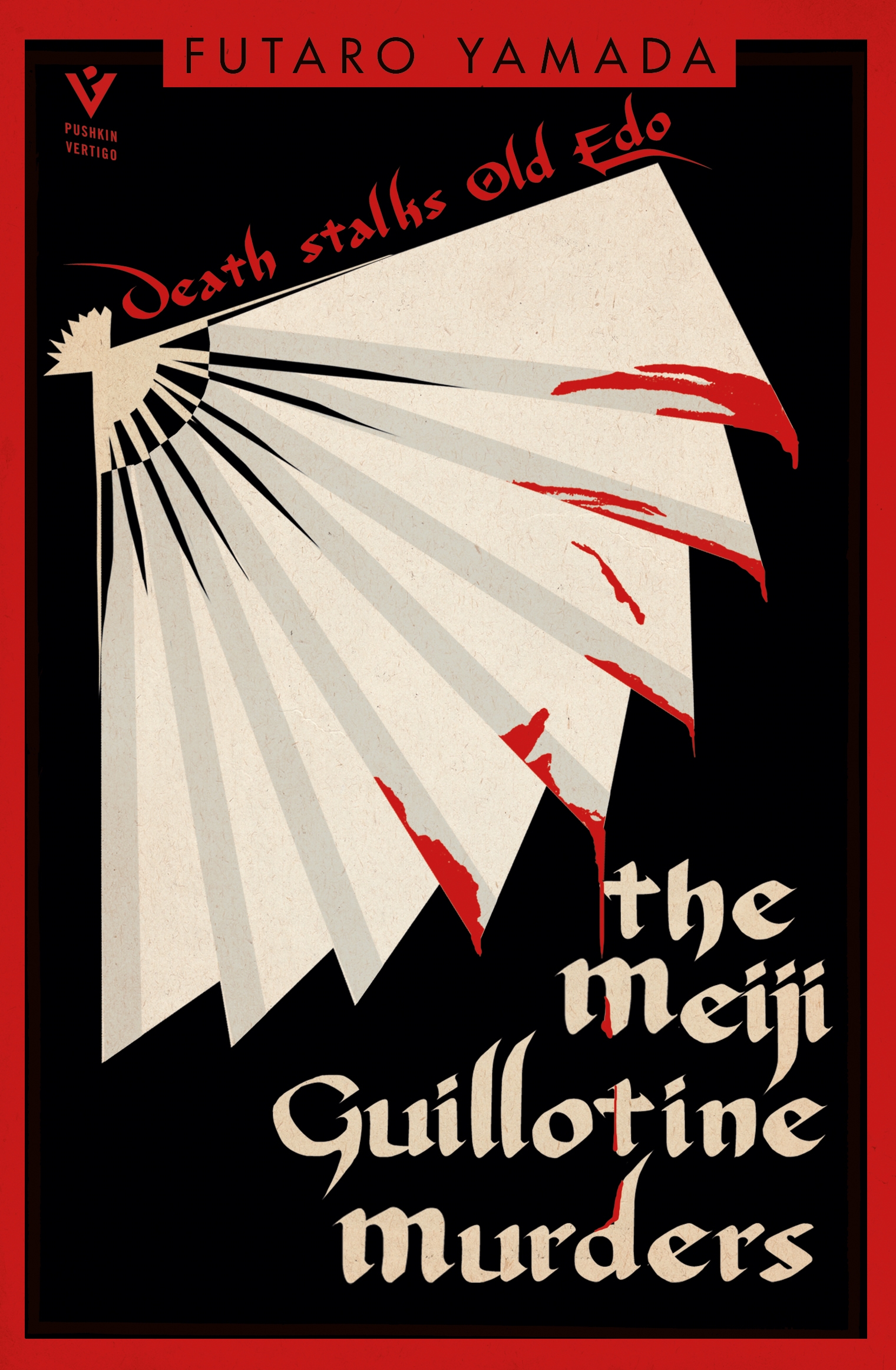
The Meiji Guillotine Murders by Yamada Fūtarō, transl. Bryan Karetnyk

This book has been translated and published off the back of the recent success of Japanese ‘locked room’ type puzzles and apparently impossible murder mysteries which nevertheless have a very logical explanation. It’s ironic that these books, written in Japan from the 1910s onwards in imitation of the British murder mysteries in particular, are now having such a renaissance in the very countries that previously dismissed this kind of writing as derivative nonsense.

However, this one is a little different, because it is historical fiction as well, set during the Meiji period, when the shogunate fell and the Emperor Meiji was restored to power in Japan (rather than just being the Shogun’s puppet) and the country opened up to foreign trade and influence. This did not happen as peacefully as it has been portrayed in some history books, and there was a period of fighting that amounted to a civil war, and a lot of new political and administrative structures which had to be rethought and set up from scratch. This book explores the new police force being set up, the corruption and factions within the new government, and introduces two detectives Kawaji (who was a real-life person and reformer of the police system) and Kaduki (a fictional character, who brought a French guillotine to Japan – presumably more reliable for beheading criminals than a sharp samurai katana?). They have to deal with corrupt policemen under their command and investigate a series of improbable and often far-fetched crimes. It is essentially a collection of connected short crime stories (best read in order).

I loved all the historical details and explanations, but I can see that someone might come in expecting this to be a very different kind of book, in which case they will be disappointed.

Girl in Tulips and Other Non-Communicable Family Diseases by Julianne DiNenna

This is a devastatingly beautiful poetry collection and the fact that I know the author and her family personally, and so know the whole tragic story behind it, should not deter you from the fact that this is moving, heartfelt poetry that will help anyone going through grief and loss, particularly loss of a child. There are so many warm, tender, loving memories, but the poet also captures the frustration and resentment, the bitter cry of a mother who wonders ‘why her, why us?’. The beauty is in the details, and I know I’ll be thinking of these poems for a long, long time. Just a word of caution: maybe don’t read them all in one go, as I did, as they can hit you in the chest. Best in small sips.

I’ll start off by saying that I think Jessica Moore really gets de Kerangal’s style, those long, dizzying sentences that start off in one direction and then spin around themselves and end up in a completely different place. So there is no particular reason why I didn’t read it in translation, but I happened to see this book on the shelves at the bookshop in Ferney this weekend and couldn’t resist. I have many of de Kerangal’s books on my shelves (I haven’t read all of them) – like Delphine de Vigan, she is a contemporary French writer that I will always read, even if they don’t always 100% hit the mark for me.

It’s a surprisingly tense little story of a chance encounter on the Transsiberian Express between two people who are both flawed (just like any one of us), can barely communicate with each other, respond unpredictably under pressure… and the stakes are high. Interestingly enough, this was initially a radio play on France Culture in 2010, after the journey the author herself made on the Transsiberian Express between Novosibirsk and Vladivostok, so there must have been more dialogue between the two main protagonists initially.

Once again, the author shows real compassion and insight into young people’s hearts, no matter how confused they might be. The short description of how Aliocha ends up unable to avoid conscription – because he has no wealthy parents bribing a doctor, no mother to join the Committee of Soldiers’ Mothers (a civil society group that has been strangely silent about the most recent war in Ukraine), no girlfriend to get pregnant – is economical in its word count yet so powerful in its detail. Yet, despite the pity we feel for Aliosha and his repeated failed attempts at running away, he is not an angel: having seen that intimidation and violence are the winners in the world he grew up in, he will make use of these (and of his impressive body size) to get his way with Helene, the French woman who happens to be travelling on the same train, or with the little boy who sees him at a critical juncture.

It’s a terse, short work, and we never find out too much about the characters’ past or future, but it has a sinister, heavy atmosphere hanging over it, although it was written before the current war. But then… haven’t Russian soldiers been involved in one war or another for so many years now?

Annual Round-Up and Plans for 2024

It’s that time of year when, whether I like it or not, I get to review my reading, writing, film-watching (even my performance appraisal at work), which inevitably leads me to wonder if blogging, reading at great speed and reviewing are indeed the best use of my time. Every year I decide that no, probably not, I should spend more time on translating and writing, and every year I fail to do things differently. Or do I?

Actually, my WordPress annual statistics show that I’ve written far fewer blog posts in 2023 (and therefore also less words) than at any time after 2013. There is a downward tendency for the number of likes and comments on my blog posts anyway, this has been the case for years after a peak in 2017 (and this is what my other blogger friends report too), so this is probably a wise use of my energy. I certainly don’t intend to post more frequently in 2024 and will only review the books that fit the ‘theme of the month’ (more about that anon). The majority of my blog visitors are from the US, followed at quite some distance by the UK. France and Canada are nearly on equal footing (very far behind those first two), and Germany and Australia are slightly behind them. I am curious what drove the single visitor from Vatican City (or Namibia or Turkmenistan) to my blog! The most popular blog post has been my sort of review of Lessons in Chemistry, which simply shows the popularity of that book rather than my qualities as a reviewer, although I’m pleased to see that my second most popular blog post hopefully encourages others to discover my favourite Japanese author Dazai Osamu. It also amuses me greatly to see that most people discover my blog thanks to Pinterest rather than Twitter or WordPress subscription or any other links: and my Friday Fun posts remain popular, although as usual they require minimal effort and are not necessarily all that representative of my interests (although yes, I suppose I am a little bit obsessed with interior design).

I’ve not written as much as I’d planned (not edited/rewritten my novel, not written a lot of new poetry or submitted anything much), I only submitted 24 things (including translations and residency applications) and I’ve very nearly had more rejections than submissions. The only two acceptances have been translations: of the fantastic (as in fantasy) short fiction by Urmuz in Turkoslavia magazine and of a short play by Edith Negulici in Asymptote Journal (forthcoming). A previous translation of Urmuz which appeared in Sublunary Edition’s Firmament Journal in early 2023 got a mention in the annual round-up by that publisher, which was a nice little boost. I’ve also had my translation of Deadly Autumn Harvest by Tony Mott published, of course, and it was great fun working on that (being a translator and editor all at once) and developing a really close relationship with the author, who was game for anything. I am also currently working on my first full-length translation of a German crime novel (page 282 of 430), which we hope to publish in January 2025.

2023 has also been a year of travelling, ostensibly for DIY writing/translating retreats although not that much writing got done: to Switzerland in January, to Lyon and Provence at the end of March/beginning of April, to Gladstone’s Library in Wales in November. Add to that family holidays – our much postponed Japan trip in August, a wedding in Romania in late October – and an online Translation Summer School in July, and you can see that I’ve managed to keep myself thoroughly busy (or distracted, whichever way you choose to look at it).

At least one third of all my time and effort has gone into my publishing venture, Corylus Books, this year (and every year since we started in 2020). Like all tiny independent publishers, particularly those of translated fiction which has substantial upfront costs and generally lower sales, we have found this year quite rough in terms of trading figures. People kept saying that Twitter didn’t sell books, but the scattered flight from that platform with no clear successor emerging shows that perhaps it was far handier in building a community and raising awareness about your books than we thought at the time. Of course, there are many other reasons (rising costs of paper, printing, distribution), the decline of reviewing off-line (and the decline in readership for online reviews), the opaque nature of gaining visibility among booksellers and festival organisers (the latter is even harder when you have authors who have to come from quite far abroad). I also have to resign myself to the fact that Romanian authors will always have a very niche appeal in the English-speaking world compared to Scandinavian ones. Anyway, I don’t mean to moan, but I’ve heard similar stories from other publishers and have compiled some of their thoughts into an article which will appear in 2024 in a special edition about books of the Romanian academic journal Culture. Society. Economy. Politics.

Photo credit: Matias North on Unsplash.

I rather like having themed months, but only selecting a few books on that theme each month, so that still have some leeway for book club reading or anything else that might catch my fancy. So these are the months I already have themed:

  • January in Japan
  • French February (includes any French language, not just from France)
  • Moldovan and Romanian March (because there is no month that starts with R, and March contains both the letters M and R)
  • #1937Club in April – and possibly that will lead to a Classics or at least pre-WW2 reading all month
  • Spanish and Portuguese Lit Month in July
  • Women in Translation in August
  • German Lit Month and Novellas in November

Additionally, I would like to make it a habit to start and end the day with some poetry, to help me gain some perspective and regain some hope, despite all this horribly depressing news from around the world.

I will stop my day job in early March and will therefore need to start making money from translating, editing and writing, as well as the freelance training work I’ve done prior to 2017. I also have a house to sell in England and a flat to buy in Berlin, and organise an international relocation, so that should keep me deeply mired in administration, NOT my favourite thing to do. Nevertheless, although I might have to scale back my personal ambitions this year, I still need to have some creative outlets or goals.

I’m almost afraid of making any writing plans, because I failed to stick to them last year, but one thing I realised, after being part of the Write Club Plus programme in 2023 with The Literary Consultancy, is that my default option is being a multitasker when it comes to writing. I need the variety of working on multiple projects: poetry, flash fiction, non-fiction, novel, alongside translating. I have to accept that and learn how to work within that constraint (and finish things). So my only ‘resolution’ is to keep working at my writing and to not give up hope.

I will continue to pitch translation projects to various publishers and generally make them aware of authors they might be missing out on, although it has been a very disheartening and depressing process these past couple of years. My dream authors to bring into English would be Marlen Haushofer, Ödön von Horváth, Lavinia Braniște, Alina Nelega, Tatiana Țîbuleac and many more. I just wish that copyright holders (i.e. foreign publishers) were more responsive to my queries, and that the English-language publishers were not so good at ghosting.

Corylus will keep us busy in 2024 with five books being published, as well as the prep for the 2025 list. We have been keeping Quentin Bates busy as a translator with no fewer than three Icelandic authors. Óskar Guðmundsson is back with a very dark, haunting novella The Dancer. The irrepressible Stella Blómkvist will appear in a second investigative outing in May. Meanwhile, fans of Sólveig Pálsdóttir’s solid police procedurals will be glad to hear that a fourth translated book will be available in the summer. The two I’m most excited about, however, are the more overtly political books: our first author from Argentina Elsa Drucaroff with Rodolfo Walsh’s Last Case and Catalan author Teresa Solana, whom I’ve long admired, with the start of a new series set in Barcelona, Black Storms, touching upon the long-term consequences of the Spanish Civil War.

Chasing the New Customers

Today my car insurer sent me the renewal quote, which was nearly double the sum I paid last year, despite having a 7 year no-claims bonus and an impeccable driving record. They also included the following message: ‘You have been with us a number of years. You may be able to get the insurance cover you want at a better price if you shop around.’

And I realised that, just like banks, phone companies, streaming services, all of these providers are so eager to lure in new customers with enticing introductory offers that they don’t bother to reward any loyalty of existing customers – or even provide them with any reasonable customer service.

When I attended the Bookseller Marketing and Publicity Conference in June, I realised that this was also the strategy for most publishers. Everyone was talking about reaching out to new markets, bringing in people who are not habitual readers – and while I’m on board with any initiative that helps people discover a love of reading, I am a bit puzzled and disappointed that the emphasis seems to be almost exclusively on the very occasional readers.

I’m not talking here about literacy initiatives or strategies for getting children into reading – those are absolutely necessary, and World Book Night is brilliant too. But publishers and even literary festivals seem to be focusing mostly on the ‘light readers’, i.e. people who read fewer than 10 books per year, and perhaps buy at most 2-3 – and yes, perhaps the ones that they buy will be written or at least fronted by celebrities. But do they really account for so many sales that it’s worth investing solely in them?

I often say jokingly that I’m single-handedly supporting the British (and also other countries’) publishing industry. I read over 120 books a year, and I buy even more than that. Last month alone (admittedly, probably a bit of an outlier month, because my stress relief is book buying) I bought 30 books. That is the equivalent of 10 occasional readers’ annual book-buying in just one month. And I know that I’m not alone in this, that most of you book blogger friends are also keen book buyers (and also use your libraries a lot).

But who is catering for the likes of us?

Photo by Radu Marcusu on Unsplash

Do they consider us a captive audience? Do they think we will purchase books no matter what? Or is it left only to small independent publishers to build a relationship with us avid readers, because they don’t have the marketing budget to splurge (and possibly waste) on those who hardly ever read?

I could go further and say that most of the cultural programmes on TV now seem to be all about attracting new audiences, rather than keeping those they have happy. Do they think that we are all old dinosaurs who are going to die out soon anyway? I was more of a culture snob in my teens, but now I am far more invested in outreach, in making all forms of culture more accessible and diverse and interesting for everyone. But why are we making the assumption that it has to be all about entertainment to have any audience at all, that anything else is too elitist or highbrow and that is a bad thing?

I don’t think experts are off-putting, I have not had enough of experts. What I crave is MORE experts, i.e. a greater variety of experts from all sorts of different backgrounds, cultures, languages, who can provide us with alternative views to what we’ve grown up with and absorbed in the past. I want high-quality information and culture. I don’t want fifty books with near-identical covers and plots or characters that are so similar they all blur after a while. I want serious discussions about books without having to become a postgraduate student and attend lectures. I believe that discussions about books, music, art, dancing and everything else can be a mix of the frivolous and the profound, both amusing and earnest. For all of its faults, Twitter has shown us that these elements can coexist and that there is an audience for it.

We are consumers too. Please cater for us too and reward our loyalty!

Bookish Musings for July 2021

This past month has been a strange one for me (for the rest of the world too, possibly, but I’ll stick to what I know best). It was composed of roughly four quarters/weeks. The first was extremely busy at work with a major event (which went well, but exhausted me). The second was spent recovering from the aforementioned major event, catching up on home life and cautiously venturing forth into the Big City. The third was phenomenally busy but exhilarating with the online British Centre for Literary Translation Summer School, which made me realise how much I enjoy the literary life and wish I could spend all my days on it. And the fourth was going back to work, trying to catch up on everything while suffering one of my huge three-four day migraines.

So overall, it’s been the kind of month where my head felt very ‘ouch’ (both literally and metaphorically) and I struggled to concentrate on any reading or reviewing. I feel very far behind on just about everything. But I do want to recapture some of the sheer glee of the third week of July, when I lived in a literary bubble that consisted not just of myself, but many other people equally passionate about words and cultures, about comma splices and sounds and rhythms. Rather than a lone madness, I had the pleasure and privilege of experiencing a folie à deux – or rather, folie à plusieurs, which is much more fun!

My brain is currently a jumble of ideas and sudden personal insights relating to books, reading, writing and translation, so I thought I’d jot some of them down here, while they are still fresh. Apologies for not having a nicely digested, thoughtful essay, but just random bullet points.

  1. I mentioned that several of the books I read in July were excellent, entertaining holiday reads, but not particularly memorable. However, I feel they deserve more credit than that.
    • The White Shepherd by Annie Dalton is a mix of cosy and serious crime, with older female amateur protagonists, published in 2015, well ahead of the current trend of precisely such crime novels, which seem to be taking the bestseller charts by storm, perhaps in the wake of one written by a likeable male TV celebrity. It’s hard to be ahead of a certain trend, isn’t it? To my mind, this book was better than several others in this subgenre.
    • Caro Ramsay’s The Tears of Angels is a well-written, impactful police procedural and, although I haven’t read others in the series (which made the large cast of characters a bit difficult to place at times), has a great sense of place. However, although there is a lot of talk of #TartanNoir (which this one is not, not exactly), it seems that Scotland is still not perceived as being as atmospheric as Iceland, Sweden or Norway. I’ve seen far too many mediocre ScandiNoir fiction lately, so it feels like publishers are scraping the bottom of the barrel, rather than focusing on homegrown stuff of equal or mostly higher quality.
    • I’ve grown to like Joanna Cannon on Twitter, but am embarrassed to admit that I hadn’t read any of her books (although I have them all on my Kindle – which usually means: out of sight, out of mind – I am far more likely to grab something off my shelves). I thought her debut novel The Trouble with Goats and Sheep was an intriguing mix of humour and grit, mostly seen through the eyes of a child, which is notoriously difficult to do. I thought she was quite clever in giving us the perspective of a child looking back, but also additional adult perspectives, which shows us events and interpretations that a child couldn’t possibly understand. And yet this breaks all the rules of what us wannabe novelists are told to do: don’t have too many points of view, don’t switch too much between timelines so as not to confuse the reader etc. By setting out all these rules, are publishers just setting themselves up for clones of whatever has been successful in the past?
    • There was a period in my late 20s and early 30s when all I read was crime fiction and Sophie Hannah was one of my favourites for the way she managed to write her way out of the most outrageous, impossible premise. Nowadays, I usually prefer crime with a social message, strong characterisation, atmospheric details, but every now and then I crave a thorough page-turner (if it has any of the above additional elements, then all the better) and am willing to suspend some disbelief for a book that will keep me up all night. It’s harder to do this than it looks, and it hurts me to say that Hannah herself seems to have lost this capability in the final stages of the execution. But one writer who seems to have taken over the mantle of this successfully is Catherine Ryan Howard. Her Nothing Man was one of the most appreciated books we ever had at the Virtual Crime Book Club, and I embarked almost immediately upon her lockdown thriller 56 Days, which is coming out imminently (and which fits none of my August reading plans, but rules are made to be broken, right?)

2. The Translation Summer School made me realise how much I belong to this ‘tribe’, i.e. of people who are fond of and curious about other languages and cultures, even if some of them got into translation by accident. To be fair, I think fewer and fewer are getting into literary translation by accident, unless they are particularly well connected, because it is becoming very competitive. Translation courses are becoming the new MFAs – yet I think there are very few translators who can make a living entirely out of their literary translations (hence perhaps the need to teach). In particular, there are still cultural institutions, funding and awarding bodies, publishers who distrust anyone who is not a ‘native English speaker’ for a literary translation, as if the (sometimes, not always) superior command and understanding of nuances in the source language is not as important as fluency in the target language. But many of us ‘immigrants’ or ‘non-natives’ have grown up with the English language, which has become a victim perhaps of its own imperial and corporate success. Given the recent brouhaha about accents on TV in the Olympic coverage, the myth of ‘proper English’ is still alive and well, although there has never been one unitary, commonly defined and monitored English language (unlike the Académie Française – which, incidentally, is looking increasingly out of touch, conservative and ridiculous), but many Englishes.

In addition to ‘who gets to translate’, there is also the issue of ‘what gets translated’. There is still far too much stereotyping of what the ‘the literature of a particular culture’ should look like, or what writing style will appeal to English language readers. There is far too much emphasis on what will sell among the big publishers, and it is left up to the small independent publishers, the ones who can least afford the risk of low sales, to educate readers and try to broaden their taste (or cater to a more diverse group of readers).

On a more cheery note, the Summer School made me realise how much I enjoy theatre and all the people who work in it (I was in the Multingual Theatre Translation stream and our tutor was the very thoughtful, encouraging and thoroughly engaging William Gregory). I was very active in theatre groups throughout school and university, and there is something incredibly satisfying about seeing a coherent, beautiful whole emerge from a group effort, something that is so much better than the work of any individual, and that depends on each person performing at their best. The work of a translator is often very solitary, but this collaborative effort that is inevitable in theatre translation is something that appeals hugely to me, and I will try to keep it in my life somehow, if I can afford it. At the very least, my eight fellow theatre group participants and I are planning to keep in touch and meet up occasionally to continue sharing our play translations.

3. The joys and woes of indie publishing

In my upbeat moments, I tell myself that Corylus Books is doing great work, taking on lesser-known languages and the kinds of quirky, genre-busting works that I like to read myself and that many of my (online or not) friends tell me they too like to read. However, the sales figures tell another story. Although each one of our books thus far has received excellent reviews, it appears that English language readers are not ready for Balkan Noir, nor for crime fiction that doesn’t fit neatly into one of the subgenres of police procedural or psychological thriller or spy thriller etc.

I don’t want to rubbish the crime fiction genre, which I truly love, and where so much great writing and experimentation is taking place. But I have to admit it is discouraging to see some of the very average and ‘samey’ offerings that are being churned out by the big publishers month after month, and which end up ranking very highly on the sales charts. Yes, maybe that is the sort of book that the wider public prefer, but I think it’s at least 50% due to the money they can afford to splurge on advertising and promotion, the connections they have to journalists and other media people, to festival organisers and celebrity endorsements etc. There is no point in being snobbish and saying that we are not influenced by the buzz: probably around 80% of readers are. It works, and that is why they do it. And if it doesn’t work for three out of ten titles, they can afford to swallow the losses, or the Amazon spokes in their wheels.

Last but not least, there is one aspect of being a small indie publisher that I hadn’t realised before (and probably should have). Namely, that if you are not a purveyor of literary fiction in translation, you are unlikely to have much chance of winning translation and publication grants from the source countries, or literary awards which can then increase sales and visibility (both are usually given to ‘works of literary merit’, which crime fiction is still not considered to be generally).

I’ve been in this position before, starting my own company, and know it can take a couple of years to find success. But at least back then, I was only tightening my own belt, while this time there are many other people that we are letting down if we don’t achieve at least a modest success. Ah well, we chose this path ourselves, so mustn’t grumble, as they say. We’ll find ways to access funding, pay our translators properly, market and distribute our books and promote our authors in innovative ways, overcoming the double barriers of Covid and Brexit.

Oh, and Happy National Day, Switzerland, miss you lots! Hop Suisse!

#ReadIndies: Poetry Presses

One area where the independent publishers really excel is poetry. Probably because there is little money to be made from it on the whole (presidential inauguration ceremony effect excepted – hurrah for Amanda Gorman!), and so most big publishing conglomerates won’t touch it with a bargepole.

Many of these poetry publishers are tiny, often one-person outfits, operating on a shoestring, often run by other poets. And all of us who love (or write) poetry are all the richer for having them: they are worth every penny of arts funding that they can get (although many don’t get any). I have written about discovering and splurging on poetry books back in 2018, so I won’t mention Ignition, Sad Press, V Press, Tapsalteerie, Bad Betty Press, Midsummer Night’s Press, Stranger Press or Burning Eye Books again here, other than to encourage you to seek out their beautifully produced volumes of poetry (occasionally flash fiction) and explore the boundaries of both English language and translated poetry written today.

In this post, I will wax lyrical about the slightly better-known poetry publishers that appear most frequently on my bookshelves and show some of their most beautiful covers.

The cover to the bilingual edition of the epic poem by Adnan Al-Sayegh.

Seren Books is the book imprint of Poetry Wales, but does not publish poetry exclusively. It does, however, focus on English language writing from Wales, although its range has expanded more recently, for example this fine dual language (English-Arabic) edition of the epic poem Uruk’s Anthem or recent poetry from Latin America. I also admire their beautiful anthologies about Women’s Work or Motherhood, and the way many of their ‘classic’ books reflect the enormous changes in Wales over the past hundred years.

Out-Spoken Press arose from the Out-Spoken monthly poetry and music events which were started in London in 2012 by Anthony Anaxagorou and other poet friends. The press was established in 2015 to give voice to writers that had been under-represented by mainstream poetry magazines and publishers, and it has demonstrated a real knack for finding talent. I’ve been following them since their creation and have had the opportunity to read poets such as Raymond Antrobus, Sabrina Mahfouz, Wayne Holloway-Smith, Hannah Lowe before they became prize-winning household names.

An example of a beautiful Peepal Tree Press cover.

Peepal Tree Press is the Leeds-based home of Caribbean and Black British writing and literary or social studies. They always punch well above their weight and, most recently, have won the Costa Book of the Year Award with Monique Roffey’s The Mermaid of Black Conch. However, I encountered them through poetry, and one particular favourite is Tiphanie Yanique’s moving, by turns tender and broken, combative and submissive, Wife.

The Emma Press is the brainchild and labour of love of Emma Dai’an Wright and publishes lovely poetry chapbooks, anthologies and children’s books, including some in translation. I’ve attended a couple of their launch events and they are brilliant at creating a wonderful sense of community. I would recommend their anthologies on love, aunts and the sea (to just name a few), as well as Poems the Wind Blew In – an anthology of children’s poems translated from Spanish by Lawrence Schimel, with amusing illustrations by Riya Chowdhury. It’s never too soon to expose children to poetry from all over the world!

Carcanet Press barely needs any introduction – it is one of the leading publishers of both classical and modern poetry (and literary criticism). Most recently, I’ve been smitten with Caroline Bird’s The Air Year and Eavan Boland’s The Historian, both shortlisted for the Costa Book Awards for Poetry (Boland’s posthumous work went on to win the prize). One of my favourite poetry collections, that I keep returning to again and again, is Her Birth by Rebecca Goss, which might explain why I was so delighted that Rebecca agreed to work with me as a mentor back in 2019.

Last and possibly the best-known of these poetry publishers is Bloodaxe Books, which, in its 40 years of existence, has really redefined poetry for the English-speaking world, always one step ahead in terms of discovering new voices, both in English and in translation. Best known perhaps for their thick, diverse anthologies such as Being Alive, Staying Alive, Being Human, I love them especially for their translations of Romanian poets (naturally!). They have introduced me to far too many poets to mention here, but let me just call out a few on my shelves: Pascale Petit’s Mama Amazonica, Gillian Allnutt’s Wake, Denise Levertov and Anna Akhmatova (translated by Richard McKane).