As India’s digital landscape matures, the imperative is shifting from simply consuming technology to architecting it. The “Road to Wiki” initiative was designed as an intervention to bridge the gap between academic theory and impactful open-source contributions.

This year, we celebrated the graduation of Cohort 1, a milestone that validates a new model for technical capacity building in the Global South. Led by WikiClub Tech in coalition with IIIT-Hyderabad, OKI -IIIT H, and the Indic MediaWiki Developer User Group, this program has successfully transformed students from passive learners into active, skilled contributors within the MediaWiki ecosystem.

The Impact Model An Evolving Framework

With “Road to Wiki,” we are piloting the  Focused Impact Model: a lean, high-touch framework that converts untapped academic potential into impactful open-source contributors, and future community leaders.

The numbers demonstrate a funnel of quality and impact:

  • Broad Engagement: The program drew participation from over 250+ students across 7 institutions, guiding over 50 participants to successfully install and configure MediaWiki—a critical first step often seen as a barrier to entry.
  • Targeted Selection: From this pool, 48 students were selected for the training cohort, undergoing 7+ expert-led technical sessions ranging from SQL to API integration.    
  • From this pool, 48 students were selected for the training cohort. They underwent 7+ expert-led technical sessions, progressing from foundational SQL and APIs to hands-on MediaWiki integration steps, ensuring they could apply their skills directly to the Wikimedia architecture.
  • High-Yield Output: The final 20 graduates delivered over 20+ merged patches on Gerrit from the first cohort of students.

Crucially, this cohort had nearly 25% female participation. While this highlights a growing involvement of women in open source, it also identifies a clear gap we intend to plug proactively through our upcoming Wiki Women in Tech initiative.

A Two-Day Convergence of Culture and Code

The graduation, held on February 27-28 in Gurugram, was not merely a ceremony; it was a transition from “student” to “active open-source contributor.”

Day 1: Building the Human Layer

Open source is sustained by people, not just patches. The opening day prioritized community connection, featuring a “Women in Tech” roundtable to address gender gaps in the ecosystem. This was followed by a strategic roadmap session led by Authorankit07, transforming graduates into contributors and mentors for the next cohort.

Day 2: Conversations with Experts

The agenda shifted to enterprise-scale engineering. Prof. Radhika delivered a keynote connecting academic theory to practical application. Crucially, the technical deep dives into MediaWiki’s large database architecture bridged the gap between the cohort’s foundational SQL training and the reality of managing data at a global scale. The event concluded with a Capstone Showcase, where students presented their merged patches to industry experts Abhijit Patro from WMF’s Language team attended onground where (Write names) from WMF spoke remotely with students. Day 2 was hosted at the Meta Office, Gurugram.

Prior to this initiative, India’s pool of active technical contributors to Wikimedia projects was estimated at roughly 50 people. Through Road to Wiki, we’ve added a new generation of developers who are now contributing code, mentoring newcomers, and helping shape the future of the movement.

In just one year, our graduates merged 20+ patches to production. But these weren’t just practice commits—they were solving real problems that affect editors and developers every day:

  • Hardening security infrastructure: One graduate noticed that the Tracker repository was granting document modification rights to all staff members, violating the principle of least privilege. They implemented proper Role-Based Access Control checks to prevent unauthorized access. Another contributor engineered a fix for the Codex Design System that automatically protects against “Reverse Tabnabbing” attacks—where malicious pages can hijack your original browser tab. Their solution now secures every menu item across the entire interface (T403791, patch).
  • Improving backend performance: A graduate discovered that MediaWiki’s API was generating unnormalized URLs with spaces, causing unnecessary redirect loops that slowed down responses. By refactoring the URL construction logic, they eliminated these redirects entirely, reducing server overhead. Another developer noticed that the hCaptcha system was making redundant API calls even when tokens were missing—adding conditional logic saved API quota and reduced authentication latency.
  • Solving complex technical challenges: When the WikiLambda Function Editor wasn’t working properly for multilingual workflows, one graduate spent weeks debugging the Vue.js reactivity model. The issue? Language fields were being disabled too early. Their fix now keeps editing smooth for contributors working in multiple languages (T358677, patch). Another student tackled a “High Risk” ReadingLists feature that required coordinating 8 dependent patches—the kind of complex dependency management that tests both technical skill and patience (T401607, patches).
  • Keeping infrastructure healthy: When CMake 4.0.0 broke Huggle’s build system, one graduate dove into C++ debugging to fix the compilation issues and keep the anti-vandalism tool running for the global community (T391309). Others fixed broken HTML generation in the Pager class and prepared Parsoid for PHP 8.3, ensuring Wikimedia’s services stay compatible as the platform evolves (Core fix). Even seemingly small issues—like fixing whitespace in RecentChanges filters—improve the daily experience for thousands of editors.

Perhaps most importantly, these graduates aren’t just contributing code—they’re passing it forward. Alumni are now mentoring the next cohort, helping newcomers troubleshoot their first MediaWiki installations and understand the codebase. See all contributions →

Supporting New Devs: Alumni are currently providing technical support to new students, helping them troubleshoot installation errors and understand the codebase. Learn More 

For a long time, even though there have been several technical outreach activities, but consistently engaging college students has been a challenge. Road to Wiki has been quite effective in tapping into the student network of various engineering colleges, creating an ecosystem for interested students to turn into potential contributors, and creating a sustainable model for new technical contributors in India. Several participants of the first cohort have retained and became part of the community. This program provides a significant boost to engage new technical contributors in India. Indic MediaWiki Developer UG

Cohort 1 has laid the foundation. To sustain this momentum, we are focusing on three strategic directions:

  1. Pathways to Specialization: Graduation is not the end. Several of our high-potential alumni are now transitioning into the Dev Skill Development Program organized by the Indic MediaWiki Developers User Group. This serves as a critical bridge, allowing our graduates to deepen their architectural knowledge and prepare for global opportunities like Google Summer of Code (GSoC).
  2. Wiki Women in Tech: A dedicated initiative to ensure our upcoming outreach champions diversity as aggressively as it champions code quality, aiming to bridge the gender gap in open-source engineering.
  3. Institutional Expansion: Scaling the “Road to Wiki” model to new Tier 2-3 engineering colleges, ensuring talent from every corner of India has a structured pathway to the global knowledge commons.

To know more about the program and to get in touch please visit our Meta Page or email wikitech@indicwiki.org

Zimbabwe is a growing community with a handful of experienced editors. it has been a long journey and as Zimbabwe we have been able to break the barriers and redefine the perceptions people had regarding Wikipedia. with the help of the Shona Wikipedia Zimbabwe has managed to add its own knowledge and promote open access throughout in Zimbabwe. To commemorate this remarkable achievement, celebrations were held across four provinces in Zimbabwe; Harare, Bulawayo, Masvingo, and Matobo.

A Journey Through Knowledge and growth

The Shona Wikipedia was officially launched on November 27, 2012. It was created to provide a platform for speakers of the Shona language to access and contribute to a comprehensive online encyclopedia in their native tongue. It has democratized knowledge, empowering individuals from diverse backgrounds to share and contribute. In Zimbabwe, this 25th anniversary served as a reminder of Wikipedia’s role in fostering education and promoting local culture and history. although the volunteer group in Zimbabwe is still small, it is working tirelessly to introduce the other official languages of Zimbabwe to Wikipedia so that it is as inclusive as possible and safeguarding the cultures and indigenous knowledge on board.

Festivities Across Provinces

Harare

The celebration kicked off in Harare, with a gathering that included Wikipedia enthusiasts, educators, and students at United Theological College. The event highlighted local Zimbabwean history, showcasing basic editing and how to contribute and our collective responsibility to keep it accessible for future generations. The 25th anniversary celebrations of Wikipedia in Zimbabwe were a significant reminder of what has been achieved and what still lies ahead. This gathering also used this opportunity to do a survey of what needs to be done in order to grow the community and increase the edits. Together, we can continue to contribute to this invaluable resource, making knowledge accessible to all, regardless of their background or location. “Rume rimwe harikombe churu”-Chiechipachie. It was an emphasis on the collaborative work which needs to be done to contribute and help each other access free knowledge without a struggle.

Masvingo

Hope conducted a birthday ceremony in Masvingo. in an attempt to cover the different regions in Zimbabwe. They spoke about the importance of documenting history and culture, emphasizing the role of Wikipedia as a platform for preserving collective memory. The event encouraged discussions about how to create more content focused on culture and heritage.

Matobo

Matobo’s celebration focused on educational outreach with the guidance of Mrs. Sichelesile Ndlovu. Matobo High School invited students and staff to participate in editing, fostering a spirit of teamwork among students. The highlight was a panel discussion about the significance of local languages, emphasizing the need for more content in Shona and Ndebele on Wikipedia.

Bulawayo

The celebration was a huge successful. We managed to gather as a group of both old editors and new ones. The old and experienced editors managed to share their experiences with editors new editors about their journey within the Wikipedia space and its sister projects. Our leader Phephile and Babongile explained the importance of Wikipedia and its sister projects in knowledge preservation as well as upholding our local languages within the Wikipedia space.

Key take-aways

  1. The anniversary events were not only celebrations but also urges to continue promoting free access to knowledge and contributing to Wikipedia, ensuring its relevance for future generations.
  2. The celebrations highlighted the ongoing journey of Wikipedia, affirming the shared responsibility to make knowledge accessible for all, regardless of background or location.
  3. Wikipedia has democratized access to information, enabling diverse individuals to share and contribute, reinforcing its role in education and cultural preservation.

Between the last days of January and the first days of February of this year, I had the opportunity to attend two major Wikimedia movement related event, the Wikimedia Futures Lab and the Wiki Cendekia. These two conferences, which was held consecutively, was unlike any other conferences I’ve ever attended for two main reasons. First, the conference was organized by two specific local chapters: the Wikimedia Deutschland and Wikimedia Indonesia, and second, the concept of these events was directed to the specific need of the organizers instead of adjusted for the attendees.

The Wikimedia Futures Lab’s Unique Way of Reflecting Challenges Ahead

Wikimedia Futures Lab was a derivative of a conference held earlier by the same Deutschland chapter to discuss the future of the German Wikimedia and brought together a limited amount of contributors to discuss various pressing matters related to the future of the movement, projects, and its main objective: freeing knowledge. I have to emphasize the word “limited” here, as it was the first time I was the sole carrier of Indonesia’s flag in a conference. The other participant from Indonesia was a representative of the ESEAP chapter, and there was a total of 5 people from the countries of the ESEAP chapter attending the conference. Personally, the Futures Lab concept was pretty novel, as there were only one line of program, with the breakout room and discussion topics being predetermined by the organizers prior. The freedom to chose only existed during the free programming session at the end of the day. The Futures Lab line of programs followed a specific pattern for three days: a sequence of presentations, followed by a panel discussion, and then a breakout session with a pre-determined group.

One of the phrases that’s still stuck to my mind today from the opening session is a statement by Malka Older that the future is the present. All of the developments regarding AI, geopolitics, as well as other technological advancements, now occured within the scale of months, or even weeks or days. Today is a whole new reality compared to yesterday, and discussions about the future are just discussions about the reality in the present. The predictions that we made in the conferences might’ve just passed before our eyes moments ago, and we’re discussing the consequences of its as its happening in front of our eyes.

Me alongside other youth attendees of the Futures Lab. (Jason Ekvidi, CC BY-SA 4.0 https://creativecommons.org/licenses/by-sa/4.0, via Wikimedia Commons)

I met with a lot of amazing people during the entire conference, ranging from your average friendly Wikipedia editor who has a lot of connections to important agencies and people, to unassuming acquaintances who, after a bit of discussion, happens to be the chief of innovation at one of the worlds largest social media company! Its truly a humbling moment to be able to stand in the shoulder of giants, to be able to sit, discuss, share and hear great ideas, one that would shake many worlds with the right willpower and implementations. Years of experiences and toiling from around the corners of the globe is directed for the sole purpose of Wikipedia’s quo vadis.

The conferences overalls could be divided into three major topics based on the days. During the first day, we’re dished out presentations regarding the reality of Wikipedia as it is now: a decrease in viewership, and a perceived need to drastically amend the website’s appearance’s, as some might suggest to do so given Wikipedia’s mostly unchanged appearance for the past quarter of a century. However, I am rest assurred that Wikipedia has went down on the right path. As one of the speakers, once said, there is no necessity to make different appearances to cater for different audiences, but instead stick to one appearance and create different abstracts to appeal for the different demographics. On the second day, instead of just discussing an abstraction of data and presentations, we began to formulate possible outcomes to the (near) future of Wikimedia, as well as responses from the contributors and support given by the Foundation. One of the interesting stuff during this day is the presence of a data lab, where we can ask Foundation staff about data related to contributor and admin retention, viewership, as well as other Wiki-stuff.

I had an amazing opportunity of formulating an experiment on detecting stale/vital articles with Daniel Sigge (left) and Ruby D-Brown (right)! By Jason Ekvidi – Own work, CC BY-SA 4.0, Link

On the last day of the Futures Lab, the format was slightly different from the previous days. Instead of being assigned to a specific breakout group, after the presentation and panel discussion sessions, we were encouraged to formulate an experiment to tackle a specific set of problem that we perceived is happening either within the movement or the projects. All in all, the attendees proposed at least, from my prediction, more than fifty different experiment that tackled different angles of challenges that the Wikimedia movement. After the experiments were laid out in sticky notes in what I remember was a very wide glass, we were encourage to discuss, merge, or refocus our experiment with fellow attendees I joined forces with Daniel Sigge and Ruby D-Brown in formulating the concept for a tool that allows us to identify popular and stale articles that are urgently in need of improvement. We completed the pilot concept in time, and I had the honor to present it in front of the audience.

Although I was really happy in meeting fresh new faces and ideas, there were some corrections that I personally feel the need to make, as anything’s not without a drawback. I was much concerned with the lack of attention given by the organizers to the topic of the future from countries outside of the Global North. I felt that the Futures Lab gave too much emphasis on AI issues, even though its not the most pressing matter for the rest of the world. Personally, as an Indonesian, the biggest threat on the existence of the Wikimedia movement here is the political matters, which is more apparent from where I am in Indonesia with the pnging restriction on Wiki’s SUL by the government. These kind of discussion, alongside with other issues such as the problem of unwritten indigenuous knowledge, technological limitations, and discrimination were largely untouched during the conference due to a lack of platform for these topics to be voiced out. Some more planning and research on the kind of future discussed needs to be done for the next Futures Lab in order to ensure its relatability and relevance with all walks of attendees.

Wiki Cendekia Prepping Up Admins for Challenges Ahead

One of the problems that came up during the the Futures Lab was the lack of support provided for administrators in developing their necessary skills in maintaining their home wikis and fending off vandals. To ensure this, one of the solutions proposed was to held a capacity building program for administrators of a specific wiki. I’m so glad that I was able to attend one immediately after the Futures Lab ended! As the title of this article suggests, hopping on from the Futures Lab to the Wiki Cendekia is like seeing the experiments in action!

Cendekia in the program’s name is an Indonesian word that means “scholar”, indicating the program’s transformative and academic nature. Unlike the Futures Lab, Wiki Cendekia had been going on for years. The first Wiki Cendekia was held way back in 2018 and continued on annually, although it was shrunk down in the early 2020s due to the ongoing COVID-19 pandemic at that time. The program has since transformed from a training of trainers to a capacity building program directed for administrators of Wiki projects under the jurisdiction of Wikimedia Indonesia.

Before the offline sessions, there were several online sessions where we could learn basic administrator skills through Wikimedia Indonesia’s learning management system platform. As the only demands were the deadlines, we are free to adjust the pace of our learning so that we could ensure we got a good grasp of each material. Additionally, there is also three separate Wiki Cendekia online meetings, with the first an overview of Wikimedia Indonesia’s learning management system, the second a brief presentation on the local and global roles of administrators, which I had the honor of presenting, and the last being a presentation on administrators’ safety, brought by the Trust and Safety staffs of the WMF.

After a good night sleep following my return from the Futures Lab, I immediately headed to Surabaya by plane to attend the conference. The atmosphere were very friendly, as I’ve been acquainted to most of the administrators attending, since most of those who attend were from the Indonesian Wikipedia, and I myself was one of them. I also met with some new faces, which were admins who hailed from Wiki projects of local languages in Indonesia.


Me discussing with several other administrator-attendees regarding the SWOT of the Wiki movement in Indonesia. By Dian (WMID), CC BY-SA 4.0, Link

In Wiki Cendekia, administrators exchanged skills with each other as every training session were brought by an admin who is an expert on a specific skillset. The end goal of Wiki Cendekia was to prepare every admin with enough grasp of every essential skillset so that we could become “jack of all trades” that wouldn’t be confused in the face of a Wiki issue. We were trained on topics relating to abuse filters, MediaWiki, bots, templates, Auto Wiki Browser, and a lot of other stuff. The interactive training method, which allows me to receive feedback, makes Wiki Cendekia sessions much better compared to trying to learn the materials by myself. As the saying goes, “hitting two birds with one stone”, I got to make new friends and converse in diverse topics in the process of obtaining these new vital skills.

Me as a facilitator at the Warung Kopi session of Wiki Cendekia, where me and other attendees discussed the challenges of adminship and AI to the future of the Wiki movement in Indonesia. By Ayu (WMID), CC BY-SA 4.0, Link

At the end of the three day training session, we had a mini Futures Lab designed locally for the Indonesian Wikimedia ecosystem, where we discussed a variety of topics such as AI, administrator retention, and – the most similar to the Futures Lab – the future of the Indonesian Wikimedia movement. It was by sheer coincidence that I had the privilege to facilitate the latter session. Overall, as iterated before, I left Wiki Cendekia with new skills, new knowledge, new friends, and new connection. The cool and fresh Surabayan air, combined with the local hospitality, doubles the entire training session as an adjustment in returning to the Indonesian atmosphere.

Farewell Frankfurt, farewell Surabaya, thank you for all the Wiki adventures. See you when I see you!

If you have ever needed to work with sentences inside an HTML page — highlight them, translate them, read them aloud — you quickly run into a deceptively awkward problem. The text is not plain text. It is interspersed with tags, attributes, inline elements, and markup that your sentence detector has no business reading.

This post walks through an exploratory JavaScript project — html-sentence-segmenter — that I built to figure out how to do this properly. It is not a polished, reusable library. Think of it as a working proof-of-concept that demonstrates the approach, with a live demo using Wikipedia articles.

On 25 February, Wikimedia Spain held the second edition of Wikidata in the GLAM context in the conference room of the Prado National Museum.  

Entitled ‘Connected Heritage: Wikidata in the GLAM Ecosystem,’ the meeting brought together professionals from museums, libraries, archives, universities, and digital communities to reflect on a common challenge: how to better connect cultural heritage through open data. 

A space that is becoming established 

The opening ceremony was led by Alfonso Palacio, Deputy Director of Conservation at the Prado, who celebrated the fact  that this second edition consolidates the previous event as a benchmark with national and international reach.  

For his part, Gustavo Candela, member of the Board of Directors of Wikimedia Spain and professor at the University of Alicante,  thanked the Prado for its ongoing collaboration and highlighted a key idea:  

‘Wikidata is much more than a database: it is a living ecosystem that connects collections, data and people.’  

This phrase sums up the spirit of the day: opening up, structuring and connecting cultural heritage so that it can travel beyond the physical walls of institutions. 

The Prado and the construction of a connected ecosystem 

The first presentation focused on the collaboration between the Prado and Wikidata. Ana Mª Martín Bravo, head of the Documentation and Archiving Service, explained how the museum has developed tools such as Augmented Reading and Timeline, which establish links between the content of its website and entities on Wikipedia and Wikidata. 

The starting point was clear:  

  • Complex texts about collections.  
  • Need to enrich content with verified external data.  
  • Construction of an ecosystem linked to other cultural institutions.  

As stated in the 2017–2020 Action Plan, the aim is to integrate the Prado’s data with that of other collections to provide  context, depth and new ways of understanding. 

Libraries and Wikidata: a natural convergence 

Elena Sánchez Nogales, director of the Library of the Spanish Agency for International Development Cooperation (AECID),  posed an essential question:  

‘Why do libraries and Wikidata understand each other so well?’  

The answer lies in shared values:  

  • Knowledge as a public good.  
  • Access to information as a raison d’être.  
  • Standards, authorities and interoperability as common DNA.  

Wikidata is presented as a key public digital infrastructure for improving visibility, diverse representation and the discovery of  heritage.  

In addition, a highly topical debate was opened:  

  • ‘What is heritage in the age of artificial intelligence?’  
  • ‘Can AI help democratise access to information?’  

Cultural institutions, they agreed, have the opportunity to contribute to a more egalitarian and inclusive AI, based on open, quality data. 

Europe, data and community

Alba Irollo, research coordinator at the Europeana Foundation, offered a European perspective on digital heritage. She highlighted how the Europeana platform, active since 2008, provides access to European digital cultural heritage datasets, with an interface and search function available in Spanish. Spain is among the 10 countries that contribute the most data to this platform.  

Since 2022, Europeana has been operating within the Common European Data Space for Cultural Heritage, a digital environment  that provides infrastructure, quality data, public services, capacity building and tools for reuse. These initiatives are transforming the way cultural institutions conceive of collections, which are no longer seen solely as objects but are now understood  as connected data.  

‘This opens up new opportunities for the management and conservation of collections, research and citizen participation,’  said Alba, highlighting how data can strengthen collaboration and innovation in European cultural heritage. 

The experience of the National Library of Spain 

One of the most illustrative cases was presented by Ricardo Santos Muñoz, Director of the Technical Process Department at  the National Library of Spain.  

In 2019, more than 80,000 authority records were enriched with metadata from Wikidata. Six years later, the results are revealing:  

  • 167,228 active links to Wikidata.  
  • More than 160,000 people and 6,700 entities connected.  
  • Greater confidence among library staff in the use of Wikidata identifiers.  
  • Time savings and better use of data.  

Yes, there were errors. But they were not always ‘Wikidata errors’: sometimes they were matching problems or conceptual differences. The experience provided valuable lessons for the present and the future. 

From catalogues to interactive visualisations 

From the University of Salamanca, Modesto Escobar and Ángel Zazo showed how enriching bibliographic records using  Wikidata allows for the creation of galleries, interactive maps, and statistical analyses.  

The process is symbiotic:  

  • Data is extracted using APIs.  
  • Contributions are made back to open knowledge.  
  • Attractive and accessible end products are generated.  

A tangible impact: identifying gaps in representation, for example, in the historical presence of women, and even influencing  library acquisition policies. 

Data science is redefining the role of libraries: they no longer just store knowledge, they activate it, visualise it and connect it.

GLAM + Wikimedia: projects with lasting impact 

Mahendra Mahey, member of the Board of Directors of International GLAM Labs, invited participants to think long term:  

  • GLAMs need physical, virtual, and mental ‘laboratories’ to experiment.  
  • It is essential to document the reuse of digital heritage.  
  • Collaboration with Wikimedia must focus on people.  

The resident Wikimedians model was highlighted as a successful example of sustainable collaboration.  

‘The impact is like standing on the shoulders of giants or like ripples in a pond: it can last for years.’ 

An ending that is a beginning 

At the closing ceremony, Gustavo Candela highlighted how Wikidata and GLAM initiatives connect collections, data and people,  opening up new possibilities for research and open dissemination.  

The conference confirmed something essential:  

When cultural heritage is structured as open data and connected globally, its reach, impact and transformative  capacity multiply.  

‘Thank you to all the attendees, institutions and communities that made this possible… May this closing ceremony be the  beginning of new connections and projects around heritage, open data and connected  communities,’ said Gustavo.  

At Wikimedia Spain, we reaffirm our commitment to cultural institutions, professional communities and volunteers who make it possible for heritage to be more open, more connected and more accessible.  

We will continue to promote meeting spaces like this one, where data, culture and collaboration come together to generate  an impact that goes far beyond a single conference. 

Further resources 

If you would like to learn more about the event ‘Connected Heritage: Wikidata in the GLAM Ecosystem,’ here is all the available material:  

  • If you would like to view each of the presentations: Here  
  • Here you can view photos of the event: Gallery of the meeting 
Campaign flyer for the wiki for human rights Nigeria trans visibility Nigeria Challenge
Campaign flyer for the wiki for human rights, Nigeria trans visibility, Nigeria Challenge

In Nigeria, LGBTIQ+ visibility is difficult to attain. When we find the necessary infrastructure to facilitate that visibility, we hold it dearly because it allows us to tell our stories unfiltered. On Wikimedia projects, the unfiltered storytelling means contributing to one of the largest online encyclopedias in the world. This vision birthed Wiki for Human Rights Nigeria. Since then, we have continued to build visibility by creating, improving, and contributing to LGBTIQ+ articles, databases, and images.

From this vision came the Trans Visibility Challenge and other campaigns we have conducted, all of which produced important articles across our databases. We also organize physical training sessions, dedicating hours to equipping participants with the skills to contribute meaningfully to Wikimedia projects. We have noticed that these events help us attract contributors who are genuinely committed to making real change. 

The Trans Visibility Challenge ran from November 1 to December 15, focusing on improving Wikimedia projects related to trans people in Nigeria. It was organised by HadasssahLove and facilitated by Obinna Tony through Wiki for Human Rights Nigeria. Thirty people signed up for the contest, and there were 21 active participants. Together, they created 18 new articles, improved 347 articles, and made edits in three languages: English, Yoruba, and Hausa. They also created 42 Wikidata items and improved 278 existing items. 

Although Wiki for Human Rights Nigeria is still a new, growing group hoping to expand across different regions, states, and African countries, the past few years have shown that queer people are eager to do impactful work. Many prefer to edit in obscurity, especially in a country where LGBTIQ+ rights remain limited, yet their commitment to knowledge-building remains strong.

One key lesson from this challenge is that people, regardless of sexuality, are willing to contribute to topics related to gender diversity and sexual minorities, particularly when there are incentives attached. It also highlights the need to do more outreach to young queer people in University, encouraging them to see Wikimedia projects as a form of digital media where they are not just contributing temporarily, but building something lasting they can look back on with pride.

A participant from the previous Queerpedia event shared that he had suggested creating an article about Fola Francis, a Nigerian trans woman. Looking back, he expressed pride in seeing that contribution come to life, in how it has grown since its creation, and in its remaining part of the public record.

Contest Winners

Overall Winner

  1. Dfertileplain, 40 points. 6 Wikidata items created and 1 English article created.

Second Place

2. Obinna Tony, 30 points. 6 Wikidata items created. (ineligible due to affiliation)

Third Place

3. Bembety, 25 points. 5 Simple English translations created. 

Consolation prizes (Branded shirts)

  1. Safiyaab, improvements on Wikidata made
  2. Royalesignature, improvements on the Yoruba Wikipedia made

Thank you to those who participated in the contest and contributed to strengthening LGBTIQ+ representation on Wikimedia platforms.

Wikimedia Australia February 2026 Update

Friday, 6 March 2026 12:00 UTC


Our latest newsletter
, Ali Smith.
Wikipedia 25 Birthday mascot by CDekock-WMF, CC BY-SA 4.0, via Wikimedia Commons

This month’s news and happenings includes celebrating volunteer achievements, inspirational projects and new events.

Subscribe to our newsletter to stay up to date with the latest from the Wikimedia Australia Community.

News

Open platforms, open minds, respectful practices: ICIP & IDSov Guide for Wikimedia Australia

Wikimedia Australia warmly invites you to attend an in-person information session with Dr Terri Janke, in Canberra, exploring how Indigenous Cultural and Intellectual Property (ICIP) and Indigenous Data Sovereignty (IDSov) intersect with open knowledge platforms such as Wikipedia, Wikidata and Wikimedia Commons.

Event details and RSVP

Get ready for WikiCon Australia 2026

The WikiCon Australia program is now live. Join us for a weekend filled with learning opportunities, networking, engaging discussions, and yes, some fun!

Registration is available to attend in person and also via Zoom.

📍 Location: National Film and Sound Archive, Canberra, Australian Capital Territory

📅 Dates: Saturday 11 & Sunday 12 April 2026

📝 Registration: Register on meta-wiki

Wikipedia 25th anniversary docuseries

The documentary series celebrating Wikipedia’s 25th anniversary featured nine Wikipedians from around the world, each of whose unique activities was compiled into a video of just under one minute. The videos were then introduced on the Wikimedia Foundation’s social media platforms from January 15th. Read more on Diff

Online tools powered by Wikis

Discover and explore games and websites powered by Wikipedia, Wikidata, Wikimedia Commons and other wikis.

Queer Memory - Queer History of the World

Explore LGBTQIA+ histories across every continent, powered by open data from Wikidata, Wikipedia, and Wikimedia Commons. Explore the tool.

Wikipedia the Text Adventure

A playable text adventure version of Wikipedia. Start anywhere that has a Wikipedia article, and explore the world a step at a time. Go on a new Adventure.

Gender Bias Detector

Search for a woman's Wikipedia biography — or an entire category — to generate an instant bias audit. Explore gender bias.

Events

Other things from around the web

Every January, librarians, researchers, and knowledge advocates around the world come together for a simple but powerful mission: to make Wikipedia more reliable by adding sources. The global campaign #1Lib1Ref (“One Librarian, One Reference”) invites participants to contribute just one citation to improve the verifiability of articles across the encyclopedia. Since its launch, the initiative has grown into a worldwide celebration of Wikipedia’s birthday and a cornerstone of collaboration between Wikimedia communities and libraries.

In 2026, the Serbian Wikipedia community once again demonstrated how impactful a dedicated volunteer network can be, securing first place globally in the campaign and reaffirming its long-standing commitment to improving content quality and reliability. This success reflects systematic work on strengthening the verifiability of articles and enhancing the credibility of the encyclopedia.

Thousands of edits for a more reliable encyclopedia

The campaign encourages librarians, researchers, editors and readers to improve articles by adding reliable references, based on the principle that every claim should be supported by a trustworthy source. During this year’s campaign, contributors on Serbian Wikipedia made a total of 12,681 edits focused on adding citations, placing the community at the top of the global leaderboard.

Although the initiative was originally designed to engage library professionals, participation extends far beyond the library sector. Experienced Wikipedians, newcomers, educators, and knowledge enthusiasts all contribute, united by the belief that reliable information should be accessible to everyone. Serbian Wikipedia is not among the largest language editions, yet it consistently achieves outstanding results in global campaigns, demonstrating that meaningful impact depends on dedication rather than size.

Extraordinary individual contributions

Among this year’s participants, editor Nikolina Šepić stood out with an exceptional personal achievement. She alone added 5,886 references, accounting for nearly half of all edits made during the campaign on Serbian Wikipedia. Other top contributors included editors Gzanag, Vanilica, Aleksandra Stojićević and BuhaM, whose efforts further strengthened the encyclopedia’s reliability and demonstrated how individual initiative can significantly influence collective outcomes.

More than a technical task

Adding references represents far more than a technical adjustment to existing text. Citations empower readers to verify information independently, explore original sources, and assess the credibility of claims. In an era marked by rapid dissemination of misinformation and declining trust in information sources, strengthening Wikipedia’s sourcing practices is a meaningful contribution to the public good. Each reference improves not only a single article but the integrity of the encyclopedia as a whole.

A culture of quality and responsibility

The continuity of success in the #1Lib1Ref campaign shows that Serbian Wikipedia has developed a strong culture of quality, responsibility, and collaboration. Support from Wikimedia Serbia, particularly through cooperation with libraries, educational and cultural institutions, helps raise awareness about the importance of referencing and open knowledge and connects traditional knowledge institutions with the digital commons.

Winning first place is both recognition of the effort invested and encouragement for continued work. The campaign’s core message remains simple yet powerful: even a single reference can make a difference. In Serbia’s case, thousands of such contributions combined into a result that resonates far beyond one language edition, demonstrating how small individual actions can collectively strengthen one of the world’s most widely used sources of knowledge.

Ultimately, this achievement is not only about rankings. It is about the volunteers who dedicate their time to quietly improving Wikipedia’s foundations and ensuring that readers everywhere have access to information they can trust.

Dagbanli is spoken by over 3 million people in Ghana and northern Togo, yet it has no comprehensive dictionary, let alone a digital one. This is the story of why we built one, why we chose to make it digital first, and why we selected Wikidata as its backbone.

Introduction

For many underrepresented languages, a “dictionary” means a basic bilingual wordlist, a bridge to or from a dominant language like English or French. But a language is more than a translation. It is a system of sounds, grammar, and cultural context that deserves to be understood and appreciated on its own terms.

In an increasingly digital world, a language’s presence online matters more than ever. When people need information, they reach for their phones first. Imagine you speak one of the world’s 7,000 languages, but when you search for a word in your own language, there’s nothing there. No dictionary app. No spell checker. No voice assistant that understands you. For speakers of Dagbanli, a major language of Northern Ghana, this is reality.

Dagbanli has a rich oral tradition, a complex grammar, and a vibrant community of over three million speakers. Yet in the digital world, it remains nearly invisible. While English, French, and other well-resourced languages enjoy countless digital tools, Dagbanli speakers have been left behind. This isn’t just an inconvenience. It’s a threat to the language’s survival in an increasingly connected world.

Today we introduce dagbanli.info, a new kind of dictionary for the Dagbanli language. Built entirely on crowd-sourced, open data, it offers a living, growing resource that puts the language first. This is the first in a series of blog posts about the Dagbanli Dictionary, telling the story of why we built it, how it works, and why we chose an open, community-driven foundation: Wikidata.

Dictionary home page with search bar and “Dagbanli Dictionary” title

The Dagbanli Language: Context and Significance

Dagbanli is a Gur language spoken by the Dagbamba people primarily in Ghana’s Northern Region. With over 3 million speakers, it is one of the country’s most widely spoken indigenous languages. Yet its digital footprint is tiny compared to its number of speakers.

The language has several features that make it both fascinating and challenging.

  • Rich morphology: Dagbanli is agglutinative, meaning words are built by stringing together meaningful parts. For example, the word “ninsalnima” (plural) is formed from the singular “ninsala” plus a suffix.
  • Tone: Like many West African languages, Dagbanli uses tone to distinguish meaning. The same sequence of sounds can mean different things depending on pitch. For example, wahu can mean “snake” or “horse” depending on tone.
  • Digraphs: The alphabet includes multi-character letters such as “gb”, “kp”, and “ŋm”, each treated as a single letter. This poses unique challenges for sorting and searching.

A note on naming: As part of the broader work of language decolonization, we’ve chosen to use “Dagbanli” throughout the platform rather than “Dagbani,” which was standardized during the colonial era. This aligns with the native system: Dagbaŋ (the land), Dagbamba (the people), and Dagbanli (the language). It’s a small but intentional step toward linguistic self-determination.

For centuries, knowledge has been passed down orally. Griots, elders, and everyday conversations keep the language alive. But today, if a language isn’t on the internet, it risks being invisible to younger generations who grow up with smartphones. Digital tools aren’t just conveniences. They’re essential for intergenerational transmission.

Moving Beyond Static Bilingual Wordlists

Dagbanli has been documented before. The lawyer and historian Ibrahim Mahama produced foundational wordlists, translating between Dagbanli and English. Researchers like Roger Blench and Tony Naden created valuable lexical checklists. But these works existed as physical books or static PDFs, closed formats that could not grow with the language, often created for outsiders seeking translations rather than native speakers seeking depth. In the digital space, most indigenous languages are still reduced to simple bilingual lists that strip away grammatical structure, usage context, and oral heritage.

This gap has real consequences because learners (both native speakers and second-language learners) will struggle to truly access the language. Writers will lack spell checkers. Linguists will lack easily searchable corpora. The language itself becomes harder to use in modern contexts.

But the gap also presents an opportunity. With today’s open-source tools and collaborative platforms, we can build a dictionary that is:

  • Free for anyone to use,
  • Searchable and accessible on any device,
  • Audio-rich, so learners can hear correct pronunciations,
  • Openly licensed, so the data, even the infrastructure can be reused by researchers, app developers, and educators.

The Dagbanli Dictionary marks an intentional shift from static archives to a truly living, growing language resource.

Why Wikidata as the Foundation

When we started, we had to choose a data source. We could build our own database from scratch, but that would mean reinventing the wheel, and the data would be locked in our system. Instead, we chose Wikidata, the free, structured knowledge base that powers Wikipedia’s infoboxes.

Wikidata offers several advantages:

  • Structured lexicographical data: Since 2018, Wikidata has supported a full model for words: lexemes (the word itself), senses (meanings), and forms (grammatical variants). This maps perfectly to a dictionary entry.
  • Open licensing: All data is CC0, public domain. Anyone can reuse it without asking permission.
  • Community-editable: The Dagbanli community on Wikidata had already started adding lexemes. By building on Wikidata, every new contribution instantly improves the dictionary. The dictionary grows as the community grows.
  • No lock-in: Because the data lives in Wikidata, it’s not tied to our code. Other projects can use the same data to build their own tools.

Choosing Wikidata meant the dictionary could be a living resource, not a one-time publication. Every time a volunteer adds a new word or sense on Wikidata, it appears in the dictionary automatically after the next harvest.

The Vision: More Than a Word List

From the start, we wanted the dictionary to be more than a list of Dagbanli words with definitions in a secondary language. We envisioned a tool that would serve the Dagbanli community in practical ways:

  • Monolingual depth: The dictionary prioritizes Dagbanli‑language definitions over English translations. This encourages users to think and read in Dagbanli as a primary language of thought.
  • Audio from native speakers: Through Wikimedia Commons, we link pronunciation recordings of words, made by real people. You can hear a word spoken, not just read it.
  • Offline-first: Many users in rural areas have unreliable internet. The dictionary can be fully downloaded and works offline, with all data stored locally in IndexedDB.
  • Bilingual and localized: The interface itself can be toggled between English and Dagbanli. We’re working to complete the Dagbanli UI so the entire experience can be in the language it serves.
  • Usage examples from Mozilla Common Voice and University of Ghana research datasets: We’ve integrated thousands of sentences with audio, so learners see words in context.
  • Removing technical barriers: Standard mobile and desktop keyboards often lack Dagbanli special characters (such as ɛ, ɔ, ŋ, ɣ, and ʒ). To solve this, we integrated a custom floating keyboard that appears when the search input is focused. This ensures that speakers can type, search, and eventually contribute in their own orthography without friction.

This isn’t just a dictionary. It’s a platform for preserving and revitalising Dagbanli in the digital age, a new benchmark for what African language tools can achieve.

Conclusion

Dagbanli deserves the same digital language tools that English and French speakers take for granted. By building on Wikidata, we’ve created a dictionary that is open, community-driven, and perpetually improvable. It’s a small step toward closing the digital language gap, but one we hope will inspire similar efforts for other under-resourced languages.

Monolingual dictionaries, where a language is defined on its own terms, remain exceptionally rare in Africa. Outside South Africa’s advanced research infrastructure (such as the African Wordnet nodes and SADiLaR’s projects), few communities have access to comprehensive monolingual tools. We hope this project serves as a model and an invitation for others to fork and replicate it for their own languages.

So how do you actually structure a language as morphologically rich as Dagbanli on Wikidata? That’s the subject of the next post.

You can learn more about the project’s goals, priorities, and how to contribute on the official Wikidata project page. This work is supported by the Foundation for Indigenous and Oral Knowledge Archives (IOKA), which champions the preservation and promotion of oral heritage through digital innovation.

Wikis were in read only mode

Friday, 6 March 2026 00:05 UTC

Mar 6, 00:05 UTC
Resolved - Wikis have been read-write for several hours, and we have now restored most user scripting capabilities.

Mar 5, 18:36 UTC
Update - We are continuing to monitor for any further issues.

Mar 5, 17:36 UTC
Monitoring - A fix has been implemented and we are monitoring the results. Some editing functionality will still be disabled.

Mar 5, 17:09 UTC
Update - Wikis are back in read write mode, but some functionalities are still disabled

Mar 5, 16:11 UTC
Identified - The issue has been identified and a fix is being implemented.

Mar 5, 15:36 UTC
Investigating - We are aware of issues with accessing some wikis, and we are investigating.

Sicily is an island in the middle of the Mediterranean Sea, at the crossroads of many cultures and tectonic plates, and the scene of a rich and ancient history.

Since 2023, Wikipedia volunteers have been working to reactivate the community through various events and campaigns. We wanted to take the opportunity of the birthday celebrations to continue this effort by connecting with volunteer editors from 3 different areas of the island, sharing our common achievements but also building on the excitement to start new projects.

In Palermo, the capital city of the region and heart of political decisions, we are nurturing the local open source community to get them actively involved in the Wikimedia movement. We continued to forge links with the participatory citizenship ecosystem in the neighborhood of Kalsa, in the historic center of Palermo, by organizing our event at Orbita, a newly created social and cultural center.

We gathered a dozen of Wikimedians as well as open source activists curious to know more about the projects, and presented Wikipedia, Wikidata, but also the collaborative map OpenStreetMap, while celebrating Wikipedia’s birthday with a delicious cake. On the second day we organized a mapping party: with the user-friendly StreetComplete app in hand, we walked through Palermo to add information about the city’s streets, commercial activities and accessibility.

This weekend of celebrations and collective activities helped strengthen ties between existing and new Wikimedians in Palermo, enabling them to grow an autonomous group.

In Catania, home of the main community organizers and digital hub of the island, we are building partnerships with aligned communities (open data, Linux and developers groups), taking advantage of every event to strengthen the bonds between our respective volunteers. 

At the occasion of the birthday, we also established connections with Legambiente, one of the organizations working on nature protection in Italy, in order to build bridges for the launch of the Wiki Loves Earth campaign later this year. We organized our celebration meetup in their headquarters in Catania and focused our presentation on the topic of documentation of protected natural areas, showing the list of parks in Sicily that are not yet illustrated on Wikimedia Commons.

Finally, in Ragusa, last stage of our journey and pulsing heart of Sicily for tourism and agriculture, we wanted to discuss how the Wikimedia projects can help document the natural heritage of the island, but also the effects of climate change on the ecosystems. A few days before our Wikipedia celebration, two natural disasters struck Sicily: Cyclone Harry, which hit the coasts of several regions in the Mediterranean, caused significant structural damage and accelerated coastal erosion ; a few days later, heavy rains triggered a major landslide in the village of Niscemi, causing significant damage to human constructions and causing distress to the residents.

During these traumatic climatic events, the Wikipedia community has a role to play in documenting not only the immediate consequences of the disaster, but also the long-term changes to ecosystems. Our Wikipedia meetup in Ragusa was the occasion to gather the volunteers who are actively working in Niscemi to gather information and pictures and publish them under a free license, which will ensure a good coverage and archive of this episode of the village’s history.

During the meetup, we also met with a local nature guide, introduced her to Wikipedia, and discussed how guides and rangers could be involved in the Wiki Loves Earth campaign, publishing their pictures of natural landscapes on Wikimedia Commons. We went on a hike together in one of the protected natural area of the region, near the mouth of the Irminio river, and had the opportunity to take pictures of the partial destruction of dunes and cliffs due to the recent cyclone.

The three Wikipedia birthday events we organized in Sicily were not only the occasion to celebrate the achievements of the community in the past 25 years, but also to highlight the relevance of Wikipedia today, and the importance of empowering local volunteers who are in the field, documenting climate events and keeping track of their effects on natural and human ecosystems.Later this year, the Wikimedians in Sicily will continue their efforts on documenting protected landscapes, participating in the Wiki Loves Earth campaign, and organizing various Wikipedia meetups. Are you in the area and interested in joining? You can have a look at our upcoming events in Sicily on Italian Wikipedia.

Wikimarathon 2026 in Ukraine: 25 Years of Wikipedia

Thursday, 5 March 2026 11:00 UTC

From January 15 to 25, Ukraine held its traditional annual Wikimarathon. This year’s campaign was dedicated to the 25th anniversary of Wikipedia.

Over the course of ten days, participants from different regions of Ukraine, as well as Ukrainians currently living abroad, created new articles, learned how to edit Wikipedia, and connected with the community.

Despite Russia’s full-scale war against Ukraine, prolonged power outages — sometimes lasting up to 20 hours per day — and unstable internet access, local organizers conducted dozens of events in various formats: from offline workshops in libraries and educational spaces to online meetings.

For Ukraine, Wikimarathon is more than an article-writing campaign. It is about in-person gatherings, supporting newcomers, developing critical thinking skills, and collaboratively improving high-quality content in the Ukrainian language. In wartime, it is also about information resilience and maintaining Ukraine’s cultural presence in the global digital space.

Results of Wikimarathon 2026:

  • 642 new articles created
  • 37 offline events held in Ukraine and abroad
  • 6 webinars conducted
  • 506 participants joined offline events
  • 237 participants took part in online activities

Participants creating an article at a “Point of Invincibility” (a public shelter providing heat, electricity, and internet during prolonged power outages) in Poltava region, Ukraine.

This year, Wikimarathon brought together participants across 14 regions of Ukraine — from Zakarpattia in the west to Kharkiv region in the east — as well as Ukrainian communities in Poland, Italy, and Switzerland. A symbolic telebridge between Switzerland and Ukraine also took place, highlighting the unity of the community across borders.

Тематика новостворених статей була надзвичайно різноманітною. Серед них були статті про вуличних котів Стамбула, озеро Бережисте у Волинській області України, народ бідаюх у Малайзії, дифракційні сплески від небесних тіл, замок Сезімбра в Португалії та багато інших.

A tradition since 2014

WikiFlashMobs (later renamed Wikimarathons) have been organized annually by the NGO Wikimedia Ukraine since 2014.

The idea of launching the first WikiFlashMob in Ukrainian Wikipedia was among the initiatives proposed by Ihor Kostenko — a Wikipedia contributor and participant of the Revolution of Dignity. In February 2014, he was killed during the shootings of protesters in Kyiv and became one of the “Heavenly Hundred” — more than one hundred activists who were killed during the protests for Ukraine’s democratic and European future.

His legacy continues to inspire the Ukrainian Wikipedia community.

Більше деталей про Вікімарафон 2026:
https://w.wiki/HMV5

Draft proposal for a Future Affiliate Landscape

Thursday, 5 March 2026 10:55 UTC
Two bees in a beehive, representing collective work.

The pilot on the ecosystem of Wikimedia organizations has published a draft proposal for a Future Affiliate Landscape. It welcomes your review and feedback. The purpose of this proposal is to provide a basis for future conversations around movement organizations and advance the process towards action and implementation of needed changes. The main goal is to achieve clarity regarding the structure of movement organizations, especially the purpose, role, rights, and expectations related to each organization type, as well as how different organization types are connected to each other.

This draft proposal follows the publication of the paper Towards a Health Ecosystem of Wikimedia Organizations. It has been produced by a focus group formed in December 2025 to come up with a proposal for next steps on that paper. This proposal is the outcome of this work.

MediaWiki Chatbot Extensions Compared

Thursday, 5 March 2026 00:00 UTC

You can now ask your wiki questions in natural language. Several MediaWiki extensions provide chatbots. Discover which one is best for you in this comparison article.

Why Wiki Search Falls Short

MediaWiki's built-in search is keyword-based. Users need to know the right terms and where to look. When they don't, relevant content goes undiscovered, and the wiki's value as a knowledge base diminishes.

Several MediaWiki extensions now provide AI chatbot capabilities, each with a different architecture and trade-offs. We created one of them (AI Assistant) and have evaluated the others. Below is our comparison.

AI Assistant

AI Assistant is a chatbot widget that sits on every page of your wiki. Users ask questions in plain language and receive answers drawn from wiki content, with numbered source citations linking back to the pages used.

The extension is permission-aware: answers only draw from content the current user is allowed to see. It supports conversation history (save, browse, and resume past conversations) and works across languages, allowing users to ask in one language and get answers derived from content in another.

Configuration happens through the admin panel, where wiki administrators set the AI provider, customize the chatbot's appearance and system prompt, and control which parts of the wiki the AI searches. AI Assistant supports Anthropic Claude and OpenAI ChatGPT out of the box. Other providers, including locally running models, are available on request.

We developed AI Assistant as a commercial extension. It is available on ProWiki, our managed MediaWiki hosting platform, and can also be installed on self-hosted MediaWiki instances.

Wanda

Wanda is an open-source chatbot extension that uses Elasticsearch for content retrieval. It provides both a special page and a floating chat widget.

With Wanda, you get the broadest range of out-of-the-box supported AI providers: OpenAI, Anthropic Claude, Azure OpenAI, Google Gemini, and Ollama (for self-hosted models). This makes it a flexible option for organizations with specific provider requirements.

Setup requires an Elasticsearch server: CirrusSearch (the Elasticsearch-based search engine used by Wikipedia).

Currently, Wanda uses text-based Elasticsearch search rather than vector/semantic search, which means its content retrieval is less precise than vector-based approaches. Vector search is planned but depends on MediaWiki adding support for Elasticsearch 8.

KZChatbot

KZChatbot is an open-source extension built for Kol-Zchut, an Israeli rights information platform. It provides a floating chatbot widget with source citations and conversation history.

Unlike most of the extensions here, KZChatbot is a middleware layer. It handles the user interface, session management, and rate limiting, but relies on a separately deployed RAG (Retrieval-Augmented Generation) backend for the actual question answering. The reference backend is Webiks-Hebrew-RAGbot.

This architecture means KZChatbot is provider-agnostic (the backend determines which AI model is used), but it also means you need to deploy and maintain two separate applications. There is no built-in authentication between the extension and the backend; security must be handled at the network level.

KZChatbot includes sophisticated operational tooling: rollout controls, banned word filters, and batch testing with CSV export. It is licensed under GPL-2.0. While technically language-agnostic, it was built with Hebrew language support as a primary focus.

AskAI

AskAI takes a fundamentally different approach. Rather than automatically finding relevant content, it lets users manually select wiki pages and specific paragraphs as context for their questions.

The workflow is: search for relevant articles via MediaWiki's built-in search, click "Add to AI chat" on the results you want, optionally select specific paragraphs, then ask your question. This gives users full control over what the AI sees, but it also means relevant content the user didn't think to include will be missed.

AskAI only supports OpenAI out of the box (adding other providers requires writing PHP code), and it runs on a special page rather than as a floating widget.

AskAI is open-source under GPL-2.0 and is in early development.

Chatbot (OpenSemanticWorld)

Chatbot is part of the OpenSemanticWorld ecosystem for scientific knowledge management. The MediaWiki extension itself is an iframe wrapper that embeds a separately deployed chatbot application (osw-chatbot).

The osw-chatbot backend supports RAG and GraphRAG, making it potentially powerful for wikis with structured data. However, the MediaWiki extension itself does not handle content retrieval or indexing; that is left entirely to the separate backend. The extension is also tightly coupled to the OpenSemanticWorld stack and has limited documentation. Using it outside that ecosystem would require significant adaptation.

Chatbot is licensed under AGPL-3.0 and is in experimental status. In its current form, it is not a realistic option for most MediaWiki installations.

Feature Comparison

AI Assistant Wanda KZChatbot AskAI Chatbot
Automatic Content Retrieval
AI finds relevant wiki pages on its own
Manual
Source Citations
Answers link back to wiki pages
Floating Chat Widget
Available on every wiki page
Special page Iframe
Permission-Aware
Respects per-page read permissions
Conversation History
Save and restore past conversations
Cross-Language Q&A
Ask in one language, get answers from another
Admin Panel Configuration
Configure via GUI, no config files needed
Setup Complexity
What it takes to get running
Low Moderate High Low High
Maturity
Development status
Stable Stable Production-tested Early Experimental
Open Source
Source code freely available

Setup Complexity

Setup complexity varies widely across these extensions and is often the deciding factor in practice.

AI Assistant requires minimal technical setup. On ProWiki, it is enabled and configured through the admin panel. For self-hosted installations, we handle the deployment.

AskAI is the simplest self-hosted option: install the extension and configure an API key. No external services required.

Wanda requires an Elasticsearch server, which is a significant infrastructure dependency if your wiki doesn't already use CirrusSearch.

KZChatbot and Chatbot (OpenSemanticWorld) both require deploying and maintaining a separate backend application in addition to the MediaWiki extension itself.

Open Source

All extensions except AI Assistant are open-source. Wanda, KZChatbot, and AskAI use GPL-2.0; Chatbot uses AGPL-3.0. The open-source extensions offer more flexibility and no licensing cost, but require more technical effort to set up and maintain. We offer AI Assistant as a managed, ready-to-use alternative.

Which One Should You Choose?

If you need a simple way for users to query specific wiki pages and don't need automated retrieval, AskAI is lightweight and easy to install.

If you have existing RAG infrastructure and need operational tooling like rollout controls and batch testing, KZChatbot's middleware architecture may fit your needs.

If you need self-hosted open-source and already run Elasticsearch/CirrusSearch, Wanda is a mature option with the widest range of AI provider support.

If you want a ready-to-use solution and prefer not to manage infrastructure, AI Assistant provides permission awareness, source citations, conversation history, and cross-language support with no setup required.

The AI and chatbot landscape is evolving quickly. If you come across something in this comparison that is out of date, missing, or otherwise inaccurate, let us know.

Get Started with AI Assistant

Want to add AI-powered search to your wiki? Learn more about AI Assistant or get in touch to discuss your needs.

Wikipedia:Administrators' newsletter/2026/4

Wednesday, 4 March 2026 17:18 UTC

News and updates for administrators from the past month (March 2026).

Administrator changes

added
readded
removed ·

Guideline and policy news

Technical news

Arbitration

Miscellaneous


Archives
2017: 01, 02, 03, 04, 05, 06, 07, 08, 09, 10, 11, 12
2018: 01, 02, 03, 04, 05, 06, 07, 08, 09, 10, 11, 12
2019: 01, 02, 03, 04, 05, 06, 07, 08, 09, 10, 11, 12
2020: 01, 02, 03, 04, 05, 06, 07, 08, 09, 10, 11, 12
2021: 01, 02, 03, 04, 05, 06, 07, 08, 09, 10, 11, 12
2022: 01, 02, 03, 04, 05, 06, 07, 08, 09, 10, 11, 12
2023: 01, 02, 03, 04, 05, 06, 07, 08, 09, 10, 11, 12
2024: 01, 02, 03, 04, 05, 06, 07, 08, 09, 10, 11, 12
2025: 01, 02, 03, 04, 05, 06, 07, 08, 09, 10, 11, 12
2026: 01, 02, 03, 04


<<  Previous Archive    —    Current Archive    —    Next Archive  >>

As we move forward in the third year of our Knowledge Equity initiative, Wiki Education is proud to announce the seven educators who will serve on the 2026 Humanities & Social Justice Advisory Committee. Representing a range of higher education institutions, humanities disciplines, and approaches to public scholarship, these faculty members share a commitment to expanding representation, improving access to reliable information, and helping students see their academic work as part of a broader knowledge ecosystem.

The committee will advise and support Wiki Education’s efforts to enhance Wikipedia’s coverage of historically underrepresented subjects through Wikipedia assignments, building on the outreach, communications, and publications work of the previous committees. 

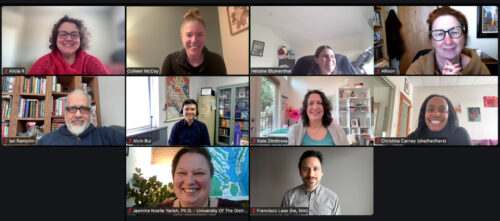
For Jasmine Yarish at the University of the District of Columbia, the committee role offers a chance to collaborate and connect with peers who share a commitment to public-facing scholarship.

“As a scholar grounded in interdisciplinarity as well as digital, historical, and cultural literacy, I wanted to join this committee to build solidarity across like-minded scholars who want to do the work to scale the walls of the academy and reach out to the public with accessible and responsible information,” said Yarish.

2026 Humanities & Social Justice Advisory Committee and Wiki Education staff

Yarish is particularly energized by the way Wikipedia challenges traditional academic roles.

“I am excited by the challenge of learning a new skillset that falls outside of the typical dichotomy of being either a knowledge consumer or knowledge producer,” explained Yarish. “Wikipedia provides a template and methodology for knowledge facilitation, where expertise and novel enthusiasm come together in an open access platform dedicated to ethical information gathering and collective learning. I like to think of it as a space that incubates innovation.”

Like Yarish, committee member Francisco Laso of Western Washington University brings a classroom perspective shaped by centering voices often missing from traditional narratives.

“I wanted to join Wiki Education’s Humanities and Social Justice Committee because my course with the Wikipedia assignment centers authors and perspectives from the Global South that most of my students have never encountered,” said Laso. “This exposure can be genuinely transformative — students regularly tell me that engaging with these voices is shaping what they want to do after graduation.”

Laso sees his role on the committee as a way to extend that impact beyond his own students.

“Wikipedia holds a special place for me — it’s one of the most democratic spaces on the internet — and having students contribute to it has proven to be among the most intellectually rigorous and personally meaningful assignments I’ve ever taught,” said Laso. “What excites me about this committee role is working ‘behind the scenes’ to help other educators build similar experiences in their own classrooms, so that the impact scales far beyond my own courses.”

Laso, Yarish, and their fellow committee members will engage in Wiki Education’s outreach and recruitment activities, conference participation, and publication projects throughout the year. We are grateful to all seven members for their service and leadership.


2026 Humanities & Social Justice Advisory Committee members:

Christina Carney

Dr. Christina Carney is an Associate Professor of Black (Queer) Sexuality Studies at the University of Missouri (Columbia) and has taught with Wiki Education since 2018. She is the author of Disreputable Women: Black Sex Economies and the Making of San Diego (2025). Her research interests include Black Feminism, Sex Work and Sex Economies, Urban Studies and the African Diaspora. While Carney’s first book examined how the sexual policing of Black women sex workers was foundational to the city of San Diego’s development as a center of tourism and the military, her current project takes a more global and transhistorical approach by examining how heritage tourism in Brazil engenders new sex economies and forms of relationality in the African Diaspora. Her work has been supported by the Institute for Citizens and Scholars (formerly the Woodrow Wilson Fellowship Foundation) and the US Fulbright Scholars Program. Carney also serves on the editorial board for African and Black Diaspora: An International Journal.

Kate Dimitrova 

Since 2019, Dr. Kate Dimitrova has been teaching classes on Medieval Art, the European Renaissance, and Medieval Islamic Art at the University of San Diego; before that she served as Assistant Professor and then Associate Professor at Alfred University in New York. She also worked at the Metropolitan Museum of Art in New York and then the J. Paul Getty Research Institute in Los Angeles. Her publications include a co-edited book with Margaret Goehring, Dressing the Part: Textiles as Propaganda in the Middle Ages (Brepols, 2014) and a forthcoming Festschrift in honor of Alison Stones. Her research has been supported by a Fulbright Fellowship in Brussels and a Kress Fellowship at the Institut national d’histoire de l’art in Paris. In 2022, Dr. Dimitrova launched the Wikipedia assignment working alongside her first-year students for an introductory survey course, “The Year 1500: A Global History of Art & Architecture” that explores the complex global connections and relationships that intertwined Europe with Asia, Africa, and the Americas during this so-called “Age of Exploration.” In addition, she has participated in the Wiki Education Scholars Program and has presented at several conferences to encourage other faculty members to embrace the Wikipedia assignment that transforms students to become both content creators and facilitators in knowledge sharing – activities that are meaningful far beyond the walls of the classroom.

Alvin Khiêm Bùi

Dr. Alvin Khiêm Bùi is Assistant Professor of History of Asian Peoples in Diaspora at Brooklyn College, City University of New York. He was a Visiting Research Fellow for the US-Vietnam Research Center at the University of Oregon’s Global Studies Institute. He is a proud product of public education and uses that education in public service, having earned his doctoral degree from the University of Washington, Seattle in modern Southeast Asian and East Asian history. During his time at UW, he served as Project Coordinator for the Washington State Racial Restrictive Covenants Project, mapping neighborhoods covered by racist deed provisions and restrictive covenants. He graduated Phi Beta Kappa and magna cum laude from UCLA in History and Asian American Studies, after which he lived and worked in Vietnam in education and venture capital. He has published on Saigonese motorbike YouTubers and their diasporic Vietnamese audiences in Asiascape: Digital Asia

Francisco J. Laso

Dr. Francisco Laso is an Assistant Professor of Geography and Environmental Studies at Western Washington University. His research and teaching sit at the intersection of Geographic Information Systems (GIS), political ecology, and community-engaged scholarship, with long-term collaborations in Ecuador and the Galápagos Islands focused on land use, agriculture, and environmental justice. Across his work, Francisco examines how environmental knowledge is produced, represented, and made accessible—and whose perspectives are amplified or overlooked in that process. His research, informed by fieldwork supported by international conservation organizations including the World Wildlife Fund, brings together qualitative and spatial approaches to make underrepresented environmental perspectives legible within dominant public and academic knowledge spaces. In the classroom, he designs public-facing, transnational learning experiences that connect students across regions and epistemic traditions, including courses such as Extractivism and Its Alternatives in Latin America, which incorporate Collaborative Online International Learning (COIL) partnerships with students in Ecuador and culminate in Wikipedia contributions requiring careful attention to sourcing, neutrality, and representation. He is also the founder of the Mapping Accessibility Project (MAP), which engages students in collaborative GIS work to document accessibility barriers and improve access to spatial information.

Allison Marsh

Dr. Allison Marsh is a public historian of technology with research interests on women in electrical engineering. During the spring of 2025 while on sabbatical, Allison enrolled in the 250 by 2026 Wiki Education course to help cultural heritage organizations build their Wikipedia presence in advance of the nation’s semiquincentennial.  As part of the course, she drafted her first Wikipedia article, a biography of engineering rockstar Mabel MacFerran Rockwell.  Her experience converted her to a Wikipedia evangelist.  She incorporated writing Wikipedia articles in her fall courses and again in the spring. So far her students have created 39 new articles on notable women in South Carolina and added 54k words. Allison suspects the Wikipedia assignment will become a staple in all future courses. She is giving her first public talk on “Teaching with Wikipedia” on 3 February 2026 at the Loblolly Society. Allison is an Associate Professor of Women’s & Gender Studies and the Co-Director of the Ann Johnson Institute for STS at the University of South Carolina. 

Alicia Rita Rueda-Acedo

Dr. Alicia Rita Rueda-Acedo is an Associate Professor of Spanish Literature, Translation, and Interpreting at The University of Texas at Arlington, where she founded and directs the Spanish Community Translation and Interpreting Program. Her work centers on connecting academic study with community engagement, and she has received multiple teaching awards, including the 2023 Example of Excelencia in Education. She is the author of Miradas transatlánticas: el periodismo literario de Elena Poniatowska y Rosa Montero (2012) and Miradas y aperturas: el artículo de opinión en el periodismo literario de Poniatowska, Mastretta y Luiselli (2024), and the co-author of Independencias, Revoluciones y Revelaciones: doscientos años de literatura mexicana (2010) and Fostering Inclusion Across Countries Through Community Translation and Interpreting (2026). She has published numerous book chapters and articles on 20th- and 21st-century Transatlantic literature from Mexico and Spain, addressing topics such as literary journalism and women authors in leading journals in the field. Dr. Rueda-Acedo integrates community translation, experiential learning, interprofessional education, and service-learning into her teaching by partnering with non-profit organizations to provide language access for underserved communities. Since 2025, she has also integrated Wikipedia assignments into her courses, leading translations of articles on rare diseases and U.S. immigration law into Spanish, as well as articles on Hispanic women writers into English.

Jasmine Noelle Yarish

Jasmine Noelle Yarish (Dr. JNY) is an Assistant Professor of Political Science at the University of the District of Columbia (UDC). As a political theorist and archival methodologist, she teaches core courses for the political science B.A. as well as civics and ethics courses for the interdisciplinary general education (IGED) program and the U.S. history sequence integrating digital literacy skills from LinkedIn to Wikipedia. Before joining UDC in the fall of 2020, she held visiting assistant professorships at Hobart and William Smith Colleges and Augustana College. A first-generation scholar raised in the Appalachian hills of central Pennsylvania, she specializes in the intersections of race, gender, sexuality, spatiality, material culture, and democratic theory. Since completing a Ph.D. with certificates in Black Studies and Global Studies at the University of California, Santa Barbara, her scholarship extends the idea of abolition democracy theorized by W.E.B. Du Bois to include political and intellectual contributions made by black women in and around the city of Philadelphia during the era of Reconstruction in the mid to late nineteenth century. With multiple publications in peer-reviewed journals and edited volumes, as well as supporting archival efforts for public history projects in the City of Philadelphia, namely the Ben Fletcher mural and I.W.W. Local 8 historical marker, Dr. JNY’s scholarship is placed prominently in the growing literature on the “Third Reconstruction,” racial capitalism, and abolition democracy.

Edits to Wikipedia and other wikis are delayed

Tuesday, 3 March 2026 10:54 UTC

Mar 3, 10:24 UTC
Resolved - Everything is back to normal.

Mar 3, 10:17 UTC
Monitoring - We think we have fixed the database issue, but we are watching to make sure.

Mar 3, 10:09 UTC
Identified - We have discovered an issue with our database servers and are working on a fix.

If you just had a quick glance at the above image, you might think it was a screenshot from the latest hit show or nature documentary. But no—it’s one of the winners of this year’s Wiki Loves Earth photo contest.

For more than a decade, this volunteer-organized competition has been capturing the breathtaking essence of the planet’s natural heritage. Photos of all sorts of nature, from iconic national parks to hidden gems in local green spaces, are eligible.

Wiki Loves Earth’s winners each year fall into two categories: a “landscapes” category for wider shots and a “macro/close-up” category (including animals, plants, fungi). This year, Wiki Loves Earth received nearly 80,000 submissions from over 5,200 participants in 57 countries—the latter figure being the most countries to ever compete in the contest.

From the submissions, 618 were selected by local jury teams and forwarded to the international competition. You can learn more about Wiki Loves Earth and its full rules on its website

Check out details on all twenty winners below.

Macro/close-ups category

1st place (macro/close-ups): The photo at the top of this post comes from Bolivia’s Carrasco National Park. Wiki Loves Earth’s contest judges heaped acclaim on User:Edunavia1’s photo. One praised the photographer for the color, lighting, and chosen perspective, which all added up to “a chef’s kiss to me.” Another said that the dramatic lighting gave the photo “an almost cinematic intensity.”

One more judge called out the drama inherent in the photo, with the combination of the snake’s pose, curves, scales, and eyes coming together for “an unrivaled capture of the reptile’s beauty in a single frame.” They added that the photo “might be the most striking photo in the entire competition”—and it indeed took home first-place honors.


Photo by Buggingitout, CC BY-SA 4.0

2nd place (macro/close-ups): The aptly named User:Buggingitout was walking beside a river in England’s The Broads National Park when they spotted this common blue damselfly. The entire fly appears in focus because of Buggingitout’s use of the focus stack technique, which combines multiple photos with different focuses to create one clear image.

Photo by Sven Damerow, CC BY-SA 4.0

3rd place (macro/close-ups): Sven Damerow is appearing in the Wiki Loves Earth international winners for a fourth time (including a first-place shot in 2019). This time, his camera found a couple of Eurasian hoopoes perhaps competing over the morsel of food being held by both of their beaks. This was one judge’s favorite photo in the competition, as it demonstrated “the interaction between the birds” and showed “how different these birds are.” They added that “even the light falling through the foliage on one of the birds beautifully emphasized this.” Another photo from Damerow appeared at macro #7.

Photo by Redante Auxilian/Rauxilian, CC BY-SA 4.0

5th place (macro/close-ups): An enormous ball of yellowstripe scad are seen here backlit from the sun above the water. Photographer Redante Auxilian dove beneath the waves in Tawi-Tawi, Sibutu and Tumindao Islands, the Philippines, to get this photo. One judge noted that his photo was strongly aligned with part of the reason for Wiki Loves Earth’s existence, which is to “unravel the many unseen wonders of our planet.”

Photo by A. H. M Ibnul Arabi, CC BY-SA 4.0

6th place (macro/close-ups): The circle of life is shown in this photo of a dead Bengal monitor and an ant trying to carry away a small amount of its flesh. Taken by A. H. M Ibnul Arabi in Bangladesh’s National Botanical Garden, a contest judge called out the image’s “heartbreaking” storytelling, and another liked that it could be used for a “learning purpose.”

Photo by Sven Damerow, CC BY-SA 4.0

7th place (macro/close-ups): In Sven Damerow’s second photo to place among this year’s Wiki Loves Earth macro winners, this Glanville fritillary butterfly is hanging out in Germany’s Wittenberge-Rühstädter Elbniederung Nature Reserve. One contest judge enjoyed that the photo looked like it could have been intentionally “made for an encyclopedia or for a well-illustrated book on the topic.” Damerow’s other photo appeared at macro #3.

Photo by Mark Kineth Kasindac, CC BY-SA 4.0

8th place (macro/close-ups): To an untrained eye, this might look like just another weevil. But according to photographer Mark Kineth Kasindac, this particular weevil’s color scheme is quite unusual: instead of its typical dark to cobalt blue, this one is more turquoise. “Everything about this frame is beautiful,” said one judge. Two of Mark’s photos took a combined sixth place in the macros last year.

Photo by Lukas Kott, CC BY-SA 4.0

9th place (macro/close-ups): Photographer Lukas Kott found the perfect angle in the Czech Republic’s Poodří Protected Landscape Area to document this male Eurasian hoopoe‘s return with food for his mate. Kott, who also took the #4 macros image above, received praise for this photo from the judges for its composition, technical skill, and lighting. Another one of Lukas’ photos placed at #4 in the macros section.

Photo by Nishant Sharma/Nishant Sharma Parajuli, CC BY-SA 4.0

10th place (macro/close-ups): Thankfully, a camera was not on the menu today for this tawny cat snake. Photographer Nishant Sharma staged this with the evening light in Nepal’s Godawari National Botanical Garden. “A good composition creates the effect of presence and a sense of tension,” said one judge.


Landscapes category

Photo by Markus Albert/Markusmachtphotos, CC BY-SA 4.0

1st place (landscapes): This year’s overall winner in the landscapes category features Markus Albert’s portrayal of a European beech tree at the height of a German autumn. Found in Germany’s Rhön Biosphere Reserve, its color presents a stark contrast with what looks to be fog in the background.

The Wiki Loves Earth contest judges gave high accolades to this image for its vivid visuals and technical skill, including one who called out the use of the surrounding trees as effective leading lines. Another called out the “immersive effect” created by Albert’s chosen perspective.

Photo by Thiago Marcel Campi/Thiagomarcelcampi, CC BY-SA 4.0

2nd place (landscapes): Coming in second place is a portrayal of climate change’s effects on the low-lying Ilha do Cardoso State Park in southeastern Brazil. Thiago Marcel Campi, the photographer, noted that rising sea levels are increasingly encroaching on the park’s marshes and mangrove trees.

Photo by Ahmad Faihan Almutairi/Di7ane, CC BY-SA 4.0

3rd place (landscapes): This aerial photo of a stream emerging north of Sulaibikhat, a district of Kuwait City, came to us from Ahmad Faihan Almutairi. One judge thought it was a “stunning” shot that “exemplifies the grandeur of landscape,” and another noted that its “abstract treatment” was “effective without compromising its context as a framed landscape.” Another photo from Almutairi placed at #4 in the landscapes category.

Photo by Ahmad Faihan Almutairi/Di7ane, CC BY-SA 4.0

4th place (landscapes): Found just west of photo #3, Ahmad Faihan Almutairi flew their drone to capture this view of Kuwait’s Jahra Nature Reserve. One judge said that this had a “painterly feel,” while another called out the “vibrant blue river water juxtaposed against arid earth tones” that evoked “a sense of serene isolation.” Another photo from Almutairi placed at #3 in the landscapes category.

Photo by Missoni Francesco/Scosse, CC BY-SA 4.0

5th place (landscapes): Far into northeastern Italy, this stunning photo of Federa Lake and the mountains of Ampezzo Dolomites Natural Park comes to you courtesy of photographer Missoni Francesco. Perhaps unsurprisingly, the contest judges called out the photo’s deep depth. Another one of Francesco’s photos placed 6th in last year’s Wiki Loves Earth landscapes category.

Photo by Nathan Atkinson/Miura-photo, CC BY-SA 4.0

6th place (landscapes): Once upon a time, a glacier carved its way through northern England and left this canyon behind. Known as High Cup Gill or High Cup Nick, it can be viewed from the Pennine Way national trail. Nathan Atkinson’s photo captures its full length and demonstrates its distinctive symmetry.

Photo by Vladimir Tadic/Svjetlopis, CC BY-SA 4.0

7th place (landscapes): For some people, this is the photo of their dreams—a lonely cabin, perhaps waiting to be filled with joy and memories. This photo near Zlatibor, Serbia’s Cigota mountain peak comes from Vladimir Tadic. One judge said that it “proves that impressive landscape [photos] are not only defined by bold and explosive colors.”

Photo by Glenn Wilks, CC BY-SA 4.0

8th place (landscapes): Winter camping is one of many hobbies a person could pick up. Last year, photographer Glenn Wilks climbed into the hills of England’s Lake District to get this shivery photo of his tent and a distant peak backlit by a rising sun.

Photo by José Nuno Rosado, CC BY-SA 4.0

9th place (landscapes): Deep in southwestern Portugal, José Nuno Rosado’s visually arresting portrait of a lighthouse in Southwest Alentejo and Vicentine Coast Natural Park brought acclaim from the judges. One noted that the framing and color treatment was spot-on, and that the photo as a whole was the sort of thing they looked for when “furthering the goals and purposes of Wiki Loves Earth.”

Photo by David Egan/Davidwegan, CC BY-SA 4.0

10th place (landscapes): Canada’s Garibaldi Lake is known for its unusual turquoise color, but on this New Year’s Day you can only see ice and the snow on top of it. This photo from David Egan was called out by the contest judges for its excellent layering and the feeling of “serenity” it invoked.


Volunteer-led and organized, Wiki Loves Earth asks people to venture out into nearby natural areas. The contest’s definition of a natural area is intentionally broad, which helps ensure that anyone, anywhere, is able to participate. The photographers’ submitted work is uploaded to Wikimedia Commons, a media library that holds many of the photos used on Wikipedia. All of the content within that library is freely licensed; it can be used by anyone, for any purpose, with only a few restrictions.*

If you would like to submit your own photos for Wiki Loves Earth later this year, keep an eye on wikilovesearth.org for organizing information and dates.


Post by Ed Erhart, Communications Specialist, Wikimedia Foundation.

*Please be sure to follow each image’s copyright tag. All of the images above, for instance, are available under a Creative Commons CC BY-SA 4.0license—you are free to share them for any reason so long as you give credit to the photographer and release any derivative images under the same copyright license.

The post “Cinematic intensity”: The winners of Wiki Loves Earth 2025 appeared first on Wikimedia Foundation.

Wikipedia:Administrators' newsletter/2026/3

Monday, 2 March 2026 00:22 UTC

News and updates for administrators from the past month (February 2026).

Administrator changes

removed ·

CheckUser changes

removed Ks0stm

Oversight changes

removed Ks0stm

Guideline and policy news

Arbitration

  • Following a motion, remedy 9.1 of the Conduct in deletion-related editing case has been amended to limit TenPoundHammer to one XfD nomination or PROD per 24-hour period.
  • Following a motion, the Iskandar323 further POV pushing motion has been rescinded.
  • The Arbitration Committee has passed a housekeeping motion rescinding a number of outdated remedies and enforcement provisions across multiple legacy cases. In most instances, existing sanctions remain in force and continue to be appealable through the usual processes, while some case-specific remedies were amended or clarified.

Miscellaneous


Archives
2017: 01, 02, 03, 04, 05, 06, 07, 08, 09, 10, 11, 12
2018: 01, 02, 03, 04, 05, 06, 07, 08, 09, 10, 11, 12
2019: 01, 02, 03, 04, 05, 06, 07, 08, 09, 10, 11, 12
2020: 01, 02, 03, 04, 05, 06, 07, 08, 09, 10, 11, 12
2021: 01, 02, 03, 04, 05, 06, 07, 08, 09, 10, 11, 12
2022: 01, 02, 03, 04, 05, 06, 07, 08, 09, 10, 11, 12
2023: 01, 02, 03, 04, 05, 06, 07, 08, 09, 10, 11, 12
2024: 01, 02, 03, 04, 05, 06, 07, 08, 09, 10, 11, 12
2025: 01, 02, 03, 04, 05, 06, 07, 08, 09, 10, 11, 12
2026: 01, 02, 03, 04


<<  Previous Archive    —    Current Archive    —    Next Archive  >>

Paging myself with email and a Raspberry Pi

Monday, 2 March 2026 00:00 UTC

A Raspberry Pi polls an inbox, matches email subjects against a pattern, and fires off low-power POCSAG transmissions to a real pager. Here's how.

Note: I have not published blog posts about my academic papers over the past few years. To ensure that my blog contains a more comprehensive record of my published papers and to surface these for folks who missed them, I will be periodically (re)publishing blog posts about some “older” published projects. This post is closely based on a previously published post by Zarine Kharazian on the Community Data Science Blog.

For nearly a decade, the Croatian language version of Wikipedia was run by a cabal of far-right nationalists who edited articles in ways that promoted fringe political ideas and involved cases of historical revisionism related to the Ustaše regime, a fascist movement that ruled the Nazi puppet state called the Independent State of Croatia during World War II. This cabal seized complete control of the encyclopedia’s governance, banned and blocked those who disagreed with them, and operated a network of fake accounts to create the appearance of grassroots support for their policies.

Thankfully, Croatian Wikipedia appears to be an outlier. Though both the Croatian and Serbian language editions have been documented to contain nationalist bias and historical revisionism, Croatian Wikipedia seems unique among Wikipedia editions in the extent to which its governance institutions were captured by a small group of users.

The situation in Croatian Wikipedia was well documented and is now largely fixed, but we still know very little about why it was taken over, while other language editions seem to have rebuffed similar capture attempts. In a paper published in the Proceedings of the ACM: Human-Computer Interaction (CSCW), Zarine Kharazian, Kate Starbird, and I present an interview-based study that provides an explanation for why Croatian was captured while several other editions facing similar contexts and threats fared better.

Short video presentation of the work given at Wikimania in August 2023.

Based on insights from interviews with 15 participants from both the Croatian and Serbian Wikipedia projects and from the broader Wikimedia movement, we arrived at three propositions that, together, help explain why Croatian Wikipedia succumbed to capture while Serbian Wikipedia did not: 

  1. Perceived Value as a Target. Is the project worth expending the effort to capture?
  2. Bureaucratic Openness. How easy is it for contributors outside the core founding team to ascend to local governance positions?
  3. Institutional Formalization. To what degree does the project prefer personalistic, informal forms of organization over formal ones?
The conceptual model from our paper, visualizing possible institutional configurations among Wikipedia projects that affect the risk of governance capture. 

We found that both Croatian and Serbian Wikipedias were attractive targets for far-right nationalist capture due to their sizable readership and resonance with national identity. However, we also found that the two projects diverged early in their trajectories in how open they remained to new contributors ascending to local governance positions and in the degree to which they privileged informal relationships over formal rules and processes as the project’s organizing principles. Ultimately, Croatian’s relative lack of bureaucratic openness and rules constraining administrator behavior created a window of opportunity for a motivated contingent of editors to seize control of the governance mechanisms of the project. 

Though our empirical setting was Wikipedia, our theoretical model may offer insight into the challenges faced by self-governed online communities more broadly. As interest in decentralized alternatives to Facebook and X (formerly Twitter) grows, communities on these sites will likely face similar threats from motivated actors. Understanding the vulnerabilities inherent in these self-governing systems is crucial to building resilient defenses against threats like disinformation. 

For more details on our findings, take a look at the published version of our paper.


Citation for the full paper: Kharazian, Zarine, Kate Starbird, and Benjamin Mako Hill. 2024. “Governance Capture in a Self-Governing Community: A Qualitative Comparison of the Croatian, Serbian, Bosnian, and Serbo-Croatian Wikipedias.” Proceedings of the ACM on Human-Computer Interaction 8 (CSCW1): 61:1-61:26. https://doi.org/10.1145/3637338.

This blog post and the paper it describes are collaborative work by Zarine Kharazian, Benjamin Mako Hill, and Kate Starbird.

weeklyOSM 814

Sunday, 1 March 2026 13:47 UTC

19/02/2026-25/02/2026

lead picture

[1] VORTAC (VHF Omnidirectional Range / Tactical Air Navigation) (beacon:type=VORTAC) | Colling-architektur, via Wikimedia Commons CC BY-SA 3.0

Mapping

  • Simgaymer has asked for comments on a tagging proposal to extend the existing building:flats=* tag, allowing mappers to record the number of flats with 0 bedrooms (studio), 1 bedroom, 2 bedrooms, and so on. For example building:flats:0_bedrooms=* to record the number of studio flats.
  • The proposal flashing_lights=* is still open for voting. The proposal intends to indicate the precise design of flashing lights.
  • Voting on the indication:*=*, a tag prefix to designate any feature with the help of existing tagging (useful for utility markers, like hydrants), refinement proposal has closed successfully at 100% approval rate (20 votes for, 0 votes against, and 0 abstentions).

Mapping campaigns

  • [1] Matt Whilden has launched a MapRoulette project focused on improving the mapping of VORTAC (VHF Omnidirectional Range / Tactical Air Navigation) beacons (beacon:type=VORTAC), a type of radio station used in aviation to help pilots determine both their direction from a station and their distance to it. According to Matt many of these installations in OpenStreetMap have been incorrectly mapped as buildings, storage tanks, towers, or other structures, rather than being tagged as aviation navigation aids. The circular shelters and antenna arrays that characterise VORTAC sites are frequently misidentified when viewed from aerial imagery.

Community

  • Following a recent outage affecting the Overpass API service used by many OpenStreetMap tools, Daniel Schep and Jacob Hall announced the launch of the MapRVA Overpass server (https://overpass.maprva.org/api/), a dedicated Overpass instance focused on the state of Virginia in the United States. Alongside the server, they also introduced a customised deployment of Ultra. The customised version is configured to use the MapRVA Overpass server and the MapRVA styling server as its default infrastructure, providing an alternative resource for users working with Virginia-focused data during broader service disruptions.
  • Michal Migurski has written about the representation of boundaries in dispute using open data and mapping with OpenStreetMap.
  • Derlamaer highlighted the current OSM proposal traffic_signals:detector=pedestrian_presence_sensor, suggesting a tag for indicating pedestrian presence detectors at traffic signals. This tag aims to improve the precision of signal controller datasets and support more detailed traffic engineering analyses.
  • FeetAndInches has written a diary entry on how they process dashcam video and GNSS data into a sequence of images for Panoramax.
  • Kevin Ratzel has written an Ultra query to visualise the 1.0 Pedestrian Working Group Schema, a tagging schema for pedestrian infrastructure mapping in OpenStreetMap.
  • Anne-Karoline Distel has published a video explaining how to map bonfire sites associated with the Eleventh Night.
  • Valentin Bachem has identified and explained several potential safety risks in the current cycling path network of Heidelberg, calling on local authorities and the media to give greater attention to these issues and to pursue improvements aimed at reducing harm.
  • SirfHaru wrote in their OSM user diary about some of the peculiarities of mapping addresses in India.

Events

  • The call for participants at SotM 2026 is open. This year’s SotM will take place in Paris, France, 28 to 30 August. The Programme Committee is ready and waiting, eager to unwrap your submissions for talks, workshops, and panels. These sessions aren’t just part of the conference; they’re its beating heart, driving conversations and sparking ideas that resonate worldwide. Presenting your work, projects and ideas at SotM is also a great way to get in touch with the wider OSM community.

Maps

  • Jochen Topf outlined several recent feature updates to OSM Spyglass, a debugging interface for OpenStreetMap that displays all tagged nodes, ways, and relations.

Open Data

  • An update of the Portuguese coastline dataset, at a scale of 1:150,000, is now available , on the dados.gov portal, published by the Hydrographic Institute.
  • The 2025 version of the Official Administrative Map of Portugal has been published on the website of the Directorate-General for Territory. There is also a viewer for online data, which uses OSM as its base map.
  • Pinhead map symbols is a repository of public domain SVG icons designed to be displayed at 15×15 pixels (minimum). You can find the project on GitHub.

Software

  • ni5arga has made Sightline, an OSINT search engine for physical infrastructure, built on OpenStreetMap data. The tool uses the Overpass API and Nominatim, supports both free-text and structured queries, such as type:data_center operator:google, and relies on deterministic rule-based parsing instead of AI inference.
  • nickrsan has built Browsm, a browser extension that allows users to edit OpenStreetMap points of interest directly while viewing a business or attraction’s official website.

Releases

  • Organic Maps has released its February 2026 update. Users can now contribute by adding real-time public transport schedule data through sending GTFS feed sources and ensuring that a city’s OSM data includes all the necessary tags, which can be verified using the gtfs-osm-matcher.

Other “geo” things

  • FOSSGIS e.V. has launched a mailing list aimed at the wider community. The list is intended as a place to ask questions about QGIS, discuss software or plugin choices, and exchange practical experiences with other users. Subscribers will also receive updates from the association, including event notices, job postings, and other announcements. Registration is available here , and joining does not require association membership.
  • The German tech outlet Golem.de reported that Google is further restricting the full functionality of Google Maps for users who are not signed in with a Google account. According to the report, the limitation has been confirmed to apply at least in the United States and Germany.
  • The Atelier Parisien d’Urbanisme (Parisian Urbanism lab APUR) has published the first Atlas de la Métropole du Grand Paris. As part of this publication, APUR has chosen to present an analysis of the departure patterns of Parisians and residents of the Île-de-France region to metropolitan seaside areas, based on data from CitiProfile , a French startup specialising in the production of decision-making tools based on the flow of people and vehicles.
  • The Zürich-based Mapillary team hosted an event on 26 February to celebrate reaching 3 billion uploaded images. The meetup offered insights into the engineering behind hosting this volume of imagery, the future roadmap, and how mapping communities are using Mapillary.
  • You can read the incredible history of Inō Tadataka, who was 55 years old when he set out to methodically survey the entire coastline of Japan in 1800, a task he would spend the last 17 years of his life working on.
  • QGIS 4.0 Release candidate has been launched, with some important improvements and, according to the developers, this major release will represent the successful culmination of a long period of technical migration, transitioning the core of QGIS to Qt6. According to the Road Map, the release date for version 4.0 is 6 March 2026.

Upcoming Events

Country Where Venue What When
flag Seattle Seattle, WA, US OpenThePaths 2026: Connecting People and Places Through Sustainable Access 2026-02-26 – 2026-02-27
flag Santa Clara Santa Clara University Friends of MSF Mapathon 2026-02-26
UN Maps Validation Friday Chat & Map 2026-02-27
flag Greater Noida Online Missing water Bodies of Delhi 2026-02-27
flag Essen Fahrrad-Messe Essen, Halle 5, Show-Truck Vortrag: Mitmachen bei OpenStreetMap, der Basis vieler Outdoor-Apps 2026-02-27
flag Potsdam Hafthorn Potsdamer Mappertreffen 2026-02-27
flag Ferrara Cimitero monumentale della Certosa di Ferrara Ferrara mapping party 2026-02-28
flag Messina Messina Mapping Day @ Messina 2026-02-28
flag Dijital Bilgi Derneği Genel Merkezi OpenStreetMap Community Meet-Up & Mapathon 2026-02-28
flag नई दिल्ली Jitsi Meet (online) OSM India – Monthly Online Mapathon 2026-03-01
flag Madurai Naveen Coffee Bar, Anna Nagar (tentative) OSM Mapping Party @ Madurai 2026-03-01
flag Milano Building 4A, Room Fassò – Politecnico di Milano PoliMappers Maptedì 2026-03-03
flag Salzburg Bewohnerservice Elisabeth-Vorstadt OSM-Treffpunkt 2026-03-03
flag Lille Salle Yser, MRES, 5 rue Jules de Vicq, Lille Rencontre OpenStreetMap à Lille 2026-03-03
Missing Maps London: (Online) Mapathon [eng] 2026-03-03
iD Community Chat 2026-03-04
OSM Indoor Meetup 2026-03-04
flag Brno Kvartální OSM pivo 2026-03-04
Harzer OSM-Stammtisch 2026-03-04
flag Stuttgart Stuttgart Stuttgarter OpenStreetMap-Treffen 2026-03-04
flag Online OpenHistoricalMap in North America 2026-03-04
OSM US Mappy Hour: OpenHistoricalMap in North America 2026-03-04
flag Flensburg Offener Kanal Flensburg 3. Open Data Day Flensburg 2026-03-05
flag Žilina Fakulta riadenia a informatiky UNIZA Missing Maps mapathon Žilina #21 2026-03-05
flag Le Schmilblick, Montrouge Réunion des contributeurs de Montrouge et du Sud de Paris 2026-03-05
flag София Rectorate of Sofia University St. Kliment of Ohrid FOSS4G:BG Open GIS Conference 2026 2026-03-06 – 2026-03-07
OSMF Engineering Working Group meeting 2026-03-06
flag Gent Wijgaard OpenStreetMap meetup in Gent – Pre-VLA-congres editie 2026-03-06
flag Hogeschool Odissee Hospitaalstraat 23 Sint-Niklaas Vereniging Leraars Aardrijkskunde (VLA) conference 2026 2026-03-07
flag Perth Espresso Perk U Later Social Mapping Sunday: Moort-ak Waadiny / Wellington Square Perth 2026-03-07
flag Perth Espresso Perk U Later Social Mapping Sunday: Moort-ak Waadiny / Wellington Square Perth 2026-03-08
flag Delhi OSM Delhi Mapping Party No.27 (East Zone) 2026-03-08
flag København Cafe Bevar’s OSMmapperCPH 2026-03-08
flag London Social Sciences Centre – Western University Friends of MSF UWO Mapathon 2026-03-09
flag Brno Geografický ústav, PřF MUNI, Brno Březnový brněnský Missing Maps Mapathon na Geografickém ústavu 2026-03-09
Missing Maps : Mapathon en ligne – CartONG [fr] 2026-03-09
flag 臺北市 MozSpace Taipei OpenStreetMap x Wikidata Taipei #86 2026-03-09
flag Hamburg Voraussichtlich: “Variable”, Karolinenstraße 23 Hamburger Mappertreffen 2026-03-10
flag Cork Logitech, Cork, Ireland Logitech Missing Maps – Office Mapathon 2026-03-11
flag Reston George Mason University, HUB VIP 3 The GAIN Mapathon 2026-03-11
flag Zürich Bitwäscherei Zürich 185. OSM-Stammtisch Zürich 2026-03-11
flag München WikiMUC Münchner OSM-Treffen 2026-03-12
flag Leuven Romaanse Poort Camera’s in kaart brengen 2026-03-14

Note:
If you like to see your event here, please put it into the OSM calendar. Only data which is there, will appear in weeklyOSM.

This weeklyOSM was produced by MarcoR, MatthiasMatthias, Raquel IVIDES DATA, Strubbl, Andrew Davidson, barefootstache, derFred, izen57, mcliquid.
We welcome link suggestions for the next issue via this form and look forward to your contributions.

Ever wondered how a computer learns to generate text that actually looks like Malayalam? Not just random characters, but something with actual structure? I’m not talking about Large Language Models here. I’m talking about Small Language Models that are efficient and explainable. something you can build and run on your own laptop.

In my previous “The Broken Token” article, I presented a Malayalam unigram tokenizer and analysed its strengths and weaknesses. I did fertility rate evaluation and then analysed the tokenization in the context of Malayalam language characteristics. A common evaluation method for tokenizers is using them in downstream tasks—so I decided to build a text generator. That’s where things got interesting.

Standard LLMs fragment Malayalam words into 15+ meaningless pieces, destroying the semantic signal required for learning. This post details the training of custom BPE and Unigram tokenizers, and explores why resolving fragmentation is the necessary first step toward solving the larger problems of data scarcity and complex morphology

Issues and degraded performance accessing Wikis

Thursday, 26 February 2026 16:58 UTC

Feb 26, 16:58 UTC
Resolved - This incident has been resolved.

Feb 26, 16:25 UTC
Monitoring - A fix has been implemented and we are monitoring the results.

THE DEM-Debate project came to an end: the final event

Thursday, 26 February 2026 15:53 UTC

On February 24, the DEM-Debate partners – Wikimedia Europe, the University of Amsterdam and Eurecat – Centre Tecnològic de Catalunya – gathered at the European Parliament in Brussels for the final event of the DEM-Debate project

This was the occasion for the researchers to showcase their analyses and offer their conclusions after they conducted an investigation that lasted 18 months. 

The research is a combination of a legal and computational analysis of the fact-checking and content moderation practices used by Wikipedia during the 2024 European Parliament elections to address disinformation. Its aim was to produce policy recommendations that could inform future legislation able to safeguard community-driven, free knowledge initiatives.

In view of future revision of the Digital Services Act (DSA) and as a concrete solution to strengthen the information integrity in Europe, the research highlights how community-governed platforms, and in particular the online encyclopaedia Wikipedia, contribute to a reliable, pluralistic online information ecosystem. 

The research offers concrete guidance to lawmakers when adopting new legislation as well as to regulators when implementing the current rules.

If you did not have the chance to follow the event, you can watch the recording here.

Issues and degraded performance accessing Wikis

Wednesday, 25 February 2026 17:24 UTC

Feb 25, 17:24 UTC
Resolved - This incident has been resolved.

Feb 25, 16:40 UTC
Investigating - We are currently investigating this issue.

The future of communication

Wednesday, 25 February 2026 08:29 UTC

I guess this could be the last post in the blog (probably for a very long time).

Even simpler to read and understand

Episode 202: BTB Digest 32

Tuesday, 24 February 2026 23:07 UTC

🕑 23 minutes

It's another BTB Digest! Hear clips from five recent episodes. Cormac Parle notes the challenges in structured data in Wikimedia Commons, Vera de Kok reminisces about her early years as a Wikimedia photographer; Stephen Harrison cautions against dismissing AI encyclopedias; Brian Wolff summarizes the philosophy of JavaScript gadgets, Shlomit Lir points out the tension between equity and neutrality, and more!

A Tech Blog Diff

Tuesday, 24 February 2026 22:39 UTC
Camel caravan in the Amatlich erg, Mauritania, Valerian Guillot

The Developer Outreach team is happy to announce that we will be migrating the Tech Blog into Diff. This move will allow us to provide better support and more visibility for the incredible work of the technical community. Diff is the community news and event blog supported by the Movement Communications team. Diff sees about 20,000 visits a month and has 1,200 email subscribers. 

  • What will happen to the Tech Blog content?
    • All Tech Blog posts will be accessible on Diff, clearly tagged with “techblog”. Old links will automatically redirect to their new location. New posts with a technical focus will be tagged with “techblog” so they will be easily discoverable.You’ll be able to find all techblog posts – old and new – on the landing page at https://diff.wikimedia.org/techblog 
  • When is this happening?
    • The migration should be complete in April 2026.
  • How do I submit a blog post with a technical focus?
    • For now, please hold your post until we complete the migration.
    • After the migration is done: The process remains the same. For WMF staff, talk to your manager about your interest in writing a blog post so they are not surprised when you ask them to approve it once it is written. For folks outside WMF, if you are part of a team or other larger organization, be sure they are aware and approve. Then, see the Diff submission process and select the category “Technology” and the tag “techblog” when writing your draft. After you submit, the Developer Outreach team will review your draft. When it’s ready to go, we will schedule your post to be published.

We’re excited for the Tech Blog to evolve and thank the Movement Communications team for helping us make this possible!