People send me books. Sometimes it is a publisher or an author sending me a review copy of a recent publication that I have requested. I’m actually still somewhat in awe of the fact that leading publishers of history of science books are prepared to supply review copies for my humble blog, but am pleased that they do so. Sometimes its authors sending me copies of their latest tomes fresh off the press because I have helped them in some way with their emerging manuscripts; fact checking, providing feedback on a historical claim or whatever. Such volumes, always welcome, also tend to get thrown into the Renaissance Mathematicus review mill. Totally unexpected but always immensely pleasing is when someone sends me a book that they think I would appreciate simply because they like what I do.
One such was recently sent to me by Arjen Dijkstra, who is the director of Tresoar, Museum, Archive and Library Fryslân in Leeuwarden, and who specialises in the history of science. Arjen and I have never met but have been Internet friends for a number of years. The book he sent me is the English translation of a book he originally published in Dutch in 2021. It is the biography of an eighteenth-century, Friesian, amateur, mathematician and astronomer, who I had never heard of and the unbelievable planetarium that he built, which I had also never heard of; Builder of Heavens: How Eise Eisinga Created the Greatest Planetarium of his Time.[1]
Before I go into detail about this book a general comment. If I get asked what I do, if I’m answering in detail, I say, I’m a narrative historian of the contextual history of science or shorted, a contextual narrative historian. Dijkstra’s book is an absolutely first class example of contextual narrative history of science. One of the cover blubs sums it up perfectly, “It is best described as a scholarly novel.” Dijkstra’s book is fine quality but highly accessible literature, which is a pleasure to read, whilst at the same time it is obviously the product of high-level, detailed, accurate research without being obtrusively academic.
In the opening chapter we get introduced to Eisinga’s home town of Franeker in the province of Friesland and why it had a strong tradition of mathematics and astronomy in his time. We then get introduced to his family and their trade as wool combers and an explanation as to why wool combers have a down period every year where they can indulge their hobbies. Next we get Eise Esinga’s education and his introduction to mathematics. Having set the context, we get introduced to the star of the show, Eise Esinga’s planetarium. He quite literally, together with his father, turned the ceiling of his living room into the world’s biggest planetarium driven by clockwork in a period of just seven years.
In the succeeding chapters, Dijkstra takes us through the lives of the planetarium and its creator. This covers a wide spectrum of the contemporary Dutch academia and politics. The academics who became fascinated with Eisinga’s creation and their descriptions and promotions of it. The highly turbulent politics of the Netherlands during Eisinga’s life, which he became highly involved in both on a local and a national level. He became part of an attempted uprising, was forced to flee into exile and then tried and punished when he returned. Not the usual path through life of an amateur astronomy enthusiast. Along the way we get detailed descriptions of the planetarium, its inner life, and its functions.
Rehabilitated, his political movement now in power, Eisinga become even more politically involved, even sitting briefly in the national assembly. Parallel to his political rise, he and his planetarium become more and more popular reaching first national and then international fame. Eisinga dreams of building an even bigger, even more elaborate planetarium, drawing up detailed plans for its construction but which are never realised.
The planetarium was bought by the Dutch king for the nation, with Eisinga’s family given the right to continue living in the house for ever. In 2023, still a major tourist attraction the planetarium was declared a world cultural heritage by the United Nations.
The book is richly illustrated with grey tone prints, which includes many of Eising’s detailed plans for his planetarium. Following the acknowledgements, Dijkstra gives a detailed description of the sources he consulted to write his biography of Eise Eisinga. There is a Brief Biography, which is largely books in Dutch. The end notes are mostly the Dutch originals of quote given in English in the main text. The book closes with a competent index.
I have not gone into as much detail as I am wont to do in my book reviews because I didn’t want to spoil the joy for potential readers. I think this is a book of joy; I can’t remember when I last enjoyed reading a book as much as I did reading this one. If you are into the history of science, or history of astronomy, or history of technology, or eighteenth century Dutch history then this book is for you. If, however, you simply like to read well written, high quality, easy to read, non-fiction books that stimulate, entertain, and make curious this is a must read!
[1] Arjen Dijkstra, Builder of Heavens: How Eise Eisinga Created the Greatest Planetarium of his Time, Translated by Liz Waters, Noorboek, 2025
What follows is a classic Renaissance Mathematicus rant! I haven’t had a really good rant in some time and this one was provoked by the following exchange on TSMSFKAT[1]. It’s quite long and I include all of so that you can get the full picture.
The timeline was started by Nancy Pearcy who is a professor at Houston Christian University, which is a private university affiliated with the Baptist General Convention of Texas so we know what her prejudices are. She is also a fellow at the Discovery Institute, which says all one needs to know about her perception of science. The Discovery Institute reject evolution and propagates intelligent design.
Nancy Pearcey @NancyRPearcey
Well-known science writer Loren Eiseley points out that many great civilizations have risen and fallen without developing the scientific method–which implies that that it requires some kind of “unique soil in which to flourish.” And what is that unique soil? To his own surprise, Eiseley discovered that: “It is the Christian world which finally gave birth in a clear, articulate fashion to the experimental method of science.” Why is that? Eiseley goes on to explain that “Science began its discoveries . . .in the faith, not the knowledge, that it was dealing with a rational universe controlled by a Creator who did not act upon whim nor interfere with the forces He had set in operation.” (Darwin’s Century) Eiseley is using the term “faith” not to say it was irrational but in the sense that it had to PRECEDE actual scientific investigation. Before science can get off the ground, certain tacit assumptions have to be in place–for example, that there is an intelligible order in nature–what we call “laws” of nature. Here’s how one historian put it: “The use of the word ‘law’ in such contexts [in talking about nature] would have been unintelligible in antiquity, whereas the Hebraic and Christian belief in a deity who was at once Creator and Law-giver rendered it valid.” (A. R. Hall, The Scientific Revolution, 1500-1800)
However, she was reacting to a quote from the effluent spewing apology for an academic Jordan Peterson, who had this to say for himself.
“With the death of God, many other things die… one of the things that dies when God dies is science—and no one expected that.” Why? Science isn’t neutral—it’s built on unprovable religious-like axioms: – Truth exists – Truth is understandable – Understanding truth is good – Good itself is real Those aren’t scientific claims. They’re metaphysical. Strip away the foundation of “good” (and God), and the whole pursuit collapses. Peterson: The gap between believing in good and believing in God? “Very narrow.” In a world obsessed with “facts only,” is he right that pure atheism undermines the very enterprise of science?
When I read this total piffle from Jordi P, I picture his sitting in a padded cell in a straight jacket flustering his inanities to an apparition standing in the corner that only he can see.
Pearcey in response tells us, quoting Loren Eiseley (1907–1977), an anthropologist and philosopher, that it was Christianity that gave birth to the scientific method . She goes on to back up this claim with a quote from historian of science, A. R. Hall (1920–2009). Hall was a leading figure in the establishment of the modern history of science in the 1950s and 60s. However, he was a man caught in his own prejudices who got an awful lot wrong.
Sarah Salviander, PhD astrophysicist and Christian, now takes up the cudgels for Christianity as not just the catalyst of the scientific method but of science itself and progenerated the Scientific Revolution
Sarah Salviander @sarahsalviander
A lot of people believe science was inevitable, like humanity was just progressing in that direction or it was an emergent property of civilization. That’s not at all the case. You don’t get science unless you first believe in the possibility of science. That’s why Christianity provided the unique set of beliefs that finally set off the Scientific Revolution.
Michal J A Paszkiewicz @MichalYouDoing amongst other things translator into English of Riccioli’s Almagestum Novum(1651) now joined the discussion with a perfectly reasonable and historically correct comment.
Christianity helped science considerably, but wasn’t a prerequisite. Astronomy, for example, has been an exact science for over 5000 years.
Sarah Salviander @sarahsalviander now let loose a major heap of codswallop
It hasn’t, though. Ancient people were excellent at tracking celestial motions, but that was for a variety of non-scientific reasons mostly to do with calendars, timekeeping, navigation, and astrology. For thousands of years, people thought the Earth was at the center of the universe. They didn’t really care if that was an accurate representation of nature, because it didn’t matter as long as the model yielded accurate predictions. Copernicus posited a Sun-centered model for its simplicity and elegance, which was championed by Galileo who supported it (albeit imperfectly) through observation. It was finally made into a highly-precise scientific model by Kepler, a deeply devout Christian who for several years pursued a fraction-of-a-degree difference between the data and the model, because he believed in God’s precision. It wasn’t until Kepler that astronomy became a mathematical science. I encourage you to read “The Soul of Science” by Pearcey and Thaxton to understand why the unique set of ideals and assumptions of Christianity were necessary (though not sufficient) for the rise of modern science.
Michal J A Paszkiewicz @MichalYouDoing responds with a very reasonable, historically accurate
It has, though. See e.g. John North’s “Cosmos”, which presents hundreds of pages of evidence of this. The problem of discarding “calendars, timekeeping, navigation, and astrology” as non-scientific is this just becomes a tautological demarcation. Even if timekeeping and navigation weren’t a science – they are (and those scientists working on accurate timekeeping would be deeply upset you had said this) – the reason for building the mathematical models, testing them, and updating the models doesn’t change whether it is a science or not. You could similarly discard a large part of Christian involvement in Early Modern astronomy, as they were similarly primarily interested in calendars, timekeeping, and navigation (see eg p.1 of Heilbron’s “the Sun in the Church”). Discarding astrology is also problematic, as parts of ancient astrology were directly connected to real physical phenomena that occurred. For example, we know well that the ancient Egyptians could accurately predict when the Nile floods would happen based on celestial observations. The same methods would have been accurate up until the 1960s. Things we consider parts of geophysics today used to be part of astrology – such as predicting the tides. Of course there were a lot of other things included in astrology, and it took a long time to segregate that from the rest. But this segregation was all part of the scientific process. Not discovering heliocentrism isn’t a valid way of forming a demarcation theory either. It is entirely arbitrary. Why not make it the moment of discovery of our galactic motion? Or going further back, the moment of discovery of Earth’s sphericity, the abandonment of homocentric spheres, the abandonment of the central fire, or perhaps the first step out of arithmetic to geometric celestial models? You said it yourself – they cared about accurate predictions. Isn’t that what scientists strive for? Copernicus wasn’t the first to strive for simplicity and elegance. Ptolemy did the same, as did Hipparchus before him, and Plato before him. Why, the Metonic cycles were simple and elegant. Islamic and Indian scholars were also making advances in astronomy through the medieval period. Copernicus benefited not only from European work, although transmission was rarely direct. Why decide that Kepler’s work was the first “mathematical science”? Because it was more accurate than the one before? Every step along the way had improved on previous accuracies. Once again, an arbitrary distinction. I follow Pearcey and read what she writes. But here she and Thaxton are off the mark. Christianity did a lot for science. Both in terms of providing a worldview that helped, in building a stable society that had time for it, and though funding it at great expense. It was perhaps necessary for the achievements of science having come as far as they are today, but Christianity wasn’t necessary for science in general.
Sarah Salviander doubles down introducing the term modern science as if it were something other than science and citing the cliché that the Scientific Revolution began with Copernicus, implying that Copernicus is ‘modern Science’.
I appreciate your explanation, but I still disagree. Just because something is methodically studied or modelled doesn’t make it modern science. The Scientific Revolution is considered to have begun with Copernicus, and for a reason.
Enter the HISTSCI_HULK stomping into the timeline in hobnailed boots!
What you are spouting is a childish, fantasy version of the history of astronomy, which isn’t even entertaining.
Sarah Salviander is naturally indignant
Perhaps I’m naive, but I’m fairly optimistic that if Michal and I were having this conversation in person, you wouldn’t insert yourself and try to insult me this way. The three of us might even have a productive conversation. But with a screen and probably thousands of miles between us, you feel compelled to disagree with me this way. Which is fine – it’s your right. But I find it very odd.
I replied in my usual style.
There is no other to express the rubbish that you are spouting without writing a 5000 word essay on the real history of science.
Before I analyse Ms. Salviander’s version of the history of science in general and the history of astronomy in particular, I would point out that if we were sitting in a café having this discussion, I might choose other words but I would react in exactly the same way to the rubbish she is spouting.
In her reply to Michal’s correct comment that astronomy has been a science for 5000 years, Ms. Salviander stacks the deck by introducing her own arbitrary definition of what constitutes science. Leaving astrology out of it, she cancels the scientific status of navigation, calendrics, and timekeeping, all of which normally enjoy the status of being applied sciences. She then drops a bomb:
For thousands of years, people thought the Earth was at the center of the universe. They didn’t really care if that was an accurate representation of nature because it didn’t matter as long as the model yielded accurate predictions.
The ancient astronomers did care very much that their cosmologies were an accurate representation of nature. They observed the cosmos empirically and drew a picture based on what they had observed. They were being scientific. Their models yielded accurate predictions because they were models based on empirical observation.
Salviander continues:
Copernicus posited a Sun-centered model for its simplicity and elegance, which was championed by Galileo who supported it (albeit imperfectly) through observation. It was finally made into a highly-precise scientific model by Kepler, a deeply devout Christian who for several years pursued a fraction-of-a-degree difference between the data and the model, because he believed in God’s precision. It wasn’t until Kepler that astronomy became a mathematical science.
Copernicus posited a Sun-centred model in order to get rid of the Ptolemaic equant point. It was neither simple nor elegant; in fact, it was more complex than the then current geocentric model from Peuerbach. None of Galileo’s observation directly supported a heliocentric model. The phases of Venus observed by several astronomers refuted a pure geocentric cosmos but were compatible with a Capellan or Tychonic geo-heliocentric model and not just a heliocentric one, and they did not require the Earth to move for which there was absolutely no empirical evidence.
I can’t escape the feeling that Salviander means here that ancient astronomers didn’t really care if that was an accurate representation of nature because their model was not heliocentric, or as she puts it Sun-centred. I have to repeat something that I’ve said many times over the years, viewed from the Earth the cosmos is geocentric, i.e. the Earth’s at the centre. From the surface of the Earth you can’t observe that the cosmos is heliocentric, which is what makes the mental leap that Aristarchus and Copernicus took so extraordinary.
Kepler did indeed produce the most accurate mathematical model using Tycho’s data but even he couldn’t get around the fact that there was no empirical evidence that the Earth moved in anyway whatsoever.
The statement “It wasn’t until Kepler that astronomy became a mathematical science” is the most mind-blowing piece of ignorance about the history of astronomy that I have ever encountered. The Babylonians had sophisticated algorithmic algebraic models of the cosmos at the latest in the middle of the first millennium BCE. The Greeks preferred using geometry and Eudoxus produced his homocentric spheres model of the cosmos in the fourth century BCE. In the same century his model was improved by Callippus and then further improved by Aristotle. All three models one hundred percent mathematical.
In the second century CE, Ptolemaeus produced his deferent-epicycle model based on earlier work by Apollonius. Once again, one hundred percent mathematical. In the medieval period various Islamic astronomers criticised and improved the Ptolemaic model most notably in mathematical terms, Nasir al-Din al-Tusi in the thirteenth century and Ibn al-Shatir in the fourteenth century.
Copernicius’ model was total based on the Ptolemaic model incorporating the work of both al-Tusi and al-Shatir. Astronomy had always been a mathematical science ever since the astronomers in Mesopotamia had begun to track the movement of the celestial bodies, way back in the third millennium BCE.
I will now turn my attention to the central claim of the discussion, that Christianity was pivotal in the creation/invention of the Scientific Method. First of all, we have the problem, what exactly is the scientific method or for that matter what is science?
Alan Chalmers published a very successful book in 1976, titled What is This Thing Called Science? In which he attacked the empiricists answer to this question. Probably the most well know philosopher of science is Thomas Kuhn with his paradigms and paradigm shifts, although the people who most often quote his name or the terms don’t actually know what a paradigm or a paradigm shift are. However, he is not alone. How about Popper and falsification, Feyerabends’ Anything Goes, Lakatos’ Methodology ofScientific Research Programmes, Toulmin’s Evolutionary Model? I could go on for hours, I spent ten years at a leading German university studying history and philosophy of science or in German, Wissenschaftstheorie und Wissenschaftsgeschichte, but I think you get the picture. There have been literally hundreds of attempts to produce a clear definition of science, since at least Aristotle, including such famous names as Bacon and Descartes, Hume and Kant. There is still no clear winner in the philosophical debate. It gets even worse if you get down to basics. Science comes from the Latin scientia the translation of the Greek episteme. They both mean simply knowledge but what is knowledge? Go ask the epistemologists but be prepared for an answer that takes six months to explicate and leaves you no wiser when they’ve finished.
We now turn our attention to scientific method, Pearcey quoting Loren Eiseley states “It is the Christian world which finally gave birth in a clear, articulate fashion to the experimental method of science,” having previously stated that many great civilizations have risen and fallen without developing the scientific method–which implies that that it requires some kind of “unique soil in which to flourish.” It is the Christian world which finally gave birth in a clear, articulate fashion to the experimental method of science.” Why is that? Eiseley goes on to explain that “Science began its discoveries . . .in the faith, not the knowledge, that it was dealing with a rational universe controlled by a Creator who did not act upon whim nor interfere with the forces He had set in operation.” What we have here is the combination of two myths. Firstly, that the concept of an ordered nature governed by laws is a Christian concept and secondly that the scientific method first came into being in the Early Modern Period. Both claims are quite simply hogwash.
On the myth that the concept of a law governed nature is Christian, I will simply quote Wikipedia:
In Europe, systematic theorizing about nature (physis) began with the early Geek philosophers and scientists and continued into the Hellenistic and Roman imperial periods, during which times the intellectual influence of Roman lawincreasingly became paramount.
The formula “law of nature” first appears as “a live metaphor” favoured by Latin poets Lucretius, Virgil, Ovid, Manilius, in time gaining a firm theoretical presence in the prose treatises of Seneca and Pliny. Why this Roman origin? According to [historian and classicist Daryn] Lehoux’s persuasive narrative, the idea was made possible by the pivotal role of codified law and forensic argument in Roman life and culture.
For the Romans … the place par excellence where ethics, law, nature, religion and politics overlap is the law court. When we read Seneca’s Natural Questions, and watch again and again just how he applies standards of evidence, witness evaluation, argument and proof, we can recognize that we are reading one of the great Roman rhetoricians of the age, thoroughly immersed in forensic method. And not Seneca alone. Legal models of scientific judgment turn up all over the place, and for example prove equally integral to Ptolemy’s approach to verification, where the mind is assigned the role of magistrate, the senses that of disclosure of evidence, and dialectical reason that of the law itself.[2]
Put simply, you won’t find a guide to the laws of nature anywhere in the Bible, this is a philosophical concept that Christianity absorbed from Neo-Platonism and Stoicism in its early years.
Myth one disposed of, now onto the scientific method. This time I’m going to quote myself from an earlier blog post.
Rather like the terms the greatest or the father of, inventor of the scientific method is an attribute that has been applied to a myriad of scholars down through the ages, Aristotle, Archimedes, Ibn al-Haytham, Galileo, Bacon (both Roger and Francis), Descartes and Newton are just some of the more prominent historical figures who invented the scientific method. Makes for kind of a crowded field doesn’t it?
The real problems start when one tries to define what exactly “The” scientific method actually is. In reality there isn’t any such animal. There are a related family of methods and practices that have been used over the centuries to produce, test and question scientific hypotheses and theories, not one single golden method.
The next problem is that these methods and practices are not exclusive or restricted to science but are procedures that are used in problem solving in almost all areas of human activity. However, if I just refer to them as methods of problem solving it doesn’t seem so impressive and at the same time it robs science of its claim to being special.
All these methods consist of is the application of logical reasoning about a problem to form a hypothetical solution, the testing of that hypothetical solution and the repeated application of logical reasoning to analyse the results of those tests. It is literally impossible to judge when humanoids first started using this approach to solve problems.
Even if we restrict ourselves to the areas of human activity subsumed under the concepts of science and technology we will never be able to find “the inventor”. Every early potter used this methodology to find better clays for his pots, better methods of firing his kilns, better materials and methods for glazing, which one of them could be said to have invented the scientific method? The same applies to brick makers, tanners, dyers, metal smelters, metal workers, the makers of flint tools and a dozen other groups of hand workers and craftsmen.
I can hear Pearcey and Salviander loudly protesting but potters, brickmakers et al are not scientist and they are not doing science. The whole point is that the scientific method is not confined to science it is a universal rational method of problem solving. Next, they protest but we meant utilising mathematics. Alright, Archimedes in the third century BCE used the scientific method and mathematics in his mechanics, Ptolemaeus in the second century CE and Ibn al-Haytham in the tenth century CE both used the scientific method with mathematics in their optics. None of them lived in the Early Modern period and none of them were Christians. Archimedes, by the way, was Galileo’s role model.
Having built up a full head of steam I could go on and on about the inanities spouted by wanna be historians and philosophers of science particularly those like Pearcey and Salviander blinded by their preconceived prejudices, in their case religious, but I think I’ve said enough for the time being.
[1] TSMSFKAT:– The Social Media Site Formerly Known As Twitter
[2] The passage is paraphrasing Daryl Lahoux, What Did the Romans Know? An Inquiry into Science and Worldmaking, (University of Chicago Press, 2012) an excellent book that I warmly recommend
The Earth is a sphere, or more precisely it’s an oblate spheroid, that is it is flattened at the poles and has a bulge at the equator. However, the deviations from a true sphere are minimal so, it can be regarded as a sphere for everyday purposes. It is mathematical impossible to simply flatten out the surface of a sphere without distortion. All two-dimensional maps of the surface of the Earth employ a projection and all projections result in a distortion of one sort or another. The most well know map projection, the Mercator Projection, named after the Flemish cartographer Gerard Mercator (1512–1594), distorts area, meaning that land masses get bigger than they really are the further away from the equator they are. Greenland, which has 2,166, 086 km2, appears greater than Africa, which is fifteen times greater with 30,370,000 km2. This has led to all sorts of arguments about the use of the Mercator Projection, with people claiming falsely it is used to express European superiority over the global south.
No terrestrial globes have survived from antiquity. Although, there appear to be quite a number of surviving Islamic celestial globes there don’t appear to be any surviving terrestrial ones. There are some records of earlier European terrestrial globes from the fifteenth century, the earliest surviving terrestrial globe, is the Behaim Globe, or Erdapfel, in Nürnberg designed by Martin Behaim (1459–1507). The sphere was made by Hans Glockengiesser (a family name that translates as bell founder) and Ruprecht Kolberger. The map was painted by Georg Glockendon (d. 1514) and the lettering was done by Petrus Gegenhart. Up till then, all globes were unique, hand crafted, one offs, so-called manuscript globes. The advent of printing in the fifteenth century would change this.
Martin Behaim’s Erdapfel
The earliest known printed globes were the small globes made by Martin Waldseemuller (c. 1470–1520) of his 1507 world map, the first to name America. None of the actually globes survive but there are four sets of surviving globe gores.
Globe gores for the Waldseemüller world map Source: Wikimedia Commons
Serial production of printed globes first took off with the work of the Nürnberger mathematicus, Johannes Schöner (1477–1547), who produced his first printed terrestrial globe in 1515, also based on Waldseemüller’s world map, and a matching printed celestial globe in 1517. Thus, establishing the tradition of matching terrestrial and celestial globe pairs. Schöner produced a new printed globe pair in 1533/34.
Johannes Schöner’s 1515 printed terrestrial globe Source: Wikimedia Commons
Both Waldseemüller, with his map, and Schöner, with his globes, published an accompanying cosmographia, a booklet, consisting of instructions for use as well as further geographical and historical information. An innovative printer/publisher in Louvain reprinted Schöner’s cosmographia, Lucullentissima quaedam terrae totius descriptio, and commissioned Gemma Frisius (1508–1555) to make a copy of Schöner’s globe to accompany it. Frisius became a globe maker, as did his one-time student and assistant Gerard Mercator (1512-1594), who went on to become the most successful globe maker in Europe.
At this time England had no globe makers and the first time printed globes entered England was in 1547, when John Dee (1527–c. 1608) returned to England following his first period of study under Frisius and Mercator in Louvain bringing with him, amongst other mathematical instruments, a pair of Mercator’s globes. It would be another four decades before someone began to make printed globes in England, that someone was Emery Molyneux (d.1598).[1]
We know next to nothing about Molyneux. The one time Tuscan mercenary soldier, calligraphist and illuminator on vellum, Petruccio Ubaldini (c.1524–c.1600), who worked in England during the reign of Elizabeth I, knew Molyneux and said he was ‘of obscure and humble family background.’ He was probably the Emery Molynox who was presented as William Cooke’s apprentice to the Stationers’ Company in October 1557, suggesting a birthdate around 1543. By the 1580s he had gained as reputation as an able mathematician and maker of mathematical instruments, working in Lambeth to the south of London. Through his business he became acquainted with Richard Hakluyt (1553–1616), and the explorers John Davis (c. 1550–1605), Walter Raleigh (c. 1553–1618), and Thomas Cavendish (1560–1592), as well as the mathematicians Edward Wright (1561–1616) and Robert Hues (1553–1632). He even went to sea with Francis Drake, possibly on the circumnavigation of 1577–1580, as Ubaldini reports ‘He himself has been in those seas and on those coasts in the service of the same Drake’. In his Pathway to Perfect Sayling (1605) Richard Polter commented that Molyneux had been a skilful maker of compasses and hourglasses.
Molyneux and Wright conceived the idea of building globes to promote England’s maritime achievements and it is probable the John Davis introduced them to his patron the rich London merchant William Sanderson (? 1548–1638). The early voyages of exploration and discovery undertaken by English mariners were actually commercial endeavours undertaken in the hope of finding rewarding opportunities for trade. To undertake such voyages the mariners needed to find backers to finance them with the hope of sharing the potential profits. Sanderson was one such backer. He was the leading sponsor of Davis’ voyage to search for the Northwest passage. He served for several years as a kind of financial manager for Walter Raleigh. Symbolically he named his first three sons Raleigh, Cavendish, and Drake. Sanderson took on Molyneux and Wright’s globe project providing £1,000 initial funding, the equivalent to more than £170,000 in 2017.
Molyneux’s large terrestrial globe National Trust Pentworth House via Wikimedia Commons
As can be seen above Molyneux was embedded in a group of mariners and mathematical practitioners, who cooperated with each other in their endeavours and it was not other with the production of his first terrestrial globe. He gathered information from the navigators and from the rutters, handbooks of written sailing directions, and pilots, navigational handbooks. Edward Wright helped with plotting coastlines and provided some of the Latin translations of the inscriptions. The globe contained the routes of circumnavigations of Drake in red and Cavendish in blue.
After Molyneux had prepared the manuscript gores these were then engraved and printed by the Flemish engraver and printer Jodocus Hodius (1563–1612).
Jodocus Hondius on a 1619 engraving by his wife Colette van den Keere Source: Wikipedia Commons
Born in Wakken, a village in West Flanders, he grew up in Ghent where he began at the age of eight an apprenticeship as an engraver. In 1584 he fled to London because of religious difficulties in Flanders. In 1587, in London he married Colette van den Keere (1568–1629) the daughter of Hendrik van den Keere (c. 1540–1580), a punch cutter who worked for the printer-publisher Christophe Platin (c.1520–1589) in Antwerp, and sister of Pieter van den Keere (c. 1571–c. 1646) engraver, publisher and globe maker, who did a lot of cartographical engraving whilst in England. The van den Kerre family had also fled to England around the same time for the same reason. Colette Hondius would later manage her husband’ business in the Netherlands. In England Hondius was particularly associated with publicising the work of Francis Drake. He also engraved charts for the The Mariner’s Mirrour (1588) the English translation of the Spieghel der zeevaerdt (1584) by the Dutch cartographer Lucas Janszoon Waghenaer (c. 1534–c. 1606), as did Augustine Ryther (fl. 1576–1593). The whole English and Dutch cartographical and navigational scene was wheels within wheels in the second half of the sixteenth century.
Frontispiece of ‘The Mariner’s Mirror’ (1588) written by Lucas Jansz Waghenaer (1533-1606)
Molyneux made a matching celestial globe which was basically a copy of Mercator’s celestial globe of 1551, which was itself based on Gemma Frisius’ 1537 globe, which Mercator had also worked on. Molyneux added the constellations Southern Cross and Southern Triangle to his celestial globe, which he seems to have taken from the diagram of the Antarctic sky by the Italian explorer Andrea Corsali (1487–?) published in 1551.
Molyneux’s large celestial globe Middle Temple via Wikimedia Commons Mercator’s 1551 celestial globe Source: Wikimedia Commons
In 1589, Richard Hakluyt announced the forthcoming publication of Molyneux’s terrestrial globe at the end of the preface to The Principall Navigations, Voiages and Discoveries of the English Nation. Referring to the map that was inserted into the volume—a reproduction of the “Typus Orbis Terrarum” engraved by Franciscus Hogenberg for Abraham Ortelius’ Orbis Terrarum (1570)—he wrote:
I have contented myselfe with inserting into the worke one of the best generall mappes of the world onely, untill the comming out of a very large and most exact terrestriall globe, collected and reformed according to the newest, secretest, and latest discoveries, both Spanish, Portugall and English, composed by Mr. Emmerie Molineux of Lambeth, a rare Gentleman in his profession, being therin for divers yeeres, greatly supported by the purse and liberalitie of the worshipfull merchant M. William Sanderson. (Wikipedia)
Molyneux’s globes were the first globes that were not affected by humidity at sea. They were constructed out of flour-paste, as related by the notorious astrologer Simon Forman (1552–1611):
the only way to caste [anything] whatsoever in perfecte forme … and yt is the perfectest and trewest waie of all wayes … and this was the wai that Mullenax did use to cast flowere [flour] in the verie forme (Bodl. Oxf., MS Ashmole 1494, fol. 1491)[2]
Ubaldini’s letters to the Duke of Milan detail Molyneux’s progress on their construction: the first pair were presented to Queen Elizabeth at Greenwich in July 1592; another terrestrial globe was presented with entertainments at Sanderson’s house in Lambeth. The largest and most prestigious globes, bought by royalty, noblemen, and academic institutions, cost £20 each. One example of this first edition survives at Petworth House, Sussex, and a later one, dated 1603 and bearing the arms which had by then been conferred on Sanderson, is now preserved with its matching celestial globe in Middle Temple Library, London.[3]
Molyneux’s large globes were prestige objects for rich customers and patrons or potential patrons. However, he also made small globes for navigators and other mathematical printers that cost as little as £2 but of which none have survived. As was the common practice, to explain the globes, guides to the use where written and published. Molyneux wrote one, The Globes Celestial and Terrestrial Set Forth in Plano, which Sanderson published in 1592 but of which none have survived. Earlier in 1590, Thomas Hood (1556–1620), Mathematicall Lecturer to the Citie of London, had written and published his The Vse of Both the Globes, Celestiall and Terrestriall. In 1594, Thomas Blundeville (c. 1522–c. 1606) in his Exercises containing six treatises including Cosmography, Astronomy, Geography and Navigation in 1594. His third treatisewas as follows:
Item a plaine and full description of both the Globes, aswell Terrestriall as Celestiall, and all the chiefest and most necessary vses of the same, in the end whereof are set downe the chiefest vses of the Ephemerides of Iohan∣nes Stadius, and of certaine necessarie Tables therein con∣tained for the better finding out of the true place of the Sunne and Moone, and of all the rest of the Planets vpon the Celestiall Globe.
A plaine description of the two globes of Mercator, that is to say, of the Terrestriall Globe, and of the Celestiall Globe, and of either of them, together with the most necessary vses thereof, and first of the Terrestriall Globe, written by M. Blundeuill.
This ends with A briefe description of the two great Globes lately set forth first by M. Sanderson, and the by M. Molineux.
The first voyage of Sir Francis Drake by sea vnto the West and East Indies both outward and homeward.
The voyage of M. Candish vntothe West and East Indies, described on the Terrestriall Globe by blew line.
Also published in 1594 was Richard Hues’ Tractatus de Globis et Eorum Usu (Treatise on Globes and their Use), which went into at least 13 printings and was translated from Latin into Dutch, English and French. Edward Wright’s Certaine Errors in Navigation, published in 1599, included commentary on the use of the terrestrial and celestial globes developed by Molyneux.
Molyneux changed tracks in the 1590s and sought Elizabeth I’s patronage for the production of a new type of cannon. On 27 September 1594, the Queen granted Molyneux a gift of £200 and an annuity of £50. He chose to surrender the latter when, sometime between March or April 1596 and 4 June 1597, he and his wife Anne emigrated toAmsterdam in the Netherlands. It seems that he wanted to distribute his globes to other European princes and Amsterdam, which was fast becoming the centre for globe and map-making, served this purpose better. Either Molyneux or Hondius, who had returned tom the Netherlands in 1594, took the printing plates for the globe with them.
The States General of the Netherlands showed more interest in Molyneux’s proposed cannon, granting him a twelve year privilege on a similar invention on 26 January 1598. On 6 June Molyneux lodged a second application, but he died in Amsterdam almost immediately afterwards.
On 1 April 1597, Hondius was granted a ten-year privilege to produce a terrestrial globe. In the same year he produced a Dutch translation of Hues’ Tractatus de Globis et Eorum Usu.
The Molyneux globes caused quite a cultural and social stir in Elizabethan England towards the end of the sixteenth century but following his departure from London and subsequent death, nobody took up the task of continuing to provide, the obviously in demand, printed globes for the practical mathematical community. It would be about sixty years before another craftsman took up the challenge of providing printed terrestrial and celestial globes in England.
[1] This post is largely taken from Susan B. Maxwell, Molyneux, Emery (d. 1598), ODNB, Print 23 September 2004, Online 23 September 2004, This version 03 January 2008 and the Wikipedia article which is itself largely taken from Maxwell or directly from her sources.
In the hyperbole of popular history of science Newton’s Philosophiæ Naturalis Principia Mathematica (The Mathematical Principles of Natural Philosophy) often gets labled one of the most important, if not the most important, works in the history of science. If you ask people why it is so regarded most of them will probably reply, because he discovered the law of gravity. As I like to point out Newton didn’t discovery the law of gravity he proved it, which is something else altogether. And although it played a central role in what is the true reason for the significance of Newton’s Principia, it is of itself not the reason. What Newton acheived with his magnum opus was to demonstarted that there exists only one set of laws of mechanics for the terestrial and celestial regions thus breaking a dichotomy in natural philosophy that Aristotle had set up two thousand years early.
Source: Wikimedia Commons
Aristotle had divided the cosmos into two seperate zone, the sublunar, everthing below the Moon’s orbit, and the supralunar, everything above the Moon’s orbit. According to him different rule existed in the two areas for motion, creating seperate celestial and terestial mechanics. The Stoics produced a philosophy that lifted Aristotles dichotomy but Aristotle won the battle of philosophical systems and his strict division ruled from his own time down to the Early Modern period.
According to Aristotle the only natural motion in the sublunar sphere was fall straight down to the earth for which he produced a mechanical theory that was factually wrong. He also produced a theory of projectile motion that was even more wrong. In the sixth century John Philiponus began to demolish Aristotles theories of motion showed by experiment that his theory of fall was wrong and introduced the theory that would become the impetus theory for projectile motion. Philiponus’ theories were taken up and expanded by various Islamic scholars.
However, his theory of the dichotomy between the terrestrial and celestial spheres remained fairly intact till well into the sixteenth century. According to Aristotle the only motion within the celestial realm was perfect, uniform circular motion. It was the job of the astronomers to provide mathematical models to explain away the obvious contradictions between this cosmological prescription and the actual observed motions of the planets. These mathematical models were regarded as useful fictions to calculate the positions of the planets but were not considered to represent reality, this was described by the Aristotelian cosmological model.
Whereas the terrestial sphere consisted of four elements–water, earth, fire, air–and was subject to change and decay, the celestial sphere consited of the fifth element aether or the quintessence, which was eternal and unchanging. The planets were carried around in nested crystaline sphere driven by a sort of friction model with the outermost sphere moved by the unmoved mover, God in the Christian version of the Aristotelian cosmos.
Aristotle’s requirement that the celestial sphere was eternal and unchanging led to his declaration that comets were atmospheric phenomena and it would be comets in the sixteenth century that led to the downfall of Aristotle’s cosmology. Already in the fifteenth century Toscanelli (1397–1482) became the first astronomer to observe comets as if they were celestial objects and track the flight paths. At the same time Regiomontanus tried to measure the paralax of a comet to determine whether it was sub- or supralunar. In the 1530s, a series of comets led to an anewed debate amongst the leading European astronomers on the nature of comets and whether they were sub- or supralunar. This debate coincided with a renewed interest in Stoic philiosophy. The Stoics having rejected Aristotle’s sublunar-supralunar dichotomy had hypothesised that comets were a celestial phenomenon. This debate provoked further intense interest in the question.
In the 1570’s there was a supernova in 1572 followed by a great comet in 1577. Both occurences were shown to be supralunar and Aristotle’s cosmology suffered a serious blow from which it never recovered. The heavens were not eternal and unchanging and the path of the comet showed that the spheres could not exists. Beyond this the creators of two new, albeit contradictory, mathematical models of the cosmos, the heliocentric model of Copernicus and geo-heliocentric model of Tycho Brahe and their supporters did not accept that their models were useful fictions but insisted that they represented reality. War had been declared between the astronomers, and between the astronomers and the philosophers. A war that would continue for much of the seventeenth century.
The above is a brief sketch of a some of the history that has been presented in various episodes of this series. It is intended to describe the state of the developments in terrestrial and celestial mechanics that existed in the second half of the seventeenth century and that the erosion and replacement of the concepts of Aristotle that had held sway on the medieval European university was a gradual process that took place not over years or decades but centuries.
As Newton began to emerge as a serious scholar the complete new terrestrial mechanic existed and had even been brought together in the work of scholars like Christiaan Huygens. The situation in the celestial sphere was somewhat different. By that time the majority of astronomers had accepted Kepler’s elliptical heliocentricity, although the debate about his second law was still rumbling on. However, more scholars accepted Descartes’ corpuscular vortexes than the forces hypothesised by Kepler and Borelli. Also, the terrestrial and celestial spheres were still handled separately.
In the next episode we will see how Isaac Newton confronted by the diverse elements terrestrial and celestial mechanics that existed, when he became interested in them, took them, modified them and welded them into a single unit.
In the previous episode of this series, I took a look at the two English mathematicians, who most influenced the young Isaac Newton (1642–1726 os) in the early stages of his intellectual development, Isaac Barrow (1630–1677) and John Wallis ((1616–1703). Today we take a first of, probably, several looks at Isaac Newton, who played a highly significant role in the evolution of physics, although it still wasn’t called that yet, when he combined terrestrial mechanics with astronomy und the umbrella of universal gravity in his magnum opus, Philosophiæ Naturalis Principia Mathematica (The Mathematical Principles of Natural Philosophy) 1687.
Source: Wikimedia Commons
The popular hyperbole calls Newton the greatest scientist of all time, which is of course rubbish. Apart from the fact that the use of the term scientist, first coined by William Whewell in 1831, is anachronistic it pays to pause and note that even as late as the end of the seventeenth century there was no such thing as a professional scientist in the modern sense and certainly no preprogrammed career path to become one. If we consider the period from the gradual revival of science in the High Middle Ages to the period of Newton the closest we get to professional scientists are the court astrologers, who were mostly also the astronomers. Even Kepler, who revolutionised astronomy and optics, earned his living mostly as a professional astrologer.
The medieval university didn’t really take mathematics seriously and there was almost never chairs for mathematics. They were predominantly Aristotelian and what are now the physical sciences were handled philosophically not mathematically. When chairs for mathematics began to be created during the Renaissance in the fifteenth century, first in Krakau and then in the Renaissance universities of northern Italy, there were actually created to teach astrology to medicine students because of the prevailing mainstream astromedicine, or iatromathematics to give it its correct name. To do astrology you need to be able to do astronomy and to do astronomy you need to be able to do mathematics. Even at the beginning of the seventeenth century Galileo, as professor of mathematics in Padua, would have been required to teach astrology to the medical students, although we don’t have a direct record of his having done so.
Chairs for mathematics and or astronomy gradually spread throughout Europe during the sixteenth century but Britain lagged well behind the continental developments. In England, Henry Savile (1529–1622), who travelled abroad to acquire his own mathematical education, established chairs for geometry and astronomy at Oxford University in 1619. Cambridge had to wait until 1663 before Henry Lucas (c. 1610–1663) bequeathed the funding for a professorship in his will, with Charles II establishing the Lucasian Chair in 1664. Newton was the second Lucasian Professor following in the footsteps of Isaac Barrow. Of course, the Gresham chairs for geometry and astronomy, set up at the beginning of the century, predate both of the university chairs but these were not teaching positions but public lectureships aimed at a general public. Henry Briggs (1561–1630) was both the first Gresham and the first Savilian professor for geometry.
To show that there no such thing as a science career path in the seventeenth century let us briefly recapitulate the life paths of four scholars who have featured in this series. who made serious contributions to the emerging mathematical sciences.
René Descartes (1596–1650) was the son of a minor aristocrat and politician. He was schooled in the Jesuit College of La Flèche meaning he received a first class education including probably the best mathematical education available in Europe at the time. He studied two years at the University of Poitiers graduating with a Baccalaureate and Licence in canon and civil law. However, instead of now becoming a lawyer he set off to become a military engineer but to do that he, a Catholic French aristocrat, went off to Breda in the Netherlands to join the Protestant Dutch States Army. Purely by chance in Breda, he met the Dutch candle maker turned school teacher Isaac Beeckman, who introduced him to both the corpuscular mechanical theory and mathematical physics. This set him off on a winding path to becoming a mathematician, philosopher and physicist.
Engraved portrait of Descartes based on painting by Frans Hals the Elder (c. 1582–1666) Source: Wikimedia Commons
Christiaan Huygens (1629–1695) was the son of a powerful aristocratic diplomat who enjoyed an absolutely first class private education before going to Leiden University to study law and mathematics followed by a period at the Orange College in Breda. He had been prepared his whole life to become a diplomat like his father but after one mission he decided the life was not for him he withdrew to the family home and supported by his father became a private scholar studying a wide spectrum of the mathematical sciences. Later he would be become a paid scholar in the new French Académie des sciences. That the Académie employed paid scholars was an advantage over the rival Royal society in London, which only paid Robert Hooke as curator of experiments.
As we saw John Wallis (1616–1703) had perhaps the weirdest life path for a scientist. The son of a cleric he also became a cleric occupying various church positions. Purely by chance he discovered a talent for cryptography and became the cryptologist of the parliamentary party during the Civil War and Interregnum. In 1649, Cromwell appointed him, a man with no formal education in mathematics, Savilian Professor of Geometry at Oxford, a post he held for fifty years going on to become one of Europe’s leading mathematical authorities having spent his first couple of years in the post teaching himself the full spectrum of mathematics.
Portrait of John Wallis by Godfrey Kneller Source: Wikimedia Commons
Isaac Barrow (1630–1677) the son of a draper born into a family of many prominent scholars and theologians. A graduate and fellow of Trinity College Cambridge he taught himself mathematics and the natural sciences with a small group of like-minded fellows. Leaving England in 1655 because of the rise of puritanism he travelled extensively through Europe and Asia Minor for four year, deepening his impressive linguistic abilities. Returning in 1659 he was appointed both Regius Professor of Greek at Cambridge and three years later Gresham professor of geometry. In 1663, he was appointed the first Lucasian Professor, resigning the Regius and Gresham professorships in 1664. In 1669, he resigned the Lucasian chair in order to devote his time to theology.
Portrait of a young Isaac Barrow by Mary Beale (1633–1699) Source: Wikimedia Commons
Although their life paths differ substantially, all four of our mathematical scholars have in common that they come from the upper, educated, well off strata of society, two of them were even aristocrats, and could afford the so-to-speak luxury of pursuing a career in still not really established mathematical disciplines. This, as we will see, was not true for Isaac Newton.
Born in manor house of the hamlet of Woolsthorpe-by-Colsterworth near Grantham in Lincolnshire on Christmas Day 1642, on the Julian calendar, Isaac was the son of the yeoman farmer Isaac Newton and his wife Hannah Ayscough. Isaac senior was not only uneducated but could not even sign his own name. He was however not poor and was a successful, prosperous farmer, who unfortunately died three months before his son’s birth.
Woolsthorpe Manor Source: Wikimedia Commons
His mother Hannah, however, came from higher social strata than her husband, from a family that valued education, her brother the Rev William Ayscough MA was a graduate of Trinity College Cambridge.
When Isaac was just three years old, Hannah married the Rev. Barnabus Smith and went to live with him in his parish of North Witham a mile and a half away, leaving Isaac in Woolsthorpe Manor in the care of his maternal grandmother. Eight years later Barnabus died and Hannah returned to Woolsthorpe with Isaac’s three step siblings. Two year later, Isaac, now twelve, was sent off to the grammar school in Grantham, where he lodged with the local apothecary, Mr Clark. Isaac lived an isolated life at school and tended to neglect his studies, which basically consisted just of Latin, but always did just enough to remain school primus.
The grammar school in Grantham, Lincolnshire, attended by Isaac Newton. Engraving, ca. 1820. Welcome Collection
At the age of sixteen Hannah removed him from the school and by 1659 he was living back in Woolsthorpe, where Hannah tried to make a farmer out of him. This proved to be a dismal failure and the school master Henry Stokes and his uncle William Asycough persuaded Hannah to let him finish his education and go to university. Stokes even remitted his school fees to convince the reluctant widow.
He graduated school primus and in June 1661 he was admitted to Trinity College Cambridge as a subsizar, this is a student whose fees are partially remitted in return for which he works as a servant for other students. Hannah Ayscough Newton Smith was a very wealthy woman so, why did she force her son to earn his way through college? She also only gave him an allowance of £10 pa. The major theory is that this was her revenge for being pressured into letting him go to university at all but I think there was an element of puritanism, he should not expect to be spoon fed but should learn the value of money.
575 map showing the King’s Hall (top left) and Michaelhouse (top right) buildings before Thomas Nevile’s reconstruction. Source: Wikimedia Commons
It would seem logical to assume that Isaac went up to Trinity because it had been the college of his maternal uncle, William Ayscough, who had pressured Hannah into sending him to university but there is a second possible source of influence in this issue. There is slight evidence that Isaac served as subsizar to the Trinity fellow, Rev. Humphrey Babington, rector of Boothby Pagnell and brother of Katherine Babington, a friend of Hannah’s and the wife of William Clark the Grantham apothecary where Newton boarded as a schoolboy. Later, Newton stayed with Babington for a time during the summer in 1666-67. It is possible that that the Rev. Babington had recognised Newton’s abilities and taken him under his wing in 1661.
“Sir Isaac Newton. when Bachelor of Arts in Trinity College, Cambridge. Engraved by B. Reading from a Head painted by Sir Peter Lily in the Possession of the Right Honorable Lord Viscount Cremorne.” National Portrait Gallery vis Wikimedia Commons
The undergraduate curriculum in Cambridge in the 1660s was little changed from that when the university was founded more than four centuries earlier. This meant Aristotle, Aristotle and more Aristotle, a diet that didn’t appeal to the young Isaac, who remained a mediocre student. Newton was a disciplined note taker all of his life and we know from his own records that he didn’t actually finish any of his set books. By the 1660s standards had fallen so low in Trinity that basically any student who stayed the course for four years could graduate. So, despite his lack of engagement Isaac duly graduated BA in 1664.
The next step was to apply for a scholarship, which would enable him to continue his studies, and this is where his lack of effort almost caused him to stumble. There were a limited number of scholarship and a larger number of excellent potential candidates and it seemed that the lacklustre Isaac was not in the running. However, somebody in the background pulled some strings and he was granted a scholarship on 28April 1664, enabling him to study for another four years for his MA and making him financially independent for the first time in his life. It is not clear who did the string pulling. It might possibly have been Isaac Barrow who had examined Newton on Euclid for his scholarship and found him wanting or more possibly the Rev Babington, now a highly influential figure in Trinity. In 1667, Babington became one of the eight senior fellow, the group that controlled the college.
What now followed in the years from 1664 up to 1672, when Newton published his first paper, is one of the most impressive period of self-study ever undertaken, including the mythical Annus mirabilis, the year that Newton spent at home in Woolsthorpe Manor having been sent down from Cambridge because of the plague in 1665-66. During this period Newton taught himself the modern mathematics, astronomy, mechanics, and optics utilising the work of the leading scholars in these fields, extending and going beyond them and creating his first contribution to these fields. I’ve written a long blog post outlining all that he did over the second half of the 1660s and am not going to repeat it here. When he entered the 1670s Isaac stood at the beginning of the process that would see him become the most powerful natural philosopher in Europe.
Regular readers will be well aware that a Renaissance Mathematicus book review is usually anything but short. I try as far as possible to give an accurate, informative, outline sketch of the actual contents of the book under discussion. This leads automatically to a lengthy essay style review, the aim of which is to give potential readers a clear picture of what exactly they can expect if they decide to invest their time and money in the volume in question. Given this approach to reviewing, how can I produce a Renaissance Mathematicus style review of a book that is seven hundred and forty pages long and contains thirty nine academic papers covering a very wide array of different aspects of a single topic without it turning into a seemingly never ending essay? The simple answer is, I can’t so, what follows will be far less detailed and informative than is my want.
So, what is the topic and what is the book that gives this topic so much attention? The topic is one that has fairly often put in an appearance here at the Renaissance Mathematicus, zero and the book is The Origin and Significance of Zero: An interdisciplinary Perspective.[1]
The book is the result of a cooperation between Closer to Truth, a broadcast and digital media not-for-profit organisation presenting a weekly half-hour television show which airs continuously since 2000 on over 200 PBS and public TV stations, and the Zero Project Foundation, which was set up in the Netherlands in 2015. Closer to Truth is the baby of the book’s one editor Robert Lawrence Kuhn and the Zero Project Foundation was set up by the book’s other editor Peter Gobets, who unfortunately passed away just before the book was published. You can view a Closer to Truth video on the Zero Project here. and read about Closer to Truth here
The book opens with a ten page preface in which Kuhn, a philosopher, talks about his life-long obsession with the concept of nothing and discusses a hierarchy of definition of nothing. The twelve page introduction from Gobets explains the motivation behind the Zero Project, its cooperation with Closer to Truth and the structure and intention of the book itself.
The book is in four parts, whereby Part 0 consists of fifteen papers on Zero in Historical Perspective. Part 1 has sixteen paper on Zero in Religious, Philosophical and Linguistic Perspective, the papers are as wide ranging as the title suggests. Part 2 Zero in the Arts is very short consisting of a very brief introduction by Gobets to eight art works by the artist British-Indian sculptor Sir Anish Mikhail Kapoor (b. 1924) devoted to Kapoor’s visualisation of the Buddhist concept of the void. Part 3 has seven papers under the title Zero in Science and Mathematics.
The papers vary considerably, in length, in academic depth, some are fairly general and superficial, some are deeply researched, and writing quality i.e. readability but this is too be expected in a book that tries to pack so many different viewpoints into one volume. At times I got the feeling that some judicious editing would have improved it in general, less would have been more.
As somebody, who is primarily a historian of mathematics it is, of course, Part 0 Zero in Historical Perspectivethat most interested me. The section opens with two papers relating to the multiple appearances of zero as a concept, as a placeholder and as a number in different cultures and the historical problems of trying to establish if, when and how influences or exchanges took place between those cultures and concepts. Neither paper is particularly helpful and the second Connecting Zeros by Mayank N. Vahia gives prominence to an ahistorical myth. He writes:
Indians were the first to work out the algebra of zero and opened the window to a completely new class of mathematics.
This was not true for the Europeans, to whom life without one was unimaginable. One was the natural smallest number for them. Zero made them uncomfortable. All cultures believed in one form or another, that there exists a Great God. This was the proverbial “One”. This Great Got then created the universe and the many variation in life. The one therefore pervades everything and remains even when all else is gone.
In early Europe it was forbidden to study zero [my emphasis] as it was considered unnatural and against the working of the Great One who would always be present.
I could write a whole blog post taking this heap of garbage apart. It comes as no surprise that it was written by a retired engineer who “has become interested in understanding the origin and growth of astronomy and science in India”. He should start by learning something about comparative religion about which he displays an unbelievable ignorance. Perhaps he could explain who the “Great God” is/was in pantheistic Hinduism? Although he doesn’t define what he means by early Europe, one has to assume he means the Middle Ages with its Christian culture, which I’m sorry to tell him, which, despite the widespread myth, never forbade the study of zero.
Things improve when we get to the histories of zero in the individual cultures. There is an excellent paper, Babylonian Zero on the sexagesimal place-value number system in Mesopotamia and the introduction of a place holder zero and the separate concept of nothing as the result of an arithmetic operation.
There are two good papers on the Egyptian concepts of zero and nothing, Aspects of Zero in Ancient Egypt and The Zero Concept in Ancient Egypt, the latter includes a brief section on the Mayan concept of zero. Followed by an equally good one on zero in ancient Chinese mathematics, On the Placeholder in Numeration and the Numeral Zero in China.
As to be expected India features next with a short paper on the appearance of numerals in Reflection onEarly Dated Inscriptions from South India followed by a longer one tracing the path from the religious term Śūnyameaning empty or void to the numeral zero, From Śūnya to Zero – an Enigmatic Journey, which includes section on the Egyptians, the Babylonians, the Incas, the Maya, China, Greece and India with reflection of the reception in Arabic and European culture. The two paragraphs here on the Incas and the Maya are the only mention of the development of zero in Middle America a serious lacuna in the book. This is followed by an essay on The Significance ofZero in Jaina Mathematics an interesting branch of Indian mathematics, somewhat outside the mainstream.
Now we get the bizarre rantings of Jonathan J. Crabtree, Notes on the origin of the First Definition of Zero Consistent with Basic Physical Laws. Crabtree has been wittering on about his “great discovery” in elementary mathematical pedagogy to my knowledge for at least twenty years and an Internet search shows that it is closer to forty years. Crabtree thinks that English language elementary mathematics teaching is a disaster because it uses an at best ambiguous at worst false definition of multiplication. I write English language because the pesky British spread this abomination through the textbooks it distributed throughout the Empire. Crabtree attributes this pedagogical error to Henry Billingsley’s false translation of Euclid’s definition of multiplication. To this he has added that Europe didn’t understand the true nature of zero because the Arabs mistranslated Brahmagupta.
Up next we next have a somewhat bizarre four page paper, Puttinga Price on Zero about a historian of mathematics asking a class of mathematicians to explain how they would allocate royalties to the various cultures which are claimants for the invention of zero. A waste of printing ink in my opinion.
Returning to more scholarly realms we now have an interesting article on a famous zero artifact, Revisiting Khmer Stele K-127. This stone stele discovered in1891 on the east bank of the Mekong River in Sambaur contains the date 604 of the śaka era, i.e. 682 CE, and is the oldest known inscription of the numeral zero.
Moving forward in time we get an essay on zero in Arabic arithmetic, The Medieval ArabicZero. Comprehensive, detailed and highly informative this article meets to highest standards and one wished that it might have been used as a muster for the whole volume. This is followed by an excellent paper on Islamic numerals, Numeration in the ScientificManuscripts of the Maghreb.
The final paper in Part 0, The Zero Triumphant is about the Tarot. This, however, is not the fortune telling Tarot but the original 15th century Italian card game, which was originally called ‘trionfi’ (i.e., ‘triumphs’ or ‘trumps’). This was played with an amalgamation of two packs of cards, the four-suited deck of playing cards brought into Europe via the Mamluk Empire from the Muslim Near East and a deck of 22 allegorical images originating in medieval Christian iconography. The Islamic deck was numbered with Hindu-Arabic numerals and the European Trumps cards had Roman numerals. The Fool or Crazy One (Il Mato or le Fol) is numbered 0.
A fascinating paper that is however flawed by repeating the myth served up in the second paper Connecting Zeros:
The concept of zero did not exist in the classical mathematics of the Greeks and Romans. And it was an abomination at first to the Christian West. What use did good Christians have for nothingness? God created something not nothing.
As noted above this is ahistorical bullshit.
Each of the papers as footnotes and its own, oft very extensive, bibliography, and the book has a usable general index. Some but not all of the papers are illustrated. The book closes with an Epilogue by Peter Gobets with more thoughts about the Zero Project and the books role in it.
Based on what I’ve read, and I admit to not having read the whole volume, I could have titled this review, The Good, The Bad and The Ugly. There are some excellent papers, some that are somewhat iffy and some that probably should not have made it into print. It is actually quite affordable given that it’s a Brill publication the hardback and the PDF both waying in at €100 plus VAT on the publishers website but I’m not sure I would recommend buying it rather than borrowing it from a library to read the bits that interest the individual reader. I do have one last complaint, the book is so thick, so heavy, and so tightly bound that I literally found it impossible to find a way to read it comfortably.
[1]The Origin and Significance of Zero: An interdisciplinary Perspective, edited by Peter Gobels and Robert Lawrence Kuhn, Brill, 2024.
Yesterday, we took a look at some of the many portraits of Isaac Newton the second Lucasian professor of mathematics at Cambridge, today, we are turning our attention to a nineteenth century occupant of that honourable chair, Charles Babbage (1791–1871).
Although Babbage came from a very wealthy family with a high social status there are no know childhood portraits. The earliest portraits seem to be from 1833, when he was already forty-two years old and Lucasian Professor. There is a stippled engraving made by the English engraver John Linnell (1792–1863). The son of a carver and guilder he had contact with several painters as a pupil before being admitted to the Royal Academy in 1805. He was only sixteen when left the Academy and went on to long and successful career as painter and engraver.
Self-portrait of John Linnell c. 1860Linnell’s portrait of Babbage
There is a second stippled engraving of Babbage from 1833 as Lucasian Professor by Richard Roffe (fl. 1805–1827) about who very little is known.
Roffe’s portrait of Babbage
There is an early painted portrait of unknown date and by an unknow artist, now in the National Trust’s collection.
British (English) School; Charles Babbage (1792-1871) ; National Trust
There is a painted portrait in the National Portrait gallery from 1876 by Samuel Lawrence (1812–1884) a British portrait painter, who painted the cream of the mid Victorian society, ncluding the polymath William Whewell, a student friend of Babbage’s.
Samuel Lawrence attributed to Sir Anthony Coningham Sterling, salt print, late 1840sSamuel Lawrence portrait of Babbage
There is lithographic portrait from 1841 now in the Wellcome Collection by D. Castellini after the pencil drawing Carlo Ernesto Liverati (1805–1844). I can find nothing on either Liverati or Castellini.
L0020480 Charles Babbage Credit: Wellcome Library, London. Wellcome Images Portrait bust of Charles Babbage with facsimile Lithograph By: D. Castellini after: Liverati, C.E.Published: –
Babbage was a man of his times and a major technology fan so we naturally have quite a lot of photographic portraits. There is a daguerreotype from around 1850 made by the French photographer and artist Antoine François Jean Claudet (1797–1867).
Antoine Claudet in 1850Claudet’s daguerreotype of Babbage
Claudet was active in the Victorian scientific community and was working with Charles Babbage on photographic experiments around the time this compelling portrait of him was made. In it, the pattern of embellished fabric on the side table is picked up in Babbage’s waistcoat. (National Portrait Gallery).
Claudet also took one of the only two surviving photographs of Ada Lovelace in c. 1843 or 1850
Claudet’s daguerreotype of Ada Lovelace
There is a seated photographic portrait of Babbage:
Half-length portrait of Babbage, seated, body turned to the left as viewed, Babbage looking to camera. The image is embossed “J M MACKIE PHOTO”. The reverse has two inscriptions. Top, in ink: “For my dear Aunt Fanny from her affectionate nephew B Herschel Babbage”. [Benjamin Herschel Babbage (1815-1878)]. Below “Copied from a negative taken for the Statistical Society about 1864. Charles Babbage was elected a Fellow of the Royal Society in 1816. (Royal Society)
There is another undated seated photographic portrait of an elder Babbage with the caption,” Charles Babbage (1792-1871). English mathematician and mechanical genius.”
The Illustrated London News published an obituary portrait of Babbage
Obituary portrait of Charles Babbage (1791-1871). The caption is The late Mr Babbage. Illustration for The Illustrated London News, 4 November 1871. This portrait was derived from a photograph of Babbage taken at the Fourth International Statistical Congress which took place in London in July 1860. (Science Museum)
Most of the images shown here were used multiple times in writings about Babbage-.
Blaise Pascal artist unknown Source: Wikimedia Commons
Pascal led a fascinating life dabbling in many scientific and mathematical fields before turning to religion and philosophy. He was born in Clemont-Ferrand in the Auvergne Region, the son of the amateur mathematician, jurist, and chief French tax officer, Étienne Pascal (1588–1651) and his wife Antoinette Begon, who died three years after Blaise’s birth in 1626. He had two sister who survived into adulthood, Gilberte (1620–1687) and Jacqueline (1625–1661).
Pascal’s place of birth in Clemont-Ferrand Course Wikimedia Commons
Following the death of his wife, Étienne moved the family to Paris in 1631. Blaise received his education from his father, who initially forbade him from learning mathematics before the age of fifteen. However, Blaise began teaching himself geometry at the age of twelve so, his father gave him a copy of Euclid.
Blaise developed a strong interest in the work of Girard Desargues (1591–1661) on conic sections. At the age of only sixteen, he presented Mersenne with a single sheet of paper containing several theorem of projective geometry, his Essai pour les conics (Essay on Conics), which included the so-called mystical hexagram. Pascal’s theorem, as it is now called, states that if six arbitrary points are chosen on a conic and joined by line segments in any order to form a hexagon, then the three pairs of opposite sides of the hexagon, extended if necessary, meet at three points that lie on a straight line, called the Pascal line.
Pascal line GHK of self-crossing hexagon ABCDEF inscribed in ellipse. Opposite sides of hexagon have the same colour. Source: Wikimedia Commons
Descartes reacted very negatively to the young man’s achievement telling Mersenne that it must be the work of the father. On being assured by Mersenne that it was indeed the work of the son Descartes reaction was dismissive:
“I do not find it strange that he has offered demonstrations about conics more appropriate than those of the ancients,” adding, “but other matters related to this subject can be proposed that would scarcely occur to a 16-year-old child.”
This presaged the future relationship between the two mathematicians that was almost never cordial.
Blaise Pascal would go on to make several important contributions to the development of mathematics. He made contributions to the theory of conics in his The Generation of Conic Sections written over a number of years but never finished. However, Leibniz and Tschirnhaus made notes from it and it is through these notes that a fairly complete picture of the work is now possible. In correspondence with Pierre de Fermat (1601–1665) he laid the foundation of the theory of probability.
Perhaps most well know from school mathematics lessons is his Traité du triangle arithmétique, written in 1654 but published posthumously in 1665.
One should point out that Pascal’s triangle was already known to Persian, Indian and Chinese mathematicians in the Middle Ages and in Europe to Jordanus de Nemore in the thirteenth century, Levi ben Gershon (1288–1344) in the fourteenth century and to, Peter Apian (1595–1552), who published on the front cover of his Ein newe und wolgegründete underweisung aller Kauffmanns Rechnung in dreyen Büchern, mit schönen Regeln und fragstücken begriffen, (Ingolstadt, 1527),
as well as Tartaglia (1500–1577) and Girolamo Cardano (1501–1576) in the sixteenth century. However, Pascal’s publication still had a major impact in the seventeenth century.
Pascal is also famous for having invented an early mechanical calculator, the Pascaline in 1642, to assist his father with his tax records. Contrary to popular opinion, the Pascaline was neither reliable nor a success and the project was abandoned within a few years.
A Pascaline Source: Wikimedia Commons
Following the involvement of first his father and then his younger sister, Jacqueline, with members of the Jansenist movement, a fringe Catholic movement based on the teachings of the Dutch bishop, Cornelius Jansen, Pascal had a religious revelation on 23 November 1654 and basically gave up physics and mathematics, with one brief exception, and devoted his life to religion and philosophy. He published his Lettres provinciales in 1656 and his Pensées was published posthumously. Both are regarded as masterpieces of French literature.
Portrait of Pascal after his religious retreat from the world artist unknown Source: Wikimedia Commons
During the final religious phase of his life, the one exception to his abandonment of mathematics was his work on the cycloid in 1658. Plagued by toothache he began contemplating several problems concerning the cycloid. His toothache abated and he took this as a signal from God to carry on with this research. Having finished his essay on the topic, he proposed a contest. Pascal posed three questions relating to the centre of gravity, area and volume of the cycloid, with the winner or winners to receive prizes of 20 and 40 Spanishdoubloons. The story of the contest is widespread and you can read it on Wikipedia, MacTutor, and probably a dozen different places on the Internet.
Following this all too brief sketch of Pascal’s life and work, we now turn our attention to Pascal’s work on hydrostatic. Pascal’s experiments with the Torricellian tube did not take place in a vacuum, pun intended, but was part of a wider interest in Torricelli’s experiments that took place mostly in France in the 1640s. You can read the sequence of events that led to Torricelli’s experiments here.
Torricelli never published his experiments but he exchanged a series of letters on the topic with Michelangelo Ricci (1619–1692), his one time colleague. In 1644, the French mathematician Guillaume du Verdus sent a partial copy of Torricelli’s letter to Ricci to Marine Mersenne in Paris. Through this letter Mersenne got some sense of Torricelli’s experiment and that Torricelli thought that the column of liquid stayed up because of the pressure of air. However, he was not clear on Torricelli’s thoughts on the production of the vacuum or on Torricelli’s intention to produce a machine to show the changes in the pressure of air. In October 1644, Mersenne travelled to Italy and in December in Florence, Torricelli demonstrated his experiment to him. From later comments it seems that Mersenne accepted the existence of the vacuum in the tube but not that it was the pressure of air that held the mercury up in the tube.
Mersenne returned to Paris in July 1645, and in the autumn, together with the French Ambassador to Sweden, Pierre Chanut (1601–1662) he tried to recreate Torricelli’s experiment but failed due to the lack of suitable glass tubes. Interestingly, later in the 1640s Chanut would carry out the experiments together with Descartes, when they were living together in Stockholm.
The first person outside of Italy to succeed in recreating Torricelli’s experiment was the astronomer, physicist, mathematician and instrument maker Pierre Petit (1594–1677), who as a military engineer was Superintendent of Fortifications and who lived in Rouen where there were good glass works. This probably took place in October 1646 because he wrote a long letter to Chanut in Sweden describing his success. This letter was later published. Blaise Pascal was now living in Rouen, having followed his father there, who was appointed king’s commissioner of taxes in Rouen in 1639. Both father and son, Pascal witnessed Petit successful demonstration of the Torricelli tube and Blaise and Petit intensely discussed what they had observed.
Their discussion centred not on the question of air pressure but on the possible existence of a vacuum at the top of the tube. This would become for a time the central discussion point surrounding the Torricellian tube, because of the strict Aristotelian principle of horror vacui or in English, nature abhors a vacuum, which even the strongly anti-Aristotelian Galileo adhered to. Pascal suggested, hypothetically, that the space was filled with air which had passed through the pores in the glass. Petit countered asking, why did air not continue to enter and the mercury continue to fall. Also, the success of air thermometers, (thermoscopes) shows that air does not permeate glass. If as speculated the air had entered through the mercury, why only a specific amount? This was typical of the exchanges that would take place between supporters and opponents of the presence of a vacuum in the tube.
This demonstration by Petit set Pascal on his way to his experiments with the Torricellian tube in 1646–47. There was a theory that the space at the top of the tube was filled with a ‘spirit’ rising up from the liquid. Pascal set up two tubes in a glass works in Rouen, one filled with wine and one filled with water. He asked those in attendance to predict which fluid would fall further. Because wine is more ‘spirituous’ they all predicted that it would fall further. Of course, the water fell further because it is heavier.
The situation was now made more complex by an announcement in July 1647 from Warsaw that the Capuchin missionary Valeriano Magni (1586–1661) had demonstrated the Torricelli experiment at the court of King Władysław IV Vasa(1595–1648).
Valeriano Magni artist unknown Source: Wikimedia Commons
Magni published his results in his Demonstratio occularis loci sine locato: corporis successivemoti in vacuo luminis nulli corpori inhaerentis (Petri Elert, 1647). He believed that he was the first to carry out this experiment. In a letter from Gilles de Roberval (1602–1675) Magni was made aware that he was by no means the first, which he then acknowledge in a further publication but stating that he had carried out the experiment following his reading of Galileo’s Discorsi and was not aware of any of his predecessor work.
Source: Wikimedia Commons
Magni’s publication, which was the first ever on the Torricellian experiment, brought the Jesuits into the discussion. Magni, a confirmed anti-Aristotelian, was already at war with the Jesuits condemning their monopoly on Catholic education, and his assertion that the space at the top of the tube was a vacuum was like a red rag to a bull for the Jesuits, who as strict Thomists rejected the possibility of a vacuum. In 1648 Niccolò Zucchi (1586–1670) published an anonymous letter attacking Magni’s experiment and the earlier one of Gaspero Berti (c. 1600–1644). Meanwhile Pascal had published his own account of his experiments Expérences Nouvelles touchant la vide in October 1647.
This was attacked by Étienne Noël (1581–1659), who had been one of Descartes teachers at the college La Flèche, and was now rector of the Jesuit College de Clermont in Paris both in a letter then in his Le Plein du Vuide, ou le corps dont le vuide apparent des expériences nouvelles est rempli trouvé par d’autres expériences, confirmé par les mêmes et démontré par raisons physiques, (Paris, 1648). And so, the debate rumbled on.[1]
Pascal had returned to live in Paris in 1647 and Descartes had visited him there twice on 23 and 24 September. Unlike Pascal, Descartes was convinced that the mercury column was held up by air pressure but aggressively rejected the idea of a vacuum. Not unexpectedly, Descartes argued that the space at the top of the tube was filled with “subtle matter.” In a letter to Mersenne, Descartes would later claim that he had suggested the now legendary Puy de Dôme experiment to Pascal. Mersenne had also suggested it in his Reflexiones physico-mathematicae (beginning of October 1647).
On 19 September 1648, Florin Périer (1605–1672), Pascal’s brother-in-law, who lived in Clermont-Ferrand, set out on Pascal’s urging with two Torricellian tubes to the Puy de Dôme a 1,465 metre high lava dome, ten kilometres west of Clermont-Ferrand.
Aerial image of Puy de Dôme (view from the west) Source: Wikimedia Commons
He left one Torricellian tube at the base of the mountain under the supervision of a friend, who had instructions to measure the height of the mercury column at regular timed intervals, noting the results. Périer set off up the mountain with the other Torricellian tube, which he set up to take measurements of the mercury column at several elevations during his ascent, including at the summit. On his way down he repeated the measurements. Back at the base he compared his measurements with those of the control apparatus.
Pascal immediately published a detailed, twenty page account of it, Récit de la grande expérience de l’équilibre des liqueurs projetée par le sieur B. P. pour l’accomplissement du traicté qu’il a promis dans son abbregé touchant le vide et faite par le sieur F. P. en une des plus hautes montagnes d’Auvergne (autumn 1648), consisting principally of Perier’s letter and report.
In a short introduction he presented the experiment as the direct consequence of his Experiences nouvelles, and the text of a letter of 15 November 1647 to Perier, in which he explained the goal of the experiment and the principle on which it was based.[2] Périer’s letter reads:
The weather was chancy last Saturday…[but] around five o’clock that morning…the Puy-de-Dôme was visible…so I decided to give it a try. Several important people of the city of Clermont had asked me to let them know when I would make the ascent…I was delighted to have them with me in this great work…
…at eight o’clock we met in the gardens of the Minim Fathers, which has the lowest elevation in town….First I poured 16 pounds of quicksilver…into a vessel…then took several glass tubes…each four feet long and hermetically sealed at one end and opened at the other…then placed them in the vessel [of quicksilver]…I found the quicksilver stood at 26″ and 3+1⁄2 lines above the quicksilver in the vessel…I repeated the experiment two more times while standing in the same spot…[they] produced the same result each time…
I attached one of the tubes to the vessel and marked the height of the quicksilver and…asked Father Chastin, one of the Minim Brothers…to watch if any changes should occur through the day…Taking the other tube and a portion of the quicksilver…I walked to the top of Puy-de-Dôme, about 500 fathoms higher than the monastery, where upon experiment…found that the quicksilver reached a height of only 23″ and 2 lines…I repeated the experiment five times with care…each at different points on the summit…found the same height of quicksilver…in each case… (Wikipedia)
Pascal repeated the experiment by carrying a Torricellian tube up to the top of the tower of the church at Saint-Jacques.de.la-Boucherie, which was about fifty metre high. The mercury fell about two lines. He determined from both experiments that an ascent of seven fathoms lowers the mercury by half a line.
Tour St-Jacques the church no longer exists Source: Wikimedia Commons
Robert Boyle (1627–1691) would later become the first person to hail an experiment as an experimentum crucis, with reference to the Puy de Dôme experiment. An experimentum crucis was a concept created by Francis Bacon (1521–1626) in his Novum Organum as instantia crucis, later called experimentum crucis by Robert Hooke (1635–1703)Descartes, who saw his belief that it was air pressure, which held the column of mercury up confirmed, suggested adding a scale to the Torricellian tube, a suggestion that perhaps marks the birth of the barometer.
At the beginning of 1649 Périer, following Pascal’s instructions, began an uninterrupted series of barometric observations designed to ascertain the possible relationship between the height of a column of mercury at a given location and the state of the atmosphere. The expérience continuelle, which was a forerunner of the use of the barometer as an instrument in weather forecasting, lasted until March 1651 and was supplemented by parallel observations made at Paris and Stockholm.[3] The series in Stockholm had been initiated by Descartes.
Pascal was working on a major treatise summarising all of his work on the Torricellian tube but abandoned this to work a shorter work instead. He seems to have finished working on this version in about 1654, which is when turned to a life of religious contemplation and philosophy. This shorter work final appeared posthumously as Traits de équilibre des liqueurs et de la pesanteur de la masse de l’air… (Paris, 1663).
This work had far less impact than it would have had if it had been published in 1654, because by 1663 both Boyle and Otto von Guericke (1602–1686) had furthered their own extensive investigations of the vacuum.
One important result in Traits de équilibre des liqueurs is what is known as Pascal’s Law (also Pascal’s Principle or the principle of transmission of fluid pressure) an extension of the hydrostatic paradox:
A change in pressure at any point in an enclosed incompressible fluid at rest is transmitted equally and undiminished to all points in all directions throughout the fluid, and the force due to the pressure acts at right angles to the enclosing walls. (Wikipedia)
This is the principle underlying the hydraulic press, a device that makes the multiplication of forces possible.
Working principle of a hydraulic jack Source: Wikimedia Commons
Pascal sat at the centre of a lively and at time acrimonious debate as to whether a vacuum could exist. He contributed much through his efforts to show that a vacuum could and, in fact did, exists in the space at the top of a Torricellian tube. He also, through the Puy de Dôme experiment settled the argument as to whether or not it was atmospheric pressure that held the mercury up in the tube. It was, which meant that air was not some nebulous Aristotelian philosophical concept but a real substance with weight. At the same time the experiment showed that that atmospheric pressure decreased with altitude i.e., the higher you go the less air is pressing down on you. The experiments that Pascal instigated led to the creation of the barometer both as an instrument to determine altitude and one to predict weather. Although, it is probably false to attribute the invention of the barometer to any one single individual. Pascal’s achievements were recognised by naming the SI unit of pressure after him.
[1] For a detailed discussion of the Jesuits involvement in the debates on the Torricellian tube and the possibility of a vacuum see Michael John Gorman, The Scientific Counter Revolution: The Jesuits and the Invention of Modern Science, Chapter 4, The Jesuits and the Vacuum Debate, pp. 125–166
This brought him into relations, and finally into collision, with René Descartes (1596–1650), a very great philosopher, most of whose ideas about physics have turned out to be wrong.
A harsh judgement but historically correct. A presentist might argue, that being the case we don’t really need to look at Descartes’ ideas about physics, however our presentist would be wrong. Descartes’ mistaken concepts had a massive influence in the second half of the sixteenth century and the first half of the eighteen century. For example, Isaac Newton (1642–1727 os) was initially, as a student, a Cartesian and his intellectual development can be traced by his gradual rejection of Descartes’ ideas. Following the publication of Newton’s Principia in 1687, the main debate in Europe over astronomy and physics up to about 1750 was the embittered struggle between the Cartesians and the Newtonians, with Isaac emerging victorious in the end.
Engraved portrait of Descartes based on painting by Frans Hals the Elder (c. 1582–1666) Source: Wikimedia Commons
Descartes most famous work was his Discours de la méthode (Discourse on the Method) published in 1637, in which he sets out, amongst other things, his rational, deductive methodology of science. To illustrate that methodology with practical example the book has three essays as appendices, LaDioptrique, LaGéométrie, and LesMétéores.
Descartes presents four precepts to be followed in the acquisition of knowledge and the avoidance of error:
To accept as true only such conclusions as are clearly and distinctly known to be true and to exclude all possibilities of doubt.
To analyse problems under consideration into as many parts as possible.
To reason correctly from the simpler to the more complex elements.
To adopt a comprehensive view which should omit nothing essential to the problem.[2]
For Descartes the one academic discipline that was beyond doubt was geometry and so LaGéométrie is one of his three appendices.
Geometrical optics is, as its name implies, based on geometry, and so LaDioptrique, which contains his theories on optics, is another of the three.
Descartes theories on optics are a mixture of horribly wrong and basically correct. From his time with Beeckman he had adopted his corpuscular, mechanistic theory of the world with one major and, in this context, important difference. Whereas Beeckman was the first natural philosopher in the seventeenth century to accept the existence of the vacuum, Descartes categorically rejected it and would continue to do so all of his life.
For Descartes the world is filled with particles, and his theory of light is derived from this particular theory:
He regarded space as completely filled with perfectly rigid particles of various sizes and shapes. Those of the “third element,” or ordinary matter, are the grossest and have an arbitrary shape. Those of the “second element, “ or “subtle matter,” are round and they fill as much as they can of the space between the former particles. Those of the “first element” are arbitrarily small and they fill the remaining interstices; they are scrapings (raclure) generated during the production of the balls of the second element by mutual attrition of rotating particles; in the process they acquired an intense agitation. The sun and the stars are spherical accumulations of the first element. They are immersed in the subtle matter of the second element. Light is nothing but the pressure (inclination au mouvement or conatus) that the sun and stars exert on the balls of the second element. This pressure is instantaneous and rectilinearly transmitted to the eye, owing to the contiguity of the balls and their perfect rigidity.[3]
Descartes illustrates the process of seeing by adopting the analogy used by the Stoics in their theory of vision.
It has sometimes doubtless happened to you, while walking in the night without a torch through places that are a little difficult, that it becomes necessary to use a stick in order to guide yourself; and you may have been able to notice that you felt, through the medium of this stick, the diverse objects placed around you, and that you were even able to tell whether they were trees, or stone, or sand, or water, or grass, or mud, or any such thing. True this sort of sensation is rather confused and obscure in those who do not have practice with it; but consider it in those who, being born blind, have made use of it all their lives, and you will find it so perfect and so exact that one might almost say that the see with their hands, or that their stick is the organ of some sixth sense given to them in the place of sight. And in order to draw a comparison from this, I would have you consider light as nothing else, in bodies that we call luminous, than a certain movement or action, very rapid and very lively, which passes towards our eyes through the medium of the air or other transparent bodies, in the same manner that the movement or resistance of the bodies that this blind man encounters in transmitted to his hand through the medium of his stick. (Descartes La Dioptique)
If I’m being honest, I don’t see how either Descartes corpuscular theory of the world, or his theory of light and visual perception in anyway fulfil his four precepts for acquiring knowledge.
Descartes delivers a second analogy for light reaching the eye with wine seeping through a hole in the bottom of a vat full of grapes, whereby the grapes are the second elements and the wine the first elements.
Now consider that, since there is no vacuum in Nature as almost all the Philosophers affirm, and since there are nevertheless many pores in all the bodies that we perceive around us, as experiment can show quite clearly, it is necessary that these pores be filled with some very subtle and very fluid material, extending without interruption from the stars and planets to us. Thus, this subtle material being compared with the wine in that vat, and the less fluid or heavier parts, of the air as well as of other transparent bodies, being compared with the bunches of grapes which are mixed in, you will easily understand the following: Just as the parts of this wine…tend to go down in a straight line through the hole [and other holes in the bottom of the vat]…at the very instant that it is open…without any of those actions being impeded by the others, nor by the resistance of the bunches of grapes in this vat…in the same way, all of the parts of the subtle material, which are touched by the side of the sun that faces us, tend in a straight line towards our eyes at the very instant that we open them, without these parts impeding each other, and even without their being impeded by the heavier particles of transparent bodies which are between the two. (Descartes La Dioptique, Wikipedia)
The multiplicity of Descartes’s analogies suggest his awareness of weaknesses in his deduction of rectilinear propagation. Yet he did not doubt the central tenet of his model of light: light is a pressure instantaneously propagated through contiguous chains of rigid balls. [my emphasis] There can be no delay in the transmission of the pressure because the matter of the balls, being pure extension, is necessarily incompressible. As Descartes wrote to his Dutch mentor Isaac Beeckman: “The instantaneous propagation of light is to me so certain that if its falsity could be shown, I would be ready to admit my complete ignorance of Philosophy.” [4]
So, folks you read it here, Descartes admitted in writing that he was completely ignorant of Philosophy, because the propagation of light is not instantaneous. To be fair to Descartes this was at the time a hotly debated issue, is the speed of light finite or infinite? Descartes was with his view on the side of the majority and had been dead for some time when Ole Rømer (1644–1744) made the discovery in the 1670s that led to the determination that the speed of light is finite.
Having set up the basics concerning the nature and propagation of light, Descartes turned his attention to the laws of reflection and refraction, this time with an analogy to the flight of a tennis ball.
Descartes’ mechanistic approach to optics was crucially extended by his derivations of the two central laws of geometrical optics. In his Dioptrics, Descartes proposes to derive the law of reflection by attending to the behaviour of a tennis ball rebounding at an angle off of a hard surface. In reference to Figure 1 below, he postulates that “a ball propelled by a tennis racquet from A to B meets at some point B the surface of the ground CBE, which stops its further passage and causes it to be deflected” (AT VI 93; CSM I, 156).
Figure 1
In order to determine the angle of the ball’s reflection, Descartes suggests that “we can easily imagine that the determination of the ball to move from A towards B is composed of two others, one making it descend from line AF towards line CE and the other making it at the same time go from the left AC towards the right FE” (AT VI 95; CSM I, 157-158). Arguing that the ray’s “encounter with the ground can prevent only one of these two determinations, leaving the other quite unaffected,” Descartes maintains that the horizontal determination of the tennis ball from A to H will remain constant in spite of the ball’s being reflected and thus will be equal to the horizontal determination from H to F (AT VI 95; CSM I, 158). Assuming further that the total speed of the ball is unaffected by reflection, Descartes is able to deduce that the tennis ball must pass through the point F, and that the angle of incidence ABC must be equal to the angle of reflection FBE, in agreement with the accepted law of reflection known since at least the time of the ancient Greeks.[5]
In the Dioptrics, Descartes next derives the law of refraction in a similar fashion by replacing the hard ground of the previous demonstration with “a linen sheet … which is so thin and finely woven that the ball has enough force to puncture it and pass right through, losing only some of its speed … in doing so” as depicted in Figure 2 (AT VI 97; CSM 1, 158). Descartes further assumes that the total speed of the ball is determined by the resistance of the mediums through which it travels, and that its horizontal speed must remain constant since in passing from the first medium to the second, “it loses none of its former determination to advance to the right” (AT VI 98; CSM I, 158).
Figure 2
Letting HF be twice the length of AH and supposing that the ball travels twice as fast in the incident medium as in the refractive medium, Descartes argues that the ball must reach a point on the circumference of the circle at the same time that it reaches some point on the line FE (since by the first assumption, if the ball travels from A to B in one unit of time, it will travel from B to the circumference in two units of time, and by the second assumption, if the ball travels from A to H in one unit of time, it will travel from H to F in two units of time). Given these assumptions, Descartes concludes that it must be the case that the ball goes “towards I, as this is the only point below the sheet CBE where the circle AFD and the straight line FE intersect,” and therefore that the ratio of the sine of the angle of incidence (BC) to the sine of the angle of refraction (BE) is a constant determined by the ratio of the resistance of the incident medium to the resistance of the refractive medium (AT VI 98; CSM I, 159). To put the same point in more familiar terms, Descartes’ derivation thus purports to establish the law of refraction – published for the very first time in the Dioptrics – that the ratio of the sine of the angle of incidence to the sine of the angle of refraction is equal to a constant determined by the resistances of the mediums involved.[6]
Descartes presents his readers with a methodological contradiction with his explanations of the laws of reflection and refraction. Having explained that “light is a pressure instantaneously propagated through contiguous chains of rigid balls,” he now uses motion to explain the laws governing light’s behaviour. Descartes answered his critics by stating that he only meant a partial analogy between the two cases: “For it is easy to believe that the action or inclination to move which I have said must be taken for light, must follow in this the same laws as does motion.” So, it seems that belief has replaced: “To accept as true only such conclusions as are clearly and distinctly known to be true.”
Up to the beginning of the seventeenth century, optics meant theory of vision so, having dealt with the basic properties and behaviour of light, Descartes now presented his theory of vision or as Darrigol so aptly puts it, “Descartes went on with a clear and persuasive exposition of Kepler’s theory of vision without caring to name Kepler.” However, he extends the understanding of the brain’s perception of images via the retina and the optic nerve.
L0012003 Descartes: Diagram of ocular refraction.
Credit: Wellcome Library, London. Wellcome Images
images@wellcome.ac.ukhttp://wellcomeimages.org
Diagram of ocular refraction.
Woodcut
By: Rene DescartesDiscours de la methode… plus la dioptrique…
Descartes, Rene
Published: 1637
Copyrighted work available under Creative Commons Attribution only licence CC BY 4.0 http://creativecommons.org/licenses/by/4.0/
Descartes initial interest in optics had been triggered by the early telescopes and the problem of spherical aberration. A lens with a spherical surface curvature doesn’t focus the light to a single point but to a messy collection of points spread over a slight distance producing unsharp images. He spent some time in the late 1620s determining that hyperbolic or ellipsoidal lenses would be aplanatic, that is with a single sharp focal point. However, grinding and polishing lenses to these shapes was beyond the technology available at the time. The final sections of LaDioptrique is devoted to this theme with Descartes’ suggestion for a machine to grind hyperbolic lenses.
The third of Descartes appendices LesMétéores is Aristotelian in concept in that it deals with the atmosphere and atmospheric phenomena.
It is divided into ten discourses:
De la nature des corps terrestres, Des vapeurs et des exhalaisons, Du sel, Des vents, Des nues, De la neige, de la pluie et de la grêle, Des tempêtes, de la foudre et de tous les autres feux qui s’allument en l’air, De l’arc-en-ciel, De la couleur des nues et des cercles ou couronnes qu’on voit quelquefois autour des astres, De l’apparition de plusieurs soleils.
Descartes started work on his Météores in the late summer of 1629, after reading a description of the parhelia (sundogs or mock suns) observed earlier that year by the Jesuit Scheiner (1573/75–1650). He first gave his own explanation of the same phenomenon, then proceeded to the rainbow and eventually added explanations of wind, rain, and snow, of elementary chemical processes, and of atmospheric phenomena.[7]
Here it is Descartes analysis of l’arc-en-ciel, the rainbow, carried out with his definition of the laws of reflection and refraction that is of interest.
The history of attempts to understand the rainbow is long and complex[8]. Aristotle thought it was caused by light reflected from the clouds. Fascinatingly, in the early fourteenth century, both the German Theodoric of Freiberg (c. 1250–c. 1311) in his De iride et radialibus impressionibus (On the Rainbow and the impressions created by irradiance, c. 1304-1311) and the Persian Kamāl ad-Dīn bin ‘Alī bin Ḥasanal-Fārisī (1267–1319) in his Kitab tanqih al-manazir (The Revision of the Optics, 1309)), independently of each other, carried out investigations of the rainbow by observing light through a glass globe filled with water. Both of them working from the Kitab al-Manazir (Book of Optics 1011–1021) of Ḥasan Ibn al-Haytham (c. 965 – c. 1040).
They correctly explained the following:
the colours of the primary and secondary rainbows
the positions of the primary and secondary rainbows
the path of sunlight within a drop: light beams are refracted when entering the atmospheric droplets, then reflected inside the droplets and finally refracted again when leaving them.
the formation of the rainbow: they explained the role of the individual drops in creating the rainbow
the phenomenon of colour reversal in the secondary rainbow
Both works were lost and forgotten. In the late sixteenth century Giambattista della Porta (1535–1615) in his De refractione optices (1589) contended that the rainbow was created by refraction alone. He was not the first to do so but was someone who might well have influenced Descartes. Marco Antonio de Dominis (1560–1624) came close to the correct solution in his Tractatus de radiis visus et lucis in vitris, perspectivis et iride published in 1611. He stated correctly that rainbows are caused by a combination of reflection and refraction but neglects the second refraction and is completely wrong on the formation of the secondary rainbow.
In his LesMétéores Descartes became the first person since Theodoric and al-Fārisī to give complete and correct accounts of the formation of both the primary and the secondary rainbow, utilising both the laws of reflection and refraction. Abandoning his fundamental principle that knowledge is won through reasoning he indulged in an empirical experiment, following Theodoric and al-Fārisī in creating an artificial raindrop in the form of a glass sphere filled with rainwater. Descartes announced correctly that the limiting angle of the primary rainbow is 42° and that of the secondary rainbow is 52°. However, he claimed falsely that he was the first to give these correct figures, stating, “This shows what little confidence can be put in the observations which are not accompanied by correct reasoning.”
However, as Boyer write:
Yet the figure of 42° had appeared in a dozen manuscripts and printed works from 1269 to 1611. If Descartes was unaware of any of these anticipations (which appeared in some of the most popular books of the time) one can only conclude that he had a remarkable facility for overlooking in the works of his predecessors anything which might be of value in connection with his own discoveries.
Although Descartes got the theory of the formation of a rainbow correct, his description of the cause of the colours is, to say the least, more that somewhat dubious. Descartes believed that white light was homogeneous, that is monochrome, so, he had to explain the colours of the rainbow or the spectrum in general, as produced by a prism, for example.
Experimenting with a prism Descartes produced the following argument. He stated that the particle of the second element, those that transmitted light, when refracted and rubbing against the particle of the third element, matter, acquired an uneven rotation which manifested itself as colours.
He wrote:
All of this shows that the nature of the colours appearing near consist just in the parts of the subtle matter that transmits the action of light having a much greater tendency to rotate than to travel in a straight line; so that those have a a much stronger tendency to rotate cause the colour red, and those that have only a slightly stronger tendency to rotate cause yellow. The nature of the colours that are seen near H consist just in the fact that these small parts do not rotate as quickly as they would if there were no hindering cause; so that green appears where they rotate just a little more slowly, and blue where they rotate very much slowly.
Note that Descartes rainbow only has four colours.
In LaDioptrique uses the same argument to explain the colour of bodies through the spin communicated to the balls of subtle matter during their impact with surface irregularities.
Of course, Descartes theory of the cause of the colours of the rainbow would be totally torpedoed by the results of Newton’s very extensive prism experiments investigating the spectrum, in which he showed that white light is in fact a heterogeneous mixture of coloured light in which, in fact, every frequency has a different shade of colour. Newton would go on to claim that Descartes contributed nothing to the theory of the rainbow that wasn’t already to be found in the work of De Dominis, indirectly implying that Descartes has plagiarised De Dominis. This was unfair as Descartes’ account was more extensive and substantially corrector than that of De Dominis.
As I hope has become clear Descartes take on optics very much fulfils the Knowles Middleton quote with which I opened this post. He wrote a great deal about the subject, which would remain for some time very influential but a large amount of what he wrote was simply wrong and the theory of vision which he got right was Kepler’s.
[1] I have dealt with their initial contact and Beeckman’s influence on the young Descartes in 1618 here
[7] Theo Verbeek, Meteors, The Cambridge Descartes Lexicon, ed. Larry Nolan, (CUP, 2015), Summary.
[8] For an excellent account of the hunt to find the true nature of the rainbow see Carl B. Boyer, The Rainbow: From Myth to Mathematics, Princeton Paperbacks, 1987
We have already looked at the philosophical motivation behind the mathematisation of science in the early modern period as well as the impetus supplied by the mathematical practitioners but there is a third aspect that we also need to address. During the seventeenth century the people developing the natural philosophy were at the same time acquiring and developing a new tool box of mathematical disciplines to replace the almost monopolistic status of Euclidian geometry in the previous centuries.
As noted in several earlier posts on this blog, mathematics did not play a major role in the education available at the medieval universities. Only lip service was paid to the Quadrivium–arithmetic, geometry, music, astronomy–which, if taught at all, was only taught at a very low level. Arithmetic and music, which had very little to do with mathematics, were taught from the very elementary texts of Boethius (c. 480–524), De institutione arithmetica libri duo and De institutione musica libri quinque. Astronomy was taught from De sphaera mundi of Johannes de Sacrobosco (c. 1195–c. 1256), a non-mathematical description of the geocentric astronomy of Ptolemaeus (fl. 150 CE). The only ‘real’ mathematics was The Elements of Euclid (fl. 300 BCE), of which, in theory, only the first six of the thirteen books was taught but in practice, courses often got no further than Book I.
This began to gradually change in the sixteenth century and by the end of the seventeenth the basics of what is still the general school curriculum in mathematics today–algebra, analytical geometry, trigonometry, calculus– was on offer for budding natural philosophers. This didn’t happen overnight but was, as already noted, a gradual evolution in which many played a part.
Algebra, originally thought of as the theory of equations, has roots in antiquity in Mesopotamia, Egypt, India, and China. Although Chinese algebra didn’t play a role in the developments that led to later European algebra. It is often though that ancient Greek didn’t do algebra but in fact they did it geometrically. The meant x is a line segment, x2 become a square or quadrate, x3 is a cube, hence quadratic and cubic equations. However, Diophantus of Alexandria (fl. 250 CE) in his Arithmetica produced a quasi-symbolic algebra.
The most advance algebra out of these sources developed in India in the Early Medieval Period, and this was taken over by the early Islamic culture and led to the al-Kitāb al-Mukhtaṣar fī Ḥisāb al-Jabr wal-Muqābalah(The Concise Book of Calculation by Restoration and Balancing) of Muḥammad ibn Musá al-Khwārizmī (c. 780–c. 850), which gave us the name algebra from the Arabic al-Jabr. Al-Khwārizmī’s work was initially translated into Latin by Robert of Chester in 1145.
A page from the al-Kitāb al-Mukhtaṣar fī Ḥisāb al-Jabr wal-Muqābalah of Muḥammad ibn Musá al-Khwārizmī Source: Wikimedia Commons
It, however, had more impact through the Liber Abaci (1202) of Leonardo Pisano (c. 1170–after 1240). Following Leonardo’s introduction algebra became what we would call commercial arithmetic in the world of commerce, practiced and taught by reckoning masters rather than a branch of academic mathematics. As was the principle use of algebra in Islamicate culture.
A page of Leonado Pisano’s Liber Abaci from the Biblioteca Nazionale di Firenze via Wikimedia Commons
The transition began in the sixteenth century with the Cossist in Germany whose Coss books were algebra rather than commercial arithmetic. Notable here are the Behend und hübsch Rechnung durch die kunstreichen regeln Algebre, so gemeinicklich die Coß genennt werden (Deft and nifty reckoning with the artful rules of Algebra, commonly called the Coss) of Christoff Rudolff published in Straßburg in 1525 and the Arithmetica Integra of Michael Stiffel published in Nürnberg in 1544
Christoff Rudolff Behend und hübsch Rechnung Source: Wikimedia Commons
A major development came with the discovery of the general solution of the cubic equation and the dispute that it generated leading to the publication in Nürnberg by Johannes Petreius (c. 1497–1550) of Artis Magnae, Sive de Regulis Algebraicis Liber Unus (Book number one about The Great Art, or The Rules of Algebra) of Gerolamo Cardano (1501–1576), which contained the general solutions of the cubic and quartic equations. The book has been hyperbolically called ‘the first modern mathematics book’, whether this is true or not is debateable, but it definitely establishes algebra as mathematics and not commercial arithmetic. It was also the book that first introduced imaginary numbers although Cardano didn’t like them.
Cardano’s Ars Magna title page Source: Wikimedia Commons
Rafael Bombelli (1526–1572) took up the baton with the publication of his L’Algebra in 1572, a comprehensive algebra textbook, which was the first book in Europe to present the complete rule for operating with negative number and then to do the same with imaginary numbers distinguishing them clearly from real numbers, although he doesn’t use either term, as they first came later. Descarte first used the term ‘imaginary numbers’, as an insult.
Title page of Bombelli’s L’Algebra Source: Wikimedia Commons
The final step was the publication of In artem analyticem isagoge (Introduction to the art of analysis) by Françoise Viète (1540–1603) in 1591. This was the first algebra book that gave the discipline a solid foundation and was largely symbolic rather than rhetorical i.e. all operations expressed in words or syncopated with some abbreviations and symbols. The Jesuit mathematician, Christoph Clavius (1538–1612), who was responsible for introducing mathematics as a primary subject into the Catholic schools and universities wrote a textbook for teaching Viète’s analysis in his pedagogical program.
Thomas Harriot (c. 1560–1621), who famously published almost nothing, wrote an excellent algebra book, Artis Analyticae Praxis, which was published posthumously in 1631. Unfortunately, his editors didn’t really understand the subject and removed all of Harriot’s important innovations. The first Latin translation of Diophantus’ Arithmetica had been published in 1621. Algebra or analysis was now firmly established as an important branch of mathematics.
Title page of the Latin translation of Diophantus’ Arithmetica by Bachet (1621). Source: Wikipedia Commons
The next development was the combining of the new analysis, as Viète preferred to call it, with the classical geometry to produce analytical geometry, that is the representation of algebraic equations as geometrical figures on a graph or vice versa geometrical figures as algebraic equations. This development was famously first published by René Descartes (1596–1650) in his La Géométrie as an appendix to his Discours de la méthode (Discourse on the Method) in 1637.
One year earlier, Pierre de Fermat (1601–1665) circulated a manuscript containing the same development, which was never published in his lifetime, but only posthumously in 1679.
The Greek mathematician Menaechmus (c. 380–c. 320 BCE) had done something resembling analytical geometry as had Apollonius of Perga (c. 240–c. 190 BCE) but as neither system was taken up by others so, the analytical geometry of Descartes and Fermat was seen as something new and even revolutionary. One should point out that it actually had its major impact through the expanded Latin translation of La Géométrie published by Frans van Schooten Jr. (1615–1660) in 1649 and further expanded in two volumes in 1659 and 1661. The later two volume edition was the one from which both Leibniz and Newton learnt their analytical geometry. It was also Van Schooten who introduced the signature rectangular or Cartesian coordinate system, which is not present either in Descartes original publication or Fermat’s.
René Descartes, Geometria à Renato Des Cartes anno 1637 Gallicè edita; postea autem unà cum notis Florimondi de Beaune (Amsterdam, 1659), Volume I frontispiece
René Descartes, Geometria à Renato Des Cartes anno 1637 Gallicè edita; postea autem unà cum notis Florimondi de Beaune (Amsterdam, 1659), Volume I title page. Source
Trigonometry went through a similar historical evolution. It was originally introduced, by Hipparchus (c. 190–c. 120 BCE) in his astronomical work in the form of chords of a circle to define angles. This was developed into spherical trigonometry by Theodosius of Bithynia and Menelaus of Alexandria. Hipparchus’ work was lost but Ptolemaeus (fl. 150 CE) took it up in his Mathēmatikḕ Sýntaxis acknowledging Hipparchus’ priority. Indian astronomers changed the standard to half chords, creating our sine and cosine, this was taken over by the Arabic astronomers. The Arabic mathematicians developed plane trigonometry out of the spherical trigonometry developing the six trigonometrical functions that became standard in European mathematics.
During the High Middle Ages trigonometry gradually began to become established in Europe. This reached a highpoint with the so-called First Viennese School of Mathematics in the work of Georg von Peuerbach (1423–1461) and Johannes Regiomontanus (1436–1476) in the middle of the fifteenth century. Regiomontanus wrote a comprehensive work on trigonometry in 1464, which, however, was first published posthumously by Johannes Schöner (1477–1547) as De Triangulis omnimodis (On Triangles) in Nürnberg in 1533. This was the first account of nearly the whole of trigonometry published in Europe, only the tangent was missing, which Regiomontanus had already presented separately in his Tabulae directionum profectionumque written in 1467 but again first published in print posthumously in 1490. Throughout the sixteenth century, improved trigonometrical tables were calculated and published and by the beginning of the seventeenth century plane trigonometry had become firmly established as a separate discipline.
A new development that was initially combined with trigonometrical functions was the invention of logarithms by John Napier, first published in his Mirifici logarithmorum canonis descriptio… in 1614 are actually logarithms of trigonometric functions. However, Henry Briggs his first work on base ten logarithms Logarithmorum Chilias prima in 1617 and a much more extensive work Arithmetica Logarithmica in 1624.
Cover of Mirifici logarithmorum canonis descriptio (1614) Source: Wikimedia Commons
The method of exhaustion developed by Eudoxus and expanded upon by Archimedes in antiquity, to determine areas of geometrical figures and centres of gravity, is a form of integration. This was revived in the sixteenth century with the Renaissance in the mathematics of Archimedes. It was used by Kepler in his Nova stereometria doliorum vinarioru (1615)to determine the volume of wine barrels. The method of exhaustion was taken up by Cavalieri and his student Stefano degli Angeli (1623–1697) in his method of indivisibles and further developed and popularised by Evangalista Torricelli (1608–1647). Cavalieri’s method of invisibles was taken up through the influence of Torricelli and degli Angeli by the French mathematicians Jean Beaugrand (1584–1640) and Ismaël Boulliau (1605–1694), the English mathematicians Richard White (1590–1682), John Wallis (1616–1703) and Isaac Barrow (1630–1677), James Gregory (1638–1675) in Scotland, Gottfried Leibniz (1646–1716) in Germany, and Frans van Schooten Jr. in the Netherlands.
Many of these mathematicians also worked on the problem of finding tangents to curves in order to determine rates of change, which became differentiation , most notably Pierre de Fermat, whose work on the topic Methodus ad disquirendam maximam et minimam et de tangentibus linearum curvarum (1679) was the one in which he introduced his version of analytical geometry. John Wallis combined the indivisibles of Torricelli and the analytical geometry of Frans van Schooten to create his De Sectionibus Conicis published in 1655 and his Arithmetica Infinitorum published in 1656, major steps towards the generalisation of the methodology of calculus.
In his Vera Circuli et Hyperbolae Quadratura published in Padua in 1667, James Gregory finds both areas and tangents and it is obvious that he knows the fundamental theorem of the calculus, i.e. that integration and differentiation are inverse operations.
Source: Wikimedia Commons
In his Lectiones Geometricae, published in 1670, Isaac Barrow also uses the fundamental theorem of the calculus.
The work of Wallis and Barrow is known to have influenced both Newton and Leibniz. The collation and formalisation of all these approaches and results into a single disciple by Newton and Leibniz led to an increased application of the methods in various areas of physics
Natural philosophers basically entered the seventeenth century with only Euclidian geometry as a mathematical tool for their work. By the end of the century, they had an extensive mathematical toolbox containing, algebra, plane trigonometry, logarithms, analytical geometry, and the calculus with which to mathematically derive and present their theorem. Ironically, Newton’s Philosophiæ Naturalis Principia Mathematica (The Mathematical Principles of Natural Philosophy) published in 1687, the most important text on physics published in the seventeenth century and some would argue the most important ever, was created entirely using only Euclidian geometry and that despite the fact that Newton had made major contributions to algebra, analytical geometry and above all, the calculus.
If your philosophy of [scientific] history claims that the sequence should have been A→B→C, and it is C→A→B, then your philosophy of history is wrong. You have to take the data of history seriously.
John S. Wilkins 30th August 2009
Culture is part of the unholy trinity—culture, chaos, and cock-up—which roam through our versions of history, substituting for traditional theories of causation. – Filipe Fernández–Armesto “Pathfinders: A Global History of Exploration”


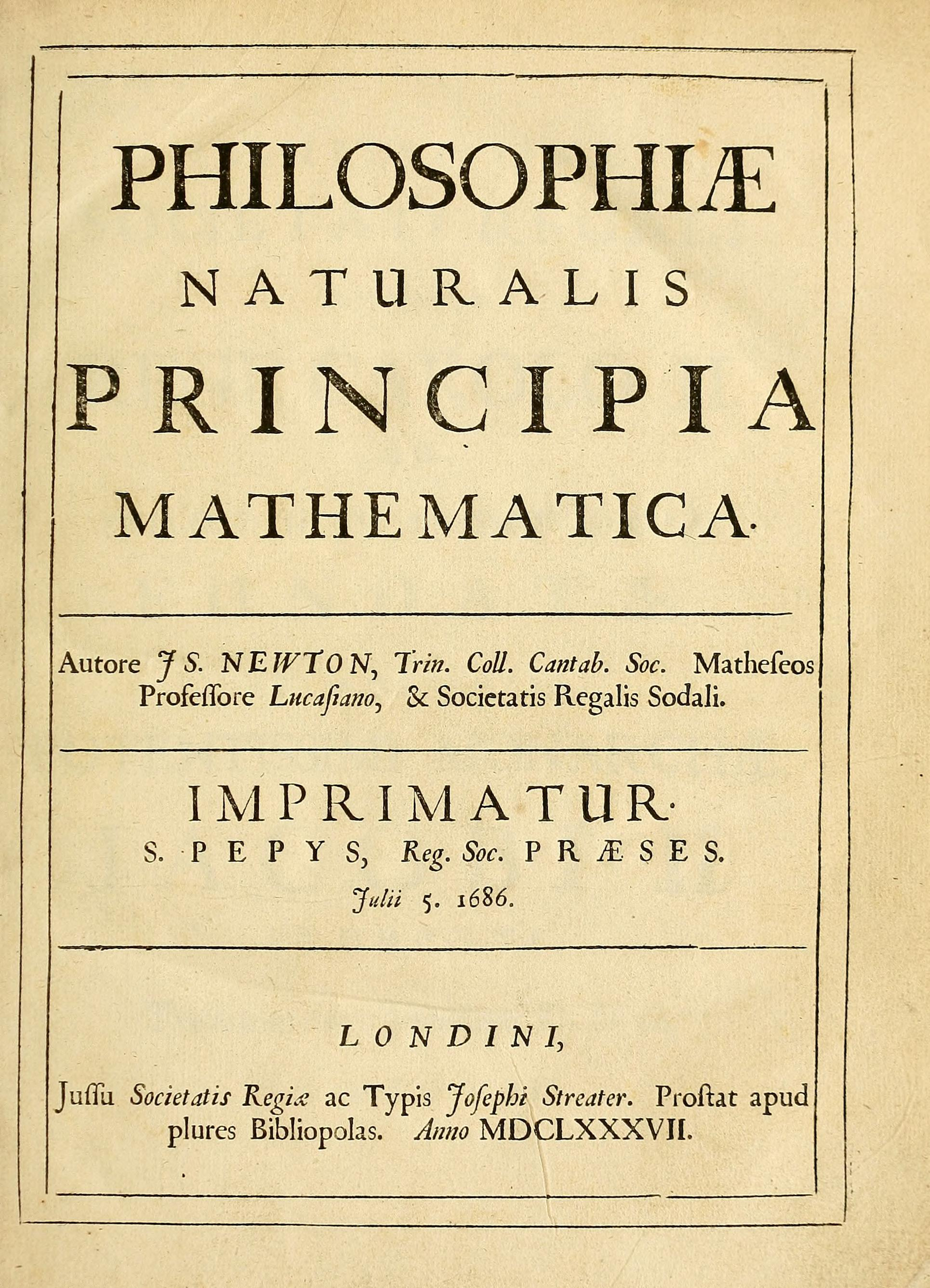


 The Renaissance Mathematicus