Tag Archives: Sant Pere de Rodes

The Three Orders’ Houses: a model on the ground

Somehow I was out doing things yesterday and forgot to write a blog post, sorry, but for once I do have time in the week, so I will make it up now.

The yard at Embsay station on 27th June 2021

What your blogger was looking at yesterday instead of his computer

Here is something about as delayed as even my various crazy backlogs can make something. This was prompted by reading something in the British Library in 2012, back when we could do that thing, and in my notes on it I even then made a note to blog about it; but I didn’t in the end process those notes until late 2017. At that point I laid down a stub to complete later, and now, four years on, here we go. All of this is ironic, because in 2012 I was for once reading something pretty new from Catalonia, an intriguing piece of settlement archaeology discussion by the medieval archaeologist to whom perhaps I owe the most favours in the world, Professora Imma Ollich i Castanyer, about the Catalan monastery of Sant Pere de Rodes.1

Monastery of Sant Pere de Rodes

Sant Pere de Rodes from its most impressive side, which is to say, the one that’s mostly there; image by Pixel – own work, Public Domain, via Wikimedia Commons

Now, that is an inaccurate over-simplification that I should immediately correct. The article, like much of Professor Ollich’s work, is mostly about my favourite study area, the comarc of Osona, and it is a fairly major argument with a basic paradigm of the social history of the tenth and eleventh centuries. This holds that, however you like to explain it, rural settlement in Catalonia was mostly dispersed and only loosely territorialised in the tenth century but by the end of the eleventh had nucleated into reasonably-defined villages. The favourite explanation hitherto has been feudalism, of course, working either through violence compelling people to group together for safety or through aggressive lordship pressing people together to intensify their farming, around either churches or castles depending on the agency, and no, neither of those are completely logical chains of events as I’ve laid them out but for some people they make sense, even now the proponents of those ideas are dead.2 This process is usually referred to as incastellamento, as coined by Pierre Toubert who first observed it in Lazio, is not yet dead and has in recent years suggested that he was probably partly wrong, or encellulement, as coined by Robert Fossier so as to get away from a dependence on castles, and it has been very widely played with, debated, contested and challenged, at least outside Catalonia.3

But this is the scenario on which Professor Ollich’s observations land like a series of well-mannered munitions. She argues that, once you have a decent picture of this area’s, and therefore quite possibly any nearby area’s, settlement patterns, it’s way more diverse than just dispersed or nucleated. She winds up developing a typology that has seven categories, including settlements around churches, settlements around castles, settlements with both (like Tona, where I have of course been and been photographed) and settlements around neither, the first three of which can be split into ones where the settlement predated the supposed focal point or points and ones where it didn’t. Only two or three of these seven types conform to the dominant paradigm, so even if it turns out still to have been numerically dominant, which Professor Ollich doesn’t think it was in Osona, that paradigm at least needs to give up some room to alternatives. It’s one of those arguments that makes such clear sense that once you’ve read it it’s hard to go back, and is a welcome attempt to provide something in place of the theory one’s out to demolish.

Sant Andreu de Tona and the Castell de Tona

Sant Andreu de Tona and the Castell de Tona, as made a tiny bit more famous by my book

But, despite its importance, that isn’t the thing that I thought, nine years ago, I should blog about. That was Professor Ollich’s final example, which is, as promised, Sant Pere de Rodes, out in coastal Empúries way to the north-east. She picks on Sant Pere because it gives her several of her types of settlement in close proximity and shows how an obvious focal point doesn’t necessarily do what the paradigm expects to settlement development. The monastery was first here, and its tangled history is more than we can go into here; suffice to say that there is an argument about whether, as its documents claim, it was founded in a wasteland location or if it was deliberately sited on Roman remains instead, and of course it could probably be both and curious treasures have allegedly been found there that might provide more esoteric explanations and we could go on. But right now I shan’t; you just need to know that in the ninth century someone started a monastery there, in the tenth century some of the local counts decided to make it their pet monastery and by the eleventh century it was, as they say ‘kind of a big deal’.4 But it didn’t ever pull a village round itself. Instead, a village that was almost certainly related grew up somewhere quite close by, at Santa Creu. It was then fortified in the eleventh century, so looks like an independent effort, but its major market and lord must still have been the monastery. Furthermore, there was also a local castle, eventually, at Verders, and that had its own church so could in theory also have gone it alone. But because they were all here they perhaps prevented each other from becoming the major force in the locality. The Google Map below sows them in relation to each other. In the end, the monastery, the oldest, was also the longest lasting, but then it was also way rich, at least for a while, so perhaps that isn’t surprising.

Now, apart from the neat demonstration that the basic model just isn’t complex enough to handle the actual variation of human activity, and the encouraging thought that nonetheless we might still be able to build an adequate one (this is a big mantra of mine these days), the obvious thing that struck me here is that it’s a settlement archaeology demonstration of that old eleventh-century trope about medieval society being divided into three orders, those who fight, those who work and those who pray. Because, look, here’s where they all lived: a castle, a village and a monastery! It should have been the perfect arrangement, at least for someone like Adalbero of Laon. As it is, I imagine they actually disputed with each other like cats and dogs, and that our records would (if Sant Pere’s charters hadn’t mostly been lost) show that the Church mostly won even if it actually didn’t, but the point is, here they all are, almost as if it was real. That is very definitely not the theory Professor Ollich set out to address, and I don’t mean to make any claim that my observation actually, you know, means anything, but once I’d thought it I had to say it, even if I do so nine years (and one day) late…


1. Imma Ollich i Castanyer, “Arqueologia de la Catalunya feudal i prefeudal: Poblament i territori. El model teòric de la Comarca d’Osona” in Jordi Bolòs (ed.), La caracterització del paisatge històric, Territori i societat: el paisatge històric. Història, arqueologia, documentació 5 (Lleida 2010), pp. 399–465.

2. The most obvious progenitors of this idea locally would be Manuel Riu, “Hipòtesi entorn dels orígens del feudalisme a Catalunya” in Quaderns d’Estudis Medievals Vol. 2 (Barcelona 1981), pp. 195–208, and, of course, Pierre Bonnassie, La Catalogne du milieu du Xe à la fin du XIe siècle : Croissance et mutations d’une société, Publications de l’Université de Toulouse-Le Mirail, Sèrie A, 23 & 29 (Toulouse 1975-1976), 2 vols. A fairly recent acceptance of it can be found in Juan Antonio Quirós Castillo, “Early and High Medieval ‘Incastellamento’ in Northern Iberia: Fortified Settlements in the Basque Country and Upper Ebro Valley (9th–12th Centuries)” in Neil Christie and Hajnalka Herold (edd.), Fortified Settlements in Early Medieval Europe: defended communities of the 8th-10th centuries (Oxford 2016), pp. 192–204.

3. Some later takes on the idea, led indeed by Toubert, in Miguel Barceló and Pierre Toubert (edd.), L’incastellamento: actes des recontres de Gérone (26-27 novembre 1992) et de Rome (5-7 mai 1994), Collection de l’École française de Rome 241 (Rome 1998); Toubert’s most recent re-evaluation in “L’incastellamento: Problèmes de définition et d’actualisation du concept” in Sandra Pujadas i Mitjà (ed.), Actes del Congrés Els Castells Medievals a la Mediterrània Nord-Occidental celebrat a Arbúcies, els dies 5, 6, i 7 de març de 2003 (La Gabella 2003), pp. 21–35. For Fossier still doing his thing, see Robert Fossier, “The Rural Economy and Demographic Growth” in David Luscombe and Jonathan Riley-Smith (edd.), The New Cambridge Medieval History, volume IV, c. 1024–c. 1198 (Cambridge 2004), 2 vols, I, pp. 11–46. More recent demolition efforts in †Riccardo Francovich, “The Beginnings of Hilltop Villages in Early Medieval Tuscany” in Jennifer R. Davis and Michael McCormick (edd.), The long morning of medieval Europe: new directions in early medieval studies (Aldershot 2008), pp. 55–82.

4. For the monastery’s early history, at least, see Montserrat Mataró i Pladelasala and Eduard Riu-Barrera, “Sant Pere de Rodes: un monasterio condal en la periferia del extinguido imperio carolingia (siglos X y XI)” in Jordi Camps (ed.), Cataluña en la época carolingia: arte y cultura antes del románico (siglos IX y X): 16 diciembre 1999 – 27 febrero 2000, Museu Nacional d’Art de Catalunya, Palau Nacional-Parc de Montjuïc (Barcelona 1999), pp. 236–242, transl. as “Sant Pere de Rodes: a large monastery under the countship on the edge of the Carolingian empire (10th – 11th centuries)”, ibid., pp. 536-539.

Revenge served stone cold? The Santa Maria de Roses inscription

For a brief flickering moment, back to the research. Trying to make things play with the altar slab from Sant Pere de Casserres and all its names has meant following up a lot of similar lumps of marble (and in one case wood) in the hope that they will tell me more about what people were scribbling on altars where and when. In this, advice from Mark Handley has been invaluable and I’d like to thank him for that. An answer of sorts has emerged, and will be in the paper some day when, but for the meantime one of these examples presents a probably insoluble query. But these days, that just means it presents a blog-post, right? So here it is.

The church of Santa Maria de Ciutadella, previously the abbey church of Santa Maria de Roses (from Rosespèdia)

The church of Santa Maria de Ciutadella, previously the abbey church of Santa Maria de Roses (from Rosespèdia)

There is not so much left these days of the monastery of Santa Maria de Roses (although Rosespèdia, the excellent community Wiki from which I borrow the above image demonstrates that the church will still hold a concert). It was probably never that huge, although it lasted a long time, till 1592. We first find it mentioned for sure in 944, when it was being handed into the middle of a clanging dispute over the monastery of Sant Pere de Rodes (not Roses).1 Roses was allotted to Rodes (stay with me) but that didn’t help much as Rodes was itself being claimed by Sant Esteve de Banyoles. It was another four years before all the relevant counts could be brought to agreement and Rodes was allowed to be independent.2 But by 960 Santa Maria de Roses was a monastery in its own right (the 944 document calls it a cella) and so it thereafter stayed, Sant Pere de Rodes not withstanding.

Map of the Catalan counties c.950, by Philip Judge and Jonathan Jarrett

Map of the Catalan counties c.950, by Philip Judge and myself, from the book

But this isn’t yet complicated enough. It’s complicated because of where all these places are. Sant Pere de Rodes—which is one of the most gorgeous ruins in Catalonia— was then in the county of Empúries, ruled by one Count Gauzfred along with Rosselló (now Roussillon, in modern France). But Sant Esteve de Banyoles is in Girona, which was ruled in 944 by Count-Marquis Sunyer of Barcelona, Girona and Osona. By the time of the final settlement Sunyer had retired to the monastery of Notre Dame de la Grasse, far to the north in Carcassonne, and his rôle had been taken over by the probably-teenaged Borrell II (natch) and his brother Miró, though Miró, even younger, appears to have played no part in this affair and Sunyer, monk or not, still appears as one of the negotiators in the 948 document. So the dispute between the monasteries is also one about whether the counts of Girona get a dependent church deep in Gauzfred’s territory or not. Where is Santa Maria de Roses in all this, you may ask, and you may then understand Gauzfred’s concern better if you know that Roses is just along the sea-shore from Empúries, Gauzfred’s capital, which the church overlooks. This was presumably not property that he wanted going to someone whom the counts next door could boss around.

Reassembled fragments of the dedicatory inscription from Santa Maria de Roses

Reassembled fragments of the dedicatory inscription from Santa Maria de Roses

All this makes this thing, which was recovered from the site in 1937 and is now in the Museu Nacional d’Art de Catalunya’s premises in Sant Pere Galligants in Girona, rather hard to explain.3 The inscription transliterates, expands and translates more or less as follows (Latin in the footnote):

The famous Count Sunyer, choosing celibacy and spurning life for the love of Christ, trading perishable things for an eternal body, for his burial ordered the church to be repaired from the foundations by his wife and sons. They, studiously following the precepts, managed to fulfil them, instituting a suitable worthy man for the ministry of Christ, Argibadus, namely, a priest and perfector of these works. By order therefore of the spirit of Prince Sunyer, I who am called Argibadus finished this work.4

Right, so, what? When this was put up, apparently the church needed repairs; there is no sign that it was monastic or that it belonged to someone else. These ought all to be good reasons to make this an early early record, from before its acquisition by Sant Pere de Rodes, and you might think that it naming Count Sunyer makes that a problem. In fact, however, though Sunyer of Barcelona seems to have made the name unpopular, it had previously been a common one among the counts of Empúries: Gauzfred had a short-lived brother of the name, his grandfather of the name had ruled fifty years in Empúries (something this family seem to have been good at was living for ages, little Sunyer aside) and supposedly forced Guifré the Hairy into acknowledging King Odo by putting up rival episcopal candidates with Odo’s consent, and his father, also Sunyer, had waged naval war on al-Andalus and been killed by Bernard of Septimania’s son William, who had by then ceased listening to his mother.5 It’s a proud lineage. The only wrinkle is the obvious implication of the inscription that the relevant Sunyer became a monk, which is not recorded of any of these Sunyers, only the one of Barcelona.6 But if he had been, as he had, Count of Barcelona, why was he not buried in his own territories, or more relevantly, at la Grasse, where he presumably died?

If you zoom in on the centre, the monastery site is flagged, but note Castelló d'Empúries just down the coast (and ignore the modern marina development between the two)

Well, the easiest solution seems to be that one of the counts of Empúries had a late and otherwise unattested conversion, really, doesn’t it? Not only is, in my fairly untutored opinion, this stone’s script earlier than Sunyer of Barcelona (compare his elder brother’s stone from 911, which might be nearer the mark), but there is the problem of the intermittent and intermittently subject monastic cell to explain otherwise and I simply cannot imagine Gauzfred allowing his principal rival to be buried over-looking him and his city.7 And it is very clear that Gauzfred controlled the whole site by 976, if not well before, and was claiming to have repopulated it from scratch after it was desolated by the pagans, which is chronologically very unlikely and which this stone more or less proves false, but which indicates a fair degree of control.8 But might it also indicate an alternative story that needed to be squashed? There was after all a dispute over this house that involved all our parties. Could our one known monastic Sunyer actually have managed to be buried in his rival’s back yard, by way of having the last word after being forced to back down? I can’t, quite, credit it, but the sheer petty commitment to superiority it implies is quite impressive to imagine even if it can’t be true.


1. That document printed in Ramon d’Abadal i de Vinyals (ed.), Catalunya Carolíngia II: els diplomes carolingis a Catalunya, Memòries de la Secció Històrico-Arqueològica II & III (Barcelona 1926-1952), 2 vols, Sant Pere de Rodes I.

2. Ibid., Sant Pere de Rodes II.

3. I learnt about this from P. de Palol Salellas, “Una lápida medieval de Santa Maria de Rosas” in Analecta Sacra Tarraconensia Vol. 19 (Barcelona 1946), pp. 273-278, but in the web-searching for this post also came across the more recent Hug Palou i Miquel, “El temple de Santa Maria de Roses. Noves aportacions als primers documents” in Annals de l’Institut d’Estudis Empordanesos Vol. 24 (Empúries 1991), pp. 32-53; both of these include a facsimile and a transcription of the slab, and it’s the latter’s image I’ve borrowed here. The latter paper is online through Revistes d’ACcès Obert, here. In attempting to find this paper just now, moreover, I also found J.—M. Nolla, “Roses a l’antiguitat tardana. El cementiri de Santa Maria”, ibid. Vol. 30 (1997), pp. 107-146, which reveals that here as in so many places there was a late antique burial ground here before there was a church, but I haven’t yet had time to soak this one up.

4. Palou, “Temple de Santa Maria”, p. 58, expansions in round brackets, editorial insertions in square ones: “CELEB(RI)S COM(ES) SVNIARIVS CELIBE(M) / ELIGENS VITA(M) SP(ER)N[EN]Sq(VE) XP(IST)I P(RO) AMORE CADVCA P(RO)PRIO / MERCATVS E(ST) CO[R]PORE EETERNA NA(M) SVO TV(MVLA)TV IVSSIT RE / PARARI A FVNDAMENTIS ECCL(ESI)A CONIVSq(VE) EI(VS) CV(M) / FILIIS EI(VS) SEqVENTES P(RE)CEPTA STVDIOSE HOC ADIMPLE / RE CVRAVERV(NT) STATVENTES QVE(N)DA(M) P(RO)bV(M) DIGNVMq(VE) XP(IST)I / MINISTRV(M) ARGIBADV(M) VIDELICET SACER(DOS) ET / [OPER]IIS HVIVS P(ER)FECTOR • IVSSV IGITVR / SVNIARII PRINCIPIS ALMI QVI VOCOR • / HOC OPVS EXPLEVIT ARGIBADVS“.

5. The ecclesiastical controversies covered to a good extent in J. Morera Sabater, “Un conato de secesión eclesiástica en la marca hispánica en el siglo IX” in Anales del Instituto de Estudios Gerundenses Vol. 15 (Girona 1962), pp. 293-315 and now J. Jarrett, “Archbishop Ató of Osona: false metropolitans on the Marca Hispanica” in Archiv für Diplomatik Vol. 56 (München 2010), pp. 1-41 at pp. 9-12; for Sunyer II’s naval career you would probably need to go back to Ramon d’Abadal i de Vinyals, Els primers comtes catalans, Biografies Catalanes: sèrie històrica 1 (Barcelona 1958; 1980). The genealogies of all this lot are more or less sorted out by Martin Aurell, “Jalons pour une enquête sur les stratégies matrimoniales des comtes catalans (IXe-XIe s.)” in Federico Udina i Martorell (ed.), Symposium Internacional sobre els Orígens de Catalunya (segles VIII-XI) (Barcelona 1991-1992), also published as Memorias de le Real Academia de Buenas Letras de Barcelona Vols. 23 & 24 (Barcelona 1991 & 1992), I pp. 281-364.

6. In Federico Udina Martorell, El Archivo Condal de Barcelona en los Siglos IX-X: estudio crítico de sus fondos, Textos 18 (Madrid 1951), doc. no. 148, about which you have heard before, as well as in a welter of forged la Grasse documents that are much too tricky to go into here. It should however be noted that it is only those documents which tell us where Sunyer became a monk.

7. I’m pleased to see that the same has also apparently occurred to our quasi-resident sage of the databases, Joan Vilaseca, whose Cathalaunia.org page for this inscription tentatively suggests a redating after 913, after Antoni Cobos Fajardo, Joaquim Tremoleda Trilla and Salvador Vega Ferrer, L’Epigrafia medieval dels comtats gironins (Girona 2009-2010) (non vidi) who suggest 909; as Joan says, Count Sunyer II was active till at least 913 so this cannot easily be right.

8. In Santiago Sobrequés i Vidal, Sebastià Riera i Viader & Manuel Rovira i Solà (edd.), Catalunya Carolíngia V: els comtats de Girona, Besalú, Empúries i Peralada, ed. Ramon Ordeig i Mata, Memòries de la Secció Històrico-Arqueològica LXI (Barcelona 2003), 2 vols, doc. no. 434, on which see J. Jarrett, “Caliph, King or Grandfather: strategies of legitimisation on the Spanish March in the reign of Lothar III” in The Mediaeval Journal Vol. 1 (Turnhout: Brepols forthcoming).

A certain sensitivity to the medieval, expressed by means of a bagful of links

One way I sometimes wind up writing a post is that I have two or three links that I see a common theme in. Because I tend to put things together over a while, these inevitably collect more links like fluff and not all of these fit the theme. The three extras this time do however pick up on old themes here. For a start, do you remember me posting something about Norse-Inuit contact in the Western Atlantic a while ago? A Canadian archæologist by the name of Patricia Sutherland had been set onto a search by some wool from circa 1300 found at Kimmirut on Baffin Island, and also come up with several other articles that she thinks can be called Norse. Some of these things later got displayed by the Smithsonian Museum, and now there is apparently more, a whalebone spade and drainage constructed in what Sutherland says is a Norse style, which would indicate some attempt at prolonged Viking occupation in what is now Canada, if she’s right. I evince caution because she seems to be a voice in the wilderness, and the article to which I’ve linked there shows that at least one other archæologist is reading the finds differently, as evidence that Western archæology just doesn’t rate the Dorset Inuit’s sophistication the way it should. I imagine the debate will continue, and more digging is afoot so it may even be resolved, but since I broached it here it seemed necessary to keep it up to date. Hat tip here to Melissa Snell at about.com.

Medieval wool recovered from Kimmirut site, carbon-dated to circa 1300

Medieval wool recovered from Kimmirut site, carbon-dated to circa 1300

The second piece was just a rather nice little piece of media antiquarianism. Would you like a digital copy of the original newspaper report of the discovery of the Anglo-Saxon royal burial at Sutton Hoo? The East Anglian Daily Times, who carried it, have put it online. Hat tip here to Sæsferd of Antiquarian’s Attic.

The original 1939 excavations of the Sutton Hoo boat burial

The original 1939 excavations of the Sutton Hoo boat burial

And the third is slightly gratuitous in as much as it’s more the period of bloggers such as, well, Ceirseach, than mine, but I hereby decree that it can never be gratuitous to feature a charter on A Corner of Tenth-Century Europe, especially a charter which has turned up somewhere rather unexpected, to wit, Brock University in Canada:

The Clopton Charter, Brock University

Donation by Robert Clopton to his son William, <i>c. </i>1216

This linked to the St Catharine’s Standard, which reports on the discovery (hat tip to News for Medievalists), where they say: “The best educated guess among faculty pegged it somewhere in the 15th century.” Well, I’m no palæographer for all I once passed a test in it but I do have a copy of Michelle Brown‘s A Guide to Western Historical Scripts from Antiquity to 1600 handy and it sure looks a lot like her sample of 13th-century cursiva anglicana to me, and indeed 1216 is the date that their examinations have settled on though I’m not going to pretend that I can read that off the JPEG myself. Still cool, though: as with the charter of Abbess Emma at Harvard or the one about Espinosa de Berguedà at Berkeley, some of this stuff has travelled a long long way. Seems to be in good shape considering…

The actual things I wanted to talk about, though, were four pieces all of which for various reasons made me quietly pleased that someone had done some genuine thinking on the basis of their knowledge of the Middle Ages, while about something where that wasn’t strictly necessary. One of these is that I have a new piece at Cliopatria talking about the two cultures and how odd it is, on a European scale, to have them. It’s not terribly surprising however that that would contain some medieval checkpoints, right? So, the oddest of these was a post at Strange Maps, in which a suggestion by Freddy Heineken, the guy who made Heineken lager a household name, that Europe would work better if its states were replaced with more equally-sized polities which punched a more equal democratic weight. It’s no more than an interesting exercise given the continuing disparity of the area’s resources, but it was slightly fascinating firstly for the breakdown of the population balances—I mean my goodness I live in a populous country compared to some—and secondly for the units he chose, apparently in collaboration with two unnamed historians. The Strange Maps crew say the new states would have had less historical baggage, but they should probably say not less, but older… Do have a look, you need their text too hence only thumbnail below.

heinekens_europe

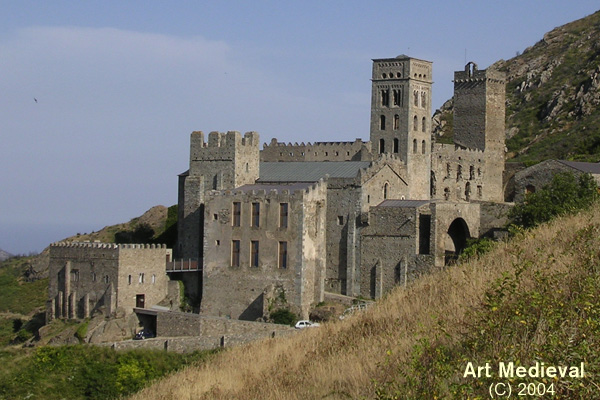
Then, I was reading a thing I downloaded more or less at whim about the Catalan monastery of Sant Pere de Rodes, which is as you see below rather splendid even now and is still a pilgrimage centre for the relics of Saint Peter that it claims to have. A few years ago the Generalitat de Catalunya put quite a chunk of money into education programmes around its historic sites, most of which are administered loosely by the Museu Hisòric de Catalunya, and one of the results has been a set of ‘Dossiers educatius’, the one for Sant Pere being here, and being written by Sònia Masmarti. Now Miss, Mrs, Dr or whatever Masmarti has or had a nice touch with the language, and although it might be slightly romantic, it is still very far from wrong to point out that:

The majority of people lived in small houses of mud and wood, and believed firmly in the supernatural powers with which the Church acted as intercessor. They would turn up at religious centres of pilgrimage with a blend of fear and hope, looking for consolation and the pardon of their sins, or indeed for the healing of their maladies. We can imagine the enormous impression that would have been produced in them by contemplating this marble portal, crossing it and entering into the magnificence of the temple, with its decorated furniture and pictures, now disappeared.

The translation is mine, because the original is in Catalan, but you get the idea.

The monastery of Sant Pere de Rodes, as it now stands (albeit mostly empty inside)

The monastery of Sant Pere de Rodes, as it now stands (albeit mostly empty inside)

Yup. That portal led to a different world in a whole range of senses, economic, cultural and theological. For all that people did easily move between the two worlds, we’re wise not to lose grip of the contrast between them.

The Regensburg fragment, a page of a twelfth-century litany of Irish saints

The Regensburg fragment, a page of a twelfth-century litany of Irish saints

And something similar seemed to strike me when I saw this, an article in the Irish Times about a fragment of a litany from the Schottenkloster, the Irish monastery, at Regensburg, the which fragment has now been bought by University College Cork. (Hat tip here to Larry Swain at The Heroic Age.) I don’t want to weigh in one way or another on the repatriation of artefacts; it doesn’t seem to me that there’s a good way to argue that that ‘belongs’ to Ireland and we should instead celebrate the fact that it can be shared by all. Pádraig Ó Riain has done some serious work on the text and brought out all kinds of ways in which it can show what bits of Ireland were feeding the Regensburg community with monks by the 12th century, when it seems to have been composed, but that wasn’t what struck me, what struck me was this:

Of course, it has immense significance as the only early medieval written record of the Irish community in Regensburg in its day, and of course it has much more to tell us than even both Ó Riains could cover in their initial lectures. But it was meant to be prayed. Following the seminar, it was at the Benedictine’s Glenstal Abbey in Co Limerick that the monks sang the litany at vespers, giving it its first ever liturgical recital in Ireland and possibly the first chanting of its verses since the 16th century.

I’m not a religious man but I find that attention to purpose and the sense of connection and duty involved in that very satisfying, both to hear of and to sort of understand.