
When I was facing my crise de confiance of the other week, one of the sillier causes was that I had processed a bunch of photos of the Foro Romano from when I was there in late 2017, and I couldn’t think of a point to posting any of them that I hadn’t made with the previous post, i. e. that we perceive ancient Rome via what the medieval (and subsequent) past chose to preserve and add to it. This has been very clear to me ever since I first saw a picture of the Foro di Nerva (I think in a paper by Chris Wickham?) with a ninth-century house’s foundations showing in it, and of course when I was actually there to see myself, it was still evident, in so far as anything is immediately evident in the thoroughly bewildering palimpsest that is the Roman fora.

A view down the Foro Romano from the Palatine Hill, by your author
But as I was absorbing all the kind comments last week, for which many thanks, like something stirring from the mud at the bottom of a pond once the sunlight has reached it, a hook for the post occurred to me, and so here we are. This post is about the Column of Phocas, which was installed in the name of that Byzantine emperor (or, as he clearly saw himself, Roman emperor) in the Foro Romano in 608 CE.1)
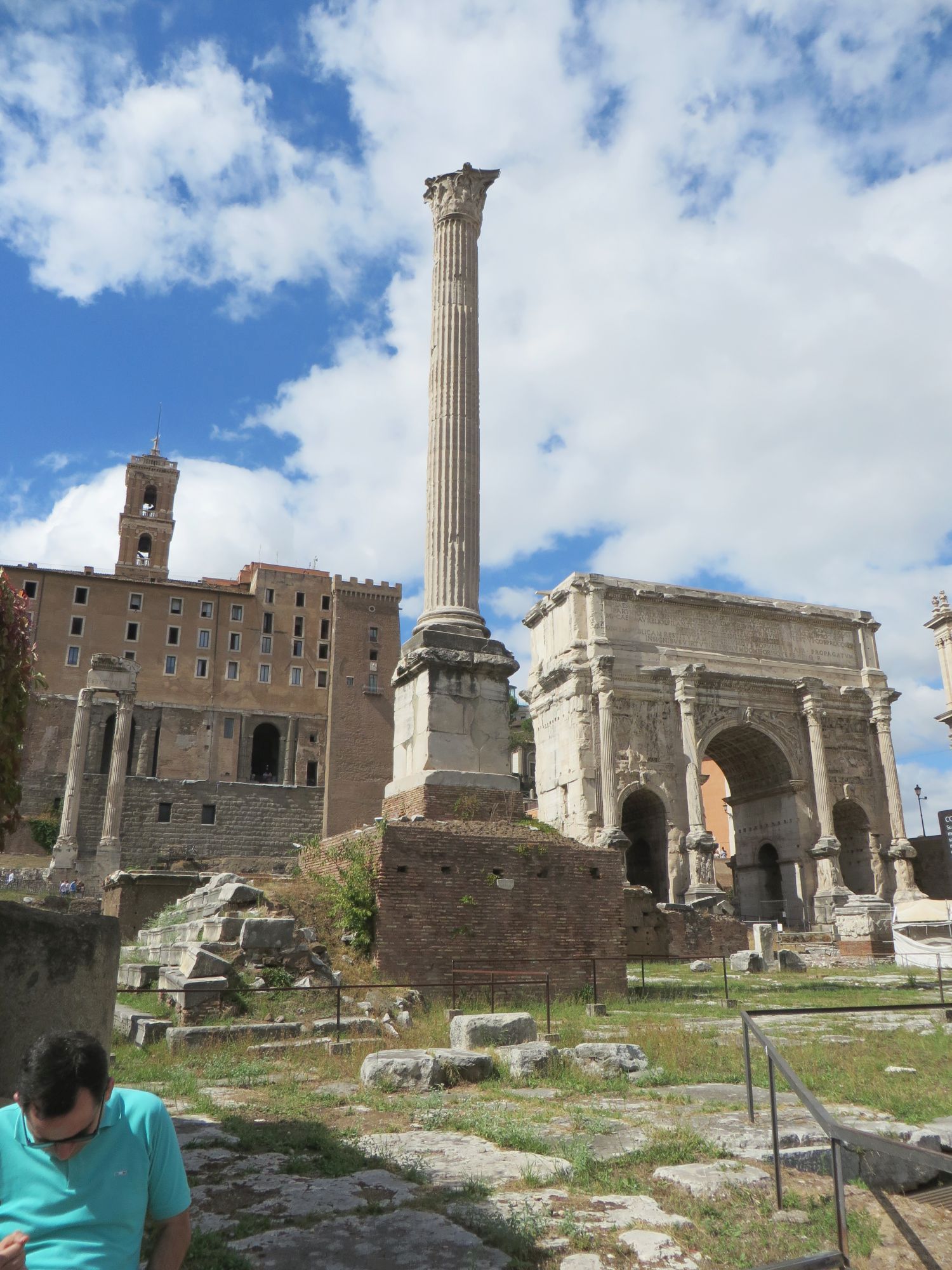
Yup, here it is, now minus the gilded statue of the eponymous emperor which apparently originally sat upon it and also the pyramid of steps by which it could still be approached in 1903
Phocas’s little offering here, which to his credit is still fairly visible, was the last piece of Roman imperial building in the Forum. We are now well past the time where the Roman emperors really had any role in Rome, you see. That time may really have ended in 476, when the last Western one who could access the city, Romulus Augustulus, was deposed (this is complex because there was also another candidate who could not, Julius Nepos; he died in 480); or it may have been earlier, really; it is, of course, as Phocas shows, a matter as much of someone wanting to do so as the emperors actually being able.2 But in any case, the role of patronage had kind of fallen to more local power-brokers since that point, such as the Ostrogothic king Theodoric (King of Italy for the Emperor 493-526 CE), much of whose monumental effort was nicked by Charlemagne in the early ninth century but some of whose modifications to the immense Palace of Domitian, which looms ruinously over the Forum to this day, are still identifiable.

The courtyard of the Domus Flavia, in the imperial palace complex on the Palatine Hill; according to the local signage its current state of remains is the one laid down by Theodoric
So the Column of Phocas is a real outlier. Its inscription makes it slightly less mysterious: it was not put up by order of the emperor, but in his honour, by the Exarch of Ravenna, Smaragdus, a man who owed his recall from exile and appointment to Phocas, or at least so says Wikipedia just now, though none of its indicated sources provide this information. This all makes a bit more sense if one understands that Ravenna, not Rome, had been the seat of imperial government in Italy since the early fifth century, and had been the base of this official, the exarch, for quite a lot of that time; he was supposed to be the ruler of Roman Italy on behalf of the emperor, a combined civil and military office which was supposed to make it easier to combat the encroachments of the Lombard kings and their warriors who had been pushing into Italy since 568.3 But this was, in general, working out better for Ravenna, secluded in marshland and on the near coast of Italy to the Byzantine Adriatic, than for inland and exposed Rome, and the people who were increasingly facing that reality were not really the exarchs, but the bishops of Rome, including especially famously this man, of whom we have heard on this blog before, Pope Gregory I (ruled 590-604).4

Ivory carving of Pope Gregory the Great being inspired by the Holy Spirit, now in the Kunsthistorisches Museum, Vienna, image by Vassil – own work, licensed under CC0 via Wikimedia Commons
Gregory I, also known as Gregory the Great, is renowned as one of the founding figures of the papacy and one of the very few early medieval popes about whom there is anything substantial written. As with all famous early medieval popes, that has a lot to do with the fact that only a very few’s letters survive, and perhaps unsurprisingly, they all have reputations for being vigorous reforming administrators, whereas the ones for whom we only have a short biography and maybe some building inscriptions are mostly forgotten or assumed to have been useless, which might not be entirely fair…5 In Gregory’s case, however, it’s a bit more than just letters that give this impression, as he also wrote some of the fundamental metatexts of Western Christianity, but it really is his letters that show him at full force (as I learnt in a different paper by Chris Wickham, which I don’t think I’ve yet blogged).6 Now, Gregory had complex relationships with the emperors. He was himself a native of the the city of Rome, and descended from senators, but had also spent some time in the imperial court at Constantinople as the papacy’s representative, under Phocas’s predecessor the emperor Maurice (ruled 578-602). During that time, Gregory was more or less unable to obtain Maurice’s help against the Lombards for Rome, and also got into a dispute over the appointment of Patriarch Eutychius of Constantinople, so it would be fair to say that he and Maurice did not see eye-to-eye. This only got worse when Gregory actually became pope. In the meantime, he had more or less taken over the civil administration of the city of Rome, as he saw it out of necessity and as the exarch saw it out of rebellious presumption, and was using the papal estates in Sicily to feed the city’s poor, thus more or less guaranteeing that in any contest between him and the exarch for their loyalty the citizens would line up behind the pope.7

It would be fair to say that now the Column doesn’t stand out much – you may be able to pick it out at the end here, next to the Arch of Septimius Severus – but it must have been even less visible among the buildings which still stood in 608.
Given all this, the fact that we have a monumental column being put up by the exarch in the name of the emperor in the absolute central imperial space in Rome soon after Gregory’s death may now seem a little more pointed. And I do suspect that this was what was going on. Wikipedia is almost certainly right to say (as it currently does):
Rather than a demonstration to mark papal gratitude as it is sometimes casually declared to be, the gilded statue on its column was more likely an emblem of the imperial sovereignty over Rome…
Of course, it wasn’t the same emperor by that time as had so offended Pope Gregory, and Gregory had indeed written very warm letters of congratulations to Phocas on his accession (the nature of which the pope was apparently able to ignore), but notice, all the same, that no column went up for Phocas under Gregory.8 In fact, though it was only four years after Gregory’s death when Smaragdus recycled various other monuments to make this one, that was already three popes, Sabinian (ruled 604-606), Boniface III (ruled 607) and Boniface IV (ruled 607-615), and Boniface IV had had to be bought off with the gift of the old and glorious temple of the Pantheon, which Boniface immediately converted into the church of Holy Mary and the Martyrs as it remains today.

The Pantheon from outside, as it now is (or was in autumn of 2017)
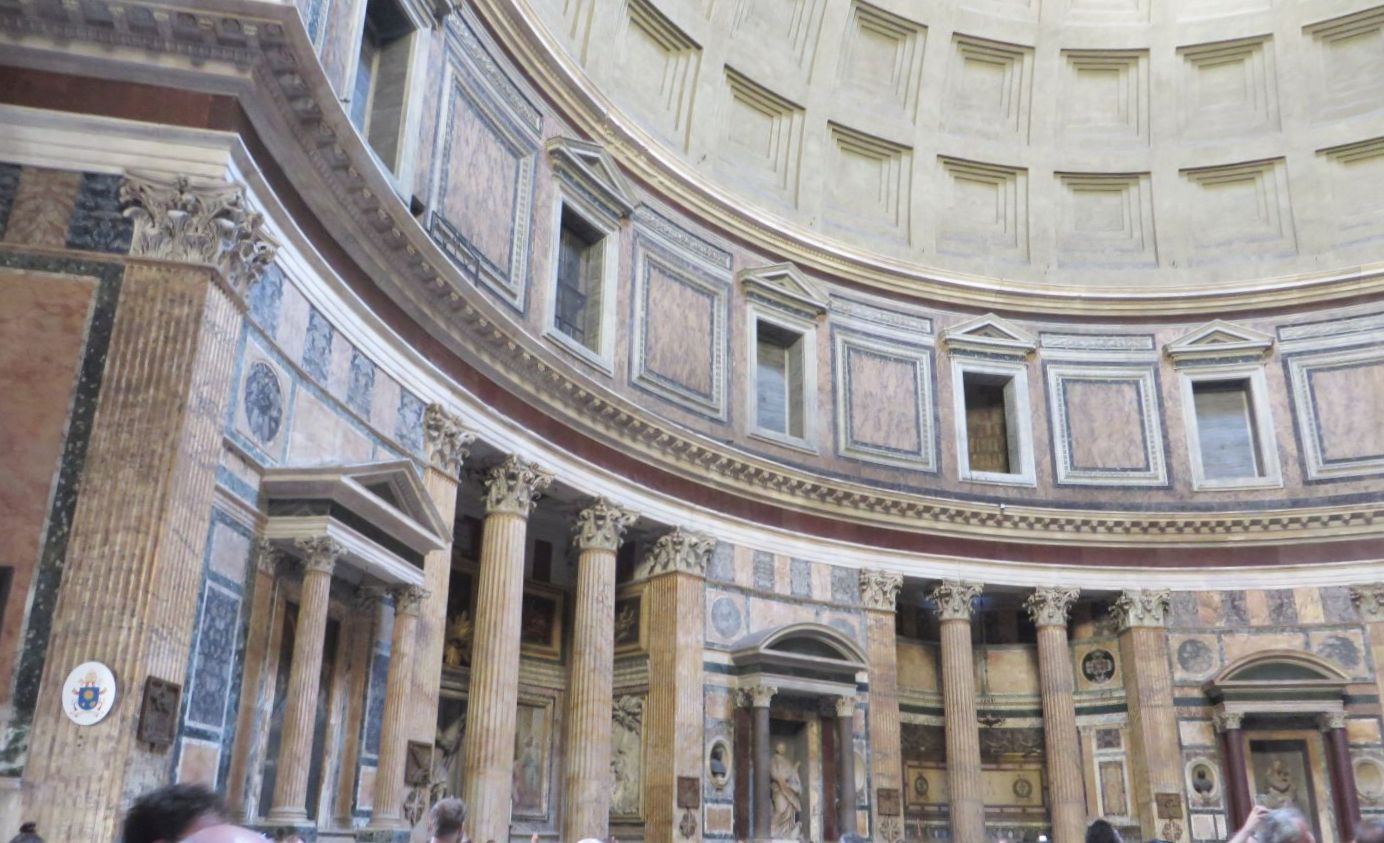
The interior of Holy Mary and the Martyrs needs some impossible wide-angle lens which I didn’t have to do it even partway justice. This is the only photo I took that gives any impression of the vertical space, and it’s still not right (albeit partly because of my cropping off tourist head level at the bottom)
So there are actually quite a few ways to read the Column of Phocas, and in the very little research I’ve done for this post I’ve been through several. It was, obviously, a statement of imperial involvement in the city of Rome once again, after really quite some attenuation. (It did ought to be said that Rome was still an imperial mint, as well, so the other such statement was the coinage, throughout this time, and that has to be put on the other side of the balance.) The Column may also have been an attempt by a slightly desperate imperial official to convince the people, after a decade of papal urban government and provision, that he had some power there, in the face of the recent evidence. And there are probably other ways to read it still. Either way, somehow it is still there, for the most part, and now really not very many people know who either Phocas or Smaragdus were and that this single monument represents about the last time the Roman emperors did something in Rome other than tax it or kidnap the pope to solve a theological dispute.9 But you are now among those people, so I hope it’s been a better way for you of displaying holiday photos than I otherwise had!
1. Ordinarily I would try to do better than this, sorry, but today because it’s late my main source for the actual Column is “Column of Phocas” in Wikipedia, online here.
2. We have discussed here before how the history of early medieval Rome is inadequately written, but some guide to the recent state of developments is to be found in Kate Cooper, Julia Hillner and Conrad Leyser, “Dark Age Rome: towards an interactive topography” in William Bowden, Adam Gutteridge and Carlos Machado (edd.), Social and Political Life in Late Antiquity, Late Antique Archaeology 3 (Leiden 2006), pp. 311–337.
3. For this the classic work is T. S. Brown, Gentlemen and Officers: Imperial Administration and Aristocratic Power in Byzantine Italy, A.D. 554-800 (London 1984).
4. Two good biographies are Jeffrey Richards, Consul of God: the life and times of Gregory the Great (London 1980) and R. A. Markus, Gregory the Great and his World (Cambridge 1997).
5. One sign of what can be done with even that kind of limited material is Caroline Goodson, The Rome of Pope Paschal I: papal power, urban renovation, church rebuilding and relic translation, 817-824, Cambridge Studies in Medieval Life and Thought 4th Series 77 (Cambridge 2010), but if there is another such for an earlier pope I don’t know about it.
6. The letters are available in translation, in full as The Letters of Gregory the Great, trans. John R. C. Martyn, Mediaeval Sources in Translation 40 (Toronto 2004), 3 vols, and in part online here.
7. Failing that paper of Chris Wickham’s, there’s Georg Jenal, “Gregor der Große und die Stadt Rom (590-604)” in Friedrich Prinz (ed.), Herrschaft und Kirche: Beiträge zur Entstehung und Wirkungsweise episkopaler und monastischen Organisationsformen, Monographien zur Geschichte des Mittelalters 33 (Stuttgart 1988), pp. 109–145, or relevant bits of Richards or Markus as in n. 4 above.
8. John R. C. Martyn, “Four Notes on the Registrum of Gregory the Great” in Parergon Vol. 19 (Perth 2002), pp. 5–38.
9. This happened more than once; see Judith Herrin, “Constantinople, Rome and the Franks in the Seventh and Eighth Centuries” in Jonathan Shepard and Simon Franklin (eds), Byzantine Diplomacy: papers from the Twenty-fourth Spring Symposium of Byzantine Studies, Cambridge, March 1990 (Aldershot 1992), pp. 91–107.


 A Corner of Tenth-Century Europe