Early Childhood Education

Week 5: Watercolours (52 Weeks of Provocations)

Provocation 5 : Watercolours

You can find more information about provocations here πŸ™‚

Provocation 5 - Introducing Paints - Adventures of a Subversive Reader

Background Information

We’ve played with watercolours before, but back before Squirm was walking. Now he is walking and he is a little taller, I was able to pull out an easel and allow Squirm to explore watercolours in a whole new way

Materials

  • Watercolour paints (from Big W)
  • A selection of brushes
  • Water and water container
  • Easel (from Ikea)
  • Big pieces of paper (Mine were left over from when I was teaching, but you can get great pieces of big paper from Storage places)
  • Table
  • Mirror
  • Various pencils and crayons

Set Up

At first I just set up the easel with the watercolours and water on the ground. This was successful, but meant that Squirm needed to do a lot of crouching and standing. The next day, I placed the easel next to the table and set up the watercolours, mirror, water and pencils and crayons on the table. This was much more successful. I gave Squirm a new piece of paper each time, though some had writing on the back from my classroom days. I made sure the watercolours were wet before Squirm began

Provocation 5 - Introducing Paints - Adventures of a Subversive Reader

Experiences

Squirm seemed to remember the watercolours from when we’d played with them before. To start with he stuck with his brushes, putting them in the paint and making long strokes on the paper. Some of the time he put the brush in water between colours, other times he didn’t. Later on he experimented with using a crayon to dip in the paint instead of a brush, and he tried some small twigs as well. He mostly kept his lines to one part of the page, though he would paint over my lines if I made any. On one of the days, he enjoyed the fact that he would use the water and the paint to make a hole in the paper.

Provocation 5 - Introducing Paints - Adventures of a Subversive Reader Provocation 5 - Introducing Paints - Adventures of a Subversive Reader Provocation 5 - Introducing Paints - Adventures of a Subversive Reader Provocation 5 - Introducing Paints - Adventures of a Subversive Reader

What Next?

Art, art and more art πŸ™‚ The easel was a massive hit, so I’m sure we’re going to use it for drawing, pasting, and painting with different types of paints. Squirm also seemed more receptive to art experiences – this has carried over into drawing which he does most days. There’s a wonderful post at How We Montessori with different art activities, which I’m definitely going to use for ideas.

Provocations are experiences offered to a child, based on past knowledge or interests, with the aim of extending the child’s ideas.

Our provocations present a small range of materials – some which are part of Squirm’s every day life, others which are new to him, or only known from other provocations. The aim is to present them in a thoughtful and (hopefully) attractive way, and to allow Squirm to investigate them in any manner he wishes. These provocations will remain in place for around a week, and then a new provocation will be presented.

Week 4: Foam Block (52 Weeks of Provocations)

You can find more information about provocations here πŸ™‚

Unfortunately we had some work done on our house which halted . . . well everything for a while. The disruption caused some problems both in the areas we could use, and with Squirm’s behaviour at the time. We seem to have everything slowly getting back to normal though, and I’m restarting the provocations – beginning with one we actually did during the disrupted period.

Provocation 4: Foam Block - Adventures of a Subversive Reader

Provocation 4 : Foam Block

Background Information

It started with a pin cushion left just in the reach of my ever growing Squirm. To my horror, I found him crouched on the floor, intently pulling out each one of my very sharp pins! Obviously, this was incredibly interesting to him, but in no way safe. But it got me thinking about what could we do to mimic the sensory experience of pulling pins out of a pin cushion. This was our (sometimes surprising) alternative.

Materials

  • Foam florists block (from the local discount store)
  • Golf tees (from the local discount store)
  • Platter for holding the block
  • Container for the tees
  • Splash mat (because we did it indoors)
  • Water

Set Up

We set this up on the floor of our kitchen on top of the splash mat. First I wet the block to make it less ‘flaky’ then pushed in the golf tees. I placed the block on an old platter I had (non breakable) and put it on the mat with the container.

Provocation 4: Foam Block - Adventures of a Subversive Reader

Experiences

Squirm LOVED this provocation. The tees and the block worked extremely well together and he enjoyed pulling the tees out (there’s a slight ‘pull’ before they come out), and pushing them back in. He also likes using the tees as tools on the foam – making holes and ‘carving’ paths and lines with them. He also enjoyed using his hands to push and pull at the block – demolishing a whole corner at one point. The tees continued to be a toy separate to the block as well – used for poking and prodding and tinkering.

Provocation 4: Foam Block - Adventures of a Subversive Reader Provocation 4: Foam Block - Adventures of a Subversive Reader Provocation 4: Foam Block - Adventures of a Subversive Reader Provocation 4: Foam Block - Adventures of a Subversive Reader Provocation 4: Foam Block - Adventures of a Subversive Reader

What Next?

The foam block made me think about using clay and the different experiences Squirm might be able to have with that. As we begin to move into more art based activities, I’m sure there’s be clay available to play with. I’d also like to use the golf tees again since Squirm really enjoyed manipulating them.

Provocations are experiences offered to a child, based on past knowledge or interests, with the aim of extending the child’s ideas.

Our provocations present a small range of materials – some which are part of Squirm’s every day life, others which are new to him, or only known from other provocations. The aim is to present them in a thoughtful and (hopefully) attractive way, and to allow Squirm to investigate them in any manner he wishes. These provocations will remain in place for around a week, and then a new provocation will be presented.

Week 3: A Collection of Stones (52 Weeks of Provocations)

You can find more information about provocations here πŸ™‚

Collection of Stones Provocation: Adventures of a Subversive Reader

Provocation 3 : A Collection of Stones

Background Information

I wanted to return to the stones which Squirm enjoyed so much in the first week, while introducing a few different types of stones. However, I thought I would also continue to use some of the excellent materials which worked so well in the second week. So this provocation kind of became a combination of the two. Plus we finally had a table to use!

Materials

  • Two stainless steel bowls (from KMart)
  • 6 large river stones (from the local discount store)
  • 6 large blue ‘glass’ stones (from the local discount store)
  • 6 large green ‘glass’ stones (from the local discount store)
  • water
  • Mirror (from the local discount store)
  • Table (from Ikea)
  • Plastic covering (from Big W)
  • Rug (from KMart)

Set Up

Because the table is a little tall for Squirm, I discovered the materials worked best if they were set up close to the edge of the table. I put the plastic covering on the table first (because we were working with water), then the rug on top. On one side of the rug, we had the bowl with the stones in it, on the other side a bowl with water, a mirror in between.

Collection of Stones Provocation: Adventures of a Subversive Reader Collection of Stones Provocation: Adventures of a Subversive Reader

Experiences

Squirm really enjoyed the feel of the ‘glass’ rocks, picking them up, turning them over in his hands, dropping them on the ground (to hear the sound) and trying to make them spin on the ground. He really enjoyed dropping them in the water, then tipping the water bowl (water everywhere!) to get them back again. He also spent a lot of time just playing with the water again. He continued his more cautious approach from last week, but also enjoyed tipping it over a bit at a time to see the water spill.

I was able to get a video of some of Squirm’s play (note, the cup was from last week’s provocation. He wouldn’t give it up πŸ™‚ )

Collection of Stones Provocation: Adventures of a Subversive Reader Collection of Stones Provocation: Adventures of a Subversive Reader Collection of Stones Provocation: Adventures of a Subversive Reader Collection of Stones Provocation: Adventures of a Subversive Reader Collection of Stones Provocation: Adventures of a Subversive Reader Collection of Stones Provocation: Adventures of a Subversive Reader Collection of Stones Provocation: Adventures of a Subversive Reader

What Next?

We’re going to give the rocks and water a little break for a while now, but I’ll be very interested in how Squirm approaches them when we pull them out in the future. I’d like to include some short sticks and even some blocks with the rocks, especially as Squirm gets more interested in stacking.

Collection of Stones Provocation: Adventures of a Subversive Reader Collection of Stones Provocation: Adventures of a Subversive Reader Collection of Stones Provocation: Adventures of a Subversive Reader Collection of Stones Provocation: Adventures of a Subversive Reader Collection of Stones Provocation: Adventures of a Subversive Reader Collection of Stones Provocation: Adventures of a Subversive Reader

Provocations are experiences offered to a child, based on past knowledge or interests, with the aim of extending the child’s ideas.

Our provocations present a small range of materials – some which are part of Squirm’s every day life, others which are new to him, or only known from other provocations. The aim is to present them in a thoughtful and (hopefully) attractive way, and to allow Squirm to investigate them in any manner he wishes. These provocations will remain in place for around a week, and then a new provocation will be presented.

Week 2: Water Play (52 Weeks of Provocations)

You can find more information about provocations here πŸ™‚

Water Play Provocation: Adventures of a Subversive Reader

Provocation 2 : Water Play

Background Information

At first I thought I would do a direct follow up to last week’s provocation. However, during the week, we noticed that Squirm was really interested in scooping up water and playing with it during bath time. We’ve slowly been introducing Squirm to cups and other drinking implements during meal times, so I thought this would be a good opportunity to extend the ideas he’d been playing with in the bath.

Materials

  • Two stainless steel bowls (from KMart)
  • A plastic mug and ‘glass’ (from KMart)
  • A small rug (from KMart)
  • A ‘tough’ mirror (from the hardware section of our local discount store)
  • Water

Set Up

At first I set this one up on the ground, with the mat laid down, two bowls of water next to each other, and the mirror, glass and mug in front. However, Squirm wasn’t great at moving around when sitting, so we moved it to the upturned crate. Although this made access easier for Squirm, it did make balancing things more precarious. I’m really glad I’ve bought a small table now!

The small rug was a wonderful way of ‘setting’ the activity – making it clear that this was something separate. It was also heavy enough that it didn’t move in the wind, and dried really well when hung up between play.


Water Play Provocation: Adventures of a Subversive Reader Water Play Provocation: Adventures of a Subversive Reader

Experiences

Squirm’s experience with the water was quite messy. His initial approach was to smack his hands into the water, resulting in some spectacular splashes and some of the times the water bowl would tip. As the week went on, I noticed that he approached the water more carefully – hitting it more softly or splashing only his fingers in it. He still played with tipping the bowl over, and enjoyed playing with the water that splashed on the ground.

When he’d emptied the water out of the bowl, Squirm enjoyed playing with the bowls themselves. They made a wonderful clatter when they were dropped on the concrete floor, and because the base was very rounded (with only a small flat bit) they wobbled and spun in a really enjoyable way. Squirm loved to tip one side, then release it, watching the way it would rock back and forward on its own.

Because he’d been scooping with a cup in the bath, I thought he’d do the same with the cup and mug here. However, he was less interested in that than playing with the cup and mug themselves. He loved the sound of them dropping on the concrete, but also the ways they would move – the cup would roll in wide circles, while the mug was stopped by the handle. He did drop them in water occasionally, but didn’t pick any water up with the cups.

Water Play Provocation: Adventures of a Subversive Reader Water Play Provocation: Adventures of a Subversive Reader Water Play Provocation: Adventures of a Subversive Reader

What Next?

I’m definitely going to continue to offer provocations with water to Squirm – he is endlessly fascinated by it and the way it moved – plus it’s easy to play with, especially as it heats up. I’m also going to keep using the mat, which really defined the working area, and the stainless steel bowls, which were just so nice to look at and manipulate. I may offer another provocation using the cups in the future, but without any kind of preconceptions next time!

Water Play Provocation: Adventures of a Subversive Reader Water Play Provocation: Adventures of a Subversive Reader Water Play Provocation: Adventures of a Subversive Reader Water Play Provocation: Adventures of a Subversive Reader Water Play Provocation: Adventures of a Subversive Reader Water Play Provocation: Adventures of a Subversive Reader

Provocations are experiences offered to a child, based on past knowledge or interests, with the aim of extending the child’s ideas.

Our provocations present a small range of materials – some which are part of Squirm’s every day life, others which are new to him, or only known from other provocations. The aim is to present them in a thoughtful and (hopefully) attractive way, and to allow Squirm to investigate them in any manner he wishes. These provocations will remain in place for around a week, and then a new provocation will be presented.

Week 1: Stones and Water (52 Weeks of Provocations)

Welcome to the first of my posts about the provocations I offer Squirm. You can find more information about provocations here πŸ™‚

Rock and Water Provocation: Adventures of a Subversive Reader

Provocation 1 : Stones and Water

Background Information

We’ve noticed that Squirm is very interested in the way things feel. He likes to pick things up, likes to thoroughly examine them. He’s also a big fan of water. I wanted his first provocation to have some familiar objects, but offered together in a way they hadn’t been available to him before.

Materials

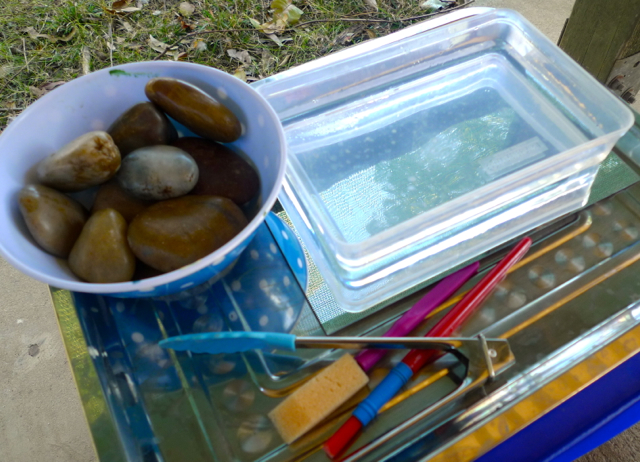
  • Β 12 river stones (from discount store)
  • Water
  • 2 paint brushes (part of a pack from Woolworths)
  • Small tongs (from Spotlight)
  • Hard plastic bowl (from discount store)
  • Plastic container (from discount store)
  • Silver tray (from discount store)
  • Mirror

Set Up

I placed the stones into the bowl and placed it next to the container of water. These were both offered on the tray, along with the mirror, the brushes and the tongs. (All of these were presented on an upturned crate-style box – I’m hoping to get a small table soon)

Rock and Water Provocation: Adventures of a Subversive Reader

Experiences

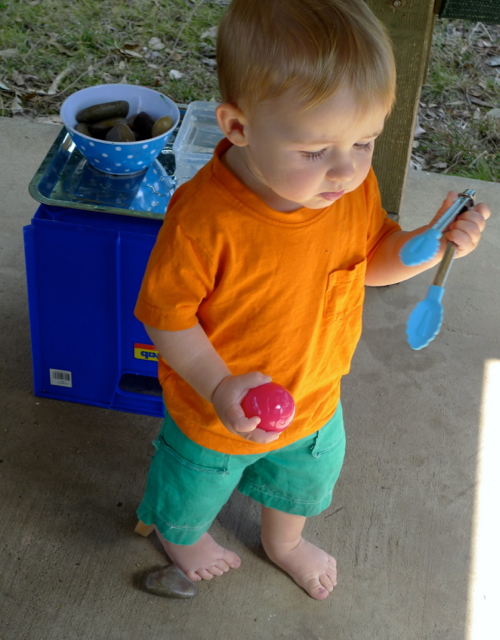
I was amazed at the huge range of activities Squirm explored with this provocation, very few of which I had expected. He spent a fair amount of time picking the stones up and dropping them into the water – which was probably closest to what I expected – but there were many other things he discovered while playing.

Most of the play was with individual items. Although he had been exposed to all these items before, this was the first time he’d really explored them – probably because it was the first time they were available constantly and in an uncrowded way. The stones were probably his favourite things – he spent a lot of time picking them up and moving them around, but he also explored the way they sounded (dropping them on different surfaces, banging them together) and the way they moved (his favourite thing was getting them to spin on the cement floor).

Sound was a common theme throughout the week – Squirm also used the brushes and the tongs to bit against different surfaces and objects, exploring the different sounds he could make. He spent a significant amount of time with the tongs, working out how to squeeze them together (though he doesn’t yet have the strength to carry things with them).

There was also a significant amount of water play. Squirm’s favourite thing was hitting the water, although he wasn’t always thrilled to be splashed by it. He also enjoyed tipping it up and examining the way it moved on the tray or the concrete.

Rock and Water Provocation: Adventures of a Subversive Reader Rock and Water Provocation: Adventures of a Subversive Reader

What Next?

Although I’m not immediately offering a similar provocation, there are a number of ways I can see this provocation being extended and changed. We could offer alternatives to the stones, or offer different materials as well as them. We could also replace the water with something different. Squirm really enjoyed this, so I can definitely see us revisiting something similar in the future.

Rock and Water Provocation: Adventures of a Subversive Reader Rock and Water Provocation: Adventures of a Subversive Reader Rock and Water Provocation: Adventures of a Subversive Reader

Provocations are experiences offered to a child, based on past knowledge or interests, with the aim of extending the child’s ideas.

Our provocations present a small range of materials – some which are part of Squirm’s every day life, others which are new to him, or only known from other provocations. The aim is to present them in a thoughtful and (hopefully) attractive way, and to allow Squirm to investigate them in any manner he wishes. These provocations will remain in place for around a week, and then a new provocation will be presented.

Contemplating Reggio and Provocations: 52 Weeks of Provocations

52 Weeks of Provocation: Adventures of a Subversive Reader

When I wrote up our trip to Ipswich Art GalleryΒ the other day, I mentioned that I’ve been spending a lot of time learning about the educational history and philosophy of the Reggio Emilia approach. This is an absolutely HUGE topic, with an amazing background, but there are some elements which consistently stand out to me.

One of these is the understanding that children are capable, that they are interested in the world and that they can construct their own learning. Often this is demonstrated through the use of projects, initiated by the children and mentored by the adults working with them. Other times children are given a chance to explore through provocations.

Provocations: deliberate and thoughtful decisions made by the teacher to extend the ideas of the children.Journey Into Early Childhood

There’s some wonderful things being written about provocations out there – one of my very favourites is from An Everyday Story (go check out the whole wonderful blog) which talks through how to set up a Reggio-inspired activity. You can also find more information here and here. But although I’ve seen gorgeous provocations for older children, I’ve seen less for children around Squirm’s age (12 months).

So, once again, I turn back to An Everyday Story to think about provocations for Squirm – there’s my guiding principal, right at the top of the Activity page – “What have they been wondering about?”

Squirm is pre verbal, so working out his wonderings is based entirely on observation. And when I started observing, I started noticing a lot! Squirm in interested in so many things, meaning that there are many, many provocations I could set up for him to enjoy.

And there’s my plan – to aim to set up a provocation each week, adjusting them and building on them as Squirm explores. As each week draws to a close, I hope to blog about them, to share the explorations, wonderings and learning that come out of them. I have no doubt that some weeks will be more successful than others, but I’m also mindful that the provocations won’t always be Big Things – that sometimes they’ll be a walk to a new place, or a slight change in a successful provocation from before. And finally, it’s important to me that these provocations are open ended, that they encourage a sense of wonder and fun, that they don’t become overly structured or prescriptive.
I think it will be a challenge. But I also think it will be a lot of fun. I’m really looking forward to learning more about Squirm and the world over the next 52 weeks πŸ™‚

Learning About Learning: Where are we now?

Learning about Learning: Adventures of a Subversive Reader

For a long time now, one of my interests has been educational philosophies. Obviously this isn’t terribly interesting to most people, and there are probably some who feel that time could be better spent learning about eyebrow shaping or penguin wrangling (my eyebrows are awful and Sea World keeps a close eye on their penguins whenever I’m nearby), but it’s something that really fascinates me – especially how we can create the best learning experiences for children.

Obviously this was useful to me when I was a teacher. I was able to implement changes in the way my classroom was set up, the way I worked with students, the types of lessons we had, even some of the topics we approached, thanks to the reading I did. But since Squirm’s birth, I’ve become more and more interested in Early Childhood learning and learning environments. I worked, primarily, with middle and upper primary, then lower secondary students, so learning about early childhood is a totally new ball game for me. I have been fortunate, though, that I have some brilliant early childhood/lower primary school teachers as very good friends, who have shown me just how good early childhood teaching can be.

One thing which deeply worries me is the pressure for younger students to be doing more academically. There are schools in my area who won’t take students into Prep unless they can write their full names – not nicknames, which might be easier for 4 or 5 year olds to write, but their full names. There’s an awful lot of pressure on children to be reading and writing by the end of Prep, so they don’t ‘fall behind’, so they’re ready for Year Three when the NAPLAN testing begins.

As this pressure moves further down – from Prep to Kindergartens which now have to incorporate phonics lessons into their program – it’s not hard to see the pressure moving further down again. If Kindergarten aged children (4 and 5 year olds) need to be able to sit still and learn sounds, then we’d better make sure that 3 and 4 year olds know what the alphabet looks like. And if 3 and 4 year olds need to know what the alphabet looks like, we’d better make sure that 2 and 3 year olds can sing the alphabet song. Suddenly early childhood learning becomes less about about discovery and invention, and more about making sure we tick all the academic boxes. And I don’t think this is coming from the educators – it’s hard to miss the pressure being applied from politicians and ‘experts’ who believe that atandardised testing is the cure-all for all educational woes (or the companies making money from them).

The focus and pressure on Standardised testing has worried me for a long time now. This is actually the first year I haven’t ‘done’ NAPLAN since it began – I’ve always had Year 5 or Year 7 classes, so I’ve had a lot of experience with it. I must admit, I’ve been able to use class results to highlight areas where I could improve my teaching, though I’m sure a low-stakes test would have given me the same information. But instead of low stakes and low pressure testing, we’ve continued to push our students through testing which has left them in tears (the break between maths tests for Year 7s was almost always guaranteed to have tears), left them physically ill, left them not wanting to come to school, made them feel cynical and tired of learning (in 2011, my students started to refer to NAPLAN as ‘That which must not be named’ to avoid the NAPLAN saturation which had overtaken the school) and then, given parents almost no information about how their child has actually performed. The tests are heavily bell curved, meaning that only so many students can achieve the top levels, and parents are left with little more than a dot on a line.

So how do we prevent this NAPLAN mania, this drive for ‘academic achievement’ from moving further and further down to our youngest children? Should we just ‘suck it up’ and join the conveyor belt, buying NAPLAN materials for our toddlers to ensure that they aren’t ‘left behind’? Or is there a different way to approach early childhood education, or a different way to approach education altogether?

Or most importantly for me – how can I make sure that learning is a joy for my child? How can I make sure that he wants to learn all his life? How can I make sure that he’ll be curious about the world, that he’ll question what he sees, that he’ll participate?

That’s why I continue to read about Educational Philosophies. That’s why I’ll continue to debate the use and methods associated with NAPLAN and other standardised testing. That’s why I’ll continue to share my thoughts on education here.