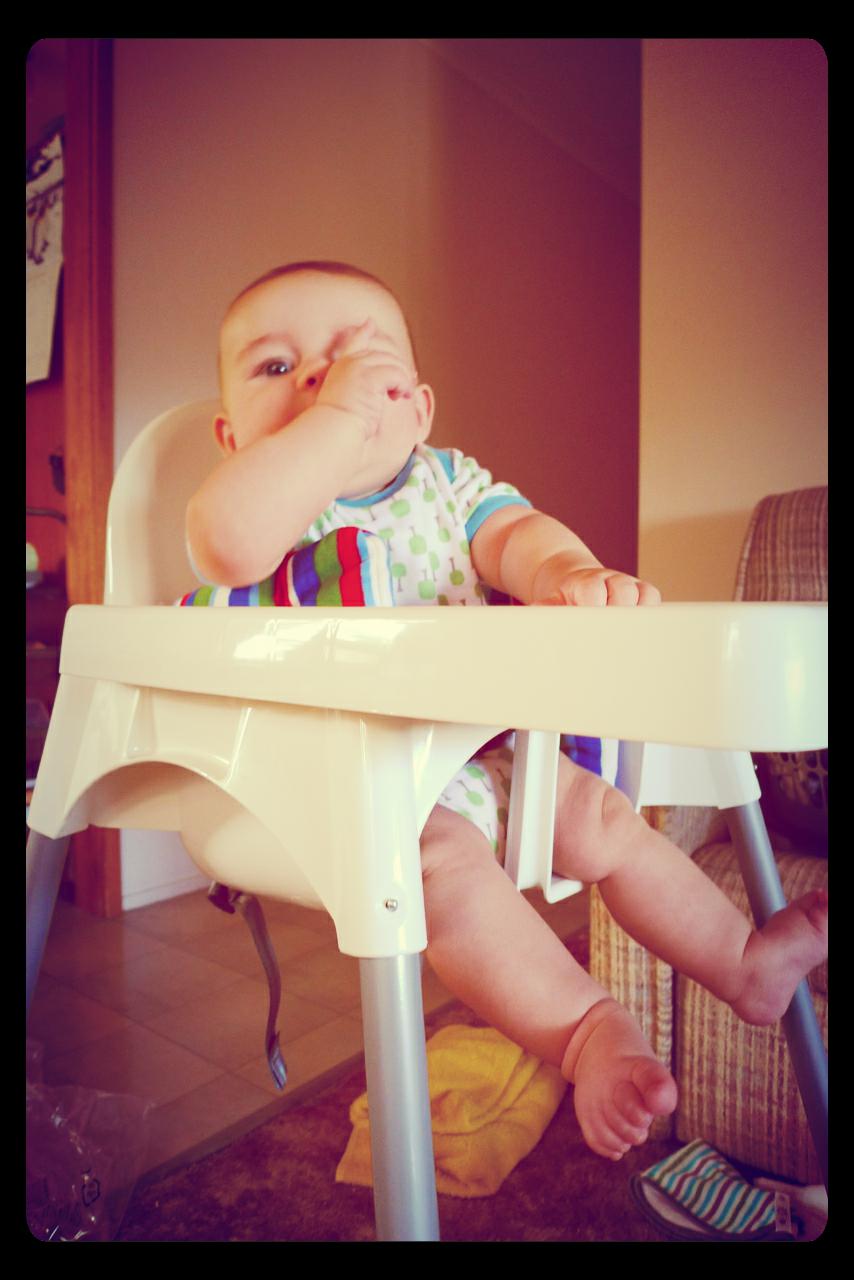
It’s been a massive time of change for Squirm – new teeth and a new high chair all in the same week.
It’s been a massive time of change for Squirm – new teeth and a new high chair all in the same week.
Last week I shared a bunch of Literary Related Fun Activities you could do for the school holidays. Today, I’m delving into the endless world of fiction. These are activities and challenges which you can do with books you have at home, with books you buy, or books that you borrow from the library! The best thing about these activities is that there’s no age limit – even adults can join in the fun!

1. Read an Author
Choose an author who appeals to you and try to read as many of their books as you can. This is a great way to learn about author’s voices and how an author will use similar themes or ideas in several of their books. You might even be able to make connections between different books – like the Jackie French books which all have Mothball the Wombat in them, or the Jordan Sonnenblick or Sarah Dessen books which feature characters from other books. With littlies you can hunt down different illustrators and see if they change their style at all, like Bruce Whatley does when he uses his left hand. (A great resource to help you find illustrator’s books is the Goodreads website.)
Suggested authors: Mem Fox, Jackie French, Eric Carle for the littlies; Dr Seuss, Mo Willems, Alison Lester for the bigger kids; Beverley Cleary, Enid Blyton, Emily Rodda for chapter books; Mike Lupica, Cathy Cassidy, Gordan Korman, Robin Klein, Morris Gleitzman for middle grade readers; Sarah Dessen, Chris Crutcher, Gary Paulson for Young Adults; Stephen King, Jodi Picoult, Bryce Courtenay, Nevil Shute, Neil Gaiman, Terry Pratchett – and hundreds of others – for adult readers.
2. Read a genre
Choose a genre that you love or one that you’re not so familiar with. Try and read as many books as possible in this genre. Have a look at some of the themes, tropes and ideas that come up again and again. Discuss what makes the perfect book in that genre. See what authors are prolific in those genres.
Suggested genres: humour, crime, mystery, fantasy, romance, science fiction, post apocalyptic, steam punk, historical fiction. For picture books and other children’s books you could look at funny books, sad books, books about animals, nursery rhyme books, fairy tale books, books about dinosaurs, books about parents, books about babies . . .
3. Create a Reading Scavenger Hunt
This is best planned before you start reading. Sit down with some friends or family and make a really, really big list of things to find – you could have anything from rubber ducks to monsters to World War Two to sympathetic monsters. Everyone involved in the challenge gets a copy of the list. When you come across one of those things in your reading, you get to tick it off. Race each other to tick off the most things!
Possible scavenger hunt themes: search for musical instruments, search for unusual words, search for mentions of countries, search for different types of food, search for different types of animals, search for different sports
4. Go on a book tour
Travel the world without leaving your seat. Look for books which are set in different countries and mark all the places you go on a map. (It’d be great on Google Maps, though it’s not so helpful if you’re reading Tolkein, unless you’re comfortable marking New Zealand). This is a great insight into places in the world and you could discuss some of the things which are different and some of the things which are the same in different countries.
Possible books for a 12 year old: Parvana by Deborah Ellis (Afghanistan), Juggling with Mandarins by V. M. Jones (New Zealand), Diego Run by Deborah Ellis (Columbia), some of the early CHERUB books by Robert Muchamore (England, plus other countries)
5. Read books about places you know
As nice as it is to go away with our books, I always get a kick out of reading about a place I know. I love Nick Earls’ books because they are so very Brisbane. I love Jackie French’s Flood and Narelle Oliver’s Home for the same reason. When I read about Washington D.C or Disneyland, I think I enjoy it a little bit more because my parents took me there when I was 12. Find books that are about your home, or about a place like yours.
6. Get Arty and Crafty
Books lend themselves to arts and crafts. You can always try to draw the characters. You could create a map of where they live or a birds eye view of what their bedroom looked like. You could use recycled material from around the home to create objects from the books. You could use felt or material or knitting or crochet to create dolls of the characters. In my family, you’d probably go on to create complete Doll Houses of the worlds. You could design or create clothes or costumes inspired by the books. There’s endless possibilities!
Possible crafts: create a Golden Snitch from recycled material (Harry Potter), create a Pigeon doll (Don’t let the Pigeon Drive the Bus), draw a perfect hole for Mothball the Wombat (Diary of a Wombat), draw characters from Diary of a Wimpy kid, cut them out and attach them to paddle pop sticks to make puppets
7. Write Fan Fiction
What do you do when you love a book so very much that you wish there is more? Well, write fan fiction of course. Fan fiction can be as simple as a short story explaining what happened next in the book. Or it could be letters from one character to another. Or retelling an important event from the perspective of a different character. Fan fiction can be written for any book, and can be in any form. And it can be shared in many forums on the internet (but be aware that there’s a lot of adult fan fiction if your children are looking for some).
What Fiction activities would you like to do this holidays?

While Ikea is only available at Logan, it’s a great excuse to get down to the Logan City Libraries. This week, after picking up a high chair for Squirm, we made our way slightly north to the Logan North Library. Like Logan Central, this library is pretty new (opened 2008 – check out some of the photos from building) and is in immaculate condition. It’s set up above a covered car park, with lift and stair access from the foyer downstairs. In the foyer there was a lovely display about U3A (University of the Third Age) which I believe is a collection of classes on various topics for older people.
For some reason, I love stairs in a library. I like the idea of winding your way upwards and a totally awesome world being at the top. Must be the Faraway Tree lover in me! This feeling was definitely helped by Logan North advertising upcoming Hobbit events in the library on the notice boards in their stairway.
The library isn’t the biggest one I’ve been to – just a nice average sized library. But it was beautifully set out, so it didn’t feel cluttered and everything felt like it had a proper place. The height of the building meant that people could sit at one side and look out windows while they read their magazines or newspapers, and there were a few people there who looked like they were doing exactly that! Then there were the displays . . . but more about that later.
The children’s and young adult sections (which were separated) take up the opposite side of the library to the newspaper section, which meant that they were also bordered with windows looking out. I’m discovering that I quite like windows in children’s sections, though I know windows can be problematic when you need wall space for bookshelves! The children’s section was quite large, with a big wet area, small tables and chairs, a special story tellers chair, big comfy sofas and a variety of smaller chairs. There were LOTS of picture books available, including the big format books, which were also available at Logan Central library. There were also very organised shelves of books for new readers and early chapter books, junior fiction, reference and non fiction as well as a very large selection of audio books. I was particularly impressed by the audio book range, and for the first time wished I could have a library card in another library system!
My favourite part of the children’s section was in one of the corners, where a tree had been created to make a reading ‘hide out’. There were cushions and stools to curl up on and baskets of books nearby for reading. It was great to see reading in the library encouraged, as well as borrowing. This creative approach to displays, and to encouraging reading was evident throughout the library. There was an awesome display called ‘The Wall of Forgotten Books’ which were books which hadn’t been borrowed in the last ten months. There was a Christmas tree made of books, and my favourite display linking the end of The Year of Reading with the Mayan ‘apocalypse’ – while promoting apocalyptic themed books!


This felt like a library where passionate people worked. It felt like they wanted people to feel comfortable here, that they honestly loved books and reading and wanted to share that with everyone. The staff were friendly and warm and the library – which could have been quite bland without these efforts – was cosy and inviting. It was the kind of place where you feel at home and you want to return to.


The best parts of Logan North Library
Important Information about Logan North Library
Corner Sports Drive and Springwood Road, Underwood, Qld,
Open Monday to Saturday. See website for details
Undercover and open parking available.
While we were there . . .
We didn’t stop for long, but this is just one exit up the highway from Ikea. There’s an oval and pool complex right next to the library. Underwood Park, which looks like it’s a fairly close drive away, also looks pretty awesome!

A few highlights of the week
With another hugely busy week, it looks like the week before Christmas might actually be a quiet(er) one!
Smell the Roses
Squirm’s baptism and the lovely family and friends who all came to celebrate with us. Or meeting Mem Fox and Judy Horacek on Wednesday.
What I’ve Been Reading
The Baby Led Weaning Cookbook for myself. Mem Fox’s Good Night, Sleep Tight with Squirm.
What I’ve Been Doing
We started the week with Squirm’s baptism. Monday then found Squirm and I at Riverbend Bookstore catching up with an old friend before she goes for an adventure in Japan. Monday night brought a bit of a change to Squirm’s personality after we discovered his very first tooth coming through! On Wednesday we braved the great outdoors and went out to see Perks of Being a Wallflower at the movies, before heading to Chermside Library to hear Mem Fox and Judy Horacek speak (they were amazing). On Thursday we went down to Ikea to pick up Squirm’s first high chair and a few other things, before making our library visit for the week. Then we spent Friday at my old school and my current school being fed and finishing up the school year 🙂 At the same time I indulged in some cooking, turning out some different dinners and even making bread for the first time!
What have you smiled at, read or done this week?
So, today is the last day of school for all Queensland schools and other states will all be finished soon. The school holidays will be stretching ahead of you – long and hot in most cases. School holidays, particularly the long ones, are notorious for boredom. And although I’m a firm believer in a bit of boredom, a couple of good activities never go astray.
Holidays are also the time when I found my students stopped reading or dramatically reduced their reading. This meant that they were often a little behind when they started back at school. Now I’m not suggesting that kids should be attached to books all holidays, but a regular diet of reading can be both enjoyable and give them a step up when they get back for the new year.
So how do you mix reading and holiday activities? Well let me present:

Go To The Library
You knew I was going to suggest this one, didn’t you! But I have real reasons for suggesting it.

To start with, they’re air conditioned, free and full of cool summer activities and ideas. Most libraries have summer reading programs, with some pretty amazing prizes available. There’s story times, craft activities, guest speakers, plus the allure of lots and lots of books you’ve never read before.
What else can you do while you’re there? Let your kids learn how to use the library catalogue. Have a scavenger hunt for information on different topics. Research a topic you’ve always wanted to know more about. Try and read all the books by a certain author. Introduce your children to the reference section (they might even have encyclopaedias!) Look for books about books or libraries, like That Book Woman by Heather Henson. Create a blog about the books you read. Make a list of awesome books for friends to share.
Another thing you can do is go to libraries you’ve never been to before. We have absolutely loved checking out new libraries. If you’re in South East Queensland, I highly recommend Logan Central, Caboolture, Brisbane Square and Redcliffe. If you’re not in South East Queensland, but you have a favourite library near you, leave a link in the comments!
Go on a Museum Adventure
Have you ever read From the Mixed-Up Files of Mrs. Basil E. Frankweiler by E. L. Konigsburg? It’s an amazing book about a pair of siblings who run away and hide out in the museum while solving a mystery. It’s a great introduction to the wonders of museums, and I thoroughly recommend reading it and then heading out on a museum adventure of your own.
Is there a museum near you? The school holidays are a perfect time to go visit it – and really explore it! A couple of years ago I did a ‘museum unit’ with my class and we took a trip to the Queensland Museum (before the latest refurbishment). While we were there we discovered the research room (with drawers full of animal poo!), cool animal exhibits and a whole lot of information about old transport (like a fire engine powered by bicycles!). We drew pictures, wrote stories, explored history and asked questions. Later we set up our own museum back in our classroom – a great activity!
Hit the Beach
 I love the Roland Harvey book At the Beach. There’s so many things going on in it that it’s like a Where’s Wally without the frustration! It’d be a great book to read before going on a trip to the beach, whether it’s a day trip or a longer one. You could make a list of some of the things you see in the book and see if you find any of them at the beach!
Of course, sand is great for all kinds of sensory play if you have an early learner. There’s also heaps of books and poems about the beach and the ocean. You can also take lots of photos and use them as inspiration for drawing or writing later in the summer.
Create a Magical World
It took a Goodreads recommendation to find Roxaboxen by Alice McLerran, but boy was I glad I did. In the book, the children create a whole world, with rules and houses and places of business out of a nearby hill. It reminded me of when I was younger and we had hideouts all over the place!
 This is a great book to inspire your own places of imagination. They can be a corner of the backyard, or a pile of boxes, arranged in just the right way. You could even make a place for stuffed animals or other toys. A blanket or a sheet over a table makes an ideal hideout, and on a rainy summer day, with a pile of books and a torch, you can’t get a better reading nook!
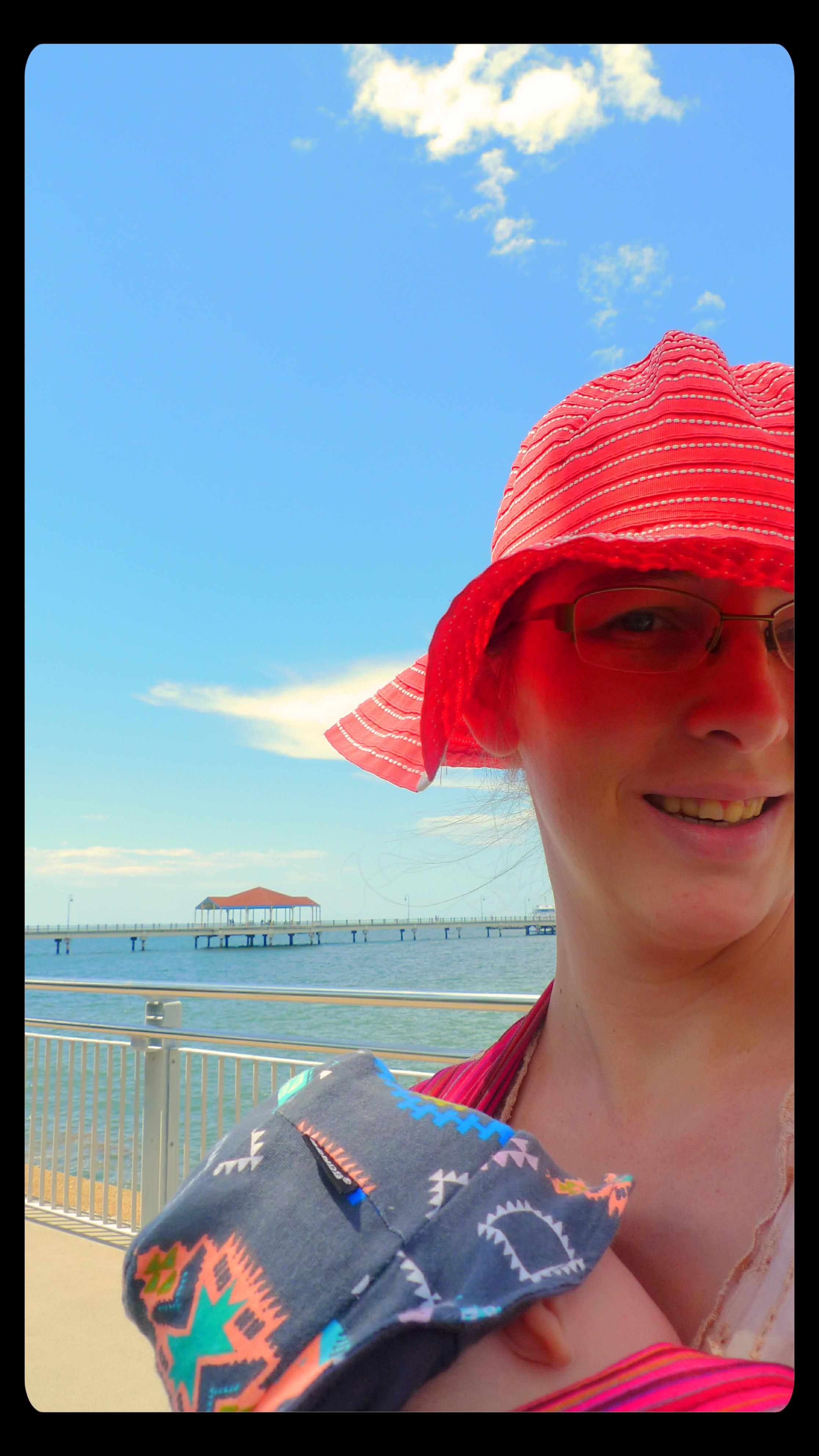
Babywearing at Redcliffe
There’s nothing quite like giving parents labels. It seems to be a popular thing in the media – from Mummy Bloggers to Permissive Parents, from Free-Range to Helicopter Parents. Earlier this year it was time for the Attachment Parents to be highlighted and (in some cases) ridiculed. From time to time I have people lower their voice, lean in closer and ask The Question – Are you an Attachment Parent?
The easy and quick answer is yes.Of course, the longer one is much longer than that. Attachment Parenting seems to have become very stereotyped – think militant breastfeeding (thanks Time Magazine), co-sleeping, dreadlock wearing hippy. Well, although I own a skirt with bells on it, I’m not actually a hippy. And although we have co slept, we also put Squirm in a cot. And funnily enough, the Attachment Parenting spectrum is as broad as any other group – parents or otherwise.
The easiest way for me to explain attachment parenting, as I understand it, is by using the word Respect – in that, I mean respect for our children, ourselves and our environment. There’s a number of activities which then come under this banner, but without that respect you really have nothing to work from. In each house, that respect will be shown in different ways and activities.
In our household we respect Squirm by breastfeeding him exclusively (since it is possible for me and this is the best way we can feed him), by responding to his cries, by showing him love. We are trying to avoid gender stereotypes which can lead to male babies getting less attention, eye contact or speech – all important parts of respect, love and learning. We baby wear him because he likes to be close to us. We don’t refer to him as naughty or bad.
In our household we respect each other and ourselves by baby wearing so we can use our hands! We co sleep at times, when we’ve grabbed Squirm from his cot and we’re too tired to get up and put him back. We share parenting when we can and we talk about it. We try to eat healthier foods that will allow us to feel good.
In our household we respect the environment by looking for cleaning alternatives. We cloth nappy and line dry when possible. We try to limit our consumption of goods and only buy things we need.
We’re not perfect, and we never went into this thinking we were. We’re finding the style which works best for us and Squirm. And we’re sure that we’re going to keep learning for a long time. Sometimes I don’t feel very ‘Attached’, but then I remind myself that I’m doing the best I can to create respect between myself and my son. And when I feel like I’m really going off track, I head to the Dr Sears website and read this again.
My favourite part from that article is this:
AP is an approach, rather than a strict set of rules. It’s actually the style that many parents use instinctively. Parenting is too individual and baby too complex for there to be only one way
Do you have a key value to guide your parenting?


So, looks like the media and the politicians are getting their collective knickers in a knot because a bunch of fourth graders didn’t get great marks in an international reading test. Poor kids, they’re the Australian Swimming team of the month. The response will be pretty predictable – the unions will call for more money, the politicians will blame the teachers (I believe they’ve already started), the media will blame a leftist curriculum and call for ‘back to basics’ and Tony Abbott will blame the Carbon Tax.
In my opinion, none of these things are useful (though the money could be, but I’ll get back to that.) The biggest problem with education in Australia is, quite simply, the low status of education in Australia.
Teachers are constantly put down, ridiculed and told that they’re not smart enough in the media. Science news is mostly contained to the ‘quirky facts’ section of the paper, or presented in the same breath as crackpot ideas from the internet (look at the fluoride debate in the Qld media over the weekend). Our ‘role models’ aren’t writers and mathematicians and scientists, but sports people and actors. And reading and writing is so dismissed in Queensland that the government stopped a minuscule amount of funding for writing awards (but horse racing is well funded up here).
It gets worse. Get into a school and listen to what the experts are telling you about reading, and all you’ll hear are programs and teacher jargon – phonemic awareness, reciprocal reading, guided reading . . . all things which lead to what Kelly Gallagher calls Readicide. Hands up if you can remember a book ‘killed to death’ by overzealous questioning, analysing and over reading? I can add Frankenstein, Cannily Cannily, Sally’s Story and The Outsiders to any list you just compiled!
Do you want my very simple way to improve reading in this country? Encourage a love of reading.
That’s it, simple. Give kids time to read. Give them a choice of material to read. Celebrate reading. Make it important. Stop over testing. Stop over teaching.
The money I talked about before? Put it towards classroom libraries. Put it towards author visits in schools.
Teacher education? Let them read books! Let them spend a day reading picture books or novels or non fiction or comic books. Let them become passionate about something, because that’s how they make their students passionate.
The media? Celebrate authors! Promote authors, put them on the front page. Write articles about reading to young children and about how to talk about books with school age kids. Make authors role models and leaders!
The curriculum? Give it back to the teachers, like they do in the best education countries in the world. Trust the teachers and let them bring their passions to the table. And let them have books and reading time!
There’s so so so much I could (and probably will) talk about on this subject – it’s one I’ve been passionate about for years. But if all the things the media and politicians suggest haven’t worked over the last ten years, maybe it’s as simple as getting people passionate again!
What makes you passionate about reading? What would you like to know about reading in schools?
Each week I review books we’ve read with Squirm. Find other reviews here
Norman Enormous by Dave Hackett

Norman is Enormous, living in a house with a roof that’s too short and a floor that’s too high. He desperately wants a best friend of his own, so he gets in contact with an old friend – Norman Not-So-Enormous – who is definitely smaller than most. Although their dinner starts off on an uncomfortable note, they soon realise they have a lot in common.
This is a sneakily funny book, told completely in rhyme. It’s one of those books where the illustrations are just as important as the text and it’s worth spending some time looking over them. Most of all, I really like that the message – that you can find ‘your people’ if you’re willing to look for them – isn’t overly cloying – it’s there without being shoved down your throat.
This would be an excellent book to look at size with – especially thinking about what things would be different or would need to change if you were very big or very small. In that way, you could also connect it with other books – the Borrowers immediately sprung to mind, even if it’s just the parts talking about how they use the normal household items differently. You could also take that into making your own dolls house!
The Queen with the Wobbly Bottom by Phillip Gwynne

The Queen (a hippo) has a bottom that wobbles like jelly and she would do almost anything to get rid of it. She offers rewards to anyone who can get rid of her wobbly bottom, but when creams, contraptions and exercise don’t help, she starts throwing people into the dungeon. Then a poet comes up with a novel idea . . .
This is a very funny story about people showing you how awesome you really are. The poet’s solution is ingenious and lovely, even if the Queen doesn’t initially agree. And I love how the characters are drawn throughout the book – another lot of illustrations which contribute to the story.
With this book, an obvious activity would be to write a lovely poem about the Queen. You could also talk about using positive affirmations – about how hearing and saying nice things about ourselves make us feel better. There’s also jelly making and experimenting which would be wonderful with this book. You could also look at the different animals in it and some of the things which they might dislike or like about their features and why.
Have you read a book about an unusual friendship?

What is Baby Rhyme Time?
Baby Rhyme Time is called different things in different library systems – sometimes it’s just rhyme time, others call it Babies, Books and Rhymes. But the set up is usually pretty similar – parents and babies (and toddlers) sit together, often on the floor in a circle, and enjoy a series of nursery rhymes and songs together. There’s a lot you can get out of rhyme time – including major language development – especially if you follow a few simple steps to make sure rhyme time is enjoyable and valuable for everyone!
1. Choose the Rhyme Time that Suits You
Not all rhyme times are created the same. I’ve seen rhyme times where the same songs are repeated every week, and other rhyme times which constantly introduce new songs. I’ve heard of rhyme times where the leader maintains strict order and children are expected to sit at all times, and others where the leader accepts normal toddler behaviour (Oh! Rhymes! Oh! Toy over there! Must investigate! Oh! Music! Must come back!) I’ve seen small and huge rhyme times and even heard of a rhyme time where the leader plays guitar!
The trick, if possible, is to find a rhyme time which works best for you. If you have a quiet child, they might benefit from a different rhyme time than a more boistrous child. Try out different libraries, different times, different styles. (Of course, if you only have one library in a reasonable distance, this might not be possible. Check out nearby libraries when you’re travelling though – a different rhyme time every now and again can be a lot of fun)
2. Get Involved
Time for an example from a rhyme time we went to recently. Several mothers were sitting with their babies on the couches at the side of the rhyme time – definitely close enough to be part of the action. But instead of getting involved, they spent the whole rhyme time in conversation with each other. They were so oblivious to where they were, they didn’t even hear the leader talking to them. It was like they were just attending because it was on a list of things they ‘should’ be doing.
The best benefits for parents and babies come when you get more involved. Sit in the circle, participate in the rhymes and songs, do the movements and actions. The more people who participate, the more confident everyone gets and the better it is for the whole group. When people sit back and don’t join in, other parents feel like they’re performing for them – and not everyone is comfortable being a performer!
Rhyme time is about exposing children to simple melodies and rhythms, as well as the wide range of language used in rhymes. It really is an activity which is about the children, not a social activity for the adults. By getting involved, you ensure all the benefits are received by your child and others.
3. Sing Along
While you’re getting involved, make sure you sing along! It doesn’t matter how bad you think you sing, your baby thinks you’re amazing! Babies have a connection to our voices from before they are born when they hear us all the time. Squirm turned towards my voice before he was even a week old! By hearing us sing, they have a better connection to the words, rhymes and melodies we are sharing.
Also, this is the one time and place where no one’s going to look at you and glare if you completely mangle Incy Wincy Spider – they’ll just be thankful that there’s another voice there to encourage them to sing along!
4. Turn Your Baby Around to Face You
A lot of the time, babies spend their rhyme time facing in to the circle. While this is great for babies to see other babies, choose a rhyme or two to turn your baby around to face you. This lets them see how you are moving your mouth to make the sounds and lets them have a better connection with you. This works particularly well with songs and rhymes which involve body parts – Heads, Shoulders, Knees and Toes or This Little Piggy, for example.
5. Sing the Songs at Home
If you only attend rhyme time once a week, there’s a long time between songs! Try and sing the songs at home as well – repeating them makes the language and rhythm more common for the babies. Ask if your library has a copy of some of the songs, see if you can borrow a book with nursery rhymes in it or borrow or buy a CD with common nursery rhymes and songs on it. (We’re kind of in love with the ABC for Kids CDS. ABA also has a great CD and music book)
When can you sing? All the time! We sing when Squirm is being changed and when we dry him and dress him after a bath. We sing when we’re in the car and we even make up little nonsense rhymes when we’re doing chores around the house.
6. Monitor Your Child’s Behaviour
This is more for older babies and toddlers, but it has the potential to impact on everyone. Babies and toddlers do have a normal set of behaviours, particularly being distracted, which we may not accept in older children. They might get shy and not want to join in, or they might want to find out what the shoe of the person sitting next to them tastes like. These behaviours are absolutely fine, and if anyone does have a problem with them, they should probably realise they are at a baby rhyme time.
But make sure that your child isn’t the one continuously throwing puppets at the leader of the session or the one who is acting in an unsafe way to the younger babies in the group. Make sure that your child is behaving in a way that makes rhyme time safe and enjoyable for the whole group. If your child is going through a stage where that really isn’t possible, think of the greater group and keep them away from rhyme time for a little while – it’s not fair if one child makes the whole rhyme time uncomfortable, upsetting or unsafe for everyone.
As we head towards 2013, Mr Pilot and I have been assessing our goals for the new year. One of the goals for both of us is looking at our food and exercise and trying to make the healthiest choices we can. There’s a number of reasons that we are thinking about this, including:
1. Squirm will be moving to solids around February. We are going to be doing Baby-Led Weaning with him, which means he’ll be sharing the same foods we eat. Obviously we want him to have the healthiest start to food possible, so that means we have to get healthier too
2. We’re becoming more aware of how good healthy food can be. There are some awesome alternatives out there to high salt, high sugar, high fat foods and it’s going to be a bit of an adventure to discover them 🙂
3. Eating healthy means making a lot of our own food, which tends to work out cheaper in the end. My maternity pay runs out soon, and we want to keep our savings up, so that’s a good reason to spend less on food.
4. There’s obvious health benefits to eating well and exercising. I have a thyroid problem, so eating well has to help that. We’re also becoming aware that health in our 30s isn’t as simple as it was in our 20s . . .
5. The pregnancy and birth took a lot out of my body. I had stomach separation and a few other health issues, plus it mustn’t have been good to eat the number of Frosty Fruits I ate!

Some Bliss Balls I made – almost entirely healthy 🙂
We’re look at this as a goal, rather than a resolution, because I think we’re more likely to approach a goal in a methodical manner. We’re going to have to learn more about the food we eat, hunt down some new recipes to cook and think about what we want the outcome to be. We don’t want this to be a weight loss thing, we want this to be a lifestyle change – so coming up with an end goal is harder. I’d like to try to cook a new meal each week and to avoid prepackaged food as much as possible (it’s much harder to be sure of the contents with prepackaged food). I also want to avoid eating lots of chocolate (I eat way, way too much) and to make healthier food choices when I’m eating away from home. There’s still a lot to consider, of course . . .
What’s your favourite healthy recipe? What goals are you setting for 2013?
 Adventures of a Subversive Reader