Book review

The Loved One by Evelyn Waugh, 1948

This was an umpteenth re-read – I revisit The Loved One (subtitled An Anglo-American Tragedy) for a chuckle every now and again. It’s not a novel (Waugh called it a novelette) that takes itself very seriously, but it is all the better for that. It also has a lot of fun at the expense of both Americans and English ex-pats in America, so what’s not to like?Image result for loved ones waugh

Sir Ambrose Abercrombie, august representative of the British community of ex-pats in Los Angeles, descends upon Dennis Barlow, a minor poet brought to Hollywood to write the script for a film biography of Shelley, to express his concern about Barlow’s new job and how it reflects on the British community in Hollywood. Barlow has abandoned his script writing for something much more valuable to society – he works at the Happier Hunting Ground, a pet cemetery.

Barlow, tasked with the funeral arrangements of his ‘housemate’ who has killed himself having been dismissed from his job in one of the studios, “developing scripts”, (there are a lot of euphemisms and avoidances such as this in this novel) visits Hollywood’s famous funeral grounds, Whispering Glades. There he quickly falls for cosmetician (she puts make-up on corpses) Aimée Thanatogenos. He woos her with quotations from the British classics, passing them off as his own. But he has a rival, the senior mortician Mr Joyboy. Aimee is torn between her feelings for Barlow and Joyboy, but despite the helpful advice columnist of local agony aunt “Guru Brahmin” she gets engaged to Barlow. Subsequently, when she finds out his poems are plagiarised, she dumps him (in fact, she ghosts him!) and returns to Joyboy. The coffin is nailed firmly shut when she attends the funeral of Mr Joyboy’s mother’s parrot at the Happier Hunting Ground, where Barlow is in attendance. The scene is set for a macabre, blackly comic finale.

Waugh was at his comic best when he gave his satirical targets both barrels, holding nothing back. Here his contempt for Hollywood, Americans, ex-pats, you name it, is out in the open and given full rein. This is more a sketch than a fully developed novel, lacking the depth of Waugh’s other work, but it is fun despite the darkness.


Standard
Book review

So long, and thanks for all the fish, by Douglas Adams, 1984

It will not take most readers long to work out that So Long and Thanks for All the Fish, the fourth book in the Hitchhiker’s Guide to the Galaxy trilogy, is a very different type of novel from its predecessors. These were all (more or less) novelisations of other iterations of the story, mainly the radio series in which Hitchhiker first appeared. Fast paced and fizzing with ideas, these earlier novels can be consumed in one sitting. So long, on the other hand, is a much more reflexive novel. Adams tries to capture some of the spirit of Hitchhiker etc, but eventually settles down to a much more traditional, earth -bound romance. 

At the end of Book 3 in the series, Life, the Universe and Everything, Arthur Dent, Adams’s eternal everyman, and his alien friend Ford Prefect were stranded on earth millenia before the present day. Things have now obviously moved on, because Arthur and Ford are no longer together. This is really Arthur’s novel, and Ford fades into the background playing only a minor role towards the end.  Having hitchhiked across the galaxy, Arthur is dropped back on Earth, even though the planet was. as you will recall, destroyed by the Vogons to make way for a hyper-space bypass. Arthur is surprisingly calm about this, and continues to do what he knows best – hitchhike, restlessly trying to understand what has happened to restore the earth, and where all the dolphins have gone? He has a hunch the two things are connected.

On his travels he catches a lift with a man named Russell and his sister Fenchurch. Fenchurch is withdrawn and uncommunicative, and Russell hints that she is mentally unwell. It slowly becomes clear that Fenchurch’s condition is connected to the demolition of the Earth and its subsequent reappearance, which the rest of the population avoids thinking about by claiming it was mass hysteria. Arthur is fascinated by Fenchurch, partly because he is strongly attracted to her, but also because he suspects that she is one of very few people left on earth who might be able to understand what he has experienced.

As the novel unfolds their paths keep crossing and uncrossing. Arthur finds Fenchurch hitchhiking, gives her a lift, but on parting manages to lose her phone number. He then miraculously rediscovers her by searching for the cave he lived in on prehistoric Earth – her flat is on the same spot on this quasi-Earth. There is something strange about Fenchurch, and it is only when Arthur finally works it out that they are able to properly connect with one another. It transpires that Fenchurch was the woman mentioned in passing in the opening chapter of the previous novel who, moments before the earth’s demolition, had stumbled across the answer to life, the universe and everything. Someone who in the previous novel was just a throw-away gag becomes here a central character. The destruction of the earth had interrupted her epiphany, and Fenchurch is now left with a nagging sensation that a tantalising breakthrough is just out of reach – and the thought is making her ill.

Eventually, they are reunited with Ford Prefect, and they set off once again across the universe to visit the planet where God’s Final Message to His Creation is written, in the hope that it might give them some peace. On the way they encounter Marvin, the paranoid android, still as misanthropic as ever, but now some 37 times older than the known age of the universe and on his last circuits.

Neil Gaiman’s introduction reveals some of the pain Adams went through in composing So Long, but if you didn’t know it would probably still be apparent. At one point for example he retells in detail an urban legend (the one about the man sitting opposite you in a cafe who helps himself to your biscuits). It’s exquisitely told, but it’s padding nonetheless. (There was a point to this story, but it has temporarily escaped the chronicler’s mind.) Gaiman reveals that Adams’ editor moved in with him in a vain attempt to ensure that the book was completed to deadline. This might have led to some of the unevenness of tone of the novel, a feeling that every word was an effort and that the end comes as much to a relief as Adams as it did to Marvin. But a bad book by a genius can’t but help but be a work of genius, even if it is flawed. There are many moment to savour in So Long, not least the title which like many of Adams’s phrases has entered the general lexicon. This is not Adams at his best or his most inventive, and the jokes are a little dated (“There is a feeling which persists in England that making a sandwich interesting, attractive or in any way pleasant to eat is something sinful that only foreigners do.”) but it must still be treasured as part of the wider contribution he made to our culture.


Standard
Book review

Adolf Hitler, my part in his downfall, by Spike Milligan, 1971

If this blog is anything, it is at heart a reading diary, a record of the books I read and my thoughts about them. What I read is not always going to be improving or classic literature – far from it – and it follows that from time to time I will review books that would not normally feature in a book blog. But having said all that I am not in the slightest embarrassed to be re-reading Spike Milligan’s inspired Adolf Hitler, my part in his downfall once again. It seems the perfect book for these times, a quiet voice of sanity amongst the madness that is the world of today.

My Part is the first volume of Spike’s war memoirs, spanning the period from the declaration of war to when he landed in Algeria as a part of the Allied invasion of Africa. It is the first of wMilliganhat was eventually to be seven volumes of reminiscences covering his war service and the years immediately after when he was trying to resume his life and break into showbiz. The diary format used captures the immediacy of the experience of being called up to fight for one’s country, the strange combination of dread and adventure that many young people must have felt. The memories of ridiculous, outrageous adventures – Milligan obviously retained a strong sense of silliness throughout his life – and tragedy (“There were the deaths of some of my friends, and therefore, no matter how funny I tried to make this book, that will always be at the back of my mind”) combine to give the novel its unique, immensely touching tone. 

The novel opens with Spike receiving a “cunningly worded invitation to partake in World War II“. Given “a train ticket and a picture of Hitler reading “This is your enemy”‘ he sets off for war – or more specifically Bexhill-on-Sea, where he begins what seems an extraordinarily long period of training in the artillery. Training largely serves as a background to his musical interests – playing in a jazz band, and chasing girls. After more than two years of training, drinking, music and girls, all overlaid with large amounts of silliness as Spike hones his comedic skills in preparation for the career that was to follow, the inevitable order to travel overseas arrives. In January 1943 the regiment finally embarked for North Africa. Milligan describes the sunrise:

...there is no light so full of hope as the dawn; amber, resin, copper lake, brass green. One by one, they shed themselves until the sun rose golden in a white sky…I closed my eyes and turned my face to the sun. I fell down a hatchway. (p 140)

There are several moments of poetic writing such as this, always undercut by the punchline. It is here, as the reality of war begins to dawn on the very young men in Spike’s regiment, that he ends the volume,

I would hazard a guess that Milligan partly wrote these memoirs as a trip down memory lane, a way of capturing the memories before they faded too much, and partly as a convenient source of revenue – the books have always sold well, and this one was also turned into a film. It’s a curious mix of seriousness and silliness, but it works, and Milligan’s wit and humanity shines through. He’s certainly not made the hero of his own book – there are far too many confessions for that – but the reader can understand why Milligan got off so lightly so often for his misbehaviour and insubordination.

Standard
Book review

Maskerade (Discworld 18) by Terry Pratchett, 1995

Regular readers of this blog (should there are any) will notice a pattern emerging in which I alternate between a classic/serious novel and the next book in the Discworld series. Today is a Discworld day, more specifically the wonderful Maskerade. And the good news is that this is one of the best, featuring the extraordinary witches of Lancre.Mask

The plot is a simple parody of the Phantom of the Opera. Agnes Nitt, destined to become a country witch leaves sleepy Lancre to seek fame and fortune at the Ankh-Morpork opera house. (It is perhaps surprising that a city as violent and lawless as Ankh-Morpork has its own opera house, but Discworld is anything but predictable). At the same time the wonderful Granny Weatherwax finds out that the equally wonderful Nanny Ogg has written a popular cookbook – but has not received any royalties from the publisher. They set out for Ankh-Morpork on a mission to collect what Nanny is owed, with an understanding that they will probably pop in and visit Agnes along the way, and if she agrees to join their coven in a firmly junior position that would all work out fine as well (“You needed at least three witches for a coven. Two witches was just an argument.”). There is nothing as definite as a plan here. 

The stage is set for what is a surprisingly tightly written mystery story – although I had read the book before I couldn’t easily work out whodunnit – as well as a wonderfully comic novel. While Pratchett always has a serious point in the back of his mind, here the seriousness never gets in the way of the fun – for example the scene where the senior witches stay in Madame Palm’s house for ladies of negotiable affection, and manage somehow to make it even more disreputable, is glorious!

Maskerade is fantastic. It features two of my favourite characters in the whole of fiction, Nanny Ogg here finally stepping out from the shadow of Esme Weatherwax with her own special brand of magic (in essence, being nice and talking to people), and of course Esme herself. The witches have been on a road trip before, (Witches Abroad) but here they can play uninhibitedly in Ankh-Morpork. Pratchett clearly had a huge amount of affection for these characters – they are immensely endearing and believable. (Re-reading what I have written there I can’t help notice the abundance of superlatives, but it’s a fair reflection of how I feel about the novel.)

Nanny Ogg is a complete nihilist –  her philosophy of life is summarised as “do what seemed like a good idea at the time, and do it as hard as possible.” She gets some great lines, such as:

“Can you identify yourself?
-Certainly. I’d know me anywhere.”
Is it me or is there a hint of the Marx brothers in that joke? This is after all a night at the opera?
There is no reverence whatsoever for the seriousness of the setting:
Well, basically there are two sorts of opera,”
said Nanny, who also had the true witch’s ability to be confidently expert on the basis of no experience whatsoever.
“There’s your heavy opera, where basically people sing foreign and it goes like “Oh oh oh, I am dyin’, oh I am dyin’, oh oh oh, that’s what I’m doin'”, and there’s your light opera, where they sing in foreign and it basically goes “Beer! Beer! Beer! Beer! I like to drink lots of beer!”, although sometimes they drink champagne instead. That’s basically all of opera, reely.”
The quality of the jokes, is as ever, both terrible and wonderful at the same time – such as here when describing Nanny Ogg’s cookbook
“What about this one? Maids of honour?”
“Weeelll, they starts out as maids of honour…but they ends up tarts.”

:

Standard
Book review

The Old Devils, by Kingsley Amis, 1986

It is only human nature to assume that reasonable people will agree with you. So when I finished The Old Devils I looked for reviews in the expectation that they would broadly align with my thoughts – that the novel had stolen the 1986 Booker prize from The Handmaid’s Tale, that it was the work of an embittered writer at the end of his career publicly working out many of his frustrations and grievances with the modern world and his own mortality, and that time would not have been kind to critical reception of the novel.

But I was wrong.

When it was first published The Old Devils was lauded with praise, winning the aforementioned Booker but also being widely recognised as a late-flowering of Amis’s comic genius. John Bayley wrote an extraordinary florid paean to the novel in the London Review of Books which is worth reading in full for its hyperbole, its use of obscure language (fauteuil, donnée), its name dropping (Elizabeth Bowen, William Trevor, Anthony Powell, Henry James, Patrick Hamilton, Jane Austen  (whom Amis has never much cared about”), A.N. Wilson and a “long ago purveyor of Gothic novels, Mrs Barbauld” are all name-checked) all without ever managing to put his finger on the elusive nature of Amis’s comic genius.

More recently a reviewer in the Guardian’s book column in 2010 wrote

“Kingsley Amis’s success at the 1986 Booker prize seems like the natural culmination of a long and distinguished writing career. One of the finest comic writers of his generation – century even – had done the natural thing and written a bloody brilliant book”

The Wales Art Review (? me neither) called the novel

“his greatest single creative achievement” and (together with Lucky Jim)

“Two of the greatest novels of the twentieth century without doubt”

V.S. Prichett, writing in The New Yorker described the novel as being in

the old, robust masculine tradition of British comedy from Fielding and Smollett”. 

And of course son Martin thought that the novel

stands comparison with any English novel of the century.”

Would that weight of critical opinion sway me?

Not a vast amount happens in The Old Devils. Alun Weaver, a writer and minor celebrity, (we are told he is a writer, but he doesn’t seem to have written very much, and the extent of his celebrity is very much open to debate) returns to his native Wales with his wife, Rhiannon. Many years ago before the Weavers left Wales their friendship group had gone through the various re-configurations that happen among younger people. In particular Rhiannon had once been loved by Alun’s old friend and now enormously, comically fat Peter Thomas. Alun and Rhiannon resume life with their close knit group of friends almost as if they have never been away – there is no suggestion they would look for other social groups – which stirs up long dormant feelings amongst former lovers. That’s pretty much it. Time is spent drinking heroic amounts of alcohol that in the non-fictional world would leave people falling over drunk in a fraction of the time sustained here. not least because there seems little else to do. Amis concludes the novel with a death and a wedding, the latter between two younger characters who have been largely ignored during the previous chapters.

I have always thought of Amis as a good bad writer, one who writes clumsy, poorly constructed sentences simply as a way of drawing attention to their deliberate awkwardness. Take this sentence for example:

“As they stood, or with some minor surgery, they were supposed to be, he had striven to make them, his devout hope was that they were, the opening section of the only really serious piece of prose he had written since his schooldays.”

These are the faltering thoughts of Alun Weaver considering the opening pages of a novel he has just started, and which turns out to be, by consensus, rubbish. No doubt it took a lot of care and craft to make the sentence so unclear and scrappy, and it does admittedly reflect Alun’s thoughts and apparently his gifts as an author. But it’s still a horrible sentence, no matter how many times you read it.

Here’s another example:

All sorts of stuff, for instance what had been taking place a little earlier, seemed much as before, or at any rate not different enough to start making a song and dance about. This state of affairs might well not last for ever, but for the moment, certainly, the less it changed the more it was the same thing, and the most noticeable characteristic of the past, as seen by him, at least, was that there was so much more if it now than formerly, with bits that were longer ago than had once seemed possible.

Ultimately you can choose to read this as a gentle meditation on aging, or the cliche-ridden (song and dance, state of affairs) muttering of someone growing old disgracefully.

The humour in the novel is intended to derive from Amis’s portraits of flawed human nature. People are pompous, lecherous, complacent, stupid, and all manner of human weakness is on display for our entertainment. But I really struggled to care about these largely unpleasant people. There were several points in the novel where I was unable to work out who was speaking in a passage of dialogue, and the suddenly realised it didn’t really matter because I didn’t care.

Here’s Amis’s unflattering portrait of Malcolm, one of the group of friends, dressed to impress an old flame:

“When he had got out of his very shiny bright-blue car and at a second attempt shut its driver’s door, Malcolm revealed himself to be wearing a hacking jacket in dark red, green and fawn checks that were too large by an incredibly small amount, cavalry-twill trousers he must have been uncommonly fond of, a pale green I’m-going-out-for-the-the-day-with-my-old-girlfriend cravat or ascot, and, thank goodness, a plain shirt and ordinary brown lace-up shoes.” 

Is this brilliantly observant, or crudely done? Older people don’t dress very smartly, even when they are trying hard to impress. The point of view judgment in this analysis comes from Rhiannon, the old-girlfriend in question, who gives thanks for the plain shirt and ordinary shoes. Amis deploys these subtle changes of point of view with the skill of an experienced writer, unquestionably, but I am not convinced that there is much humour here, even if there is less spite than earlier later Amis either.

I appreciate I am edging round the question of whether I actually thought The Old Devils was any good. Let’s put it this way – I have my doubts. Without question the praise I have referenced earlier in the post is over the top. This is not a classic or a masterpiece or anything like it. Most of the time I managed a wry smile, at best, and much of the time I was bored. The characters are hard to like – Amis goes out of his way to make them unattractive and unappealing, and they are poorly delineated, particularly the women who Amis struggles to distinguish between other than by their physical features.

My principal source of irritation with this novel is its dishonesty. Amis had at this point in his career developed a reputation as a declining writer focused on personal themes – his serial adultery, his alcoholism, his declining health. He has sketched out a series of characters with these qualities or attributes, then ventriloquized through them on his tired personal and political hobby-horses – homosexuality, the ridiculousness of compulsory Welsh/English language public signage, faux-Welshness, trade-unionists and so on. Of course one must always be careful to distinguish between the personal views of an author and their characters, but there is a strong case for concluding that Amis shares many of the prejudices his characters articulate – he repeats these views consistently in a series of later novels, he attempts to make the characters articulating these views sympathetic and invariably shows only the reasons why they are justified in these views – opposing views are ignored. Reviewers seem relieved that this is not the openly misogynistic rant of Stanley and the Women or Jake’s Thing, but that doesn’t make it Lucy Jim either.

Finally, and for me most seriously, there is what I think of as the “shagger” issue. (apologies for the language but it seems appropriate in the context, and any euphemism wouldn’t quite meet the mark). There is a recurring character in many of Amis’s novels who is an appalling chauvinist with nevertheless a mysterious and limitless powers of seduction. He is always on the lookout for an opportunity for random sexual encounters, however inappropriate or untimely, always “up for it” irrespective of time, place or situation. He will sleep with anyone at anytime, and inexplicably has the power to persuade the women in his life, invariably married to someone else – to sleep with him with the minimum of seduction/persuasion/courtship. They just jump into bed with him – because the narrator can portray them doing so, not because these powers are in any way realistic or believable. So Alun Weaver has not been back in Wales many hours before he pops in to visit Sophie, wife of an old-friend, in the expectation of a casual encounter. The conversation is initially hostile but Alun charms his way into Sophie’s bedroom, and slowly the quotation marks are interrupted by rows of dots suggesting intimacy is underway. They only confirmation that the seduction has succeeded is the phrase “Much too late to spoil it the telephone-bell rang on the landing”, “it” in this context being Amis’s coy euphemism for sex.

This is all a long-winded way of explaining why I think the critics I cited earlier in this post were wrong, and why this novel has aged poorly. I looked at the Goodreads reviews for this novel to see if contemporary opinion of the lay reader was closer to mine. This is obviously a question of me seeking evidence for a previously determined position, because if these statistics had not confirmed my conclusions I would probably not have included them, but here they are. Goodreads reviewers gave The Old Devils an average score of 3.33 out of 5. That’s below average for most Booker prize winning novels. I sampled a number of others at random and only Anne Enright’s The Gathering scored lower at 3.07. (Full results as follows:)

The Sense of an Ending Julian Barnes 3.72

The Sea John Banville 3.51

White Tiger Aravind Adiga 3.73

Life of Pi Yann Martell 3.90

How Late it was, how late James Kelman 3.57

Paddy Clarke, Ha, Ha, Ha Roddy Doyle 3.76

Wolf Hall Hilary Mantel 3.86

The Seige of Krishnapur J.G. Farrell 3.90

A Brief History of Seven Killings Marlon James 3.87

The Milkman Anne Burns 3.61

The Sellout Paul Beatty 3.77

Lincoln on the Bardo George Saunders 3.77)

So on average the good readers of Goodreads agree with me, which is a comfort, of sorts.

Standard
Book review

Witches Abroad, (Discworld 12) by Terry Pratchett, 1991

Is it possible to have two favourite Discworld books? I have three favourite children after all, so conceptually it should be possible. Were it to be deemed so by the powers that be, then ‘Witches Abroad’ would definitely be my joint favourite Discworld novel alongside Witches-abroad-cover‘The Night Watch’. Granny Weatherwax, Nanny Ogg, her perfect foil, and Magrat Garlick on a road trip across the Disc, travelling through a landscape of fairy stories brought to life by Lilith de Tempscire, Granny’s evil sister. Just perfect!

Granny and Nanny are two of my favourite Discworld characters – Magrat is a wet hen, and I can take her or leave her – and together they are wonderful. Nanny Ogg is sometimes overshadowed by Granny’s awesomeness, but her she is in full flow, a force of nature that bulldozes its way across the Disc, all the way to Genua. Genua is a coastal town with an annual celebration called Fat Lunchtime, a tradition of cooking based around gumbo and, and all in all bears a strong resemblance to New Orleans.

Witches Abroad also contains the greatest Discworld story Sir Terry never wrote. At the end of this novel, when the bad guys have been defeated and order restored, the witches have a choice – to go home, or to go and “see the elephant”, a colloquial expression for going home the long way, continuing their holiday as much as possible. They agree to see the elephant, and the reader is left to picture what a glorious, outrageous adventure that would have been. (If it turns out that this novel was actually written, and I have just forgotten it, which is quite possible, I will be both deeply embarrassed and hugely delighted).

So what is it about this novel that makes it so full of wonder? It can’t be the jokes, because they almost all qualify as ‘dad’ jokes – even the title is a pretty silly play on words (Witches Abroad = witches out and about, and also in foreign lands). Or try this schoolboyish fun with the fact that in some languages words have gender, which might be funny if you are 11

“‘S called the Vieux River.”
– “Yes?”
– “Know what that means?”
– “No.”
– “The Old (Masculine) River,” said Nanny.
– “Yes?”
– “Words have sex in foreign parts,” said Nanny hopefully.”

Or here’s another joke, when the witches see a stuffed lion’s head:

By gor’, that’s a bloody enormous cat.’
‘It’s a lion,’ said Granny Weatherwax, looking at the stuffed head over the fireplace.
‘Must’ve hit the wall at a hell of a speed, whatever it was,’ said Nanny Ogg.
‘Someone killed it,’ said Granny Weatherwax, surveying the room.
‘Should think so,’ said Nanny.  ‘If I’d seen something like that eatin’ its way through the wall I’d of hit it myself with a poker.”

OK, silly jokes yes, but slapstick can be funny?

Is it the ‘world building’? (“The process of constructing an imaginary world, sometimes associated with a whole fictional universe. The resulting world may be called a constructed world.”) I think this is getting closer. STP made no attempt to make the basic concept of Discworld anything other than fun, but over time he developed a geography and history for the world that within its own constraints – it is balanced on a turtle carrying four elephants after all – is believable. Is it the story-telling? Definitely not. One of the joys of rereading these novels is rediscovering (and then quickly re-forgetting) what happens, because what happens is usually not very important. We know the good guys are going to win, and the demons from the Dungeon Dimensions are going to be defeated in that somewhat vague way that most of these novels deploy to resolve matters. In the tradition of most great story writers STP borrows plot lines freely and openly, even going so far in this novel to make that borrowing itself part of the plot. Dracula, The Wizard of Oz, Little Red Riding Hood, Cinderella, – you name it, STP borrows from it.

So what’s left? It would be wrong to use the term “philosophy”, but the underlying humanism of the author’s perspective on the world shines out from every one of his novels. He has profound insights into the human (and dwarven, troll and other life-forms) condition. You really have to read the books to get this point properly, but for now how about this from Granny Weatherwax?

“You can’t go around building a better world for people. Only people can build a better world for people. Otherwise it’s just a cage.”

Lastly, there are the novel’s extraordinary, deeply loved, characters. I’ve written at length in previous Discworld reviews about Granny, Nanny and Sam Vimes in particular, so I am not going to repeat myself too much other than to say they are utterly magnificent, utterly believable, and full of the humanity that makes these novels some of my favourites on the planet. Sorry, roundworld.


Standard
Book review

Moving Pictures (Discworld 10) by Terry Pratchett, 1990

Moving Pictures

At this point (1990) in his writing career, Terry Pratchett was producing two Discworld novels a year. He’d published Sourcery (Discworld 5) and Wyrd Sisters (DW 6) in 1988, Pyramids (DW 7) and Guards! Guards! (DW 8) in 1989, and Eric (DW 9) already in 1990, before he produced Moving Pictures for the Christmas sales at the end of the year. By any reckoning this is an extraordinary sustained level of output, all the more so given that Moving Pictures is such a rich and cleverly written novel.

I am fairly sure when Sir Terry was writing these novels there was no overall grand plan in his head. (I may have read that somewhere). People have retrospectively tried to impose some order on the novels, and grouped them around the principal topics – the Witches series, the City Watch series, and so on. Several of the Discworld novels use as their inspiration the coming of round world technology to the Disc – The Truth (printing), Going Postal (Clacks/telegrams), Raising Steam (trains) and so on. Monstrous Regiment is sometimes included in this group but I am not sure why – maybe it will become clearer when I eventually reread it!) These groupings can be contentious, but they do make the series more accessible to new converts to the cause of all things Pratchett, so are therefore a good thing. Moving Pictures is the first in the Industrial Revolution series of novels, and is a quite affectionate satire on the rise of cinema in the early part of the twentieth century, the Century of the Fruitbat.

Pratchett isn’t interested in subtly disguising his targets, so the small out of the way coastal area where movies begin to be made is called Holy Wood. Holy Wood is watched over by a guardian who performs strange rituals to protect the site from the strange spirits that are trapped in the hill. When the guardian dies, sand starts to trickle away from Holy Wood Hill, allowing the spirits or some kind of unpleasant entity to escape. It quickly infiltrates the vulnerable minds of the alchemists of Ankh-Morpork. Alchemists are a disgruntled group of marginalised not-quite wizards, best known for blowing themselves up and turning gold into less gold. Without quite understanding how, the alchemists quickly invent cinema – moving pictures – and decide to decamp to Holy Wood, starting a gold-rush of sorts as people head out to the coast in search of stardom, bedazzled by the glamour of Holy Wood. One such ingenue is Victor Tugelbend, the oldest student in the Unseen University, skilled at not passing his exams. He sets out to become a star, followed by numerous citizens of the capital including Cut My Own Throat Dibbler, Detritus, a troll bouncer from the Mended Drum, and Gaspode the Wonder Dog, who between them represent some of Discworld most popular secondary characters.

Victor breaks into the movies, literally, with the help of the talking Gaspode, and is introduced to Ginger, his co-star. All the while people are largely unaware of the strange magic that Holy Wood is casting over them. There’s a lot of scene setting as Pratchett lays the ground the novel’s finale, but it’s worth it. The pay off is a magnificent parody of King Kong and Gone With the Wind. Pratchett scatters funny references to movies throughout the novel – this is probably the richest novel for this feature, often with several clever little references to cinema or other aspects of popular culture on every page. This must make it a nightmare to translate!

Moving Pictures is of course much more than an affectionate parody of the film industry. Cinema is in any event something of a soft target – the early days of the movies in particular were ridiculous in so many ways, but they did give us some great films. They did cause people to behave out of character, but was there really any great harm done? So this is not a satire with any significant purpose, more a very light-hearted, at times even silly, commentary on the industry. There’s so much to enjoy here, from spotting the references to the wonderfully strong cast of characters, many such as Gaspode making their first substantial appearance in the series. There is a darker element to some of the Discworld novels, but it is almost completely missing here – whatever it is that escapes from Holy Wood Hill and infects the minds of men, women and animals, is ill-defined but relatively easily defeated.

Pratchett always has something interesting to say even when his is being at his most light-hearted, such as this wonderful paraphrasing of A Room of One’s Own:

“You know what the greatest tragedy is in the whole world?… It’s all the people who never find out what it is they really want to do or what it is they’re really good at. It’s all the sons who become blacksmiths because their fathers were blacksmiths. It’s all the people who could be really fantastic flute players who grow old and die without ever seeing a musical instrument, so they become bad plowmen instead. It’s all the people with talents who never even find out. Maybe they are never even born in a time when it’s even possible to find out. It’s all the people who never get to know what it is that they can really be. It’s all the wasted chances.” 

Eric was undoubtedly a blip, something that had all the hallmarks of a rush job, but Moving Pictures was equally obviously written with love and care. It’s wonderful, and a great place to start the collection if you have spurned the chances offered by Wyrd Sisters or Guards! Guards!

Standard
Book review

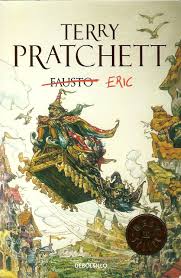
Eric, by Terry Pratchett, (Discworld 9) 1990

Eric, the ninth Discworld novel, was originally published as a Discworld story to distinguish it from its predecessors in the series. It came in a large format with illustrations throughout by Pratchett’s then cover illustrator, Josh Kirby.eric

This is going to make me hugely unpopular with Pratchett fans everywhere, but I have never been a big fan of Kirby’s work on the Discworld covers. For a start the emphasis seems always on under-dressed young women in various states of peril. If this was done tongue in cheek then he might have got away with it now and again, but the covers are essentially childish, and the books are not. I think this didn’t help Pratchett get the recognition his work deserved, and although a new illustrator took over when Kirby died in 2001, by then a lot of the damage had been done. Brandon Sanderson once famously wrote of STP (in an essay which described the Discworld novels as “the highest form of literature on the planet” which even I think it a bit of a stretch) that

“I’m embarrassed by how long it took me to discover Terry Pratchett. I avoided him during much of my early reading career”.

Could it be that Sanderson was put off by the covers perhaps?

(Incidentally, since writing this I have also found this quote from Sir Terry himself on LSpace.org, The Annotated Pratchett file:

The next UK paperback reprint of TCOM (they do a couple a year) will not have a Kirby cover. This is an experiment — there’s been feedback to me and to Transworld that suggests there are a large number of potential DW readers out there who think they don’t like fantasy and don’t get past the Kirby covers.”

Well there you have it.)

Anyway, Eric is now available widely without the art work, as are all the Discworld novels, so each to his own. Eric is a gently humorous retelling of the story of Faust, as the front cover of most editions with the word Faust struck through and replaced by the word Eric leaves little doubt about. It’s part of the continuing adventures of Rincewind, the original Discworld hero, who we left trapped in the Dungeon Dimensions at the end of Sourcery.

Rincewind is summoned out of these dimensions by a teenage demonologist, Eric, who like all teenagers wants to meet the most beautiful woman in the world, live forever, etc. Rincewind is compelled to play the part of the world’s least convincing demon, although strangely he does seem to have powers to fulfil Eric’s wishes. A very unfunny parrot provides a form of chorus as they travel to Klatch, followed shortly behind by the luggage, to Troy, or the Discworld equivalent Tsort, and finally Hell. There’s a ‘doing it by numbers’ feel to the plot, closely following as it does the source story, with only glimpses of the humour and thoughtfulness that characterises a typical Discworld novel. After they escape from Hell – of course – and go on their way, the story pretty much peters out rather than ending with any satisfying conclusion.

Normally I am falling over quotes to use in a post about a Discworld novel – with Eric that’s more of a challenge. For example:

“What’re quantum mechanics?”

“I don’t know. People who repair quantums, I suppose.”

just isn’t that funny, is it, let alone telling us something essential about life as the best STP quotes often do. Or take this below-par use of the word ‘horology’, I hesitate to call it a pun, which only Eric would be amused by:

“The Tezuman priests have a sophisticated calendar and an advanced horology,” quoted Rincewind.
“Ah,” said Eric, “Good.”
“No,” said Rincewind patiently. “It means time measurement.”

“Oh.”

I am not going to labour the point, this was a bit of a dud, and I am going to move swiftly on to the wonders of some of later novels.


Standard
Book review

Pyramids, (Discworld 7) by Terry Pratchett, 1989

As an experiment I tried crowd-sourcing this review. I joined a Terry Pratchett appreciation group on Facebook, and posted the following message:pyramids-cover

Hi all. Quick question – what do people think of ‘Pyramids’? I am writing a review and my initial impression is that it is one of STP’s less successful books in the series, but struggling to pinpoint why. There’s some great lines and ideas, but it just doesn’t take off. What do people think?

I received over 100 replies (and counting) which was amazing – this is obviously a really vibrant online community. Given this was a group for fans of all-thing Discworld, it is hardly surprising that most of the comments were along the lines of “amazing” and “wonderful”. At the same time it’s hardly in the spirit of crowd-sourcing to only selection for quotation those comments I agreed with – I may have well just written my own review in the first place!

Quick plot summary for context – Pteppic, the crown prince of Djelibeybi (one of the better jokes in the book) is a trainee at the Assassins’ Guild in Ankh-Morpork. On the death of his father he returns home to become king, and oversee the construction of his father’s tomb, the biggest pyramid ever built. it’s not all fun as a living god however – the high priest Dios acts as voice of the king, and doesn’t allow Pteppic to make any decisions for himself.

The ancestral pyramids covering most of the country are used to control time in the kingdom, apparently, and in a scene that you just have to accept, the new pyramid, being built with magic, is so large that it causes some kind of space/time anomaly. Djelebeybi rotates out of alignment with the rest of the world by ninety degrees. Pteppic and his handmaiden Ptraci travel to neighbouring Ephebe to try and find a way of recovering the kingdom, while back in Djelibeybi the Old Gods and all the late kings come back to life, causing chaos. With the help of a mathematically advanced camel, Pteppic manages to put things back to right and all is well with the Disc.

So back to these readers’ comments. Positive comments first. There is a consensus here that the jokes really work, the ideas are great and the characters are believable and interesting. Lots of people tried to explain really engaged with the question I posed about my doubts about the novel (which was really kind actually) which mainly revolved around it being one of the few standalone novels, in a setting which STP didn’t return to. No-one said I was wrong – this isn’t that kind of community.

I really liked it. But I think the books with recurring characters will always have an edge as favourites

Love it. Sometimes it has to do with the mood you are in. Try again in a year.

It’s better on the second read through. Not his best, but not bad by any stretch.

I think as a stand alone discworld novel its great, like Reaper Man or Small Gods. However because the witches, the Watch (my personal favourite) or Rincewind appear in multiple books you have more time to get to know them and so you care more about them. Just a hypothesis based on opinion though

Love the book. Possible the reason it “less successful” is that there is not seque, As with Vimes or the witches books. As a stand allow or is as strong as any.

I love it. Its take on organized religion and the nature of belief is spot on.

I really loved it, one of my favourites. Teppic is a great characters and Dios is one of STP’s best written antagonists in my opinion, even if his name is a little on-the-nose.

I love it. That opening sequence (the assassin exam) is exquisite.

I really like it. One issue for me as a fan is that I like the relationship that develops as characters mature through the cannon. As a stand alone book it feels more superficial because of the need to establish the characters.

One of my favourites actually. Of course we all have different tastes and they often change over time.

It’s one of my favourites, possibly because it is one of the first times the theology of the disc becomes explicit.

One of if not my favourite. love the detail and so many jokes

One of my favourites, it was the second I read after small Gods. I think the standalones are a good entry point. And a bit of religion and mythic philosophy were very appealing to teenage me

Loved the school stuff! One of my favourite passages of any discworld books 👍

You Bastard (the camel) is one of my favourite characters.

These were the comments that were generally negative, and tried to explain why:

I agree, and I blame inferior characterization. Ptepppic is no Moist von Lipwick, Ptraci is no AdoraBelle, Dios is no Vorbis. Hence their verbal and dramatic interactions don’t stand up to comparison with later novels. Nonetheless, I re-read it … and my initial dislike lessened. A not-quite-so-good Pratchett novel is better than anything else.

I have just finished rereading this in my chronological reread, and I agree that it’s not his best. It has some good ideas, but for some reason the whole just doesn’t gel. It feels like he raced through it to meet a deadline. It especially suffers in comparison to Guards! Guards! which comes after it.

They don’t quite work together cohesively as a theme, I think. The assassins are great, the camels are great, Ephebe is great, all the Djelibeybi jokes are great… But nothing really ties them together thematically except the plot.

One of my least favourites. Didn’t find myself rooting for the characters. Didn’t understand what was going on a lot of the time.

Just rereading and think it’s the lack of familiar characters. It makes it hard to latch on to.

My “least favourites” tend to be the early ones where the plot and characters are mostly there to serve the jokes. I think Pyramids qualifies. At times, it’s like the really good pun or silly name is hard-elbowing its way past everything else.

It’s not one of my favourites but I do like it a fair bit. It’s one of the few of his books that doesn’t really flow as a whole story and feels a bit more like the storyline could have been created by another author.

Interesting that you asked. It was my 7th or 8th one from the series and I thought it was so boring and dumb I stopped reading his books for a few years. Would not recommend it.

For me, it is one of my least favourites. Although I do like Dios as a character, the book seems to be either a bit too stretched, as in thin in the middle, the beginning and the end are fun and go along at a decent pace, but the middle just loses something for me. I trend to have the same reaction to small gods and moving pictures however.

Not my favourite. I think it is because there isn’t a character I really care about.

There are some really good points here – even STP not at his best is still worth reading – but what is interesting is that people seemed to agree that the lack of familiar characters and settings – or characters that were to go on to become familiar – was an issue.

My sneaking suspicion is that Sir Terry would have happily accepted that this wasn’t his finest hour, which is why he never returned to these characters. It’s not that its a dud, it’s just not quite at the same standard as most of his other work. There are some jumps in the logic of the story where the reader just has to do a little too much work. But I would also agree with many commentators that the Assassins’ Guild examination chapter is worth the purchase price of the novel on its own.

Standard
Book review

Early Riser, by Jasper Fforde, 2018

This is a really welcome return to writing ffor Fforde after a ffour year hiatus. (sorry).

I am guessing, but my suspicion is that his inspiration for this novel was the question “What if the last Ice Age had not finished when it did?” We know that human evolution – or probably more accurately the development of human civilisation – was profoundly affected by the most recent Ice Age. It can’t be a coincidence that the glaciers began to retreat around 11,700 years ago, and we can start to trace the rise of civilisation as we know it from around 10,000 years ago. But what if the ice had never gone away – what would human civilisation look like?fforde

Fforde builds his world around this premise, or something very similar to it. In this chilly world humans hibernate, and it is part of his slow reveal technique that it is not until around 250 pages in that we discover what we should have probably already worked out, that humans have retained body hair more akin to our monkey cousins than our current-day down.

This world is shown through the eyes of Charlie Worthing, a trainee Night Consul. The Night Consuls are a police force who maintain order while 99% of the population sleep through the winter, protecting the sleeping from the Villains and others who choose not to hibernate. Charlie is very much the innocent abroad, who tries to do the right thing but is constantly stumbling into situations where his presence is at best a complicating factor.

In this alternative world, death during the winter is a frequent occurrence, not just for the Night Consuls. Go to sleep thin and you don’t wake up. The drugs people take to stop calorie sapping dreams can also take their toll, leaving some survivors as little more than brain dead and very hungry zombies. Charlie’s first job as a consul is to escort one such walker to a research facility, and when his companion is stolen, Charlie goes in pursuit, setting off a chain of events that cause mayhem in this sector of snow-bound Wales.

Fforde’s world building is wonderful – he has really given a huge amount of thought to what life in his world would be like. It is in many ways a quite sinister dystopia – fertility rights are traded down generations for example. He has also created a detailed vision of what dream manipulation might look like. As a detective story the novel is slightly less successful – Charlie is a hapless hero who is always on the spot when someone else is blown away by one of the freaky new percussive weapons people have, or predated by one of the WinterVolk – semi-mythological creatures who people the winters, along with the surviving mega-fauna such as mammoths. Somehow he always survives, and for me this pattern became a little predictable – Charlie and A.N.Other character set out to explore mysterious scenario a, b, or c, peril threatens and A.N.Other is blasted to kingdom-come with Charlie watching open-mouthed alongside them.

The novel is chock-full of in-jokes and contemporary references, (and not-so contemporary references – Rick Astley features, for example) and the winter-world  is very recognisable, even if given a tweak. There is a Jane Bond film franchise, with one controversial male casting. References to the Welsh setting and the class war with the English give the novel a very specific set of cultural references that may not travel well – the novel is not yet published in the US, and it will be interesting to see how it is received there.

Quibbles aside, it is fantastic to have Fforde back. I don’t know if Charlie Worthing will be appearing in any sequels – I have a hunch not – but anything he writes is definitely worth reading. Highly recommended. If you haven’t read Fforde before then I also cannot recommend ‘The Eyre Affair’ highly enough – it is brilliant.

Standard