Book review

Goodbye, Mr Chips, by James Hilton, 1934

I knew ‘Goodbye, Mr Chips‘ from the faithful-to-the-book and gentle 1939 film version of the story, featuring Robert Donat. (A later film version, a musical no less, starring Peter O’Toole bears very little relation to Hilton’s story). It is a charmingly nostalgic portrait of a retired schoolmaster looking back over his life, but has some unexpected depths to its discussion of imperialism and jingoism.

Mr Chipping is a classics teacher (Latin and Greek) at Brookfield, ‘a good school of the second rank‘. Brookfield is a public (that is, fee-paying) boarding school set in the English countryside:

Across the road behind a rampart of ancient elms lay Brookfield, russet under its autumn mantle of creeper. A group of eighteenth-century buildings centred upon a quadrangle, and there were acres of playing fields beyond; then came the small dependent village and the open fen country.

Told in retrospect from his retirement and old age, Goodbye Mr Chips is his recollection of the years spent teaching generations of young boys. Cleverly it is also a commentary on the changing times that Mr Chips lives through, from the mid-nineteenth century to the early nineteen-thirties. A recurring feature is that many of his students go on to die in various imperial wars:

Dear me, I remember Collingwood very well. I once thrashed him—umph—for climbing on to the gymnasium roof—to get a ball out of the gutter. Might have—umph—broken his neck, the young fool. Do you remember him, Mrs. Wickett? He must have been in your time.” Mrs. Wickett, before she saved money, had been in charge of the linen room at the School. “Yes, I knew ‘im, sir. Cheeky, ‘e was to me, gener’ly. But we never ‘ad no bad words between us. Just cheeky-like. ‘E never meant no harm. That kind never does, sir. Wasn’t it ‘im that got the medal, sir?” “Yes, a D.S.O.” “Will you be wanting anything else, sir?” “Nothing more now—umph—till chapel time. He was killed —in Egypt, I think….”

At another time, reminiscing with his housekeeper, Chips remembers two other students:

“And that affair about the rat that Dunster put in the organ loft while old Ogilvie was taking choir practice. Ogilvie was dead and Dunster drowned at Jutland”

There is also a tragic scene where a student is worried his father has been lost on the Titanic – look at the sad final line. Chips chastises a child because his work that day is not up to scratch:

“Grayson, I don’t want to be—umph—severe, because you are generally pretty good—umph—in your work, but to-day— you don’t seem—umph—to have been trying at all. Is anything the matter?” “N-no, sir.” “Well—umph—we’ll say no more about it, but—umph —I shall expect better things next time.” Next morning it was noised around the School that Grayson’s father had sailed on the Titanic, and that no news had yet come through as to his fate. Grayson was excused lessons; for a whole day the School centred emotionally upon his anxieties. Then came news that his father had been among those rescued. Chips shook hands with the boy. “Well, umph—I’m delighted, Grayson. A happy ending. You must be feeling pretty pleased with life.” “Y-yes, sir.” A quiet, nervous boy. And it was Grayson Senior, not Junior, with whom Chips was destined later to condole.

Chips is a conservative man, resistant to change, and feels threatened by the phenomenon of women exploring increasing freedoms as the century comes to a close:

He did not, he would have said, care for women; he never felt at home or at ease with them; and that monstrous creature beginning to be talked about, the New Woman of the nineties, filled him with horror.

But he then meets a young woman who manages to change his mind and his life:

Her name was Katherine Bridges; she was twenty-five—young enough to be Chips’s daughter.

Chips is 48 at the time. The relationship is described largely from Chips’s perspective and he is untroubled by the age gap. There’s a suggestion that Katherine is aware that it is a little creepier than that – she explicitly compares their relationship to that of teacher and pupil:

On the night before the wedding, when Chips left the house to return to his hotel, she said, with mock gravity: “This is an occasion, you know— this last farewell of ours. I feel rather like a new boy beginning his first term with you. Not scared, mind you—but just, for once, in a thoroughly respectful mood. Shall I call you ‘sir’—or would ‘Mr. Chips’ be the right thing?

Sadly we see far too little of this bright and entertaining character, because Hilton has her die in childbirth soon after their wedding. This is a pity because Katherine brings new life to Chips and indeed to Brookfield itself and challenges many of his preconceptions and prejudices. An example of this is when an exchange visit in planned between Brookfield and a state school in the East End of London. The idea of the exchange is unpopular with the school authorities and underlying their objections is some fairly obvious class prejudice, but she argues passionately for the visit to go ahead, claiming:

“Chips,” she said, “they’re wrong, you know, and I’m right. I’m looking ahead to the future, they and you are looking back to the past. England isn’t always going to be divided into officers and ‘other ranks.’ And those Poplar boys are just as important—to England—as Brookfield is.

His brief relationship with Katherine, cut brutally short, makes Chips re-evaluate many of his ideas. He becomes something of a radical or free-thinker. During the Boer war he challenges the populist anti-Boer sentiment:

It was typical of him that he did not share the general jingo bitterness against the Boers. Not that he was a pro-Boer—he was far too traditional for that, and he disliked the kind of people who WERE pro-Boers; but still, it did cross his mind at times that the Boers were engaged in a struggle that had a curious similarity to those of certain English history-book heroes—Hereward the Wake, for instance, or Caractacus. He once tried to shock his fifth form by suggesting this, but they only thought it was one of his little jokes.

Although he is not an entirely reformed character and is caught making what we can infer is an Anti-Semitic jokes about one of his students:

Once Chips had got into trouble because of some joke he had made about the name and ancestry of a boy named Isaacstein.

Later he outrages the school by expressing sadness at the news of the death of the school’s former German master on the Western Front, despite the fact that he is killed fighting for ‘the enemy’. Expressing sympathy for the loss of a former teacher who fought for his homeland was one step away from treachery, but by this time Chips is virtually irreplaceable at the school, the majority of masters of fighting age having joined up, so the indiscretion is overlooked. Hilton gives Chips a nobility that comes from old-age and having lived through tragedy. Slowly Chips becomes a sage-like observer of the breadth of English history, including the end of the Victorian era and the birth of a new century:

He had been left a vision that grew clearer with each year—of an England for which days of ease were nearly over, of a nation steering into channels where a hair’s breadth of error might be catastrophic. He remembered the Diamond Jubilee; there had been a whole holiday at Brookfield, and he had taken Kathie to London to see the procession. That old and legendary lady, sitting in her carriage like some crumbling wooden doll, had symbolized impressively so many things that, like herself, were nearing an end. Was it only the century, or was it an epoch?

After his retirement, Chips’ career has one last flourish. He returns to the school, never having really left, to return to teaching and eventually become acting Headmaster when the current head and most of the teaching staff volunteer or are conscripted for the Front. The years and the major historical events begin to speed past:

1915. Armies clenched in deadlock from the sea to Switzerland. The Dardanelles. Gallipoli. Military camps springing up quite near Brookfield; soldiers using the playing fields for sports and training; swift developments of Brookfield O.T.C. Most of the younger masters gone or in uniform. Every Sunday night, in the Chapel after evening service, Chatteris read out the names of old boys killed, together with short biographies. Very moving; but Chips, in the black pew under the gallery, thought: They are only names to him; he doesn’t see their faces as I do…1916… The Somme Battle. Twenty-three names read out one Sunday evening.

Goodbye Mr Chips is an enchanting portrait of that special brand of teacher that leaves a lasting impression on their students. It is warmly nostalgic for the pre-War years that are only hinted at in the story’s closing paragraphs – even in 1934 the storm clouds massing over Germany were hard to ignore. And while the story is nostalgic it is honest about cost of the first world and earlier wars and about the challenges the new century brought to many people.

Goodbye, Mr Chips, by James Hilton, 1934

Aside
Book review

The Harpole Report, by J L Carr, 1972

I am a great admirer of J L Carr, particularly his 1980 novella A Month in the Country, and therefore my expectations for The Harpole Report were high. While it doesn’t reach the heights of A Month, on its own terms this was an enjoyable little novel. It is told in the form of report by an unknown author, commissioned by Harpole himself into his last term as a teacher. This ends up being simply a framing device rather than the more ominous introduction to a report into a serious incident – it never really becomes clear why the report is required, but by the time that becomes apparent the reader cares little for that minor anachronism. The report’s author uses and quotes from a wide variety of sources, including the school logbook – a kind of official record or diary – as well as correspondence, diaries, and other official and less than official sources.

Stories set in schools are usually written for children, be it the slapstick comedy of St Trinian’s and St Custards, or adventures in the manner of Enid Blyton and her successors. I can’t recall reading another novel told from the perspective of the long-suffering teaching staff. This novel is grounded in personal experience – Carr was a primary school teacher for almost 40 years, including 15 years as a Head. It opens with his avatar, Harpole, being temporarily given the headship of the Church of England primary school of Tampling St. Nicholas. The setting is the early 1970’s, at a point where much of education was still dominated by attitudes from the pre-war era (Tampling is described as being “run along the lines which were the height of fashion when Chadband (the former head) was trained in the 1920s by men who learnt their educational practices in the early years of the century”) and progressive attitudes towards education were hard to find. Corporal punishment, even for younger children, was commonplace, the curriculum unchanged for decades, and schools still maintained a ‘backward class’ taught by an untrained teaching assistant.

Harpole makes some tentative attempts to modernise the school, moves that are fiercely resisted by the Education board, his teaching staff, his recalcitrant janitor, and the parents. Some of the minor battles, such as whether to fly a flag at the start of each school day, are lost, but slowly through stubbornness and dedication Harpole begins to get his way. The ferocity with which Harpole’s attempts to drag the school into the modern era are resisted prove the source for much of the novel’s comedy.

In addition to completing the school log, Harpole keeps a personal journal revealing more detailed information which he often wants to keep out of the official record. Although many of his innovations are modest at times he shows signs of what could almost be described as radicalism. He proposes that caning be abolished – which provokes a response accusing him of encouraging “acts of the utmost depravity” – and that students stop referring to teachers as ‘Sir’ and ‘Miss’. Each proposed step forward is met with fierce resistance, not least from the education authorities that see him as a trouble-maker. Even a simple request for a new blackboard is met with astonishment at his effrontery. Despite this resistance he slowly begins to reform his school, encouraging outside visits for each class, (which inevitably go disastrously), securing support for some of his children who are being mistreated at home, and winning the confidence of his staff.

Two sets of correspondence are threaded through the narrative. Harpole’s letters to his fiancé, Edith Wardle, unanswered apart from her ‘Dear John’ telling him she has found love elsewhere, are dominated by details of his missing spanner – it’s not hard to see why she moved on. His place as teacher of the Scholarship class, a group of students identified as having the potential to pass the 11+ and go on to grammar school, has been taken by a supply teacher and recent Cambridge graduate, Miss Foxberrow. her letters to her sister are full of her lively independence of thought. References to Harpole are initially mocking, but her admiration for him slowly grows, particularly when he confronts a parental bully, Mr Bullitt. beating him with a cricket bat. Immediately after the fight she describes her reaction:

“a great hush had descended on the building and it was evident that all lessons had ceased and everyone was listening in petrified rapture. GH then turns towards me his eyes positively glittering, and hackles rampant (with me quite limp with adoration and the joyous expectation of being dragged off to his cave and debauched).”

There is a hint of the origins of A Month in the Country in the scene when Harpole and Miss Foxberrow are out in the country on a date of sorts, visiting a remote church in Ferry Farthingale in the sea-marshes.

“She then pointed out an area of decomposed painting above the nave arcade. This showed three ancient lords in fine raiment parading in a field of lilies and the three same, naked (with even the hair around their parts scorched off) in a fiery furnace.

This medieval wall painting is precisely the type of relic that Birkin is employed to restore. The fruition of George and Emma’s relationship in such unlikely circumstances is one of the many delights of the book. If you haven’t discovered J L Carr yet, this might not be my recommended starting point, but on its own terms it is a witty and enjoyable novella.

The Harpole Report, by J L Carr, 1972

Aside
Book review, Charles Dickens, Nicholas Nickleby

Nicholas Nickleby, by Charles Dickens, 1838-9

In her reading diary Jacob’s Room is full of books’ Susan Hill describes her habit of reading one Dickens novel a year. This struck me as an eminently sensible habit – if you tried to read them all in one you would go a bit mad, and I suspect the novels would start to bleed into one another. One a year on the other hand allows plenty of time for other reading and would leave most readers with a realistic prospect of working their way through the whole canon. So I thought I would give this practice a go, starting with one of the more accessible novels, ‘Nicholas Nickleby’.nn

Nicholas Nickleby’ was Dickens’s third novel, published in monthly instalments over 18 months in 1838 and 1839. In many ways it is quintessential Dickens. Almost all of the features of a typical Dickens novel appear – the episodic switching between narrative threads, the mysterious stranger who reveals a long buried secret, fortunes lost and re-won, child-like romances, and the long drawn out death of consumptive innocents. Probably the one other most distinctive feature of all Dickens’ work is his concern with social justice. This aspect of his work is already fully formed in this novel, as for example here in this extraordinary meditation by Nicholas:

But now, when he thought how regularly things went on, from day to day, in the same unvarying round; how youth and beauty died, and ugly griping age lived tottering on; how crafty avarice grew rich, and manly honest hearts were poor and sad; how few they were who tenanted the stately houses, and how many of those who lay in noisome pens, or rose each day and laid them down each night, and lived and died, father and son, mother and child, race upon race, and generation upon generation, without a home to shelter them or the energies of one single man directed to their aid; how, in seeking, not a luxurious and splendid life, but the bare means of a most wretched and inadequate subsistence, there were women and children in that one town, divided into classes, numbered and estimated as regularly as the noble families and folks of great degree, and reared from infancy to drive most criminal and dreadful trades; how ignorance was punished and never taught; how jail-doors gaped, and gallows loomed, for thousands urged towards them by circumstances darkly curtaining their very cradles’ heads, and but for which they might have earned their honest bread and lived in peace; how many died in soul, and had no chance of life; how many who could scarcely go astray, be they vicious as they would, turned haughtily from the crushed and stricken wretch who could scarce do otherwise, and who would have been a greater wonder had he or she done well, than even they had they done ill; how much injustice, misery, and wrong, there was, and yet how the world rolled on, from year to year, alike careless and indifferent, and no man seeking to remedy or redress it; when he thought of all this, and selected from the mass the one slight case on which his thoughts were bent, he felt, indeed, that there was little ground for hope, and little reason why it should not form an atom in the huge aggregate of distress and sorrow, and add one small and unimportant unit to swell the great amount.

This is classic Dickens, with its clinical and yet at the same time passionate dissection of the social ills of Victorian Britain, but sadly also without offering any hope or constructive solutions. Yes the bad guys always come to a messy end in his novels, either the gallows, deportation or similar, and the central characters find happiness and prosperity through the bequests of long lost relatives, but the poverty disease and degradation are still all there.

The other source of enjoyment I find in Dickens is his wonderfully perceptive portraits of the fallibility of human nature. In this he probably has no peer other than Jane Austen. Mrs Nickleby is a particular favourite, bringing to mind her obvious predecessors Mr Woodhouse and Mrs Bennett, where the author’s use of reported speech conveys the full impact of her rambling complaints, without us having to work our way through them all:

To this, Mrs. Nickleby only replied that she durst say she was very stupid, indeed she had no doubt she was, for her own children almost as much as told her so, every day of her life; to be sure she was a little older than they, and perhaps some foolish people might think she ought reasonably to know best. However, no doubt she was wrong; of course she was; she always was, she couldn’t be right, she couldn’t be expected to be; so she had better not expose herself any more; and to all Kate’s conciliations and concessions for an hour ensuing, the good lady gave no other replies than Oh, certainly, why did they ask her?, her opinion was of no consequence, it didn’t matter what she said, with many other rejoinders of the same class.

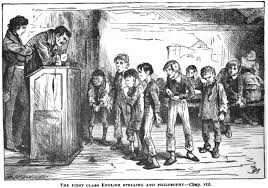
There’s no denying the fact that Dickens’s villains are two dimensional, with very few shades of grey in their character, but what wonderfully wicked villains they are. Even if you have not read any Dickens, you will be able to get a good idea of the character of the schoolmaster Wackford Squeers simply through his name alone.

So why isn’t ‘Nicholas Nickleby’ considered in the top rank of Dickens’ work? That assessment is open to debate of course, but I think it reflects a consensus. Dickens had five novels in the BBC Big Read list of the 100 most loved novels (‘Bleak House’, ‘A Tale of Two Cities’,David Copperfield’, ‘Great Expectations’ and ‘A Christmas Carol’) but Nickleby was omitted. My theory is that this is because the scenes of peril in the novel are rarely sustained. The dangers characters face at different points is never very serious, and is usually resolved quickly. (This is reminiscent of the ‘fake’ deaths at the end of many Disney films: the scene in which a character appears to die, only to revive moments later is a feature of many children’s films, and it is a very reliable rule that the quicker they revive (think of Baloo surviving the fight with Shere Khan in ‘Jungle Book’, or the brief moment in ‘Robin Hood’ when we think he has been shot with an arrow and drowned) the younger the target audience.

From this perspective Nicholas lives a charmed life. When his father dies unexpectedly, rather than ending up in the workhouse, his family has a rich uncle Frank to turn to. He easily gets a job as a teacher despite his lack of qualifications. While Dotheboys Hall is a nightmarish place for the boys, for Nicholas it is far less uncomfortable, and when his patience is pushed too far he can simply beat Wackford and walk away, something of which the boys can only dream.

His sister Kate and their mother are given lodgings free of charge by the villainous uncle, and Kate is found a perfectly respectable job as a milliner’s assistant. When this does not work out another equally respectable job, as a lady’s companion, appears quickly enough. The trauma of the subsequent assault on Kate by Sir Mulberry Hawk is obviously serious, but is quickly stopped by Ralph.

Nick’s good fortune however continues. He finds a job on the stage in Portsmouth and debuts almost immediately as Romeo. Later, compelled to return to London, he again finds well-paid work straight away with the lovable merchants, the Cheeryble the brothers. Nicholas has been accompanied on his adventures by Smike, an orphan runaway from Dotheboys. Smike has the misfortune to run into Squeers, who kidnaps him, but is rescued within hours. A subsequent attempt to reclaim Smike by the use of forged documents to the effect that he is the long-lost son of a man named Snawley is avoided by the simple expedient of ignoring it.

Inevitably, romantic interest intervenes. Nicholas nobly tries to avoid making Madeline Bray, the penniless daughter of a debtor, fall in love with him, but it comes as no surprise when this plan fails. There is a far-fetched plan to marry Madeline off to Arthur Gride, an early iteration of Fagin, in return for the promise of paying off her father’s debts to be foiled. This scheme falls apart on the day of the wedding when her father drops conveniently dead. The happily-ever-after then comes in a rush as all the plots against Nicholas fall away as so much background noise.

There is much more sustained threat in Dickens’ later novels. Imagine how more scary being a pupil at Dotheboys would have been compared to being a master? Indeed, Dickens gives us this comparative experience himself with David Copperfield’s experiences at Salem House, and those of Oliver Twist in the workhouse. Ultimately, this lack of genuine peril is what makes this novel considered suitable for children. if you are looking for an introduction to Dickens for a younger reader this is an excellent place to start.


Standard