Book review

I know my review of Jacobson’s The Finkler Question was probably a bit harsh, so I thought I would give him another try. I’ve had Redback on my book shelves, sitting unread and unloved for goodness knows how long, so it seemed an obvious supplemental read to Finkler.

Jacobson isn’t alone amongst novelists for mining his past for material in his early novels. Redback‘s central character, Karl Leon Forelock comes from the northern English town of Partington, the wettest spot in Europe (Jacobson grew up in Prestwich which is in Greater Manchester). Partington is the most depressing, crime ridden and deprived town in the universe – Jacobson obviously didn’t have particularly happy memories of Prestwich! Forelock somehow manages to gain a place at Cambridge, eventually graduating with a double starred first in Moral Decencies from Malapert college. (Jacobson went to Downing College where he studied English, and emerged with the slightly less impressive 2:2). After university Forelock secures funding from the CIA to go to Australia. It’s never clear what he is supposed to be doing for the CIA there – there’s no-one in particular to spy on, and all he seems to do is go to parties. The publisher’s summary of the novel says his role is to “teach the Australians how to live” which is meaningless surely? Anyway, it gives Jacobson a reason to take his character to Australia where Jacobson himself spent three years teaching, and this is where the majority of the events of the novel take place.

The novel’s descriptions of the Australian wildlife and way of life is tired and cliche-ridden – we know Australian abounds with dangerous and poisonous animals. Australians probably wouldn’t mind the novel’s portrayal of themselves as heavy drinkers and uncultured but again no cliche is left on the shelf. As the novel’s publisher puts it: “Leon quickly discovers that there are some natives who believe that they have an education to pass on in return. But it is at the hands of the women in Australia that Leon receives his most painful, and on occasions his most pleasurable, lessons.” Which sounds awful doesn’t it? They are trying to promote the novel as a sex comedy, and while there are element of ‘Carry On Down Under’ about the whole affair (Forelock has a prolonged menage a trois with a pair of enthusiastic Australian synchronised swimmers for example) the comedy has not aged well.
Throughout the novel the narrator (Forelock) refers every few pages to his having received a bite from a Redback spider that drastically changes his character and outlook on life (although sadly not his attitudes towards women):

in a foul, dilapidated bush privy, way up in the Bogong high plains, the Redback sucks her teeth and waits her turn.

This bite only comes at the very end of the novel, and it’s not clear why it changes his character, in what way, and why the reader should care. If this is symbolism for a traumatic and transformative experience then I am not sure what it stands for, but by this point I didn’t care either.

The blurb to the Bantam Press hardback edition of Redback claims that “the author is the most devastatingly funny novelist writing in English today” Not “one of the most devastatingly funny writers” but “the most devastating”, and not just of English writers but of those “writing in English”. That was a bold claim given that in 1987 when this novel was first published Douglas Adams was writing the Hitchhikers Guide to the Galaxy, Terry Pratchett was writing The Colour of Magic, and Stella Gibbons, Kurt Vonnegut, Joseph Heller and Sue Townsend to name just a few were still active. Kingsley Amis to whom Jacobson owes the most obvious debt had just won the Booker Prize for The Old Devils. If that hyperbole wasn’t enough, the blurb back page also quotes the Sunday Times as describing Jacobson as “the most dangerously funny writer in the English language”, a quote that is still used on the book’s listing on Amazon and elsewhere to this day, although I wasn’t able to track it down to source. I know ‘quite amusing but not laugh out loud funny’ wouldn’t have sold as many books, but it would have been a lot more honest.

One of the principles of comic writing Jacobson outlined in his speech to the Royal Literary Society I referenced in my previous post was not to give your characters ‘funny’ names, because Dickens had used them all. This was obviously a lesson learnt from experience, because almost all the characters in Redback have unfunny funny names: Montserrat Tomlinsom, Vance Kelpie, Hartley Quibell, Ruddles Carmody, etc, etc. The comedy is also very crude at times, not least in the novel’s opening anecdote when undergraduate Forelock meets “a wholesome young Australian girl with powerful mandibles and an MA in fine art“. They hit it off, but in his rooms later that evening, “after a heavy supper of pasta and fishthe chemistry decides to play up” and the sex misfires. “He falls asleep on his back with a fart and sweats and snores“. He wakes in the morning, “relieved to discover that the girl has gone; but an odd feeling, an unaccustomed tingling of the skin, a sensation of discomfort and unease around the heart, causes him, still on his back, to cast an eye over his person, whereupon he finds that she has left a little memento of herself – a Freudian gift, hard, compact, warm, in its own way perfectly formed, a faecal offering smelling of fish and pasta (of tagliatelle marinara) – nestling amongst the soft hairs of his chest, only inches from his gaping mouth.”

If you find that funny, Redback might be the novel for you. But I found it entirely forgettable – I only finished a few days ago but in the course of writing this review had to go back and check how it ends (did I really finish it?) only to find that it doesn’t really end at all, it just peters out. Like this review.

Redback by Howard Jacobson, 1987

Aside
Book review

Pnin, by Vladimir Nabokov, 1957

Goodreads tells us that Pnin is one Nabokov’s “best-loved novels” and that it “features his funniest and most heart-rending character”, comments that I have to say gave me pause for thought. Published just after Lolita, Pnin is apparently the novel which established Nabokov in the public mind, or at least that much of it that exists in America. It follows the titular Professor Timofey Pnin, a comically disorganised Russian émigré lecturer working at an American college in the 1950’s. Pnin is an everyman character struggling with the challenges of everyday life – driving a car, taking a bus, hosting a drinks party, and not least the complexities of the English language. As you would expect with Nabokov the novel features a slightly sinister narrator who is far more than just unreliable but who towards the end of the novel seems to be actively malevolent towards Pnin. By this stage the reader feels protective towards Pnin, but the peril dissolves without coming to a head.

Image result for pnin

Pnin was first serialized in The New Yorker and then published in book form in 1957.  It is everything Lolita is not – gently comic, uncontroversial in its subject matter, and comparatively straightforward. There are some autobiographical elements – Nabokov was a refugee from Nazi-occupied France, arriving in the USA in 1940, and taught Russian at an American university. I am a massive fan of Nabokov’s transgressive, challenging novels, so there’s no point in trying to disguise the fact that I was a little disappointed in Pnin. I am sure the problem was that I was expecting or hoping for something in the same vein as Lolita (or Pale Fire, another wonderful novel), and the gentle comedy just took me unawares. On its own terms its a perfectly successful novel, it’s just not the Nabokov I expected.

There is an episodic character to the novel, without doubt deriving from its original publication format. Pnin is sensitive to noise and moves from house to house, hoping to find a noise-free environment, but finding each noisier than the last. He tries painfully to be a welcoming host at his little dinner party, but ends the evening with the devastating news that he is being fired. He fails, then passes, his driving test:

“…If he failed the first time he took his driver’s licence test, it was mainly because he started an argument with the examiner in an ill-timed effort to prove that nothing could be more humiliating to a rational creature than being required to encourage the development of a base conditional reflex by stopping at a red light when there was not an earthly soul around, heeled or wheeled. He was more circumspect the next time, and passed…”

It would take a harder heart than mine not to be touched when he throws away the football bought with some difficulty for his ex-wife’s son after finding out he is not interested in sport. Slowly the character of a kind, well-meaning man at odds with the modern world emerges. On its own terms it is engaging and entertaining – I can see how it would have worked in serial magazine form, where there wasn’t time for the understatement to become underwhelming.

I am not sure whether it is best to read Pnin as a companion piece to Lolita, a palette cleanser after the monstrosities of Humbert Humbert, or to try and isolate the two works and read Pnin entirely on its own merits. In practice I suppose the latter is impossible, so the former it is. It is clearly from the same hand as Lolita, showing a command of the subtlest nuances of English which from a non-native speaker is breath-taking. Here’s Pnin recovering from having all his teeth taken out for example:

A warm flow of pain was gradually replacing the ice and wood of the anaesthetic in his thawing, still half-dead, abominably martyred mouth. After that, during a few days he was in mourning for an intimate part of himself. It surprised him to realize how fond he had been of his teeth. His tongue, a fat sleek seal, used to flop and slide so happily among the familiar rocks, checking the contours of a battered but still secure kingdom, plunging from cave to cove, climbing this jag, nuzzling that notch, finding a shred of sweet seaweed in the same old cleft; but now not a landmark remained, and all there existed was a great dark wound, a terra incognita of gums which dread and disgust forbade one to investigate. And when the plates were thrust in, it was like a poor fossil skull being fitted with the grinning jaws of a perfect stranger.”

What an extraordinary collection of imagery packed into that brief paragraph! I can’t quite forgive Pnin for not being another Lolita, but I know it deserves more than that. At just over 160 pages it is the briefest of reads, so perhaps I should return to it when feeling less locked-down and in need for something escapist?

Standard
Book review

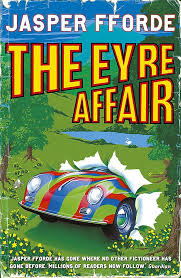
The Eyre Affair, by Jasper Fforde, 2001

When I was drafting my review of Fforde’s recent novel, Early Riser, I planned to refer back to an earlier review of his first published novel, The Eyre Affair – only to find that in fact I hadn’t written it! I must have read this novel before I started my blog, although I have reviewed some of the later novels in what was to go on to become the Thursday Next series.Fforde

The Eyre Affair is a brilliantly original genre-busting novel. It follows the adventures of Literary Detective Thursday Next, on the trail of a genuinely sinister villain, Acheron Hades. The novel is set in a strangely recognisable parallel universe, in which England and Imperial Russia are still fighting the Crimean War, Wales is an independent nation, and where literature is given its rightful value by society (one of my favourite scenes is where Thursday and her on/off boyfriend Landen Parke-Laine go to a performance of Richard III which is a parody of the audience-participation showings of the Rocky Horror Picture Show).

Some of the jokes – a character is called Braxton Hicks, for example – are groan-inducing, but the literary references are very clever. There’s a throw-away joke about Cardenio and the repartee about the Shakespearean authorship “question” for example shows a depth of knowledge and love of literature you won’t find in many mystery/adventure/detective novels, let alone comedies.

Thursday is a strong central character around which Fforde builds his narrative. She is a veteran of the Crimean war, where she lost her brother in a modern version of the Charge of the Light Brigade. She is in the career doldrums when she is unexpectedly recruited to track down criminal mastermind Acheron Hades, her former university professor.  Hades is a formidable and ruthless criminal, kills without hesitation or any trace of remorse, and nearly kills Thursday herself until the fortunate intervention, and this is where it gets really wild, of Mr Rochester from Jane Eyre. Yes, that Mr Rochester. Because in this universe it is possible, somehow, to move from the world of literature to what I am going to refer to as the round world, and vice-versa.

This fluidity between worlds allows Thursday and others to intervene in texts and change their outcomes. Some of what happens to Thursday, such as the supernatural message that leads her to change her life, is paralleled in the events of Jane Eyre, but Thursday is no Jane. She is not a passive figure but a woman of action and ideas.

Fforde’s achievement is that he doesn’t just parody genres, he delivers a series of interwoven narratives that all succeed in their own right. The detective story is an enjoyable mystery; the adventure elements are exciting, and the romance between Thursday and Parke-Laine, albeit kept in the background, is believable and touching, and plays its part in the novel’s finale. Fforde’s world building relies on the contrast between the familiar and the bizarre – for example in this world the dodo has been genetically re-engineered. Best of all, for me, were the literary jokes, which are done with respect for the source material. Both of the novel’s endings, one in Jane Eyre, the other in the ‘real world’ are borrowed from the Bronte text but with a clever twist.

Basically, I loved it. I can’t understand why it’s not been adapted for television I will never know, I can see it working brilliantly.


Standard
Book review

Where Angels Fear to Tread, by E M Forster, 1905

I first read Forster’s ‘Where Angels‘ forty years ago as one of my ‘O’ level texts. It was interesting to reflect on what I remembered and what had not survived the loss of brain cells over the years. The basic plot outline was still there, although the ending came as a pretty unpleasant surprise. Strangely one sentence about the novel’s protagonist, Philip, one of the fools rushing in where angels fear to tread, remained crystal clear:

“He might be a puppet’s puppet, but he knew exactly the disposition of the strings”.

This was the type of quote that we all were taught to underline and memorise, as a key to understanding Philip’s character. Looking back I am not so sure it works that way, although certainly Forster suggests as much by the heavy handed language (in what way is Philip a puppet’s puppet – who is the puppet who is controlling him – his mother? Hardly a puppet surely, more a very headstrong woman, another fool rushing in without thought or consideration. And ‘he knew exactly’ rather than ‘he knew the exact’ is a clumsy formulation which again serves to make the sentence stand out.)

‘Where Angels’ is a slight novel, chosen I suspect as an ‘O’ level text because of its length rather than any particular intrinsic literary value or its interest to teenagers. Lilia Herriton is widowed in her early thirties, and undertakes a Grand Tour of Italy at the suggestion of her in-laws, who appear keen to get rid of her for a while, despite the fact that she leaves behind a young daughter, Irma. Her travelling companion, Caroline Abbott, a younger single woman, is intended to act as a chaperone, but fails miserably to prevent Lilia from falling in love with and marrying a much younger Italian man, Gino. The Herriton’s suspect Gino is a Mediterranean cad – his father is a dentist for goodness sake!

“A dentist! A dentist at Monteriano. A dentist in fairyland! False teeth and laughing gas and the tilting chair at a place which knew the Etruscan League, and the Pax Romana, and Alaric himself, and the Countess Matilda, and the Middle Ages, all fighting and holiness, and the Renaissance, all fighting and beauty! He thought of Lilia no longer. He was anxious for himself: he feared that Romance might die.” 

(I recognise, of course, that this over-the-top reaction is supposed to be funny, pricking Philip’s pomposity. I am not sure it is though.)

Arguably this is the first of several instances of fools rushing in, but it is quickly followed as Lilia’s brother-in-law Philip hurries to Italy to try to prevent the marriage, arriving too late and leaving ineffectually empty-handed. Philip feels partly responsible for this inappropriate marriage – he was very enthusiastic about the idea of Lilia going on an Italian tour, being something of a connoisseur of all things Italian.

Lilia finds life in Italy much less romantic and interesting than she anticipated – Gino is a stereotypically unfaithful Latin lover, and she is effectively confined to her house in a small provincial town. Forster sometimes uses deus ex machina techniques such as a sudden death to inject drama to his novels, and he succumbs to this plot device again when Lilia dies in childbirth. This felt as if Forster was laboriously setting up the novel’s denouement, getting his pieces in play for the final scene, rather than an integral part of the narrative, and her death is announced casually. The reaction back in England is at first to ignore the new born (who is not a blood relative of the Herritons). Quixotically they change their minds – or more specifically Mrs Herriton, the family matriarch, changes her mind – when she hears that Caroline has decided to go back to Italy to ‘save’ the child from the horror of being brought up motherless, and worse, Italian. Philip follows Caroline accompanied by his scary sister Harriet aiming to gazump Caroline and effectively buy the baby from Gino.

Gino is not interested in selling his son, of course and is planning to remarry to provide him with a mother. In a melodramatic finale Harriet kidnaps the baby and flees for the coast. Racing to meet the train, their coach crashes and the baby is killed. The aftermath of the crash is painful to all. Philip eventually realises that he is in love with Caroline but she is still in love with Gino, having been so all along.

There is a soap opera element to the repeated overnight journeys to Italy and back, the sudden deaths and unsuitable and unrequited romances. In an otherwise positive essay for the Guardian back in 2002, Zadie Smith wrote “there is a lot in Forster that fails, is both cloying and banal” – which made me wonder what she would have said if she really didn’t like his work. I quote her here because this phrase resonated with me – there is a lot in Where Angels that doesn’t work, is sentimental, over-written and dull. When it was first published over 100 years ago the Guardian then called it (again in another not altogether hostile review) “a sordid comedy culminating, unexpectedly and with a real dramatic force, in a grotesque tragedy.” The two elements, humour and tragedy, sit uncomfortably together – the novel is neither a gentle comedy about silly English people and their class distinctions, nor a tragedy about how good intentions can go wrong. Ultimately I found it melodramatic and not in a good way.

Standard
Book review

How Not to Be a Boy by Robert Webb, 2017

How not to be a boy‘How not to be a Boy‘ was promoted as a feminist analysis of masculinity in the UK in the 21st century, how toxic it can be, and how it can be avoided (look at the front cover “Rules for Being a Man” if in doubt – confusingly man not boy). It does indeed contain this analysis, but this goes alongside a very traditional childhood to adulthood rags to riches autobiography. The book was also marketed as unblinkingly honest, one in which Webb confront his demons, looks them in the eye and names them. Again, this is only part of the story – there’s plenty of glossing over of difficult issues here alongside the franker discussions about early homosexual experiences, or his abusive father.

I am sure life wasn’t easy growing up in the Lincolnshire Badlands in the 1970’s and 80’s, fourth son of a forester who was physically abusive towards his mother and older brothers. His parents’ divorced when he was five and his step-dad seems to have been only a minor improvement. He always had the comfort of his grandparents to fall back on, but he grew up in the shadow of the death of an older brother before he was born, and for whom he was in some way a replacement. Webb records in detail a childhood that will seem familiar to a large part of the population, apart from a determination to one day achieve fame through acting or comedy. The death of his mother just before his A levels knocks him off course, although retakes see him securing the place at Cambridge that is principally a way of getting into the Footlights and on that well-trodden road to success. Webb skips over the difficult post-Cambridge years fast forwarding to marriage, Peep Show, Mitchell and Webb, and fatherhood, where the more interesting observations about ‘The Trick’ i.e. patriarchy can be found.

Has Webb got anything original or interesting to say about feminism? Everything he says is undoubtedly valid and supported by clear arguments and evidence. It’s an authentic record of his mistakes and opinions, and as far as it goes that would probably make a worthwhile Sunday supplement article or two. But no, it’s not original. And while the patriarchy made some of his childhood unhappy, he still managed to make it to Cambridge and beyond. I’m not criticising him using his platform for making some useful arguments in favour of men looking after themselves, seeking help, cultivating their friendship group and so on. Even if just one person is helped by this then it is worth doing.

The other, larger part of the narrative, the autobiography, sits (for me) uncomfortably with these observations. He has failed to avoid many of the mistakes he so clearly outlines. Why take advice from someone so skilled at being a traditional male – bad at relationships, bad at looking after himself, bad at even passing exams! While at Cambridge he was obnoxious – his seduction technique for example seems to have been “Get your coat” – and he is horrible, unfaithful and neglectful to the women he dates, all of which he cheerfully admits. None of this makes him easy to like.

My other issue with this book is its dishonesty. For a book that takes pride is being brutally honest, it isn’t. I can completely understand why he would want to avoid giving too much detail for example about his teenage homosexual relationships – the other people or person involved in still alive, now happily married – although the implication that this is in some way shameful or to be avoided is at odds with his claimed comfort with his sexuality and masculinity. Punches are pulled and the soul-searching only goes so far. Later at Cambridge he claims to have done literally no work – not attended any seminars, lectures or supervisions, devoting himself entirely to the Footlights and his romantic affairs – but he somehow emerges with a 2.2, which Cambridge University tends not to hand out for blank pieces of paper. This section of the book is a close copy of Stephen Fry’s account of his time at Cambridge – work heroically neglected, triumphs on stage, some last minute cramming and out pops a good degree. I don’t believe it for a minute. Webb at one point admits to humblebragging – well recognising that you are boasting while pretending to be humble (a chapter about having dinner with Carrie Fisher for example) doesn’t make you any less of a bull-shitter.

Standard
Book review

The Restaurant at the End of the Universe by Douglas Adams, 1980

The Restaurant at the End of the Universe, the sequel to The Hitchhiker’s Guide to the Galaxy, picks up immediately where Hitchhiker ends, with our hapless adventurers under attack from the Vogons, despite there being no tea. Having faced imminent death 220pxRestaurantAtTheEndOfTheUniverse.jpgseveral times before, this causes them less concern that you would expect, and another last minute rescue leads to the party (Arthur Dent, earthling, Trillian, hitchhiker, Ford Prefect, researcher for the Hitchhiker’s Guide to the galaxy, Zaphod Beeblebrox, President of the Galaxy, and Marvin, the paranoid android) being separated once again.

Zaphod and Marvin are transported to the offices of The Hitchhiker’s Guide to the Galaxy on Ursa Minor Beta. Zaphod is determined to trace down whoever left a message in his brain, even if it turns out to be himself. The Guide’s offices are taken prisoner and carried to Frogstar World B. FWB is a benighted planet whose economy has been ruined by a critical mass of shoe shops. The intention is to destroy Zaphod’s mind by sending him into the Total Perspective Vortex, a torture device designed to show people how small they are compared to the size of the Universe. Zaphod emerges unscathed because after all, he is Zaphod Beeblebrox.

Through some trickery with artificial universes, the party is reunited long enough for breakfast at Milliways, the Restaurant at the End of the Universe. Marvin has to take the slow route, parking spaceships while waiting for the humans to arrive (or is it return?). The Restaurant at the End of the Universe is one of Adams’s most magnificent creations. I always loved the selectively bred cow that actually wants to be eaten:

“Four rare steaks please, and hurry, we haven’t eaten in five hundred and seventy-six thousand million years.”

The animal staggered to its feet. It gave a mellow gurgle.

‘A very wise choice, sir, if I may say so. very good…I’ll just nip off and shoot myself.” He turned and gave a friendly wink to Arthur. “Don’t worry, sir” he said, “I’ll be very humane”. 

There’s a very special, poetic aspect to the way the end of the universe is described by the show’s host, undercut by the Second Coming of the Prophet Zarquon. We also get to meet Hotblack Desiato at the restaurant, a rock star spending a year dead for tax purposes. After a further narrow escape from imminent death, this time by diving into a star to provide backing effects for a rock concert, which is to be honest a pretty rock and roll way to go, Zaphod and Trillian get to meet the man who runs the universe, while Arthur and Ford discover the origins of life on earth, and why everyone is so bloody useless (which is probably something to do with the fact that we are all descended from hairdressers and telephone sanitisers).

Adams’ commentary on modern life is razor sharp. I especially enjoyed the way the Golgafrinchams (Ark B) make leaves their currency to disprove the argument that money doesn’t grow on trees, and then tackle their galloping hyperinflation by burning down all the forests. Isn’t that austerity economics for you? I was slightly concerned that Restaurant wouldn’t sustain the brilliance of Hitchhiker, but I shouldn’t have worried. Yes there are some uneven patches – I never quite understand the point of Zarniwoop –  but the concepts are extraordinary and the jokes never miss. Marvin continues to be a paradoxical source of joy (“The first ten million years were the worst,” said Marvin, “and the second ten million years, they were the worst too. The third ten million years I didn’t enjoy at all. After that I went into a bit of a decline”). I think it is best not to see ‘Restaurant’ as a sequel but more as the second half of ‘Hitchhiker’, best read one after the other with as short a break as possible. I am minded not to push on with the third, fourth and fifth books of the trilogy – I absolutely understand why they were written, but there is a certain polished perfection to these two novels that might be tarnished by anything that doesn’t meet their sustained genius. What do people think?

Standard