Five Common Wrongs for English Teachers to Avoid by @JamesTheo

teachingbattleground's avatarStarter for Five

Name: James Theobald
Twitter name: @JamesTheo
Sector: Secondary
Subject taught (if applicable): English
Position: Teacher
What is your advice about? Five Common Wrongs for English Teachers to Avoid

  1. Teaching pupils that a comma is used to mark a pause or to take a breath. Hearing, this, is, enough, to, make, me, hyperventilate.
  2. Using the word ‘connective’ to describe a part of speech. It’s a made-up term used to lump words together into arbitrary groups.
  3. Using the phrase ‘wow word’ to mean ‘sophisticated language’. Unless, of course, you are trying to teach the concept of irony.
  4. Teaching that simple and complex sentences are about length. A well-written simple sentence can often be a long, lingering, meandering piece of carefully crafted epic beauty.
  5. Doing something else when there’s an opportunity to read. If you are studying Shakespeare, the best thing pupils can do is to read some Shakespeare.

View original post

How to teach a book by @JamesTheo

teachingbattleground's avatarStarter for Five

Name: James Theobald
Twitter name: @JamesTheo
Sector: Secondary
Subject taught (if applicable): English
Position: English Teacher
What is your advice about? How to teach a book

  1. Firstly, be a History teacher: spend lots of time teaching social, historical, cultural and biographical contexts. Give pupils something to hang their ideas on when reading.
  2. Next, tap into your inner Maths teacher: identify the patterns – the recurring themes, motifs and symbols. Draw attention to them throughout reading.
  3. Be a Psychology teacher: focus on characters and their intentions. Treat them as studies in humanity. What can pupils learn about the world from them?
  4. Be a teacher of Philosophy: identify the questions the text provokes. Pitch these as ways into chapters/sections or as essay questions in response to the text.
  5. Most importantly, be an English teacher: make sure pupils read lots (including reading outside of the text); plan for pupils to write about what…

View original post 2 more words

What is the point of Speaking and Listening? #BlogSyncEnglish

There has been much hand-wringing over the past couple of years about the place of speaking and listening in the English curriculum. The refrain from English teachers and teaching unions has generally been along the lines of this cri de coeur from Joe Walsh of NATE:

“What is proposed is essentially a downgrading of the importance of speaking and listening skills in the English GCSE.”

And where have teachers placed the blame of this devaluation of speaking and listening? Step forward Michael Gove and the DfE.

The thing is, I’m not so sure that speaking and listening has been devalued. Or at least if it has, Gove and the government aren’t entirely culpable.

When I trained, speaking and listening was a teacher-assessed element of the English GCSE, making up 20% of the overall grade in the AQA specification that my school followed (three tasks in, broadly: presenting, role-playing and discussion).

It might also be worth adding that one of the three pieces of coursework in the concurrent AQA English Literature GCSE was also allowed to be delivered orally too – that piece constituted 10% of the overall grade.

This, one would assume, is the evidence that speaking and listening once had a place of value in English. By removing it from the GCSE and letting it stand alone, we are told, Gove has devalued speaking and listening.

This suggests that the very value of speaking and listening is subjective rather than intrinsic: that its value is only based on the utility teachers and pupils see in it. When the speaking and listening assessment affects a pupil’s GCSE grade, it has value. When it doesn’t, its value is diminished. This seems to also suggest that the value of speaking and listening is ultimately decided by schools, teachers and pupils – even if that decision is provoked by curriculum changes.

But the narrative of a devalued speaking and listening is one that troubles me. It is my contention that speaking and listening may now actually be finding its rightful place in the English curriculum, and that the changes made in the past few years are actually bestowing speaking and listening a more intrinsic value.

When announcing the changes, Ofqual admitted that that there were huge inconsistencies in teacher assessment of speaking and listening. This meant that “in schools where the rules are interpreted differently, or where marking is more vulnerable to pressures from accountability measures, [pupils] may have received extra credit – when grade boundaries were set – for work of the same quality.” This seems a euphemistic way of saying that some schools inflate grades in speaking and listening assessment. Indeed, I did placements in three schools during my training year and was struck by the vast difference in interpreting the grade descriptors. It was clear in one school that they were inflating the grades to give low achieving pupils a better chance of passing the GCSE (they did this with the kindest of intentions – they cared about their pupils and truly wanted the best for them). However, this is anecdotal so we should adhere to a principle of charity and suggest that the majority of teachers weren’t cowing under the pressure of accountability measures and that they continued to approach the assessments with integrity. But even if this is the case, inconsistency is still rife. This is because, as Daisy Christodoulou has suggested:

So even if we think we are rigorous in applying the rules and we take pride in fair and accurate marking, the outcomes probably still aren’t actually fair and accurate.

Of course, speaking and listening in the new GCSE English curriculum is also teacher assessed. However, it seems that exam boards will be taking moderation a little more seriously than they did in the old GCSE. Whilst details are still yet to be finalised on this, it seems that they will be requesting audio-visual recordings of a sample of students from each centre. Moderation in previous qualifications meant that an examiner from your board came in once every five or so years and schools handpicked a few pupils to do a speaking and listening assessment in front of them. As a process of moderation, it was a fleeting nod to the idea of rigour.

I would hope that, with the new assessment, schools will produce audio-visual recordings of all pupils’ tasks for internal moderation. I think this will have the further benefit of bestowing a sense of formality about the speaking and listening ‘examination’, suggesting that we as schools value this strand of our subject highly. In this sense, it will still down to schools to decide on the value of speaking and listening. If we take it seriously then we are saying: this has value.

We really need to stop the hand-wringing and the ‘think of the children’ arguments like this one: “For some, these S&L activities have been proud moments, huge hurdles to overcome, only for their grades to become worthless.” Their grades are only worthless if schools and teachers don’t value them.

However, it isn’t solely down to us. I actually think that in separating the assessment from the GCSE grade, Gove, the Dfe, Ofqual – whoever you want to hold responsible – have brought out a more intrinsic value in speaking and listening. It no longer has subjective value as a component part of the GCSE. In previous qualifications, it was hidden away: once the exam certificate was printed all we could see was the overall English grade. But now speaking and listening has achieved independence. Future GCSE certificates will give a grade for English (reading and writing, still enmeshed) and a separate grade for speaking and listening. Potential suitors (colleges, employers, etc.) can now see exactly how well their petitioner has demonstrated verbal communication within the context of formal education. As a former of employer in an industry of mainly customer-facing roles, I would have found this incredibly useful.

So to suggest that separating the speaking and listening from the GCSE is downgrading it seems absurd to me. I think that, finally, speaking and listening may have been elevated to its rightful place.


The Reconciliation of The Debate (Is it possible? Is it desirable?)

Yesterday, I wrote a blog about how important debate around the distinct philosophies of teaching has helped me. I’ve had some really positive responses to it, but I thought it particularly pertinent that a large number of people echoed my experiences of watching and taking part in the debate. By way of showing the extent of the debate and how it has helped shape a number of teachers’ understanding of their practice, I thought I’d share some of the tweets where people claim to have undertaken a similar journey to me. I think this shows how important and useful the debate has been.

https://twitter.com/MrHistoire/status/683346276008751104

https://twitter.com/Debsgf/status/683360414369972229

https://twitter.com/emma_teacher/status/683362279153348609

https://twitter.com/mr_chadwick/status/683598937970860032

https://twitter.com/A_R_Kerrigan/status/683602159510892544

There have been some really thoughtful blog posts on this topic too:

Can a false choice be an object of research? by Greg Ashman

Varieties of boredom by David Didau

Boredom by Toby French

Dangerous Conjectures by Horatio Speaks

Shutting down debates by Rory Gribbell

The Unexamined Life by Phil Stock

In the last of these links, Phil Stock expertly draws our attention to the importance of the “insights that can emerge from holding two opposing ideas in tension.” Phil also alludes to the way that many teachers who dismiss the debate actually try to reconcile the two philosophies – he notes how people say things like “one day I am traditionalist and another I am progressive”. As Phil points out, this confuses methods and philosophies, but a wider point that we might draw from it is that some see the goal of the debate to reconcile these ideologies. Indeed, if they claim to be bored of the debate and to have moved on, as Anthony Radice points out, the assumption is that they have managed to reconcile them:

https://twitter.com/AnthonyRadice1/status/683362437630947328

If this is the case, I would dearly love to see someone – who positions themselves as having moved on from the debate – write about how they have reconciled these two competing philosophies. At the moment, I follow Phil’s opinion that holding these opposing ideas in tension is where the power of both of them lies, but I’d be incredibly interested to read, from any commentators, about the reconciliation of progressive and traditional education philosophies.

As you can see from the tweets above, I am confirming my own biases that the debate is useful. This is a genuine open request to challenge those biases. Over to you.

I Was a Teenage Progressive: A Defence of the Debate

I listen to a lot of podcasts and one of my favourites is David McRaney’s ‘You Are Not So Smart’, in which he discusses and explores the cognitive biases and self delusions we all have as humans.

Yesterday, as Twitter responded to some prominent bloggers’ attempts to suppress the debate over progressive and traditional philosophies of education, the latest edition of YANSS hit my iPhone. It was called, ‘Bullshit’. The episode mainly discusses PhD candidate Gordon Pennycook’s excellent work on the topic of, well, bullshit (apparently it is a clearly defined concept which is marked as quite different to mere ‘lies’) – work which you can read here.

But the preamble to the podcast really reminded me of my formative years in teaching and on Twitter, and how taking part in the progressive vs. traditional debate, as well as observing it, has helped shape and develop my understanding of the differing philosophies of teaching. You should listen to the whole podcast, but I’ve transcribed the first seven or so minutes of it below.

https://soundcloud.com/youarenotsosmart/066-bullshit-gordon-pennycook

The podcast starts off with David McRaney narrating the story of web developer, Seb Pearce, who then picks up the story himself…

David:  Seb told me that, as a teenager, he became fascinated with new age thinkers, new age writings, and new age personalities.

Seb: When I was about 19 or so, I was kind of a self-help junkie.

David: But the more he learned about new age ideas and new age personalities, the more he read books by these people and the more he connected with them and their online presences, the more he noticed something that… unsettled him.

Seb: I noticed after being involved in that stuff for a while that there were a lot of things that they were saying that didn’t really match up with what they were doing.

David: Public tantrums, egotistical behaviour, flaunting of wealth and status… you know: people stuff. It all began to take a toll on Seb’s belief and his trust in these supposedly enlightened individuals.

Seb: It all culminated in this debate I was watching on YouTube one time. It was a debate – I can’t remember where it was, but it was called ‘Does God Have a Future?’

David: ‘Does God Have a Future?’ was a debate televised on ABC in which science communicators, Sam Harris and Michael Shermer, debate famous new age figures, Deepak Chopra and Jean Houston.

Seb: When questions were asked to Chopra and Houston, their answers were just kind of like the spiel that they would do on their book tours and stuff that was just… it was like selling their product. Full of buzzwords – yeh, they would throw out these words that they knew that other people didn’t understand, um, but they sounded scientific and so that kind of lended (sic) authority to them I think.

David: Here’s a sample of what Seb is talking about…

Deepak Chopra (clip from ‘Does God Have a Future?’): Science tells us that nature is a discontinuity, that is, an on-off phenomenon. That there are gaps between every two ones where you find a field of possibilities, a field of pure potentiality. Science doesn’t call it God, but what is God if not the immeasurable potential of all that was, all that is, and all that will be? Science also tells us that there’s a field of non-locality where everything is correlated with everything else.

David: Seb was so struck by what he heard as a nonsensical verbal smokescreen, that he wondered if he could write a computer programme that could replicate it. Basically, he took all the buzzwords that he could think of that felt ‘new-agey’ and fed them into a programme that was written to obey the rules of English sentence structure. And then he added code that would produce the sort of statements that use, as he explains on his blog, “language games and emotions that lure people into this stuff”.

Seb: You notice the people who think that they do understand it, like the followers… even they don’t understand it – to them understanding it just means not disagreeing with it, I think.

David: Yeh, because its purpose is to create an emotion, to create a feeling…

So Seb created the New Age Bullshit Generator, which is quite good fun. You can play with it here.

But it isn’t what Seb created that struck a chord with me, it’s his journey from self-confessed new age ‘junkie’ to skeptic that seemed very similar to my development through understanding philosophies of teaching.

You see, I was once what you might consider a progressive teacher. I believed in progressive aims of education, and my approaches in the classroom reflected this. But – and this is important – I didn’t actually know that my philosophy was progressive. I thought I was just teaching and that the beliefs I had and approaches I undertook were entirely neutral in their ideology. They were just what was handed to me by my entirely impartial and objective teacher training.

And then I got involved in social media. I saw people like Andrew Old arguing against some of the things that I believed in. I argued against Andrew. He was obviously wrong and was tied to some ideology. I made it clear that what I was doing was free from ideology, it was just common sense in teaching. Andrew very patiently argued his case clearly and coherently. It was frustrating. Infuriating, even.

And I watched others argue against Andrew. And like Seb with his new age thinkers, I started to see how what they were doing didn’t stand up to the arguments Andrew made against them. Andrew was patient. He wouldn’t deviate from his argument. His arguments were logical. I noticed that the arguments against him were often fallacious and the behaviour of his interlocutors often didn’t match up with what they were saying – here were people arguing for group work, social interaction, critical thinking, individuality, etc., and yet they were displaying behaviour that seemed antithetical to this. What’s more, and this is hard to admit: I was one of these people behaving this way.

I started to understand that there were these two movements: progressive and traditional education. As I began to understand that my philosophy came from a tradition – that of progressive education, I also began to debate what I believed. Some of my beliefs stood up and I still hold them; but many of them, under scrutiny and challenge, shifted and changed. They often didn’t change in the moment of debate, but more likely over time as I took things away from the discussion and reflected on them. I would defend the same idea against different challenges from different people and each time I was able to add light and shade to my belief: sometimes the idea stood up under challenge, and sometimes it crumbled. I would go away and seek out reading and research based on the debates I was having or witnessing.

The discussions were never framed as Progressive vs. Traditional, but the knowledge that these competing ideologies were circling around the debate was vital to understanding them.

So, like Seb, I shifted from one side of the debate to the other because of my experience of seeing the debate in action. Where Seb shifted from new age junkie to self-help skeptic, I too have swung from being knee deep in progressive education to being heavily skeptical about its claims. I even wrote about how I’d changed a while ago.

So I am thankful for the debate. I hope it continues to enlighten people as to the philosophies and ideologies of education that are often hidden from us when we train. It may not change people’s beliefs as it has mine, but it will enlighten them as to the tradition of their beliefs. It may even strengthen the beliefs that they already hold.

Like Seb, I listened carefully to the debates and it took a toll on my belief and trust in what I had been told. But, unlike Seb, I wouldn’t go as far as to call progressive education ‘bullshit’. That would be like calling a debate ‘boring’.

It’s a Wonderful Battery Life

With his frothy coffee in his hand, Joseph looked at his tablet screen: 121 new notifications. He sipped his coffee and looked back at the screen. He noticed the subject line for a number of them contained the same name: George Bailey. With the deftness of a man at one with his tablet, he dabbed his finger at one of these notifications and read:

– Dear Goople, I owe my whole career to you and your products. But my friend, George, needs your help.

And another:

– George is a good guy. Please give him some tech support.

And another:

– Please, Goople. Something’s the matter with Mr. Bailey.

Joseph quickly opened up his messenger window and prodded at the name ‘Franklin’ in his contacts list. He got an instant response:

– Hello, Joseph. Trouble?

– Looks like we’ll have to send someone out – a lot of people are asking for help for a man named George Bailey.

– George Bailey. Yes, tonight’s his crucial night. You’re right, we’ll have to send someone out immediately. Whose turn is it?

That’s why I messaged you, sir. It’s Clarence’s time again.

Oh, yes: Clarence. He hasn’t got his education sales bonus yet, has he? We’ve passed him right along.

– Because, you know, sir, he’s got the I.Q. of a rabbit.

– Yes, but he’s got the faith of a child – simple. Joseph, send for Clarence.

Joseph called up his contacts list again and tapped on the name ‘Clarence’.

– You need me, sir?

– Yes, Clarence. A teacher in a school needs our help.

– Splendid! Does he need an upgrade on his entire school’s hardware?

– No, it’s bad news. He’s become cynical about edtech. At exactly ten-forty-five PM tonight, that man will be seriously thinking about throwing away God’s greatest gift.

– Oh dear, dear! His… class one-to-one ePads? 

– Yes. You have one hour. You will spend it getting acquainted with George Bailey.

– Sir… if I accomplish this mission – I mean – might I perhaps win my education sales bonus? I’ve been waiting for over two years now, sir – people are beginning to talk.

– Clarence, you do a good job with George Bailey, and you’ll get your bonus.

– Oh, thank you, sir. Thank you. I’m on my way…


Just a short walk from Bedford Falls Primary School, George stood by the railing at the centre of Pottersville Bridge. The snow was falling hard. He held a box of ePads over the edge.

“Wait! Don’t do it, George!” came a cry from behind. George turned around to see a man in a crisp suit standing there.

“What? How do you know my name?” George replied.

“Oh, I know all about you. I’ve downloaded all of your personal details and history from the eCloud.”

“Who are you, then?”

“Clarence Odbody, Goople junior sales team.”

“Junior sales team? Why only junior?”

“I haven’t got my education sales bonus yet. I’ve got to earn it. And you’ll help me, won’t you?”

“Sure, sure. How?” said George, humouring Clarence.

“By letting me help you.”

“Only one way you can help me. You can give me a hand chucking this lot in the river. I won’t be needing them anymore.”

“Now look, you mustn’t talk like that. I won’t get my bonus with that attitude. You just don’t know everything that your ePads have done. If it hadn’t been for them…”

“Yeah, if it hadn’t been for them, the pupils would be a lot better off. Deeper learning, less screen time, better handwriting…” said George, clearly annoyed with Clarence. “Look, little fellow, go off and haunt somebody else, will you?”

“No, you don’t understand. I’ve got my job…”

“Aw, shut up, will you.”

Clarence looked at the floor. “Hmmm, this isn’t going to be so easy.” he muttered to himself.  He thought for a moment, then looked up at George, and said, “So you still think destroying your ePads would make everyone feel happier, eh? Your headteacher spent a lot of money on them…”

“Oh, I don’t know,” said George dejectedly. “I guess you’re right. I suppose it would have been better if I’d never bought them at all.”

“What’d you say?” said Clarence, a little taken aback.

“I said I wish I’d never bought those ePads.”

“Oh you mustn’t say things like that. You…” A smile crept across Clarence’s face. “Wait a minute. Wait a minute. That’s an idea. Yeah, that’ll do it. All right, you’ve got your wish: you’ve never bought them.”

“What did you say?”

“Well, not literally. I mean, I can’t actually change the past. But I can show you a class in the school down the road who haven’t got ePads and show you what they are doing… you know – show you what it would be like if you’d never bought them for your class?”

“What?”

“Come with me…”

Presently, they found themselves outside the gates of St. Martini’s, a primary school in the neighbouring borough.

“Come on in,” said Clarence. “They are expecting us. I have an appointment to sell them… I mean, show them some of Goople’s products.”

Clarence was right – they had been expected. The receptionist guided them to the classroom of Miss Nickbert, a Year 6 teacher.

“Hi! Come in!” said Miss Nickbert. “Let me show you what these pupils have been doing. We have quite a few pupils who, when they started here, were a bit further behind than we’d have liked them to be…”

Clarence smiled and muttered to himself, “This’ll be good.”

“…so we’ve really focused on reading lots of great books, writing lots and practising things like times tables.”

“Great!” said Clarence. “We have apps that can help with those. I’m sure with ePads, you would be able to get those pupils up to speed in no time. Here, let me show you a video clip of a school that made great progress using…”

“Oh, we don’t need ePads,” said Miss Nickbert. “Our pupils have made great progress by focusing on reading, writing and practice. Here, let me show you our class data and examples of what they can do. Or you could ask them yourself?”

“Yes, yes, but an ePad means that…” tried Clarence.

“I understand that pupils can make progress using ePads,” Miss Nickbert broke in. “But our pupils made progress without using them. A class set of ePads would cost us… what… twelve thousand pounds?”

“Well, we could do a very good deal on…”

“Here, look at this stunning work from Sophia.” Miss Nickbert picked up an exercise book from the table of the child working away next to them. “What does that tell you about whether we need to spend money on ePads or not?”

Clarence tried to ignore the book that had been thrust under his nose, but George elbowed his way in front and took the book from Miss Nickbert.

“This is brilliant!” said George. “And they are able to do this without the use of one-to-one devices?”

“Yes. I’m sure pupils with one-to-one devices make good progress too,” replied Miss Nickbert. “But if pupils can make progress without them, it kind of makes you wonder why you’d spend thousands of pounds on them, don’t you think?”

“Yes, quite.” said George.

“But without ePads,” tried Clarence, “you leave an awful hole in these kids lives, George. You are widening the digital divide. And we can help you change that by making you a Goople Certified Distinguished Facilitator…”

“I’ve heard things like this,” said George. “You’ve got me in some kind of spell, or something. Well, I’m going to get out of it. I know how, too.”

“But… but…” Clarence was clasping at straws now. “But… they’ve got a wonderful battery life…”

“Enough, Clarence! Please… go. I don’t want your ePads. I want to… I want to teach again!”

Clarence stared at George, his mouth agape. He looked across to Miss Nickbert, then back to George. He slowly closed his mouth and, with a look of uncertainty, turned and made his way out of Miss Nickbert’s classroom.

“I hope I didn’t say the wrong thing?” said Miss Nickbert, looking at George.

“Not at all,” replied George. “He was looking for evidence that one-to-one devices make the difference. I don’t think any evidence exists. You just saved me years of upgrade and app costs. Thank you.” He smiled at Miss Nickbert. “Of course, he’ll lose his education bonus now, though. Shame – he was a nice fellow, really.” George looked down at Sophia and handed her back her book. “And thank you, young lady. This work is excellent. And all done without an ePad.”

“Thank you, sir,” replied Sophia. “Don’t worry about that man. He’s always coming in here trying to make us use ePads. Miss says, ‘For every school that aren’t ePad owners, another Goople employee loses his bonus.”

“Hmm.” George thought. “That’s right. That’s right.”

Essential Books for English Teachers by @JamesTheo

Starter for Five's avatarStarter for Five

Name: James Theobald
Twitter name: @JamesTheo
Sector: Secondary
Subject taught (if applicable): English
Position: Teacher
What is your advice about? Essential books for English teachers

1: ‘The Elements of Eloquence: How to Turn the Perfect English Phrase’ by Mark Forsyth.

2: ‘Gwynne’s Grammar’ by N.M. Gwynne.

3: ‘Shakespeare’s Restless World: An Unexpected History in Twenty Objects’ by Neil MacGregor.

4: ‘You Talkin’ To Me? Rhetoric from Aristotle to Obama’ by Sam Leith.

5: ‘A Little History of Literature’ by John Sutherland.

View original post

The Jellyfish Effect: why bad ideas hang around

We all want to know ‘what works’.

But sometimes when we say “this works”, we do so under the influence of our many (perfectly human) biases.  When we apply ideas and approaches in the classroom, we know that the list of biases in play is extensive. Whether we have been influenced by garden variety confirmation bias or sunk cost fallacy; or disposed to effects: Hawthorne, Pygmalion or golem; or whether we have fallen foul of the all-too-common Texas sharpshooter fallacy; or indeed affected by any number of the many cognitive biases in operation, caution is always needed when we are told “this works” – particularly when there is little replicable evidence to support it.

But such caution doesn’t always exist which means that bad ideas can often get foisted upon teachers, often at the whim of one or two people who believe in that idea. Such bad ideas may come from the DfE, or from Ofsted (previously by implied decree; more recently by misinterpretation of inspections requirements in schools), or they may be imposed at school or department level. It can even happen at new teacher mentoring level. When I mentored an NQT some years ago, I suggested she try some things out with narratives and QR codes. I still feel shame at the thought of imposing this bad idea on her. It gave her huge amounts of work to do with no discernible outcome. (Incidentally, she is an absolutely brilliant teacher now – an outcome that has literally nothing to do with my mentoring.)

As suggested in my example (*shudders*), by ‘bad ideas’ I mean things that have little or no (or sometimes even detrimental) impact on pupil outcomes, but do impact on teachers’ practice, time or workload.

I’ve written before about how teachers, in the face of a curriculum that doesn’t support high pupil outcomes, will often create their own ‘desire paths’ – deviations away from the prescribed route.

I think that teachers often do similar things with bad ideas – they deviate from them in order to have greater impact. The problem is that much of this is done surreptitiously. On the surface, the bad ideas are still seen to be accepted practice – often showcased in observations in order to find favour with the observer or line manager. (If you think that is just me being cynical, see these pieces of advice on observations by a seasoned teacher and a middle manager.)

The problem here is that such practice perpetuates the bad idea, feeding its flames with oxygen so that it may live longer. And while the bad idea lives on, it continues to be detrimental to teachers (and so it must follow: students).

I call this the jellyfish effect.

Bad ideas can damage teachers. They impact on practice, time and workload. It may mean that focusing on the bad ideas takes time away from other, more important stuff (planning, marking, teaching, etc.) Or it may mean that teachers have to work harder to counter for the lack of impact of bad ideas. This kind of damage takes its toll.

For some jellyfish, when they are damaged they can regenerate. When a predator decides to have a jellyfish tentacle for lunch, some species can simply grow back the lost limb. Cut a hydra in half and each half will grow back its missing parts: the lower half will grow a new head and the upper half will grow a new foot.

The moon jellyfish also regenerates. However, it can’t merely grow back the parts that it has lost. No, if a moon jellyfish loses a limb, it will focus on restoring anatomical symmetry. In short, it will shuffle its limbs around until it appears to be symmetrical. Even if a moon jellyfish has lost six tentacles, it will restore its symmetry.

In the same way, when teachers are damaged by bad ideas, they try to regenerate: they work harder to replace the losses. In many cases, the damage can’t be fixed, so teachers just try to restore symmetry. For any onlookers, things look fine. Bad ideas aren’t noticed because teachers work hard to counter them. And so the bad ideas linger.

This is the jellyfish effect: bad ideas hang around, because teachers work hard to repair the damage caused by them. This means that outcomes are good and policymakers assume this is down to their (bad) ideas.

But nobody notices the damage this has on teachers. We shuffle to restore symmetry. But each time, we do so with one less limb.

So what happens when we have nothing left to shuffle around?

I imagine that’s when we get a teacher recruitment crisis.

A free resource – but not for everyone: literary terms display

I recently wrote about how a colleague and I plan on approaching the teaching of 19th century fiction extracts as part of the new English Language GCSE.

To support the introduction of some more sophisticated figures of rhetoric, we’ve also produced some A4 posters to display in classrooms, the idea being that they don’t give definitions of the devices but are merely there to be memory cues for pupils. We want pupils to learn the devices – if they contained more information, we feel that pupils would rely too heavily on them, which isn’t helpful when they get to the exam hall.

I’ve had loads of requests for the display so, as promised, I’m sharing it here.

BUT IT ISN’T FOR EVERYONE.

I’ve written before about why I think people selling resources to teachers is wrong.

When people sell resources to other teachers, they are restricting those resources from people who can’t afford to pay for them, as well as from those who just don’t want to have to pay for resources.

With this in mind, I’m going to set a restriction on downloading this resource: if you sell resources to other teachers, either on your own website, on a resource website or on TES, then this resource – that is available to download free of charge – isn’t for you. I don’t care if you give some resources away – if you sell some resources too, you aren’t allowed this one.

Obviously, if you DO sell resources to teachers, I have no way of stopping you from downloading this, so I am just going to rely on you being honest. Of course, you can be totally dishonest and download this display and use it anyway. That’s your prerogative and is out of my hands.

But for anyone else who is happy to share resources for free, here is the GCSE 19th Century Fiction – Literary Terms Display, as promised. I hope it is useful.

NB: the idea for this display came from a t-shirt I saw someone wearing – it was of a design very similar to the ‘Hyperbole’ poster. So I can’t claim complete originality on this, I’m afraid.

The new English Language GCSE: introducing 19th century fiction

Despite my delight at the inclusion of unseen 19th century fiction on the new English Language GCSE, I know that it will present some challenges to pupils. This means it will also present challenges to teachers in working out how pupils will access prose that differs greatly from the kind of prose written today.

With that in mind, I thought I’d share how a colleague and I have thought about introducing 19th century fiction to pupils starting the new GCSE this year.

We decided that, rather than concentrate on exam skills in the first instance, the initial study of 19th century fiction should be an introduction: we will look at conventions, literary devices and stylistic features.

So, whilst we are teaching for the Edexcel specification*, which differs from other specifications in some ways, this may still be useful as an introduction to 19th century writing if you are using other exam boards, or when introducing the English Literature GCSE 19th century text.

The challenge in reading 19th century fiction is, as mentioned earlier, that it does differ from the prose of today: there are stylistic, linguistic, grammatical differences, not to mention that the historical context means the content may be quite alien to pupils reading it today.

Of course, when talking about ’19th century fiction’ we are making reference to hundreds of different writers, from different countries all over the world, and from literary schools of different aesthetics, writing at different times over a period of 100 years, so we should acknowledge that it isn’t a homogenous mass and that each text will present it’s own separate challenges. However, there are certain similarities we can see across a varied range of texts, similarities that are a result of 19th century fiction’s placing within the wider literary tradition.

So here’s how we will be approaching the teaching of this topic.

After a lesson or two recapping sentence structures and composition, we’ll start by looking at a piece of 19th century prose fiction alongside a contemporary piece of writing and try and identify the differences. We’ve chosen the opening to Melville’s Moby Dick (1851) and the opening to Meg Rosoff’s How I Live Now (2004), if only because of the beautiful symmetry in seeing the opening words alongside each other.

Slide02

We’ll ask pupils to note how the writing is different, eliciting ideas on sentence length, syntax and language.

Before exploring these differences in detail, we’ll want pupils to understand a context for these changes, and will prompt them to think about this with these images:

Slide03

We’ll briefly introduce the idea of the rise of the ‘plain style‘ that we are familiar with today, and situate 19th century writing within the context of its readership. Pupils should note that, amongst other influences:

  • many writers of the era had enjoyed a classical liberal education and so were well versed in elaboration
  • a lot of Victorian fiction was aimed chiefly at educated women of leisure – an audience with nothing but time to kill were compelled by elaborate prose.
  • industrialisation and rise of mass media democratised written language – as more people could read, fiction began to appeal to a broader audience (one without a classical education).
  • speed of communication (rise of the telegraph) meant that brevity was king – letters would previously take weeks to arrive so more time was taken over elaboration.
  • perhaps increasing secularisation meant that the ornamental language of scriptures became less pervasive.
  • in the early 20th century, influential writers such as Ernest Hemingway openly promoted the plain style.

With a little historical context behind us, we’ll spend some lessons looking at:

  • syntax – how much of the 19th century writing may just seem strange or initially difficult because of word order, and how moving around that order can help pupils decipher it. Mark Miller‘s excellent post on syntax was hugely helpful in our planning here.
  • archaic language – how can pupils try to make sense of language that isn’t in regular use today? We’ll go through some basic reading strategies that pupils can use to overcome this. We’ll ask pupils to see if they can identify and root suffixes or prefixes within these archaic words and whether they can help with meaning. And we’ll encourage pupils to look at the word within the context of the writing. In this example, I’ll point out that ‘flags’ here doesn’t mean those cloth things:Slide22

Finally, we’ll spend a bit more time looking at the lengthy sentence structures, or more specifically:

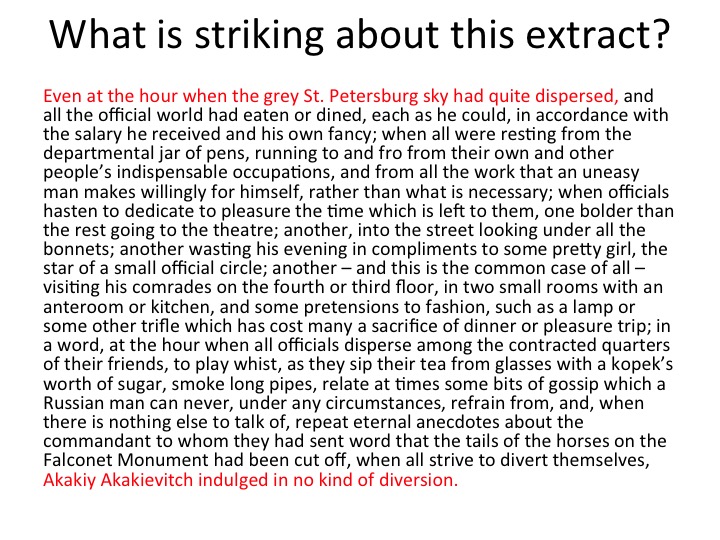
  • periodic sentences – these are those long, winding sentences that withold the main clause to the end. They often have a number of subordinate clauses that build the sentence up, and are prevalent in 19th century writing. We’ll look at the effect of them and have pupils identify the main clause in examples. Here are some examples of periodic sentences, starting with a famous one from Nikolai Gogol’s excellent short story ‘The Overcoat’:
Slide02
The subordinate clause at the opening is eventually reconciled by the main clause at the end.
Slide11
A short periodic sentence from Jane Austen’s ‘Emma’ – the main clause in red; subordinate clauses in green and blue.
From Melville's 'Moby Dick': the main clause is in red; the subordinate clauses are numbered.
From Melville’s ‘Moby Dick’: the main clause is in red; the subordinate clauses are numbered.

Once these key features have been explored, we decided that we would then explore other linguistic features of the writing across a range of extracts.

We sat down and looked at some extracts together and noticed how much of the writing utilised classical rhetorical devices. So we turned to our secret weapon… Mark Forsyth’s excellent book The Elements of Eloquence.

elements

We noticed how writers relied on figures of rhetoric throughout the extracts we’d selected (from Jane Austen, Edgar Allan Poe, Charles Dickens, Anthony Trollope, Charlotte Brontë, Nathaniel Hawthorne, Henry James, amongst some already spoken of in this post). Probably something to with that classical liberal education that I mentioned earlier. We identified a number of these figures that were used more prolifically than others and chose to structure lessons around introducing these within the context of the writing.

The lessons from hereon in will follow a similar structure (note that this structure isn’t necessarily all one lesson – these stages will most likely take place over a couple of lessons):

  1. Introduce figure of rhetoric.
  2. Explore examples of the figure in literature, look at varieties of usage and identify the effects created by the writers in using it.
  3. Introduce an extract from 19th century fiction and explore: look at meaning and various linguistic features used by the writer and their effects; identify where the writer has used the figure of rhetoric introduced earlier and explore effects.
  4. After modelling by teacher, pupils will write a short response to the extract (we start with David Didau‘s Reading Skills Ladder as a structure), discussing the effects of identified language.
  5. Pupils will then be given a stimulus linked to the extract (image/video clip) and then a writing prompt to produce a piece of imaginative writing. They will be asked to try and use the figure of rhetoric they have just learned about and, as they work further through the unit, to use a variety of these as they accumulate in their writing ‘armoury’.

We’ve also produced a display of the linguistic devices pupils will need to know over the course of the scheme of work. The premise of this display, similarly to the one I produced on the elements of language before, is to only give memory cues to pupils: they don’t explain the devices, they merely give images and examples that should help pupils recall the figure in question. Below is an overview of the display, so you can see the figures of rhetoric pupils will explore over the unit. For lower ability pupils, you may choose to condense some of these figures into one device (i.e. isocolon and anaphora parallel structureslitotes and hyerbole emphatic expressionanadiplosis and diacope = repetition). Once this is fine-tuned, I’ll upload the display here.
Screen Shot 2015-08-19 at 15.23.55

So this is how we’ll try to introduce 19th century fiction on the new English Language GCSE this year. It isn’t groundbreaking at all – I’m sure that this is a structure that many use. And I’m not saying it is the right way – I’m sure that our ideas will develop a lot as we teach it. But hopefully this will be of some use to some of you; moreover, we hope that you might be of some help in how this develops with any comments you have on it.

*(I think Edexcel slightly differs from other specifications, as Edexcel will always use 19th century extracts on Paper 1, whereas others such as AQA may draw from 19th, 20th and 21st century for their Paper 1 – correct me if I’m wrong.)

I'm just a teacher, standing in front of a class, asking them to be quiet and listen.

Jean Smith

P A I N T I N G S

missdcoxblog

My views on Teaching & Education

Round Learning

What's past is prologue.

MrHistoire.com

What I've been thinking

The World Is Maths

Musings on (maths) education

Teachwell

All views are my own.

Filling the pail

"Education is not the filling of a pail, but the lighting of a fire." - As W. B. Yeats never said

A Total Ed Case

Eric Kalenze, writer and educator, on education practice and reform

Carl Hendrick

Education, research and stuff.

must do better...

thoughts on improving education

Esse Quam Videri

A blog about education. Follow me on twitter @HeatherBellaF

mrbunkeredu

An English teacher trying to get better. Looking to discuss and share teaching and learning ideas.

Horatio Speaks

Speak to it, Horatio - thou art a scholar!

Socially Redundant Education

Unpacking the dynamics of socially constructed educational experience. A spoof by @greg_ashman

Trivium 21c ltd.

Preparing young people for the future with lessons from the past.

Reflecting English

In search of classroom answers

Design a site like this with WordPress.com
Get started