This is nearly verbatim from the Nation, by Dan Simon. I have edited it to make it more concise and easier to absorb.
The percentage of American voters who still support Trump is already vastly greater than the percentage of Germans that supported Hitler during his rise to power.
In 1928, the National Socialists—the Nazis—were a negligible, declining party. Out of his disappointment with his party’s electoral ineffectualness that year, Hitler defied conventional wisdom and changed direction, throwing his organizational muscle to the countryside instead of the cities. Two years later, in the parliamentary elections of 1930, the Nazis suddenly emerged as a force with just over 18 percent of the vote. And in 1932 they reached just over 37 percent of the vote nationally, their high-water mark, prompting Hitler to call on President Hindenburg to name him chancellor.
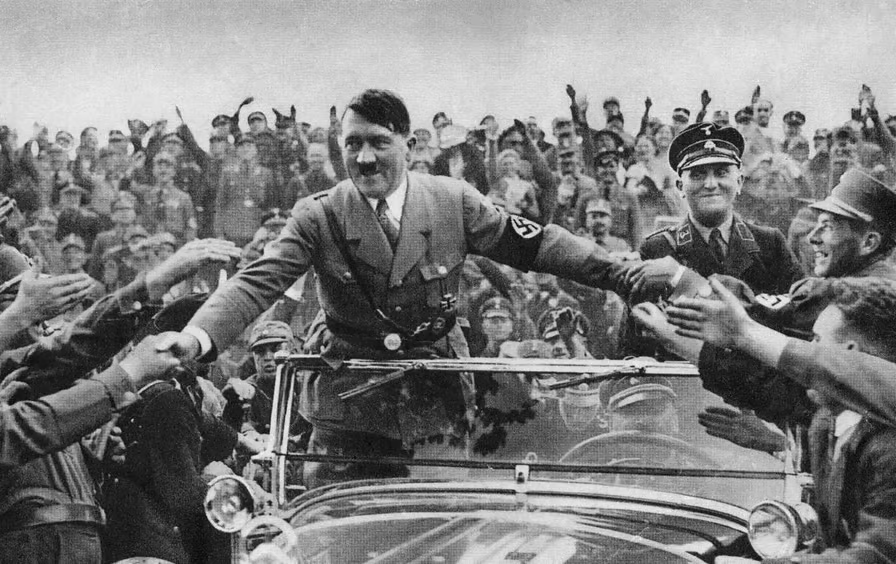
Hindenberg scheduled another parliamentary election instead, and in November of 1932 Hitler’s Nazi party suffered a major reversal, losing 2 million votes by comparison with its results just four months earlier. Then, in a fateful miscalculation, thinking the Nazis were now in a weakened state and thus controllable, Hindenberg proceeded to name Hitler chancellor after all.
Hitler now held sway over the police and the only electronic media of the age—radio.
In February, 1933, the Reichstag, Germany’s parliamentary building, was set on fire. The Reichstag fire became the justification for the arrests en masse of known Communists, including all Communist members of Parliament, clearing away the Nazis’ main adversary.
(This is why Trump calls January 6th a love fest and will declare in a National Holiday, if elected. )
What followed with almost blinding speed was the consolidation of power by Hitler, the building of a war machine, and then the start of Second World War itself. Within just a few months, the Nazis had asserted complete control over industrial output, finance, labor, the military, and politics in Germany.
But the key election was the one that took place on July 31, 1932, when Hitler’s Nazi party secured only 37.3 percent of the national vote. Since only three out of eight voters supported Hitler at that point, one must ask, which Germans voted for Hitler and why?
In the East Prussian town of Thalburg. In April 1930, the Social Democratic Party (the SDP) announced a major rally there on the subject of “Dictatorship or Democracy.” The Nazis announced a counter-rally on the same day at the same time. The local police then prohibited both meetings. With the goal of preventing the SPD rally achieved, the Nazis now announced that their meeting would proceed, only at a new location in a small village just outside of town.
About 2,000 people came out for it, where they saw among other stirring sights a parade of some 800 storm troopers. The local press coverage emphasized how impressed Thalburgers were by the “size and determination” the Nazis displayed.
Two years later, in the election year of 1932, by which time the National Socialists had grown to be a major, albeit minority, force in German national politics, the biggest event of the year in the East Prussia region around Thalburg was a speech by Hitler himself. The Nazi Party arranged for trains to bring people in from all over the region. It was going to be an open-air meeting with seating capacity for 100,000 people, scheduled to begin at 8 in the evening. The seats were all filled by early afternoon. When Hitler’s plane flew overhead just before 8, there was a roar of “Heil!” from the swastika flag– and handkerchief-waving crowd.
There was the impression of a surging movement. But at the time, dues-paying Nazis in Thalburg numbered only 40 souls.
( This reminds me of the Trump rallies and TV coverage. Trump also created the illusion of a surging movement early on. )
The paramilitary Storm Troopers not only provided protection at events but also, traveling from place to place for planned events, bulked up appearances. Since many of the Storm Troopers were unemployed, so the Nazis set up soup kitchens and free breakfast programs, and these locations became natural gathering places for the party’s hardcore enforcers.
Thalburg’s Socialists maintained slogans and methods which had little correspondence with reality. They maintained the façade of a revolutionary party when they were no longer prepared to lead a revolution. They never seriously attempted to mend fences with the middle class and frequently offended bourgeois sensibilities. ( This reminds me of the Democrats, who really never fixed things for the working people, though they talked as if they wanted to. )
The Communists and Socialists mainly served as a threat with which the Nazis could whip up anti-Communist fervor, much as the radical right in America today uses socialism as a pejorative term.
In the decisive July 31, 1932, election, Hitler received exactly 37.3 percent of the overall vote across Germany. He fared less well in the cities, averaging 32.3 percent in urban centers with populations over 100,000. However, in towns with fewer than 25,000 inhabitants he scored better, averaging 41.3 percent of the vote. And in some of the smallest rural communities across Germany, he scored 80 percent or more of the votes, and in several the Nazi vote was 100 percent. The rural groundswell for Hitler included people of all classes and income levels. But what is most striking is how none of the three other major parties managed to present a clear alternative.
Similarly to the unprecedented number of voters here in the 2020 US presidential election, the level of participation in the German vote increased from 1928 to 1932, from 75% to 84% percent in 1932. And everything possible was done during the Weimar years to enfranchise voters in Germany, from having elections on Sundays so as not to compete with work demands, to having ballot drop-offs at convenient locations.
At the same time, there was a shift in these years, generally, away from the traditional liberal and conservative parties, toward the parties of the left on the one hand and on the right, the Nazis, on the other. The threat of the Communists was perceived to be ever greater, even if in reality their influence was decreasing.
One gets the general sense that the major liberal and conservative parties increasingly saw Hitler and his party as a hedge against the left. In other words, the German voters of the upper classes felt that Hitler could appeal to workers who might otherwise align themselves with the Communists. And the establishment parties felt they could control Hitler, make sure he worked for them, and use him as their attack dog who, despite his violent ways (or possibly because of them), was still essentially supportive of the same German Protestant conservative values that they themselves espoused.
( The lesson here is: the biggest threats of a second Trump presidency will come from his supporters, not Trump himself. )
Where did the voters of the Weimar period get their information about the National Socialists? Answer: from newspapers, the mainstream liberal, conservative, business, and other special interest press.
From the Munich Beer Hall Putsch of 1923—which first introduced Hitler and the Nazis to the German people—onward, the press was surprisingly indulgent of Hitler. Something like: Hitler may not always use methods we would agree with, but he has Germany’s best interests at heart, he is passionate, and he says things we agree with even though we might not come out and say them.
(History repeats or rhymes because people do not change much in 100 years. Their toys change, but their passions are pretty much the same.)
Or as one editorial put it on April 3, 1924, following his conviction on charges of treason, Hitler sought a Germany “free from the domination of international Jewry and finance capital, free from…Marxism and bolshevism.” From the outset, Hitler was presented positively across the whole spectrum of conservative and liberal newspapers as a man of action who could “effectively counter the communist threat.”
( The immigrants have replaced the communists as the others in this scenario. )
Many of the mainstream newspapers of Germany—the Fox News, CNN, NBC, Twitter, and Facebook combined of the day—all came to take a friendly attitude toward the National Socialists. They may not have supported them, but they did not condemn them outright either, treating them more as rascals whose heart was in the right place.
As for the violence, the newspapers provided an easy excuse: it was a justified response to the provocations or attacks that had come first from the other side.
The fight for the hearts and minds of Germany’s voters became an unequal one: The Nazis and their supporters conveyed a sense of extreme urgency, whereas the alternatives to the Nazis, including the Communists, social democrats, and traditional conservatives, were not able to present their own cases in ways that were either urgent or even clear.
In Berlin, the highest levels of support for the Nazis came from the upper- and upper-middle-class districts. Hitler’s Nazis commanded some 60 percent of the vote in those districts—nearly twice the national average. The disproportionate support for Hitler came from the well-heeled districts, motivated by their sense that Hitler would be their weapon against Communism; and because the Nazis had also successfully nurtured a covert anti-Semitism among the upper classes. Working class-neighborhoods were split more evenly, not strongly anti-Semitic, though susceptible certainly to the Nazi’s organizing exertions.
It is a point of some irony that the educated upper- and upper-middle-class populations, who react so enthusiastically to the claims of mass-society theories, should themselves have been the victims of a process that they, with such evident disdain, assume to be moving other people.
And then, one after another, the traditional conservative parties—including the Center Party, which had kept itself aloof from any sign of support for Hitler and his National Socialists for over a decade—began in the late 1920s and early ’30s, as the worldwide economic depression took its toll, to form alliances with the Nazis.
These alliances were characterized above all by a wishing away of the undisguised violence, including the murders of political opponents, the destruction of the property of despised groups, and other tactics, despite their being transparently visible.
And so it was that the Center Party finally capitulated to an alliance with the Nazis in March of 1933, an alliance of Catholics with Protestants, giving Hitler his first majority, which in turn allowed him to assume dictatorial powers. In a word, there came to be, if not a consensus, then at least irresistible momentum around the idea that what Germany needed wasn’t a democracy so much as a strong leader, a Führer.
Hitler is named chancellor on January 30, 1933, cements control in the March 5 elections, and secures dictatorial powers under the Enabling Act passed on March 23. Once he has been installed fully in power, among the first things he does is to outlaw the Communists and cripple the Social Democrats. At the same time, the bourgeois parties are dissolved, and the paramilitaries are consolidated.
Military expenditures increase during the 1930s by 2,000 percent. Taxes on business skyrocket, essentially doubling from 20 percent in 1934 to 40 percent in 1939, and caps are placed on profits from stocks and bonds, and interest rates. In all, state control is total and the country is put completely into war machine mode.
The greatest danger with a movement like the one embodied by Hitler’s militant Nazis does not stem from the movement itself, always a minority, but rather within the larger society and its halfhearted disavowal of the Nazis, together with a kind of secret brainwashing of the educated and well-off middle class that is vulnerable precisely because they think they aren’t.
The Nazis came to power because they had enough support from almost every demographic group, and not strenuous enough opposition from any demographic or gatekeeping group. And if your heart is sinking because of how familiar that sounds, I feel the same way.
We need to remind ourselves that in fighting for democracy what we are fighting for isn’t to have an administration that is better than Trump’s.
It’s only worth fighting for if the fight is for a future in which all people really are treated equitably, and with natural respect; where all people are entitled to a basic standard of living that includes universal health care; where we make peace also with the natural world around us and stabilize or reverse global warming and ecological despoliation; and where no one is homeless or hungry.
Unless these are the things we’re fighting for, it’s a losing battle.
These are the lessons of Hitler, and also the lessons of Trump.

 THE ENGLISH CODE