The war on men and children continues by women

As I’m sure many of you have seen by now, the famous polling of positive vs negative view of the opposite sex. Younger women are being more and more radicalized by social media and scare mongering to be afraid of men.

This is generally also born out in the the fact that women have by far being going more liberal over time, and we know that party basically hates men.

For all of the sex war stuff, it has mainly been the women becoming more radicalized. I think it’s quite obvious with the LBGT stuff, but this lends more credence with actual data.

Interestingly, there has also been some analysis several years ago about men’s income vs women’s income and how that relates to how many children they have.

I found that for husbands, personal income was positively associated with their number of biological children, and for wives, personal income was negatively associated with their number of biological children, as previous research has shown. That is, husbands with higher income tended to have more children, while wives with higher income tended to have fewer children. 

Additionally, the more a man’s wife earned, the fewer children he was likely to have, and the more a woman’s husband earned, the more children she was likely to have. This was true for the entire sample as well as for the subset of men and women aged 45-65, who likely have completed fertility but are unlikely to be retired. This was not because of childlessness among low-income men and high-income women, but also held true for all those with children. For almost all the analyses, these findings held true regardless of whether or not education was controlled, i.e., held constant.

These results indicate that men earning high incomes with a spouse who has a low income have the most biological children in the United States, while women with low incomes with a spouse who earns a high income have the most biological children. These differences are not large—as very few people in the U.S. have large numbers of children—but they exist, nonetheless. For women, there is likely reverse causation as women who have children tend to work less outside of the home, which would mean lower income. Women with children may also experience wage discrimination. There may be reverse causation for men also, as men with children may try to earn more or may experience positive wage discrimination.

Even so, these results suggest that for men in the U.S., fathering children is still related to being able to provide, as it has been historically. For women, husband’s income remains important for childbearing. My study was based on data collected in 2014 when fertility rates in the United States were very low and falling. In 2021, the U.S. population grew at the slowest rate since the founding of the nation, in part due to historically low fertility rates.7 The findings presented here suggest that the decline in the proportion of men employed full time8 and the decline in male earnings relative to female earnings9 likely have contributed to the decline in aggregate fertility rates. Given the positive relationship between education and earnings, lower rates of men attending college are likely to exacerbate these tendencies in the near future, with a continuing downward pull on fertility rates. 

Generally, when men get income they tend to go right to thinking how can I have a family and kids. On the other hand, women get income and tend to skip all of that and just go for a house, car, vacations and comfort. Maybe some have a couple of kids here and there, but much less than a family where it is primarily the man making the money. This has also started to go mainstream with talking about it on more podcasts as well.

Overall,

  1. The more women become so-called independent the more they hate men, hate children (abortion, don’t have kids) and become more selfish. Of course, we haven’t also brought up the statistics on the decline of female happiness, increased usage of anti-depressants, and all of the other negative effects.
  2. The funny thing is, though, that even many Christian men and women will say it’s a good thing that women are more independent, and they definitely don’t want to roll any of it back.

To me this is enabling addictive negative behavior. Like feminism, womens’ independence is a failed experiment.

Titus 2:3 Likewise, teach the older women to be reverent in the way they live, not to be slanderers or addicted to much wine, but to teach what is good. 4 Then they can urge the younger women to love their husbands and children, 5 to be self-controlled and pure, to be busy at home, to be kind, and to be subject to their husbands, so that no one will malign the word of God.

Not that we didn’t know already, but the Bible dispenses the best and most accurate advice.

Posted in Godly mindset & lifestyle | Tagged | 3 Comments

Sex differences and 1 Timothy 2

One of the struggles that the complementarians have had issues with is the interpretation of 1 Timothy 2. Not in terms of allowing female pastors but rather having an adequate justification for it.

1 Timothy 2:11 A woman should learn in quietness and full submission. 12 I do not permit a woman to teach or to assume authority over a man; she must be quiet. 13 For Adam was formed first, then Eve. 14 And Adam was not the one deceived; it was the woman who was deceived and became a sinner. 15 But women will be saved through childbearing—if they continue in faith, love and holiness with propriety.

One of my main theories on this from a psychological perspective is that men are able to compartmentalize better than women, which is exceptionally useful in terms of separating work from family life. However, not only that it also may be at least one of the reasons for verse 14 where it says Eve was deceived whereas Adam sinned and wasn’t deceived.

I’ve recently returned to some analysis on differences between men and women, and one of the most robust psychological differences between men and women in the scientific literature is that men tend to focus on things and women tend to focus on people. This is true even in science itself. It”s why western governments have wasted a lot of money forcing women into STEM fields when they don’t really care about them that much, and often the women end up hating it even if they are.

Male headship both in terms of the family and of the Church becomes more clear in this line of thought. Though families and the Church are composed of people, organizing, leading and governing groups of people based around a theological framework is more of a focus on things rather than people. The case in point is that it is important that men lead both their families and the Church according to sound doctrine.

2 Timothy 4:3 For the time will come when people will not put up with sound doctrine. Instead, to suit their own desires, they will gather around them a great number of teachers to say what their itching ears want to hear. 4 They will turn their ears away from the truth and turn aside to myths. 5 But you, keep your head in all situations, endure hardship, do the work of an evangelist, discharge all the duties of your ministry.

As we can see in the progressive mainline “churches” that have fallen to culture, those that start agreeing more with the culture rather than God and the Bible regarding it’s moral doctrinal stances not only compromise with the world but bleed out members. Their faith is false, so what’s the point of God and the Bible at that point? It is not too surprising then that we see that aside from these “churches” falling in regard to LGBT and other social justice movements they also allow female leaders (priests, pastors, and more) among them.

This is not to say that women cannot be things focused or that some women can’t compartmentalize as well as some men. However, given the preponderance of evidence suggesting there are significant sex differences that God created between man and woman there is something unique in why men are called to be both the heads of families and Churches.

Posted in Godly mindset & lifestyle | Tagged | 6 Comments

Round up: I helped build the manosphere then it destroyed me, I lived the feminist dream and want my money back, marriage got better so why is it declining, and men aren’t signing up to singles nights

I helped build the manosphere — then it destroyed me

Now this is an interesting article.

The internet “loved the idea of this blonde Nazi chick”, she told The Times in her first mainstream media interview since the release of her book This is Not Real Life. “I was basically the hardest drug you could get at that time. But it wasn’t real.”

Southern was 19 in 2015 when she rose to notoriety as a telegenic YouTuber promoting hateful opinions on immigration, feminism and the “Islamisation of the West”. At the time, Donald Trump was entering the political scene and these ideas were beginning to gain traction.

She befriended the far-right extremist Tommy Robinson, known for stirring anti-Muslim feeling, and became a female face for the manosphere, producing the viral hit video “Why I Am Not a Feminist”. In early 2018, Southern distributed flyers in Robinson’s hometown of Luton calling Allah “gay”, as part of what she said was a social experiment. That earned her a ban from the UK on the grounds that her presence in the country was not “conducive to the public good”.

Southern continued to fall into a dark online world, exploiting it before it eventually began exploiting her. She wrote her book last summer expressing regret for the role she had played, but only now feels ready to talk about it. “I had no understanding of the world or how it worked,” Southern said over Zoom from her living room, still sporting the trademark red lipstick and dark mascara on which she built her brand. “There was no notion that I would ever become famous or even travel or anything like that.”

Basically, Southern claims to have became one of the faces of the “manosphere,” yet only encountered some version of the extremist alt-right portion.

She was allegedly raped by Andrew Tate in 2018, and then became a “Christian tradwife” in 2020.

She posted “A New Chapter” on her website about her decision to take some time out and focus on her “soul”. She had fallen in love and married an Australian man she had been dating, who she has never publicly identified. The couple had a son in 2020. 

But her hiatus didn’t last long.

The same year her son was born, she reinvented herself as a “trad wife”, which she suspects played into a Christian need for redemption. She posted photos of a curated life that showed her exercising and baking at the couple’s home in Australia. “I figured if I just follow the manual of ‘look pretty, quit my job, have babies, serve my husband’ then I would be able to have this happy family life that so many people crave,” she said.

But Southern claimed her husband became controlling when she tried to assert any amount of independence. She alleges that he would lock her out of the house, calling her a “worthless dead weight”. Southern said her husband left her and their son after she went against his wishes by visiting her family in Canada. She filed a protective order and the couple would end up officially separating — a cardinal sin in the traditionalist movement. The backlash was swift. Commentators called her a “whore” and wished her damnation. Her estranged husband was unreachable for comment.

In any case, you can’t make this stuff up. Not surprising that if you grift too hard you can get exploited back.

But I think it’s sad she thought she was building up the manosphere at all when there are multiple divisions of it doing their own thing. Even most of the men who cling onto the women grifters hyping them up as women to look up to aren’t exactly the men you want to marry either. Guess she learned the hard way.


I Lived The Feminist Dream. I Want My Money Back.

To be honest, this one reeks of a man impersonating a woman in how articulate and self aware the writing is.

Either that or a woman found a bunch of manosphere-related articles and then had AI draft an essay for them and then added some cherries on top for engagement farming. 

The marketplace is made up only of your options. It’s a comparison, like grading on a curve. Just twenty years ago, your options (the market) was limited to those in your geographic vicinity, plus the occasional setup from a relative or camp friend. Now, the options have widened considerably due to dating apps and we’re competing across hundreds, even thousands of options. On top of that, Instagram has widened the option pool even further, even though none of the men around me could realistically date any of these women, they exist constantly in their field of view, and thus are part of the sample size. Now stack on top of that that we’re no longer competing within our age group; it has widened to include girls 10-20 years younger than us—and this is where feminism really screwed us.

We were sold the lie to go after our careers, make money, and make our mark on the world first, and then go find a partner once we’ve accomplished A through C. We used to have a backstop against some of this—our biological clock ticking louder around our mid-thirties—but we did an end run around that too, with egg freezing. And the worst part of it is that we, women, did this to ourselves. Not a single man told us to do any of this. In fact, historically, they’ve been pretty petulant about the whole thing, but we pushed right through that sentiment by calling them all “toxic” and threatening them with cancellation if they didn’t comply. We are our own worst enemy, and the architects of our own demise.

While we were busy climbing the corporate ladder, raising unheard of amounts of money, and optimizing ourselves in every possible way, the men in our cohort weren’t just waiting around for us to feel “ready” to settle down. They were dating, and as we aged up, still too busy self-actualizing for them, they continued to date twenty-year-olds (women in their fertile prime, because that’s what men are biologically programmed to find attractive). So we freeze our eggs, maybe buying us some additional time. Ten years go by. Surely, the men left in their forties are still single because they’re looking for something real, something mature; a woman of substance. Wrong. They’re still dating twenty-year-olds, just now with a hair transplant and an eye-rolling age gap. And it’s not really their fault; it’s mostly biology. Men have about the same fertility as they age until well into their sixties. Up until that point, they will be pursuing women in their fertile prime, as their biological directive is telling them to procreate, and with a mate with the highest likelihood of success to carry on the gene pool.

Feminism sold us the lie that being a well-rounded, articulate, and successful woman would up the value of our stock; the investment in ourselves was worth it. In reality, it does absolutely nothing to our market value and, actually in some cases, lowers it, as many men prefer to be more successful and smarter than their partners. Women date laterally and up, men date laterally (sometimes), but mostly down. Most men couldn’t care less if you’re successful or incredible intelligent, or have any amount of self-knowledge you might have gleaned on your therapy journey. Sure, those things are “nice-to-haves,” but often they don’t even come into their assessments until after you’ve already been dating for a while. They have the ability to make a marginal difference, at best. Men, even when they say they want someone they can ‘talk to on their level,’ are kind of kidding themselves—they look mostly for biological markers of fertility and high estrogen (waist-to-hip ratio, full lips, heart-shaped face), and as far as talking goes… they just want someone to listen. It’s women who want someone to talk to on their level—another gross mis-assessment of feminism.

This is only part of the article, but it pretty much hits all of the obvious talking points that men have discussed for the past two decades. Women also distinctly don’t use terms like marketplace and market value. 

The article is actually pretty long and worth a read, but I don’t think a woman actually wrote it or if they did they used a significant amount of AI to make it happen. Very few women have that type of self awareness and then will write it out, using the terms that the manosphere has coined. 


Marriage Got Better—So Why Is It Disappearing?

This one actually does use logic and was written by a man to connect the dots.

nitially, that might seem like a paradox. Individual marriages have become stronger, yet the institution of marriage as a whole has never been weaker. But there’s a simple explanation: Largely as a result of our rising level of wealth and stability, marriage isn’t dying, but it is stratifying. And a result, the people who could benefit most from marriage’s social and economic benefits are the least likely to have examples of strong marriages in their lives. This reality should force us to prioritize rebuilding a scaffolding of culture and policy changes that can help today’s young people grow into tomorrow’s adults capable of committing to marriage.

For many years, marriage provided an important economic function for women whose earning power was constrained by law and custom. Women’s rights, economic opportunities, and educational pathways have expanded, and our society has grown wealthier. Women looking at a male as a potential mate today expect more than their sisters of yesteryear. Desirable skills in a partner have less to do with earnings and wages and more to do with social and interpersonal skills. And men, particularly those who are on the bottom half of the income spectrum or without a college degree, are unable to adjust to the fact that the bar over which a man becomes “marriageable” continues to rise.

We might borrow a concept from economics to illustrate this a little more clearly. In labor markets, economists refer to a given worker’s “reservation wage”—the amount below which a certain job just isn’t worth it. If you have a degree in engineering and are looking for work, you might be able to get hired for a $12-an-hour gig making sandwiches, but you’re more likely to hold out until a better offer comes along. As societies get wealthier, a given worker’s reservation wage goes up—there’s a reason back-breaking, low-paying jobs tend to be filled by immigrants rather than native workers.

For most of American history, the bar for a “reservation boyfriend” was pretty low. The question was less whether to marry than who to marry, and the pool was, on the whole, fairly limited. Men and women met at church, or barn raisings, or high school. The plot of 1971’s The Last Picture Show, set in a small town in Texas 20 years earlier, revolves around the pairings-off of teenagers whose eligible partners are essentially the same couple dozen young people they’ve gone to high school with, and the annoyed familiarity that results. You can’t fully understand the “you can’t live with ‘em, you can’t live without ‘em” ethos from outside the context of early marriage and limited pathways to divorce.

Technology progressed, values changed, society liberalized. Marriage used to offer a “bundle” of goods—companionship, sex, old-age security, the ability to have children, some measure of social standing. Overt societal pressure to get married before having sex, living together, buying a house, or having a child is a thing of the past. In the words of Johns Hopkins sociologist Andrew Cherlin, marriage is a “capstone” to a successful young adulthood, rather than the “cornerstone” on which young couples once built a life together. For women, the average age at first marriage has risen from 22 to 28.5 over the past four decades.

I suppose the irony is that the conclusion is more reductionistic to mostly economic shift of marriage away from men and women. However, this is painted as a masculine issue later in the article where women depended on  men economically and men haven’t pivoted well out of it going into ‘using weed, acting out violent scripts from pornography, or gambling their weekly paychecks.’

Can’t help but throw men under the bus while ignoring womens’ inflated expectations.


Men aren’t signing up to singles nights – I launched my own and found out why

There’s several variations of this going around, and I just chose this one.

The events have been full but I’ve still hit roadblocks with men dropping out at the last minute, despite having paid for tickets and made commitments to their female friends, leaving the women struggling to find replacements. This is small fry compared to what other singles nights organisers deal with. Very few companies sell tickets in pairs like me (though I’ve noticed a few introducing this since I started Red Lips), and so often this means it’s a case of selling tickets separately for single women and single men.

In these instances, tickets for single women sell out almost instantly, whereas those for men linger in a limbo of perennial availability. Some event organisers have told me they’ve ended up with rooms full of single women vying for the attention of just a handful of men, while others have resorted to bribing male friends to attend, and some are literally just going out onto the street and approaching any men who walk past.

Matters are worse overseas, it seems, with The New York Times recently sending one of its reporters to a wine mixer where tickets for women cost $100, while men could attend for free. “I think the truth is that there are a lot more women out there interested in showing up for these dating events, and it’s not as easy to get men to show up,” said Luke Vander Ploeg in an episode of The Daily, claiming there were 15 women in attendance and just five men. If even freebies aren’t enough to get men to these events, what is? After all, it’s not like they don’t want to meet women.

“The most obvious explanation is time pressure,” says one single friend in his 30s. “Any woman looking to start a family is facing constraints that men just don’t have. The result is they end up being more open-minded to alternative, unusual, and, let’s face it, less romantic ways of meeting people than men because they want to get there faster. It’s not that men are put off, it’s just that there is less of a push to meet someone, and because a singles night is a slightly forced interaction, it’s easy to persuade yourself it’s a bit lame and unnecessary.”

It’s a brutal reality, but clearly one that resonates. “I think men just have less desire for singles nights,” posits another single male in his thirties who came along to one of my events. “We get all we need from dating apps, and those of us who don’t probably won’t have the confidence to go to a singles night where there are things like speed dating.” Gender norms could play a role, too, at least in terms of how men want to interact with women they’re attracted to. “I think more traditional men feel like it’s on them to be charming, funny, and cool in a limited time, while it’s on the women to just be hot. So the pressure is higher for the men. Like, a super boring hot girl would probably do better at a speed dating event than a super boring hot boy.”

The funny thing is they still don’t really understand why it’s happening.

As the man says in the last paragraph unwittingly, you can get enough dates from apps (if you’re attractive) and there’s no need to go to a singles night.

If you aren’t getting enough dates as a man, it’s because you’re deemed unattractive. Why would an unattractive men want to go to a singles night even for free to waste his time talking to a lot of women just to get rejected more? And not just rejected online but in person as well where the stakes are clearly higher.

If you want singles to meet and date you have to address the overinflated expectations of women, and also get them to realize they’re not going to make the attractive man who is dating dozens of them commit to anything. But I don’t think many women are ready for that type of thing.

Posted in Godly mindset & lifestyle | Tagged | 3 Comments

The myth of the mental load

Mental load or emotional labor has recently been making a come back with more and more women complaining about it. Even academic institutions seem to want to get on the train including academic articles about it. Here’s the abstract of the last link which does an alright job at explaining what it is.

The mental load has received considerable public attention especially in the wake of the COVID-19 pandemic. In this article, we synthesize existing literature to argue that the mental load is a combination of cognitive and emotional labor and it is this combination that makes the mental work a load. We argue that the way the mental load operates within families and society has three characteristics: (1) it is invisible in that it is enacted internally yet results in a range of unpaid, physical labor; (2) it is boundaryless in that can be brought to work and into leisure and sleep time; and (3) enduring in that it is never complete because it is tied to caring for loved ones which is constant. We also offer some future directions for addressing the problems associated with the mental load. First, questions measuring the mental load should be standard in health and social surveys to better understand the problem. Second, employers should adopt better policies that allow for greater work-life reconciliation to lessen the mental load. Third, caregiving should be vital infrastructure developed and invested in by governments to reduce competing work and care demands that accelerate the deleterious consequences of the mental load.

The funny thing about this phenomena is that it’s based in the feminist perception that women should want to have it all and do it all. Be the boss babe and head of the household and do everything.

Because male leadership is seen as bad to the feminist worldview, wives and mothers must take on all of this extra role of what was previously part of what male leadership of the family was. Hence, what is actually happening is that women are fooled into thinking that they should be taking on extra responsibilities at their own expense Then because they feel overwhelmed once they are taking on these extra responsibilities, they complain about it and cry that the men should be helping them.

If you treat men like they are someone that you have to mother and take care of, then most men will step back. They don’t want to get into a fight about responsibilities especially if the wife is going to lash out to him about taking the leadership of the marriage and kids. It’s basically the no-win situation for men. If you try to be the leader then you get yelled at because male-led marriages are bad, but if you step back and let the wife do it she’s going to complain that she’s the leader with all of these excessive responsibilities.

When you *gasp* have the man lead the family, the wife can literally just dump most of her worries about how things are run and just focus on her parts which are being a good wife and mother. She doesn’t have to worry about all of these other things.

This is one of the fundamental flaws of feminism especially with the boss babes. They want the authority without the responsibility, and every time they have the responsibility they complain about it. Having it all means having the ability to manage everything, and women were not created for that. But I’m sure that many women will be chomping at the bit to disagree with that even as they complain about it behind closed doors.

Posted in Godly mindset & lifestyle | Tagged | 2 Comments

Round up: American Pride divergence, Joshua Harris’ return to Christianity, liberal Protestant Churches fall, and self identified dominant vs submissive in men and women

American Pride slips to new lows

Probably the most interesting chart from this article is this one. All credit goes to gallup for their chart.

My general assessment of this is as follows

  • Democrats appear to be viewing the US from the victim perspective and when you do that everyone is exploited. I expect this to go down to 0-20% levels over time probably because there’s no end do that
  • Independents after Trump’s presidency ends I expect to hover around 50% maybe fluctuating up and down 10%. They can see that that the US is becoming a Corporatocrasy and that it kinda sucks out here for a lot of people.
  • Republicans are like your Boomer Evangelicals thinking everything is fine and hard work solves all things.

Objectively, the US is still one of the best countries to do anything with your life. However, many are starting to not see it that way. Either way with the rise of AI things are going to be shifting a lot in the near future.


In other news, Joshua Harris of I Kissed Dating Goodbye fame, his divorce, and his deconversion went on one of the Christian podcasts and says he was perhaps too hasty to totally de-convert but was right to perhaps deconstruct from Evangelicalism. A brief summary, and here’s a link to the podcast which the interview starts around minute 53-54.

  • He admits he lacked wisdom when writing the book, and lamented that he didn’t pay attention to one of the off handed comments by one of the old pastors in passing that the other pastor said he wouldn’t write a book until he was at least 40.
  • Trump’s first term accelerated his disillusionment from Christianity, but overcorrected by bringing black and white thinking into the picture, and that it would have been better to just deconstruct from Evangelicalism rather than Christianity as a whole
  • Wants to move away from immediate answers and fear driven stances and supposedly walk with Jesus slowly and rebuild whatever that faith is supposed to look like

Having been through the beta-forming Evangelical-Boomer cog machine myself I can see where he is going, although he definitely could have handled it better. However, hopefully he is on the right track back to being a Christian but with eyes wide open to all of the secular and Boomer-led Churchianity.


Clergy and Laith in liberal mainline Protestant Churches

I believe either Aaron Renn or another Christian blogger mentioned this before, but this thoroughly explains why the mainline Protestant denominations have fallen to the culture. All charts are credit to this blog.

Not that being a Republican means being a true Christian, but we know for sure that most people who are Democrats almost certainly do not believe that marriage is one man and one woman. The erosion of marriage being between one man and one woman then leads to love being disambiguated into LGBT+ acceptance and further down the rabbit hole.

On the left side we can see that the Clergy is becoming more and more Liberal Democrat. Over 40 is 44% and younger than 40 is now 59%. Same with the number shifts for the Laity from 22% to 32%. As the leadership is there the congregation will go.

The mainline Protestants are a sinking ship because they have totally joined the secular culture and do not preach the real Jesus.


Finally, an interesting chart from Cartoonshateher on Men and Women and others, and if they prefer to identified as Dominate, Mix/Neutral, or Submissive. All credit to the blogger’s site for the image.

This is not news to anyone who has read this blog for a long time, but the summary is that on average

  • Men are pretty much only Dominant or Mix
  • Women are pretty much only Mix to submissive
  • Gay men tend to have more feminized brains and are much more like women in distribution
  • Lesbian women tend to have more masculined brains and are much more like men in distribution
  • Bi/pan and non binary tend to skew toward one or the other depending.

The author also makes several comments that are not too surprising to us either

  • “For a while now, my theory has been that a great proportion of men who extoll the virtues of submissive women don’t actually want a woman who is submissive in a way that requires them to show dominance or leadership, but rather a woman who submits to the idea of having sex with them, aka a “woman who likes them.” Better yet if she makes this as easy as possible, with zero concern about rejection or looking stupid. TLDR: men want hot women to willingly sleep with them and dispel any fears of being rejected or accused of sex-pestistry. What else is new?”
  • “the more common expectation isn’t for women to be submissive, it’s for men to be dominant.”
  • “And the biggest mismatch when it comes to straight men and women is the idea of pursuit and initiation. Nobody loves making the first move, but straight women hate it more than anyone.”

Whenever we would get comments from the Christian women they would always make excuses as to why Christian women could not do any sort of initiation. It’s always men must initiate, men must pursue, men must do this and that.

However, as we have seen from a vast array of anecdotal evidence and analysis of the Bible and such it’s the case that the most successful relationships form when the women have some to a lot of interest in the man, and they make some at least subtle moves like indicating interesting, hanging around him a lot, or even nudge him verbally or with actions in her direction to make her interest known so that he picks up on it and then initiates.

Women would do well to pick up on Honeycraft if they have men they are interested about in order to indicate her interest to him so he can officially initiate and act dominate toward her. Men need to get used to making the first move and looking for any indicators of interest if they want to go anywhere with relationships. But we all knew those things already. Just a confirmation.

Posted in Godly mindset & lifestyle | Tagged | 4 Comments

Does pooling finances vs separate finances lead to less divorce?

From the paper pooling finances and relationship satisfaction. Found this one browsing through married data and definitely worth posting for the divorce risk reduction. 

It’s not unsurprising to find that all pooling > partial pooling > not pooling in the aspects of divorce because of the improved aspect of trust and unity. There appears to be about a 5% reduction for each of them all things being equal where:

  • Fully pooled – 75-78%
  • Partially pooled – 71-75%
  • Fully separate – 66-72%

God’s plan of ‘one flesh’ marriage being one in all aspects is supported yet again by science. 

Posted in Godly mindset & lifestyle | Tagged | 2 Comments

The Apex Fallacy – Rooting out job demographic myths and understanding degree and job hypergamy

Jack briefly mentioned this in his latest post Church-wide, but I wanted to look at US demographics and generate a pyramid that would help identify what this actually looks like in real life for most men.

Now that we have some data to work with, what does this look like for a so-called pyramid of jobs in terms of hypergamy for women. 

  • Top CEOs – 90-92% men at approximately 6000 positions
  • Other CEOs – 68.5% men at approximately 42,000 positions
  • C-suite, VP, and upper management – 68% men at approximately 310,000 positions
  • Middle to lower management – 54% men at 20,000,000 positions approximately
  • Regular white collar work – 45% men at approximately 50,000,000 positions

Disparities in total numbers are:

  • Top CEOs – 48,00 more men than women
  • Other CEOs – 15,540 more men than women
  • C-suite etc – 116,000 more men than women
  • Middle to lower – 1,600,000 more men than women
  • Reg white collar – 4,531,940 more WOMEN than MEN
  • Overall2,800,000 more women than men

Blue collar jobs are generally considered the lowest totem pole that women don’t want to marry these men because it’s “low class manual labor” type jobs. These are 80% men and approximately 30% of the work force or approximately:

  • 51,000,000 blue collar jobs total of which about 40,800,000 men and 10,200,000 women.

Other collar work is tougher to decipher, but because we have enough data from the white collar and blue collar work we can deduce how many men and women are in these positions.

  • 171 million workforce of which 47% is female is 80,370,000 women and 90,630,000 men.
  • 70 million white collar jobs which are 48% male which is 33,600,000 men
  • 51  million blue collar jobs which is 80% male which is 40,800,000 men
  • 90.63 million – 33.6 – 40.8 is 16.23 million men in other collar work
  • 171 workforce – 70 white – 51 million blue is about 50 million other collar work
  • Men make up 32.5% of other collar work

What the pyramid actually looks like

In the past, blue collar men and blue collar women married at approximately 10% rate whereas it’s only 3.5% today. This means most of the 40 million blue collar men are pretty much at the bottom of the totem poll.

  • Dregs of the totem poll – About 7 million men 25-54 are not working
  • Bottom of the totem poll – 40.8 million men blue collar men
  • Middle of the totem poll – 16.23 million men other collar men
  • Top of the totem poll – 22.56 million regular white collar men
  • Top tier totem poll – 10.8 million middle/lower management men
  • Apex of the totem poll – 245,000 CEO, C-Suite, VP men

In percentages this is:

  • Dregs of the totem poll – 7.1% unemployed or not working
  • Bottom of the totem poll – 41.78% blue collar
  • Middle of the totem poll – 16.6% other collar
  • Top of the totem poll – 23.1% white collar regular
  • Top tier totem poll – 11.1% white collar regular management
  • Apex of the totem poll – .25% CEO, C-Suite, VP, etc.

Men don’t really care as much about womens’ careers in terms of selecting them as a mate. However, as we covered there is likely correlation to men being in proximity of women that likely leads them to marrying in similar socioeconomic tiers

About half of all women of working age are married now.

In percentages this is:

  • 22% out of the workforce
  • 9.9% in blue collar jobs
  • 32.7 in other collar jobs
  • 26.3% in regular white collar jobs
  • 8.9% in white collar regular management
  • .11% in CEO, C-Suite, VP, etc. positions

And I was able to figure out how to graph these.

And finally we have a look at how hypergamy would look at this job structure since women generally want to marry up similar or up in terms of education and careers. It’s pretty ugly so if someone figures out how to do a better one then go for it.

One interesting thing about the visualization is you can see that men are slightly more top heavy in the CEO and White collar management (light blue and orange). However, once you start getting into the regular white collar and other collar workers there is a huge disparity (green and yellow).

  • In fact, this disparity in the regular white collar and other collar jobs is about 59% of the total women and 39.7 percent of the men which is about a 60% women and 40% men ratio.
  • This disparity is almost the same as the education statistics with 58% of all people going to college are women, and 60% of all graduate degree enrollment are women.

Given the the estimate that 33% of US women may not marry (not just my prediction data, but other sources now like IFStudies), this chart is particularly good at showing it. It’s likely the top 50% of men and some portion of the blue collar men will marry. Probably at 50-60% range, and then those men who get divorced will be the ones remarrying the rest of the 7-17% of women to make up the full 67% of women married since men are more likely to marry after divorce than women.

Additionally, this chart goes with my previous assertion on the married men data a couple posts ago that if you want to be married you at the very least want to probably get a college degree or professional degree and get on a good salary track.

Do some blue collar work if you need to get by, but try not to get stuck there even if you have to go back to school or do a drastic career pivot. The trades are represented in other collar, so that can work as well. However, you will have a generally better selection pool of women if you have white collar and professional degrees and job as they tend to carry more prestige.

I would not be surprised to see some form of this analysis eventually going mainstream as well.

Posted in Godly mindset & lifestyle | Tagged | 11 Comments

Round up: the amount of women reaching 40-50 without marriage, criticizing women in power or anti-male sentiment, why society offers men less sympathy, and others

4 million women have reached age 40-50 without being married.

  • Never married – black > hispanic > white > asian
  • Childless – white > black > asian > hispanic

These are not too much of a surprise. The cultures with women that tend to be more masculine are getting married less, though white people even though marrying more are having less kids.

  • Probability Married – grad > bachelors > some college/associates > high school > less
  • Childless – grad > bachelors > high school > some college/associates > less

Also not too much of a surprise here. More likely to get married with higher education which is correlated to higher incomes. However, the ones who don’t get married are more likely to be childless probably from pricing themselves out of the market from their own hypergamy.


There seems to be a larger prevalence of actually criticizing women in power or anti-male sentiment coming out recently. Some of these were mentioned on various sites or newletters (e.g. Aaron Renn) but I’ve run across some others off social media and other places.


Why society offers less sympathy when men fall behind

The interesting thing about the study associated with this article is that when men “fall behind” it’s more seen as a lack of effort whereas when women fall behind it’s usually interpreted into some other means such as “women still face wage gaps, underrepresentation in leadership, and cultural stereotypes that constrain opportunities.”

Hence, people are less likely to help struggling men than struggling men.


Meet cute surveys on men and women

Men and women are still looking for it.

  • For men being approached – bar/party > coffee shops > social clubs/run > networking > bookstore library > park/beach > grocery store
  • 92% of men were open to being approached by someone they’re into and 75& would feel flattered even if not mutual
  • Women generally don’t like being approached in gym/fitness > work > transit commute > nowhere is off limits
  • Only 40% of men are now “somewhat likely” or “very likely” to approach women these days, whereas most women won’t approach men even if they’re interested.

Generally, though I’d suspect women are not really approaching men unless you’re very tall or attractive. Example of someone women approach all the time. Men unfortunately just have to take the risk.

Women strongly rely on eye contact and a man smiling at them, so working on these and waiting for them to smile at you if they’re interested or reading other non-verbal signs are still your best bet.


A war breaks out along the lines of mostly men vs mostly women after a man asks if he’s overreacting when his girlfriend say “I’ve had my fun, it’s time for me to settle down”.

Predictably, men and women think about this topic very differently usually. Men negatively and women positively. 

Posted in Godly mindset & lifestyle | Tagged | Leave a comment

Are the good men are married – data on what men are most likely to get married

Aaron Renn posted Crimieux’s article looking at if the marriage premium is true. The marriage premium shows that generally married men earn much more than their single counterparts.

All charts attributed to his site.

There’s more charts, but in general this one seems to encapsulate it the best.

Basically, it’s not that married men earn more because they are married, but men that are successful are getting married more often and that success continues several years pre-marriage into several years post-marriage. Unsurprisingly, reduction or loss of income is correlated with divorce as well.

Taking it a step further, it’s likely the men developing the key attributes of manliness also are relate to job success — being assertive, confident, competent, and such that get the promoted and earning raises — are the key attributes that also make them successful with women as well. The money is more or less a side effect of the development into a confident and successful man, and obviously helps in the dating game and acquiring relevant marriage signalling attributes like a house as well.

I’ve been sitting on a few IFStudies articles related to this which is a good time to pull them out. One of those articles posits that High status (and earning) men are attracted to ambitious women contrary to the popular notion that men are turned off by ambitious women. All charts are credit to IFStudies link above.

They draw this conclusion through several charts.

Unfortunately, this is a classic correlation is not causation fallacy when interpreting the data.

  • The main thing that most men tend to communicate is that ambition in women is not attractive and not that it’s a turn off.
  • The main turn off is when high earning women are trying to take the role of the man in the relationship by being adversarial.

Aside from the growing “online” segment, the majority of people still meet their spouse from work, friends and family. This means that men who are at the lucrative jobs are more likely to meet other women with lucrative jobs based on the fact that they either work with them or near them, and their friend groups are likely to be in the same socioeconomic class which means if they meet through friends or family they will have similar higher earning jobs.

Likewise, many of my friends who did go to graduate school or professional schools either met their spouses in college, in the post-college schooling, or from friends and family or colleagues out of those schools once they started to work. 

It’s unlikely that a high earning man is going to go to a dive bar in the poor part of town trying to meet women. Even if he does somehow meet a woman in a bar, it’s likely going to be an upscale bar because he has the resources to be there and it’s likely going to be more frequented by upscale women as well. 

It’s only in the Disney stories and RomComs that you see the prince and the peasant or rich man marring the poor woman most of the time. 

Another IFStudes blog looked at the fact that women are still marrying up. 

This is not shocking given the past two articles we went over and confirms what I hypothesized on the fact that the higher income men tend to marry the women in proximity to them — work, same social and socioeconomic group, friends, and family. 

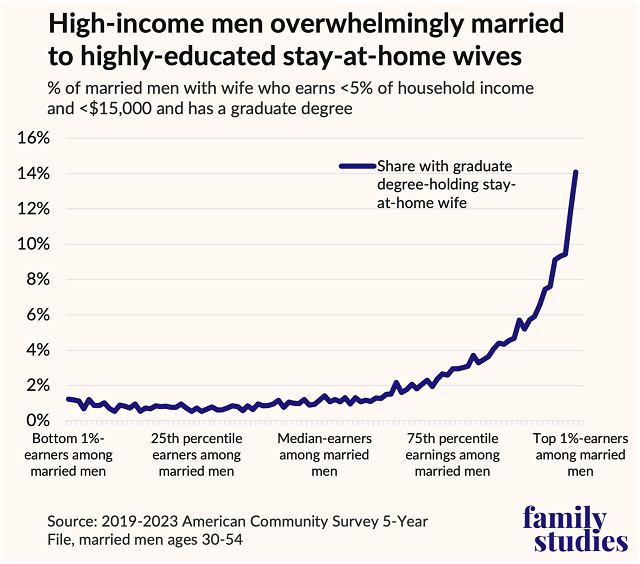
If young women want to be married, the Mrs degree is coming back basically. It’s also the high earners that are overwhelmingly married to stay-at-home moms because one income can support that unlike in many areas of the country now. 

This is echoed in another IFStudies piece on high earning women are more likely to marry.

Female marriage rates by income and year

Female marriage probability by income and education

Male marriage rates by income quintile and year

Male marriage probability by income and education

As we all knew as well women are more likely to be married younger, but men are more likely to be married older. Men married older is skewed by the male divorcees remarrying because they are more attractive to women than female divorcees. 

In general, for both men and women the plan is pretty clear. 

Men succeeding at work tends to likely develop the masculine traits and money needed to support a family at the same time. For women if they want to marry such a man they need to put themselves into proximity to these men. Or at the very least, have a high earning job even if it doesn’t require college or graduate school or a professional degree (trades) and put yourself in proximity to good women. 

Obviously, Christian is a must for both, but this is likely the way you want to go if you want to have the most successful model which I covered in the other article which is a higher earning man with a stay at home wife. 

Posted in Godly mindset & lifestyle | Tagged | 5 Comments

Say please

Jack has a great post about exposing demanding and negotiative mentality in women.

When a wife is saying, “[Husband] should do X, Y, Z”, then she is being demanding. I’ve covered how to handle demands before. The standard way for a man to deal with demands from women is to be more demanding of her than she is of you.

But when a wife is saying that “[Husband] should do X, Y, Z, … BECAUSE [Wife] does A, B, C”, then she is being negotiative or transactional. She’s also comparing her opinion of you to her view of herself.

The standard way of handling demands by being more demanding may not work in this case. If she is a lazy or passive wife, then she might fold. But if she is the type of person who is always pushing for excellence and improvement (which a lot of women do, including good women), then it turns into brinkmanship and one-up-manship that puts ever more pressure on the man because it is essentially a competition of who can outdo the other. Although this dynamic might be beneficial for personal improvement, a man has to watch that it never crosses the line into a competition of ‘Equals’ as women would like to think that it is.

There is a very easy way to put the brakes on the showmanship, if deemed necessary.

This is a good way to conceptualize the matter.

However, the most effective way I’ve found when helping men over the years is to defuse demands is with the the pressure flip.

  • Wife: Demands you do X, Y, and Z
  • Husband: (in a playful tone) “You forgot to say pleaseee…”

The one phrase instantly communicates several things to the wife which are:

  • She’s acting like a brat demanding things and trying to get her way
  • Typically, the show of manners is demanded by parents to children or teachers to students which automatically flips the scenario from her demanding something of you (her in authoritative position) to you demanding something of her (you in the authoritative position).
  • It’s just good manners, so there’s no way for her to come back on it without looking a jerk.
  • The playful manner means it’s not that serious, so it shouldn’t escalate into a full blown argument unless she is too far gone into the rebellious and disrespectful zone where she is thinking about divorce. If the situation is that serious where the wife continues to argue about it, typically the best way to defuse again is to use the same tactics that the women use against men: tone policing. Start policing her tone for being rude and disrespectful.

Side note – tone policing is one of the ways wives, feminists, and left uses to nullify any argument and make men and husbands look like the bad guy. It can be reversed on them and they typically look shocked or confused when it happens because it rarely does happen to them.

The problem beyond this though is if the relationship has slipped into such a position, so this is not the only things men should be doing to act as the leader. But this is usually a good way to defuse the situation and reverse it in the short term.

Posted in Godly mindset & lifestyle | Tagged | 2 Comments