As America celebrates its Semiquincentennial (250th anniversary) this year, explore a curated list of materials preserved at the Internet Archive documenting the nation’s founding, the Declaration of Independence, past ephemera created for the nation’s anniversaries, and new efforts to capture and preserve the materials published by democracies.
Democracy’s Library

The Internet Archive’s Democracy’s Library project helps preserve critical information and publications produced by federal, state, provincial, and municipal governments, and makes them available for users to access and to anyone wanting to build new services on these public documents. Learn more about Democracy’s Library.
Declaration of Independence
The National Archives of the United States lists three documents as the “Founding Documents”: the Declaration of Independence, the Constitution, and the Bill of Rights.
Preamble to the Declaration of Independence

We hold these truths to be self-evident, that all men are created equal, that they are endowed by their Creator with certain unalienable Rights, that among these are Life, Liberty and the pursuit of Happiness.
The Declaration of Independence was ratified on July 4, 1776, creating a historical date that Americans observe every year as “Independence Day.” Internet Archive preserves many materials related to the Declaration including a souvenir copy, a full reading of the text from LibriVox, and more educational and informative items.
The Declaration of Independence on the Wayback Machine
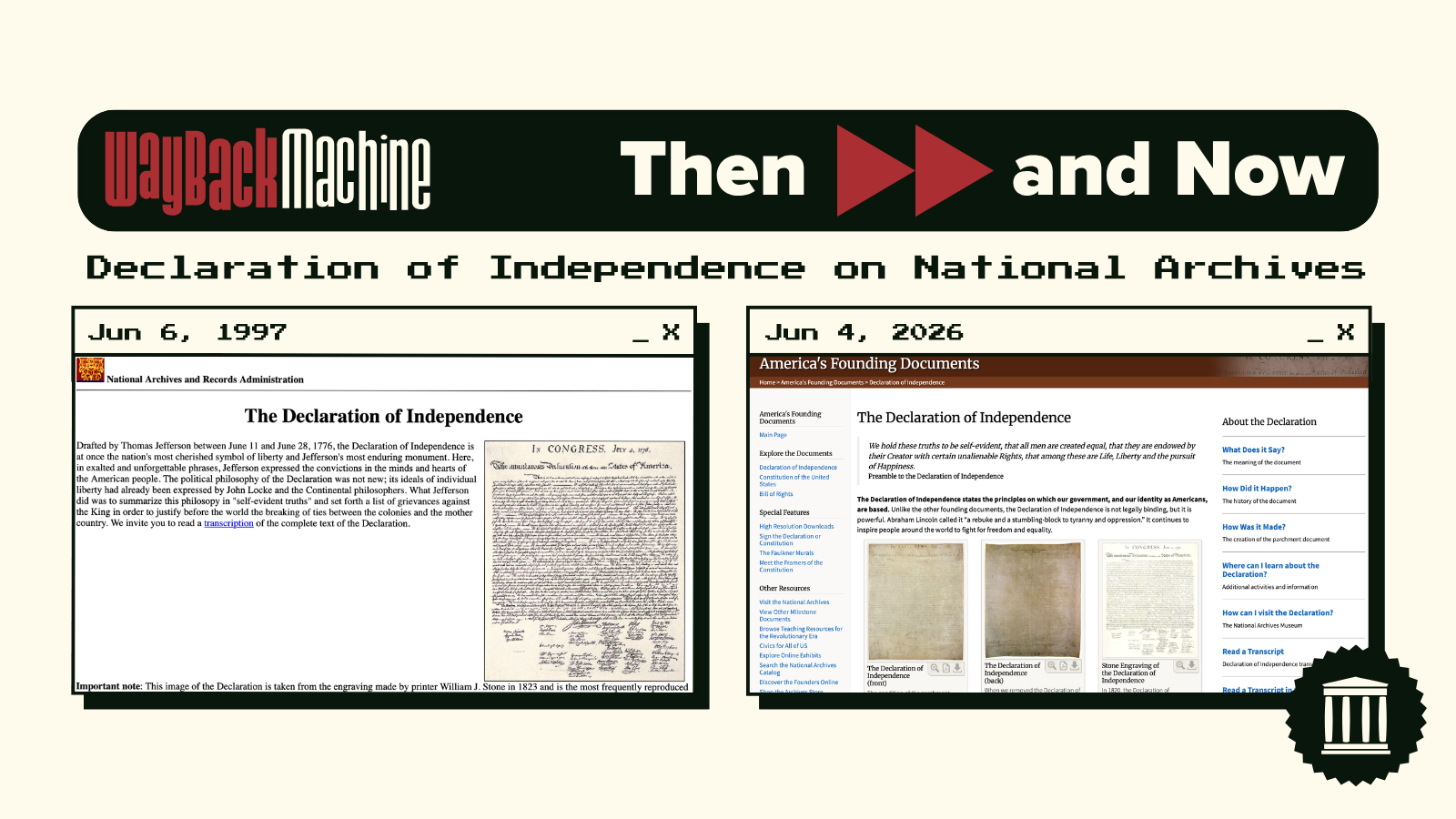
Internet Archive has been archiving the National Archives and Records Administration website since 1997. Compare the earliest capture (June 6, 1997) of the page displaying the Declaration of Independence via the Wayback Machine to a more recent capture (June 16, 2026). These preserved web pages allow Americans and other observers to trace the ways that presentation of the document has changed online over nearly 30 years.
How has America celebrated past ‘-Ennial’ anniversaries
Since its founding America has always told stories about itself. These stories see hotspots every 50 years during the various ‘-ennial’ anniversaries dating back to 1826. Below is a selection of materials highlighting each past anniversary. To explore more, check out the broader collections linked within the relevant sections.
Semi-centennial (1826)
On its first 50-year anniversary, America still was in living memory of the American Revolution and the signing of the Declaration of Independence. Almost symbolically, two titans of that moment would pass on that very day: John Adams and Thomas Jefferson.
Jefferson was instrumental in drafting the original Declaration while Adams was one of the 56 signatories. Each man served as President during the earliest years of the United States’ history.
Within the Internet Archive’s collections is The John Adams Library at the Boston Public Library, containing many items related to Adams’ life. To learn more about the dual death of Adams and Jefferson please read more at the Library of Congress Blog.
The Semi-Centennial was commonly referred to as the American Jubilee at the time. The document below is a printed version of a speech given by Reverend William B. Johnson in 1826:
The speech traces a providential history of America from European settlement through the Revolution and into the nation’s first fifty years, reflecting the patriotic and deeply religious tone common to many Jubilee observances. It offers a snapshot of how Americans in 1826 understood their country’s past and envisioned its future.
Centennial (1876)
Following the American Civil War, the late 1860s and 1870s saw the passage of the Civil War Amendments (XIII, XIV, XV) that altered the civic order of the nation. As the 100th anniversary came about, the United States hosted the Centennial Exposition in Philadelphia. Explore more from this moment in our collections.

This map of the United States, published by cartographer J.A. Caldwell around the time of the nation’s Centennial celebrations in 1876, reflects how Americans visualized their country at its 100th anniversary. As a Centennial-era artifact, it captures both the geographic reach of the United States and the national growth, infrastructure, and westward development in the decades following the Civil War.
This 1876 recipe booklet from the collections of the Smithsonian Libraries and Archives illustrates how Centennial-era businesses tied themselves to the celebration of American progress and industry. The booklet offers a glimpse into everyday domestic life during the Centennial year, while also demonstrating how companies used cookbooks as an early form of marketing to reach households across the country.
Sesquicentennial (1926)
Part of the Roaring Twenties, the 150th Anniversary of the United States was informed by the cultural and technological expansion of American society. Once again coinciding with an Exposition, this celebration saw a greater focus on the contentious topic of immigration and technological modernity. Explore more from this moment in our collections.
One of the official musical works of Philadelphia’s 1926 Sesquicentennial Exposition, John Philip Sousa’s Sesquicentennial Exposition March transformed the anniversary of American independence into sound. Written by the nation’s most famous bandleader, the march reflects the exposition’s blend of historical commemoration, civic pride, and large-scale public celebration. This recording comes from the United States Marine Band.
Created for the 1926 National Sesquicentennial Exposition in Philadelphia, this booklet explained the United States Public Health Service’s responsibilities through photographs and descriptions of medical practices. The booklet reflects a period of heightened concern over immigration and public health in the United States, coming just two years after the restrictive Immigration Act of 1924, when medical screening and exclusion of immigrants were central features of federal immigration policy.

Created for visitors to the Bell Telephone System exhibit at Philadelphia’s 1926 Sesquicentennial International Exposition, this booklet celebrates the fiftieth anniversary of the telephone through a first-person narrative spoken by the technology itself.
Bicentennial (1976)
The 200th anniversary of the Declaration’s signing coincided with an all-out blitz of media and governmental efforts to commemorate the occasion. From Congressional Committees, to civic engagement, and the leveraging of Hollywood Stars, the 200th anniversary was everywhere. Explore more from this moment in our collections.
Produced during the 1976 United States Bicentennial celebrations, this television advertisement features John Wayne promoting U.S. Savings Bonds as a way for Americans to participate in the nation’s future while commemorating its 200th anniversary.
This Amtrak brochure promoted a special Bicentennial-era excursion ticket that allowed travelers to visit cities closely associated with the American Revolution and the nation’s founding. By combining discounted rail travel with visits to historic landmarks, the brochure demonstrates how the 1976 Bicentennial transformed heritage tourism into a national pastime.
Produced as part of the Bicentennial celebration, New Spirit for ’76 demonstrates how organizers and promoters sought to frame the nation’s 200th anniversary as a moment of reflection, optimism, and shared identity.