Hollyland Mars M1 Enhanced | Wireless Video 5.5" Transceiving Monitor 150m, HDMI, SDI
€445.00
Reinvent your production approach with the Hollyland Mars M1 Enhanced, a 5.5-inch monitor and transmitter engineered for professional workflows....
Filter By
Brand
Brand
Price
Price
€445.00 - €12,200.00
Video Input
Video Input
Screen Size
Screen Size
Screen Resolution
Screen Resolution
Max Input Resolution
Max Input Resolution
Display Brightness
Display Brightness
Aspect Ratio
Aspect Ratio
Features
Features
Professional video monitors built for broadcast, cinema and live production environments. From compact on-camera displays to large-format studio reference screens.
Active filters
Every frame matters when a production is underway, and the monitor you rely on determines whether what you see matches what the sensor actually captures. A washed-out display, a barely visible screen under midday sun, or a colour cast that only becomes obvious in post — these are problems that cost time and money. Professional-grade video monitors exist precisely to eliminate that guesswork. They deliver calibrated colour, high brightness and reliable connectivity so that camera operators, directors and colourists can make confident decisions on set, in the control room or out in the field.
What separates a broadcast-quality monitor from a consumer screen goes far beyond resolution. Colour accuracy measured against Rec.709, DCI-P3 or Rec.2020 colour spaces, peak brightness expressed in nits, contrast ratio, bit depth, 3D LUT support and professional-grade connectors like 12G-SDI — these specifications define whether a display can be trusted for critical evaluation. The range of monitors available today spans from ultra-compact 12.7 cm (5-inch) on-camera units weighing under 350 g to 80 cm (31.5-inch) studio reference panels capable of native 4K UHD output with full HDR processing.
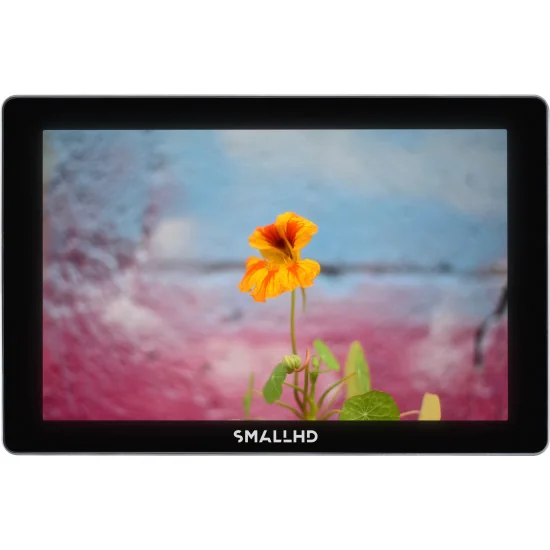
Mounting a dedicated screen on top of a camera rig, gimbal or drone gives the operator a far sharper and brighter view than any built-in camera LCD. The critical parameters here are brightness, weight and response time. Shooting outdoors under direct sunlight demands at least 1 000 nits; some units push well beyond that figure. SmallHD builds its Ultra 5 with a 3 000-nit IPS panel at 1920×1080 — bright enough to remain fully readable even on a rooftop at noon. The touchscreen interface running PageOS 5 lets operators swipe between monitoring tools — false colour, waveform, focus peaking — without navigating buried menus. Dual 3G-SDI and HDMI 2.0 connectors with cross-conversion mean it accepts a signal from virtually any camera and passes it onward simultaneously.
For productions that need recording alongside monitoring, Atomos occupies a unique position. The Ninja line combines a 13.2 cm (5.2-inch) 1 000-nit touchscreen with ProRes RAW capture up to 6K — turning the monitor into both a viewing tool and a recorder. Camera operators working with compatible bodies from Canon, Sony, Nikon or Panasonic can bypass internal compression entirely and write RAW data straight to an SSD through the HDMI input. The Shinobi 7, on the other hand, strips away recording to offer a pure 17.8 cm (7-inch) 4K HDR monitoring experience at a lighter weight and lower cost, which suits focus pullers and second-unit shooters who simply need a reliable image.
A director rarely stands next to the camera. The viewing station — sometimes called video village — sits metres away, and the screen there needs to be large enough for multiple people to evaluate the shot simultaneously. Sizes between 43 cm (17 inches) and 80 cm (31.5 inches) are standard for this role. Lilliput manufactures a range of broadcast-grade panels in this segment: the Q31 delivers a 31.5-inch native UHD 3840×2160 display with 12G-SDI input and output, supporting single-link 4K signals over one BNC cable. The Q28 and Q18 offer 28-inch and 17.3-inch variants with equivalent SDI infrastructure. For facilities that have adopted fibre transport, Lilliput integrates 12G-SFP optical modules on several models, allowing signal runs over hundreds of metres without degradation.
Colour fidelity at this stage is non-negotiable. Directors and cinematographers use these screens to approve lighting, wardrobe and makeup under a colour pipeline that must match the final grade. A monitor with full Rec.709 coverage at minimum — and DCI-P3 coverage for theatrical work — combined with user-loadable 3D LUTs, gives the on-set team a realistic preview of the finished image. Histogram, waveform and vectorscope overlays allow the DP to verify exposure and colour balance without relying solely on visual impression.
In a live broadcast truck, a multi-camera studio or a corporate event control room, monitors serve a different function: they must show multiple feeds at once, integrate with switchers and tally systems, and survive long hours of continuous operation. SEETEC builds its ATEM series specifically around this need. The ATEM156S and ATEM173S feature quad-split display modes, four HDMI inputs with loop-through, and LED tally indicators that synchronise with Blackmagic ATEM switchers — a detail that makes them immediately useful for live-switched productions and streaming setups. Brightness levels around 400–500 nits are sufficient indoors, and the focus shifts toward accurate colour rendering and long-term panel reliability.
For larger installations, RGBlink provides studio-grade solutions. The Aura UHD 24 Gen 2 packs a 60.5 cm (23.8-inch) IPS panel at full 3840×2160 resolution with 1 000-nit brightness, four 12G-SDI inputs, four SDI loop outputs and dual HDMI 2.0 inputs. It handles RS-422, GPI and LAN control — the kind of integration that a broadcast facility's engineering team expects. Multiview layouts, on-screen markers and audio level metering are accessible without external hardware, reducing rack complexity.
SWIT takes a complementary approach with monitors that support NDI natively — a first in the professional segment. For studios already operating on IP-based video infrastructure, receiving a feed over Ethernet rather than coaxial cable simplifies cabling and opens up monitoring positions that would otherwise require long SDI runs or expensive fibre converters. Their 4K models with QLED panels also offer pixel-to-pixel zoom, CIE scope analysis and eye-pattern monitoring — tools typically reserved for engineering-grade test equipment.
The boundary between a field monitor and a studio monitor has blurred considerably. A production shooting a documentary in a remote location one week may use the same 17-inch display in a post-production suite the next. Durability, accurate colour under varying ambient light and a wide range of power options — V-mount battery, Gold Mount, D-Tap, mains AC — matter as much as the panel specification itself. SEETEC's 12G series (the 12G238F at 23.8 inches and the 12G320F at 32 inches) targets both environments with 12G-SDI connectivity, full 4K resolution and a chassis that fits equally well on a C-stand in the field or mounted on a desk arm in an edit bay. Contrast ratios above 1 000:1 and wide viewing angles ensure the image holds up when several crew members gather around one screen.
Rackmount configurations remain essential for outside broadcast vehicles and master control rooms. Lilliput's RM-1730S slots into a standard 19-inch rack and delivers a 43.9 cm (17.3-inch) panel with SDI and HDMI connectivity — a straightforward solution when rack space is limited and multiple monitors need to sit side by side. The RM-0208S takes the concept further by fitting eight 5 cm (2-inch) screens into a single rack unit for multi-channel confidence monitoring.
Running cables between a moving camera and a stationary director's station is often impractical — think Steadicam shots, crane moves or multi-room setups. Hollyland has built its product line around solving exactly that problem. The Mars M1 Enhanced combines a 14 cm (5.5-inch) 1 000-nit monitor with a built-in wireless transmitter and receiver in one body. It pushes a 1080p signal up to 137 metres (450 feet) line-of-sight with roughly 80 ms latency, and supports monitoring from up to four devices simultaneously through its app-based Broadcast Mode. Inputs cover both HDMI at 4K/30 fps and SDI, with a full suite of on-screen tools: waveform, vectorscope, zebra, focus peaking, anamorphic desqueeze and aspect markers.
The Pyro 7 Kit steps up to a 17.8 cm (7-inch) dual-screen wireless package at 1 500 nits — enough brightness for outdoor monitoring with no shade — and adds proxy recording plus direct camera control from the receiver side. For crews that need to stream simultaneously, RTMP output is available directly from the unit. HollyOS provides a consistent interface across the range, with factory colour calibration that keeps the transmitted image faithful to the source. Dual-band operation on 2.4 GHz and 5 GHz helps avoid interference in crowded RF environments such as concert venues or trade shows.
Choosing a monitor also means choosing which signal ecosystem it belongs to. 12G-SDI (SMPTE 2082) carries 4K at 60 fps over a single 75-ohm BNC cable at 11.88 Gb/s — the current standard for broadcast infrastructure. It is backward-compatible with 6G, 3G and SD-SDI, so a single monitor input can accept signals from older and newer equipment alike. HDMI 2.0, with its 18 Gb/s bandwidth, handles 4K at 60 Hz and remains the primary output on most mirrorless and cinema cameras below the high-end broadcast tier. Many professional monitors offer both SDI and HDMI with cross-conversion, allowing a signal received on one connector type to be output on the other — a feature that proves its value daily on mixed-equipment shoots.
USB-C connectivity is appearing on newer portable monitors, enabling both video input and power delivery through a single cable from laptops or compatible cameras. SFP fibre modules extend SDI signals over single-mode fibre for cable runs that can exceed a kilometre without signal loss — essential in large venues and permanent broadcast installations. Ethernet and NDI (Network Device Interface) represent the IP-based future: monitors that accept video over standard network cabling reduce infrastructure costs and allow monitoring from any point on the network.
Each connector choice carries trade-offs in cable length, bandwidth, cost and compatibility. A thorough understanding of the signal chain — from camera sensor through transmission to display — ensures that the monitor you select integrates seamlessly with the rest of the production equipment, rather than becoming a bottleneck.
check_circle
check_circle