Sachtler Dr. Bag – 1 Small
€190.00
Sachtler Dr. Bag 1 is the smallest member of the iconic doctor-style series and targets crews who must grab the camera fully rigged and go. The...
Filter By
Brand
Brand
Price
Price
€190.00 - €12,499.00
Camera accessories determine shooting speed, camera safety and on-set control. From media and power to support, transport and wireless tools, every detail affects reliability.
Active filters
Camera accessories decide how reliably a production unit performs once the camera leaves the prep table and enters a real set. A body with a strong sensor and codec is only one part of the equation. Daily work in broadcast, live production, documentary shooting, branded content and studio recording depends on stable power delivery, media that can sustain modern data rates, support systems that hold balance under changing payloads, and transport solutions that protect equipment between locations. A professional buyer does not look at accessories as secondary items. They are the parts that keep a camera recording, keep lens changes under control, keep the rig balanced, and keep the operator moving without unnecessary delays.
That is why accessory choice usually starts with technical compatibility. Media has to match codec and bitrate. Charging systems must fit the battery ecosystem already used in the company. Rigs must leave enough clearance for cables, wireless transmitters, top handles, matte boxes and follow focus motors. Support must match camera mass, centre of gravity and shooting style. In practice, one production may combine Angelbird recording media, OWC readers, SWIT batteries, a Tilta cage, SHAPE shoulder support, a Sachtler or Cartoni tripod, and a wireless link from Teradek. The point is not brand stacking. The point is predictable operation under production pressure.
Batteries and chargers are the first control point for dependable shooting. In studio work they reduce interruptions during long sessions; in ENG and event production they determine whether the camera, monitor, wireless transmitter and accessory motors can stay powered from a single system. Buyers usually look at battery chemistry, mount standard, charging current, output options and hot-swap capability before anything else. A compact USB-C travel charger can be enough for light mirrorless kits, while V-mount or B-mount ecosystems with multi-bay chargers are more appropriate for cine cameras, LED lights, field monitors and wireless transmission packs. SWIT is relevant here because its range covers compact chargers, fast multi-channel charging stations and power accessories such as hot-swap plates and D-tap to USB-C solutions, which matter when a rig must run several devices from one controlled power layout.
Recording media is no longer a simple storage choice. It directly affects whether the camera can sustain RAW, high-frame-rate intraframe codecs or long-form event capture without dropped frames. Productions working with 4K, 6K and 12K acquisition increasingly expect CFexpress, CFast, SD V60/V90 or high-speed SSD-based recording paths with stable sustained write performance rather than only headline read speeds. Angelbird and OWC are strong examples because they address both capture and offload: cards for demanding recording modes, plus readers and media handling tools that shorten transfer time at the ingest station. For a production company, that translates into quicker handover to the editor, fewer bottlenecks during card rotation, and better discipline when several cameras generate material simultaneously.
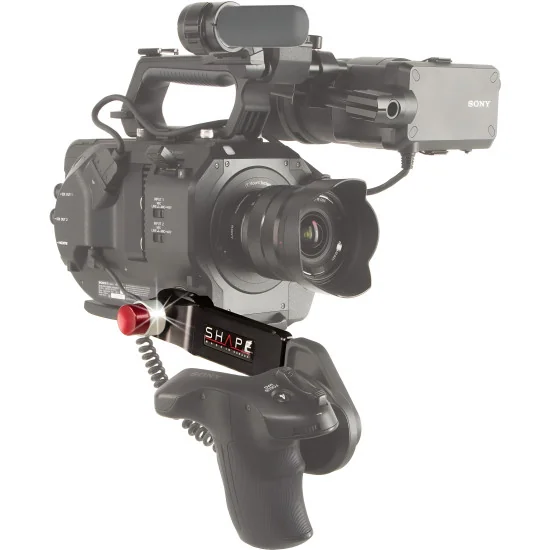
Rigs are what turn a camera body into a usable production platform. A cage is not only protection against knocks. It provides mounting points for monitor arms, microphones, wireless receivers, SSD holders, timecode boxes, handles and power distribution. Shoulder systems matter when the operator needs a stable handheld base over a long day. Rod-based builds matter when a matte box, follow focus and lens motor must remain aligned after quick lens swaps. SHAPE is closely associated with support structures and operator ergonomics, while Tilta extends the rigging concept into cages, matte boxes, lens control and powered camera ecosystems. For interviews, documentary, vehicle rigs, compact gimbal builds or stripped studio setups, the right support architecture keeps the camera easier to balance, cable and service.
Stabilisers and motion accessories matter whenever the brief calls for controlled movement rather than a static frame. That can mean walking shots, product reveals, tabletop moves, interview motion with slight parallax, or repeatable camera travel for branded content and e-commerce video. edelkrone brings useful reference points here because systems such as HeadPLUS, JibONE and linked motion accessories target compact, programmable moves that can be repeated precisely. In a different part of the signal chain, Teradek supports mobile camera operation through low-latency wireless video and control tools, which is often just as important as physical stabilization when a gimbal, handheld camera or roaming broadcast position cannot be tethered.
Tripods remain one of the most critical camera accessories because they influence not only stability, but also pan consistency, re-framing speed and operator fatigue. Buyers in television and live production pay attention to bowl size, payload class, torsional rigidity, leg lock speed, spreader options and transport mass. A lighter set may suit documentary work and small cine builds; a heavier system is more appropriate for long-lens operation, studio cameras or teleprompter use. Sachtler, Cartoni and Libec all fit this discussion from different angles: fast-deploy carbon tripod systems, classic professional head-and-leg combinations, and support ranges that also connect easily to sliders and compact production rigs. A well-matched tripod preserves horizon control, supports repeatable framing and gives the operator confidence during long takes.
Sliders are chosen when movement has to stay measured, linear and visually clean. They are common in product cinematography, interview enhancement, corporate image films, tabletop shoots and studio inserts where a slow lateral move adds depth without changing the camera language too aggressively. Rail quality, carriage smoothness, load distribution and mounting compatibility are more important than marketing claims. Libec and edelkrone represent two useful directions: practical slider systems for field and studio use, and motorized motion tools for programmed moves, product loops and repeat takes. In a professional environment, that means cleaner movement for edit points, controlled reveal shots and a better chance of repeating camera paths between takes.
Bags and cases are often judged too late, usually after a transport problem or a rushed location change. Their real value lies in keeping cameras, lenses, media, batteries and support items ready for immediate deployment while reducing mechanical stress during travel. The buyer should pay attention to internal layout, shell stiffness, opening width, transport comfort and whether the case holds a ready-built camera or only stripped components. Sachtler and Libec are relevant because they cover camera bags, tripod bags and carry solutions linked to real production support gear. Datavideo also enters the accessory conversation through teleprompter systems that frequently travel between studio, conference and webinar locations, where safe packing and fast assembly matter as much as optical performance.
A strong camera accessories package gives a production team more than convenience. It brings predictability. Media offloads faster, battery swaps are cleaner, rigs stay balanced, the tripod reacts the same way every time, and transport becomes less chaotic. For companies producing broadcast segments, streaming sessions, multi-camera events, interviews, branded films and studio recordings, that consistency is easier to monetise than any headline feature on the camera body itself.
check_circle
check_circle