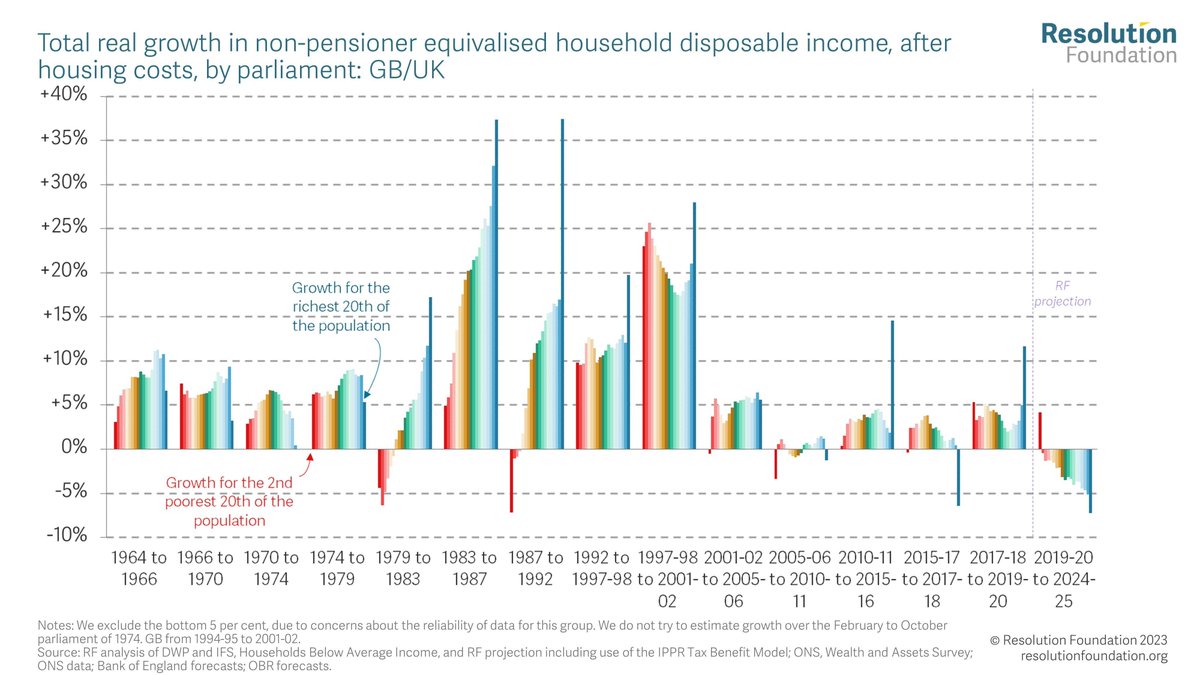
This parliamentary term is on track to be by far the worst for living standards since the 1950s.
Typical working age household incomes are on course to be 4% lower in 2024-25 than they were in 2019-20.
Never in living memory have families got so much poorer over a parliament.
Resolution Foundation
52.9K posts
The Resolution Foundation is an independent think-tank dedicated to lifting living standards in the UK.
- Who gains most from the Chancellor's income tax cuts next year? The richest tenth of households are overwhelmingly the biggest winners
- Replying to @resfoundationMiddle income Britain stands to lose most from the overall impact of all tax and benefit policies announced over the parliament. The poorest fifth of households gain £90 on average, with the middle fifth losing £780, and only the top five per cent gaining significantly (£2,520).
- British households are on course to be poorer going into the coming election, than they were coming out of the last one. This Parliament looks set to be the worst on record for household income growth... 👇
- This parliamentary term is on track to be by far the worst for living standards since the 1950s. Typical working age household incomes are on course to be 4% lower in 2024-25 than they were in 2019-20. Never in living memory have families got so much poorer over a parliament.
- Replying to @resfoundationLabour's plans would mean the size of the state growing to a mid-table European size. This is not radical from an international perspective, but is radical given Britain's recent economic history.
- Cutting Universal Credit by £20 a week could drive up relative poverty from 21% today to 23% by 2024-25, while a further 730,000 children would fall into poverty. The decision on UC will help define whether this is to be a parliament of levelling up incomes, or pushing up poverty
- Average annual pay is projected to be £1,030 lower in 2022 than was forecast in the March 2017 Budget. That extends Britain's pay downturn to 2025 - 17 years of lost pay growth
- Replying to @resfoundationThe Chancellor’s huge package of personal tax cuts will disproportionately benefit London and the South East – with households in these regions standing to gain to three times as much on average (£1,600) as those living in Wales, the North East and Yorkshire (£500) next year.
- NEW Blowing the budget - the RF overnight analysis of the Chancellor's September Fiscal Statement. Here's a short thread of the key highlights ahead of you reading the full 31 page report.... 🧵
- If only this were true. A Universal Credit claimant on the National Living Wage will take a home as little as £2.24 from an extra hour’s work. A small increase in working hours will be nowhere near enough to cover the £20 a week cut coming their way next month."£20 a week is about two hours extra work every week, we will be seeing what we can do help people perhaps secure those extra hours” On #BBCBreakfast Work and Pension Secretary Thérèse Coffey says the increase to universal credit was always temporary. bbc.in/3k2swRY
00:00 - NEW RF analysis of #SpringStatement2022 - The scale and distribution of the cost of living squeeze means a further 1.3 million people are set to fall into absolute poverty next year, including 500,000 children – the first time Britain has seen such a rise outside of recessions.
- Graduate salaries have stagnated while the minimum wage has risen, leading to convergence between the two. Two decades ago, the median graduate in a ‘graduate job’ had a salary 2.5 times that of a minimum wage worker, by 2023, the typical graduate earned 1.6 times a minimum wage
- Replying to @resfoundationBetween 2021-22 and 2023-24, the number of people living in absolute poverty is on track to rise by 2.3 million, including 700,000 children.


