Use the Purchasing Managers’ Index for accurate and timely insights into the health of the global economy. Data available only via subscription, info here: okt.to/v4XDnc
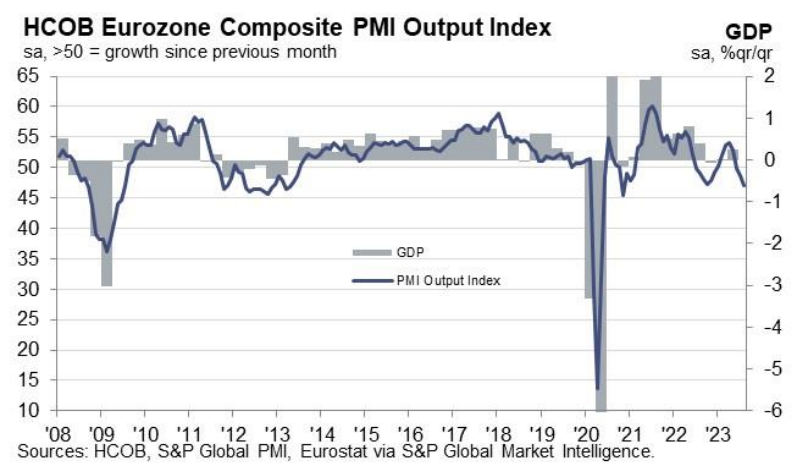
The Eurozone Composite #PMI pointed to the sharpest decline in private sector activity for nearly 3 years in October (46.5; Sep: 47.2), leading firms to cut staff for the first time since early-2021. Read more: ow.ly/N1L550Q4qK2@HCOB_Economics#eurozone#trading
Flash #Eurozone#PMI fell to a 33-month low of 47.0 in August (Jul: 48.6). The downturn spread to the service sector, hitting output and new orders, whilst hiring came close to stalling and inflation gauges ticked higher. @HCOB_Economics Read more: ow.ly/XTCW50PCfkB
Eurozone flash #PMI drops to 48.9 in July (June: 49.9) to signal the quickest fall in output for 8 months, while new orders and confidence data predict a potential worsening of the downturn. Read more: ow.ly/v0Xq50Pja2V
COVID-19 caused the largest collapse in business activity ever recorded in the eurozone, according to our data. The Composite Output PMI fell to 31.4, falling over 20 points and signalling a quarterly contraction of approximately -2%. More: ihsmark.it/KBOB50yTX8g
The global economic upturn gathered pace in May, according to the headline JP Morgan PMI, covering manufacturing and services in over 40 economies. In fact, having accelerated for seven months in a row, growth surged to a 12-month high. 🧵(1/5)
#Eurozone manufacturing sector fell deeper into contraction territory in July, as #PMI data signalled the sharpest decline in output since May 2020. Cost pressures remained sharp, but softened from June. Read more: ow.ly/IR8J50K8jHF
🇺🇸 Flash US #PMI Composite Output Index slips to 47.5 in July (Jun: 52.3), signaling a contraction in private sector output for the first time in two years. Read more: ow.ly/UHPt50K28Ln
Recession risks increase for the #UK as indicated by the flash #PMI data, as the downturn in output records the steepest since the global financial crisis in 2009, barring only the pandemic lockdown months. (1/6)
🇺🇸 At 52.2 in July (June: 52.7), the latest US Manufacturing #PMI indicated the softest growth in two years. Production levels and new orders fell amid weak client appetite, ongoing supply chain disruptions and inflationary pressures. Read more: ow.ly/B0XM50K8ARb
#Eurozone output contracted for the first time since February 2021 in July, according to flash #PMI data, with the headline index posting at 49.4 (June: 52.0). Excluding lockdowns, new orders fell at the quickest pace since May 2013. Read more: ow.ly/isGu50K1SMX
Global price and supply pressures are easing, according to our Manufacturing #PMIs, with reports of supply #shortages at a 17-month low. Price pressures softened to the weakest in 1.5 years (1/2) ow.ly/FlxN50JNBBg
#Taiwan Manufacturing PMI fell sharply to 44.6 in July (June: 49.8) to signal the quickest decline in operating conditions since May 2020. More positively, weaker demand pressures resulted in the softest rise in input costs for 23 months. Read more: ow.ly/zNWz50K8hQv
#Eurozone manufacturers continued to report a sharp contraction in September, the @HCOB_Economics#PMI signalled (43.4), as new orders shrank at one of the fastest rates since the survey began in 1997. Read more: ow.ly/9hyn50PRLkN