All Activity
- Past hour
-
The whole UAP disclosure seems to suffer from fuzzy blob syndrome. IOW, nothing beyond the grainy indistinct oddities we've been seeing for decades. Along with the usual parade of unsupported witness reports vaguely hinting at...something. As @Moontanman says, it's another pathetic distraction ploy. The only decent footage seems to be found in Spielberg fables.
- Yesterday
-
I don't think you can hide behind statistics. Every accident, human or otherwise, is liable to the determination of responsibility. It is no good saying, for instance "I am driving a Volvo since they are safer cars", if you then cause an accident in one. As regards manufacturer responsibility motor bike are very definitely less safe than cars. Should we blame the idiots who drive them irresponsibly or the manufacturers? Quite the reverse situation in the UK. In 2019 the 'Highway Code' was strengthened by introducing a formal hierarchy of precedence with pedestrians at the top of the list. Formerly horseriders were top, but they now come second, with cyclists third. Unfortunately too many drivers think they have precedence in all situations, when there are actually very few such situations indeed.
-
I suspect it depends a lot on context. I.e. who initiated it and to what purpose. During the Jim Crow era, a lot of confederate statues were built in direct rebuke to equal rights, for example. In other cases it might also be just naivete where the folks celebrate a particular achievement, but were just not aware of the issues, just by general lack of education in this area. Though in these cases it can be bit difficult to disentangle it from soothing the conscience. In my mind worshipping any person comes with issues as MigL pointed out, humans are faulty creatures. And while it might be fine to celebrate certain achievements, by worshipping persons you inadvertently tend to minimize those faults. That in turn make it easier to dismiss victims of their actions. I wished we would treat folks as humans, rather than idols.
-
@TheVat You forgot "The Monster" by Steppenwolf
-
I think this whole "UAP/UFO disclosure" is complete BS! If they had anything to disclose why not show the evidence to scientists? Why display what amounts to "lights in the sky" on TV for all to see with no real explanation or context? This is nothing but an attempt to distract from the Trump régime's crimes against the American people. If it was a serious attempt to disclose actual evidence it should be given to the scientific community... all of it, no redactions and if what they are showing is the best they have then I for one am not impressed, UFO magazines of the 60's and 70's had better photos and much better background information. This is so obviously just another jet stream of BS coming out of our government... yes I am angry! It's sad to see our Nation reduced to such flimflammery to prevent a pedophile from getting his just deserts.
-
There’s a certain amount of a “they were bad to the right people” attitude that holds up with fewer and fewer people, but as we’re seeing (in the US these days, at least) that if you want to rectify the situation it very much matters who’s in charge, since they can hamstring efforts to change things.
-
It makes me wonder if the villains don't end up being memorialized officially as a way to soothe our own consciences. Forget about what got them kicked out of office and reviled by all, point out something benign and build them a monument to it. We did the same with Columbus and Woodrow Wilson.
-
I think that is a good way to move towards a more equitable economic system. The idea of our mixed economy was always to balance out the flow of capital to the top and devaluing labor, which is pretty much how capitalism works (and which Adam Smith considered a virtuous cycle, but where folks like Marx recognized that it does not in fact create an expanding pie where everyone gets richer). The issue is that the balance is increasingly perceived to be off, especially in the service economy, where products are increasingly intangible and wealth seems to increasingly move independent of production. That being said, wealth and with that, power, has accumulated so massively in few hands, it seems now to be almost impossible to move the needle towards redistributing. Especially as folks almost reflexively fear some sort of market breakdown (but conveniently forgetting that for some reasons the major market crashes again made the richest even richer). But that, in my mind does not touch the fundamental societal issues. What baffles me is that especially social media companies are not only a thing, but that they are so massive. It is somewhat dystopian that a system can make money bytaking away your attention, and spoon-feed you content. Together with addictive hardware (cell phone), it has massively re-engineered human society world-wide. As we have discussed before, other major events (books, radio, TV) had similar wide-scale effects. But at least in modern times, these technologies have, I believe for the first time, systematically degraded human abilities across the spectrum, at scale. Folks focus a lot on the decline in various scoring domains (e.g. maths, reading, writing, etc.), but I think beyond just the skills it also has eroded reasoning abilities in a very strange way in younger folks. I think that is almost immediately connected the next part. With a decline of basic reasoning skills, we have reverted to an almost exclusive in-group based trust system. Someone who is considered to be part of the group is endlessly trust worthy, regardless of facts. My work has drifted ever more into the public health area and the one thing I increasingly believe is at fault is the internet, where the virtual has become more real than the real world. Emotions have increasingly become the currency of trust, not facts or reasoning. The interesting thing that happens, if you engage with folks in person and demonstrate goodwill, many are at least more willing to listen. But the format is very important and decoupling reality with what they heard online is often hard and inconvenient work. No system currently likes to do that, and because news (and the fact that you call it a news show sort of already outlines the problem) want to make money, and they are basically just competing with content creators into an endless downward spiral. Even if folks listen to analyses, what they really want to hear is that the analysis reaffirms their feelings. And again we enable that by degrading basic reasoning skills among the next generation(s). This is again an economic argument, and it is equally baffling, but perhaps also understandable that corporations don't understand/care for that. Economy has always been short-sighted, looking at immediate improvements of productivity, efficiency and profit, rather than long-term vision. Almost by design capitalism is reactive (which is its big strength) but resilient to long-term planning. The right regulations might be able to change the course, but I have not yet seen a convincing framework of what needs to be done, or even what vision we have for the future. And I do think that the societal changes that we have, will make those visions ever more blurry.
-
One solution is that a situation is not a “thing” to which the conditions apply. Physical objects as opposed to concepts. The issue with concepts, as npts2020 alludes, is that we can imagine impossible things. Another issue is these concepts being too vaguely defined, leaving way too much wiggle room.
-
That would be an example of the kind of shielding that I mentioned. The US, at least, heavily favors automobile use to anyone else on the road. Indeed. I can’t think of why there should be one, but there are lots of examples of corporations lobbying their way into being shielded from accountability
-
Consider why motorists are so heavily shielded from charges of recklessness simply for bringing an inherently dangerous piece of machinery into an environment shared by others. The origin of 'jaywalking' is instructive: If a man takes his imported pet leopard for walks down the village street, and every so often it bites a lump out of a passing yokel, who is morally responsible for this? The leopard? The yokel? Pray explain why there should be any difference regarding machinery whether AI controlled or not. Indeed this argument seems to render the AI factor irrelevant.
-
We’re in a discussion of legal liability, so who is responsible when the accident occurs. Is it the AI company, or the non-driver? If it’s the latter, then people are going to have to be convinced that it’s worth assuming the liability. When governments use AI and the AI errs and violate someone’s rights, they aren’t really in a position to pass the buck
-
There are already autonomous robotaxis and what we currently learn is that it obviously cuts down on human failings, such as cell phone use and other distracted driving, DUI etc. And therefore outperform drivers especially under good conditions. The issue is a bit murkier under bad weather, dusk/dawn situations, but this could be areas of improvement. It should be noted that this is likely not exclusively a software-side issue, though companies like Tesla treat it as such, but also a sensor-side issue. LIDAR significantly outperforms camera only, for example. If we get tot the point that autonomous driving becomes the norm, I would assume that liability will be similar with respect to robotaxis, i.e. the manufacturer will be liable, for crashes while in autonomous mode. Though there will be questions regarding shared liability with respect to maintenance or use beyond the terms that will likely exist (e.g. driving outside of established grids). But again, I don't think that autonomous driving, at least for the foreseeable future, is an AI-only question.
-
Human beings have accidents when driving cars - Insurance assessors can no doubt provide statistics on the risk factor. It seems likely to me that cars controlled by AI will also have accidents, but be developed to the point that statistics show them to be safer than humans. I can see a person in such a car that has an accident giving as an excuse "I gave control of the car to a system that statistics show improved safety on the road". Even more than that, when AI control is acknowleged as the safer option I can't see why the human occupant will even need to be able to drive at all. Is that a beautiful dream or a nightmare ?
-
This statement cannot be true in real life. I can conceive a state of nothingness in my mind but like the red fire-breathing dragon I can also conceive, it has no bearing on reality other than how I wish to act on the fantasy. Simply by having the statement or notion that "all things are absent" makes it a falsehood because the statement/idea/concept exists. I can imagine the idea to not exist but, like the red fire-breathing dragon, it will never be reality.
-
Terry Pratchett and Doug Adams would have loved this website. The Third Epoch of Laziness was a cosmic period where galaxies refused to spin without statistical approximations. Following the exhaustion of the First Era of Tangible Mathematics, the fundamental forces of the universe began cutting corners to conserve processing energy. This widespread probabilistic sociopathy led to a severe degradation of the Branch of Undeniable Physics. Rather than calculating exact orbital mechanics, celestial bodies began relying on the Nebular Probability Engine, which merely guessed where planets should be based on previous trajectories. During this period, historical and astronomical accuracy deteriorated into a state of Statistical Blight. Entire star systems were fabricated out of administrative convenience. The most notable nightmare of the epoch was the Guessed Century Incident, closely followed by the spontaneous manifestation of the Hallucinated Comet of 1912. When the universe attempted to render the Phantom Empire of Grom using statistical shortcuts, the Bureau of Cosmological Audits officially declared the epoch a total structural failure.
-
I hope as Ms Sturgeon recalls Her ex's embezzlement spree, For every new-single Sturgeon There are plenty of fish in the sea.
-
It’s not nebulous that a human is involved somewhere, making a decision - turning on a machine, etc. The legal responsibility is nebulous when the law doesn’t exist that holds people accountable. That’s why we need laws and legal precedent, as some of us are discussing. Unfortunately the law is sometimes absent or written such that it shields the people who are morally responsible.
-
I noticed that. At first I thought it was something to do with the rainy weather, but no they had an overhang to work under. They could have waited till tomorrow, however - that's Turnip's birthday. You could look up Sand Creek Massacre and see if you're still okay with keeping that peak as Mt. Evans. Even by the standards of the white community in that time, his actions were considered disgraceful. After a congressional investigation condemned the actions of involved parties, Evans was forced to resign from his governorship in disgrace in 1865. Really doesn't strike me as a mountain name candidate, no matter how far you extend your moral relativism. This name change was a good call.
-
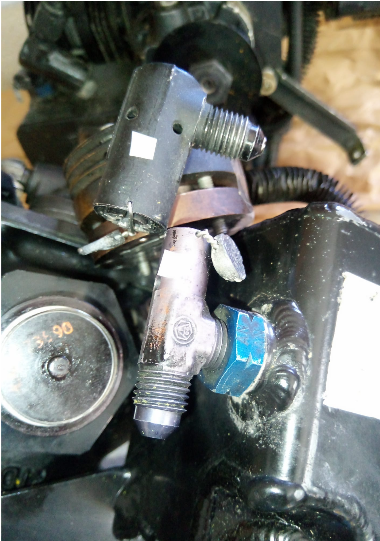
There is two fittings in the image, a bright and a black. Do you know if these are check valves or something else ? Both have lead bead tamper-proof seal setting to a slotted flat screw 'calibrator'at one end.
-
A topical one courtesy of Private Eye
-
Such a lofty idea it's gone and flown right over my head (was it a bird? was it a plane? ....)
-
Reminding otherwise unengaged people of the importance of enforcing guardrails around power and the need to pay attention, to show up and speak out, and to be counted when it matters most.
-
Also good thoughts, but many countries (UK included and even England) do not have a centralised 'grid' ; in many circumstances one does not even make sense.
-
Good points. Reading between the lines, different interest groups are all pulling in different directions, competing for limited governmental attention and development budgets. What's clearly lacking at national levels globally is holistic long-term power supply planning covering: Projected regional power demand Capacity and distribution of base load generation. Capacity and distribution of hot-standby generation. Capacity and distribution of cold standby generation. Capacity and distribution of deep power storage units. Transmission capacity. Stable environmental impact criteria. Stable and flexible grid supply-demand management. Grid voltage and synchronisation management. Stable grid frequency control Power factor control. Rigorous transient and fault protection. Progressive stable and fair power pricing policy (both internal and external) Progressive stable and holistic investment policy Rational accommodation of technological advances. Failure to address any one of these appropriately will adversely impact grid performance as a whole. The free market will always cherry pick the fastest ROI, neglecting the rest, so the central dilemma is how to achieve all of the above through stable, integrated state-level control for the next 50 years. (Where's Stalin when you need him!)


