
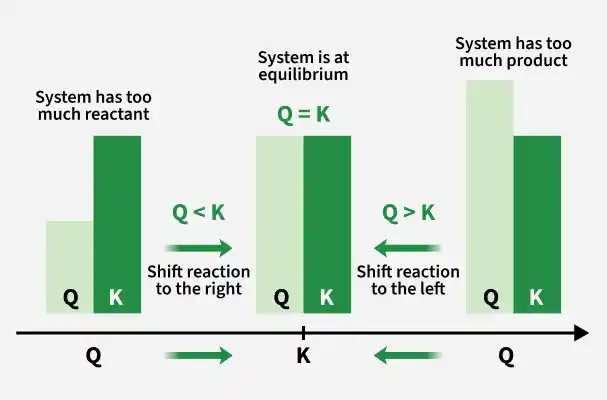
A chemical reaction attains a state of dynamic equilibrium when the rates of the forward and backward reactions become equal and the concentrations of reactants and products remain constant. The ratio of the concentrations of products to reactants at equilibrium is called the equilibrium constant, expressed as Kc (in terms of concentration) and Kp (in terms of pressure).
Characteristics of Equilibrium Constant
The important characteristics of equilibrium constant are as follows:
1. Depends only on temperature: The value of equilibrium constant changes only with temperature and remains unaffected by other factors.
2. Independent of initial concentrations: The value of K does not depend on the initial amounts of reactants and products.
3. Independent of catalyst: A catalyst does not change the value of K; it only speeds up the attainment of equilibrium.
4. Indicates direction of reaction: If K > 1, products are favoured. If K < 1, reactants are favoured.
5. Same for a given reaction at equilibrium: For a particular reaction at a fixed temperature, K has a definite value.
6. Changes for reverse reaction: The equilibrium constant for the reverse reaction is the reciprocal of the forward reaction.
Equilibrium Constant in terms of Concentration (Kc)
The equilibrium constant expressed in terms of molar concentrations is called Kc. Concentrations are taken only at equilibrium. Pure solids and liquids are not included in Kc expression. Value of Kc remains constant at a given temperature.
For a general reaction:
aA + bB ⇌ cC + dD
K_c = \frac{[C]^c [D]^d}{[A]^a [B]^b}
- [A], [B], [C], [D] represent molar concentrations at equilibrium
- a, b, c, d are stoichiometric coefficients
Example:
For the reaction:
N2 (g) + 3H2 (g) ⇌ 2NH3 (g)
K_c = \frac{[NH_3]^2}{[N_2][H_2]^3}
Equilibrium Constant in terms of Pressure (Kp)
The equilibrium constant expressed in terms of partial pressures of gaseous substances is called Kp. Applicable only to gaseous reactions. Partial pressures are taken at equilibrium. Value of Kp remains constant at a given temperature.
For a general reaction:
aA(g) + bB(g) ⇌ cC(g) + dD(g)
K_p = \frac{(P_C)^c (P_D)^d}{(P_A)^a (P_B)^b}
- PA , PB , PC , PD represent partial pressures of gases at equilibrium
- a, b, c, d are stoichiometric coefficients
Example:
For the reaction:
N2 (g) + 3H2 (g) ⇌ 2NH3 (g)
K_p = \frac{(P_{NH_3})^2}{P_{N_2} (P_{H_2})^3}
Relation between Kp and Kc
For gaseous reactions, the equilibrium constants in terms of pressure and concentration are related as follows:
K_p = K_c (RT)^{\Delta n}
Where:
- Δn= (moles of gaseous products − moles of gaseous reactants)
- R= universal gas constant
- T= temperature in Kelvin
Example:
For the reaction:
N2 (g) + 3H2 (g) ⇌ 2NH3 (g)
Δn = 2 − (1+3) = −2
K_p =
K_p = K_c (RT)^{-2}
Effect of Changing the Equation on Equilibrium Constant
The value of the equilibrium constant changes when the balanced chemical equation is modified.
1. Reversing the reaction
If the reaction is reversed, the equilibrium constant becomes the reciprocal of the original equilibrium constant.
K_{\text{reverse}}=\frac{1}{K}
2. Multiplying the equation by a factor
If all stoichiometric coefficients are multiplied by nnn, the new equilibrium constant becomes:
K' = K^n
3. Dividing the equation by a factor
If all stoichiometric coefficients are divided by nnn, the new equilibrium constant becomes:
K' = K^{1/n}