At 22, I wish I could have lived the entirety of my girlhood in retrospect. As I stand at 22, looking back at 13 is lighter, pastel-coloured and blurry with the warm, fuzzy blanket of nostalgia. I think of girlhood like a peach; powder-pink and tinged with the excitement of coral, a blanket too soft to protect but enough to conceal the whirlwind of flavours within it that intermingle and grow with time around a firmly rooted pit that resists weathering. Even if the outside gets bruised, the pit remains solid.
My greatest fate in life has been being my parents’ singular child. With just one child at hand, my parents did not have a son (or a daughter, for that matter) to compare me to so I didn’t necessarily grow up categorising the many attractions of my endlessly colourful life using small, insignificant words like ‘boyish’ or ‘girly’. Within their unbearably limited means, Baba and Ammi worked day and night to foster my world of interests, filling my life with storybooks and paint-cakes dissolving in water, tricycles and guitars, Barbie dolls and dinky-cars.
2005: Dressed in the kind of Barbie pink I don’t wear anymore
I believe the oppression of women exists to shrink the limitlessness of young girls. In a world where societies are created based on black and white boundaries, girls dream big and in technicolour, threatening to live simply celebrating the very fact of their lives as women. And fulfilment is a powerful tool.
I’m making being a boyband fangirl sound like a potent war strategy but believe me, I’m fully equipped to make this comparison. Entering my teenage years through the portal of One Direction was a swift fall from grace and I say that despite never having been interested in ‘typically girly’ avenues like clothes or makeup. It makes me wonder what an unbearably terrible time it must have been for girls around me who did dabble in such interests.
For me, it went something like this: both men and some women told me that losing my mind over One Direction was an utterly idiotic pursuit, often punctuating their lectures with ‘just joking’ and stale humour, and sometimes by asking me the rationale behind my ‘useless’ interest and my even futile crush on Liam Payne “that will inevitably weather”. Even at a young age, I didn’t understand why my crushes or music interests needed to have a strong base of reasoning.
2005: Enjoying the day in with my cuddle buddies
They were wrong, not in that I never got over Mr Payne — though I still think he’s just as attractive — but because my interest didn’t weather naturally. It rotted prematurely, the peach of it bruised with a knock. It made me look at myself in the mirror only to see a young, brainless thing. Worse, it made me look at my friends that way, too.
Far too quickly, in doing myself the injustice of denying ever having anything to do with One Direction, I took away from myself the possibility of ever wearing makeup — I am now a self-proclaimed eyeliner artisan but that’s about it — cooking or wearing pink. In fact, for the longest time, I simply opted to not wear clothes from the girls’ section. I had successfully extrapolated the idiocy of wildly following a boyband into other things the girls around me enjoyed and I simultaneously envied them while looking down at them. “Well, at least I’ll do something useful with my life,” I thought to myself snarkily.
This experience was not unique to me. Today, it’s not One Direction that’s vilified — it’s listening to Taylor Swift or BTS, it’s watching anime or To All The Boys I’ve Loved Before, it’s wearing makeup or doing your hair in morning, it’s touching up your lipgloss or being excited to watch the Barbie movie.
2016: After having stopped wearing clothes from the girls’ section. Unbelievable that this was Eid
I’ve spent the past three weeks talking to 12 girls between the ages of 12 and 16 about their interests and it has been an incredible joy. I have giggled and teared up with these girls and they have brought back the careless laughter of my childhood.
“You’re the first person who has asked me this,” 12-year-old Angel* replied when I asked her to tell me what she liked, in detail. “I love doing makeup, on myself and others, and I’m actually really good at it. Everyone keeps telling me it’s a completely useless pursuit and that I should just focus on studying for now but I do study. You know, I came first in fifth grade?”
But I knew she wasn’t alone. Just the day before, I spoke to Farah, a 16-year old makeup enthusiast and Swiftie — a fan of singer Taylor Swift. “I really don’t understand why I’m the butt of every joke. Like at some point, it’s not really just a joke, is it? Not if it’s hurtful. Dressing up, caring about how I look, listening to Taylor Swift are the same as following a sport and I can do all of them. What’s so funny? But of course, if I ask this I’ll never hear the end of how triggered I get over nothing.”
I loved watching football, slowly filling my room with Barcelona merch. But I learnt very quickly never to watch it with it men. “Watching sports with men is such a difficult task,” 15-year-old Aleena said. She explained to me how she practically has to prove to the men in her family that she loves watching cricket by constantly engaging in infuriating trivia about the history of the sport. “Like how would I know what the shoe size of Afridi’s daughter is?” she laughed. “If I started asking them about the cast of every film we watch, they’d be completely clueless. But I don’t do that. I’m always happy to share an interest instead of feeling unnecessarily possessive about it.”
2014: Cover of my teenage diary
It’s an inescapable cycle of ridicule. Two girls I spoke to said the same thing about discourse on K-pop and anime. “There’s a clear distinction between the music and anime made for girls, usually cheap plots and brainless music, and the one made for boys. In a weird twist of events, girlbands are taken more seriously than boybands because they ‘make music for boys’. And if you argue about it, then you’re just ‘overly emotional’, as if men around the world aren’t setting things on fire and causing damage to things about missed goals and wrong penalties. I don’t think men register anger as an emotion,” retorted 15-year old Swaleha.
“You know, I kept getting my Barbie and Ken married and then divorced according to what my friends thought was more badass at the time,” said 14-year old Areeba, the most endearingly tragic confession I heard. Many, like her and I, said they simply let go of what they liked to find some peace while many others created their own secret havens where their interests could bloom.
It’s a travesty what we do to young girls and I wish I had interviewed the men in the lives of these girls who make them feel this way to ask them why they do it. But I have my assumptions.
2014: The same diary containing One Direction lyrics, football charts, fictional pieces and narratives on politics and Partition
The most common critique of Jane Austen is that she wrote so repetitively about marriage. Unsurprisingly, that is not a critique pointed towards Shakespeare about history or Hemingway about war. The interests of men are considered far superior to those of women. Our world is designed for hunters — politics, economics, men’s sports and vehicles run it. Gatherers sit on the side and carry on the slow and careful work of nature, of feeling all their feelings, of beautifying, of bringing forth the spring of life.
And of course, age factors in. The generation at the world-running, policy-making end of affairs has decided their way of life and entertainment is ‘timeless’, not understanding that that’s exactly what every generation before them has thought, only to pass on the baton. It’s almost embarrassing. To let young people, especially girls, relish their pursuits would be to acknowledge that at least in this sliver of the world, they know more and that is unacceptable. If young girls know the politics of prejudice, the power of managements behind their favourite boybands while also knowing every football rule, then who will be mansplained to? That’s too many men unemployed from their favourite vocation and they can’t have that.
But what I consider the greatest underlying reason of this injustice against young girls is society’s core utilitarian ideals. In this consumerist world that benefits off people’s dissatisfaction and urges them to work as cogs in wheels to attain some unrealistic expectation of having it all, young girls harbour infinite joy and excitement for things they know will never be ‘useful’ or things that don’t require reason. To me, that is a form of personal resistance. It is a push against the notion of always accomplishing something other than just plain happiness from a pursuit.
Listening to Taylor Swift’s music doesn’t have to be any more than listening to music. It doesn’t need a purpose or reason.
Young girls teach us the way of mirth, of rejoicing without reason other than a celebration of life itself. I plan to wear my first pink shirt in about a decade when I go to watch Barbie next week and I owe it to these young girls who light the path of most resistance.
You can slice it with the peel or without, cut and pull it apart into two cups or simply cut it into cubes. Just as long as you never skimp on sucking off the flesh from the seed, any way is a good way to enjoy a mango.
In Pakistan, mangoes are the saving grace of the harsh summer months. In May, June and July, as the days grow longer and hotter, we look forward to ice-cold mangoes stored in the fridge or in an icy water bowl in a freezer. Fathers haul boxes full of ripe and unripe mangoes home and mothers are put to the task of storing them strategically so that the ripe ones get eaten first while the unripe ones can rest a few more days in the box before being shifted into cold storage.
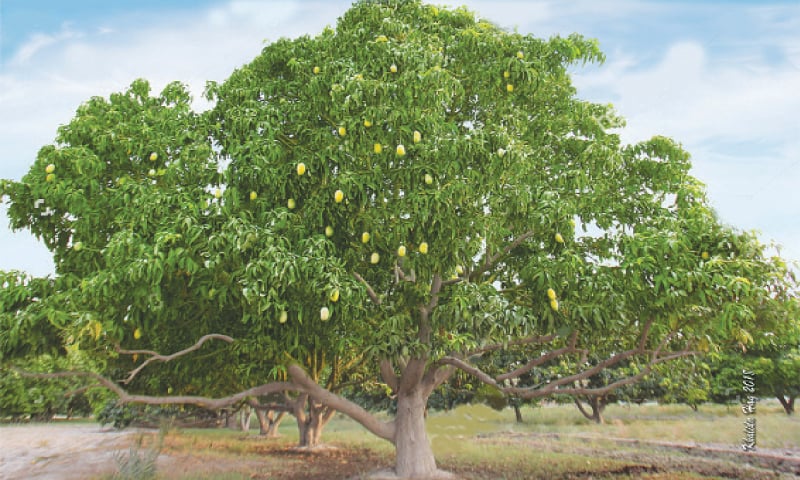
Unlike money, mangoes do grow on trees and I suppose that’s good enough for me. Mango trees are planted as six to 18-month seedlings or grafted shoots during the fall and spring seasons. As they grow, they require moderate winds and consistent moisture in the soil to grow in a steady and healthy manner. Mango trees grow to have short, stout trunks and thick, circular canopies of green leaves and within about five years, they bear thin and pale yellow flowers, clusters of them covering the trees until they overpower the deep green of the leaves. A single mango tree can bear fruit for more than 40 years. How lucky for us!
The great mango debate often falls between seed-grown (tukhmi) mangoes, which are known to be fleshier and sweeter, and graft-grown (qalmi) mangoes, which are more commercially available.
Mangoes are a very sensitive fruit that bruise easily. For this reason, they are picked off trees while they’re still considerably raw and then packed into wooden crates in which they ripen with time during the processes of shipping, selling and storing. Once they have ripened, they are best stored in cool temperatures to prevent further ripening and eventual spoilage.
Like most fruit, mangoes are a great (and yummy) high volume, low calorie sweet treat. Keeping variations in type and size in mind, one mango approximately provides 99 Kcal and is a great source of vitamins and minerals, particularly vitamin C, which aids immunity, iron absorption, and cell growth and repair. It is also linked to the health of organs such as the eyes and heart.
Sweet tastes, stronger opinions
Fortunately for us desis, Pakistan is the sixth largest mango producer and third largest mango exporter in the world. The moderately hot climates of Punjab and Sindh from May to August, coupled with their fertile soil and freshwater irrigation from the Indus, serves as the ideal condition for mango trees to bear fruit in glorious yellow bunches of sweetness.
Not only does Pakistan grow hordes of mangoes, the vast variety of the fruit available is stunning every summer. And since so much is made easily available, us Pakistanis have our preferences written in stone. This is not just applicable to the type of mangoes people like but also how they like them cut. The correct opinion, of course, is that chaunsa, cut in slices with the skin on, is the best of all 400 different types of mangoes grown locally, including the 30 different types available in the commercial market.
The South Asian vigour for mangoes is part of our ancestral legacy, bestowed upon us by our most intellectual minds. Since I was very young, my father would repeat the following historical conversation just about every summer. “Once a companion of the great Mughal court poet, Ghalib, offered a slice of mango to a donkey nearby for which the donkey expressed his abject aversion. The companion retorted, ‘Look, Ghalib sahib, even donkeys don’t like mangoes.’ Ghalib, who was known for his quick wit, swiftly rebutted, ‘Janab, ONLY donkeys don’t eat mangoes!’”
All summer, I’m known to initiate conversations with the topic of mangoes; it’s simply natural considering that I come from a family in which post-dinner dessert is a compulsory affair. All my life, I’ve heard my grandfather and father say that one could be full to the throat and still have two mangoes because the mango compartment is a capacity apart from the stomach. I have full faith in this biological theory. Speaking with extended family, friends and acquaintances, I’ve heard a range of love declarations for mangoes such as, “I’ve thought about mangoes all through work today” and “I think I’m having a mango deficiency!”
With that being said, here are some of the most celebrated varieties of mangoes grown and loved locally.
Langra — green but ripe
It’s hard to say why a mango would be named after the Urdu word for “lame” but langra is usually the first of its companions to make a grand entrance in the market. Grown in the rich region of South Punjab, langra hails from areas in and around Multan and Rahim Yar Khan and remains in the market all through May, June and July. What distinguishes it so easily among such a varied landscape of mangoes is that its fragile skin remains green even after it is ripe instead of turning the signature yellow mangoes are known for.
This mango is known for its strong smell, its dense and dull-yellow flesh and its unique taste, ranging from bitterly sour to fragrantly sweet making it best suited for pickling and canning.
Anwar Ratol — short king
Another jewel in the crown of Punjab, Anwar Ratol hits the market in two short bursts, one in May and then between July and August. I think of Ratol as nature’s candy because I’ve personally never had one that wasn’t unbearably sweet. In fact, since I don’t really have much of a sweet tooth, I find its sweetness too overbearing. But I know people who simply lose count of how many they’ve had at a time owing to its distinguished smell, taste and miniature size.
Chaunsa — the best one (obviously)
Chaunsa is named after a district in Bihar, India, my family’s pre-1947 home so I suppose it’s just fate, some kind of homecoming, that it’s my favourite mango. It has four varieties that appear in the order of summer chaunsa, white chaunsa, azeem chaunsa and black chaunsa between mid-June and August.
Only a true chaunsa connoisseur understands the nuance of the sweetness and fibre content of these four varieties of this delicious mango. It would not be a very outrageous claim that chaunsa is one of the most loved mangoes, not just in Pakistan but also around the world, owing to its exceptionally sweet and juice-running-down-the-arm quality. I’m telling you, it really doesn’t get better than this.
Sindhri — the heart of Sindh
Often growing to be larger than the average hand, the sindhri is the pride of Sindh with its origin in a town of the same name in the district Mirpurkhas. Apart from its larger than average size, sindhri is known for its distinct fragrance and its signature yellow colour covering sparsely fibrous flesh that can range from enjoyably tart to exquisitely sweet. You can enjoy it whole as a hearty, filling meal or you can turn it into a milkshake, ice-cream, custard or pudding all through May right up to August.
Dussehri — bringing out the small guns
During the first two weeks of July, round and small dussehri mangoes hit the market and replace just about every kind of dessert in Pakistan. These mangoes are primarily cultivated in Sindh’s Mirpurkhas and Hyderabad districts. They may be small, but dussehris pack the juiciest, pulpiest punch, delighting their consumers for an unfairly short amount of time.
Since Pakistan produces a whopping 1.8 million tonnes of mangoes annually, this if obviously not an exhaustive list. Other commercial and table varieties such as saroli, fajri, gulab khans, totapari, neelum, malda, alphonso etc are also grown in Sindh and Punjab and loved all across the country.
Hitting some roadblocks
Photo: Ayaz Khan
Mango production in Pakistan has now had its fair share of setbacks and I, for one, consider that a personal problem because a world without mangoes is dangerously dystopian to me.
Like every other life-sustaining force, climate change is disrupting mango growth patterns in Pakistan. Last year, unexpected heatwaves caused a water shortage in Punjab, setting back mango production and export targets by more than half. I spoke to Sanaullah, an experienced mango farmer in the Khanpur Katora village of district Rahim Yar Khan, about mango cultivation.
He explained to me that mangoes grow out of mango flowers called bhur. Once these flowers bloom, the tree requires moderate winds and soil that is neither too dry nor too wet but retains a constant level of moisture that keeps it clay-like. For this reason, the growth of mangoes becomes entirely dependent on the largely predictable forces of nature during the hot Punjab summers. However, since the green province has been receiving untimely storms and rainfall, the fast winds and excessive water have caused acres of bhur to wilt and fall from the trees, causing a sharp decline in mango production in Punjab.
I was curious about how the devastating floods of the past year affected mango production so I spoke to mango cultivator Mir Amanullah Talpur from Mirpurkhas about the issue. “Unlike Punjab, the groundwater is fresh in only very few areas of Sindh such as Umerkot, Mirpurkhas, Tando Allahyar, Matiari, Tando Adam, Sanghar and Nawabshah, making them conducive to mango cultivation. The issue is that the water table of Sindh has been raised because of the flooding,” he explained, “and when the water evaporated, it left behind a layer of salt on the ground, which mangoes are very sensitive to.”
In addition to this, he added that the recent cyclonic rains, which are known to be chloride-heavy, have negatively affected mango production in the region.
A mango tree in flower
Climate change and poor management are coupled with pest attacks that occur with excessive rain and moisture, eating way at unripe fruit. The issues only escalate due to the lack of governmental support for mango farmers. Talpur, said that in 30 years of working as a mango cultivator, no government has extended any substantial support to the trade.
There are still no proper channels of selling export-quality mangoes and farmers have to get by on meagre profits due to third-party involvement at auction places. Talpur woefully remarked, “There’s an annual mango show that happens in Mirpurkhas but, you know, it’s just an idiotic show. Sindhri is currently ranking as the third most popular mango around the world because, you know, it’s beautiful and Westerners eat with their eyes first and then with their mouths. But sadly, there is no substantial budget for agricultural research, growth or international input in the mango markets of Pakistan.”
Recently, the Trade Development Authority Pakistan (TDAP) initiated a pilot project for mango-bagging in the mango-cultivating districts of Sindh and Punjab to encourage mango exports, which is a major source of foreign exchange for Pakistan during the summer months.
I refuse to live in a world that is growing hotter by the day but bearing fewer mangoes every year. Mangoes encapsulate the delicate balance of our ecosystems, of the exquisite specificity of each leaf, each fruit that occurs in nature, and most importantly, of the urgent need to take care of the world that sustains us in such wonderfully sweet ways.
Just as the first rays of sunlight illuminated the morning sky, the call for morning prayers signalled the last sip of water and the last bite of food for residents of Karachi’s Gujjar Nullah until sunset. Little did they know how soon fear and terror would replace the slow, languishing wait of Ramazan days.
The Sindh government’s demolition campaign along the Gujjar and Orangi Nullah is backed by a Supreme Court order passed on 12 August, 2020. This order directed the NDMA and the Sindh Government to remove ‘encroachments’. In February, 2021 the government began enforcing the order and as of today, at least 6600 houses have met the jackhammer, leaving at least 66,500 homeless in the wake of the sudden destruction.
On Saturday, June 10, a solo show by Zahabia Khozema, Kya Yeh Taraqqi Hai? Tumharey Liye Ya Humarey Liye, opened at VM Art Gallery, shedding light on the devastation that completely incapacitated the lives of the Gujjar Nullah residents forever.
After finishing her BA in Mass Communication from the University of Karachi and a BFA from the Indus Valley School of Art and Architecture, Khozema now works at the VM Art Gallery and independently as a visual artist. As an avid organiser with the Karachi Bachao Tehreek and an active part of the Progressive Students Federation, Khozema’s visual work exists in that unique intersection of art and activism that is both supremely engaging and important. In this first solo show, Khozema utilises diverse literary and visual mediums such as poetry, narration, photography, film, printmaking and installation. In doing so, she examines Karachi’s public policies and specifically the demolition at Kauser Niazi Colony, Gujjar Nullah, in an impressively holistic and nuanced way.
Curated in a dimly lit gallery and illuminated by pale yellow halos of light, the works attract and repel one another to create a ruinous and rather morose environment. This gloom is amplified by the largely dull colour palette that ties the show together.
Large-scale, mixed media works, At the Nullah I and II, gape at their viewers, drawing them into their battered landscapes resembling landfill sites turned temporary settlements. Arbitrary shapes appear almost as pale, two-dimensional buildings sharing walls, suffocating one another as they recede into the background to make space for the nullah in the foreground.
Khozema’s enigmatic screen prints, What Remains I, II, III and IV, use the sharp contrast between red and white to create images of disintegration. Largely linear and devoid of tonalities, the works are stripped bare to depict the fragmentation of Kauser Niazi Colony, once a lively brick and steel residential area reduced to wooden anchors and thick plastic sheets doubling as ceilings, walls and curtains. As the name suggests, what remains of the lives of the area’s residents conversely also speak volumes of the unimaginable losses they have survived, another instance of lives being completely uprooted and displaced in Pakistan’s long and tragic history of partition and fragmentation. A gallery-goer ruefully commented that “as a person who’s not aware of these mediums and techniques, I found these particular works devastatingly intense. Their collaborative nature is very evident and dispelled my suspicions about the show being insensitive and distant from the crux of the issue.”
Blown up and scaled down photography works studded the show as testament to Khozema’s direct involvement with the residents of the Kauser Niazi Colony and as proof of the devastation that has torn apart the chest of the Gujjar Nullah settlements.
Khozema herself spoke about the deeply sensitive nature of the issue at the core of the show, saying, “I was very scared of making work about the issue since I consider myself to be in a position of privilege and I didn’t want to voyeuristically look upon the lives of the displaced people as an outsider and benefit off them. That’s why you’ll notice that there aren’t any people in the photos I’ve taken. I wanted to instead focus on the changing landscape, the visuality and materiality of the area. I had to fight this fear of misrepresentation because I believe it’s very important for these conversations to happen in galleries, especially because most people believe these spaces belong to the elite.”
Residents of the colony also attended to the show and spoke about the harrowing experience of their sudden displacement. They explained how, despite living in the area for decades and holding legal leases to their homes, their houses were struck down without any prior notice and without any opportunity to salvage their belongings. One of them sadly remarked, “We know very well who’s behind this cruelty. But we can’t say anything as we watch our homes fall to the ground. They only want to keep what’s visually beautiful but they don’t realise that our lives were also equally beautiful and deserving of safety.” They also spoke about how construction at the site in the name of ‘development’ is largely dangerous since, despite multiple requests, the authorities have not cordoned off the area properly, causing the death of an eight-year-old boy and seven others.
In response to the research conducted by NED University’s Infrastructure Engineering and Development Department, the government began the demolition of the Gujjar Nullah settlements to expand rainwater and sewage drains and to construct new roads. Funded by the World Bank, the area was razed to the ground without provision of alternate housing. Only a few people received financial compensation, but even that was too modest in proportion to the losses suffered by the displaced residents.
Khozema’s work creates an environment for meaningful discourse to emerge and sheds light on the power politics that deplete the fabric of unsustainable development in Karachi.
The show continues till July 4, Monday to Saturday, 11am to 7pm at VM Art Gallery.
Growing up as the only child of two working parents, I was nurtured singlehandedly by my paternal grandparents who I lived with. Naturally, I forged my first ever friendships with them and it is this fact that has marked my life and personhood. My days were filled with the calm, hazy softness attached to childhood; cranky mornings and refusals over milk, polished shoes and school in the sweltering Karachi heat, the van ride back home as I searched eagerly for Daada (my grandfather) who would be standing outside my house to pick my bag and I up to carry inside where Dadda (my grandmother) would have a cold bath and warm plate of daal chawal (boiled rice and lentil soup) ready for my grumbling tummy. Daada and Dadda bathed me, fed me, and sang me to sleep but they also played with me, told me stories, and entertained me.
Daada, Dadda and my maternal grandmother, Nano, who happens to be Dadda’s niece, all migrated as children from Bihar in colonial India to Dhaka in East Pakistan when India was partitioned in 1947. But their journey did not end there. In 1971, with another slash across the map, Dhaka fell, Bangladesh was formed and my grandparents migrated from Dhaka to Karachi, West Pakistan, known as the Islamic Republic of Pakistan today. Nana (my maternal grandfather) migrated directly from India to present-day Pakistan. Such is a brief history of my family.
Among these stories were the mingling echoes of their pasts that they would recall like fiction and that I, too young to know as fact, would laugh and gasp about. Daada would mention a place called colonial India where fairies would live in flowers, a constant reminder to never pluck them. He would look at Indian music channels differently, more longingly, more knowingly, than I did, humming to Lata and Kishore songs. Dadda would gather her sari into a bunch and watch Rapunzel with me to tell me that she must have eaten a lot of fish when she was a child, just like me. Even when they would show me photos, I would look at them like characters I will never meet but loved knowing about. All that time, they were sitting right in front of me.
Growing up a considerably dark-skinned South Asian woman, I look back at my childhood and reflect on what a favour my grandparents did me by never hiding from me. I look around me at the political, religious, and social polarization of the state and I can easily look past it, back to the Mughals and the British, Bihar, and Dhaka to remind myself that my person is more nuanced, more complex than a simple national and religious identity.
With this project, I intend to trace my family history to oppose the forceful, unilateral Muslim and Pakistani identity imposed by the state upon the various people who call this country home.
The Creation of a Unilateral Muslim Identity of the Citizens of Pakistan
History is a product of the imagination and memorialization of those who have the power to formulate narratives. Within a nation-state such as Pakistan, of which the foundations have been laid aligned with the ideals of a particular religion, in this case, Islam, the power of narrativizing national history rests squarely with the political, military and religious elite. The distribution of this power is seen to be in tandem with economic might, politics being a profession that pays well on behalf of the decades of rampant corruption within the bureaucratic ranks, and religion being the tool of mass control that never fails to sell. The elite’s economic power is materialized through their ability to buy and manipulate all amenities available to the public in the specific ways in which the common man can be stuck within this cycle of consumption. Such is the case until a permanent national view begins to emerge that satisfies the public while still benefitting the elite class. It is this very formula that the elite has used, historically and to this day, to create a singular Muslim identity aligned with the national identity of Pakistan. This paper charts the major ruptures that the history of the land of modern-day Pakistan is fraught with and challenges them with long denied truths and alternate possibilities to disrupt the unilateral Muslim history that Pakistanis are made to memorize and identify with.
Religion is a global phenomenon and the contemporary world owes it to its ancient ancestors for this idea of a belief in one or more higher powers. One of the most primitive civilizations of the world, the Indus Valley Civilization, located in present-day Pakistan, has been discovered to be replete with symbols of religious beliefs such as ritual purification, the deification of fire and trees and the use of sculpture, terracotta figurines and animals (McIntosh, 2008). All the aforementioned expressions of belief are recognizable in Hinduism as we know it today as rituals of bathing in the River Ganges to attain purification, the sculpting of gods and goddesses such as Lord Ganesh and Lord Krishna and the sanctity associated with the Mother Cow translated into the prohibition of consuming beef. However, ‘few structures [in the Indus Valley Civilization] suggest a religious function, and these differ from place to place’ (McIntosh, 2008), once again echoing the mobility of temples as both public and private places of worship depending on the situating of the idols, the wide array of religious beliefs and practices that form Hinduism and the many versions of the religion that are formally accepted today. The Indus Valley Civilization was survived by the Indic nomadic tribes of Central Asia, who migrated and settled in the South Asian region and began to shape a new culture of the land, both absorbing local culture and integrating it with their own. ‘Among the most prominent features of this culture are three religions, all of which emerged toward the end of the Vedic period: Hinduism, Buddhism and Jainism’ (Essential Humanities); Islam yet to be born. While the three religions are ritualistically close to one another in the way that Abrahamic religions are practiced in tandem, that ‘the two peoples lived side-by-side for a significant period of time’ (Essential Humanities) foreshadowed the consistently homogenous and multi-religious spread of South Asia in which its people participated in a cultural give-and-take instead of a separatist approach to life. The Vedic period was followed by the consolidation of Hindu power in the Indian subcontinent by powerful kingdoms of the Mauryas and the Guptas and it is up until this beehive of kingdoms in history that the historical narratives of Pakistan completely eradicates or manipulates. The removal of the non-Muslim discourses that have framed present-day South Asia is best exemplified by the insistence of well-known Pakistani scholars that Pakistan’s ‘roots only strike into Islam and Islamic culture’ (Jalal, 1995), within which there is no space for any non-Islamic influences upon this geography. This denial has created a dichotomy of the narratives presented regarding ancient civilizations such as Indus Valley, Moenjo Daro, Harappa and Taxila. On one hand, an idea of these civilizations being somewhat, intuitively Muslim despite being pre-Islamic, is promulgated. While, on the other hand, young students are taught a politicized version of architecture in history wherein the power of such archaeological sites should be recognized as inferior to religious monuments like the Ka’abah, a comparison that is positively unnecessary and impossible to determine. In this way, all through history, ‘South Asia was the physical and imagined location for categorizations of religion, and it fundamentally altered how religion is thought about’ (Fuerst, 2019) as well as how the geography of the region was thought of as consistently religiously-charged, defining the people who belonged to it, an idea that had multiple implications in the long run.
It is fundamental to precede any discourse on South Asian religious practices with destabilizing definitions of what we accept as religions today. ‘Ancient Persians and Arabs referred to the land beyond the river Sindhu or Indus as Al-Hind or Hindustan and the people inhabiting that land as Hindu’ (Bose and Jalal, 2018), the label defining a wide array of South Asian cultural practices at the time, influences of a new Hinduism being just one of them. This is the first instance of the impression that the people of South Asia had a singular religious identity. With this narrow view taking roots, Muslim kingdoms at the time that had gained military might, saw South Asia as an opportunity to further an Islamic agenda into a new, virgin land and to extend the borders of the global Islamic Empire, a Golden Age of Islam akin to the preceding Greek and Byzantine Empires. Political expansion ruptured the geography of Makran under the Caliphate of military warriors such as Umar, Ali and Muawiya, exemplary fighters of the Islamic world, until South Asia was invaded by what became the region’s Muslim origin in the Muslim mind. Mohammad bin Qasim invaded South Asia in 712 A.D. and consolidated the monotheistic ideals of Islam in the region, accompanied by Arab traders who did not actively participate in religious conversions amongst the Hindu population of South Asia but altered the local culture in subliminal ways (Aziz, 2010). The next step into the Muslim legacy of the region was brought about by the Afghan and Turkish invasions that fortified the dynasty that, to this day, defines South Asia at its modern prime, the Mughals. History has been warped in South Asian Muslim minds until this point in time. The formation of the Hindu identity by early Arabs is echoed in the equation of India as synonymous with Hinduism, referred to as Hindustan in Pakistan and Bangladesh to this day, despite the fact that Muslims in the region lived in cultural harmony with Hindus with regards to food, dress, language and even certain religious celebrations, making the Muslims a part of the Arab imagining of a ‘Hindu’. Not surprisingly, Mughal rule remained consolidated insofar as the early emperors fostered this Hindu-Muslim religious harmony, and fell to its decline with Emperor Aurangzeb who tried to further a stringent, Wahabi Islam in a region where Hindus have historically been a majority and where his lineage was that of settler colonists who gained imperial power. Few understand that the rule of the Mughals was as foreign to South Asia as the British who colonized the land after them (Aziz, 2010). Furthermore, the half-witted glorification of Muslim power in South Asia is marked by romanticizing violent military expansion, iconoclasm and settler colonialism. If Muslim identity was not already locally located in violence, ‘after the Rebellion [1857], Muslims were almost unequivocally understood as inherently violent, obligated to revolt’ (Fuerst, 2019) despite Hindu leaders like Rani of Jhansi having fought in the Rebellion at equal footing with Muslim leaders. This unfair placement of responsibility for political unrest occurred because ‘religious concepts like jihad with long, multifaceted histories became synonymous with a religion and its community’ (Fuerst, 2019), Islam having become politically charged with anti-British sentiments on the ground of religion. Despite such accusations, history textbooks relate the 1857 Rebellion as a “War of Independence” against the British (Aziz, 2010), a phrase that is factually incorrect for the uprising of locals against an established government like that of the British, more accurately known as an anarchical mutiny.
The 1947 Partition is the most evident adverse effect of the selective erasure of history. ‘Was Pakistan created for Islam or for Muslims, is an important question’ (Engineer, 1996) because the discourses that mobilized the Pakistan Movement in the 1940s were highly secularist. Belonging to a minority Khoja Shia sect of Islam himself and having married the Parsi Ruttee Bai, ‘Jinnah [was] emphasizing nationality rather than the religious aspect of the problem’ (Fuerst, 2019) because, under the threat of unfair national circumstances created by the overwhelming majority in the subcontinent, the masses of the region had ‘evolved a shared cultural ambiance, but at the same time [were] deeply attached to distinctive cultural beliefs and practices’ (Bose and Jalal, 2018). In such conditions, it was not the ideology of Islam itself being threatened but the livelihood of Muslims who lived as a substantial minority in Indian society. The subjugation being employed may have been based on religion but the issue that Jinnah was concerned with was social class. So secular was his stance that ‘Maulana Maududi, the founder of Jamat-e-Islami, did not support Jinnah’ s movement for Pakistan as it was ‘un-Islamic’ in character’ (Engineer, 1996).
Despite the secular foundations of the new state, Pakistan’s bureaucratic class fell into a hardline Islamic rut with regard to running the country after Jinnah’s quick demise in 1948. When the Progressive Writers’ Association arose as a platform for ‘the articulation of ideas of secularism, progress, and egalitarianism’ and for furthering leftist, anti-imperialist ideologies, their publications led to ‘various crackdowns from the state to stop its activities, as the establishment attempted to define Pakistan as a nation-state tied to the global capitalist order’ (Ali, 2018) to restore and reconcile both Islamic and global expectations from the new state. ‘Since ‘the narrative of “us” in its myriad imaginings requires a parallel construct of an equally imagined “them”’ (Jalal, 1995), the othering of Indian Hindus and Muslims alike, who were relatives and neighbours practically minutes ago, became necessary. This process of othering was mobilized since all through history, the politics of origin and sacrifice have been employed to distort the image of the South Asian Muslim. From the glorification of highly Westernized personalities like Sir Syed Ahmed Khan to the tampering of dates such as the Lahore Resolution (Aziz, 2010), history textbooks are controlled by the state to produce minds that are unquestioning of the country’s past beyond Islam, laying claim to the origin of life in South Asia completely and thus Muslims’ due right to the land. Such claims also vilify the people of Bangladesh who were abandoned by the West Pakistan government on grounds of their “Indian-ness” and thus their closeness to Hindu traditions. On the other hand, a narrative of military and civilian sacrifice by Muslims frames Pakistan as a holy reward to believers, ranging from the martyrs of the 1947, 1965 and 1971 wars to the ‘claims of the Urdu speakers who can point to a much longer history of sacrifice to preserve the cultural and religious identity of India’s Muslims’ (Jalal, 1995).
History is collective memory and the way it is framed has implications on the collective life of its people. The history of Islam in South Asia, albeit, heavy on military and imperialistic in nature, had been inclusive of the diverse cultures it fostered until the imagining of a separate nation. Today, the religious minorities of Pakistan are ailed by the twisted version of history taught in the country, leaving no place in the subcontinent that they can claim to be their own. Our history is Muslim but not true, fractured not collective.
Aziz, Khursheed Kamal. The Murder of History: A Critique of History Textbooks Used in Pakistan. Lahore: Sang-e-Meel Publications, 2010.
Bose, Sugata, and Ayesha Jalal. Modern South Asia: History, Culture, Political Economy. Fourth edition. London; New York: Routledge Taylor & Francis Group, 2018.
Engineer, Asghar Ali. “Pakistan: Religion, Politics and Society.” Economic and Political Weekly 31, no. 41/42 (1996): 2800–2803.
Jalal, Ayesha. “Conjuring Pakistan: History as Official Imagining.” International Journal of Middle East Studies 27, no. 1 (1995): 73–89.
McIntosh, Jane. The Ancient Indus Valley: New Perspectives. ABC-CLIO’s Understanding Ancient Civilizations Series. Santa Barbara, Calif: ABC-CLIO, 2008.
Just like the production of food, the subcontinent is rife with crops of raw materials used in the textile industry. The availability of raw textiles and the rise in the image of the rural Indian as the true spirit of the land together became the reason that cloth has served as a symbol of nationhood for the people to whom it is native. The most well-known example of this phenomenon is the use of hand-woven white cloth called khaddar by Mahatma Gandhi as a symbol of self-rule or swaraj in the Indian subcontinent under the oppressive colonization of the land by the British, rejecting imported cloth as an act of passive defiance. To this day, the Indian flag bears the spinning wheel or the chakra as a symbol of the country’s independence and self-reliance, and the poster image of Gandhi is widely known as him wearing an unsewn khaddar cloth. Discourses on Pakistani textiles are always bound by the indigenous materials and techniques of the natives of present-day Pakistan. I visited Mohatta Palace to seek out influences of Indian and Bengali cloth and design on Pakistani clothes from among their vast exhibits on textiles and did not find a connection between them since most exhibits on textiles were based on Sindhi, Baluchi and Pashto crafts. I find this interesting because while Afghan influences on Pakistani cloth are highlighted and celebrated, an influence that is a product of Mughal settler colonialism, while echoes of the country’s Indian and later, Bengali past seem to have been lost within history despite having been part of the same undivided land for centuries.
Wangho, Tharparkar, mid-20th century, Mohatta Palace.
Detail of an embroidered cushion cover (ghilaaf); Swat valley, Khyber Pakhtunkhwa, Mohatta Palace.
Since my personal experience has been marked by Bengali textile and dress (I will touch upon examples of these in a later section), I decided to do some research on the textile industry in Bangladesh. Here is a summary of what I found.
During the 16th, 17th and 18th centuries, the area known as present-day Bangladesh was the center of muslin and silk trades and the production of cotton peaked in the capital city of Dhaka to the extent that muslin came to be called ‘Daka’ in the markets of Central Asia. These materials were then exported to markets worldwide such as those in Europe and Southeast Asia. While secondary and tertiary industries have seen a rise in post-Independence Bangladesh, the country is still known to export raw materials instead of finished goods. Such was also the case during this time when raw cotton was exported without taxes or tariffs to secondary textile industries in Britain who then imported them into Bengal, essentially deindustrializing the region. Even today, fast fashion brands like Zara, H&M, Calvin Klein, Walmart and Disney International outsource raw materials at dangerously low prices from Bangladesh and then import them back into the country at the cost of the national deficit and environmental deterioration.
From 1947 to 1971, like most industries, the textile industry in East Pakistan was owned by the bureaucratic class existing in West Pakistan. After separation, Bangladesh lost capital and technical expertise which destabilized the textile and jute industries set up by entrepreneurs in the 1960s. However, after Independence, Bangladesh shifted its agricultural focus from import-related to export-oriented industries by making readymade garments and finished materials instead of exporting raw cotton and silk. To this day, the general population of Bangladesh wears sarees, lungis, fatua, dhoti, gumcha and kurta shalwar.
LungiGumchaSari
Part III
Poetry
I find that poetry is a powerful tool for recalling the nostalgia of a long-lost past and my reflections on India and Bangladesh reminded me of these two diaspora poems by Moniza Alvi. I record them here.
The Sari
Inside my mother I peered through a glass porthole. The world beyond was hot and brown.
They were all looking in on me – Father, Grandmother, the cook’s boy, the sweeper-girl, the bullock with the sharp shoulderblades, the local politicians.
My English grandmother took a telescope and gazed across continents.
All the people unravelled a sari. It stretched from Lahore to Hyderabad, wavered across the Arabian Sea, shot through with stars, fluttering with sparrows and quails. They threaded it with roads, undulations of land.
Eventually they wrapped and wrapped me in it whispering Your body is your country.
Analysis of Note:
References to brown colour, a hot climate, bullocks, the Arabian Sea and cities like Lahore and Hyderabad recall the topography and geography of South Asia.
Since the sari is a one-piece dress, it can take on the image of a singular piece of land, both organic and fluid but sturdy and symbolic. The action of covering the body with the sari recalls the physical embodiment of charting the land that is deemed feminine onto a feminine body as its identity.
The Wedding
I expected a quiet wedding high above a lost city a marriage to balance on my head
like a forest of sticks, a pot of water. The ceremony tasted of nothing had little colour – guests arrived
stealthy as sandalwood smugglers. When they opened their suitcases England spilled out.
They scratched at my veil like beggars on a car window. I insisted my dowry was simple –
a smile, a shadow, a whisper, my house an incredible structure of stiffened rags and bamboo.
We travelled along roads with English names, my bridegroom and I. Our eyes changed colour
like traffic-lights, so they said. The time was not ripe for us to view each other.
We stared straight ahead as if we could see through mountains breathe life into new cities.
I wanted to marry a country take up a river for a veil sing in the Jinnah Gardens
hold up my dream, tricky as a snake-charmer’s snake. Our thoughts half-submerged
like buffaloes under dark water we turned and faced each other with turbulence
and imprints like maps on our hands.
Analysis of Note:
The institution of marriage is an important part of South Asian culture and the familiar systems of family and society are based on it. For this reason, the symbol of a wedding is important in recalling a united South Asia.
The motif of sandalwood is fundamental since brides in most South Asian regions, Indian, Pakistani and Bangladeshi, are expected to sit in a pre-wedding ceremony called a Mayun in which sandalwood is rubbed on her skin to clear out her complexion. The immediate mention of England in the same stanza echoes the South Asian obsession with fair complexion, a remnant of our colonial past.
Rural symbols of bamboo, buffaloes and rivers are all native to South Asia.
The idea of the groom and the bride not seeing each other until after the marriage is contracted is a tradition that is followed in South Asia irrespective of religion to ward off the evil eye. For this reason, a ritual known as Munh Dikhayi, literally translated to Seeing the Face, is observed in which the first time a groom looks at the bride, he does so under a veil in a mirror reflecting the bride’s image and that mirror is then broken, having been affected by the so-called evil eye. At present, this tradition becomes null since, in most cases, partners know of and have seen each other before getting married but up until the 1980s and, in some areas of South Asia, even today, the bride and groom marry one another blindly.
Part IV
Visual Art
I am listing down the artists I began looking at with respect to taking this project forward visually. The following is a preliminary list, the artists and artworks that inspired works in this project are recorded in the sections regarding those artworks.
Shilpa Gupta (There is no border here): Looking at the formal symbols of borders, flags and nationhood and the idea of text as visual art since I consider writing to be a core strength of this project.
Bani Abidi (Mangoes): Food as an expression of national identity and pride.
Hammad Nassar (Lines of Control): For the importance of remembrance and memorialization of the past to create and situate identities in the present and to problematize the existence of borders and their arbitrary quality.
Naila Mahmood (Bangladeshi women in kitchens): The intersection of class and gender in the production of multicultural food in Pakistani kitchens.
TRAIN (The Afterlives of Monuments in South Asian Studies): Looking at colonial influences of architecture in areas like Saddar in old Karachi to investigate the histories attached to them and the meaning of their existence in Pakistan today.
Kader Attia (The Repair from Occident to Extra-Occidental cultures, Ghardaia, Memory of Forgetfulness): In celebration of all my South Asian features; brown skin, snub node, black hair and in reminding myself that they do not need to be changed. This artwork is also an important reminder of the ways in which history is changed by people in power to manipulate narratives, challenge unities of geography and erase important influences from the past.
Fazal Rizvi (Coloured Fields): Methodologically, this work is important to me because of its use of words as visual art and mark-making. But this work is also crucial because just like my family, Rizvi’s family was Bihari, living in Bangladesh after the Partition of 1947 and this fact of his life significantly marks his work.
My name is Rahma, originating from the root word Rehm (Mercy). It is a name my mother picked carefully, for this precise reason. Being merciful is a difficult quality to manifest, and this difficulty is faced every day that I choose to live as an individual who cares for their education. I am a third-year history major at the Institute of Business Administration, Karachi. And committing yourself to the study of history requires you to forgive fabrication, manufactured truths, and tragedies that could have been prevented.
I am a 20-year-old student of history who has come from Lahore, Pakistan’s pride-worthy acclaim to Mughal history. And I now live in Karachi, whose historic value in contrast has been unfairly diminished to a little more than nothingness. I want to find answers to Pakistan’s history through these contrasts.
You can find my Instagram Kathak blog here and my visual art blog here.
What sparks your interest in South Asian and specifically Pakistani history?
My interest in South Asian history began with certain artistic practices and fashion preferences. I began seeking formal training in Kathak in 2018. Despite the fact that my paternal aunt had learned dance when she attended school, it was harder to negotiate permission when it came to me. And though multiple drawing-room conversations have revealed to me the popularity of the sleeveless sarees my grandmother wore in her youth, the rules pertaining to fashion have become stricter as I grow up. Initially, it was for the sake of understanding these shifts toward a more inflexible expression of identity, that I developed an inclination toward South Asian history. So much of our country’s history is half-forsaken, leaving much that is either wholly eradicated or pushed under the rug. The desire to unearth this is what led my intention to specialize in South Asian History.
How do you navigate the fractured identity of being South Asian?
I am reminded of Moneeza Alvi’s diaspora poem, The Sari, which portrays how the yards of the sari help her consolidate her identity and map it onto her body. The idea of veiling with a curtain or a translucent sheet and the politics of selectively hiding and revealing your identity is very central to how I have engaged with art over the years, specifically with the painting I did when I was first planning to apply to NCA, before I started recording my dance videos. This is also because covering and uncovering is how we read history because it is very difficult to evade the biases of the education system and it is much later that we realize how much of what we are taught is incomplete and false. The artwork below is my attempt at reconciling a classical dance aesthetic with the idea of trying to search for something in a vacuum, echoing my concerns of hiding and showing.
What has your own experience of being a South Asian female classical dancer been like?
In Pakistan dance is a very politically charged art form. It was formally banned in the 1980s under President Zia-ul-Haq’s military regime. Ever since it has been seen as resistance to the values dear to the state.
It is difficult to keep larger political ideologies from penetrating into the life of the individual. It was the same for me. My family continues to have reservations about me performing anywhere beyond my living room. This explains the veiled nature of most of my performances.
How do you trace your own family history as an archive of the larger South Asian diaspora?
My family migrated from Ambala in India to Lahore in West Pakistan. My paternal family claims to be the descendants of Multani Mughals, a sub-category of Mughals who weren’t necessarily the ruling elite but were artisans who made weapons for the Mughal army. I have been told in passing that in the basement of the house that my grandfather grew up in, there were swords dating back to the Mughal era. In addition to that, my mother’s father owns a cinema in Lahore and this transaction materialized in the way that he was initially very well-settled in colonial India and owned a cinema there and then when he moved to Pakistan in 1947, he was given this cinema house, called Ratan cinema, in Lahore as compensation. Ratan cinema is still present in Lahore and while it’s not functional anymore, I do have photos of it from the year 1947 and I dug deeper into the cinema’s history throuogh formal and personal research about it.
Rahma’s maternal grandfather with Bollywood actor, Dilip KumarRatan Cinema, IndiaRatan Cinema, India
Once the only entertainment center of its kind, Ratan Cinema is now an abandoned building located at the heart of Lahore’s McLeod Road. And I have always heard about it in nostalgic and reminiscent terms. A vibrant past, now lying in shambles, with ‘Ratan’ still erected on top of the building, its blue fading behind the dust and heat of Lahore.
As a child when I would go to McLeod road to visit my grandmother, I would look at the cinema from the window of the apartment building opposite Ratan. And my mother would recall the time my grandfather hosted a Basant celebration on the cinema’s roof, long before the festival was banned in the country. Most events associated with the cinema were segregated on the basis of gender. The celebration of Basant usually excluded the women. Other than this my mother also recalled the time she would phone the cinema with her siblings asking for bottles of coke to be sent to their home. This was often done with the fear of a scolding from my grandfather hanging over their hands. This was one of the many mischievous things my mother associates with her childhood which she spent living across from the cinema.
Ratan Cinema, called ‘Balwant Rai Cinema’ before partition, was allotted to Chaudhary Eid Mohammad in 1947. He was an electrician who, before migrating from Ambala to Lahore, ran a cinema in Dera Dhon. Partition led him to let go of this cinema and eventually own Ratan Cinema, where he himself served as the film operator.
When Eid Mohammad gained a claim to Ratan Cinema due to his affiliation with Raj Kapoor Productions, he faced a hitch with the courts who had objections regarding the name ‘Ratan’ because it was essentialized as ‘Indian.’ Eid Mohammad defended his case by saying that even Mohammad Ali Jinnah’s wife was named Rattanbai, and efforts to eradicate all connections to shared histories between India and Pakistan were naive.
The Cinema held a unique place in many regards. Chaudhary Eid Mohammad was on good terms with Dilip Kumar, whose film ‘Aan’ was first screened in Pakistan at Ratan Cinema. Another film first screened at Ratan was Umrao Jaan Ada. Since the owners of the Cinema both produced and distributed films, it had the honor of hosting multiple first screenings.
The Cinema made headlines when the popularity of certain films, including ‘Aan’ and ‘Khana E Khuda,’ caused a historic turnout. It is said that enough people lined outside the cinema to watch these films that the line stretched to Lahore Railway Station. And the Cinema’s monopoly over the entertainment business was further asserted when people made history by sleeping outside the cinema to catch shows that were the craze of the times.
Chaudhary Eid Mohammad had six sons, each of whom had the right to a ‘Proprieter’s Box’ where they could host affiliates and friends. And there was always a separate line for females primarily filled in by college girls, amongst whom films found their most loyal fans. Moreover, since films were distributed on a single roll in vintage times, the same film could not be screened at more than one Cinema simultaneously, allowing the Cinema to uphold its popularity.
Personal Communication, Qamarunissa Shahbaz (daughter of Eid Mohammad)
Personal Communication, Muhammad Faisal Ishaq Chudhary (grandson of Eid Mohammad)
What are your aspirations with this concern of South Asian history?
I intend to focus on the history of performance art in Pakistan. There are many unresolved questions that must be asked about why the arts in the country are nearing extinction, and how this can be prevented. I feel the need to explore the distinction between art forms that we have discarded as “foreign” (mostly Indian) and those we are somewhat willing to accommodate. For now, I hope to eventually publish works that attend to these ideas.
I once asked Daada about the house he lived in pre-1947, when he was a resident of Patna in the Indian state of Bihar. Daada recalled having a house with 52 rooms teeming with servants and acres of mango orchards. But what stuck out to me as an avid seafood lover was a pond with shrimp in it from where my great-grandmother would extract shrimp in her sari’s aanchal in one swift motion and cook it fresh.
The day Daada moved from India to East Pakistan, he asked my great-grandfather where they were going and he was simply told that they have to pack whatever they can and leave. He remembered the stations passing by as he and his siblings sat on a train and when he asked when they will go back home again, his father told him, never.
Dadda remembered the murder of a servant-boy of her neighbours in Bangladesh by Hindu goons during the 1971 disturbance. She also remembers women being kidnapped, raped and killed.
Both afflicted by dementia in their old age, Daada remembers only India and keeps mistaking Karachi for Patna, asking to go home to his family. He also talks in Bangla and sometimes we hear him tell his caretaker, “Chor aaso” which is Bangla for, “A robber has broken in”. All through her battle with dementia, Dadda was stuck in Bangladesh, talking about the fall of Dhaka as if it was happening in the present.
Nano (my maternal grandmother) recalls wearing saris to college in Bangladesh but, interestingly, she completed her education in Urdu. At this point, I was compelled to look into the language dispute that eventually gave birth to Bangladesh.
Dadda and Nano told me that their marriage rituals of mehendi and mayun were adopted from the Hindus they lived in close association with. Cultures of music and dance were also included as a reflection of the larger Hindu population surrounding them.
All through my childhood and up until they both needed help to be dressed, Daada used to wear a vest and a lungi while both Dadda and Nano used to wear saris permanently, sleeping and waking, routine and for events. In Bangladesh, Daada also wore collared shirts and trousers. While other women in my family have now reverted to wearing shalwar kameez, my mother still wears saris regularly and especially on formal occasions. Mughal dresses like Gharara, Bihari designs like Chhapa and Hyderabadi cuts like Khara Dupatta are commonplace in my family.
All my grandparents understand and speak Bangla. My Nana was from Hyderabad Deccan and also used to understand Tamil and wrote in Sanskrit script. Daada and Nano understand some English. Interestingly, since my mother grew up in various cities in Punjab, she also understands and speaks Punjabi
Growing up, I ate a vast cuisine of food corresponding with the vast array of cultures that my family has experienced in history. We eat Mughlai biryani but also biryani from Delhi, Hyderabad and Sindh. We also eat other Mughlai dishes such as daigi qorma, shahi tukra and murgh musalam. We are big fans of Bihari kebab and after having looked around, I realized that this is one of the foods that Bihari migrants spread across the map of Pakistan and it is available at all restaurants that serve BBQ. From Bangladesh, we picked up the habit of eating boiled rice and lentil soup every day for lunch with one meat gravy and one vegetable curry, as are we massive fans of having seafood in all its forms, fried and gravy. We eat snacks that people don’t know of like daal peethi, baasi bhaat and khatwa. The fruits and vegetables we eat are also influenced by the time my family spent in East Pakistan, fruits like jackfruit and singhaara and vegetables like palwal. We all also love eating paan after having food on special occasions.
My mother used to wear sindhur (a red pigment worn in the hair parting to indicate that a Hindu woman is married) and mangal sutar (a gift given by the groom that is worn by his spouse, like an engagement ring, also a Hindu tradition) initially as a married woman.
Growing up with borrowings from such various cultures, I am used to and love these cuisines and fashions and languages, having learnt them over time and I am also representative of the newly and quickly globalizing world so I wear trousers and shirts and consume continental cuisine in addition to all the aforementioned cultures which adds a new dimension to my identity.
Memorialization
I asked my elders about their lives in colonial India and Bangladesh. Here is a sneak peek of their answers that often rambled on for hours. During these calls and sessions, I have laughed aloud and cried actual tears and I can only wonder what quality of nostalgia they went through as they talked me across their youth.
Nano:
I was about a toddler in 1971 when my family moved to Dhaka in the newly made East Pakistan. The transfer of property had happened such that the Hindus of Bengal have gotten our homes in Indian exchange for their homes in East Pakistan where we, Muslim migrants, settled. I can never forget my haveli in Bangladesh. It was a triple story bungalow with 10 rooms, a basement and stair landings filled to the brim with the golden-coloured cutlery that the Hindus had left as they migrated in a hurry. A Rolls Royce tea set, Silver oil lamps that were lit up at weddings, huge gardens and foyers with a spacious kitchen. We lived a very happy and well-settled life. I studied Political Science in English and took up Urdu Advanced as an elective; we understood Bangla but never learned to write it. I used to wear a white sari with a blue border as a uniform but we wore shalwar kameez at home. Initially, we used to go to college in a horse carriage but then my father got us hitched with a college van. Our routine food was daal chawal and it was a must to have fish at least two days a week. My father loved having fried fish eggs. However, all our traditions are Bihari.
Manan Sahab was our neighbor and he and my father used to play chess all night. We were like family, we used to have food together. The night Dhaka fell, Manan Sahab came to our house and asked my mother to take off all her gold jewelry and hand it over since Bangladesh was not a country for Urdu-speaking people like us anymore. During the unrest, Bengali goons used to kidnap girls and cut away their clothes. They would throw a chit of paper in the morning with the girl’s name into the house and by night, they would kidnap her. One time, we got a chit with my name and the names of my sisters so my father told Manan Sahab to keep us safe in his house for the night. In lieu of safekeeping us, he came to our house and took all our appliances, our freezer and clothes, everything he could manage to shift. All night, my mom and grandmother prayed for our safety. Mujib-ur-Rahman himself visited us and told us to be respectful of Manan Sahab’s wishes.
We used to be able to watch the Ganga from our bedroom windows, flowing across the landscape. It was beautiful. We had to keep our lights on during Hindu festivals and even though we never had food from Hindus but our neighbours always brought it for us. In college, we used to celebrate Basant, wearing saris with yellow borders and a red blouse. Basant used to be the only day we could keep our hair open in college. When I first came to Karachi, I realized how suffocating it was to live here and how we had no respect here as new residents. In Bangladesh, my mother had saris with real gold and silver embroidery on it, like jewels sewn onto the clothes. We left only with the clothes we were wearing and my degree that was nullified when we migrated to Karachi. I have to leave all my jewels, gold, silver, and rubies. We moved to a generous family friend’s house here where we had to wear burqas. To make us feel like family, they would make me wash the dishes at night as family duty and I wanted to cry thinking about my life in Dhaka. We had never cooked food in oil, only ever in desi ghee and this was also new to us here. I remember the final terror of living in Dhaka but I miss it. I wish I could go back.
Bari Dadda (My Grandfather’s Elder Brother’s Wife)
I don’t remember much about India, I was still very young when the partition happened. I remember every evening, processions would pass by our house chanting slogans like, ‘Le ke rahein ge Pakistan, ban ke rahe ga Pakistan.’ On the morning of 14th August 1947, I woke up and went to my father and asked, ‘Pakistan ban gaya?’, and my father replied in the affirmative. I remember the news was first reported in a newspaper at the time called Asr-e-Jadeed. On 15th September, my father came back from work and told us about East Pakistan, a new land where Biharis were safe.
I mostly remember my life in Dhaka. The people there were used to living communally, settled in an agriculture-based life. They were well-read and well-versed but leaving Calcutta in India was painful. I remember thinking as a child that I’ll never leave India. We had to fly from Calcutta to Nepal where we stayed for a few months until we were allowed entry into Dhaka.
Look, as usual, we lost East Pakistan due to the ruling class. One thing is that ‘Bangaliyoun ka dil chhota hota hai.’ On the other hand, West Pakistanis were brainless, but the Bengalis were nationalist intellectuals. As modern-day Pakistanis, we have distorted history to our will, but I also believe that Muslim countries have always had more enemies than secular ones. I remember living in close proximity to foreigners in Santahar, Bihar.
Over the years, some army generals, not the entire army, mind you, have ruined Pakistan. Our culture is fundamentally Islamic. When we were living in Bangladesh, there were some things about our lives that we had in common with the Hindus, but these things were still not adequately alike. For example, in Bangladesh, there was no culture of saying Salam. In the college I used to teach, a native Bengali teacher once complained to me that, ‘Ap ki larkiyan, jo Punjab se aati hain, wo baar baar salam kar ke hooting karti hain aur hamara mazaaq uraati hain.’ I had to explain to her that in our culture, greeting Salam is considered respectful. On the other hand, Bangladeshis used to touch the feet of their elders in respect like the Hindus.
Amrita Sher-GilBengali ActressSynthesis (2022), Chalk on Paper
Amrita Sher-Gil is one of the few female modernists who managed to break through the glass ceiling in South Asia as an established artist at a very young age. Her equally eccentric and tragic life and her art, replete with South Asian symbols and sensibilities have inspired my work on multiple occasions.
A synthesis of two of Sher-Gil’s works, Group of Three Girls (1935) and Hill Women (1935), (2018).
I found the second photo in the archival pile of photos my grandfather has saved from his time in India and Bangladesh. It is a photo of a Bengali actress whose name my grandfather could not remember but who worked in a Bengali film that he was editing in Bangladesh. I saw the striking resemblance of the pose, dress and the features between the Indian Sher-Gil and the Bengali actress and decided to create the image of the joining of the two pasts in an hourglass image to show exactly how similar we all are in lieu of our joint past and despite the multiple ruptures that have separated us. This work is also a reminder of how women have, through language, dress, art and food, single-handedly preserved a united South Asian culture despite being pushed to the margins throughout history.
Audio-Informed Mark-Making
Haveli (1/2) (2022), Ink on PaperHaveli (2/2) (2022), Chalk on Paper
To me, the most important part of this project is to invoke memory as a reliable tool for the formation of a historical narrative. I want to reconcile my present self with the youth of my grandparents. I was inspired to attempt this work after looking at Naiza Khan’s The Journey We Never Made (2016) in which Khan creates an image of Manora Island through collected objects, photographs and drawings to portray the relationship between a land and its history. With this series, I was also inspired to use mark-making as a way to create works that are not necessarily finished but are important because of their process.
Naiza Khan, The Journery We Never Made (2016)Naiza Khan, The Journery We Never Made (2016)
In this manner, I collected some archival photos from my grandfather’s albums and created a collage out of them for the background of these works. I, then, asked Nano to tell me what she remembered of her house in Bangladesh which she had previously told me that she would miss a lot. In an attempt to recreate her memory in the time that she remembered it, I recorded the making of these marks with her voice guiding me. I consider this my visit to her house that she herself will never be able to return to and in this reminiscing, I hope to have been able to transport her, even if just momentarily, to the place she misses so dearly.
You can watch the films Haveli (1/2) here and Haveli (2/2) here.
Noise, Clarity
After having lived through the consistently tumultuous history of South Asia and the ongoing political and international crises that the region faces, it becomes easy to forget that history is experienced more intensely by individuals who are affected by it, their memories, homes, relationships, lives deconstructed by the decisions of a ruling class that does not identify with or cares for them. I realized this when I heard my grandparents talk about the Partitions of 1947 and 1971; constantly relating events from their childhood and youth, the nostalgia and the loss and the grief of it all, instead of taking political sides. With this collage video, I wanted this distraught feeling of constant, uncaring confusion to come across as the reason nationhoods are stolen from the lives of the people who depend upon them.
After the process of memorialization and the analysis of archives, I wanted to take from my history what I could and internalise it. I have never been required to, and consequently, never been taught how to cook. Routinely, I wear T-shirts and jeans. For the prupose of this project, I wanted learn the skills from my mother that I have always thought will die with her. I could have learnt an army of skills but I wanted to pick from her the things I feel most connected with, most strongly about and the things that I knew I would remember and be able to replicate after this project was long done. I call this part of the project Inheritance because that is a highly debated issue for women in South Asia, young women often being denied their due inheritance from family assets. Through these processes, I live through the lives of Dadda and Nano, I assure Ammi that I will carry her name after she is gone and I remind myself of my right and role in society as a South Asian woman.
The first film is inspired by Fazal Rizvi’s The Sherbet Project (2020) that charts memory through food, the art that South Asians arguably know best. I also looked at Yasmin Jahan Nupur’s Let me get you a nice cup of tea(2019) in which she uses the symbol of tea, once again a food substance, as an invitation for conversation.
Fazal Rizvi, The Sherbet Project, (2020)
I invoke this Proustian memory by learning how to make our staple daal chawal as Dadda used to make in Bangladesh and as we have continued to eat every afternoon.
My interest in textiles began with my observation of women in my family wearing saris. The second film is inspired by Yinka Shonibare’s The End of Empire (2016) in which he used textiles to express the brutality of war and to asset his African identity. More pertinent for this project was Risham Syed’s The Seven Seas (2012), using textiles as a form of story-telling to recall the lives of Indian and Bengali freedom-fighters and activists.
Yinka Shonibare, The End of Empire, (2016)Risham Syed, The Seven Seas, (2012)
In my film, I learn to wear a sari from my mother, who learnt it from her mother. I use my Nano’s sari for the process.
When I first thought of collaborating with Rahma, my intent was to learn classical dance from her, an edict of India as it was before 1947, until its division which shattered the avenues of Classical dance in the newly formed Pakistan, political forces declaring it un-Islamic. In this manner, dance became a form of resisting the unilateral, Muslim identity forced upon the people of Pakistan and became a way to connect the geographies of India, Pakistan and Bangladesh through an art that is still alive in nooks and corners in Pakistan.
I was first inspired to learn Indian classical dance a few years back when a teacher in colleger told me about the life of Jahanara Akhlaq, the less known daughter of Pakistani modernist sculptor, Zahoor-ul-Akhlaq, who was murdered for her interest in classical dance. I took inspiration from Bani Abidi’s The Ghost of Mohammed bin Qasim (2006), in which she comically critiques the idea that bin Qasim brought Islam to the subcontinent as a 17-year-old, an idea that has been challenged time and again by scholars but that continues to chart the so-called consistently Muslim history of the Indian subcontinent. I inverted this idea and directed a photo of Rahma to invoke the memory of Jahanara Akhlaq, with the hope that she knows that there are many women like her who will not let her be forgotten.
Bani Abidi The Ghost of Mohammed bin Qasim, (2006)Jahanara AkhlaqThe Ghost of Jahanara Akhlaq
For this project, I wanted Rahma to have maximum agency and so she chose the music for our dance and choreographed the sequence. She chose the song Urr Jaa Re, recalling her own search for the truth in history and her belief in the strenght of womanhood united against falsehood. The film is recorded as a silhouette to remind the audience that this story is mine, Rahma’s but also every single woman and every single dancer who has been pushed to the margins to create space for false narratives. This film was recorded at my house.




 Jharoka