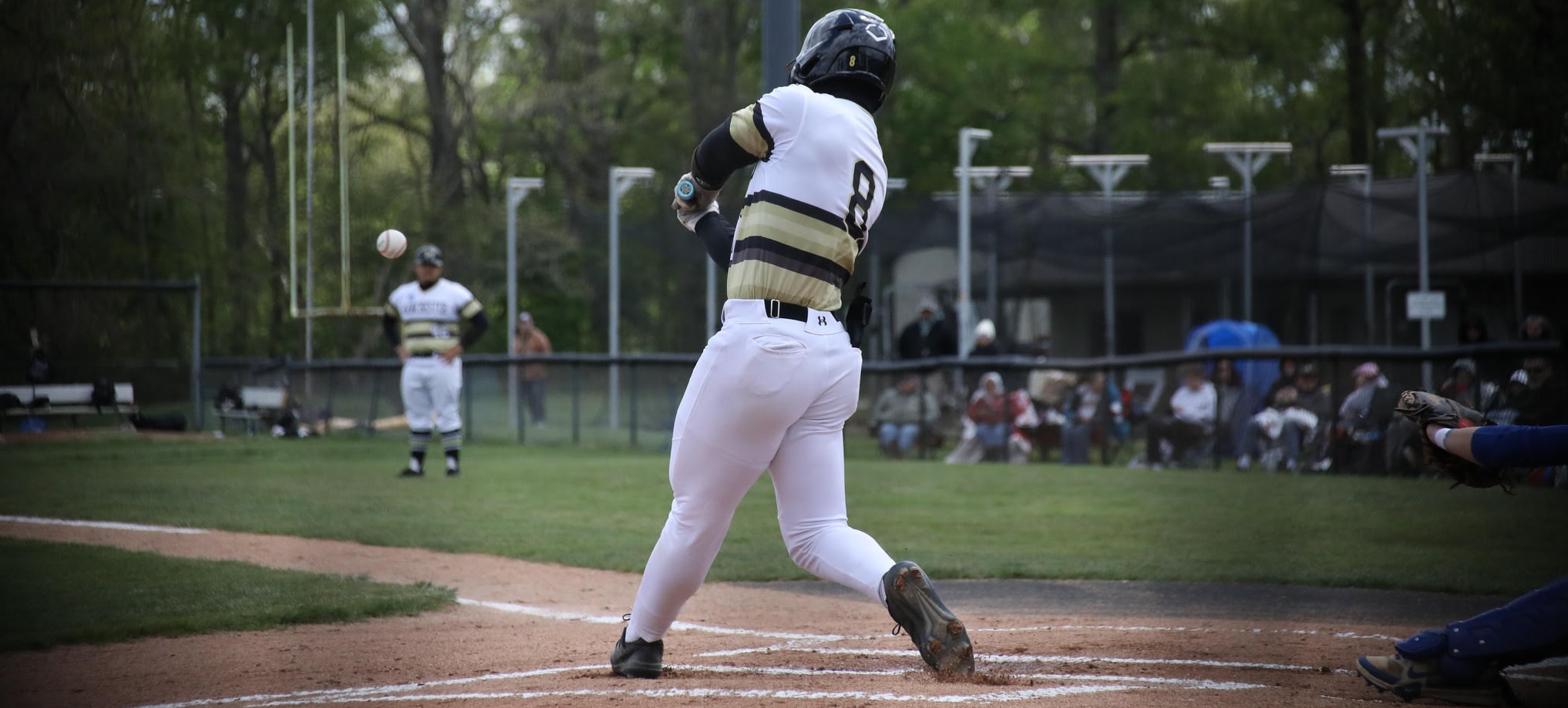
Decker works way into Indiana University starting role in 2026

By STEVE KRAH
IndianaRBI

Cole Decker cracked the lineup in his second college baseball season and the Evansville, Ind., native has continued to make improvements to his game.

Decker, a 2024 graduate of Evansville North High School where he was Indiana High School Baseball Coaches Association All-State honorable mention and invited to the IHSBCA North/South All-Star Series following his senior prep season.

The summer after high school, he moved to Bloomington to begin lifting weights, hitting and going to class. In the spring of 2025, he got into 23 games as an Indiana University freshman.

On a team stacked with outfield talent (including Korbyn Dickerson, Devin Taylor, Andrew Wiggins, Hogan Denny and Caleb Koskie), Decker was used extensively as a pinch-runner and got five hitless at-bats.

He kept grinding in practice and went to the Appalachian League’s Bluefield (W.Va.) Ridge Runners in the summer of 25 and got into 43 games and hit .305 (43-of-141) with two home runs, six triples, seven doubles, 19 runs batted in, 34 runs scored, 22 walks (vs. 39 strikeouts), an .889 OPS (.407 on-base percentage plus .482 slugging average) and three stolen bases.

Says Decker of the Appy League experience, “It was really good baseball and it was really fun.”

Back at Indiana in 2026, the 5-foot-10, 180-pound Decker became the Hoosiers head coach Jeff Mercer‘s everyday center fielder — a position he patrolled frequently as an Evansville North Husky.

In 58 games (54 starts) with IU, the lefty swinger hit .343 (69-of-206) with seven homers, four triples, nine doubles, 40 RBI’s, 36 runs, 30 walks (vs. 44 strikeouts), .971 OPS (.439/.532) and eight stolen bases.

“My best (offensive) asset is getting on-base,” says Decker, 20. “I’m at my best when my approach is to hit line drives over shortstop or up the middle.

“I try to go (opposite field). As for pitch types, I’ve always been a fastball hitter. I try to stay on fastball timing every single pitch, especially early in the count. I like working counts. It helps me get a lot of walks, and then I’m able to use my speed on the bases.

“I’ll shorten up with two strikes just to get more balls in-play.”

Since before college, Decker has used his wheels to get infield singles and take extra bases.

At the end of his high school days, he began bunting a good deal — something endorsed by head coach Jeremy Jones.

“I rarely ever got out on a bunt,” says Decker. “Then in college I kind of switched up my mechanics up.

“This year, I had six or seven bunt hits. But I can also beat out those ground balls in the infield.”

As for stealing, Decker says Indiana employs two different basic leads.

“With the New School you take a three- to six-foot lead and shuffle into it as the pitcher goes to the plate,” says Decker. “The Old School is just a 12-foot lead and going straight off the movement.

“I’m just more comfortable with the Old School.”

How about Decker’s defensive keys?

“The main thing is to get a good jump on the ball and that just comes with practice and getting reads in batting practice or in games,” says Decker. “Every game, you get better at it.

“Once you’ve developed that, then you can go into how you can get better in different ways.”

Playing IU home games at Bart Kaufman Field, Decker has learned how to cope with the sun being directly behind the plate area.

The mindset is to always be aggressive.

“You can’t care what happens to your body if you run or jump into the wall,” says Decker. “You’ve just got to go get it.”

Positioning for outfielders comes through scouting reports and direction from assistant coach Zach Weatherford.

“We have a system in games where we have a shift card and I’ll look at him and move like three steps to the right, three steps left or back and that sort of thing,” says Decker. “We do it for each hitter based on a righty or lefty pitcher (and the ball-strike count).

“With two strikes, we call it rolling down and we go two steps in and two steps oppo. Sometimes, it’s a power guy and he’ll just stay back (on each delivery) and I’ll look at (Coach Weatherford) on every pitch just to make sure.

“It’s fun because you obviously get more in-depth with the game in college.”

Unless the proposed NCAA “five-in-five” eligibility extension is adopted, Decker has two years remaining on the college diamond.

Originally planning to be a Business major, Decker opted for Sports Marketing and Management.

Says Decker of his future, “I just want to be around sports, because that’s what I’m passionate about.”

This summer, Decker is with the Northwoods League’s St. Cloud (Minn.) Rox. His first game was May 25.

He is enjoying building relationships with new teammates from all over the country.

“In the summer, you get pretty close pretty fast,” says Decker. “You really don’t know anybody and you have these bus trips that are six or eight hours long.”

Much of the time is spent competing in online games.

Born in Evansville and raised on the Pocket City’s north side, Decker played his early baseball with what is now the McCutchanville Ball Club and spent some time with what is now Evansville East Youth Baseball.

Travel ball teams included the Indiana Nitro, Louisville Legends and falls stints with 5Star Midwest and Chicago Cubs Scout.

He was with the freshman team much of his first prep season and was a varsity pinch runner during sectional time.

Decker is very fond of Evansville North field boss Jeremy Jones and a staff that includes Tyler Owen, Jesse Simmons, Peanut Titzer and Zane Mauser.

“He’s a hard worker and somebody who cares about you and who you become as a person,” says Decker of Jones. “He’s done a great job of setting expectations and habits on the field, and I think it helps guys become better people.

“I’m really proud of all those (coaches). I’m not surprised at the success they’ve had the last two years, and hope they win state (the Huskies were Class 4A state runners-up in 2025 and are in the 2026 4A south semistate Saturday).”

The last three years, Cole was on varsity including the 2022 season when he was a teammate of older brother Cameron Decker (Evansville North Class of 2022).

The older of Chad and Libby Decker’s two sons was selected in the 18th round of the 2022 Major League Baseball First-Year Player Draft by the Los Angeles Dodgers and the shortstop is now with the High-A Midwest League’s Great Lakes Loons in Midland, Mich., after a stint on the injured list.

“We get closer every year,” says Cole of Cameron. “We grew up together and always hit together.

“The other day I was on the phone with him talking about baseball and life. He’s my best friend, so obviously the distance hurts. But we stay in-contact. We’re both playing baseball and that’s part of it.”

The Deckers root for the Cincinnati Reds. Chad’s father — Donald Decker — played in the minors for the organization.

Cole’s all-time favorite is retired first baseman Joey Votto.

Says Cole, “That’s why I wear No. 19.”

Indiana University players are all over this summer.

Besides Decker, Hoosiers in the Northwoods League include Crown Point Class of 2025’s Logan Cotton (Kalamazoo), Evansville North Class of 2025’s Kellen English (Royal Oak) and Fort Wayne Snider Class of 2025’s Landen Fry (Richmond).

In the Cape Cod League, there’s Mooresville Class of 2024’s Hogan Denny (Cotuit), Jake Hanley (Cotuit), Caleb Koskie (Cotuit), Will Moore (Brewster) and Jackson Yarberry (Cotuit).

In the New England Collegiate Baseball League, there’s Cooper Malamazian (Keene).

The Appalachian League features Boone Grove Class of 2025’s Xavier Carrera (Bluefield), Floyd Central Class of 2025’s Blane Metz (Greenville), Owen Shinada (Greenville) and Owen ten Oever (Greenville).

The Western Canadian Baseball League has Bedford North Lawrence Class of 2025’s Cal Gates (Okotoks).

Zionsville Community Class of 2024’s Nash Wagner (Kokomo) and Forest Park Class of 2023’s Clayton Weisheit (Dubois County) are in the Prospect League.

The Sunbelt Baseball League has Evan O’Neill (Alpharetta).

Miles Mador (San Luis Osbispo) is in the California Collegiate League.

Cole Decker. (Grace Urbanski/Indiana University Athletics Photo)
Cole Decker. (Indiana University Athletics Photo)
Cole Decker. (Emma Pearce/Indiana University Athletics Photo)
Cole Decker. (Indiana University Athletics Photo)

Right-hander Plank contributes to Indiana Tech baseball success

By STEVE KRAH
IndianaRBI

Indiana Tech earned 43 baseball victories and qualified for the NAIA Opening Round in 2026.

Right-handed pitcher Kaden Plank played a major part in the Fort Wayne-based Warriors’ success, making 19 mound appearances (13 in relief) and going 7-1 with a 3.72 earned run average, 54 strikeouts and 27 walks in 58 innings.

The 6-foot-5, 165-pounder hurled competed in both games of the Wolverine-Hoosier Athletic Conference championship series, the all-WHAC second-teamer going 2/3 of an inning in relief then four innings as a starter against Madonna.

In the Upland Bracket of the NAIA Opening Round, Plank worked 5 2/3 innings of relief against Abraham Baldwin and two out of the bullpen against eventual national runners-up Taylor.

Plank, a 2023 graduate of Northridge High School in Middlebury, Ind., redshirted his freshman year at Indiana Tech and has two seasons of remaining NAIA eligibility going into his redshirt junior season in 2027. His career record is 7-2 with a 4.79 ERA, 89 K’s, 38 walks in 82 2/3 innings.

With a low three-quarter angle, Plank uses a four-seam fastball, slider, curveball, change-up and occasional two-seam fastball.

“I get a good amount of arm-side run on my four-seam,” says Plank of a pitch that was clocked as high as 87 mph during the season. “(The slider) moves a lot. In my bullpens this winter, it had anywhere from 18 to 26 inches of horizontal run.

“My catchers and the hitters I face tell me it’s still pretty sharp. It’s not like a big loopy slow sweeper. It’s still pretty tight and moves a lot.”

Rapsodo readings on the slider have gone as high as 3200 rpm which Plank considers pretty good for the velocity he throws.

The curve ball breaks more vertical than horizontal.

This past year, Plank added a “kick” change with a spiked middle-finger grip, causing the pitch to dive with reduced velocity and spin.

“It has the exact same shape as my fastball,” says Plank. “The only difference would be the speed and it has a lot more depth.”

The two-seamer tends to have more run to it than the four-seamer.

Kip McWilliams is Indiana Tech’s head coach and this spring also handled pitching coach duties (after Westfield Class of 2020’s Zach Zaborowski handled that role in 2025).

What comes to mind for Plank when considering his coach?

“I think of big leadership,” says Plank. “He’s got a well-managed team.

“He knows how to run a practice and organize a big group of guys. He also instilled some good work ethic.”

Pitching feedback comes from McWilliams and other veteran arms on the staff.

While working during the week, Plank is pitching on Sundays and Thursdays with the Celina, Ohio-based Great Lakes Summer Collegiate League’s Grand Lake Mariners, coached by Mike Roberts.

Plank did not play in the summer of 2025. In 2024, he was with the McWilliams-coached Northeast Kekiongas after having a few outings with that Indiana Summer Collegiate League team the previous summer.

A Sport Management major, Plank wants to stay involved with baseball beyond graduation, possibly as a coach.

Born in Goshen, Ind., to Jackie Plank, Kaden grew up in Jefferson Township in Elkhart County with his mother and grandparents Ron and Kathy Robinson.

Ron Robinson is a Chicago White Sox fan and passed that down to his grandson, who calls former Chicago pitcher Chris Sale (who is 6-6 and 180 and left-handed with 2,665 whiffs in 2,156 2/3 career innings) among his favorites.

“It was cool to see a tall, skinny, scrawny kind of guy being really successful at that level,” says Plank, “He’s a big strikeout guy with that good sweeping slider.”

Plank, who turns 22 in September, says he goes for the strikeout when he’s ahead in the count and reads the batter and finds he’s not connecting with his pitches.

He played a few years at Middlebury Little League then was in travel ball with the Middlebury Mavericks from 8U to 14U. Many of the players wound up as high school teammates.

Says Plank, “That was really cool, playing baseball with my best friends.”

After a few summers off as a full-season travel baller, Plank went with the Landsharks in 2022.

The COVID-19 pandemic took away Plank’s freshman season at Northridge in 2020. He was a pitcher-only on the junior varsity as a sophomore then played for the varsity as a junior and senior.

As a senior, his mound mark was 5-4 with one save, a 2.50 ERA, 55 strikeouts and 11 walks in 47 2/3 innings.

Among his teammates in 2023 were future college baseball players in seniors Qade Carrington (Olivet Nazarene University) and Gavin Collins (University of Pennsylvania), junior Max Horner (Manchester University) and sophomore J.T. Tabor (Taylor University).

Andrew Brabender led the Raider program when Plank entered high school and Chad Gerard became head coach beginning with the 2022 season.

“Coach Brabender is about discipline,” says Plank. “He’s not scared to tell you if you’re doing something wrong.

“He’s a perfectionist.”

Relationships are where Gerard and his assistants shine for Plank.

Says Plank, “They’re really good at connecting with players.”

Kaden Plank. (Indiana Tech Photo)

Wanner helps in Judson University diamond turnaround

By STEVE KRAH
IndianaRBI

Owen Wanner has been part of a baseball resurgence at NAIA Judson University in Elgin, Ill.

The Eagles posted nine victories in 2024 — head coach Evan Ruechel’s first season — then followed that with 31 in 2025 and 37 in 2026. Win totals in the Chicagoland Collegiate Athletic Conference went from four in 2024 to 20 and 19 the past two seasons.

“He’s a pretty incredible recruiter,” says Wanner, a 5-foot-10, 180-pound right-handed pitcher. “He turned our program around in a hurry.”

Judson has gone to the last two National Christian College Athletic Association World Series in Kansas City, Mo.

A year after going 1-2 at the NCCAA World Series in 2025, the No. 4 seed Eagles went 3-2 and finished as runner-up to No. 6 seed Southwestern Christian University in 2026.

Wanner tossed 1 2/3 innings in relief in Judson’s first game in 2025.

In 2026, he hurled 7 2/3 innings in the Eagles’ first contest in beating No. 5 seed The College of the Ozarks and all eight innings in the championship game against Southwestern Christian.

Besides baseball, Wanner and his team got to take part in a worship service, awards winner and service project, doing some drills with elementary schoolers during their recess.

With all the teams staying at the same hotel, there was the chance to meet many players.

So far during his college career, Wanner has made 28 mound appearances (22 starts) and is 11-7 (8-3 in 2026 as an all-CCAC second-teamer) with a 4.60 earned run average (3.30 in 2026), 109 strikeouts (67 in 2026) and 71 walks (50 in 2026) in 133 innings (87 1/3 in 2026).

Anthony Zak is Judson’s pitching coach.

“I’ve developed a pretty personal relationship with him,” says Wanner of Zak. “He’s been great for me mentality-wise and everything.

“He’s really helped me settle in and mature as a baseball player. He does a great job of building relationships with our pitchers.”

Throwing from a high three-quarter arm slot, Wanner offers a four-seam fastball, two-seam fastball, curveball, slider and change-up.

The four-seamer sits between 86 and 88 mph and has touched 89. The pitch rides and jumps on the hitters’ hands.

“The two-seamer is more like a sinker,” says Wanner. “It goes down and in to right-handed hitters and goes down and runs away from left-handed hitters.:

The curve is “very vertical.”

The slider has “sharp horizontal (break) with a little bit of vertical.”

The change-up is characterized by “vertical drop and some arm-side run.”

Born in Indianapolis, Wanner grew up in the Berne, Ind., area. He played at South Adams Youth League and traveled with the Berne Bears, Summit City Sluggers and Bluffton-based Indiana Bandits.

Wanner was a multi-sport athlete at South Adams Junior/Senior High School in Berne, where he graduated in 2024.

He played football for four years — three years as the Grant Moser-coached Starfires’ starting quarterback. Wanner passed for 5,132 yards and 59 touchdowns.

In the winter, he was a junior varsity basketball player as a freshman, a wrestler as a sophomore (his father coached the sport), participated in 7-on-7 football as a junior and was a varsity point guard in basketball as a senior on a team coached by Garrett Krieg. That winter, Wanner averaged 10.8 points and 3.0 assists per game.

As a four-year varsity baseball player, Wanner was a middle infielder who did not pitch as a freshman. His last three prep years were spent as a pitcher and shortstop. On the mound, he won 16 games and struck out 294 in 181 2/3 innings.

Brad Buckingham is head baseball coach at South Adams.

“There was routine and fundamentals,” says Wanner. “No matter what kind of talent we had, everything was pretty much the same and you knew what you were going to get in a very good way.”

Wanner, who turns 21 in October, is an Exercise Science major. He sees his future as a physical therapist or a private pitching trainer.

Introduced by family friend and University of Saint Francis pitcher Perry Stow (Fort Wayne South Side Class of 2022), Wanner has trained remotely with Harrison Francis, which pitched in the Arizona Diamondbacks system and with the independent Gary (Ind.) SouthShore RailCats, of Tallahassee, Fla.-based Holistic Pitching Path.

“I really enjoyed that,” says Wanner. “I’d like to try to get into that somewhere.”

Wanner got into a couple of games with the 2025 Portland Rockets. This summer, he is staying at his college apartment working two part-time jobs and getting in some workouts.

Though he’s not currently with a team, he does not rule out seeking out an opportunity to get in a few starts before the end of the summer.

Owen is the oldest son of South Adams graduates and former college athletes. Ben Wanner was once a wrestler at the University of Indianapolis and now a truck fleet manager. Jeni Wanner played softball at the University of Saint Francis and is now an accountant.

Younger brothers Jax Wanner (South Adams Class of 2027) and grade schooler Zaxx Wanner are both involved in football, basketball and baseball.

Following his father’s lead, Owen is a Chicago Cubs fan and has been to Wrigley Field a couple of times since going to college in Chicagoland.

His favorite players are second baseman Nico Hoerner and center fielder Pete Crow-Armstrong.

“Hoerner is kind of how I played in high school — not a huge power guy but a good defensive middle infielder,” says Wanner. “PCA is just fun to watch.”

Owen Wanner. (Amanda Acker Photography Photo).

The Community Learning Center in Kendallville to throw spotlight on Ford Frick

By DEAN JACKSON
For IndianaRBI

Friday, June 12 David Bohmer will talk about Noble County native Ford Frick, and honestly, it’s about time.

Most people only know his name from that wooden sign on U.S. 6 between Kendallville and Ligonier. Frick Lumber remembers him. Not many others do.

Around here, his whole legacy gets reduced to a couple of dates and a job title, nothing about the guy who helped shape baseball into what it is now.

The Community Learning Center in Kendallville wants to fix that.

From 11 a.m. to 1 p.m., it’ll host Bohmer for a two‑hour look at how a kid from Noble County helped push Major League Baseball into the modern age.
Bohmer spent years digging into Frick’s life for his new book, Ford Frick: Baseball’s Third Commissioner and His Four Decades of Shaping the Game. He has taught journalism for many years and was once the director of DePauw’s Pulliam Center for Contemporary Media. He is using all that experience to tell Frick’s story well, especially in the place where Frick grew up.

What he might not say directly, I will.

Frick was one of the most important people in baseball history who never played the game.

Most fans only know the basics. He was commissioner from 1951 to 1965. Before that, he ran the National League. That’s the easy stuff, the headline version of his life.

What they don’t know is everything that came before. They don’t know he ghost wrote for Babe Ruth, helping shape the Babe’s public voice when he was the biggest star in America. They don’t know he hosted a New York morning show called Musical Clock. They don’t know he was one of the first radio sports voices in the country, giving daily reports on WOR when teams still thought radio would hurt ticket sales.

They don’t know he wrote nationally syndicated baseball columns while climbing the league ladder.

They don’t know he handled public relations for the National League while becoming one of the sport’s most trusted storytellers.

And they definitely don’t know he did all of this at the same time: broadcasting, writing, ghostwriting, league work, and building the résumé long before he ever got the title.

That’s the part that gets lost.

Reduce him to a job title, and you miss the whole person.

Frick didn’t just end up running baseball; he built toward it across different jobs, different mediums, and different decades. If you don’t know that part, you don’t know him.

And he was at the helm when baseball was going through its most significant changes.

The sport was stretching, shifting, and figuring out what it wanted to be, and he was the one steadying it as everything around him moved.

Start with the obvious: Frick helped give baseball structure. The 162‑game schedule — the one every season uses now — didn’t just appear. He pushed for it and made it standard. It’s one of those decisions people forget about because it works so well.

He also helped open the map.

In 1958, the Dodgers moved to Los Angeles and the Giants moved to San Francisco, and baseball suddenly jumped from two time zones to three. That turned the sport from an East‑and‑Midwest thing into a national one. Then came expansion with the Angels and the new Senators in 1961, followed by the Mets and the Colt .45s in 1962. This gave baseball a coast-to-coast presence that changed everything: money, travel, TV, and the league’s entire structure.

He strengthened the Hall of Fame, too. As National League president, he supported the idea of creating a permanent home to preserve baseball history. Later, as commissioner, he helped shape the voting rules and standards so it wouldn’t turn into a popularity contest. He believed the Hall should mean something, and he worked to make sure it did.

And then there’s the asterisk.

When the schedule increased from 154 to 162 games in 1961, he decided that Babe Ruth’s 60 home runs during 154 games should remain the record. Any new record set in the longer season, such as Roger Maris’s 61, had to be listed separately. That decision sparked the Maris controversy and stayed in place until 1991. Through all of it, Frick’s goal was simple: keep the record book clear and keep the history straight.

And you can argue integration would’ve taken longer without Frick’s quiet support. After years of opposition under Commissioner Kenesaw Mountain Landis, Branch Rickey faced a hostile environment. When National League players tried to start a petition to keep Jackie Robinson off the field, Frick stopped it right away. If they refused to play with Robinson, he told them, they wouldn’t play at all. It wasn’t loud, but it removed the last internal barrier. Without that moment, the timeline almost certainly changes.

Add it all up, and calling him one of the top builders of modern Major League Baseball isn’t a stretch; it’s the truth.

And he was one of ours.

A small‑town Indiana kid who worked his way up. Not bad for a kid from Brimfield.

  • Event — David Bohmer presents on Ford Frick’s life, legacy, and impact on modern baseball.
  • When — Friday, June 12, 11 a.m. to 1 p.m.
  • Where — The Community Learning Center, 401 E. Diamond St., Kendallville, IN 46755.
  • Focus — How a kid from Noble County helped push Major League Baseball into the modern age.
  • Speaker — David Bohmer, director emeritus of DePauw’s Pulliam Center for Contemporary Media.
  • Book — Ford Frick: Baseball’s Third Commissioner and His Four Decades of Shaping the Game.
Ford C. Frick’s National Baseball Hall of Fame plaque.

Marin makes himself into better ballplayer, weighs future options

By STEVE KRAH
IndianaRBI

Erick Marin just finished a productive junior college baseball stint and is now pondering his future.

“I’m still weighing out my options,” says Marin. “I’m thinking of making a decision in late June.”

Marin says he has at least two years of remaining eligibility and possibly three.

The corner infielder has options at four-year schools after making an impression for Glen Oaks Community College in 2026.

“I’ve developed so much not only as a baseball player, but personally,” says Marin of his time at the school in Centreville, Mich., and a program led by Tucker Waddups (Pioneer Junior/Senior High School Class of 2016 and Taylor University Class of 2021). “Coach Waddups turned the program around in one year (going from nine wins in 2024 to 25 in 2025). “He’s just an amazing coach.

“He knows a lot about baseball. I just really love how he plays the game and talks to players. He was always teaching us something new everyday.”

A first baseman when he joined the Vikings in 2023-24 following his days at John Adams High School in South Bend, Ind. (he played four years including his senior year of 2023 on varsity for the Mike Cass-coached Eagles), the 6-foot-1, 2-5-pound Marin was asked to also play some third base.

“I struggled at the beginning, but really got a lot better towards the end,” says Marin. “Coach Waddups really emphasized being on time with your prep step.

“A half a second could be the difference between making a diving play or hitting off the tip of your glove or not being able to get it.

“You want to hit the ground right as the ball is crossing the plate.”

The righty swinger appeared in 50 games (48 starts) and hit .347 (51-of-147), .349 with runners in scoring position, 99 quality at-bats, no home runs, no triples, eight doubles, 28 runs batted in, 39 runs scored, an .860 OPS (.459 on-base percentage plus .401 slugging average) and 13 stolen bases.

Hunting the second strike — especially from the second at-bat of the game on — was a key for Marin.

“I was always trying to be in a batter’s count or chase that second strike — whatever’s close to the zone,” says Marin. “Even if it’s a half a ball off the plate, I feel like it’s a good pitch to hit.

“I go to the opposite field a ton. That’s really where most of my success comes from.”

Marin’s efforts earned him all-Michigan Community College Athletic Association Western Division second team honors.

In 2024, Marin played in 39 games (31 starts) and hit .283 (30-of-106) with no homers, no triples, 10 doubles, 18 RBI’s
27 runs, a .794 OPS (.417/.377) and six stolen bases.

A torn meniscus caused Marin to miss the 2025 college season and take a medical redshirt. He was back on the diamond in the summer with the Northern League’s Elkhart County Miracle.

On the academic side, Marin earned Glen Oaks associate degrees in Applied Science and Business and Arts and certificates in Supervision as well as Marketing and Management.

Marin was born in Cumana in the state of Sucre in Venezuela.

There he began playing baseball. His family — including his father Rafael Marin (now a Walmart delivery man), mother Maryoris Nunez (now a University of Notre Dame housekeeper) and older brother Maryoris (now a graphic designer for )— moved to West Palm Beach, Fla., in 2012 and they landed in South Bend the next year.

Erick was on Marcus LaSane’s 10U Michiana Repetition travel team that went to the Cal Ripken World Series in Palm Beach Gardens, Fla.

From 2022-24, Marin competed and learned with South Bend American Legion Post 151 and manager Tony Cruz.

“It’s been amazing,” says Marin of his Legion experience with Cruz. “I’ve never had more fun playing baseball than with him.

“I’m really grateful for everything he’s done for me. He’s helped me get into college ball and to keep following my dream of playing baseball.”

Marin credits Cruz for helping him get his footwork right.

“That helped me a ton at the college level and made me stand out,” says Marin. “I also could come home in the summer and wouldn’t have to be so stressed.

“He just made it a real fun environment to play in. I just love the way he runs things. He plays small ball. He knows how to include fun while taking it seriously at the same time.”

At 20 (he turns 21 in October), Marin is too old to play for the Post 151 Seniors but trains with the squad and on his own while he considers his next move.

By passing a test and attending a naturalization ceremony in Chicago in 2025, Erick joined his brother as a U.S. citizen.

Marin’s family are friends and customers at the Caracas Bistro, a Venezuelan restaurant in Mishawaka, Ind.

Marin roots for the Atlanta Braves. His favorite current player is Venezuelan Ronald Acuña Jr.

“It’s the swag and how he carries himself,” says Marin of the 28-year-old outfielder. “I like to wear all yellow (accessories) as well.

“We both went through injuries around the same time.”

Miguel Cabrera — another Venezuelan — and star who retired with 511 home runs and 3,174 hits is the player Marin admires most all-time.

Marin wore No. 24 — Miggy’s number — at Glen Oaks.

“Growing up, my dad also liked Miguel Cabrera,” says Marin. “When he won his Triple Crown (in 2012), we were in Florida.

“He’s just like the biggest motivation for me.”

Maryoris Nunez (left), Ilich Marin, Erick Marin and Rafael Marin at Glen Oaks Community College.
Erick Marin at Glen Oaks Community College.
Erick Marin with the Elkhart County Miracle.
Erick Marin with South Bend American Legion Post 151.
South Bend American Legion Post player Erick Marin (left) and manager Tony Cruz.

Holtzleiter, seasoned Eastbrook Panthers bound for regional

By STEVE KRAH
IndianaRBI

With an attention to details, Eastbrook High School in Marion, Ind., has assembled a collection of players with plenty of varsity seasoning and it’s led to a 25-4 record and the Panthers’ sixth sectional championships including two in the past three seasons.

“Our big thing is just making the routine play, throwing strikes and defending,” says fifth-year Eastbrook head coach Kris Holtzleiter. “We’re lucky enough to have almost an entire roster that can play defense at a high level.

“Most of them are good pitchers as well. They can swing it. The details are what we focus on most.”

With a 2-1 win against Alexandra-Monroe June 1 in the title game of the IHSAA Class 2A Blackford Sectional, Eastbrook earned the right to face Eastern of Greentown (21-11) in a regional at 3 p.m. Saturday, June 6 on the turf at spacious Kokomo Municipal Stadium.

“It’s huge that the outfield is turf, where a ball that may be just a single in the gap can go to the wall in left and it’s a triple and if it goes to right it’s a triple at minimum,” says Holtzleiter. “It forces your players to take different angles.

“Bunts tend to be a little quicker. Eastern is a good bunting team, so those things are going to be a big key.”

But so many of them have played on turf for years during their summer travel ball seasons and have logged lots of high school playing time.

“We’ve got an athletic core,” says Holtzleiter. “Even though we have one senior (Ryder Gipson), we have a bunch of guys (juniors Kyler Hackman, Malakai Luthy, Jacob McDermit and Austin Mikel) who’ve started for a long time.”

For the second straight season, the Panthers have well over 120 stolen bases.

Says Holtzleiter, “We’re trying to run when the game calls for it.”

In the sectional championship game, Holtzleiter’s lineup featured left fielder Luthy, junior first baseman Kavion Martin, left-handed pitcher Mikel, sophomore third baseman Blake Jacobs, shortstop Hackman
right fielder McDermit, catcher Gipson, junior designated hitter Landon McEvoy and sophomore second baseman DeMarion Dungy. Junior Jon Bennett was the center fielder.

“I feel like we’re an experienced team and we’ve got a ton of pitching, too,” says Holtzleiter. “We’ve got five or six guys that we can run out there and compete against about anybody.”

Southpaws 6-foot-5 Mikel and 5-10 Martin are considered by Holtzleiter as his 1A and 1B. Jacobs is the closer. Right-handers Hackman, Luthy and Bennett are also in the mound mix.

Eastbrook (enrollment around 515) is a member of the Central Indiana Athletic Conference (with Alexandria-Monroe, Blackford, Elwood, Frankton, Madison-Grant, Mississinewa and Oak Hill).

The Panthers were part of an IHSAA Class 2A sectional grouping in 2025 with Alexandria-Monroe, Blackford, Madison-Grant, Muncie Burris and Wapahani.

Holtzleiter was pitching coach and recruiting coordinator for five years at Indiana Wesleyan University in Marion before taking over leadership at his prep alma mater.

His coaching staff includes Brian Abbott, Ryne Otis, Steve Shelby, Mike Scott, Caleb Landrum, Jim Landrum and Dave Glickfield.

Indiana Baseball Hall of Famer and former Huntington University pitching coach Abbott, who was Holtzleiter’s high school head coach, is Eastbrook pitching coach.

Former Taylor University standout Otis is hitting coach. IWU assistant Steve Shelby guides infielders. Former Mississinewa High School head coach Scott leads catchers and baserunners. Caleb Landrum is junior varsity head coach, Jim Landrum JV assistant and Glickfield, who coached with Holtzleiter at Southwood Junior/Senior High School, is in charge of outfielders.

For the first time, the Panthers fielded three teams — varsity, junior varsity and freshman — in 2026. There were almost three dozen players in the program. There were just over a dozen in Holtzleiter’s first season at Eastbrook (2022).

What about the Panthers’ on-campus diamond?

“When I played there, (Eastbrook) was a sectional and regional site,” says Holtzleiter. “Coach Abbott kept that place flawless.

“We’re trying to keep up the legacy and bring it back to its former glory.”

Feeders for the high school include Eastbook Youth League with fields in Upland and Van Buren. The Babe Ruth diamond in Upland has been upgraded and that’s where junior high baseball — led by Matt Wiseman — was played this spring.

Holtzleiter, a financial advisor at Edward Jones in Marion, has been married to Jessica for 15 years. The couple has three children — son Jackson (15) and daughters Madison (13) and Braelynn (2 1/2).

Jackson Holtzleiter (Eastbrook Class of 2029) is on the baseball team. Madison Holtzleiter (Eastbrook Class of 2031) just finished the seventh grade.

Jessica (left), Jackson and Kris Holtzleiter with Eastbrook’s IHSAA Class 2A Blackford Sectional baseball championship trophy.

Northridge graduate Horner shines as a student-athlete with Manchester U.

By STEVE KRAH
IndianaRBI

Max Horner enjoyed a strong freshman baseball season and an even better sophomore campaign for NCAA Division III Manchester University in North Manchester, Ind.

In his first college year of 2025, left fielder Horner played in 43 games (42 starts) and the righty swinger hit .353 (61-of-173) with two home runs, three triples, 15 doubles, 36 runs batted in, 48 runs scored, .976 OPS (.467 on-base percentage plus .509 slugging average) and three stolen bases.

D3Baseball.com & American Baseball Coaches Association/Rawlings All-Region VIII and All-American plus all-Heartland Collegiate Conference first team honors came to Horner in 2026. He was named to the D3Baseball.com Team of the Week March 11 after a 10-for-14 three-game series at the plate against DePauw which featured a grand slam, three doubles and three runs and no strikeouts.

In 37 games (all starts), Horner hit .445 (69-of-155) with five homers, three triples, 20 doubles, 43 RBI’s, 39 runs, a 1.221 OPS (.511/.710) and eight stolen bases.

“Max is the complete package,” says Manchester head coach Rick Espeset. “Student, athlete and person.

“Dedicated to being the best he can be in all aspects. He is relentless in the weight room. Teammates selected him for our sportsmanship award. And his baseball numbers speak for themselves. An Accounting major who is on path to earn two degrees — bachelors and (Master of Business Administration) — in four years.”

This summer, Horner is doing an internship with Genesis Products in Goshen and Fort Wayne and finding time to enjoy the golf course.

At the bat, the 6-foot, 210-pound Horner tries to keep it simple — something he learned as a freshman at Northridge High School in Middlebury, Ind., with Andrew Brabender then the Raiders head coach.

“My spray charts say I’m probably 90 percent to the pull side, but in my mind I’m just trying to sit back on a baseball and hit it to the right side,” says Horner, who turns 21 in December. “If you’re a little early, you hit the ball to left field. If you’re a little late, you’re hitting it down the right field line.

“The key in my mind is to spray the field. That’s what I see many good hitters at any level do. It’s the threat that this guy can hit it anywhere in the ballpark.”

On defense — from about age 10 — Horner was a center fielder. With Michael Dierckman (Fort Wayne Class of 2023) in center since 2024, he was asked to move to left.

“It’s a pretty big difference, honestly,” says Horner. “Ball flight in center field is a lot easier to read off a bat.

“(In left or right,) ball flight comes at you with a little different spin. It probably took me 10 games before I was honestly comfortable with seeing that ball off the bat in left field.”

Speed is a part of Horner’s game.

“I’m a very good ball-contact player so I have a decent amount of hits on just hard-hit ground balls,” says Horner. “I’m quick out of the box.”

Horner enjoys playing for Espeset.

“He’s one of the most laid-back people from a coach standpoint,” says Horner. “He just kind of goes with the flow.”

Says Espeset, “I do not review the game with the team immediately after the game. It can be an emotional time for players and coaches. A little time to reflect is good for everyone.

“I believe guys are more receptive and attentive the next day. And you have time to talk to guys individually.”

Horner was a four-year letterwinner at Northridge, where he graduated in 2024. In 108 games, he hit .318 (104-of-327) with five homers, 10 triples, 25 doubles, 79 RBI’s, 95 runs, a .928 OPS (.426/.501) and 44 steals.

“I loved playing for Coach Brabender. I dropped basketball and had one off-season with him and the baseball team.

“It was one of my best years of growth as a baseball player.”

Horner had to prove himself again when Chad Gerard and his coaching staff came in.

“They’re great people,” says Horner. “They’re fun to be around.”

Born in Goshen and growing up in Jefferson Township, Horner started out at Middlebury Little League and played travel ball for the Michiana Scrappers/Canes Great Lakes.

Horner pulls for the Los Angeles Dodgers. His affinity grew when his family began vacationing in LA about a decade ago.

He points to golfer Tiger Woods and basketball player Michael Jordan as his favorite athletes.

Says Horner, “It’s just the way they carry themselves and the legacy they left behind in their sports and pretty much the sports world.”

Max is the son of Chad Horner and Dr. Stacy Young. His father works at Boundless RV. His mother is the Manchester U. president.

Sister Allison Horner (Northridge Class of 2021) was a prep cheerleader who earned her MBA from Manchester online. She works at Genesis and is to be married in August.

Max Horner. (Manchester University Photo)
Max Horner. (D3Baseball.com Image)

LaVille graduate Quinn’s baseball journey takes him to Spoon River College

By STEVE KRAH
IndianaRBI

Karson Quinn grew up playing baseball in the central portion of northern Indiana.

Born and raised in South Bend, Quinn graduated from LaVille Junior/Senior High School in Lakeville, where he was a catcher for the Brian Lawler-coached Lancers and graduated in 2025 after a season in which he hit .466 (27-of-58) with two home runs, no triples, nine doubles, 26 runs batted in, 15 runs scored and 1.224 OPS (.500 on-base percentage plus .724 slugging average).

“Coach Lawler was a great part of my journey,” says Quinn. “I was upfront about my goals with him from the beginning and he spent the time to help develop me not only defensively, but offensively too.”

When it came time to expand his education and diamond horizons, Quinn opted for Spoon River College, a National Junior College Athletic Association school in the west central Illinois city of Canton.

“What appeals to me about junior college baseball is the opportunity,” says Quinn. “It is a great chance to prove yourself and eventually get to that four-year program.”

As a freshman in 2026, the 6-foot-2, 215-pound Quinn appeared in 56 games and the righty swinger hit .351 (66-of-188) with two homers, no triples, 14 doubles, 36 RBI’s, 49 runs, 26 walks (vs. 21 strikeouts), an .890 OPS (.433/.457) and one stolen base.

John Kurtz is head coach for the Spoon River Snappers.

“Coach Kurtz, is a great coach,” says Quinn. “There’s not much beating around the bush, we attack the problems we see in games at practices, making it super easy to move forward and fix these issues.

“I am primarily a catcher, but have had a lot of chances to work in at first base and also some time getting to designate-hit.”

What’s Quinn thinking next to the dish?

“My personal offensive approach has been to jump on the fastball and do my best to stay offensive in the box and understand that the pitcher has to come to me,” says Quinn. “For me personally behind the plate the biggest key for me has been not giving up on close pitches and working for our (pitching) staff.”

The Business major says he is not certain where he will go after Spoon River. This summer, he is with the Crestwood Collegiate League’s Pipeline Patriots. Games are played in northeast Illinois and northwest Indiana.

As a youngster, Quinn played at South Bend South East Little League and later with South Bend American Legion Post 151 and the Northern League’s Elkhart County Miracle.

Quinn roots for the Boston Red Sox, but his favorite MLB player is retired St. Louis Cardinals catcher Yadier Molina.

Says Quinn of Molina, “It was great to see what he was capable of behind the dish.”

Karson is the son of Scott Quinn and Sarah Nowicki and has a brother — Konner Quinn (LaVille Class of 2023 and now a 6-foot-5 left-handed pitcher at the University of Southern Indiana after two seasons at Wabash Valley College in Mount Carmel, Ill.).

Karson Quinn. (Spoon River College Photo)

Rochester Community alum Reinartz makes immediate college impact as Huntington U. freshman

By STEVE KRAH
IndianaRBI

Tanner Reinartz is super-confident when at the plate.

“My mindset when I step in the box is that I’m better than the pitcher and I’m going to win,” says Reinartz, a righty swinger who was a baseball standout at Rochester (Ind.) Community High School and turned heads during his freshman season at Huntington (Ind.) University in 2026. “My approach is middle-away. I’m really just trying to hit a line drive over the second baseman’s head, staying on-time and staying connected.

“If you’re thinking middle-away, you’re going to be on top of the fastball and anything off-speed, you’re going to be able to take to the pull-side gap. That’s just my mentality.”

The 6-foot-3, 205-pounder played in 50 games (46 starts) at Huntington (39-14) and hit .338 (54-of-160), 15 home runs, one triple, 22 doubles, 60 runs batted in, 43 runs scored, 1.210 OPS (. 441 on-base percentage plus .769 slugging average) and three stolen bases.

Operating mostly out of the No. 6 spot in Foresters head coach Thad Frame’s batting order, Reinartz was an all-Crossroads League first-team outfielder and struck out 33 times while walking 27 and being hit by a pitch five times.

Says Reinartz, “(Frame and assistant coach Ryne Wheeler) has already preached to have a 1:1 ratio of strikeouts to walks and hit by pitches because that’s the way you win ball games.”

What does Reinartz think of Frame as a coach?

“He’s just a highly-intense dude and knows his ball,” says Reinartz. “He can make plays that I don’t think a lot of coaches can.

“He just knows the game inside and out.”

A third baseman and pitcher in high school, Reinartz was a right fielder at Huntington and that’s where he is this summer with the Prospect League’s Owen Oreskovich-managed Burlington (Iowa) Bees.

Reinartz, a Business Management major who turns 20 in September, credits Foresters assistant Jamar Weaver for helping him make the adjustment to the outfield.

“There’s just the positioning on different batters in different counts,” says Reinartz. “With two strikes, you move up and for a bloop single.

“That type of knowledge taken from Jamar is just great. I didn’t see that before. He’s really just opened my eyes.”

At Rochester, Reinartz was a three-sport athlete — tennis for head coach Mason Heyde, basketball for Rob Malchow and baseball for Cory Good.

He represented the Zebras in No. 1 doubles as a freshman, No. 2 singles as a sophomore and No. 1 singles as a junior and senior.

Says Reinartz of the now-retired Malchow, “He’s a great dude and he loves to win. He can’t stand losing and I’m the same way.

“I love him to pieces.”

Says Reinartz of Good, “Great man and great coach. He really just brought my love for the game to the next level and that desire to win.”

On the diamond, Reinartz was first-team Indiana High School Baseball Coaches Association Class 2A all-state at third base in 2025 and a four-time all-Three Rivers Conference first-team selection — pitcher in 2023, infielder in 2022, 2024 and 2025.

He was selected for the 2025 IHSBCA North/South All-Star Series in Lafayette.

In 105 games for the Zebras, Reinartz hit .440 (136-of-309) with 15 homers, no triples, 35 doubles, 114 RBI’s, 116 runs, 78 walks (vs. 21 strikeouts), a 1.242 OPS (.543/.699) and 13 steals.

Born and raised in Rochester, Reinartz participated in the Rochester Youth Baseball League before travel ball stints with the Warsaw-based Attack, Michiana Scrappers, South Bend Cubs, Tomahawks of Gas City and USA Prime Indiana of Indianapolis.

Reinartz names Philadelphia Phillies slugger Bryce Harper as his favorite pro baseball player.

Says Reinartz of Harper, “I like how he handles himself on the field and is a Godly man.”

Matt and Wendy Reinartz have two sons — Kyle and Tanner.

Matt Reinartz is Chief Operating Officer for Professional Roofing Solutions & Construction in Warsaw. Wendy Reinartz works for Shepherd Chevrolet in Rochester.

Kyle Reinartz (Rochester Community Class of 2021) played tennis, baseball and baseball in high school and was a left-handed pitcher at Grace College in Winona Lake. He now works with Good at The Winning Edge athletic outfitter in Rochester and was head boys tennis coach at RCHS last fall.

Tanner Reinartz. (Huntington University Photo)

Chemistry key as Richardson, Monroe Central earn first sectional title since 2014

By STEVE KRAH
IndianaRBI

The Golden Bears of Monroe Central Junior/Senior High School in Parker City, Ind., rang in the month of June with something that had not happened since 2014.

With a 16-1 triumph against Cambridge City Lincoln June 1 in the Class 1A Seton Catholic Sectional championship game at Earlham College in Richmond, Monroe Central won its eighth IHSAA baseball sectional title — the first since 2014.

The Golden Bears were part of the sectional field with Blue River Valley, Cambridge City Lincoln, Randolph Southern, Seton Catholic, Union (Modoc) and Union City.

Next up is Monroe Central (11-15) vs. North Miami (18-12) 11 a.m. Saturday, June 6 in the Oak Hill Regional.

Sean Richardson is in his third season as Golden Bears head coach. He had been an assistant with Keith Nunley then Matt Deckman for six years, took a season off then took on leadership of the program.

Assistant coaches include Kory Benbow, Brook Pence, Jon Cooper and Tyler Haney.

The lineup in the sectional title game went like this:

Leading off, sophomore center fielder Myles Oliphant (.357, 18 RBI’s), followed by sophomore second baseman Jed Ferguson (.406, 16 RBI’s, 19 stolen bases) and sophomore right-handed pitcher Caleb Luedike (4-2, 1.77 earned run average; .487, 16 steals).

Hitting clean-up was junior third baseman Isaac Middleton (12 RBI’s), followed by freshman designated hitter Alex Middleton (.333, 19 RBI’s), senior first baseman Levi Pence (.312, 25 RBI’s), senior left fielder Kyler Bogue (10 RBI’s, 13 steals), junior catcher Carson Siekmann (17 RBI’s) and freshman right fielder Collin Baker. Sophomore Carter Morris was at shortstop.

Luedike, who is Richardson’s youngest son, plays third base or shortstop when he’s not on the mound.

Richardson considers his top four pitchers to be Luedike, Isaac Middleton (2-3), Morris (3-2) and Oliphant (1-3).

There are moving parts on the 15-man roster. The idea is to put the best possible defense on the field.

The Golden Bears have three seniors — Bogue, Pence and Tashaun Beatty.

“These seniors and my juniors are really good leaders,” says Richardson. “Isaac Middleton is just incredible with his teammates. He’s always positive. He’s the first to say, ‘Hey, don’t worry about it, we got the next one.’”

Monroe Central (enrollment around 300) is a member of the Mid-Eastern Conference (with Blue River Valley, Cowan, Daleville, Eastern Hancock, Randolph Southern, Shenandoah, Union of Modoc, Wapahani and Wes-Del).

Monroe Central’s seventh and eighth graders won the first-ever county championship this spring.

MC’s on-field diamond has been revamped in recent years through a combination of time, effort, fundraising, the community and administration including athletic director Kyle Parkison.

“You get what you give,” says Richardson. “A little at a time, we’ve rebuilt this.”

The field was laser-leveled, an irrigation system was installed and new dugouts were installed. New backstops are in the future.

The secret to the Golden Bears’ success in 2026?

“It’s chemistry,” says Richardson. “We try to teach these kids as much as we can about the game, but also make sure they understand that these are times that they’re never going to forget.

“It’s a balance of work, fun and really making memories. We talk about this stuff all the time. This game is hard. It’s a game of failure. Everybody understands that. When you’re dealing with high school kids, failure is not easy.

“We try to emphasize with these guys how to handle failure. Mistakes are going to be made, but it’s how you react to the mistakes that make the difference.”

“This has been a fun ride to be on. I’ve been around this game for a long time. I played it at a high level.

“To be able to share this with my friends, these kids and my kids as well, it’s the ultimate dream for a ballplayer and a coach.”

Richardson, who grew up in Maryland, participated in the 1988 Mustang World Series in Caguas, Puerto Rico as his team won the U.S. East Regional championship and the 1992 Pony World Series in Edmund, Okla., after his squad earned a U.S. East Regional title.

A1996 graduate of Northeast High School in Pasadena, Md., Richardson played on an Eagles unit that was Class 2A Maryland Public Secondary Schools Athletic Association state runners-up.

In college, he was on the baseball team for two years at what is now NCAA Division II Limestone University in Gaffney, S.C., followed by two years at NCAA D-I Coppin State University in Baltimore with former big leaguer Paul Blair as head coach.

“He was unbelievable with us players,” says Richardson of Blair, who died in 2013. “His knowledge of the game was just something I soaked in.

“He would give it to you real. He was never one to shy away from a situation. He didn’t sugarcoat things. He would tell us all the time that he was preparing us for life. Not everything in life is soft. You’ve got to be able to handle adversity.

“He did a lot for me, just helping me along with things in the game and in life.”

Amber Rose Richardson, Sean’s wife, died of breast cancer on Feb. 17, 2026. Sean and Amber were together for 16 years and married for 14. They lived in Farmland, Ind., with sons Cole and Caleb.

Says Sean, “It’s been a tough road this season.”

Cole Luedike (Monroe Central Class of 2024) is a sophomore baseball player at Hanover (Ind.) College.

Other recent Monroe Central alums going on to college baseball include Class of 2021’s Bryce Deckman at Huntington (Ind.) University and Class of 2022’s Aidyn Coffey at Stony Brook University and Joel Kennedy at Manchester University.

Richardson’s day job is operations manager for Flow Solutions, a company specializing in compressed air systems.

Monroe Central Baseball is on Instagram.

Brook Pence (left), Kory Benbow, Sean Richardson, Jon Cooper and Tyler Haney. (Monroe Central Junior/Senior High School Photo)
Cole Luedike (left), Sean Richardson and Caleb Luedike. (Monroe Central Junior/Senior High School Photo)