Heroic Sacrifice

This weekend, here in the U.S., we celebrate Memorial Day. It is a day of remembrance, when we honor those who have made the ultimate sacrifice for their country; when we pay tribute to all the brave men and women who have lost their lives in armed conflicts over the years. Most of us know someone (or many someones) who we thank and honor for their service on this holiday, whether we spend the day itself visiting national monuments, leaving flags and flowers at cemeteries, or just spending time with those closest to us.

It may seem strange to honor fictional characters as well as real-life heroes, but I often think about the fact that literature and pop culture act as both mirror and tribute to the real world. Books, movies, and TV give us access to stories we might not otherwise be exposed to, and teach us lessons about ourselves and the world we live in. Through stories, we learn to be brave, to be selfless, to fight for the things we hold most dear, and to always stand up to injustice. We spend this weekend honoring and remembering real-life heroes, but here are a few of the most poignant and selfless fictional sacrifices in literature and pop culture that have inspired me also.

(No big spoilers for anything released in the last 3 years.)

Sydney Carton, A Tale of Two Cities

Sydney Carton is a brilliant but depressed drunkard, full of cynicism and self-loathing for his wasted life. He falls deeply in love for Lucie Manette, but she marries Charles Darnay, Carton’s client and eventual friend who bears an uncanny likeness to Carton. When Darnay is imprisoned and set to be executed in Paris during the French Revolution, Carton smuggles himself into Darnay’s cell and swaps himself for Darnay, ensuring he will be executed in his place. I was always deeply touched by this dissipated character who trades his own life for the happiness of a woman who could never love him.

“It is a far, far better thing that I do, than I have ever done; it is a far, far better rest that I go to than I have ever known.

Buffy, Buffy the Vampire Slayer

There were many sacrifices on this series *coughSPIKEcough* but none which brought on the waterworks like Buffy’s death in Season 5. In order to prevent the hell-god Glory from murdering her younger sister in ritual sacrifice, Buffy realizes her greatest gift is her ability to die for her friends, her family, and ultimately the world.

“She saved the world. A lot.”

Hodor, Game of Thrones

In one of the most affecting episodes of Season 6, we finally learn the background and history of Bran’s sweet but simple-minded ally, Hodor. When wights led by the Night King attack Bran’s hiding place, Hodor bravely holds the door to save Bran, losing his life in the process. But his heroic gesture ripples through time and space, and we discover it was this harrowing event that broke his mind many years ago.

Donna Noble, Doctor Who

Donna had one of the most inspirational character arcs as the Doctor’s companion, going from a spoiled and self-centered woman to a compassionate and empathetic time traveler. But when she develops near-godlike powers, she poses a threat to herself, the Doctor, and the world. Her mind must be wiped of all her memories with the Doctor, and all the growth and learning she did on her journeys. While Donna doesn’t technically die, her mind, personality, and growth are all erased, returning her to the person she was before she met the Doctor.

Obi Wan Kenobi, Star Wars

Star Wars has a number of heroic sacrifices to choose from, but Obi’s always struck me the hardest. In order to give his protégé Luke time to escape, Obi-Wan faces off against Darth Vader, ultimately letting Vader kill him. Obi willingly gives his life for the greater good, but Luke has to lose his friend, guide, and surrogate father in order to achieve his destiny, which is always a heartbreaking moment.

“If you strike me down, I shall become more powerful than you can possibly imagine.”

Lily Evans, Harry Potter

Another series with so many sacrifices to choose from! Yet the selfless sacrifice at the heart of these books is the one made by Lily Potter on the night Voldemort came to murder her infant son. Her willingness to die in Harry’s place works such powerful magic that Voldemort cannot harm him. She saves her son’s life, nearly kills He-Who-Shall-Not-Be-Named, and sets off one of the most iconic stories of our time, all with the power of a mother’s love.

The Iron Giant

*deep breath* I’m getting a little weepy just thinking about this one.

A lonely boy meets an enormous robot who is being pursued by the military. As their friendship unfolds, Hogarth explains to the metal behemoth that he doesn’t have to be the villain the army paints him as–he can choose to be a hero instead. So when a nuclear missile inadvertently hurtles toward their small town, the Giant says a heartfelt goodbye to his young friend before flying into the sky to intercept the bomb. He forces the missile out into space, and it begins to detonate, smiles and whispers:

“SUPERMAN.”

Who are the heroes you honor on this Memorial Day? Real or fictional, let me know in the comment section below!

GRRM and the Three Bears…

…or, the virtue of leaving clues that are visible to the average reader but not ham-handed, neon-bright arrows.

I’m going to start with a small qualifier: I have neither read A Game of Thrones/A Song of Fire & Ice, nor have I watched the HBO series. I am, however, a sentient human being with access to the internet, so I know the last episode – in which the Mother of Dragons went postal – created something of a stir. Or a shitstorm. Or therabouts.

I know this in part because Chuck Wendig made a tweet thread in which he argues that character should come before plot – accusing implying that GRRM &/or the series creators may have overlooked this small detail.

You can read his thread HERE, and you should. He knows his stuff. Also, he deconstructs the episode – and the series – HERE. (And if you’re really into it, fashion bloggers Tom & Lorenzo also have a detailed review you can find HERE.)

The big concern with the Game of Thrones episode seemed to be that Daenerys Targaryen behaved in a way that was inconsistent with her character. Maybe or maybe not – I did see at least one tweet prior to the episode suggesting that the Mother of Dragons might end up being the Big Bad, which tells me there must have been at least a couple hints along the way.

Hints that the vast majority of the television-watching public apparently didn’t notice.

Sunday night, while the rest of humanity was glued to HBO, I started a mystery by a new-to-me author. It was a pretty standard trope: Big City Woman is dragged back to her small-town home for Reasons, where she Learns Things, Figures Out Whodunnit, possibly Falls In Love, and then decides to Stay Forevermore.

Sadly, I bailed on it by about 30 pages in, because:

  • I didn’t connect with the main character. At all.
  • Which turned on my editing brain, so that every time her eyes wandered around the room, I lost a little more patience. (Her gaze wandered. Her eyes stayed in her head. Thanks.)
  • As a result of my lack of connection and super-editor, the clues to the character’s arc were glaringly obvious.

The main character was the only one in the family who had the time to take care of the problem in the Small Town, even though it meant leaving her job in the middle of a project and pissing off her boss. Because apparently a woman’s work is never too important to interrupt.

Whoops. That’s another blog post.

Anywhoodle, her stated goal was to return to her uber-exciting life in the Big City, but from just about the moment she arrived, she had Feelings. Right there in her internal dialogue, she noticed a strange connection to the place, one she could not understand. “Why do I feel this way?” she’d ask herself.

Why?

Because it says in the blurb that you’re going to have a change of heart, sweetie, and you’ll want to stick around.

*ahem*

Leaving aside the (potentially sexist) set-up, to me these “what an odd emotion” moments were clunky, too-obvious road signs to her character’s development. I think it would have worked better if she’d had a chance to earn that sense of connection rather than just stumbling into it like a slap-happy princess in some insta-love romance.

And honestly, maybe she did. I mean, I did quit at only 30 pages. But hey, I’m over 50 and there are too many books left for me to read to waste time getting annoyed.

Although the stories are very different, I think the essential problem is the same. Daenerys’s behavior took a wild left turn from her established character, and the mystery character’s “odd feelings” didn’t relate to anything intrinsic to her personality. In the one case, the clues were too subtle, and the other, too blatant.

Seems like we should be able to split the difference somehow.

I wish I could say I knew how to avoid either mama bear or papa bear details. I’m researching Victorian London with an eye to writing a mystery, so I’ve done a lot of thinking about how to leave baby-bear style clues – hints that give readers just enough to keep going, but don’t beat them over the head.

The best advice I can come up with is that character trumps plot, and to be ready for a shitty first draft and lots of editing. To that end, I’m brainstorming characters’ goals and motivations and secrets and wounds and all the good stuff that will (hopefully) help me construct a story that’s character driven, and not the other way around.

With a plot Chuck Wendig would love.

Wish me luck!

Writing Under a Pen Name

Not everyone knows I have a nom de plume, which I do. I started writing under Leila Bryce Sin almost as soon as I started publishing under this name.

My first series was a YA series but I found that I had a little bit of talent at writing racier content and came up with this idea of a race I called Bright Elves. Bright Elves were kind of a take on a succubus who didn’t kill. They raised magic and power through lust and love and all that good stuff.

But, since I was starting out as making my name as a YA author, I was a little worried about the wrong audience picking up something they weren’t expecting from me.

So I decided to publish under Leila Bryce Sin. One of the cool things about writing paranormal erotica was that I didn’t have put out full-length novels every time–a lot of readers of that genre like novellas and short stories. I liked it too because it helped me hone some writing skills. When writing fantasy and world building I tended to get lost in descriptions and narrative, but if your word goal is less than fifty thousand words, you tend to focus on character and plot.

But then I had an idea for a novel. A story set in Las Vegas, one of my favorite places, following an actual succubus who was hiding from the other demons of Hell and working as a bartender at an Irish pub. Billie the Bartender.

I love Billie and her story was pretty well formed in my head when I first set out to write her book. I didn’t realize it was going to be a full-length novel, let alone the trilogy it turned into, but some characters demand more stage time than others.

I got the first novel, Hellfire, and the second novel, Holyfire, written in good time while trying to balance writing under my real name. But the novels I was working on as Shauna Granger definitely took precedence and I realized, as I was starting to hit a creative wall thanks to a massive word count I was building, I didn’t have anything left in the tank to figure out the third and final book.

I’d ended book two with a cliffhanger and the start of a war, I couldn’t not write the ending. But I also couldn’t write it. While I’d given myself a creative outlet for a different audience and type of story, I’d also pushed myself to the limit and couldn’t find it in myself to keep going.

So there was a very long break between publishing Holyfire in April of 2016 and even starting the outline of the final book this past autumn. Honestly, if it wasn’t for NaNo last year, I don’t know if I would have finished writing the book, let alone be ready for it to be live tomorrow. #shamlesspromo

But I did.

So what I can tell you about writing with a pen name is that it gives you a lot of freedom. You can delve into new genres or age categories that you don’t normal wade into. You can try new techniques and voices that don’t lend themselves to your normal milieu. And if those genres are a bit racy and you don’t want friends and family to know it’s your work, they don’t ever have to know! But you need to be careful. As with any creative job, it takes something from you, so if you’re not careful, if you don’t find a balance, you can wear yourself out and burn out before you’re ready.

History and Storytelling

The Pantheon in Rome

A few weeks ago I had the great privilege of visiting Italy with my husband. Although I travelled fairly extensively through Europe in my twenties, somehow I never made it to the land of wine and pasta (with the exception of one short stopover in Sicily where a raging storm kept me and my friend stuck in our hostel for three days straight). It’s been on my travel list for years, so when the opportunity arose, I flung myself bodily upon it.

It was an amazing trip. But one of the reasons Italy has now bumped itself near the top of my favorite-places-in-the-world list came from a somewhat unexpected angle–one that felt more than a little salient to this blog. Italy felt so rich with history–and therefore, stories–that I almost didn’t know what to do with myself.

Who needs armor when you got dat booty?

While I’m no historical scholar, I do know my way around European history. But while touring the various cities we visited in Italy, I found myself nearly overwhelmed by the sheer breadth of history steeped into every inch of the country. In Rome, two thousand year old Imperial ruins abide beside Renaissance basilicas and glossy designer stores. In Tivoli, the rococo grandeur of Villa d’Este stands mere miles from the ancient pleasure palace of Emperor Hadrian. In Umbria, we stayed on an olive-producing estate whose owners once protected Via della Spina, a major arterial road connecting Rome to the Adriatic, used from Etruscan times through the Byzantine Empire. In Venice, the very canals seemed to whisper the astonishing story of a city founded by peasants fleeing Attila the Hun, which would someday become one of the world’s greatest ship-building and mercantile capitals.

Byzantine Mosaics in Ravenna

I don’t write historical fiction. I don’t even really write historical fantasy, although most of my other-world fantasies are in some way informed or inspired by our world’s history. But everywhere I turned in Italy, I felt as though I was touching the edge of some great, palpable history, and I hated that I could only discover so much about each story. Etruscans settling the hills around Rome; the growth of a vast, tumultuous empire where slaves could become emperors; a dissolute, gilded bureaucracy beset by “barbarians”; popes and princes and art and music; a modern legacy of food and fashion and incredible wine. For me, all those periods and stories felt layered on top of one another–a palimpsest place, with fading years etched like ink upon its face. I wanted to read every single line, even the ones lost to time.

As a storyteller, that much history felt incredibly inspiring. I tried to take in as many of those histories and stories as I could–I can only hope that one or several will take root inside me and begin to grow. And if not? I certainly enjoyed the wine, pasta, and sunshine along the way.

Where have you traveled that inspired you with its history or stories?

Hamilton: Three Lines That Grab Me as a Writer

I want this poster!

Earlier this month, my mom took me to see Hamilton in Chicago as an early 40th birthday present (my birthday is in August, but we were up there for a conference). I knew it was going to be good, but I was not prepared for how much it blew me away! I could go on and on about how great the choreography and lighting were, and how much of a genius Lin Manuel Miranda is, but this is about an aspect I never anticipated…how much Hamilton touched me as a writer.

I cry at musicals. A lot. It’s because I love theater and it makes me very emotional. But there were several moments that touched me deep down as a writer and made me sob all the more, but this time, they were happy tears because I knew someone else–and Lin Manuel nonetheless–felt the same way.

First, from a song called Non-Stop, which is the last song in the first act: “Write like you’re running out of time. Write like you need it to survive.”

HOLY CRAP! THIS IS ME! I have never felt so seen as I did during this number. I constantly feel the pressure (self-induced and otherwise) to write more and faster. I’m scared I will die before I get write all of the stories in my head. Writing is literally all I do outside of my day job because a) I LOVE it and b) I feel like if I do anything else it will just get in the way of realizing my dreams.

There is a certain obsession that can overcome a writer that I am feeling very keenly as I’m researching my first biography. I don’t know that I can explain it. It is an extra drive, a stronger sense of need, of owing the characters your all, of being put on this planet to write…so you have to do it ALL THE TIME.

Secondly, from My Shot, perhaps one of the most iconic lines:
“I’m not throwing away my shot.”

Yes, yes, everyone and their brother loves this song. But as an indie author, it has special meaning to me. People ask me all the time how I win so many awards, etc. I don’t want to sound flippant, but honestly, I win because I enter contests. Of course, you have to have a great product, but you can’t win if you don’t play.

Being an indie author is all about taking chances. Sometimes you win big, like I did with taking a chance on a new company called Taleflick and ending up with a movie option for Madame Presidentess. Sometimes you lose so much money you want to cry. *cough* print ad in a magazine *cough* But the key is you have to try. Pay attention to the opportunities in the industry, investigate them and if they sound good to you, inquire. That’s all it takes. If you see a shot, take it. If you don’t win, you’ve lost nothing (or as in my case with the ad, you’ve only lost money). But if you do, it could be your ticket to success.

Last, but certainly not least, from the closing number of the show: “And when my time is up, Have I done enough? Will they tell my story?…Who tells your story?”

First of all, “when my time is up, have I done enough?” OMG, the question every artist asks. And chances are good the answer will be no, because there is always something new to create. It’s both the blessing and the curse of being a creative.

As for the other half of the quote: I write biographical historical fiction and now biography because the idea of someone’s life being forgotten rips my guts out. That’s how strongly I feel about it. That’s why I choose the unknown/little-known characters. Everyone has done something worthy of being remembered and if someone doesn’t tell our story, it feels like we never lived. I want to save as many historical women from that fate as possible.

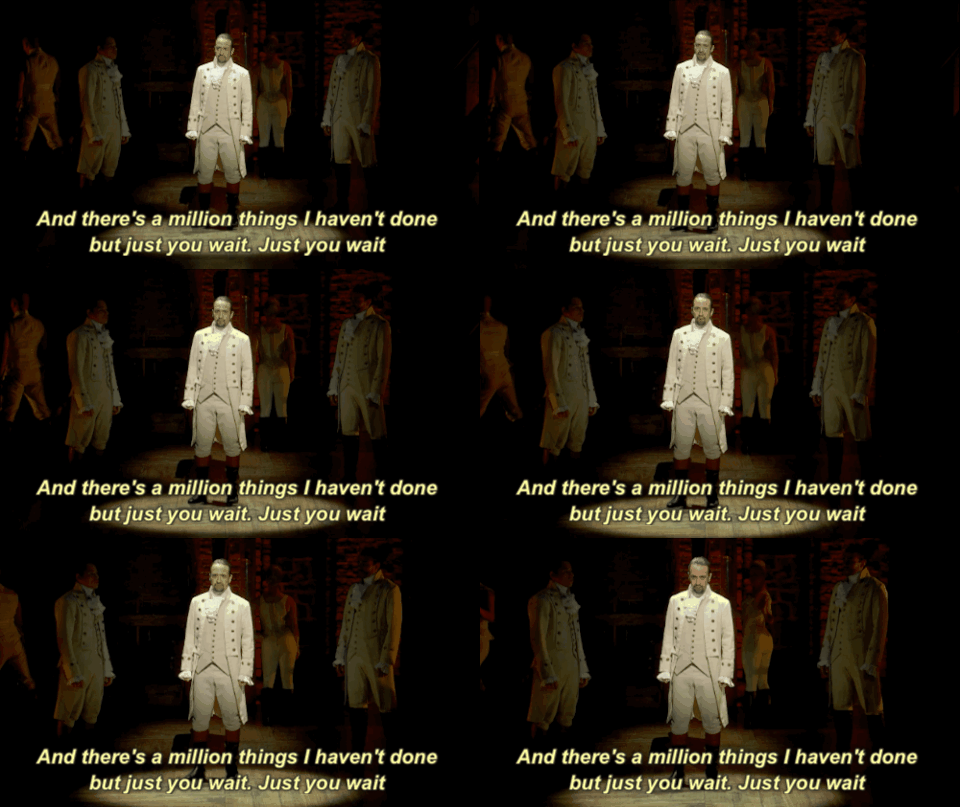
Will my story be worth telling someday? I certainly hope so. In the meantime, I’ll be over here “writing day and night like I need it to survive, not throwing away my shot” and eventually, winning a Pulitzer. Just you wait.

It’s time.

This time last year – April 5th, 2018 – I published a post that, among other things, reflected on the upheaval surrounding the RITA Award nominations.

You can find that post HERE.

The RITAs are the romance genre’s version of the Oscars. They’re sponsored by the Romance Writers of America (RWA), and if you write romance, getting a RITA nomination is a Very Big Deal. When the awards were announced last year, there was a huge uproar because the majority – the large majority – of the nominees were white.

In years past, authors of color have been nominated and a couple have won RITAs, but no black author has ever won a RITA award.

I finished last year’s post by encouraging everyone to read outside their comfort zone, to buy books by authors of color, and to listen to what authors of color have to say about how they’ve been treated and how they want to be treated.

And then a weird, but not entirely surprising, thing happened.

Nothing.

I mean, I wrote that post with the best of intentions, and in fact I followed my own recommendations, picking up books I might not otherwise have read. The ‘listening’ part didn’t happen, though. Not because I didn’t care, but because…I don’t know…the opportunity didn’t present itself?

Yeah, that’s kinda lame.

See, for the last year and a few months I’ve been treasurer of the Rainbow Romance Writer (RRW), the LGBTQIA chapter of the RWA. Last year when the RITA nominations caused such a stir, it was brought to the attention of the RRW board that authors of color view our chapter as unwelcoming. At the time, we put out a statement vowing to change.

Which makes my inaction that much worse, because I could have worked for an opportunity, and I didn’t.

Did I mention that when the RITA nominations were announced this year, they were just as white as in years past? The biggest difference has been the fall-out: authors of color spoke more forcefully, on twitter and on various RWA forums, calling out the Nice White Ladies whose subtle, unexamined racism perpetuates the system.

I am a Nice White Lady.

I care about the usual range of liberal causes, and I want to live in a world where racism isn’t a thing, where we can all let go of that particular piece of baggage.

It’s a nice idea, but we’re nowhere close to that yet.

In the days since the announcement of this year’s RITA nominations, I’ve kept pretty quiet, preferring to read the twitter threads and Facebook posts and show my support through re-tweets and likes. Which is fine, but it’s also a demonstration of the thing I can’t ever let go of.

My own privilege.

Here’s the thing. Once the social media dust settled last year, I was able to put aside these issues and focus on other things. The authors of color I know – even those I consider friends – don’t have that luxury.

This was brought home to me with particular eloquence in this essay on privilege by NBA player Kyle Korver. (HERE‘s the link to his essay.) More than anything else, this paragraph resonated with me, and prompted me to write this post:

What I’m realizing is, no matter how passionately I commit to being an ally, and no matter how unwavering my support is for NBA and WNBA players of color….. I’m still in this conversation from the privileged perspective of opting in to it. Which of course means that on the flip side, I could just as easily opt out of it. Every day, I’m given that choice — I’m granted that privilege — based on the color of my skin.

No matter how important I think the fight against racism is, I have the ability to put it aside in a way some of my friends don’t. Hell, I was able to take a whole year off, even after hearing that a group I help run is part of the problem.

It’s a sobering thought.

I’m left asking myself how I’m going to make things different this year. It’s easy to throw things down in a blog post and then let them slide because there’s no accountability. I will say I’m lucky, because the same authors who pointed out that our RRW chapter has issues are willing to work with us, to share their ideas so that we can create a more diverse chapter.

I’ll be working with the other RRW board members to move forward on that dialogue. (Can it be a dialogue when one side is mostly listening?) In addition, the RWA has put together a number of resources for encouraging diversity, and while I don’t want to make a bunch of empty promises, I’ll be exploring what’s there.

I may not be able to change the world, but I can work on myself. I can put more effort into recognizing all the ways the game is rigged in my favor,
in the hope of finding places I can level the playing field, so that next year’s RITA nominations are a celebration of diversity as well as excellence.

The Benefit of Critiques and Betas

When you first start writing, it is not uncommon to be the only person in your social sphere to be a writer. When you first start out, you often don’t have a writing community yet. Maybe you’ve joined Twitter and started following other writers and maybe you’ve even been brave enough to start joining in on some conversations, but you’re not quite ready to ask people to read your work. Starting out, especially alone, in this world is difficult and scary.

When I wrote my first book, I was the only person I knew writing a book. I wasn’t familiar with the writing community on Twitter–I didn’t even *have* a Twitter account when I started. I went to B&N and bought a copy of Writer’s Market and started following some of my favorite authors’ Facebook pages so I could jump in on Q&A’s and ask them how they got their starts.

But I had no one to read my manuscript–no beta readers or critique partners yet. I asked a couple of friends who liked to read to have a look at it and tell me their thoughts, but totally unsurprisingly they all said they “liked it!” And that was it. One friend was helpful enough to write out a list of typos, which, you know, was helpful but did nothing for the story.

Reader, trust me, that first draft was damn trash. No one should have liked it. And they probably didn’t actually like it, but being my friends and people who’ve never attempted to write a book themselves, they weren’t going to tell me anything was wrong with it.

It took eight drafts to fix that book and sheer luck that my BFF’s new husband’s cousin had a degree in literature and came into my new circle and was willing to try her hand at editing. Which, amazingly, led to her starting Joy Editing and has been my long-time editor ever since.

So, I know what it’s like to need help and not have it. I know what it’s like to try to figure out what is wrong with your masterpiece but not being able or ready to step back from it and look at it with a critical eye. Sure people saying they like your book or think it’s so cool you did that is nice, but you know, deep in you heart that’s not actually helpful.

You need someone else who knows what they’re doing to read your stories before you shop or publish them. You need someone else to say, “yes, I understood the story, it made sense, I followed along, the characters were fully formed, motivations made sense, etc. etc. etc.” Or, “I didn’t really understand the point of the book, the antagonist wasn’t believable as a bad guy, the dialogue felt unrealistic, you mentioned this thing but then never came back to it, that’s not how police procedures work, that one thing you did would actually kill a person but the character didn’t die, how did they just magic their way out of that dangerous situation, why did he fall in love with her she seems terrible, etc. etc. etc.” But we don’t always have the support system we need.

So, I started offering content editing and manuscript critique services. I’ve written my fair share of books and read my fair share of other writers’ WIPs that I have managed to hone my skills enough that I have become pretty good at this, IMHO.

Dropped plot threads, two dimensional characters, lack of motivation, flat dialogue, confusing plot lines, unbelievable magic, you name it and I will hunt it down for you.

And right now, I’m offering a ten percent discount on my services. If you’d like to find out why I’m offering that right now, feel free to bounce on over to my personal blog and have a read.

All you have to do to secure this deal is email me at shaunagranger82 @ gmail . com and mention this blog post. If you’re not ready to have your book read right this minute, you can still get the deal, just reserve your spot and pay a small deposit.

You dream of being a published writer but first, you need to make that manuscript shine…

How I’ve Been Refilling the Well

My forthcoming novel DIAMOND & DAWN (AMBER & DUSK book two) was not only the first sequel I ever wrote, but it was also the first book I wrote under contract–meaning the manuscript wasn’t written at the time my publisher decided to acquire the novel. I’d written five complete, full length novels at the time I signed the contract, so I wasn’t really worried about the fast turn-around and bracing revision schedule my editors requested.

I maybe should have been.

I wrote D&D from scratch to relatively polished in the space of 4 months, over the holidays no less (and I am NOT a fast drafter). I completed the first revision in three weeks, which included cutting over 20k words and restructuring the entire manuscript. The final revision had to be finished in one week, earlier this month. And that’s when I realized I’d been on deadline for the better part of 6 months!

Part of me wanted to jump right in with a new plot bunny I had simmering on the brain. Another part of me wanted to sit on the couch and do literally nothing for the foreseeable future. I confess, I opted for option number 2! For the past week or so, I’ve tried my best to refill the well, with good books, interesting TV, and a few high-profile movies. Here’s what I’ve been doing to refresh my creativity!

The Magicians, FX (available to stream on Netflix)

Okay, I am officially this show’s new #1 mega fan, and I can’t stop talking about it to anyone who’ll listen (and even those who won’t). I watched Season 1 when it came out a few years ago, but wasn’t blown away. I more or less forgot about it until I stumbled across Season 2 on Netflix, and then…I couldn’t stop watching. People, this show is weird AF, and I love it so much it’s hard to put into words. It’s like Harry Potter had an R-rated baby with Narnia, and then that baby got stuck in a time loop and maybe did some drugs. No, I’m not making any sense. Yes, you should watch it anyway.

Enchantée, by Gita Trelease

I heard of this novel sometime around the release of A&D, and automatically had an attitude towards it based on some superficial similarities to my own book. But I’m truly glad I wound up picking it up! Ms. Trelease has crafted a vibrant, romantic, brutal vision of peri-revolutionary France, complete with magic, love, idealism, glamor, and even hot-air balloonists! I devoured this book like candy, and would absolutely recommend it to fans of YA, history, and fantasy.

The Umbrella Academy, Netflix

Everyone on Twitter was talking about this show, so I decided to give it a whirl. I finished the season, but if I’m honest, it wasn’t my favorite thing in the world. I enjoyed the premise, some of the off-beat elements of the world, and a few of the characters (I’LL DIE FOR YOU KLAUS). But I anticipated nearly every twist in the plot, and had a hard time connecting with several of the character beats. I’d download the soundtrack, but I probably won’t watch Season 2.

Vanity Fair, Amazon Prime TV

I’m only a few episodes into this one, so I can’t speak to its entirety. Now, I love the 2004 Reese Witherspoon version of Vanity Fair as a guilty pleasure–it’s ridiculous and over the top, but the costumes are fantastic and Witherspoon is a delight as a truly wicked Becky Sharp. This adaptation takes a different tone. This Becky Sharp is still smart, ambitious, and cunning, but the creators of this show give us a much better sense of Becky’s milieu–the social stratification of her world that forces her to go to such lengths to take what she believes she deserves from people who loathes everything she represents. It paints her as, dare I say, a slightly sympathetic anti-heroine. I look forward to seeing how her character sharpens over the course of the series!

I think I’ve nearly reached the end of my self-enforced writing hiatus–today I had to fight the urge to open up a new document and start on that project (I stopped myself because I need to at least pretend to outline first). But I’m glad I took the time to refill the creative well–consuming new stories in every medium helps my brain look at my own work with fresh eyes!

What have you been watching, reading, or otherwise enjoying lately?

Rhythm in Writing

The other day, a friend asked me to beta-read her newest story. (Meaning the project was still a draft and she wanted me to make comments on what worked and what didn’t work.) I love her stuff and was happy to give her new one a read.

Here’s the comment I made on the very first line: You might want to cut <redacted> because it’s a cliche and it messes up the rhythm of the sentence.

Now, ranting about cliches certainly deserves it’s own post, but for today, I want to focus on the second half of that comment.

“….it messes up the rhythm of the sentence.”

Do you pay much attention to the way a sentence flows? I do. It’s one of my favorite parts of writing. I love fiddling with words, because sometimes a small change can take a mundane idea and make it pop.

Here’s an example from my story Change of Heart:

My family disproved the term poor as dirt. See, we was poor, but we had plenty of dirt. We just couldn’t get much to grow.

Now, there are a bunch of different ways I could have communicated the same ideas – the character’s family was poor and their farmland was worn out – but for me, the paragraph’s structure emphasizes the beats.

Is that vague enough for you? Let me see if I can break it down a little more. To my ear, the first sentence has four even beats: my FAMily disPROVED the term POOR as DIRT. The commas in the second sentence scramble that steady rhythm: SEE (pause) we was POOR (pause) but we had PLENTy of DIRT. And then the last sentence picks up the steadiness of the first sentence, but with three beats instead of four: we just COULDn’t GET much to GROW.

Now, when I wrote that paragraph, I didn’t set out with an agenda. I didn’t think “I want X beats here and Y beats there.” I just kept fiddling with the lines until they sounded interesting. I only analyzed the rhythm after the fact – like today, writing this post.

Here’s another example where the rhythm of the sentence really works for me. This is from Alexis Hall’s book, Glitterland.

And when he kisses me it feels a bit like fear and tastes a bit like tears, but it’s as bright and sweet as sherbet, and I decide to call it joy. 

The music in this sentence comes from the way he links the phrases together, mostly by repeating the word “and”. Alexis is a master of cadence. He’s one of the writers I turn to when I need some inspiration to break out of a slump.

Another example is from Sarah Perry’s fantastic The Essex Serpent

He felt his faith deeply, and above all out of doors, where the vaulted sky was his cathedral nave and the oaks its transept pillars: when faith failed, as it sometimes did, he saw the heavens declare the glory of God and heard the stones cry out.

“….and heard the stones cry out.” … sigh …

I’ve only recently discovered Sarah’s work – I read Melmoth last week and OMG spooky and wonderful – and she’s a lovely writer. Her words just flow.

Writing prose isn’t like writing lyrics to a pop song, where there’s a set number of beats to every line. But it is like writing lyrics to a pop song, because when the rhythm is right, your work will sing.

As long as I’ve got your attention, I’ve got a couple books on sale this week. AQUA FOLLIES (gay romance set in 1955 Seattle) is marked down to $0.99 (regular $4.99). Also, HAUNTED (Reluctant psychic meets skeptical historian. Shenanigans ensue) is on sale for $0.99 too!
Jump HERE for AQUA FOLLIES.
Jump HERE for HAUNTED.

Happy reading!!

Margie Lawson has a post over on the Writers on the Storm blog that talks about creating compelling cadence – same idea, different words. Margie’s an excellent teacher, so you should check out her post!

“It is Unknown:” The Joys and Frustrations of Biography Writing

Purchased from Adobe Stock.

As many of likely know by now, I’m up to my eyeballs in research for my first biography, which is on suffragist Virginia Minor and her husband, Francis. (This is actually the second biography I’ve started researching, but the other one is on the back burner at the moment for various reasons.)

I never thought I would write a biography. (Just like I never thought I’d write fiction, write non-fiction, or blog, but that is another story.) I didn’t think I was qualified. Hint: As long as you are willing to put in the work, there are no qualifications; while many professional biographers are historians or journalists, those are not the only paths. All you really need is the ability to write and a passion for research. Beyond that, there seems to be no one right way to go about it.

If I have learned nothing else it is this: you must have a passion for your subject in order to write a biography about her/him/them. In the course of research, you will get to know these people inside-out, and backwards, and possibly even diagonally. You will chase down letters, diaries, wills, land deeds, birth/marriage/death certificates, follow their address changes through city directories, and read more newspaper articles than you ever thought possible. You’ll contact libraries and historical societies across the country (or maybe even internationally) and beg for information. You will also do a lot of speculating on motivations when the evidence doesn’t make them clear. In short, they will become like family. If you don’t have a deep love for them, chances are good you will either burn out before the project is completed or produce a sub-par product.

The research can be frustrating, especially when your subject didn’t leave behind personal affects like diaries, journals, or personal letters. Other times the historical record doesn’t match up or you can’t verify an un-cited claim in one of your sources. That’s where the “it is unknown” in the title of this blog post comes from. You’ll find yourself writing that phrase, or some variant, more often than you’d like. And sometimes you just have to delete a line of thought or a theory because you can’t back it up with facts — which really sucks if it’s something no one or not many people have reported before. And the footnotes, don’t even get me started! (I talked about the issues surrounding them a bit in my last post on plagiarism.)

But the joys far outweigh the frustrations, at least for me. I love going down a new path of research (Can I figure out why the Minors moved to Mississippi for a year? Why didn’t Francis fight in the Civil War? Does the fact Virginia only had one child indicate fertility issues or maybe marital strife?) because you never know what you will find. It’s kind of like being a private investigator. When you find the answer, it is a great rush. And when you uncover something no other book has touched upon, the feeling is like winning a gold medal. You feel like you are actually contributing something to the world.

I also love coming across really random facts…so random that I’m not sure they will make it into the final book. For example, I found a newspaper article that talks about an incident where Francis and a judge (Francis was a lawyer) got into an argument over the correct pronunciation of a word. Francis, being from Virginia, pronounced it differently from the judge, who was a native St. Louisian, apparently to much hilarity. (Why this made the paper I have no idea. Slow news day?)

You will also hold history in your hands. I’ve touched Civil War record books, traced Virginia and Francis’ handwriting with my fingertips and gazed upon documents no one has likely looked at in decades, if not for more than a century. (I’ve also gotten a crash course on genealogy, but the verdict is still out on whether that one is a joy or a frustration.)

One of the great joys is the community that you build when researching. Archivists, librarians, and historians are some of the nicest, most helpful people I have ever met. If you explain you aren’t from the area, most will gladly send you a photocopy or a scan of what they have, sometimes for a nominal fee. (There is only one place that basically told me I have to come to them and find the information myself. *sigh* There is one in every crowd.) I think the willingness to share information can be attributed to your shared passion for your subject and a desire to see that person/people recognized by the wider world.

I know sometimes we (I speak here as a reader) can be tempted to dismiss biography as a dry, staid, and boring genre. But I’m really coming to admire the work and dedication it takes to reconstruct or chronicle a person’s life. And I marvel at the commitment of the people who make it their career. (I don’t expect to have more than two biographies in me. But then again, I didn’t think I would even have one…) I don’t plan to give up my fiction and other non-fiction writing, but I can attest to it being a rewarding field.

One last note: I did a quick study of soon-to-be-published biographies on Amazon not long ago when I was looking for comparable and competing titles for my biography. What I found is the vast majority of them are about men by men. We women really need to start telling our stories and immortalizing the women who have come before us!