Anatomy of a USA Today Bestseller or How I Made the List

Many people have asked me how I hit the USA Today Bestseller list with The Guinevere’s Tale Trilogy, so today I am going to share exactly what I did, including more detail and numbers than you could ever want. This is going to be a LONG post.

This method is not the only one by any means, but it is time-tested and many authors have used it with success. Of course, if you want try it, you’ll need to adjust it to your own needs and budget.

A Bit About the USA Today Bestseller List
Each of the bestseller lists is a little different, but USA Today counts sales from Monday to Sunday, so you would want your promotion to mirror this. As the name of the publication implies, only sales in the United States count toward their list. The number of sales you need varies, but the general advice is 5,000-9,000, though I hit the low end of the list with 4,191. The number depends on the time of the year because there are busy and slow periods in publishing just like in any other industry. But the good news is pre-sales count if you are trying to hit the list with a new book. The general rule is that you need at least 500 sales at Barnes & Noble and iBooks in order to make a list, so you can’t try if you are Amazon exclusive. There is debate about whether that 500 is combined or separate or if it is even accurate; some people say the real number is closer to 150 or 200. The point is you need a mix of sales–USA Today won’t count you if you are only on Amazon.

Quick Tips
For those who don’t want to read the whole post, here are some quick recommendations. But I do suggest reading the whole thing because not everything you need to know is covered here.

  • You really need a Bookbub Featured Deal in the U.S. to make this work.
  • Ad stacking is key to gaining and maintaining momentum.
  • Have a budget before you start so you don’t go crazy with your spend.
  • Put thought and strategy behind your advertising, graphics and text.
  • Lower your price at least 3-4 days in advance at all retailers. I did this and still had problems with NookPress and Google Play not lowering correctly.
  • When you put your retailer links into the forms for your ads, save which ones you used. One or two nights before your sale, check all them to make sure they are reflecting the sale price – especially if you use distributors. I had a rouge Barnes & Noble link that was removed from a major newsletter because the price didn’t drop with that link, even though it did with all the others I checked. By the time they told me there was a problem, the newsletter had already gone out and they refused to send the correct link. I will always wonder how many sales I missed out on because of that stupid link.
  • Ask for help! People are so willing to share and do what they can to help you succeed!
  • Tell people you are aiming for a list. That’s not something people get to help others do everyday and I really believe letting people know makes them more likely to share than if you just say your book in on sale.
  • Don’t be shy or get worried you will annoy people. You may, but they will also understand why you are posting so much. And if they don’t, you don’t need to be friends with them anyway.

My Sales By the Numbers
I’m listing these early in the post so you can see what I achieved with the method outlined below.

Total sales: 4,191
Estimated Total Income= $2,136.30
Estimated Expenses = $1,672 (newsletter ads) + $761.40 (social media ads) + $9 (graphics) – $2,442,40
Estimated Total Loss = $306.10

It doesn’t bother me that I lost a little money on this. Profit was not my endgame. My goal was to hit the list and I did. You may feel differently and that is totally fine.

By retailer breakdown:

Amazon = 3,574 ebooks (and five print books, but those don’t count toward the list)
Barnes & Noble = 298

  • Nook Press = 6 (I had issues with them not changing prices, so that is why it is low)
  • Distributed through Smashwords: 283
  • Distributed through Draft 2 Digital = 9 (I don’t use them like I should)

Apple

  • Distributed through Smashwords. (I have yet to go direct with them, but I should) = 224

Kobo

  • Distributed through Smashwords = 91

Smashwords = 5

Smashwords sales

(Google Play was not included because they never lowered my price.)

My Category Rankings
Barnes and Noble

  • #1 in fantasy
    • Held for 2.5 days
    • In top 15 for 4 days
    • Bestseller status for 5 days
  • #11 in ALL Nook ebooks
    • In Top 100 for 3 days

Amazon

  • #1 in three subcategories on Amazon
    • Held for 2.5 days
  • #4 in Fantasy on Amazon
    • Held for 2 days
  • #5 in Sci-fi and Fantasy on Amazon
    • Held for 2 days
  • #40 in ALL Kindle ebooks
    • In Top 100 for 2.5 days

Apple

  • #8 in Sci-fi and Fantasy on iBooks (I only thought to look at this on Sunday, so I’m not sure if it was any higher. It likely was at least on Thursday.)

Smashwords

  • Made their Hot List two weeks in a row.
    • Week 1
      • #1 selling book
      • #1 selling boxed set
      • #1 selling fantasy boxed set
      • #1 in fantasy
      • #1 in fairy tales
    • Week 2 (this is with it back at full price)
      • #4 selling boxed set
      • #1 selling fantasy boxed set
      • 1 in fairy tales

Outsold both George R. R. Martin (2 books) and Nora Roberts at certain points. I know most of their fans likely already have these books so it isn’t like I outsold a new release, but still, these authors are HUGE!

BookBub is Key
You can try the other elements described below without a BookBub Featured Deal in the US, but unless you already have a huge audience, I wouldn’t recommend it. BookBub is expensive, but very powerful. They say most authors average about 3,000-4,000 in sales from one of these deals, but that depends on the category you are in. (I was in fantasy, where they say the average is 2,100. My numbers were just above that at about 2,500.) In my experience, if you want a US deal (which is where the vast majority of subscribers are) DON’T click both US and International, even though they say it increases your chances. Every time I’ve clicked both, I’ve gotten international only. While that is good for increasing sales and establishing greater foreign readership, a US deal is what gives you the chance to make a list. This was the first time I indicated I only wanted a US deal, and the first time I got one.

When you are submitting for a deal, unless you are published by a major house, the general advice is to focus on your ebook only. This is partly because of the costs involved in printing paperbacks, which limit how far indie authors can reduce our prices before we lose money on a sale. It is also because many of the lists count paperback and ebook sales separately, so focusing on both won’t actually increase your chances. Plus, most readers of these newsletters are buying ebooks anyway. (I did find that I saw a slight increase in paperback sales during the campaign even though that book wasn’t on sale, so you may see the same benefit.)

When thinking about your potential deal, there are two big decisions you have to make: which book and what price? As for which book, it is easier to make the list with a boxed set (either of your own books like I did with the Guinevere’s Tale Trilogy or with a set from various authors who have established fan bases) than it is with a single book. This is because readers feel like they are getting greater value when they get more than one book at a sale price. (Hey, I can’t blame them.) It is definitely possible to do it with a single book, but you will have to work that much harder at advertising and rely more on your fan base to promote.

Another fairly big decision is which genre to advertise in. Bookbub only has so many choices so you have to decide which best fits your book and its potential readers. If your genre is straightforward like contemporary romance, it will be an easy decision because they have that as a category–and it is a very popular one. However, The Guinevere’s Tale Trilogy is historical fantasy and they don’t have a category for that, so I had to choose between historical romance (which it is not), historical fiction, and fantasy. I’ve learned from previous experience that my Guinevere books sell better when I market them as fantasy, so that is the category I went with, even though historical fiction has a bigger BookBub subscriber number. (A lot of this has to do with anticipating reader expectations. I think straight historical fiction readers could be turned off by my Guinevere books because she is a mythological, rather than historical figure and the book has mystical elements to it.)

Marketing expert Amy Collins told me once that the bigger the price drop you can demonstrate for BookBub, the more likely you are to get a featured deal. How far you choose to drop it depends on your goals for your campaign. If you are looking to make money (or at least break even), you may not wish to go all the way down to $0.99 like I did. (My normal price is $9.99.) However, if you don’t care about a profit and are just looking to try to make a list, as I was, drop the price down as much as you are comfortable. I personally wouldn’t advise free because 1) you won’t make any of your money back and 2) many of the lists don’t count books offered for free.

Rumor has it Tuesday and Wednesday are the best days for BookBub deals because you can then ride the “tail” from the ad for the rest of the week. Mine was on a Thursday, and I did just fine. My sales dropped off pretty quickly Saturday and Sunday, so for me, the tail wasn’t as long as some had led me to believe. If you don’t like the day/date that Bookbub gives you, just email them (quickly – I think their rules say it has to be a certain amount of time before your deal) and they will change it. Mine was originally on a Saturday and I asked them to change it because I was traveling and also asked for a different day based on when other major advertisers had open slots.

You Got a Featured Deal, Now What?

Ad Stacking for Newsletter Lists
The first thing you should do when you find out that you got a BookBub Featured Deal (besides celebrate) is start planning the other ads you are going to run in the week of your promotion. These are usually mostly ads targeted at newsletters/mailing lists of readers. Some of the really popular ones (especially Robin Reads and Fussy Librarian) fill up a month in advance, so keep that in mind when confirming your BookBub date. Also keep in mind that some of these sites are VERY expensive. Don’t feel bad if you can’t afford them. I went into debt for this and I don’t advise anyone else to do so. Below are ones I used, along with the price, which of course, they can change at any time. Some of them are flat-rate pricing and some let you choose what package you want. Here’s a great database to use to evaluate potential ad companies.

Location Date Cost
BookBub Thurs 7/11 $516
Just Kindle Books Wed 7/10 $53
Fussy Librarian Tuesday 7/9 $20
Book Gorilla unknown free, part of a package with another company
BargainBooksy Wed 7/10 $40
ManyBooks Wed 7/10 $78
Robinreads Mon 7/8 $85
ENT Tues 7/9 $35
Choosey Bookworm Mon 7/8 $36
Kindle Nation Daily week $119
BooksButterfly 6/8-6/12 $190
BookRebel Mon 7/8 $25
Riffle Select Wed 7/10 $75
Early Bird Books Mon 7/8 $300
The Portalist Wed 7/10 $100
Total 1,672

There are a few that I would have liked to have used, but couldn’t and why:

Book Barbarian full
Book Cave not accepted
Free Kindle Books Didn’t have enough reviews
BookDealio date conflict
Booksends not enough reviews
Ebooksida not enough reviews
Writerspace not appropriate for a short period promo; better for new release

The best advice I can give is to cluster ads from these types of companies around your Bookbub ad, preferably BEFORE the day of your Featured Deal. Don’t run other ads on the day of your Bookbub Featured deal; just let it do its job on its own. It is better to get some heavy hitters in before your Bookbub deal so that they jump-start your sales and trip Amazon’s algorithms into paying attention. That way your book is primed for the big BookBub day.

Based on my sales, the promotions that seem to have done the best are the ones I scheduled on Monday (Robinreads, Bookrebel, Early Bird Books), as I had 625 sales that day, as opposed to 227 on Tuesday and 220 on Wednesday. I’m only using Amazon as my example because they have the easiest report by day but my sales at other locations showed a similar pattern.

It is still important to continue to advertise after your Book Bub deal. You can do this through ads from the places above and/or through your own ads. I had scheduled all of my ads with other companies earlier in the week, so I relied upon Facebook/Instagram, Amazon, and Bookbub ads that I created during the last four days of my campaign (Friday-Sunday). My sales reflected that as they trended steadily downward. I will go into more detail on the ads I created myself below.

Theme
When you’re planning your campaign, you need to think like a marketer. This means:

  • Being consistent in your messaging through all of your graphics and other communications.
  • Keeping your color scheme and fonts consistent as well.
  • Having a theme to tie together your copy and images.
  • Using images that are professional (I recommend stock photography from iStock, Adobe Stock or some other paid site) and that are consistent.
  • Using comparison titles to help readers understand what type of book you’re promoting.

You can choose to base your theme around anything–perhaps an upcoming holiday, season, news event, TV show or movie that your books are similar to–as long as it gives your audience something to identify with and as well as a clear, honest picture of what to expect from your book.

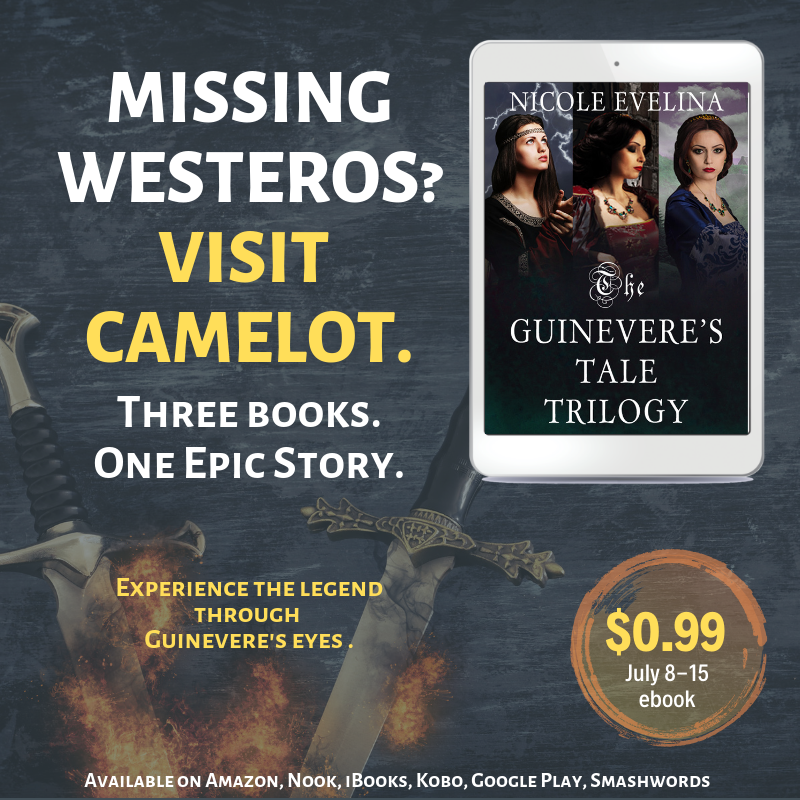
I chose to target the “showhole” left behind by the end of Game of Thrones because my Guinevere books have a lot of similar attributes (political conniving and maneuvering, murder for the sake of gain (though not as many deaths as GRRM’s books], a quasi-medieval setting [though mine is more early medieval], and a bit of magic). I also played off the idea that in the show at least the women did not fare well, but they do in my books. This also ties nicely into the resurgence feminism is having at the moment. I also wanted to touch on the idea that fans have waited a long time for The Winds of Winter and still have a long wait, so they can use that time to read my book.

Once I saw how the various messages performed (more on that below) and I had some solid success to back up revising my ads (this was on Friday after the big Bookbub push), I decided to keep the basic graphics and message the same, but change them a little to play on the books’ new bestseller status and create a sense of FOMO (fear of missing out), since the campaign was coming to an end.

Graphics
Once I had those basic ideas in mind, I decided to create eight graphics that I would both use as the basis for my Facebook/Instagram and Bookbub ads and share on social media. The reason two were similar is I wanted to see which type of background connected better with people, simple or complex.

Out of those, four played heavily on the Game of Thrones theme:

But I knew not all my readers were fans of the show, so I didn’t want to put all my eggs in one basket. I also created an ad that appealed more to readers of historical fantasy, one for readers of epic fantasy, one that emphasized the award the book recently won, and one to those who are attracted to the romance in my books.

I use Canva to create my graphics. I’ve tried Bookbrush, but I can’t get it to work correctly for me. (Some people swear by it, so use whatever you are comfortable with). All of my images either come from Canva or Adobe Stock. (It is very important to use legally purchased images. Yes, it costs money, but it’s better than getting yourself sued for something you stole off of Google.) I have a running account with them that costs $29.99/month, so I have hundreds of credits to use anytime I need them. I don’t have any special graphic design training; I think I just picked things up over my 15 years in PR and marketing.

Once the Bookbub deal happened and I had several things to crow about, I edited my graphics. You’ll notice the bestseller seals (which I created myself, based off of things I had seen others do). They aren’t on every image and I don’t always include all three because sometimes that made the design too busy. I let the ad dictate what I did and did not include. Also note the change in language. It is simpler and uses terms like “Buy now!” Don’t Miss Out!” and “Hurry!” to create a sense of urgency and FOMO. These graphics also emphasize the end date more which is both a helpful reminder for people and another way to emphasize this is a limited time offer.


Prep Work

There are a few things it would be wise for you to do before your promotion week.

  • Make sure your book page is properly formatted on all sites. You’d be surprised how messed up they can get, especially on Amazon (their editor follows no known HTML logic) and Barnes and Noble (which I never did get fixed, despite multiple attempts).
  • Check Amazon your categories. Amazon is always adding new categories, so if you haven’t checked yours lately, you might want to shift them around. It is easier to hit #1 in a smaller, more niche sub-category. But I actually took my book out of the Arthurian niche sub-category and put it into the bigger historical fantasy category because I wanted to see how it did. My two categories are Fiction > Fantasy > Epic and Fiction > Fantasy > Historical.
  • Check your Amazon keywords. These are how Amazon will throw you into a third category, so make sure your keywords really reflect what you book is about. This is how I got into the Sword and Sorcery subcategory
  • Get any typos fixed that you or readers have identified and be sure to upload the new files in plenty of time before your sale.

I also did a few other things that are totally optional:

  • I asked on Facebook if any of my author friends had a newsletter timed to the sale and was willing to mention it. From that, I got nine people who said they were willing to share anything I posted on Facebook, a suggestion for someone to contact who might help, a newsletter swap with author Nancy Bilyeau and an interview and newsletter mention from marketing expert Amy Collins. This is something I would totally do again. The worst people can do is ignore you or say no.
  • I was heading to the Historical Novel Society Conference just a few weeks before the sale and I knew they would have a swag table so I had 25 small cards printed advertising the sale. I didn’t count how many were left after the conference (a lot) but I needed something to do with them. So I handed them out to people I knew at my day job. I have no way of knowing how many people actually bought the book from the card, but as several of my co-workers said, “Hey, if we can ask you to buy cookies and pizza for our kids, you can certainly ask us to buy a $0.99 book.” I would advise checking on your company’s solicitation policy if you’re going to do this, just to be safe. It was fun, but it’s not something I think I would do again.
  • They say the higher the number of reviews your book has on Amazon, the more likely readers are to buy your book, so you may want to try increasing your number before your promotional week. I emailed my newsletter subscribers asking for review in exchange for free book (not sure if that is totally okay or not, but I did it). It only netted me two reviews out of 2,000+ newsletter subscribers. I won’t take that exact tack again, but if I had more advanced notice I might have done Choosy Bookworm’s Read and Review program, which I’ve used before and had success with.

Newsletters/Blogs
Another important step is to email your newsletter subscribers and if you have a blog, write a blog post letting people know about the sale, your desire to hit the list (don’t be shy about this!) and how they can help you. The messages can be pretty much the same. I would advise making your story as personal as possible. After all, if you’re going to ask people to help make a dream come true, it’s only fair that they understand why this is your dream. 

Because I changed newsletter providers, I don’t have access to the email I sent to my newsletter subscribers, but here’s the post that I did on my blog. It’s a little longer than I would recommend, but the important things are:

  1. Include your buy links up front so people don’t have to look for them
  2. Bold the key messages for those who will skim
  3. Provide more detail toward the bottom for those who want it
  4. Say thank you. After all, you can’t make a list on your own; you are reliant on people buying the books and spreading the word. 

You may also want to send a reminder close to the end of the sale period and/or provide updates along the way. This is especially good if you are doing interviews or writing articles to try to attract attention to the campaign. It gives you (and your fans) more things to share online, too.

Here are mine:

These not only may spur some people to action, but it will also serve to keep the energy up around the campaign. And be sure to do a wrap up post after, especially if you make the list!

Also, if you are part of any group blogs, make sure you post to those as well! They will reach different audiences.

Street Team
If you have a Street Team – a group of dedicated superfans who have promised to help promote your books – even a small one (mine is only 29 people, but I know authors who have around 1,000 in theirs), make sure you let them know about the sale and provide them with resources to help tell people about it. I created a page on my website with ready-made graphics for Facebook and Instagram, as well as tweets that could be copy/pasted: https://nicoleevelina.com/spread-the-word-the-guineveres-tale-trilogy-0-99-sale/. I included this link in all my communications with them via email and in our secret Facebook group. The idea is to make sharing your information as easy as possible for them. (When I updated my graphics, I created another page: https://nicoleevelina.com/new-sale-graphics-guineveres-tale-trilogy/ and let everyone know about the updated information.)

I also invited my team members to share suggestions in the Facebook group for how to keep up interest over the weekend. Then I added some of my own, a few of which were good, a few of which were really dumb. I included everything because you never know what might spark an idea.

If you have a large Street Team, you may want to run a contest with prizes for the person who gets the most shares/likes/etc. or something else to reward the people who put in the most effort. This is something I wish I would have thought to do.

If you don’t have a Street Team, start one now. You can begin by setting up a simple sign up form on your website and then ask your fans on social media, your blog and your newsletter if they’d like to join. Then put a link on your website as well. It will grow over time.

Social Media
I am active on Facebook, Twitter, Instagram and Pinterest, so that’s where I posted these graphics. I did daily posts (with a different graphic each day) on Instagram and Facebook (both profile and page…yes, I know technically you aren’t supposed to do that kind of thing on your profile). If you are aiming to hit a list, TELL PEOPLE. As one of my writer friends said, “You should never be modest about your accomplishments [or in this case, goals] as an author.” I think most people really want to see you succeed and if they know you have a goal like that in mind, they will be more willing to help than if you just say, “Hey my book is on sale.” Sales happen all the time; it’s not every day you can help someone hit a bestseller list.

Instagram

  • I did daily posts with a different graphic each day.
  • I used a core group of about a dozen hashtags and then added others that were more specific to the given graphic. For example for the one with the guy on the side that talks about Lancelot, Arthur and Aggrivane, I used the ones below. You’ll see the specialized tags about romance at the end.


  • The graphic that did the best was the Winds of Winter ad. Instagram has hidden the number of likes for me, but I was mentally keeping track and it got over 1,000. I have never had anything like that happen before and I can’t explain why it was this one that hit. I used the same hashtags. This was even still the case when I updated my ads with the award seals.
  • When I started to get great numbers and making bestseller lists at Amazon and Barnes and Noble, I took screenshots and posted those as well. That was mainly just me being excited but also a little to show others how well the book was doing in the hopes they’d want to jump on the bandwagon and but the book, too.

Facebook

  • I did daily posts with a different graphic each day on both my profile and my page. (Yes, I know you aren’t supposed to advertise anything on your profile, but with the low percentage of people who see anything you post to your page, I do it anyway.)
  • I pinned my favorite post to the top of my profile on Monday. That way it would be the first thing people saw all week.
  • When I started to get great numbers and making bestseller lists at Amazon and Barnes and Noble, I took screenshots and posted those as well.
  • I asked everyone on FB over and over to please share my posts that had the graphics and buy links. I estimate that atleast 30 people shared over the course of the week.
  • I drove everyone I know crazy with the above, I’m sure.
  • I also posted to about three or four different Facebook groups a day, totaling about 15 groups. There were several others that I never got around to posting in.
    • Here’s my whole list. Some will apply to you, some won’t. But you can find ones in your genre.
    • Be sure to read a group’s rules (usually the post pinned to the top in the main area or over on the right-hand column) to see if they allow promotions. Some do, some don’t, and some only allow it on certain days or in certain ways (i.e. you have to comment on a post the admins start; you can’t start your own.)
    • Don’t do too many right in a row or even in the same day because Facebook might accuse you of spamming and lock you out for a period of time, not something you want during a promotion.
    • It’s a good idea to participate in the groups first so you don’t just look like a spammer.

Twitter

  • I did daily posts with a different graphic each day. I pinned that tweet to the top of my profile.
  • When I started to get great numbers and making bestseller lists at Amazon and Barnes and Noble, I took screenshots and posted those as well.
  • When I was getting close to number 1 in Canada, I started doing specific tweets aimed at Canadian readers. This was my only Canadian promotion; I hadn’t done any ads (mine were specific to the U.S.). The rest was word of mouth.
    • At the same time I also asked my friend, Canadian author Susanna Kearsley, if she would mind sharing my promotion to to her fans. She did. 🙂
      • I was very careful in who I asked and how. This is not something you want to take advantage of. If you are going to ask other authors to share your promotion, it is best to stick to the ones you know well, and ask politely. Some may say no or not respond and that is okay.

Pinterest

  • It didn’t occur to me to add my promo graphics to one of my boards (I have one called “Book Shelf (My Books)” for this very purpose) until Friday.
  • The reason to do this is to get the graphics onto the boards of your followers for free. I have 18,900 monthly viewers, so that is a lot of people. I wish I would have done it on Monday instead so they would have had longer to see them.
  • Two of the graphics were in my top 10 pins for that week, netting a total of 1,018 impressions for free.
  • I also promoted a pin, which I will talk about below. It is not included in the numbers of the bullet above.

Advertising (non-newsletter lists)

Facebook/Instagram

Total spend: $353.78

  • I ran a total of five ads using Boosted Posts over the course of a week. In total they reached 13,872 people, 5,062 who engaged (liked, shared, etc.) with the post and 24 of whom clicked a link.
  • My most popular post in terms of both reach and engagement was The Winds of Winter ad (which isn’t surprising since FB and Instagram are now linked). I just wish I understood what made that one so popular.
    • Interestingly, I didn’t even post that one until Friday.
  • The two that posted on Monday and that ran the entire campaign had very different results. The one I thought would do better only had 1,430 reach and 646 engagement, but the other one that was female-focused blew it away with 5,206 reach and 846 engagement. Go figure.
  • I had one ad (the bottom one in the image below) that wasn’t doing well at all, so I killed it right away.

Pinterest

Total spend: $16.28

Strategy

  • This ad was a last-minute decision that I made on Friday night on a lark.
  • I decided to promote one of my pins (the romance one with the guy) instead of creating an ad. It is a new option and frankly, way easier. I chose that pin because I felt like it appealed to the widest variety of people and aligned well with Pinterest’s mostly female audience.
  • I only had two days left in the campaign at that point (less once Pinterest approved my pin), so I didn’t throw a lot of money at it – only $20, of which I actually spent $16.28

Results

  • The results were 10,328 impressions, 1,400 close up views, four saves and 132 clicks on the buy link, for a click through rate of 1.28%.
  • Verdict: I would totally do this again, but keep my spend low.

Bookbub

Total spend = $383.37

Strategy

  • I broke my ads up into ones that would run in the early week before the BookBub Featured Deal and ones that would run in the end part of the week.
    • They say the average click-through rate for a BookBub ad is about 0.5%. even though we should all be aiming for at least 3-5%.
    • There are a lot of complexities about how you set up your ads and how that affects your rate. I’m not an expert, so I just tried different things to see what worked.
    • These ads appear at the bottom of the emails, so opening the email counts as an impression but doesn’t guarantee that the ad is seen or clicked on.
  • I targeted my ads both by category (fantasy and historical fiction) and author because just doing category alone made my audience too broad. Authors I targeted included Deborah Harkness, Patrick Rothfuss, Terry Brooks, Philippa Gregory, Diana Gabaldon, George R. R. Martin, and Susanna Kearsley.

Results

  • The Bookbub ad that did the best for me.

    I ran a few different ads with a few different goals:

    • In the early part of the week (Mon-Wed) I ran five ads.
      • Three were different graphics, just to see which performed better.
        • Missing Westeros? Visit Camelot: 6,597 impressions, 17 clicks, click through rate of 0.26%
        • Historical Fantasy at its Finest: 6,682 impressions, 26 clicks, click through rate of 0.39%
        • A Woman Rules Camelot: 7,302 impressions, 18 clicks, click through rate of 0.25%
      • I also ran ads that just targeted certain retailers, i.e. Apple or B&N, to try to drive up sales there. That didn’t work at all. My click through rate for those were 0.03% for Apple and 0.08% for B&N, which is abysmally low. I won’t be doing this again.
    • In the later part of the week (Fri-Sun) I ran three ads, two which I designed myself and one of which I used the Bookbub ad generator for.
      • Historical Fantasy at its Finest: 2,259 impressions, 3 clicks, click through rate of 0.13%
      • Missing Westeros? Visit Camelot: 2,046 impressions, 0 clicks, click through rate of 0%
      • Bookbub generated ad: 12,364 impressions, 37 clicks, click through rate of 0%
  • Things I learned:
    • Simple ads with little text and the book cover work the best.
    • You may as well just use Bookbub’s ad generator instead of spending the time to design your own.
    • The more money you throw at an ad, the more impressions you will get (my budget for the BookBub generated ad was twice that of the others) but that doesn’t necessarily mean much higher click-through (that one had only 0.30% vs one of the ones I created with 0.39%)
    • I need to take some classes on how to create ads that work.
  • Will I do Bookbub ads again? I’m honestly not sure. I am reading that some people thinking they have gone the way of Amazon ads: too popular and too expensive to really make a difference anymore. If I do them again, I won’t budget as much money, that is for sure.

Amazon Advertising

Spend: $2.75 (lockscreen) + $5.22 (product ad) = $7.97

Strategy

  • I originally had two ads going, a lockscreen ad (shows on the locked screen of a Kindle) and a sponsored product ad (shows in the product listing on Amazon when people search for certain terms or authors that you define).
  • Amazon doesn’t give you a lot of options for customizing your ad. Your image will be your book cover and you have only 150 characters for your ad copy.
  • My ad copy was: “Missing Westeros? Visit Camelot. Priestess. Queen. Warrior. Guinevere was much more than a sinner. Experience life through her eyes in a 3-book set.”
  • My copy focused on Game of Thrones, but I also told my audience a little about who the book was about (a Guinevere, who is not your average portrayal. She is a priestess, a queen and a warrior who was more active than the traditional sinner) and what they should expect (there is an implication in the roles I mentioned that they will get magic, political mechanations, and action, plus you know that you will be reading her experience as it happens).
  • I chose manual product targeting by category. My categories were 1) /Books/Science Fiction & Fantasy/Fantasy/Epic Fantasy 2)/Books/Science Fiction & Fantasy/Fantasy/Sword & Sorcery Fantasy and 3) /Books/Science Fiction & Fantasy/Fantasy/Historical Fantasy. I picked these because they are my categories for the book within Amazon as well as the categories I thought my readers would read. Interestingly, these are the three categories I hit #1 in!
  • I also targeted a few products, mostly GRRM books, The Mists of Avalon, and the categories of Arthurian Fantasy, Historical Fantasy, Romantic Fantasy, Epic Fantasy, Sword and Sorcery Fantasy, Fantasy Anthologies, Mythology and Folk Tales, and Myths & Legend Fantasy.

Results

  • I stopped the lockscreen ad after only a day and only spending $2.75 (with 0 sales) because Amazon just wasn’t pushing it out. I won’t do lockscreen ads again, as I’ve noticed from personal experience that they are HEAVILY weighted toward Kindle Unlimited books. (Plus a lot of people have them turned off in their settings.)
  • Interestingly, my sponsored product ad wasn’t pushed out much either. I only spent $5.22 for 16,846 impressions, but made $44.15 in sales from it. I had an average click-through rate of 11.82% which is really good.
  • Verdict: I might do a sponsored product ad in the future, but I am finding Amazon Ads to be less and less effective.

Things I Would Do Differently
No matter how good any marketing campaign is, there are always lessons learned and things you would do differently next these are mine:

  • I didn’t find out about merchandising with major retailers (Barnes & Noble, Apple and Draft2Digital) until my campaign was almost over. Apparently if you tell them you have a sale (and mention BookBub if you have on because they understand how important that is) they may help promote your book. I emailed all of them and only heard back from Barnes & Noble. It was too late for this campaign, but now I have the links to their forms for the future. 
  • May not use quite as many newsletter ad services in the future. I don’t know. I’m on the fence about that.
  • Add my graphics to Pinterest on the first day of the campaign rather than when it was almost over.
  • Contact a few people I know (Chuck Wendig, Joanna Penn)  who might have helped promote the book. 
  • Possibly engage a VA like Kate Tilton on the campaign.
  • Look at Apple stats earlier. That just totally slipped my mind.
  • Run a contest with prizes for the person who gets the most shares/likes/etc. or something else to reward the people who put in the most effort.

I’m sure there are other things I could have done differently or better, but that is what is coming to mind. If can think of anything else, please let me know!

Questions?
If you’ve made it this far into the post, congratulations! If you can think of anything I haven’t covered or that you want more detail on, please comment and I will totally share!

Building Characters, One Verb at a Time

Sometimes it’s hard to see the forest for the trees…

Last October I heard Damon Suede speak at the Emerald City Writers Conference. He’s a terrific speaker who wraps a lifetime of knowledge and experience in an entertaining – like, LOL funny – presentation.

Damon could explain this a lot better than I will, but the basic premise to his master class was this: a reader gets to know a character by the character’s actions. Period. And those actions make it on the page in the form of verbs. So, rather than spend hours developing a detailed character biography, pick a handful of verbs and a few adjectives and make that the template your character grows from.

(If you’re curious, you can read about his approach in Verbalize: Bring stories to life and life to stories.)

And you know what? It works!

I recently wrote a holiday novella, the first piece I’d started from scratch since hearing Damon’s presentation. Over the years I’ve done my share of character biography worksheets – the more detailed, the better – but this time I came up with names, chose half a dozen verbs and the same number of adjectives, and wrote simple goal-motivation-conflict statements for each of the two main characters.

Here’s the beginning of my character worksheets for Bo and Jon, the heroes in my holiday novella:

Bo Barone – the crafty one: Adjectives & verbs: bright, shiny, quick, glittering, smiling, laughing, glowing, self-assured, patient, detail-oriented, crafting, inspiring, protecting, intimacy issues, performing, caring

Background: big family, Italian, local Seattle, Midnight Mass at St. James

Jon Cunningham – the artist: Adjectives and Verbs: dark, deep, methodical, dedicated, passionate, reserved, commanding, distancing, consider, create, observe, listen, measure, perform, practice, reflect, teach

Background: Seattle family, missed out on much of high school, studied at Juilliard, Dad had a stroke

Can’t you just picture them? Instead of pages of detail, I had a few lines, yet I felt it took me less time to get a handle on Bo & Jon than just about any of my other characters. I’ll admit things morphed a little during the writing process, particularly in terms of their goals/ motivations/ conflicts, but the characters’ essence, who they were, was pretty solid.

That essence was captured in the verbs and adjectives I chose for them.

Happy Hydrangeas!

Whenever I wasn’t quite sure how a character would respond or what they’d do next, I had my list of verbs and adjectives to guide me. Even though both my heroes changed over the course of the novella – because that’s what the plot is for – still, their core remained constant.

You’ll have a chance to see how well I did, because Dreamspinner offered me a contract for the novella, so A Holiday Homecoming will be released ~ 12/1/19. If you have the change to hear Damon speak, do it. You’ll learn a lot. And the next time you’re stuck with on a character, focus on their verbs and see if it helps.

Hybrid Tea Rose Tequila Sunrise. Cheers, mate!

Best Reboots

Reboots. Returns. Revivals.

I’ll be honest–these days it sometimes seems like I can’t turn my head without seeing an advertisement for a new reboot or revival of an old franchise. Often, these reboots are of something that played an important role in my childhood or adolescence, and seem cringingly designed to play on my sense of nostalgia. From live-action remakes of Disney movies to newly diverse CW reboots of 90’s television, it can seem like the only new movies and TV shows getting made these days…are old movies and TV shows.

As a writer, this sometimes strikes me as short-sighted. After all, there are so many amazingly talented authors, screenwriters, and playwrights out there writing original, creative, and often groundbreaking content that would be perfect for the big or little screen. But at the same time…sometimes these reboots really nail bringing an old storyline to a new audience. So with no further ado, here are my favorite reboots/revivals/returns from the last few years.

A Star Is Born

I know, I know, me and everyone else in the Academy. For me, though, this was really a high bar as far as comparison goes. I’m a big old movie buff, which means I’ve seen (and enjoyed, in different ways) both the 1937 and 1954 versions by the same name, starring Janet Gaynor and Judy Garland, respectively. (I have not seen the 1976 version with Barbra Streisand). I thought Bradley Cooper and Lady Gaga’s rock-opera reimagining of the familiar story was poignant, inventive, and incredibly well acted.

Queer Eye

Full disclosure, I’ve never actually watched an episode of the original early-naughts version of Queer Eye for the Straight Guy. However, even without a comparison, I think 2018’s reboot of the franchise is nearly impossible to argue against. The newly minted Fab Five are just about everything this world needs: a group of queer, diverse, empathetic, thoughtful, kind, and playful men who bring joy, change, and self-worth to people’s lives. If anyone who works in TV is reading this…more of this, please!

Mad Max: Fury Road

Mel Gibson, Shmel Gibson. I’d rather partake in this heart-pounding, feminist reimagining of a parched post-apocalyptic world, headed up by a prosthetic-wearing, shaved-head sporting, monster-truck driving Imperator Furiosa (played with aplomb by Charlize Theron). Bonus points: every still this movie looks like it could be a poster.

Roswell, New Mexico

Oh, I had my doubts, not least of all because the original show wasn’t very good (sorry!). But with the 2019 reboot, Liz is a scientist, the daughter of undocumented immigrants, and Max is–well, Max is very attractive. All joking aside, while the reboot is not without flaws, it does a much more thorough job of placing an alien invasion storyline amid the real-world xenophobia of modern America.

Ghostbusters

From the moment they announced an all-female reboot of this beloved classic, I knew I was all in. And I was not disappointed. Featuring some of the funniest ladies in comedy–Kristin Wiig, Kate McKinnon, Melissa McCarthy, and Leslie Jones–and the welcome eye candy of Thor himself (sorry, can’t think of him any other way) this reboot did not disappoint. Ghosts, occultists…I can’t really say more without giving spoilers. Just trust me, hilarity ensues.

And that’s just a few of the reboots/returns/revivals, past and present. What are your faves, or ones you’re looking forward to? Personally, I’m really excited about Disney’s reboot of Mulan, and Amazon’s Lord of the Rings TV series!

How You Can Help Me Make a Dream Come True

Being a writer is full of “dream come true” moments.

Some happen with each book, like typing “the end,” or holding a hard copy in your hands for the first time, or celebrating your publication day.

Some happen more rarely, if at all, at least for most authors. Hitting a bestseller list is one of those, especially for an indie author since we don’t have the distribution power of traditional publishers.

This week I have the chance to make that happen. You see, I have a Bookbub featured deal in the United States today for my Guinevere’s Tale Trilogy. The whole thing (all three books in one volume) are only $0.99 in ebook through July 15. If enough people purchase it by then, I could possibly hit the USA Today bestseller list.

I’m a firm believer that God helps those who help themselves, so I am not being shy in asking for your help. I only ask one thing of you in return for a series that took me 19 years to write: please download The Guinevere’s Tale Trilogy by June 15. Even if you already have one or more of the books in another format, even if you don’t ever intend to read it, please consider spending $0.99 to support my dream.

If you aren’t tied to Amazon for your ebooks, please consider downloading from Barnes and Noble or iTunes (authors have to have a certain number of sales from there to make the list; Amazon alone doesn’t qualify.)

amazon-logo-icon nook-icon-150x150KoboIconWeb

Tell Me More
What’s the book about? You can read the full description here, but in short, it is the story of King Arthur and Camelot from Guinevere’s point of view—her life story.

  • Book 1, Daughter of Destiny, covers her early life as a priestess of Avalon and her first love during a time she never dreamed of becoming queen, as well as how she met Morgan and Arthur.
  • Book 2, Camelot’s Queen, tells the story we are all familiar with, Guinevere’s time at King Arthur’s side, but it also provides a twist on why she had her famous affair with Lancelot.
  • Book 3, Mistress of Legend, includes the fall of Camelot and Guinevere’s later life as she seeks to reestablish her identity once she is no longer queen and preserve the legacy of her mother’s people from the invading Saxons.

In case you are wondering what others have said about the trilogy, I’ll quote from a few reader reviews. (You can read the trade reviews on the book page.)

“The Guinevere’s Tale Trilogy shows us not a passive woman, but a strong one…This is a must-read for anyone who loves adventure woven with a touch of fantasy.” – K9freind1

“Loved this series! Strong, vibrant characters. The world building is detailed and pulls you right into the story…I’d highly recommend it for a great summer read.” – John

“I didn’t want this story to end!…This book is 100% book of a lifetime to read!” Kristinann

Going Above and Beyond
If you are so inclined, please also share information on the sale on social media. I’ve created a page that has ready-made images (just right-click on them to download) and sample tweets and links to where the book is for sale to make it as easy as possible to share.

What do you get in return? Three books that are my baby. If I could list with this single-volume boxed set, it would be especially meaningful to me because I originally imagined Guinevere’s story as one gigantic volume (ala The Mists of Avalon). While I certainly don’t mind it being broken up into a trilogy, I love that I can offer it the way I envisioned it as well.

If you’ve already helped my dreams come true by buying, THANK YOU. If you have time to leave a review, that is always appreciated and may encourage others to buy. Here’s the link to review on Amazon.

Thank You
Thank you for any help you can give. Know that your support makes you agents of fate in my life. Let me know how/when I can return the favor for you. 

In the meantime, if you need me, I’m going to be fighting the temptation to look at my Amazon rankings every five minutes…I’ll let you know in a few weeks if we were successful in hitting the list!

The Tail of Brody and the Fourth of July

When I saw that the Fourth of July fell on a Thursday this year, I knew that we wouldn’t get a lot of blog traffic, but I also didn’t want us to just skip the week in case there were people still surfing the web, looking for some distractions.

But what to post? It didn’t seem like the kind of day to post writing advice and I’ve been in a bit of a reading slump so I don’t have any recommendations but, then, I thought of it. This is a writing-based blog so, how about a story set on the fourth?

The last week of June in 2008 my husband and I had been living in our new home for a little over a month. I’d grown up a cat person, mostly because that’s the best kind of pet to have in apartments. But my husband was always, always a dog person. And he’d been missing having a dog. But now we had a house to rent instead of an apartment and houses can have dogs. It was time to look for a pup.

One morning we decided to go to the shelter, just to look mind you. Just to look.

And there he was. Adorable. Floppy-eared, brown-eyed, sweet-faced. Waiting for us.

We were kind of stunned because it’s not often that you find an actual puppy at the shelter; they’re usually snatched up as soon as they’re available. But we knew, this was our puppy and we had to meet him.

When we got to meet him, he flopped on his back and gave us his belly and climbed into our laps, desperate to lick our faces, as if to say, “Finally! Finally you found me! I’ve been waiting for you!” Obviously, we were a match.

But Brody—as we would name him later—wasn’t available for adoption yet. We had to leave him, with tiny cracks in our hearts, and come back for him and hope that no one else would show up wanting to adopt him that morning because then we would have to submit to a random drawing and leave it up to The Fates. And they can be a trio of bitches if they want to be.

When the adoption day came there were a few people waiting to get inside to be the first come in first serve and we were more than a little anxious. I started asking around to see what pup people were there for.

“The black one,” a bespectacled girl answered.

“Yeah, the black one, us too,” a man cut in, drawing a glare from the girl. “I think we’re all here for the same dog.” He gestured to the other people waiting.

My heart sank. We were going to have to do a drawing.

When the doors opened I rushed to the counter with Brody’s ID number memorized.

“Anyone else for A773790?” the guy behind the counter called out. My stomach twisted as I waited for the others to say something. But then: nothing!

Turning, I furrowed my brow at the bespectacled girl, wondering why she wasn’t saying anything.

“Oh,” she said, understanding dawning on her. “You’re not here for the pug? The black pug?”

“No,” I said and my husband smiled. No one else was there for Brody.

On June 30, 2008, we took him home.

The thing with puppies though is you can’t take them out until they’ve had all their shots. So when the Fourth of July rolled around we knew we couldn’t take our new puppy out to the parade or the fair downtown*. But we still wanted to go.

We’d decided to crate-train Brody but I still had reservations about leaving him in a crate for any real amount of time when we weren’t home; I only wanted to crate train him so if we needed to put him in the crate for emergencies we could. I never intended to put him in a crate when we weren’t home. That’s what house breaking and training is for. But five days after coming home, he wasn’t house broken, so we couldn’t let him roam.

I decided to put his crate against the doorway leading into the kitchen, with the door facing into the kitchen so he would be able to have the whole kitchen to himself with a bed, pee pad, food and water, and the crate if he chose while we went out for just two hours to enjoy a little bit of the holiday. It was a big crate, too big for him at the time, because we knew he’d be over 50 pounds when he grew up we bought a crate for a 50 pound dog but at least I knew he couldn’t move it and get out of the kitchen.

Brody barked a little when we put him in the kitchen and didn’t stay with him, but he wagged his tail and set to sniffing every nook and cranny once he accepted we weren’t going to move the crate so he could follow us.

Off we went to enjoy the fair downtown.

I don’t even think we made it a full two hours. I was worried about leaving Brody alone for too long in his new home after living at the shelter.

When we got home and opened the door, we heard Brody yapping excitedly from the kitchen and his whip of a tail thumping on the linoleum floor.

But something was amiss.

There were things scattered on the floor in the living room.

A ball of yarn from the back room was unspooled and strewn across the floor. Papers were scattered. A lone shoe had made it out of a bedroom.

Someone had been in our home.

Our front door is mostly glass so we spun to inspect the panes, but they were all intact.

“You had to unlock the door to open it, right?” I asked my husband.

“Yeah,” he answered in a low tone, eyeing the doorway into the hallway. “Wait here.”

I watched as he went to make sure the back of the house was safe before I went to check on Brody—so relieved they hadn’t stolen him.

I could see him sitting in the middle of the kitchen floor, goofy puppy smile on his face, and his tail still wagging. His crate was exactly as we’d left it: pressed against the wall and blocking the doorway so he couldn’t get out. It wasn’t shoved so I knew, I knew, Brody hadn’t gotten out. After all, he was still in the kitchen.

“All clear!” John called out to me from the back of the house.

“Okay,” I replied as I scooped up the unspooled yarn. I stared at the tangle of thread, wondering how it had made it from my knitting bag in the back bedroom to the living room floor.

A loud clatter interrupted my thoughts and I spun toward it.

Brody’s front paws were on top of his crate, claws gripping the metal frame as he pulled desperately, his back paws pedaling in the air, looking for something to push against.

“Wha—” My voice died as I watched my three-month-old puppy pull and wiggle and claw himself up and on top of his crate until he was able to sit on it, still smiling but obviously desperate to say hello to me. His tail banged against the metal grate as he waiting for me to recover.

“John,” I said, then, louder, “John get out here you have to see this!”

“What? What?” John ran into the dining room to see me still standing there, holding the yarn, staring. He turned to follow my stare to see Brody sitting proudly on the top of the crate.

Brody got to his feet and picked his way to the edge of the crate before jumping to the floor and raced over to us, so happy that we were home.

John bent to pick him up, holding the bundle of fur against his chest to stare him in the eye before turning to look at me.

“So,” I said, pausing. “He climbed up there, jumped down, then went through the house, having a great time and then…”

“Climbed back over to get back into the kitchen before we came home so he wouldn’t get caught,” John finished.

And that is how we knew, from the very first week, that Brody was too smart for his own good.

Brody is still clever with a big personality and has been immortalized in my Ash & Ruin Trilogy as the inspiration for Blue. I mean, a dog like that could only be fiction, right?

*Fun side note: Turned out the bespectacled girl and her roommate won the drawing for the black pug. How do I know? Because we ran into her on the 5th, at the vet, where they were having their tiny puppy treated for heatstroke because they couldn’t resist taking him to the very same fair we made sure not to take Brody to. Yes, the puppy is fine, but that’s a lesson learned, right?

Summer Reads: What’s on YOUR list?

We’re having Juneuary, that stretch of time between the end of May and the Fourth of July when the temperature sits in the 50s and 60s (that’s 10-15 degrees C) and it rains and everybody whines about how summer’s never coming. It’s a Seattle thing. We always act like rain in June is a huge surprise.

Every year.

At least I haven’t turned the heater back on. (Yet.)

To remind myself that it is summer – on the calendar, at least – I thought it would be fun to make a list of the books I’m most looking forward to reading once beach weather starts for real. Lately my kindle has been heavy with non-fiction – cool stuff, but not light and fluffy beach reading material.

For example, I’m in the middle of “The Moment of Lift: How Empowering Women Changes the World” by Melinda Gates. She uses personal glimpses into the lives of women world-wide to illustrate the appalling way women are treated, and while I have no doubts about her commitment to her foundation’s causes, I wish she’d taken a more academic, less-Hallmark tone. She’s walking the walk when she really doesn’t have to, and I respect that. That said, when I finish, I’m definitely going to be ready for something lighter.

With that in mind, here’s a handful of books I can’t wait to dive into!

Caveate: I’ll have to start a couple of these in the next week or so – before Seattle’s summer meanders in – because the Seattle Public Library has a way of dumping *all* my hold requests on me at once.

Who needs to clean house? Not me…sigh…

First up is “The Affair of the Mysterious Letter” by Alexis Hall. It’s a Sherlock-adjacent fantasy novel, and I cannot wait! Here’s the blurb:

Upon returning to the city of Khelathra-Ven after five years fighting a war in another universe, Captain John Wyndham finds himself looking for somewhere to live, and expediency forces him to take lodgings at 221b Martyrs Walk. His new housemate is Ms. Shaharazad Haas, a consulting sorceress of mercurial temperament and dark reputation.

When Ms. Haas is enlisted to solve a case of blackmail against one of her former lovers, Miss Eirene Viola, Captain Wyndham is drawn into a mystery that leads him from the salons of the literary set to the drowned back-alleys of Ven and even to a prison cell in lost Carcosa. Along the way he is beset by criminals, menaced by pirates, molested by vampires, almost devoured by mad gods, and called upon to punch a shark.

But the further the companions go in pursuit of the elusive blackmailer, the more impossible the case appears. Then again, in Khelathra-Ven reality is flexible, and the impossible is Ms. Haas’ stock-in-trade.

This book has had such amazing reviews! I’ve never read anything by Casey McQuiston before, but a number of my reading buddies have been singing the praises of “Red, White & Royal Blue”, and I can’t wait to dive in. Here’s the blurb:

What happens when America’s First Son falls in love with the Prince of Wales?

When his mother became President, Alex Claremont-Diaz was promptly cast as the American equivalent of a young royal. Handsome, charismatic, genius―his image is pure millennial-marketing gold for the White House. There’s only one problem: Alex has a beef with the actual prince, Henry, across the pond. And when the tabloids get hold of a photo involving an Alex-Henry altercation, U.S./British relations take a turn for the worse.

Heads of family, state, and other handlers devise a plan for damage control: staging a truce between the two rivals. What at first begins as a fake, Instragramable friendship grows deeper, and more dangerous, than either Alex or Henry could have imagined. Soon Alex finds himself hurtling into a secret romance with a surprisingly unstuffy Henry that could derail the campaign and upend two nations and begs the question: Can love save the world after all? Where do we find the courage, and the power, to be the people we are meant to be? And how can we learn to let our true colors shine through? Casey McQuiston’s Red, White & Royal Blue proves: true love isn’t always diplomatic.

And finally, I’m dying to read Hither, Page by Cat Sebastian. It’s a cozy mystery set in post-war England and it has LIV’S CATNIP written all over it. Here’s the blurb:

A jaded spy and a shell shocked country doctor team up to solve a murder in postwar England.

James Sommers returned from the war with his nerves in tatters. All he wants is to retreat to the quiet village of his childhood and enjoy the boring, predictable life of a country doctor. The last thing in the world he needs is a handsome stranger who seems to be mixed up with the first violent death the village has seen in years. It certainly doesn’t help that this stranger is the first person James has wanted to touch since before the war.

The war may be over for the rest of the world, but Leo Page is still busy doing the dirty work for one of the more disreputable branches of the intelligence service. When his boss orders him to cover up a murder, Leo isn’t expecting to be sent to a sleepy village. After a week of helping old ladies wind balls of yarn and flirting with a handsome doctor, Leo is in danger of forgetting what he really is and why he’s there. He’s in danger of feeling things he has no business feeling. A person who burns his identity after every job can’t set down roots.

As he starts to untangle the mess of secrets and lies that lurk behind the lace curtains of even the most peaceful-seeming of villages, Leo realizes that the truths he’s about to uncover will affect his future and those of the man he’s growing to care about.

“A Lady’s Guide to Celestial Mechanics” by Olivia Waite is another book that’s had great buzz. It just came out this week, and I can’t wait to dive in! Here’s the blurb:

As Lucy Muchelney watches her ex-lover’s sham of a wedding, she wishes herself anywhere else. It isn’t until she finds a letter from the Countess of Moth, looking for someone to translate a groundbreaking French astronomy text, that she knows where to go. Showing up at the Countess’ London home, she hoped to find a challenge, not a woman who takes her breath away.

Catherine St Day looks forward to a quiet widowhood once her late husband’s scientific legacy is fulfilled. She expected to hand off the translation and wash her hands of the project—instead, she is intrigued by the young woman who turns up at her door, begging to be allowed to do the work, and she agrees to let Lucy stay. But as Catherine finds herself longing for Lucy, everything she believes about herself and her life is tested.

While Lucy spends her days interpreting the complicated French text, she spends her nights falling in love with the alluring Catherine. But sabotage and old wounds threaten to sever the threads that bind them. Can Lucy and Catherine find the strength to stay together or are they doomed to be star-crossed lovers?

So yeah, this is shorter than my usual to-read posts, and it also seems to be very white. Hmm…I need to make diversity more of a goal. Is that something you think about? What’s on your reading list for the summer? If you have any suggestions – diverse or otherwise (as long as it’s not some heavy non-fic tomb) I’d love to hear them.


Learning to Love…Myself

Today’s post is a little personal and a little vulnerable, so I hope you’ll bear with me. This year has been a bit of a whirlwind for me so far–tight deadlines interspersed with post-debut-year *feelings* punctuated by a few personal crises have made for a bit of a rocky emotional landscape. Now, emotional rollercoasters aren’t something particularly new for me. I’m an empath and a creative and I always feel things pretty strongly.

But something about this year has put me in a bit of a tail-spin. I’ve been stress eating like whoa. When I wasn’t on tight deadline, I binge-watched like 8 seasons of a show I didn’t particularly like just because it let me turn my brain off. More than once, I’ve started off an evening happily having a glass of wine while cooking dinner with hubby, only to drink too much and start crying about nothing. These aren’t normal behaviors for me, but so far they haven’t been problematic enough to raise any crazy red flags.

Until last week, when I walked into the bathroom, looked myself dead in the eye in the mirror, and said out loud: “I hate you.”

Cue record scratch sound.

You’re probably wondering how I got here. Truth is…so am I.

I’ve talked on this blog before about how much of a perfectionist I am. The problem with perfectionism is that it sets up ideals that can never be met, because perfect is impossible. Don’t get me wrong–setting goals is important. It’s a way of marking progress and keeping yourself focused. But when the goals are unattainable…you’re just setting yourself up for failure. And that’s what I do to myself, over and over and over again. I set myself an unattainable goal (whether in my work, my fitness, or my personal relationships), and when I inevitably fail, I punish myself. And then set even stricter goals.

This sets up a spiral of disappointment that leads straight down to self-loathing. And if you tell yourself you hate yourself enough, you start to believe it. And that? That affects every area of your life, not just your mental and physical health.

I think self-love and self-acceptance have been pretty buzzy phrases the past couple of years, especially if you follow more than a handful of so-called influencers on social media. If you’re anything like me, you scroll right past that gorgeous girl in a bikini posing with detox tea while touting self-love–been there, seen that. But the fact is, your relationship with yourself is like any other relationship in your life, in that it takes work.

So, this week I’ve been putting a lot of thought into how to mediate my own relationship with myself. Like anything else, I’m a work in progress, and I’m sure these steps won’t change me overnight. But I thought I’d share them in case–like me–you’re struggling with learning to love the most important person in your life: you.

  1. Practice positive self-talk. Since my negative self-talk was the thing that initiated this desire to change my relationship with myself, I’m starting here. Our internal dialogues are more important than we give them credit for. It feels really silly, but sometimes I make myself stand in front of the mirror and, out loud, practice complimenting myself. I practice forgiving myself for my flaws. I practice telling myself I love me. I dare you to try it–it feels weird, but also, very very powerful.
  2. Practice gratitude. As an ambitious person who thrives on external validation, I am constantly moving my own goal-posts. I set a goal (usually an impossible one) and if I miraculously hit it, I immediately shift where the next finish line rests. Sometimes, it’s important to sit down and think about all the things I have, all the things I’m able to do, all the goals I have accomplished already.
  3. Practice mindfulness. I have a hard time sitting still and just being. Oh, I’ve downloaded the meditation apps and the breathing apps, but (shocker) they always make me feel like a failure. So, I’m trying something new. For 5 small minutes each day, I’m just going to sit with myself. No TV, no phone, no music. Just me. I’m going to try to watch my thoughts, feel my emotions, catalog my wants. Not to act on them, but to understand what they are, where they’re coming from, and how I have the capacity to act on them, or not, as I choose.

I’m starting off small. But I hope it’ll help me change in a big way. I’m just a girl, standing in front of herself, asking her to love her. And I think it’ll work out in the end.

Do you ever struggle with self-love? If so, what are your tips for learning to accept yourself? Any advice is appreciated 🙂

Book to Screen is Becoming Easier

Image purchased from Adobe Stock.

There once was a day, not long ago, that the only way to get your book turned into a TV series/movie was to traditionally publish, sell a TON of copies, and pray your publisher’s rights department had really good connections. It was a rarity that anyone, even the bestsellers, got these deals.

But over the last several years this has been changing. I’m not exactly sure when it started–I first noticed it after the success of Twilight, but that doesn’t mean anything other than that’s when I was paying attention–but Hollywood began adapting more and more books. These were usually still traditionally published bestsellers. Enter Netflix, Amazon and Hulu with their constant desire for content to adapt, and TV/movie deals grew even more common.

Then came 50 Shades and The Martian, which showed that a rare few indie books might be worthy of adaptation, you know, if they sold like a million copies. Indie authors with sales numbers like that began to be able to contract with film/rights agents just as if they were traditionally published.

Now it seems everyone is in on the game. Hallmark has had a production arm for their TV channels for ages and now has a publishing arm to feed it. We’re all familiar with Reese Witherspoon’s production company Hello Sunshine. The Obamas and Hillary Clinton have formed their own production companies. Back in February, Wattpadd formed Wattpadd Studios. Just yesterday, Harlequin announced they are starting their own TV/Movie sector.

There is even hope for us indie authors. One of my friends just mentioned that more and more Hollywood people are attending major book conferences to hear pitches. (I think she specifically mentioned the Willamette Writers Conference.) If you write romance, Passionflix (I swear to you it’s not what it sounds like), will take a look at your book. (Although most of the books they’ve adapted to date seem to be traditional bestsellers.)

Then there is Taleflick, a relatively new company (first publicized last August), that aims to bring together Hollywood types (directors, producers, screenwriters, etc.) with books written by indie authors.

FULL DISCLOSURE: I got my movie/TV option for Madame Presidentess through TaleFlick. But I do not work for them, they have not paid me to endorse them or in any other way suggested that I should speak positively about them. I am just a VERY happy customer.

If you want a quick rundown on who they are, I was just quoted in a Publisher’s Weekly article about TaleFlick. I really like that they don’t care about your sales numbers. They are looking for a quality story and a professionally produced book. That’s it.

All of this means more opportunities for authors than ever before. Granted, they still say 99% of books that get optioned never make it to film. Alyson Noel, a YA author whom I consider a bit of a mentor, had her book, Saving Zoe, on option for 10 years before it was ever made into a movie. (Opening in select theatres and streaming online July 12.) She has several others on option that still haven’t been made. Deborah Harkness had A Discovery of Witches optioned several times (I know of at least four, including at least one major Hollywood studio) before finally landing with BadWolf Productions, a new company who made the TV series that aired in the U.S. earlier this year to much critical and fan acclaim. So options still aren’t guarantees, but they are opportunities that are getting more and more within our reach.

Even if my books, or your books, never make it to that point, being able to say they were optioned is worth it, at least in my opinion. It gives you credibility that is SO difficult to come by as an indie author. And you’ll make a little money (and I mean a little) on selling the option. What do you have to lose?

Writing Research

We often hear writers talk about researching something for hours, maybe even days, just so one character can say one, off-hand comment naturally, like an expert. And trust me, that is a true thing. If you’re a writer and haven’t had to do that yet, just wait.

When I was writing the last book in my apocalyptic trilogy, I was lucky enough to be Twitter friendly with a cool scientist chick who I messaged to ask a few science questions and she was kind enough to loop me into a group email with other scientists to were willing to answer my laundry list of Science-For-Dummies questions (and subsequent follow ups because, I was definitely an English major) so I could figure out the cure for the plague in my story.

But that’s what a dedicated writer should do. Whatever it takes to make the non-fiction in the book as correct as possible. Readers who are familiar with subject matters know when a writer screws up and gets something wrong. There’s nothing worse that being absorbed by a book or other media only to have the creators get something obviously wrong to throw you out of the magical fiction trance.

There’s an art to naturally threading references into your narration so the reader becomes familiar with the characters’ vocation, expertise, etc.

For myself, I’m doing something new for a potential character. I have this creature in my head. She’s interesting and intriguing. She has magic and skills. I’m trying to get to know her so I can get her to tell me her story so I can write it down. I see her, walking in her boning and brocade and frock. But I also hear the tap of her cane on the cobbles. And I can see her using that cane for more than support.

I always say the two most impressive things a writer can do well is to write something scary or something funny. But, if I’m honest, another incredibly difficult thing to write well is fight scenes. They can be so boring. Almost like reading a complicated, dry math problem.

Which is why I’ve always, when I could, actually acted out my fight scenes. I’m incredibly lucky that my husband is a weapons expert and self-defense instructor. So I can go to him and ask if something is realistic. If a particular wound would be fatal or not. And for him to let me act out a fight scene on him. That way, when I go to write the scene, I can describe it in more than just fists and blows. I can describe the whirlwind feeling, the false sense of time, the confusion. There’s always more to physicality than you realize.

So I’m going back to that well and I’m going to be taking cane fighting lessons from him. We’ll no doubt add in sword and dagger and some other fun things, but I’m really looking forward to learning this almost-lost art. Even just talking about it unlocked some ideas in my head about this new, possible story.

Writing research, real, dedicated research is so important to creating a rich, detailed world for you and your readers. It’s a another way to refill your well when you think you’ve run out of ideas. I know my well has run dry and I’ve had difficulty thinking of something new and fresh to write, so if you’ve found yourself in the same boat, it may be time to start researching, learning something new–you never know what it may trigger for you.

Rom-Coms: the Good, the Bad and the Mis-categorized

Image purchased from Adobe Stock

I have a love-hate relationship with rom-coms. On one hand, they are lovely and sweet and much-needed female fantasy. On the other, they drive me crazy when they are overly contrived.

During the Memorial Day weekend I caught a marathon of Gary Marshal films on Lifetime. I started watching with Pretty Woman and then The Princess Diaries 2 came on. I watched until I literally couldn’t keep my eyes open (it was past midnight). These are the movies I love. They focus on the romantic and have (at least a little) themes of female empowerment. This is certainly true in The Princess Diaries, which ends with the proclamation *SPOILER ALEERT* that Princess Mia doesn’t have to marry to rule. And although Edward is the Prince Charming of most of Pretty Woman the nearly final lines of Pretty Woman hint at gender equality in a way that was uncommon when it came out in 1990:

Edward:” What happens after the knight rescues the princess?”

Vivian: “She rescues him right back.”

Last week I was trying to listen to a rom-com on audio (it shall remain nameless) that really had the potential to be cute, but was so OVER THE TOP (yes, so much so as to deserve caps) and ridiculous, I couldn’t finish it. The main character was utterly clueless time and time again. No one is that stupid or naive. And the author completely ignored how the real world works to point of pretending certain laws don’t exist and changing basic human behavior to suit her plot needs. Ugh!

Today, I read a review in USA Today of a much-touted soon-to-be released rom-com. This quote could so easily have been applied to the book I’m referencing above: “It’s a ridiculous plot that would never happen in real life − the perfect ingredient for an inherently idealistic rom-com.” Yet they still gave the book 3.5/4 stars.

I’m trying to figure out when this requirement for the farcical in a rom-com began. I guess I could blame Shakespeare (I mean, Hero pretending to be dead in Much Ado About Nothing is pretty out there.) But the movies of the 1930s and 1940s like and It Happened One Night (1934) were witty and intelligent. Now, I realize rom-coms have always had elements that would never happen IRL, from Bringing Up Baby (1938) to What Men Want (2019). That’s what makes them female fantasy. But nowadays its like you have to ignore the laws of life in a major way to be a rom-com, such as doing things that would actually get you arrested or that borderline on psycho.

When I was thinking about it, honestly, as much as I love the movie, I blame Bridget Jones’ Diary. Bridget is the first rom-com heroine (at least that I can recall) who was clutzy (which is fine–I totally am and I like being able to relate–but it has been taken to a terrible extreme). Plus as the movie went on (not to mention in the sequels), the plots became more and more outlandish. Because that was successful, that was the formula that was followed by authors thereafter.

Last night I watched the rom-com satire movie Isn’t It Romantic. It was really, really cute and it brought up some serious issues that I have with rom-coms. The biggest is that I HATE deception, especially when it could be remedied by a simple conversation that most normal people would naturally have–or you know, by not lying in the first place. But this has become a classic defining characteristic of the rom-com. So much so that when I wrote Been Searching for You, I purposefully didn’t include it and people told me I couldn’t call it a rom-com. Even screenwriting guru Micheal Hauge lists it as a must-have for the genre.

A few other pain points for me in rom-coms:

  1. Female colleagues must be mortal enemies; there is no other way. This is so stupid and does nothing for female-kind. In Been Searching for You, I never even considered making almost-entirely female agency have work enemies. We have plenty of other enemies and frienemies in the rest of life. I honestly think this idea came from male writers of early rom-coms who couldn’t conceive of women as good for anything other than bitchy cat-fights. Then again, I work for a non-profit and not a corporation, so maybe it is different there. Regardless, we should be building one another up rather than fighting with each other.
  2. You have to have a gay stereotypical sidekick who has no life outside of the heroine’s. And this is why Annabeth has two best friends, a guy and a girl, and Miles isn’t gay (Mia is bisexual, but that has nothing to do with her role in Annabeth’s life). I can’t suffer the disrespect of an outrageously gay male best friend character. Yes, I love very gay men, but to use them in this way is just wrong. Gay men come in all types, just like straight ones, and not all of them (or even most of them) want to be your fashion consultant/cheerleader/lap dog. And even if they do, they have their own lives. How about exploring their sub-plots a little and maybe even letting us see their happily ever after? The world is ready.
  3. The person you’re supposed to be in love with has been right in front of you all along. Yes, sometimes this happens in real life, but this is certainly not the case for every woman. I don’t currently have any close male friends, but when I did, ew, no! They were like brothers to me. Ick! This also reinforces the idea men and women can’t be just platonic friends, which I think is disingenuous. Just like not everyone marries their high school sweetheart, not everyone marries the guy they work with/live door next to/get their mail from, etc. Some of us actually have to go looking.

And if this isn’t enough, until recently (I’m not sure when it changed, but I just checked and it has) the books that topped Amazon’s romantic comedy category where really erotica. I don’t know how that happened or why, but it was a thing for at least a year. Thank God it seems to have been rectified.

Yes, Amazon, these are indeed rom-coms. (Click to enlarge)

But it looks like their sponsored ads may still need some work. I kid you not, when you look Been Searching for You up on Amazon, you get these “related” sponsored books. These are what used to top the romantic comedy category and could not be further from what a rom-com really is:

And these are related to my sex-off-the-page rom-com how? (Click to enlarge.)

Anyway, all this to say I fail to understand why “it could really happen” or at least only slightly fantastic rom-coms aren’t a thing anymore. Are we that in need of escape that anything that smacks of real-life isn’t acceptable? Do we secretly like watching other women make fools of themselves? (Because let’s be honest, that’s a LOT of what the farce comes down to, even in Bridget Jones.) Or have we lost/changed our definition of romance altogether? (I could get on a 50 Shades soapbox here, but I’m really so clumsy I’d fall off of it.) It would be really interesting to hear a publisher/producer’s perspective on this issue.

I’m going to keep writing what I write (there are two more books in the Chicago Soulmates series that Been Searching for You started), and hope for the best. In the meantime, I can’t wait for The Princess Diaries 3–which might actually happen!

What are your thoughts on rom-coms, both books and movies?