


English for software engineers is about more than grammar. It’s about having the right phrase at the right moment — in a standup, a code review, or a technical interview.
If you’re looking for a more structured learning path, explore our English courses for software engineers.
💡 Tip
Start with situations you encounter most frequently. If you’re in daily standups, master those phrases first before moving to technical interviews.
⚡ Do this today
Write down the one work situation where you feel least confident in English — standup, code review, or meetings. That’s your starting point. Work on that first and nothing else.
🎬 New: Business English for IT — Complete Resource Bank
A complete learning hub built specifically for IT professionals — including videos, charts, graphs, dialogues, and an interactive dashboard. Everything you need to communicate confidently in technical environments, in one place.
Free Resources by Category [START HERE] 🟢
Follow a structured path based on your level — from beginner pronunciation to advanced technical communication:
🟢 Beginner: Foundations
Build confidence with pronunciation, basic vocabulary, and natural speaking patterns
→ Common Tech Mispronunciations
→ Word Stress for Developers
→ Pronouncing -ed Verbs
→ Action Verbs for Programmers
→ Idioms for Software Engineers
🟡 Intermediate: Real Communication
Improve listening, meetings, and real-world technical discussions
→ Daily Scrum Listening Example
→ Retrospective Meeting Example
→ Discussing Code Example
→ Code Review Listening Practice
→ Connected Speech
🔵 Advanced: Technical Precision
Communicate complex ideas clearly in code reviews, architecture discussions, and interviews
→ Active Voice for Developers
→ Passive Voice for Bug Fixing
→ Phrasal Verbs for Bug Fixing
→ Technical Modifiers
→ Placement of Modifiers
→ Parallel Structure
→ Noun Phrases Guide
→ Imperative Tense
Want a structured path instead of jumping between guides?
Explore our full English course for software engineers →

Speak clearly. Explain complex ideas. Pass interviews.
Improve your technical English →
Example Resource: Tobacco Use by Country — Data Visualisation
What it is: A global visualisation showing smoking rates by country, useful for practising data description and trend analysis in English.
Why it matters: Reading and describing charts is a daily task for data analysts, product managers, and engineers presenting metrics to stakeholders.
Key English you’ll learn: prevalence (how common something is in a population), to account for (to explain or represent a proportion), outlier (a data point significantly different from the rest), to correlate with (to be statistically related to), per capita (per person in the population).
Use it in practice: “Usage rates in Southeast Asia are notably higher per capita. This outlier is worth investigating — it could correlate with regulatory differences.” — View the visualisation →
Find more resources like this →
Example Resource: NEOM — What is THE LINE?
What it is: A video about NEOM’s THE LINE — a proposed 170km linear smart city in Saudi Arabia — covering its infrastructure, technology, and controversy.
Why it matters: Large-scale infrastructure projects combine tech, logistics, and business language in one — excellent practice for discussing ambitious or speculative projects professionally.
Key English you’ll learn: feasibility (whether something can realistically be done), infrastructure (the foundational systems that support operations), at scale (operating across a large system or user base), visionary (thinking ahead with ambitious ideas), trade-off (gaining one thing by giving up another).
Use it in practice: “It’s a visionary project, but the feasibility at that scale raises serious questions. The infrastructure costs alone would require a completely different funding model.” — Watch the video →
Find more resources like this →

Example Resource: Game Theory and Probability — Jane Street Mock Interview
What it is: A video of a mock quantitative trading interview at Jane Street, where candidates solve probability and game theory problems out loud.
Why it matters: Thinking out loud in English under pressure is one of the hardest interview skills — watching how native speakers structure their reasoning teaches you the exact language to use.
Key English you’ll learn: expected value (the average outcome of a decision weighted by probability), to reason through (to work out a problem step by step), scenario (a specific set of conditions for a problem), to hedge (to reduce risk by taking offsetting positions), edge case (an unusual or extreme scenario).
Use it in practice: “Let me reason through this. In the base scenario, the expected value is positive. The edge case I’m worried about is low probability but high impact — so I’d hedge by setting a floor.” — Watch the mock interview →
Find more resources like this →

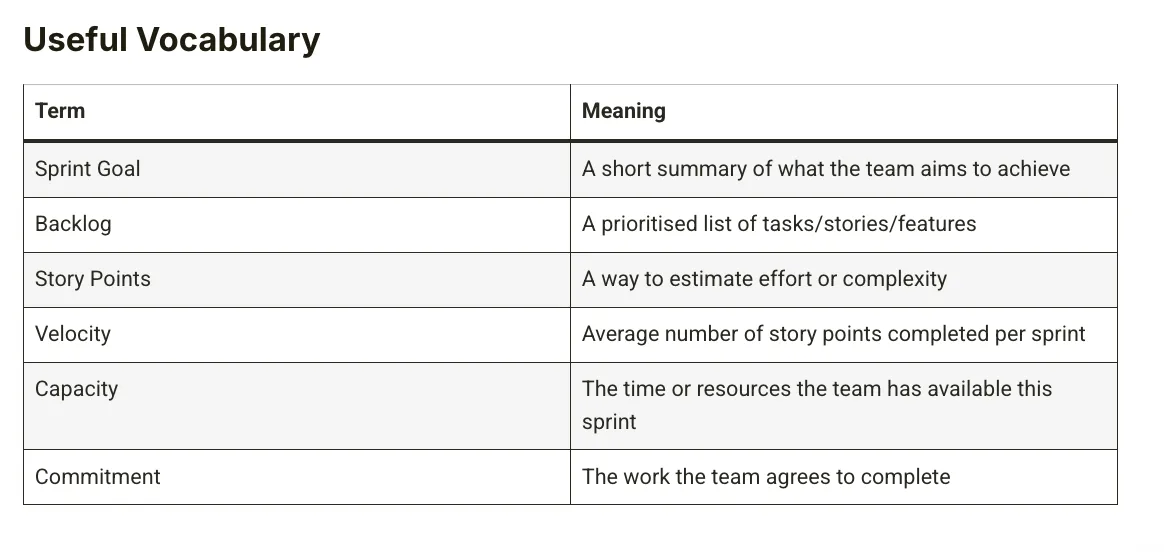
Example Resource: Sprint Planning in English
What it is: A language guide for sprint planning sessions, where teams decide which tasks to complete in the next two-week cycle.
Why it matters: Sprint planning involves estimation, negotiation, and clarification — three areas where non-native speakers often feel least confident.
Key English you’ll learn: story points (units used to estimate effort), to scope something (to define the size or boundaries of a task), to push back (to respectfully disagree or challenge), velocity (how much work a team completes per sprint), acceptance criteria (conditions a feature must meet to be considered done).
Use it in practice: “I’d estimate this at eight points — there’s more complexity here than it looks. Can we break it into two smaller stories, or are we committed to delivering it whole this sprint?” — Read the full guide →
Find more resources like this →
Master Daily Communication as a Software Engineer
Your daily interactions — standups, Slack messages, and quick technical discussions — are where you build your reputation as a clear communicator. These moments require specific structures that native speakers use instinctively. For software engineers working in English, mastering these daily patterns is the fastest way to build confidence.
To hear how a real standup sounds, work through our daily scrum listening example — one of the most useful exercises for non-native speakers preparing to join an English-speaking team. It also helps to understand connected speech in English, which explains why native speakers can sound fast or unclear in fast-paced team calls.
- Structure your standup updates: “Yesterday I completed [specific task], today I’m focusing on [current priority], and I’m blocked on [specific issue with context].”
- Ask for clarification professionally: Instead of “I don’t understand,” use “Could you walk me through the reasoning behind [specific decision]?” or “I want to make sure I understand the requirements correctly…”
- Share progress updates: “I’ve made good progress on [feature]. The API integration is working, but I’m seeing some performance issues with large datasets. I’ll have a solution by [timeframe].”
- Escalate issues effectively: “I’ve hit a blocker with [specific technical issue]. I’ve tried [approaches attempted] but [specific problem persists]. Could we discuss this in the next hour?”
💬 Real example
“Yesterday I finished the user authentication API. Today I’m integrating it with the frontend, but I’m seeing CORS errors that I haven’t been able to resolve. I’ve checked our nginx config and tried different headers. Could someone review this with me after standup?”
Key takeaway
Daily communication builds trust — be specific about what you’ve done, what you’re doing, and what you need.
⚡ Do this today
Before your next standup, write out your update using this exact formula: “Yesterday I [task]. Today I’m [priority]. I’m blocked on [issue].” Say it out loud twice before the call. Done.
Excel in Code Reviews: English for Software Engineers
Code reviews are where technical leadership becomes visible. The way you give and receive feedback directly impacts how colleagues perceive your expertise and collaboration skills. Software engineers who communicate well in code reviews are more likely to be promoted and trusted with complex projects.
To hear how a real code review conversation sounds, try our code review listening practice. You can also strengthen your written feedback with our guide to essential noun phrases for testing and code review, and make your comments cleaner using parallel structure in English.
- Frame constructive feedback: Start with “Consider [alternative approach]” or “What do you think about [suggestion]?” rather than direct criticism.
- Explain your reasoning: “I’m suggesting this refactor because it’ll make the code more testable and easier to extend when we add the notification feature next sprint.”
- Ask questions to understand: “I see you chose [approach]. Could you help me understand the trade-offs you considered?” This shows respect while gathering information.
- Acknowledge good work: “Nice solution for handling the edge case with empty arrays. This is much cleaner than our previous approach.”
- Respond to feedback professionally: “Good point about the error handling. I’ll add try-catch blocks and proper logging. Should be ready for another review by tomorrow.”
⚠️ Watch out
Avoid phrases like “This is wrong” or “You should do X.” Instead, use collaborative language: “What if we tried…” or “I wonder if… might work better here.”
⚡ Do this today
Open your next PR comment and replace any direct criticism with “Consider [X] because [reason].” One comment, one change. That habit alone will shift how your team perceives you.
Lead Technical Discussions in English
Whether you’re proposing an architecture change or explaining a complex bug, leading technical discussions requires specific language patterns that help others follow your reasoning. This is one of the most important English skills for software engineers who want to move into senior or lead roles.
A key skill here is knowing when to use active voice as a developer to sound direct and confident, and when passive voice is more appropriate — for example when reporting bugs diplomatically. You’ll also want to get precise with technical modifiers in English and the correct placement of modifiers so your explanations are unambiguous.
- Set the context: “I want to discuss our caching strategy. We’re seeing response times increase as our user base grows, and I think we need to reconsider our approach.”
- Present options clearly: “I see three possible solutions: [Option A], [Option B], or [Option C]. Let me walk through the pros and cons of each.”
- Use data to support arguments: “Based on our monitoring data, 80% of our API calls are hitting the database unnecessarily. Implementing Redis caching could reduce our average response time from 300ms to under 50ms.”
- Address concerns proactively: “I know there are concerns about adding complexity. The Redis setup will require some DevOps work initially, but it’ll actually simplify our application logic.”
- Guide toward decisions: “Given our timeline and the performance requirements, I recommend we start with Option B. We can implement it this sprint and measure the impact before considering more complex solutions.”
🗣️ What native speakers actually say
Instead of “I think we should use microservices,” say “I’m leaning toward microservices for this use case because…” The word “leaning” shows you’re open to discussion while stating your preference.
⚡ Do this today
Next time you have a technical opinion to share, use this structure out loud: “I’m leaning toward [X] because [one-sentence reason]. The main trade-off is [Y].” Practice it before the meeting, not during.
Handle Meetings Confidently in English
Meetings are where decisions get made and influence is built. For software engineers working in English, having the right phrases ready helps you contribute meaningfully rather than staying silent when you have valuable input.
For Agile teams, it’s worth studying the language of specific meeting types. Our retrospective meeting example in English shows exactly how these conversations flow. And our discussing code listening example is great practice for following fast-paced technical conversations in real time.
- Jump into discussions: “I’d like to add something to that…” or “Building on what Sarah said…” These phrases help you enter conversations naturally.
- Disagree diplomatically: “I see it differently. In my experience with similar projects…” or “That’s an interesting approach. Have we considered the implications for…”
- Buy time to think: “That’s a great question. Let me think through the technical implications…” gives you a moment to organize your thoughts.
- Redirect when needed: “Before we decide on the framework, shouldn’t we clarify the performance requirements?” helps refocus discussions.
- Summarize and confirm: “So we’re agreeing to use GraphQL for the API, with implementation starting next sprint, and John will research the authentication integration. Is that correct?”
💡 Tip
When you need to interrupt politely, use “Sorry to jump in, but…” or “Can I add something quickly?” Most native speakers appreciate directness when it’s framed politely.
⚡ Do this today
In your next meeting, commit to saying one thing using “Building on what [name] said…” — even if it’s a small point. Speaking once with a clear entry phrase is better than staying silent the entire call.
Master Technical Interviews in English
Technical interviews require you to think out loud while solving problems. For software engineers, the language you use is as important as the solution itself — it shows how you approach problems and communicate with team members. English for software engineers interviews is one of our most popular topics for good reason.
One area many engineers overlook is pronunciation. If interviewers struggle to understand you, even a great answer can fall flat. Check out our guides to common tech mispronunciations in English, word stress for developers, and how to pronounce -ed verbs in technical English — these three alone can make a significant difference to how confident and clear you sound.
- Think out loud systematically: “Let me break down this problem. I need to [restate the problem], the constraints are [list key constraints], and I’m thinking the optimal approach might be [initial strategy].”
- Explain your reasoning: “I’m choosing a hash map here because I need O(1) lookup time, and the extra space complexity is worth the performance gain for this use case.”
- Handle uncertainty honestly: “I’m not immediately sure about the optimal solution. Let me start with a brute force approach and then optimize it” shows good problem-solving process.
- Ask clarifying questions: “Should I assume the input array is sorted?” or “Are we optimizing for time complexity or space complexity?” demonstrates thorough thinking.
- Test your solution: “Let me trace through this with the example input… I’m getting [expected result], which matches what we want. Let me also test an edge case…”
💬 Real example
“I’m going to solve this step by step. First, let me understand what we’re looking for — we need to find the longest substring without repeating characters. I’ll use a sliding window approach with a hash set to track characters we’ve seen. Let me code this up and walk through the logic…”
⚡ Do this today
Pick any LeetCode easy problem and solve it out loud in English — record yourself on your phone. Play it back and listen for silence, filler words, and unclear reasoning. Do this once a week minimum.
Write Clear Documentation as a Software Engineer
Written communication is often overlooked, but clear documentation, pull request descriptions, and technical specs are crucial for career advancement. They demonstrate your ability to explain complex concepts clearly — a key English skill for software engineers aiming for senior roles.
For commit messages and technical writing, the imperative tense is the standard — read our guide on how to use the imperative present tense to get this right. When describing bugs and fixes, knowing your phrasal verbs for bug fixing will make your PRs and tickets sound natural and professional.
- Structure pull requests effectively: Start with “This PR [brief description of what it does],” followed by “Changes include:” with bullet points, then “Testing:” with verification steps.
- Write clear commit messages: Use the imperative mood: “Add user authentication middleware” not “Added user authentication middleware.” Be specific about what changed and why.
- Document decisions: “I chose PostgreSQL over MongoDB because we need ACID transactions for financial data, and the structured nature of our data fits well with a relational model.”
- Create helpful README sections: Include “Getting Started,” “Prerequisites,” “Installation,” and “Usage Examples” with actual code snippets that work.
- Write effective technical specs: Start with the problem, explain your proposed solution, list alternatives considered, and include implementation details with timelines.
Key takeaway
Good documentation saves everyone time and shows you think about the developer experience.
⚡ Do this today
Go to your last three commit messages. If any start with a past tense verb (“Added”, “Fixed”, “Updated”), rewrite them using imperative mood (“Add”, “Fix”, “Update”). Make that your permanent standard from now on.
Common English Mistakes Software Engineers Make
Even experienced software engineers make these communication mistakes that can hurt their professional impact. Here’s how to avoid them:
❌ Vague problem descriptions
“The API is broken” or “It’s not working”
✅ Specific problem descriptions
“The user API returns 500 errors when the request includes special characters in the name field”
❌ Apologizing unnecessarily
“Sorry, but I think maybe we could possibly consider…”
✅ Confident suggestions
“I recommend we implement caching because it will solve our performance issues”
❌ Technical jargon overload
“We need to refactor the polymorphic associations in the ORM abstraction layer”
✅ Clear explanations
“We need to simplify how our database models relate to each other. The current setup is causing performance issues”
⚠️ Watch out
The biggest mistake is staying silent when you have valuable input. It’s better to speak up with imperfect English than to let important insights go unshared.
⚡ Do this today
Next time you report a bug or blocker, force yourself to include: what broke, when it happens, what you already tried. Three sentences minimum. Vague reports are a career limiter — specific ones make you look senior.
Pro Tips for Software Engineers Learning English
- Record yourself explaining technical concepts: Listen for filler words, unclear explanations, and areas where you lose confidence. Practice until your explanations flow naturally.
- Learn the rhythm of technical discussions: Native speakers often start with context, present options, discuss trade-offs, then recommend a solution. Follow this pattern in your own explanations.
- Build your technical vocabulary gradually: Instead of memorizing lists, learn new terms in context. When you encounter a new concept, practice explaining it in your own words.
- Use analogies for complex concepts: “Think of microservices like a restaurant kitchen — each station handles one task really well, and they communicate through orders” makes abstract concepts concrete.
- Focus on structure over perfection: The engineers who communicate best aren’t always the most fluent. They know the right structure for the right moment.
“The best technical communicators don’t use the most complex words — they use the clearest structures.”
⚡ Do this today
Set a 5-minute timer and explain your current project out loud in English as if talking to a new teammate. Record it. Don’t stop. Play it back and find the one moment where you hesitated — that’s your practice target this week.
All Resources for English for Software Engineers
This is your complete learning path for mastering technical English as a software engineer. Start with the fundamentals, then move into real-world communication and advanced technical discussions.
How to use this
Follow the steps in order. Don’t try to learn everything — pick 2–3 resources, apply them in real conversations this week, then move forward.
Frequently Asked Questions: English for Software Engineers
How can software engineers improve their English?
The fastest way is to focus on the specific situations you face at work — standups, code reviews, and meetings. Learn the exact phrases used in each context rather than studying general grammar. Daily 15-minute practice sessions are more effective than occasional long study sessions.
What English skills do software engineers need most?
The most important skills are: explaining technical decisions clearly, communicating blockers without losing credibility, giving and receiving code review feedback professionally, and thinking out loud during technical interviews. Written skills like commit messages and PR descriptions are also crucial for remote teams.
How do software engineers speak in technical meetings in English?
Use structure: start with context, present your options, discuss trade-offs, then recommend a solution. Key phrases include “I’m leaning toward…”, “The main trade-off here is…”, and “Building on what [name] said…” to enter conversations naturally.
Is there a course specifically for English for software engineers?
Yes — Speak Tech English offers ebooks, worksheets and courses created by data engineers specifically for tech professionals. Unlike general business English courses, the content is built around real engineering situations like standups, code reviews, and technical interviews.
How long does it take to improve English as a software engineer?
Most software engineers see noticeable improvement in 4–6 weeks when practising daily. Focus on one situation at a time — master standup language first, then code reviews, then meetings. Confidence in specific situations builds faster than general fluency.
Your Next Step
Pick 2–3 phrases from this guide and use them this week — in a standup, PR, or message. That’s how English for software engineers becomes natural.
English for Developers — communicate clearly in real engineering environments
English for Tech Interviews — structure strong, confident answers
Business English for IT — videos, charts, dialogues and an interactive dashboard for IT professionals
The Stack Newsletter — weekly insights for global engineers
Mockly English Interviews — practice real interview scenarios


