4. How do kids think about unsimplified equations?

pic1

Balance problems provoke students to use a special sort of thinking — what I’ve been unhelpfully calling “balance reasoning” — and this sort of thinking can be helpful for solving equations. This has potential to be helpful for students in their path on the way to using equality properties to quickly solve equations.

But I really, really wish that I didn’t have to rely on balance problems for this.

That’s not because I have anything against balance problems. They’re lovely! Students should get a chance to play with them. But I’ve taught too many sad high school students who shiver when an equation shows up in class. I want these kids to be happier in those classes, to be able to see more lovely math. I really, really would like my students to be able to solve equations, and relying on balance problems to do some of this work makes me nervous.

I get nervous about relying on balance problems because it’s really a subtle thing to help students make connections between two different scenarios. It’s possible, of course, but it’s hard. This might be a melodramatic way to put things (sorry) but using these problems is a risky move.

(And the same can be said for using “pick a number” problems.)

Is there any way I can gain the benefits of balance problems without shifting contexts from equations to mobiles?

The benefit of balance problems is “balance reasoning,” a particular way-of-seeing an equation. Can this way-of-seeing be developed by students while sticking to the solving equations context? If so, what experiences would they need to have in order to develop this way-of-seeing?

I’m not sure. I’ll put out a guess, but what I (or somebody else) would really need to do is watch kids work on different sorts of linear equations and listen to them talk about how they solved them.

Here’s my guess: most students will eventually develop balance reasoning after lots of experience with unsimplified equations. By unsimplified, I mean equations like these:

  • 2 + x = x + x
  • a + a + a + a – 12 = a + a + a + 8
  • 5 – b – b = 3 – b

Unsimplified equations are (more or less) the equations you’ll get from translating balance problems into equations.

I bet that kids who work on these equations using guess-and-check will eventually be able to understand (either by discovery, instruction from friends, discussion, direct instruction from me) how to use balance reasoning as a short-cut for their inefficient methods. And then I bet we can name it, formalize it, and extend it to less obvious situations (like 5 – b – b = 3 – b, which is tough to represent in a balance problem).

(I wonder whether these students would draw on a balance metaphor, or whether it would just be a regularity that they notice? If students do notice this pattern, how would they make sense of it? Which is another way of asking, how would they remember it?)

It’s important to note that unsimplified equations are not quite the same thing as the sorts of equations we eventually want kids to be able to solve. Not everyone who can solve an unsimplified equation will be able to solve the simplified version of that equation. Kids might not see that 4a – 12 = 3a + 8 is the same as its unsimplified version. This is the same dilemma that we had with balance problems in the first place (transfer of skills from one type of problem to another). But I’m less worried about the jump from unsimplified to simplified equations than I am about the jump from balance problems to equations. We’re all still talking about equations, it’s a smaller leap than the leap from a context that might look drastically different from an equation to a kid.

If all this is right (and who knows if it is!) then students can develop balance reasoning in an equations context, rather than a different scenario. And there are advantages to that — the leap from equation to equation is less tricky for learning than the leap from balance scenario to equation.

There still might be reasons to study balance problems in class, or even to use balance problems to develop balance reasoning.

  • It often happens in my classes that kids get fed up or frustrated after a week of playing with any one scenario. They need something that isn’t just different, but it has to feel different to them. Balance problems certainly feel different than equations.
  • The surface level difference between balance problems and equations is also helpful when dealing with students who have bad associations with equations, variables and numbers. Balance problems could be a sneaky way to get balance reasoning on the table for a group of kids, before we arm them with it for equations.
  • Because balance problems look different, on the surface, they could make great application problems for students who understand equations in some other context. Or maybe it’s helpful to start a unit with a few balance problems, to establish a metaphor that we can later connect to the unsimplified equations?
  • Maybe we think that the learning of balance reasoning will be more effective if it takes place in the balance problem context, for some reason.

I’m influenced here by the way students can get better at arithmetic in elementary years. There’s no substitute for work with actual numbers in number contexts. Students start multiplying with some basic fact knowledge, but they extend this knowledge by finding shortcuts and regularities (successive doubling, doubling and halving, finding friendly numbers, breaking apart by place value). This makes me wonder whether it’s a mistake to jump to balance problems to develop balance reasoning for solving equations. (Though balance contexts might serve an important purpose for all the reasons mentioned above.)

If any of the above is right, then the next step of this project needs to outline problem types for solving linear equations. (Analyzing problem types was the first published part of the Cognitively Guided Instruction project.) Here are some problem types I know of so far:

  • Simplified vs. unsimplified equations
  • Equations with addition vs. subtraction
  • One-variable equations vs. multiple-variable equations

The importance of these problem types is that different linear equations allow for different sorts of reasoning. I want to get systematic about what each of those types of linear equation are, and the thinking that they each invite.

Then, I really really really need to start looking at some student work to see if the picture I’m developing resembles reality at all.
3. How do kids think about “pick a number” problems?

pic1
Source: http://algebra.mrmeyer.com/

I want to help students move from guess-and-check to using equality properties in the equation work. There are some problems that might be helpful in this work — like balance problems — but there are limitations to their usefulness. Balance problems allow for a sort of “balance thinking” that has close analogies in the world of solving equations — when you take things off of both sides things stay balanced (subtraction property) and when you divide each side equally each divided part is balanced (division property).

It’s hard, though, to represent negative numbers or fractions in balance problems, and there’s little reason to use anything resembling either the addition or multiplication property in that work. So there are limits to the usefulness of balance problems.

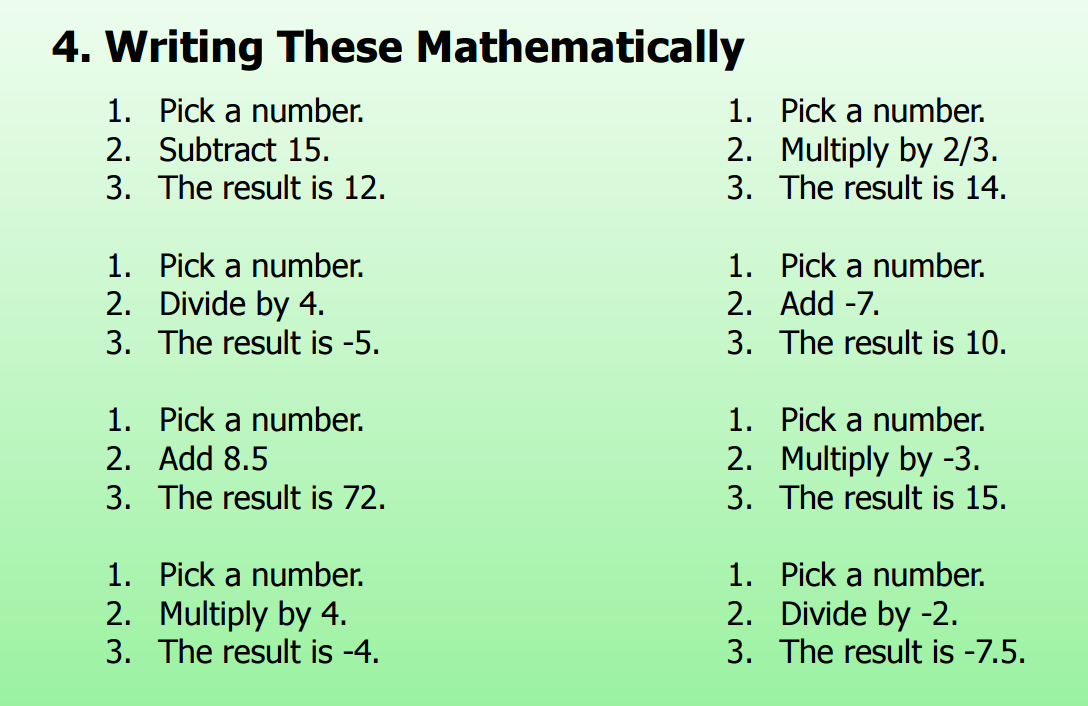
What other problems might be helpful? Another promising problem type is the “pick a number” problem, as seen at the top of the post. (There has got to be a better name for this type of problem. They’re not number tricks. “Closed number tricks”?)

I’d like to get precise about what makes pick a number problems promising for learning to solve equations. There are two things that I’m looking for to gauge potential usefulness of a new scenario or problem type: resemblance and novelty.

  1. Resemblance: My students will able to use guess-and-check to solve equations, but I want them to be able to use equality properties. Can guess-and-check and equality properties both be used for this problem type?
  2. Novelty: To be useful, some different way of thinking about this problem type, beyond guess-and-check and equality properties, needs to be available to students. Otherwise, the problem is just functionally equivalent to my equations.  Is there a new strategy students can use to think about this problem type?

“Pick a number” problems allow for guess-and-check, and you could also translate the steps into an equation and solve it conventionally. So there is resemblance.

The novelty is “backtracking” thinking. This is the thinking that, step by step, reverses the steps of the recipe until the original “pick a number” is revealed.

So, kids are likely (I bet) to think about backtracking problems in one of three ways:

  1. Guess and check
  2. Backtracking
  3. Equality properties

Suppose that kids got very, very good at these “pick a number” problems. What benefits could that have for their solving equation skills? Could backtracking help them develop equality property strategies?

I see two possible teaching strategies along these lines:

  • Ask students to translate equations into steps, and then have students use backwards thinking in its natural setting.
  • Develop generalizations in the “pick a number” problem that can be extended to solving equations.

The first option seems like a bad idea, since there are all sorts of equations that cannot be usefully translated into steps. Even basic equations like 4 – x = 10 don’t really work well with backtracking reasoning. (Pick a number. Start with 4. Subtract your number. You get 10.) You’d have to help students understand a specific class of equations that work well with backtracking, and that sounds like a headache.

I like the second option more. We could form generalizations from backtracking that are easily applicable to equations. “To find your number, you need to undo the operations that are done to it” is as true for “pick a number” problems as it is for equations. Of course, we would need to clearly show how that reasoning applies. But work in these problems could help students use the inverse of operations to reveal the starting number. Balance problems only gave you the subtraction and the division properties, but “pick a number” problems also give you multiplication, addition, squares and square roots properties of equality.

The big limitation is that variables have to be on one side for “pick a number” problems to work. These problems are unlikely to develop tools that are helpful for anything that has a variable on each side, because backtracking only works if we’re imagining the equation to have one, single picked number. How can you reverse the steps in “I multiply my number by 7, I add 18, I get 10 times my starting number”?

That’s the first big limitation of this problem type.

The second big limitation is the same one that balance problems had: this is a new scenario. Any skills that we want students to take away from “pick a number” or balance problems to equations will not come for free. We will need to spend time helping students see how the skills they use in one context are applicable in another. There’s an art to this, but maybe it’s not worth it.

I want to think about this more in the fourth post in this series.

2. How do kids think about balance problems?

pic1

When I teach students to solve linear equations, I’m aiming to help move them from guess-and-check to using the properties of equality.  I’m in search of the ways of thinking that could help students move towards the more sophisticated techniques.

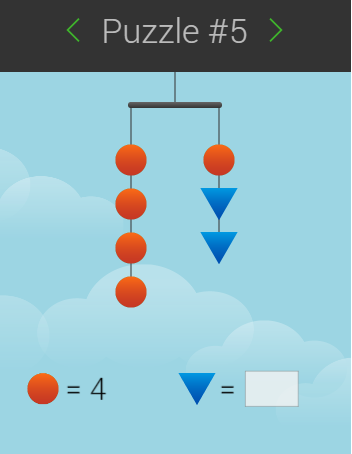
Balance problems (i.e. mobile problems) seem promising. They seem promising because they can be solved using guess-and-check, just as linear equations can. They can also be solved using the properties of equality, if you translate the situation into a linear equation.

In short, the thinking that students can do with balance problems is close enough to the thinking used to solve equations to be useful. If there happens to be a special way of thinking about balance problems, that way of thinking might help students develop facility with properties of equality. Much in the same way that visual pattern problems can help shepherd students from recursive to functional thinking, balance problems might help students move from guess-and-check to equality-property-thinking.

And, in fact, there is a special way of thinking that balance problems allow for. I don’t know what to call it. Maybe I’ll call it “balance reasoning.” That seems almost tautological, but whatever, balance reasoning! Balance reasoning is available for balance problems.

This is the reasoning that goes like, “If the left side has four circles and the right side has one circle and two triangles, then it’ll have to stay balanced if we take one circle off of each side. So it must be that three circles on the left side and two triangles on the right side are still balanced.”

In sum, students can use three types of reasoning for balance problems:

  1. Guess-and-check
  2. Balance Reasoning
  3. Properties of Equality

Noticing patterns in what we do with balance reasoning can help us develop properties of equality within balance problems. With enough experience with the sort of “remove the same things from each side” thinking we could formulate a technique: “If you can, take off the same number of things from each side.” This is a close analogue to the addition property of an equation.

With enough experience with other balance problems, we could get something like the division property of equality: “If you have all squares (or whatever) on one side and all triangles (or whatever) on the other, split up one side and give it to the other.”

Yay, kids can now solve equations! Right?

Well, not so fast. All of this is taking place in an unusual, foreign context. Balance problems are not equations. How do we make the move back into solving equations? I think we need to design activities that make explicit the connections between balance problems and equations. We translate back and forth between them. We formulate new rules for solving equations that explicitly mirror the rules that we know and love from balance problems.

So, now kids can solve equations! Right?

No, because balance problems aren’t natural settings for a lot of equations. Anything with negatives or fractions or subtraction is awkward to use with balance problems. Sure, we can extend balances to work with all sorts of signed variables or subtraction (like -2x – 3 = 0) but it’s awkward. It’s mathematically fascinating and valuable for its own sake, but unlikely to be much help when a kid is staring at an equation and feeling the urge to guess-and-check.

In short, balance problems can be solved using three modes of reasoning. One of those modes has promise for helping students think using properties of equality, but not all the properties of equality.

The goal of using balance problems in this context would be to develop properties-of-equality-thinking. Our feedback should be oriented towards that. Balance problems are useful, but only in a very particular way.

In the next post, I’ll think a bit about developing facility with other properties of equality.

1. How do kids think about solving equations?

I want to get ready for the school year. I’ll be teaching Algebra 1, and that’s where solving equations happens. These skills are seriously useful, so I want to do right by my students. I want to teach this topic well.

As far as I can tell, the most useful way to get better at teaching something is to better understand how kids will think about that something. So: how do kids think about solving equations?*

Actually, there are a few different ways of wording this question I might focus on.

  1. How do kids think about solving equation problems?
  2. How can kids think about solving equation problems?
  3. How will kids think about solving equation problems?

These three questions have different connotations to me. Do suggests the present reality. If I surveyed 1,000 students, what sorts of thinking would they in trying to solve an equation. Can implies future possibility. This might include useful, but unnatural models. Will implies future inevitability. An answer to “How will kids think?” might include common misconceptions or models that students tend to fall into.

I think I’m interested in answering all three questions. I want to know the ways that my students might think about this problem when they walk into my class, I want to know which models might be helpful for them to obtain, and I want to know what ways of thinking they are likely to fall into.

With all that said, I sit down with a pen and paper and try to get clearer on the potential thinking. A big problem quickly arises. There are a lot of ways that students do, can or will think about linear equations.

Here was the list that I started making for how to solve 2x + 3 = 10.

  1. Mental Guess and Check – “2 times 4 plus 3 is 11… 2 times 2 plus 3 is 7…”
  2. Guess and Check on paper-  Same, but on paper so it’s easier to notice how close we’re getting.
  3. Organized Guess and Check – “2(0) + 3 = 3.,  2(1) + 3 = 5,  2(2) + 3 = 7 …”
  4. Make a Table – Which is a way of organizing an organized guess and check
  5. Use a graph – Graph y = 2x+3 and look for where y is 10.
  6. Use a scale model – (Either with manipulatives or with paper.) Draw 2 circles and 3 boxes on one side of the scale, 10 boxes on the other. Proceed…
  7. Use a number line – Start at the origin. Draw an arrow to the right, label it “x.” Do that again. Then indicate a move to the right of three units. The whole thing lands at 10 on the number line. Proceed…
  8. Work Backwards – “We’re adding 3 at the end to make 10, so everything else makes 7. So what times 2 makes 7…”
  9. Use Properties of Equality – “Subtract 3 from both sides. Divide by 2.”

There are certainly more ways that students might think about solving equations that I haven’t listed here.

This listing could go on and on, but I don’t think this list-making will help me very much. What I need isn’t an encyclopedic knowledge of how kids think about equations. What I need is a framework for thinking about teaching solving equations. I need to know what my goals are, the value of different curricular choices, the feedback that would be helpful to give, the challenges I should anticipate.

So, I go back to my notebook. I know that I prioritize one of these ways of thinking above all others. The most useful, powerful way to solve equations is to use the properties of equality.

I think the most likely situation is that my students will come into my class being comfortable with using some version of guess and check to solve an equation.

I’ve got the beginning (guess and check) pinned down. I’ve got the ending (properties of equality) pinned down. Anything else is a toss-up. But this gives me some clarity. I’m essentially looking for mental models that can help shepherd my students from guess-and-check to using the properties of equality.

In the next piece in this series, I’ll look at candidates for that middle model.

Thinking Through “Falling Leaves”

CJXTWOVUkAAy8ZL

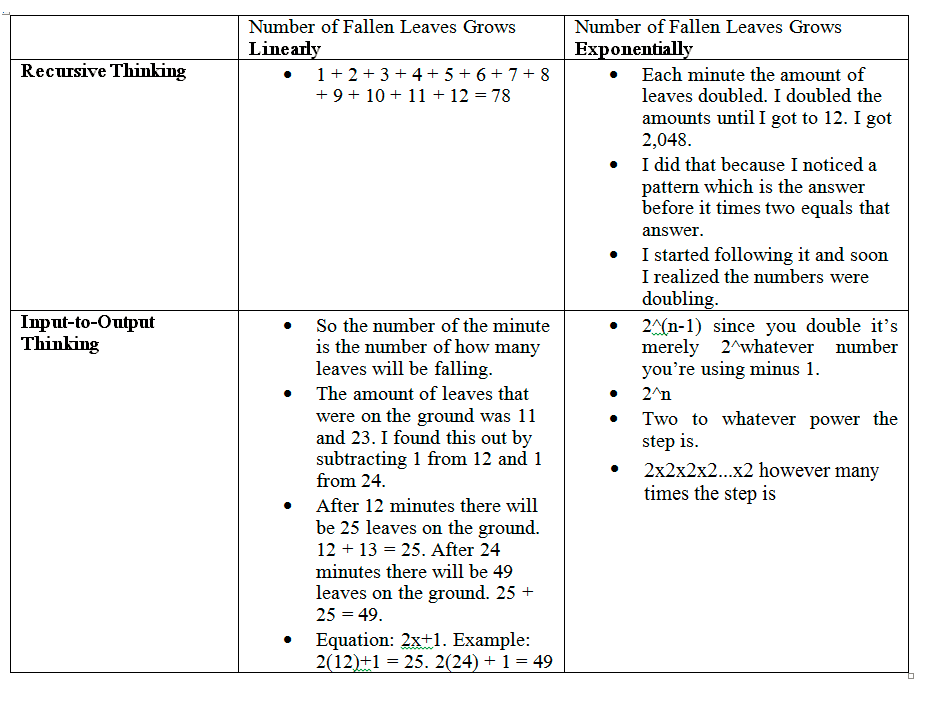
How will kids think about this? As part of the Math Forum’s EnCoMPASS project (http://mathforum.org/encompass/) I sorted through and categorized about two hundred student responses to this problem. Here’s the thinking that I saw, with sample responses that seemed typical of the things that I saw.

pic1

Now that I’ve systematized student thinking, I want to use this to analyze the possible uses of this problem for learning math, and the feedback and hints that can help kids meet those goals.

Goals:

My first instinct is to say that any sort of thinking that you can use to solve a problem might be a helpful goal for a classroom. In this case, though, there’s little to be gained by encouraging students to see this as a linear pattern!

Instead, I’d say the two ways that students think this through with an exponential lens would make good goals:

  • To recognize an exponential pattern and use any method (e.g. recursive or explicit) for calculating a given step in the pattern.
  • To recognize explicit functions to describe exponential patterns.

Seeing this pattern as linear at first could be productive for the first goal, as the contrast between the linear and exponential model could make their differences seem even more stark. (See “Teaching to the Negative Space”)

This sort of analysis leads me to a different conclusion than some of the teachers who also considered this question. Other teachers and I are on the same page, almost. Some samples:

  • I’d want them to make sense, organize info, realize it’s non-linear.
  • Goal: for students to compare and contrast this with linear sequence.
  • (I’ll just add one goal) Make sense of the story.
  • I think I used this problem with my 7th graders. Wanted them to be able to to explain in word number relationship in pattern.
  • Goal: organize the information in a clear manner, look for and identify patterns
  • Identify pattern, represent algebraically & graphically; identify function.
  • Goal: organize the sequence/data, make conjectures, discuss a limit to # of leaves on tree
  • Goal: Connect the pattern to geometric sequences and exponential functions

I don’t think “make sense” is a particularly helpful goal for students, because they’re already trying to make sense of problems, and the way they make sense of problems is through specific acquisition of new models, concepts, paradigms, representations. So I don’t buy the existence of some universal “sense-making” skill that kids can practice, and therefore I want to know how kids are going to make sense of this problem. That probably means recognizing this as a “doubling” pattern.

Likewise, I’m not a huge fan of “explaining in words,” “organizing in a clear manner,” “identify patterns” or “make conjectures” as a goal of the problem. These are all things that people do through specific models, paradigms, etc. and if a kid can’t already do them for this problem, they’ll need these new sense-making, pattern-identifying, organizing lenses.

If I’m being too hard on anyone, it’s on “organizing in a clear manner.” This seems like a broadly useful way of working on patterns, and it’s fairly useful no matter what the pattern is. I didn’t include that in my description of student thinking above. I wonder how much “make a table” helps before you know what patterns to anticipate. Maybe I should’ve included “make a table” as a goal above. I’m not sure.

Hints/Feedback

I’ve tried to identify thinking that could happen with this problem, and then I tried to use that to identify the goals we might have when using this problem. (Roughly, the goals are for all students to use some of the thinking that can happen with this problem.)

We’ve made the decision to intervene, either through feedback, hints, lecture, whole-group discussion or something else. How can we do so in a way that helps kids learn something?

There are two situations that I think we need to worry about.

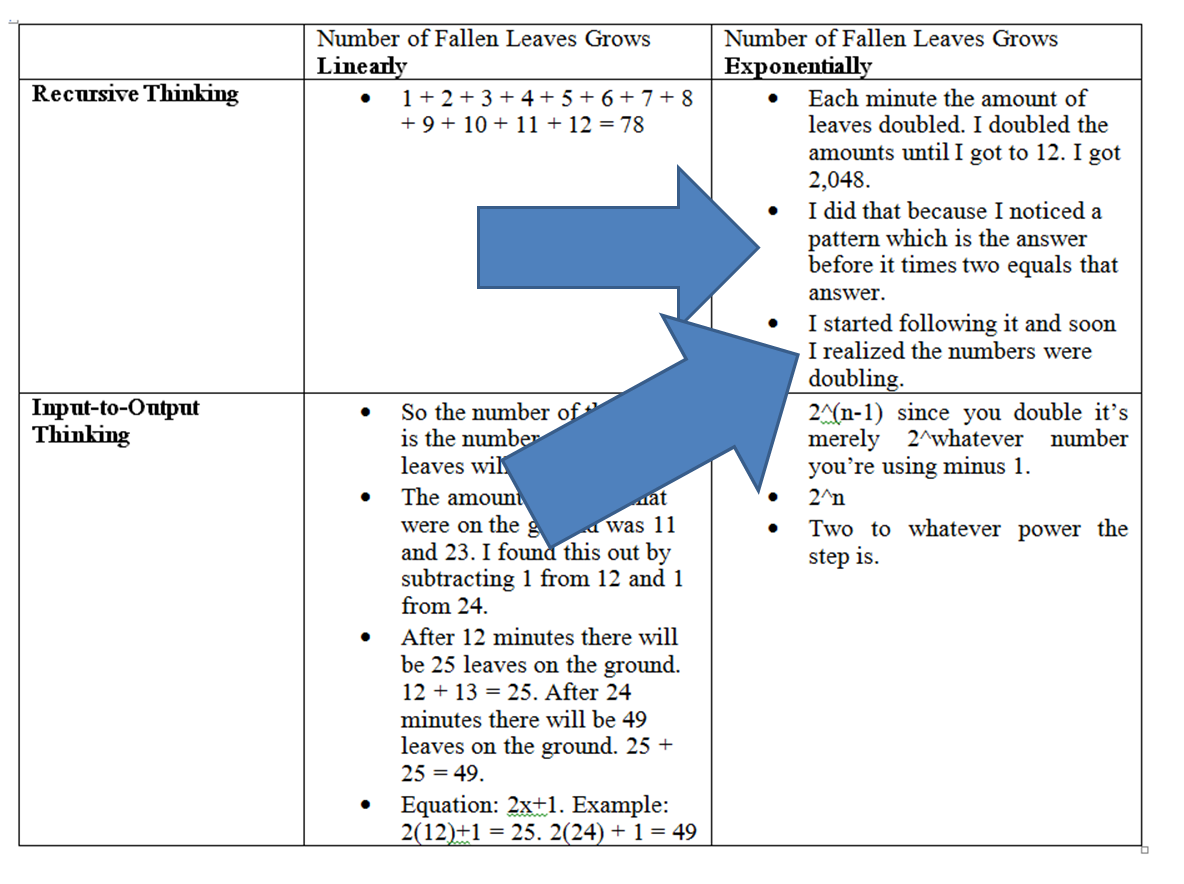
Helping Kids See an Exponential Pattern Rather Than a Linear One

pic1

The trick here, as Max puts it well, there’s no sense in which the exponential model emerges out of the linear one. It’s sort of a dead end. Sure, we’d like students to check their model against cases, but even knowing to do that comes from an awareness that the model might not be linear. This is something that is learned through experience with non-linear models, and so “check your work!” might not even be an accessible habit to these kids.

In this case, the teacher can help learning by drawing attention to the wrongness of the linear model. Some teachers will do this with questions that put kids in the right zipcode for noticing their own mistake, others will be more direct. The choice is partly a matter of style, values, knowledge of the particular kids and the teaching situation. I think it’s important to see that all of these choices help learning in the same way: by drawing attention to the insufficiency of the linear model.

  • Can you explain to me your thinking about the first 5 rows in your table?
  • Can you check your work with Sam’s group? I think you’ll have an interesting chat with them.
  • Explain to me your thinking about the first 5 rows in your table.
  • Can you show me how you got 3 for the 3rd minute?
  • Can we act out how the leaves are falling in the first few minutes?
  • Another group got 4 leaves falling during the 3rd minute. Could you prove them wrong?
  • Can you revisit the 3rd minute? I think there’s something there you haven’t noticed yet.
  • The 3rd minute is sneaky, actually. Could you try it again!
  • Can you show that the 3rd minute is not 3?

These go across the “question to request” axis and the “vague to specific” axis, but they all aim to draw attention to the 3rd minute. Because one way or another, you need to see that this is not linear if you want to learn something new and cool here.

Helping Kids Calculate a Step In This Pattern Explicitly Rather than Recursively

pic1

How does a kid move from successively doubling to explicitly using exponents?

One pathway towards conceptualization in math is the “process to object” pathway. (And maybe it’s a really really important pathway. See Sfard.) This is where we take some process and gradually see it less as something do be done or followed (like a law or rule of a Soccer) and more like something that can have properties and do stuff itself (like a person or an Oak tree).

Maybe this “process to object” is a helpful lens through which to see the movement from successively doubling entries in a table to coming up with an explicit formula for any step in the pattern. After all, the exponential notation isn’t strictly necessary for describing the nth step. You could say (as a few students did) that the nth step involves 2*2*2*2…*2 n-times. So there’s a way of describing the nth step that doesn’t strictly depend on notational knowledge that kids are lacking, yet most kids don’t go for it. The conceptual gap (between seeing the growth as a process versus an object) might explain way.

If this is true, then we’d want to ask questions and make requests of students’ thinking that help them see doubling as an object. I think this means that we’d want kids to notice the properties of this growth, and this means that we want students to compare this growth with other sorts of growth.

I think a particularly helpful way to make these comparisons is to follow-up this activity with an activity with some other sort of growth and then explicitly ask students to compare the growth. The other growth might be linear, quadratic, or even exponential with another growth rate (tripling, or halving or something). Feedback/Questioning/Hints on the given problem alone might not be the best way to support the move from recursive to explicit thinking about this pattern.

That said, if we are giving hints and feedback (for whatever reason) we can talk about the feedback and hints that might be helpful. They’d draw attention to the properties of the growth in this problem:

  • I notice that you can rewrite the first minute as 2*1 and the second as 2*2. Can you keep on doing this? Can you explain what you find?
  • How would this table look different if instead of doubling each minute it tripled?
  • Can you show how this table would look different if instead of doubling at each minute it added 2 at each minute?
  • Can you prove that this table only ever uses powers of 2?

There are other questions we could ask. A common suggestion from other teachers, I bet, would be “How many 2’s are you multiplying in step 3? Step 4?” because we teachers love asking our students no do some inductive reasoning. I’m not such a fan of that question, because I feel like that doesn’t leave much for students to think about, besides noticing the pattern. Maybe it’s just a style thing, but I would replace that with my first bullet-pointed question. Maybe that’s not an important difference. Really not sure. (Thoughts?)

Questions I Have

There are things that I’m not sure about. For example, some students (3 out of 222, to be exact) used a sort of proportional reasoning to find the answer to this problem. That reasoning goes, like, “Oh so I figured out at 12 minutes the answer is 78 and so the 24th minute is just double 78.” That proportional reasoning is false, but I’m not sure exactly why to say it’s false. At first I’m inclined to say that this proportional reasoning is just an instance of using a linear lens on the pattern (and using a false linear model for that matter), but then one kid used exponential doubling to get to the 12th step and then used proportional reasoning to get the 24th.

Should we think of that kid as quickly switching from an exponential to a linear lens on the growth? Or should we think of proportional thinking as a sort of patch that can be a component of any way of seeing the pattern?

I’m inclined to say that while there are no hard and fast rules for how thinking matches up, it’s most helpful to see proportional reasoning as something that tends to mean that you’re seeing the pattern linearly and recursively. But dunno if that’s really a true or useful generalization.

Another question I have is how much “make a table” is its own way of thinking about this question, or how useful “make a table” is. In particular, would a lesson that had its goal to help students “make a table” be really helpful? Or is the “be organized” instinct one that comes more or less naturally once you see the growth in an organized way? Or do they come together? Basically, I’m struggling to bring together my instinctive dislike for all-purpose problem solving moves with the fact that making a table is actually pretty useful for a large class of pattern problems.

I’m also struggling to figure out the right terminology for what I called “input-to-output” reasoning above. This is lousy terminology, since a recursive perspective also has inputs and outputs. What else could this sort of thinking be called? “Functional reasoning” sounds wrong, since recursive thinking is still functional. “Explicit reasoning” (ala “explicit formula”) doesn’t sound right to me, since that sounds like you’re just making your reasoning explicit. And “Closed form reasoning” doesn’t really describe anything unless you know what “closed form” means, and honestly I find that language weird so I’m guessing others do too? I wish I had a better way to talk about the kind of reasoning that generalizes a pattern into a closed-form formula (be it in algebraic language or not).

Finally, I’m generally concerned that I’ve gotten the analysis of student thinking wrong. Wrong, in this case, would be not useful, or unable to productively guide teaching. It feels right to me, but maybe I’m on the wrong track?

Preoccupations with naive interpretations of reality

Constructivism begins with an emphasis on the constructed world of the knower and the relationship of that world to reality. As von Glaswerfeld observes: It is necessary to keep in mind the most fundamental trait of constructivist epistemology, that is, that the world which is constructed…makes no claim whatsoever about ‘truth’ in the sense of correspondence with an ontological reality…

Among philosophers, Kant usually is recognized as the main person to introduce the notion that the mind does not passively reflect experience but rather actively creates meanings by attributing patterns and regularities that cannot be perceived directly. So, two centuries after Kant’s death, radical constructivists’ preoccupations with naive interpretations of reality seem quaint — especially in a field like mathematics where the notion that mathematics is about truth was abandoned hundreds of years ago — following the discovery of non-Euclidean geometries. In fact, since the discovery of Godel’s Theorem, the Axiom of Choice, and other related issues in mathematics, mathematicians have recognized that they can not even guarantee the internal consistency of any system that is more complex than the integers.

From Beyond Constructivism, Lesh and Doerr. I don’t think they’re right about the field of mathematics having discarded truth in light of non-Euclidean geometry. (Quine and Putnam would certainly disagree. Frege wrote after the discovery of non-Euclidean geometry, and was an unabashed realist. Godel too. And so on, many others.)

The critique of radical constructivism is sharp. It applies well to the writings of Constance Kamii:

Piaget’s theory provides the most convincing scientific explanation of how children acquire number concepts. It states, in essence, that logico-mathematical knowledge, including number and arithmetic, is constructed (created) by each child from within, in interaction with the environment. In other words, logico-mathematical knowledge is not acquired directly from the environment by internalization.

From Young Children Reinvent Arithmetic. This sort of talk either ignores philosophy or rests on a really ungenerous interpretation of Locke, Hume and other empiricists.

More from Lesh and Doerr:

As constructivists surely would agree, the key issue is not whether a theory is true or false, but rather whether it is useful. So, one implication of this policy is that, for researchers whose goals are to test and revise or refine theories, a philosophy that is accepted by nearly everyone is not useful. In other words, constructivism itself ceases to be useful to theory developers precisely when virtually every potentially competing theory claims to adopt this philosophy.

In sum, radical constructivism (and Lesh and Doerr) claim that realism in mathematics is dead. It aint. But to the extent that there is necessarily a gap between reality and our thought, that mismatch is agreed upon by basically everyone and has been since Kant pointed it out, so there’s no real need to shout it from the rooftops today. And since everyone basically does agree on that, radical constructivism is not a particularly useful framework for math educators or researchers.

A methodology, I guess?

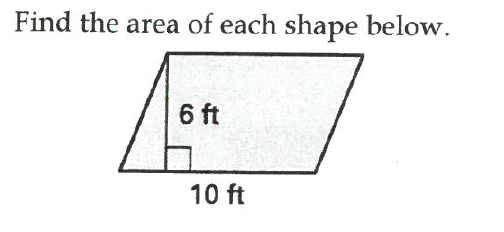
We start by wanting to know what hints or feedback we might give a student who is stuck on a fairly typical area problem.

pic1

(Or, we want to know when a student’s struggle is likely to be productive and we should just smile and listen instead of yammering away.)

Right away, we run into a serious problem. It’s frankly impossible to talk about this while ignoring the details of the child, the course and the classroom. Kids don’t universally enter school with a wealth of experience that would help them dive into this problem. (This is a sense in which this problem is quite different from addition and subtraction word problems.) We need to know, what relevant experiences will this imagined kid have had before working on this problem? That question, is essentially, a curricular one. What comes before this problem?

There’s no easy way to answer this, because there is no agreed on curricular sequence. We can imagine that students have experience finding the area of shapes by chopping up and rearranging shapes, but there’s no guarantee of this. (Kids have some everyday experiences with chopping up areas, but maybe not the kind that would help them with this.) We can imagine kids have thought about area formulas for different shapes and how they’re similar or different, but who knows if a class studied that.

If we can’t know the experiences that students are likely to draw on, then we’re unlikely to be able to plan out helpful feedback or hints. This speaks against the possibility of pursuing a hint-gathering project in all its generality. Boo.

We’re left with some options, both of which are pretty promising:

  1. Focus on particular curricular sequences. Make those curricular assumptions explicit. (e.g. My kids have experience chopping up and rearranging shapes. They also have experience with finding the area of right triangles and rectangles and some triangles. They know triangle area formula.) Craft feedback and hints that are particular to the course and the curriculum.
  2. Start with problems at the beginning of the development (with problems that students are very likely to be able to use their everyday experience to solve) rather than the problems at the end (the problems we eventually want our students to be able to solve). (e.g. What strategies do kids tend to use with Ramp Steepness Comparison problems? vs. What strategies do kids tend to use for right triangle trigonometry?) Outline student thinking, in general, for problems that children’s common experiences are highly likely to equip them to solve. These problems can’t just be accessible, they also need to be promising, in the sense that they have to yield mathematical thinking that can be directly applicable to problems that we eventually want our students to solve. (The strategies you develop from getting better at comparing the steepness of ramps can be directly applicable to finding missing sides of right triangles using trigonometry.)

The first option seems promising on a personal level. After all, I know my kids and my course and my classroom. I’ll be able to directly observe my students’ thinking, so I can articulate a bunch of learning trajectories that are consistent with my curriculum, and then adjust these in response to what I actually see in my students. I think this would make me a better teacher for my students, as I could also plan for feedback and hints in a way that is sensitive to my students’ likely thinking. (As a bonus, any teachers or departments that are working together could work on developing frameworks in this way.)

The big downside to that first option is that the work is unlikely to be helpful for teachers who don’t share my curricular assumptions. That’s a bit of a downer.

The second option seems better suited for coordinating a broader conversation around student thinking. Since we’re starting with problems that students can almost certainly solve without instruction (using everyday or very common school experiences and knowledge) we can all understand each other when we talk about how students will think about these problems. We can then show the way that students can develop in their thinking about these very accessible problems. To be useful, we’d have to show how these strategies are useful for the problems we eventually want our students to solve.

When it comes to area, what might this project look like?

  • I use the CME Project’s Geometry text in my classes. I could look at the way units are sequenced there, along with what I suspect (based on experience) that my students will know from their previous courses. I can use this to detail the thinking that my students are likely to use on this problem. I can use my guess at the thinking that students will use to plan for feedback/hints in advance.
  • The other thing I could do is identify a problem that most students are almost certainly able to work on productively using everyday knowledge (or strategies that they almost certainly would have from earlier coursework), but that can also lead to being able to find the area of parallelograms and other shapes. Then I could use student work and experience to outline how thinking might develop as students get a lot of experience with these sorts of problems. I’d want to draw a line from early strategies to advanced strategies, and show how these strategies can be applied to finding the area of a parallelogram.
  • These projects could go together. If I look at the CME Geometry text, I might find problems that students could work on using everyday strategies. If I find problems that kids could make sense of using earlier experience, I might want to rewrite parts of my curriculum around them.

Long-winded, but I think that’s the plan.

5 Research Results on Problem Solving

Does the problem-solving literature have anything of value to guide instructional decision making? The answer is that, although the literature on problem-solving instruction presents ambiguous messages, five results stand out:

1. Students must solve many problems in order to improve their problem solving ability.

2. Problem solving ability develops slowly over a prolonged period of time.

3. Students must believe that their teacher thinks problem solving is important in order for them to benefit from instruction.

4. Most students benefit greatly from systematically planned problem-solving instruction.

5. Teaching students about problem-solving strategies and heuristics and phases of problem solving (e.g. Polya’s, 1945/1973, four-stage problem-solving model) does little to improve students’ ability to solve general mathematics problems.

Source: “From Problem Solving to Modeling,” Frank Lester and Paul Kehle, in Beyond Constructivism.

Thinking about Problems vs. Thinking about Topics

Over at Lani’s place, Max talks about expanding CGI beyond CGI.

“Another grand challenge could be to extend the kind of work that went into CGI [Cognitively Guided Instruction] to high school Algebra, Geometry, Probability, Statistics, and Calculus concepts, so that teachers teaching, say, right-triangle trig, or similarity proofs, or solving quadratic equations, or standard deviation, had a map of learning progressions in that space and ideas about kids’ informal intuitions and misconceptions, multiple representations that connected to various aspects of a fully operational mathematical understanding, and then linkages among those multiple representations.”

Max talks about detailing how kids learn topics. But I’m not sure that this is exactly how I read CGI, though I can see it through that lens. The question is, do we seek learning progressions mapping how students think about problems or how students think about concepts? Meaning, do we want knowledge about how kids think about addition or about how kids think about addition problems?

I don’t think that this distinction really causes issues at the elementary level — to know addition is to know how to solve addition problems, and we all agree on what addition problems are — I wonder if it’ll be harder to nail down on the secondary level.

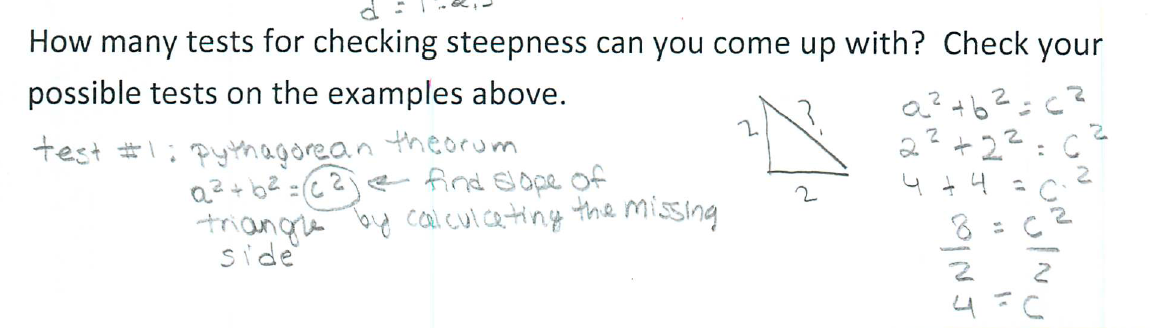
I was working on something I noticed in a trigonometry unit I recently ran with 9th Graders. Following CME Geometry, I see a road into trigonometry concepts that begins with comparing the steepness of different right triangles.
pic1
Here’s the different sort of thinking that I saw students doing in “comparing steepness” problems during the unit:
  • Comparing steepness visually, or by measuring the angles of the ramps
  • Comparing steepness by comparing the sides of the triangles
  • Comparing steepness by looking at both the height and width of the triangles, but not distinguishing between ratio of sides, difference of sides, etc.
  • Comparing steepness using the height/width ratio of each triangle
  • Comparing steepness using the ratio of any two sides of the right triangles

Here are some samples of student thinking to prove that I’m not totally pulling this out of my elbow.

pic1

pic1

pic1

I think it would be wrong to say that this is a way that my students thought about trigonometry. It’s certainly how my students thought about problems that are deeply related to trigonometry. It’s definitely how my students thought about “steepness comparison” problems.

Where does this leave us, if we’re interested in providing something of value to other trigonometry teachers?