
On Friday, I asked my Algebra 1 students to make sense of 3 – (-5) and problems like it. This is the holy grail of integer instruction. It’s the hardest type of problem to make sense of, harder than (-5) – (-3), harder even than (-3) – (-5).
My students had two productive ways to make sense of 3 – (-5), and it seems to me there’s at least another way they didn’t use. That makes three ways to think about 3 – (-5). Maybe there are more ways out there, but we’re constrained by the ways in which it makes sense to think about subtraction, so the possibilities aren’t endless.
What are these three ways to make sense of subtraction? Subtraction can be seen as a “Take Away,” “Compare,” or “Additive Inverse” operation. Here’s what I mean by each, as applied to 10 – 2:
- 10 – 2 might mean “you start with 10 things, you take away 2 of them.” It’s dynamic, meaning, there’s change, action. This is how most of our young friends think about subtraction.
- You might also think of 10 – 2 as a comparison between two quantities, “how much more 10 things is than 2 things.” Older students are sometimes taught to interpret this as the distance from 2 to 10. Either way, there is no action, rather there is a measurement in place of change.
- Finally, you might think of subtraction as doing the opposite of addition. 10 – 2 means, then, do the opposite of what 10 + 2 does. 10 + 2 means (whatever it means but possibly) you add 2 more to 10, so 10 – 2 means take 2 away from 10.
My students adapted the “take away” and “additive inverse” to make sense of 3 – (-5). They might have used comparison, but they didn’t. Here’s what those first two models looked like:
Take Away:
Here’s one way to use the take away interpretation for 3 – (-5).
You start with 3 positives. Really, though, we’re going to want to think of this as starting not with 3 positives but with a net charge of positive 3.

And this is still a net charge of positive 3…

Now, take away 5 negatives. Or, take away a charge of -5? Anyway…

…now you have 8. Tada!
Kids in my class weren’t explicit about that middle step, but they referred to it obliquely. They said things like, “well you have to imagine a lot of negatives and positives hanging around there.” I’ve seen curricula where you talk about a soup of charges. That works!
Of course, this needn’t be a model limited to charges. Swap charges with money/debt, or with helium/sandbags, floats/anchors. While kids might have different familiarity or comfort with different contexts, they all seem to help support the same kind of thinking.
Opposite of Addition
My heart’s with this one. I think it’s very promising.
It depends on knowing what 3 + (-5) is, because the idea is that 3 – (-5) should do the opposite of it.
So, when presented with 3 – (-5), you think, OK, what does 3 + (-5) do. Oh, that’s the same thing as moving to the left/taking away from 3:

Now grounded, you reason that 3 – (-5) does the opposite. So it makes 3 more positive, moves to the right, etc.

(N started talking about this in class in a mumbled way that I didn’t completely understand. Then, later, I offered the number line representation on the board, presenting it as a way that no one had mentioned yet. But N said, “That’s exactly what I was saying!” I found that heartening.)
Comparision
This is where the word problems can come, in full force. How much does the temperature change if it starts at -4 and moves to 10? What’s the difference in elevation between -10 and 20?
I’ve claimed before that kids don’t tend to come into their work with this interpretation of subtraction in their back pockets. That’s fine, it still works, potentially.
You say, 3 – (-5) means “how do you get from (-5) to 3?” The answer is, you add 8 to (-5).
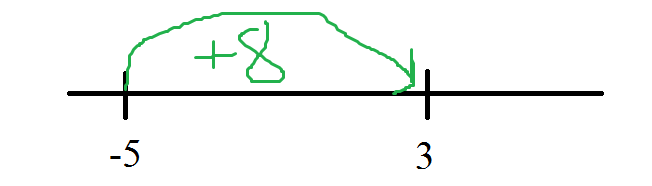
Why does 3 – (-5) mean getting from (-5) to 3? Not much we can say here, ‘cept that it’s consistent with 5 – 2.
Comparison seems like the least promising interpretation for me, but, hey, some people seem to swear by it.
—
Like I said, my heart is with the additive inverse approach at the moment. My representation of it was triggered my by kids’ work with a problem from Transition to Algebra (which I recommend highly). This was the problem, and I think it helped my students develop the ideas needed for that additive inverse interpretation:





 Teaching With Problems