

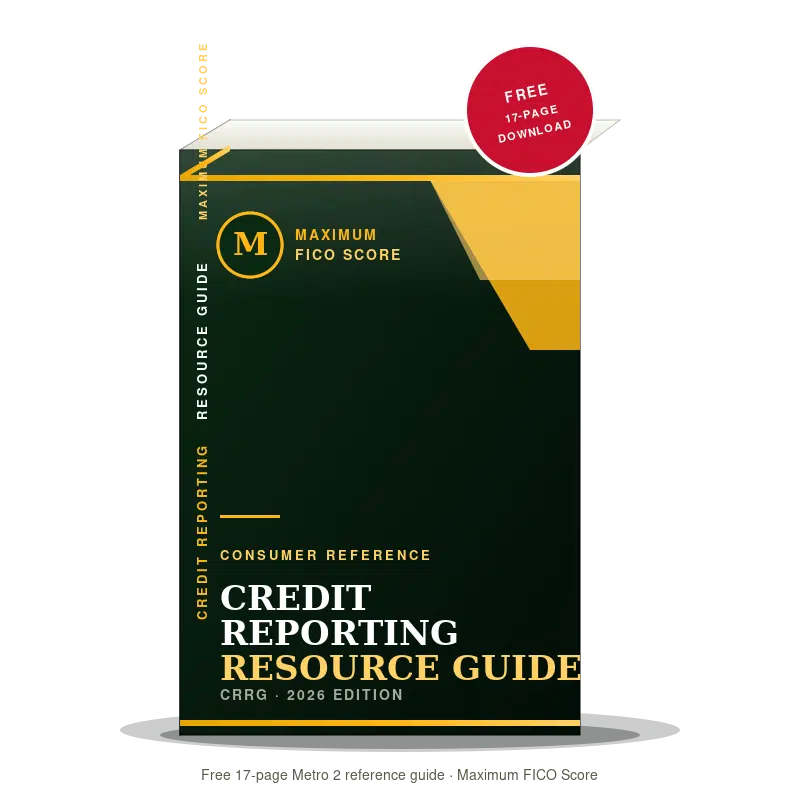
The Credit Reporting Resource Guide
A consumer’s plain-English reference for Metro 2 reporting, FCRA disputes, and tradeline corrections — written by the Maximum FICO Score team. Tell us where to send it and we’ll email your free copy.
- Metro 2 codes & required data fields, explained simply
- How FCRA disputes actually work, step by step
- A sample dispute letter you can adapt
- The 7 most common Metro 2 violations & a full glossary
Get Your Free Copy
Enter your details and we’ll email the 17-page guide right away.
We respect your privacy. Your information is never sold, and you can unsubscribe at any time.
What’s Inside the 17-Page Guide
The Consumer Data Industry Association’s official Credit Reporting Resource Guide is sold only to banks, lenders, and collectors — for several hundred dollars. We wrote this free consumer version to close that gap. Original, plain-English explanations of every section, referenced to federal law.
- 01 Welcome & how to use this guide
- 02 What Metro 2 actually is
- 03 Why Metro 2 matters (FCRA mechanism)
- 04 Required Metro 2 data fields
- 05 The 7 most common Metro 2 violations
- 06 Account Status Code reference (19 codes)
- 07 Compliance Condition Code (CCC) reference
- 08 Special Comment Code reference
- 09 Writing a Metro 2 dispute letter
- 10 Sample Metro 2 dispute letter
- 11 Your federal rights (FCRA, FDCPA, CROA)
- 12 Glossary of credit reporting terms
What Makes This Guide Different
📋 The Codes
Complete reference tables for Account Status Codes, Compliance Condition Codes, and Special Comment Codes — the same fields furnishers report. Most consumers never see this information.
⚖️ The Law
Every right and every dispute strategy in the guide is tied to its FCRA, FDCPA, or CROA citation. You’ll know exactly which federal statute backs you up.
✉️ The Letter
A full Metro 2 dispute letter template you can adapt for your own disputes. Same structure we use for our clients — sent certified mail to all three bureaus.
What Is a FICO Score?
A FICO Score is a three-digit number between 300 and 850. Fair Isaac Corporation (FICO) created it. It is the most widely used credit scoring model in the United States. Lenders use it to decide whether to approve a loan and at what interest rate.
The 5 Factors That Make Up Your FICO Score
35%
Payment History
On-time payments are the single biggest factor. One missed payment can lower your score significantly.
30%
Amounts Owed
This is your credit utilization rate. Keep balances below 30% of your limit. Below 10% is ideal.
15%
Length of History
Older accounts help your score. Do not close your oldest credit card without a strong reason.
10%
Credit Mix
A mix of revolving credit (cards) and installment loans (auto, mortgage) shows responsible use.
10%
New Credit
Each hard inquiry can lower your score slightly. Limit new applications before a major loan.
What Is a Good Credit Score?
FICO Scores range from 300 to 850. The higher your score, the better your access to credit and the lower your interest rates. Here are the standard score ranges used by most lenders in the United States.
| Score Range | Rating | What It Means |
|---|---|---|
| 800 – 850 | Exceptional | Borrowers typically qualify for the best rates and are seen as very low risk. |
| 740 – 799 | Very Good | Borrowers typically receive near-top rates on loans and credit cards. |
| 670 – 739 | Good | Most lenders approve borrowers in this range. Rates are average to slightly above average. |
| 580 – 669 | Fair | Some lenders approve borrowers here but at higher rates. FHA loans are often an option. |
| 300 – 579 | Poor | Approval is difficult. A secured card or co-signer can help rebuild. |
Note: FHA loans may be available to borrowers with scores as low as 580 (3.5% down) or 500 (10% down). Conventional mortgages typically require a minimum score of 620. Lending decisions are made by lenders, not by Maximum FICO Score.
Federal Laws That Protect Your Credit Rights
Four federal laws govern how credit is reported, collected, and repaired in the United States. Every consumer should know these laws. Maximum FICO Score operates in full compliance with all of them.
FCRA — Fair Credit Reporting Act
The FCRA, 15 U.S.C. § 1681, controls how Equifax, Experian, and TransUnion collect and share your credit data. It gives you the right to dispute errors, access your reports for free once per year, and receive notice when adverse action is taken. Bureaus must investigate disputes within 30 days.
CROA — Credit Repair Organizations Act
The CROA, 15 U.S.C. §§ 1679–1679j, governs all credit repair companies. Under CROA, a credit repair organization cannot charge you before completing services. It must give you a written contract and a three-day right to cancel.
FDCPA — Fair Debt Collection Practices Act
The FDCPA, 15 U.S.C. § 1692, bans abusive, deceptive, or unfair debt collection tactics. Collectors cannot call at unreasonable hours, use threats, or misrepresent the debt.
FCBA — Fair Credit Billing Act
The FCBA, 15 U.S.C. § 1666, gives consumers the right to dispute billing errors on open-end credit accounts like credit cards. You must submit a dispute in writing within 60 days of the statement.
How to Dispute an Error on Your Credit Report
Under the Fair Credit Reporting Act (FCRA), 15 U.S.C. § 1681i, you have the legal right to dispute errors on your credit report. Each bureau must investigate within 30 days. For a deeper walkthrough, see our FCRA Dispute Process Guide.
Get Your Credit Reports
Request your free reports from Equifax, Experian, and TransUnion at AnnualCreditReport.com. Under the FCRA, you are entitled to one free report from each bureau every 12 months. Review all three.
Find the Error
Look for accounts you do not recognize, wrong balances, late payments you did not make, duplicate entries, or accounts past the 7-year reporting limit (10 years for Chapter 7 bankruptcy).
Gather Your Proof
Collect documents that support your dispute: payment receipts, bank statements, account letters, court records, or identity documents.
Send a Written Dispute to the Bureau
Write a dispute letter to Equifax, Experian, or TransUnion. Include your full name, address, the account in question, a clear description of the error, and copies of your proof. Send by certified mail.
Wait for the Investigation
The bureau must investigate within 30 days under FCRA, 15 U.S.C. § 1681i. They contact the creditor, review your evidence, and make a decision. You will receive the result in writing.
Review the Result and Follow Up
If the bureau removes the error, request a new copy of your updated report. If rejected, you can add a 100-word statement of dispute, escalate with a Metro 2-based dispute, or contact Maximum FICO Score for help.
Get the 6 Credit Dispute Letter Templates
Ready to put the steps above into action? The same letter structures our team works from — written in plain English, referenced to federal law, and ready for you to customize. Tell us where to send them and we’ll email your free editable toolkit.
- Credit Bureau Dispute Letter (FCRA § 1681i)
- Debt Validation Letter for collectors (FDCPA § 1692g)
- Goodwill Adjustment Letter
- Unauthorized Hard Inquiry Dispute Letter
- Method of Verification Follow-Up Letter
- Personal Information Correction Letter
- Plus a how-to guide, bureau mailing addresses & a compliance disclaimer
Where should we send them?
Enter your details below and your free templates will be emailed to you right away.
We respect your privacy. Your information is never sold, and you can unsubscribe at any time.
These templates are educational information only and are not legal advice. No specific result is promised or guaranteed. Results vary by individual credit profile.
How to Improve Your Credit Score
These are some of the most effective, legal strategies for working toward a higher FICO Score. No shortcut bypasses your credit history — but these steps can build healthier credit over time. Results vary by individual credit profile.
📅 Pay Every Bill On Time
Payment history is 35% of your score. Set up autopay for at least the minimum on every account. One 30-day late payment can drop your score by 50 to 100 points.
📉 Lower Your Credit Utilization
Pay down balances to get below 30% of your credit limit on each card. Aim for under 10% for best results. See the AZEO Method.
🔍 Dispute Inaccurate Items
Errors on your credit report can cost you points you did not deserve to lose. Under the FCRA, each bureau must fix or remove confirmed errors after investigation.
👤 Become an Authorized User
Ask a trusted person with good credit to add you as an authorized user on their card. Their positive history can appear on your report and may help your score.
🏦 Open a Secured Credit Card
A secured card requires a deposit as collateral. Use it for small purchases and pay it off in full each month. Builds positive payment history over time.
🚫 Limit New Credit Applications
Each hard inquiry can drop your score by up to 5 points. Avoid applying for new cards or loans in the months before a major purchase.
📋 Keep Old Accounts Open
The length of your credit history is 15% of your score. Closing your oldest account shortens your average account age and can lower your score.
🔄 Diversify Your Credit Mix
Having both revolving accounts (credit cards) and installment accounts (auto, mortgage) shows lenders you can manage different types of debt responsibly.
Credit Repair Glossary
The most important credit terms every consumer should understand. Each definition is factual and precise so you can make informed decisions about your credit.
Credit Utilization Ratio
The percentage of your available revolving credit that you are using. Makes up 30% of your FICO Score. $3,000 on a $10,000 limit = 30%. Keep below 10% for best results.
Hard vs. Soft Inquiry
A hard inquiry happens when a lender pulls your credit for a lending decision — can lower your score up to 5 points, stays 2 years. A soft inquiry (checking your own score) doesn’t affect your score.
Charge-Off
When a creditor writes off your debt as a loss after 120–180 days of missed payments. The debt still exists. Stays on your report 7 years from the date of first delinquency.
Collections Account
When a creditor sells your unpaid debt to a collection agency. Lowers your score significantly. See our How to Remove Collections guide.
Debt-to-Income (DTI)
Total monthly debt payments ÷ gross monthly income. Not part of FICO, but lenders use it for affordability. Most mortgage lenders prefer below 43%. FHA allows up to 50%.
Statute of Limitations
The time period during which a creditor can sue to collect a debt — varies by state, typically 3–10 years. Separate from the FCRA’s 7-year reporting limit.
Credit Score FAQ
What is a FICO Score?
A three-digit credit score (300–850) created by Fair Isaac Corporation. The most widely used credit scoring model in the U.S. Five factors: payment history (35%), amounts owed (30%), length of history (15%), credit mix (10%), new credit (10%).
How do I dispute an error on my credit report?
Under FCRA §611, send a written dispute to the bureau (Equifax, Experian, or TransUnion) by certified mail with proof. They must investigate within 30 days. See our step-by-step guide.
How fast can I improve my credit score?
Paying down high balances can improve your score within one to two billing cycles. Removing errors after a dispute can take 30 to 45 days. No company can legally remove accurate negative information instantly — any claim like that violates CROA. Results vary by individual credit profile.
What is credit utilization?
The percentage of your revolving credit limit you are using. 30% of your FICO Score. Below 30% is good, below 10% is ideal. See the AZEO Method for the optimization strategy.
What is a good credit score range?
Exceptional 800–850, Very Good 740–799, Good 670–739, Fair 580–669, Poor 300–579. Most conventional mortgage lenders require at least 620. FHA loans available with scores as low as 580 (3.5% down).
Ready to Put This Into Action?
Since 2016, Maximum FICO Score has helped thousands of consumers dispute items that appear inaccurate and work toward their credit goals. Our process is ethical, CROA-compliant, and built around your rights under the FCRA. Results vary by individual credit profile.
Start Free Assessment Book Free ConsultationMore Free Downloadable Guides
Download these free educational resources — no email required. All are CROA-compliant educational content from our team. Looking for the Credit Reporting Resource Guide or the 6 Letter Templates? Grab those using the forms higher up this page.

Bonus Credit Materials
Dispute errors, work on your score, and build business credit for growth. Start your journey to financial freedom today!
📥 Download PDF
Removing Student Loans
Step-by-step guide to dispute inaccurate student loan information, manage defaults, and work on your credit.
📥 Download PDF
How to Remove Bankruptcy
Learn strategies to challenge inaccurate or outdated bankruptcy records on your credit report.
📥 Download PDF
DIY Credit Repair
Empowers you with tools to work on your credit, dispute errors, and understand your report — all on your own.
📥 Download PDF
Unauthorized Inquiry Disputes
Methods to identify and dispute unauthorized credit inquiries and help clean up your report.
📥 Download PDF
Mastering Business Credit
Build and manage strong business credit with this guide. Secure funding, establish credibility, and grow your business.
📥 Download PDFFederal Credit & Financial Resources
Trusted, official resources to help you learn about credit, protect your identity, reduce unwanted offers, and get help with taxes or student loan issues.
Consumer Financial Protection Bureau (CFPB)
U.S. government agency that makes sure banks, lenders, and other financial companies treat you fairly.
Federal Trade Commission (FTC)
Protects the public from deceptive or unfair business practices. Also runs IdentityTheft.gov and the Do Not Call Registry.
IRS Taxpayer Advocate Service
Independent organization within the IRS offering free assistance to help resolve tax problems.
OptOutPrescreen.com
Official Consumer Credit Reporting Industry site to opt-in or opt-out of firm offers of credit or insurance.
National Consumer Law Center (NCLC)
Student loan cancellation, repayment, and collection assistance resources.
Ready to Move From Reading to Doing?
If you’re navigating multiple collections, an upcoming mortgage application, or a long-running dispute, we can help. Free assessment and consultation. No advance fees. Bilingual support. Results vary by individual credit profile.
Start Free Assessment Book Free ConsultationPrefer to talk first? Client Support: (661) 505-8085
Already reviewed your options and ready to enroll?
Sign Up Now