This is a Sugar Loaf view from the hill where the Christ the Redeemer is at.
The last time I measure the view distance was about 5 kms. (Not that it wold change!)
Double click the image to enlarge.

This is a Sugar Loaf view from the hill where the Christ the Redeemer is at.
The last time I measure the view distance was about 5 kms. (Not that it wold change!)
Double click the image to enlarge.
One of my many visits to Rio de Janeiro. I took this photo at the top of the hill where the Christ the Redeemer is. That is a height of about 2,329 ft (710 metres.) and the height of the statue is 125 ft (38 meters), so we were basically at the same height but standing on different places. Keep these numbers in mind because it took me quite a while to figure them out.
Gliders are common and tend to pass by above the tourists. I think this was one of those lucky shots.


I’ll be in love with you.

This monument is located at the Basilica de Nuestra Señora del Rosario and Convent of Santo Domingo on Av Belgrano and Defensa street.
Although the Dominicans occupied the site of the current Basilica of Our Lady of the Rosary and Santo Domingo Convent from 1606,1 it was not until 1751 that the current building designed by the Turin architect Antonio Masella began to be erected. On June 29, the cornerstone of the temple was laid, but the works did not advance steadily, due to disagreements between the designer and the order.2 It was not until 1762 that they were resumed with Don Juan de Lezica y Torrezuri as the main benefactor and probable director. of work until 1779.2 The church was consecrated on October 17, 1783, without being completed


On Juana Manso Av. in Puerto Madero, Buenos Aires, Argentina.
Love doesn’t need to be elaborated. It just is. A mother and her baby in a stroller, and a sign where causalities do not exist.


Love is all you need


Moctezuma was the ninth Aztec emperor of Mexico, famous for his confrontation with the Spanish conquistador Hernán Cortés.


Moctezuma II by Daniel del Valle from the Museo Nacional De Arte, Mexico.
Moctezuma II visiting the tombs of his ancestors (Moctezuma in Chapultepec), 1895. Faced with premonitions and signs about the arrival of the Spanish and the near end of his reign, Moctezuma had his portrait and that of all his ancestors sculpted on a rock in Chapultepec.
Daniel Del Valle’s oil painting portrays the moment when the monarch and his entourage burst into tears when contemplating the sculptures.
A Chimalli or pre-Hispanic shield made of feathers from a great variety of birds and feline skin.
It was made in the specialized workshops of the empire of Moctezuma II and sent by Hernán Cortés to Carlos V before 1524. A little over three centuries later, in 1865, Maximiliano de Habsburgo arranged for his return to Mexico to become part of the Museum’s collections. Imperial (later National Museum); in 1866 the shield arrived in Mexico from Austria. Since 1944, this chimalli with feathers and feline fur has been a treasure of the Castle of Chapultepec. It should be noted that this pre-Hispanic shield is the only one of its kind that is preserved in Mexico and one of the four existing ones known in the world.

Stay of the feathered shields in the Old Continent.
In 1522 Hernán Cortés sent the bishop of Palencia, Spain, three shields. One of them with the red field and a monster of gold and feathers.
Between 1523 and 1524, Carlos V received and distributed in different cuts, plumages and shields that showed the wealth of the conquered territories: to his brother Fernando I of Austria he awarded eleven objects. Eighty relics were given to his aunt, Archduchess Margaret, and included shields. A “made with the skin of an animal with spots” stands out. This collection was registered in the Palace of Mechelen in Flanders.
Around 1569, two rodelas with fretwork designs could have reached the court of Stuttgart, Germany. Until the 19th century, news of the four rodelas that are preserved today were once again described in the inventories of castles in Austria and Germany.

Adrian Unzueta, Sacrifice of Spaniards by Mexica, oil on canvas, 1898.


Spanish armor

Spanish armor

Eagle Warrior.
Clay patterned with stucco
Mexica culture. Late Postclassic. (1325-1521)
In his tiahuitztli they stand out a helmet of a real eagle of great proportions with the open beak from which the youthful face of the warrior emerges; the feathered suit with outstretched wings and the sharp claws of the raptor.
Eagles and jaguars were protectors of the prestigious cuauhtl-ocelotl warriors associated with the cult of the Sun. This clay character represents the dead warrior on the battlefield that accompanied the Sun on its way to the zenith; hence its association with daytime warfare.

The typical mexica warrior costume was tied at the back, covering arms and legs; sometimes they were feathered or helmeted. Unfortunately no ancient examples have been preserved.
The long pole is a replica of a macuahuitl in carved and lithic wood, oak, obsidian and tree resin. It is a Mexica shock weapon. Oak wood stick with more than 80 centimeters long to which obsidian blades with huizache or mesquite resins were added.

Spanish armor

Moctezuma receives the messengers
This image presented corresponds to the work “Moctezuma receives the messengers”, (1893). In this painting, the emissary of the Mexica tells Moctezuma about the foreigners who have begun to advance towards Tenochtitlan. Moctezuma is accompanied by nobles and warriors who are attentive to the message.
Adrián Unzueta was a Mexican painter born in 1865, and of whose biography there is little information. It is known that he entered the Academy of San Carlos around 1880, where he was a student of important teachers such as Juan Urruchi, José María Velasco and Santiago Rebull. Later, in 1897, he became a professor at the same Academy.
In general, his work enjoys strict academic rigor in anatomy and composition, while his subject matter highlights the iconography and passages of the pre-Columbian history of Mexico.

The Tro-Cortesiano Codex
The Tro-Cortesiano Codex or Madrid Codex is a Mayan codex. It is considered the most important book in the Museum of America in Madrid, and one of the most outstanding pieces in the entire collection, although due to conservation needs what is exposed to the public is a facsimile and the original remains stored in the museum’s vault. .
It is one of the only four pre-Hispanic Mayan codices that are preserved, along with the Dresden Codex (State Library of Saxony and the Dresden University, Dresden), the Paris Codex or Peresian Codex (National Library of France, Paris ) and the Grolier Codex, or Saenz Codex, (National Library of Anthropology and History, Mexico City), whose authenticity was long disputed, 1 although an in-depth study published in 2016 by a team from Brown University (United States Unidos) assured that it is not only authentic, but the oldest of those preserved.

Second Treatise on Error.
by Miguel Carrillo Lara, 2003

The fusion of two cultures. Jorge González Camarena, 1963.
(The painter is also brother to Guillermo González Camarena who had invented the color TV, his patent also registered in the US here.)
In the dramatic scene conceived by the artist, the conqueror and his horse confront the indigenous warrior. Gonzalez Camarena represents some characteristics of the military conquita, such as violent death. However, these were not the only facets of the confrontation of 1519-1521 in which the Mexica were defeated not only by the Spanish, but also by indigenous peoples.
I hope you have enjoyed this post. As a side-note I did’t travel this whole year as many have not. I rarely post photographs from Mexico or its history, now it is a good time. There are so many stories to tell but I rarely do because I think I would be biased. Our culture has a long history way back and many customs have stayed with us, as strange as it seems.
If you would like to know something in particular or general, write a comment and I’ll get back to you!
*All photographs taken by me.

Aztec timeline.
I Love You
(Yo te quiero)
This is the latest song from my daughter Miranda.
She has several songs already recorded. I bet you will like them all, nevertheless there will not be a video for each one.
This video is kind of different from the previous one since this has a story to tell. A curious thing that happened is that the green jacket used in the last one is used here also. Production just did not realized that, so now is a token of good luck! Another fun fact is that there is a car involved that is also green and nobody had noticed that either.
Her music is different. It is not the classic pop or anything like that. I am a person that listens to lots of music of many kinds and I am surprised that something different that we are not used to would be widely accepted… So far so good!
You can see her on her social media:
You can also find her music on Amazon, Apple Music, YouTube Music, and on Spotify
Enjoy! and thanks for watching.
Just a couple of days ago I took a company training called “Plain English”. As many company web-trainings are I really thought this was not going to be any different.
To my surprise this was very entertaining. Not only did I learn, I was able to be aware for two straight hours.
I am not a native English speaker even though it was taught to me at a very early age. There is a ton of cultural difference on how I (we) write in Spanish, which is a more elaborate, fancy and confusing way. Yes, not many writers take care of their readers.
I found out that it is better to write in a simpler, colloquial (inside joke, ha!), plain way than adding adjectives one on top of the other. The benefits seem plenty. Writing this way is supposed to keep your readers interested on what you are trying to communicate, it also states that there are more chances to keep them all the way to the end.
I had a chance to comment about this with an English friend. He raised his eyebrows and said, “those are Americanisms!” -end of quote. Since I am a citizen of the world, I didn’t pay much attention to his mock. For much I care about him, I know he can be obnoxious just for fun, even though he is not Irish. (unconscious biased? another joke.)
One of the lessons mentioned that if you address complex subjects to others, explain them in a simple way like if you were talking to your family, the message will get across. There is a readability index (The Flesch–Kincaid) which points how hard or easy is to comprehend a text. The target index score for plain English is 70-60 which correspond to school level eight or nine.
Wondering why Reader’s Digest has been around since 1922 and has a total circulation (Yr. 2020) of 3,029,039?. Plain English!
| Item | Readability Index (the higher # the easiest) | Item | Readability Index (the higher # the easiest) |
| Comics | 92 | Newsweek | 50 |
| Consumer ads in magazines | 82 | Wall Street Journal | 43 |
| Movie Screen | 75 | Harvard Business Review | 43 |
| Seventeen | 67 | New York Times | 39 |
| Reader’s Digest | 65 | New York Review of Books | 35 |
| Sports Illustrated | 63 | Harvard Law Review | 32 |
| New York Daily News | 60 | Standard auto insurance policy | 10 |
| Atlantic Monthly | 57 | Internal Revenue Code | minus 6 |
| Time | 52 |

Hopefully you made it this far, which means I did good on my training! I added a video from a restaurant in Windsor in the UK, to remind my Englishman friend that plain English is not only “Americanisms”…
Either way I had to add something so…

This place is the Castle Hotel, Windsor Mgallery in the UK.
Tell Me About You is a song.
(Cuéntame de tí)
This song was written and is performed by my daughter Miranda.
She started her musical carrier when she was very young, and after a long path and many tries she has finally produced her first music album.
Tomorrow she will be working on the video of her next song. As I father I am very proud and I know I have a very creative and independent daughter.
Of course, one’s daughter is always the best!
You can see her on her social media:
You can also find her music on Amazon, Apple Music, YouTube Music, and on Spotify
Enjoy! and thanks for watching.

Maximilian of Augsburg (Austria), Emperor to México

Entrance to the Castle of Chapultepec.
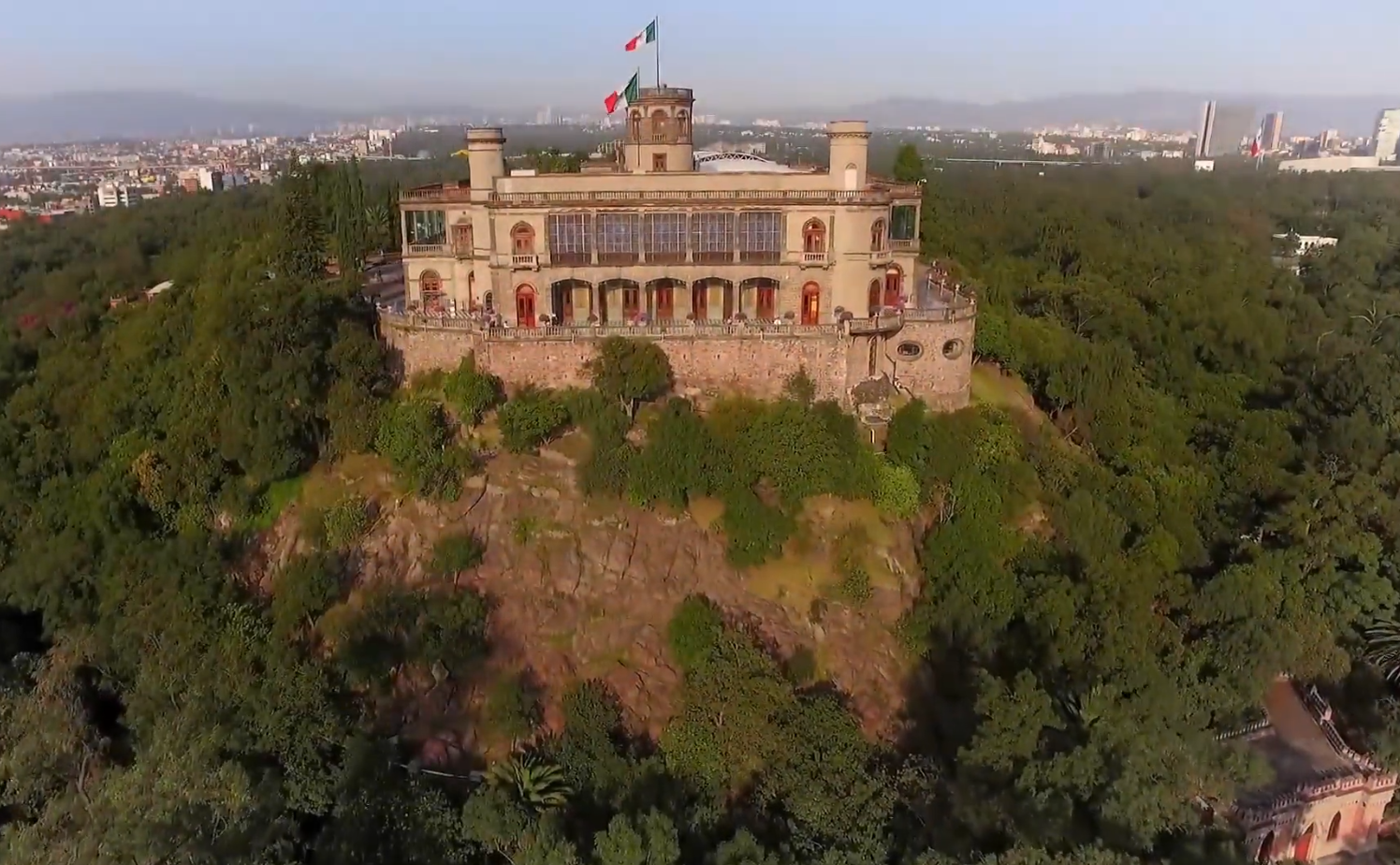
This is the short story about The Castle of Chapultepec
I was organizing my photographs and found a nice deck I had not posted yet, and they are quite recent, so I will use them here and tell you a story.
Before I start I will give you some general highlights about this place. To start with, the place where the Castle was built is three thousand years old know as Bosque de Chapultepec or Chapultepec Forest. You should note by now the catchy Chapultepec name, which for all and sundry is a Nahuatl word (tongue spoken by Aztecs and Mexicas ) that stands for “Grasshopper Hill” (Chapulli – Grasshopper/ Tepe – Hill). Without any intend we are going way far into history.
To make a long story short (you are not getting away yet, though) the Castle had many uses:
Its construction began in 1778 as a summer house for the viceroy (forget about Camp David!), It happens to be the only Royal Castle in America (America the continent not the country, and let’s not go there this time.) It was also used as a gunpowder warehouse to a military academy in 1841 where also a battle took place: the Mexican-American war (September 13th, 1846 – February 2nd, 1848). Can we have California et. al. back?
During 1864-1867 it was the official residence to the Emperor Maximilian I (July 6, 1832, Schönbrunn Palace, Vienna, Austria /June 19, 1867, Cerro de las Campanas), the younger brother of the Austrian emperor Franz Joseph I, who accepted an offer from Napoleon III of France to rule Mexico.
Spoiler alert: having an Austrian emperor would be the outcome of the infamous “Batalla de Puebla” / Puebla’s Battle where Mexicans fought against the French men, and that gave origin to the Mexican celebration known in many places and abroad as “5 de Mayo” (fair to say this is not Mexico’s Independence day which date is September 16th).
This is getting interesting, isn’t it?, and I haven’t told you about that when the Emperor died (by a firing squad), they had to trim his legs because he was too tall to fit his coffin. Don’t get me started to talk about his wife who went insane after all this ordeal and people would call her “Carlota la loca” (Carlota, the crazy one).
After this tragic chapter and some years later Chapultepec’s Castle became the residence for the country’s presidents between 1884 and 1935, and today it is the National Museum of history , Chapultepec forest became Chapultepec Park which I may add is known as the green lung of Mexico City, it is at least two times bigger than Central Park of New York with more than 686 hectares where many cultural events take place.
Yes it has a lake.
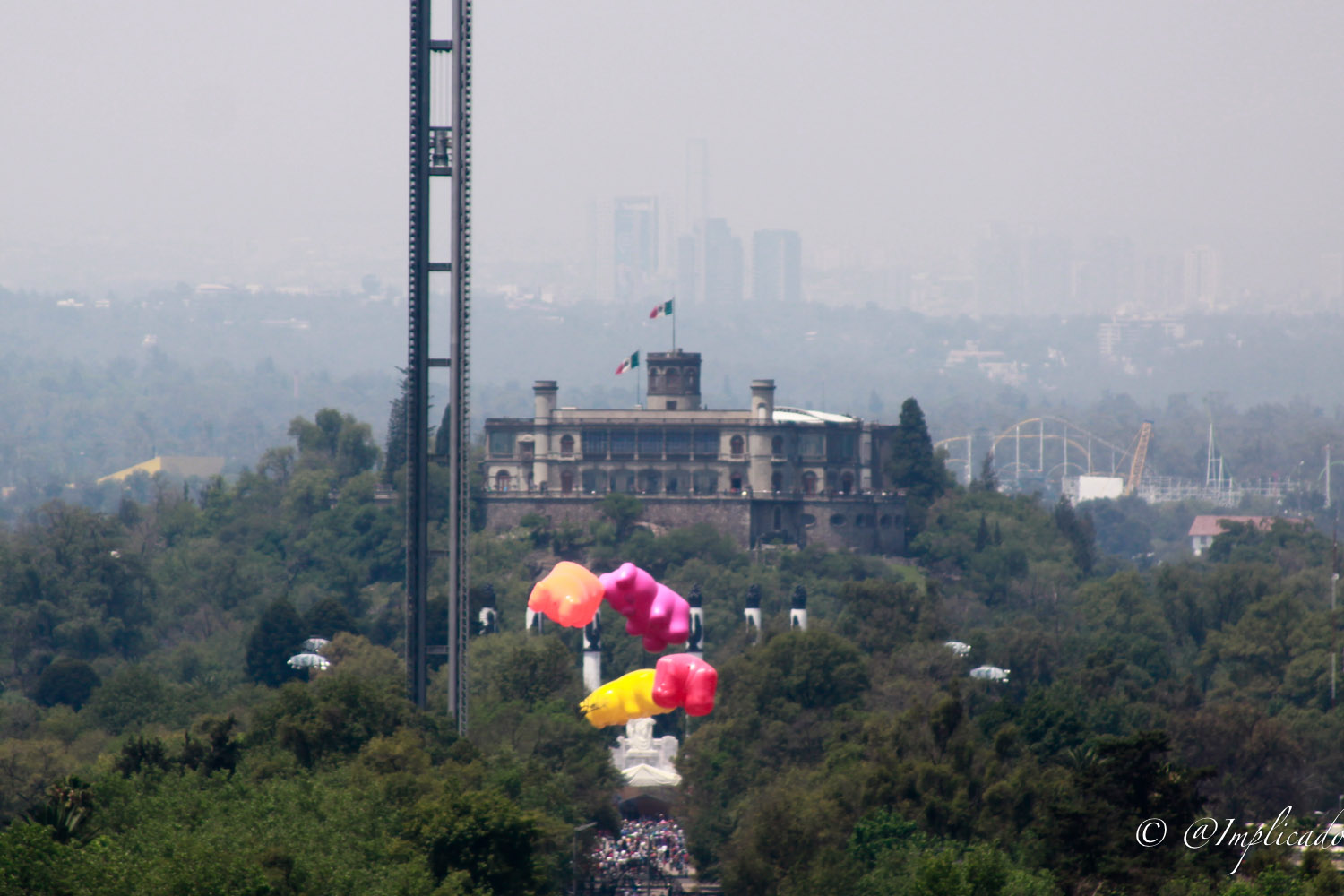
I took this photograph some years ago when I wrote a post about Reforma Avenue and Castillo de Chapultepec. Not easy to take a brand new one since I had to go up through the Angel of Independence Memorial and that is not accessible now. At the distance, this is how the Castle looks like, and as you can appreciate it is on the top of a hill.
Just to give you an idea of its dimensions, here is a map of the area:

The Castle has many accesses being the main one by Reforma Avenue, where there are many Museums. Actually, Mexico City has 160 museums, just 85 on the area where the Castle is at.
Why Mexico City Could be the Next Paris
Official listing of the museums in Mexico City 2020. (Spanish)
I will update this post once in a while to keep adding information that may be of interest.
In the meantime, enjoy!

Entrance to the Castle’s Garden

The main square of the Castle. It is the main entrance to the site.

The pergola in the garden, where you can see the woods, lake and the buildings on Reforma Avenue.

This is the view from the pergola. You can see many buildings: Hotels and offices.

At the Castle’s Garden there are some monuments and fountains.

The access to upper floors covered by paintings of Mexican artists.

Maximilian Chariot very well preserved.

One of my favorite rooms: The Piano Room. There is a mirror that goes from floor to ceiling flanked by two portraits.
On the left Maximilian and on the right Carlota his wife.

A waiting room.

A view the City down the hall.

A view to Reforma Avenue. One of Mexico’s main avenues that hold many museums, hotels and other landscapes.

Stairs connecting upper floors.
A waiting room

Another access to upper floors.

The upper floor that one has access to. There is a higher corridor, but there is no access to it. It surrounds part of the Castle.

Marvelous Stain Glass work. There about six of them along a corridor.

Marvelous Stain Glass work. There about six of them along a corridor.

Stained glass corridor leading to the Caste’s rooms.
 Upper garden and Mirador to the city.
 A painting with some of the motives that the Castle has.
Note that on the top, there is a horse with an American Flag representing the Mexican- US war.
 The tower in the Castle
 An opposit view to the Castle’s entrance
 Turists.
  Same turists, differnt angle. 🙂
 On the main entrance this painting is on the ceiling. It represents one of tne scenes of the US invasion to Mexico.
One of the cadetts of the Castle, at that time it was a Military School, grab the Mexican flag and jumped off to the Cliff.  Paintngs for famous Mexican muralists
 The green cups and door made out of malachite stone were a gift from Rusian Emperor Zar I
 A view to the City from the main Castle’s square.
 Maximiliam of Augsburg, Emperor to Mexico
 Mexican Murals
  Mexican Murals, This by Gonzalez Camarena brother to the Mexican Color TV inventor. (That is another story some place on this blog.)
 A painting representing the Mexican France Battle of Puebla. This battle is the reason to Cinco de Mayo
 Mexican President and Dictator Porfirio Diaz. The reason there was no more Austrian Emperor.
He fought France and after 30 years of dictatorship in Mexico he finally was exhiled and lived his last years….. in France.

A view from atop.
(Not a photo of mine but worth looking)

Life is made of opposites. You wouldn’t be able to appreciate day without night, cold without hot, joy without sorrow…. and the list goes on and on…
Songwriters: Ryan Merchant / Sebu Simonian
Don’t wait for an invitation
No need for reservation
This life is an exploration
And you gotta see what I see in you
I can’t wait one minute more
The sun will shine
The sun does shine
We can’t wait one minute more
The sun does shine
The sun does shine
Just think of the destination
I’ll be your transportation
We’ll find there’s a kind of place
That can only be seen with a naked mind
I can’t wait one minute more
The sun will shine
The sun does shine
We can’t wait one minute more
The sun does shine
The sun does shine
There’s a key that opens a door
Will you find it and turn it?
Take your time, don’t take too long
There’s a map that’s washed ashore
Will you find it and burn it?
Unleash your imagination
Two stars, one constellation
Bright lights just to guide the way
Can you see what I see in you?
I can’t wait one minute more
The sun does shine
The sun does shine
We can’t wait one minute more
The sun does shine
The sun does shine
I can’t wait one minute more
The sun does shine
The sun does shine
We can’t wait one minute more
The sun does shine
The sun does shine


 Implicado