A to Z Challenge 2026 – Military and “M” Fabrics plus a few Mills…

“Choose any subject you would like to write about…” that is the object of the A to Z Challenge, and thinking of things that interest me is not a problem for me, but choosing a subject not only to write about, but to write in a way that other people will catch my interest – that is the real challenge! This year I turn to a subject, close to our skin if not our hearts, and yet, again, I wonder if this subject will get some people past the title on the list – dismissed as niche? For this year, my theme is What We Wear – Fabrics and Fibres

The choice of fabric for military clothing is a good illustration of the balancing act required in all fabric choices, but military clothing is subject to more extreme uses and thus requirements – warmth for cold climates, breathability and sweat wicking for hot climates, durability, resistance to tearing, ability to assert power on the one hand, or camouflage the wearer on the other.

We already encountered the fabric that dominated military clothing in the 18th and 19th centuries – Broadcloth, under H for Historical Fabrics – from the assertive red uniforms of the British army, to the uniforms of the British Royal Navy, broadcloth reigned supreme. Britain excelled in wool production and broadcloth – first woven, oversize and then hammered to felt and shrink it, made it tough, warm and water-resistant and still warm enough when fully wet. One might pity the soldiers forced to wear red which presumably made them easy targets for the sake of projecting power…

Because of the dense nature of broadcloth, very small seam allowances will suffice and this webpage examines quilts made by soldiers and sailors using scraps of uniform fabric and these tiny seams are shown below – a photograph which also shows the nature of broadcloth.

Kent Uniform Coverlet Quilters’ Guild Collection
From YorkStitcher – Textile Artist
Kent Uniform Coverlet Quilters’ Guild Collection
Detail of the reverse showing stitching and seams
From YorkStitcher – Textile Artist

Kersey, or Kerseymere – was a thinner, cheaper imitator of broadcloth and clothed the lower ranks – originating in East Anglia around the village of Kersey in Suffolk by the 18th Century the largest production was in West Yorkshire, particularly in the Keighley area (where I live).

The properties of Kersey made it popular for coats and cloaks for the lower orders. Frequently used during the Civil War as a cloth for soldiers’ coals and breeches, by the latter half of the 18th Century these items were made from Broadcloth. However, Double-Milled Kersey was used for sailors’ jackets by the Admiralty and for Army greatcoats, Cavalry cloaks (in red or blue for heavy and light) and fatigue jackets (in natural or buff for buff faced Regiments). – https://louisebyford.blogspot.com/2013/06/historical-fabric.html

Serge – Like Bay, Serge is a cloth with a worsted warp and woollen weft, although in this case twill woven. The twill helps to maintain the stability whilst retaining enough flexibility to be used as a lining material. Sturdy, but itchy, and absorbing huge amounts of water, which made it difficult to dry out.

from Fabriclore

Khaki – By the late 18th century, the industrial weaving of cloth and the changing sensibilities around the idea of camouflaging soldiers led to the introduction of Khaki a cotton fabric dyed in earthy shades to blend with the natural environment. This early version of camouflage had a profound impact on future military clothing.

By the First World War, the uniforms in the trenches were a combination of wool and cotton offering warmth, durability, and comfort in trench warfare conditions and just as red uniforms had, in the past, meant that blood did not show up (increasing the idea of invulnerability), the khaki uniforms did not show up the mud of the trenches so badly thus preserving the idea of a uniformed army…

This website gives a complete breakdown of the WW1 British Army uniform.

The coming of Synthetics – the Second World War saw the advent of synthetic fabrics like nylon and polyester, which offered lightweight, durable, and weather-resistant properties. I received a pair of “indestructible” socks for Christmas one year made from pure nylon and soon discovered, that whilst they were indeed tough, they made for very smelly feet! This page looks at the pros and cons of nylon! However, as a blend with other fibers such as cotton, nylon can lend strength to fabrics and the right balance was soon found.

Postwar fabrics and the uniforms made from them continued to evolve and the uniforms tended towards evermore specialist kit for different theatres of war, different requrements, different camouflage and the incorporation of new synthetics like Gore-Tex – both waterproof and yet breathable, Kevlar the miracle bullet-proofing fabric, but more of that when I get to Synthetics.

Mills

Salts Mill

Almost every town or village in the area in which I live in West Yorkshire has a mill – or more precisely, if they lie along the Leeds-Liverpool Canal. The canal brought coal to power the steam engines that drove the mill machines, cotton from America via Liverpool, and the finished goods were shipped to Leeds for distribution to all points South or to Liverpool for export from the docks to the rest of the world.

Above is Salts Mill, which, when built, had the largest room in the world, stretching the entire length of the building! Sir Titus Salt, the mill owner, built it to new specifications regarding fire, following lethal fires in previous mills, where aerialised lint and wooden floors caused rapid upward spread of fires killing many workers. Sir Titus created brick arch ceilings with a foot of ash on top and the next floor on top of that. He built the neighbouring Saltaire to house his workers (no pubs though as he was teetotal) and lived in nearby Bradford. Bradford had more millionaires in the 19th century than any other city in the world. There was no shortage of ash since every mill produced tons of the stuff and so every mill site has a great mountain of the toxic stuff somewhere nearby. In our village of Silsden, a steep little stream valley was culverted and the valley filled for some 300 yards with ash…

Amongst other things, Salt’s Mill houses a permanent David Hockney Gallery – another Bradfordian made good and there is a small museum about the history of the mill – however, there is not a single piece of fabric known to have been made in the great mill – all that is mere ephemera… So imagine my pleasure in finding a Dewhurst “Sylko” Machine Twist colour sample chart from the Belle Vue Mill in Skipton – the other direction from our house from Saltaire. Grubby on the outside, the threads still look great inside. I took a photo of the mill – now converted to apartments just this week…

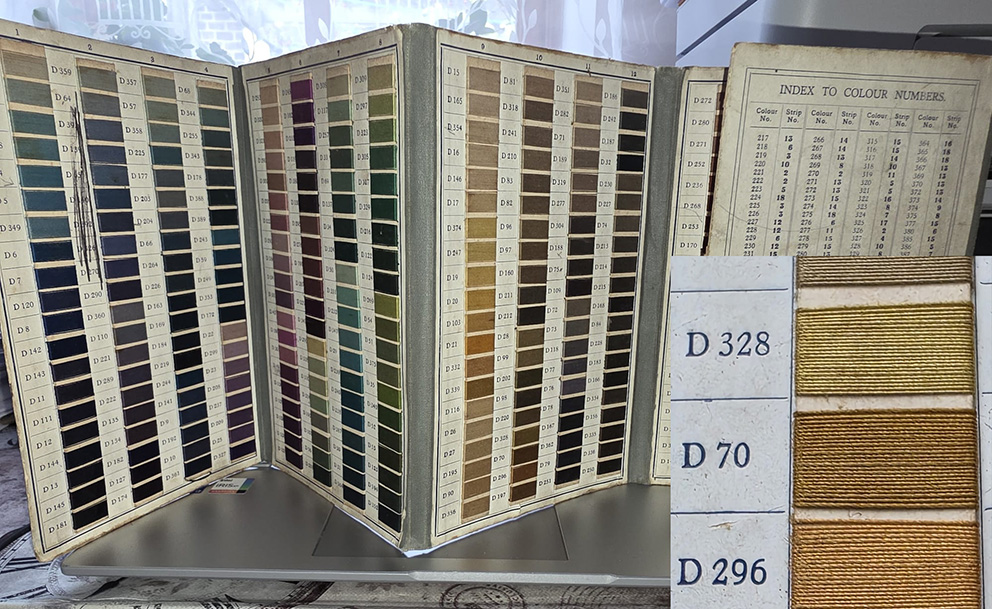
The chimneys are gone but otherwise, Belle Vue mill is still much the same on the outside…
A smaller mill in Keighley but look at the pride and assurance with which the name is carved in stone. This was the “Workpeoples Entrance” now bricked up…

“M” Fabrics

Mackinaw -The story of Mackinaw is fascinating and varied encompassing a smuggled contraband item concealed in the covers of Prairie wagons, an iconic lumberjack shirt and the sometime “uniform” of the Beach Boys – I refer you to the Wikipedia account...

The Beach Boys, 1963.

Madapollam – is a soft cotton fabric manufactured from fine yarns with a dense pick laid out in linen weave. Madapollam is used as an embroidery and handkerchief fabric and as a base for fabric printing.[1][2] The equal warp and weft mean that the tensile strength and shrinkage is the same in any two directions at right angles and that the fabric absorbs liquids such as ink, paint and aircraft dope equally along its X and Y axes.

Madapollam fabric was used as the covering for the de Havilland Mosquito a pioneer of wooden monocoque airframe construction in military aircraft, as well as in other aircraft, where it was tautened and stiffened with aircraft dope. Wikipedia

Madras – a lightweight cotton fabric with typically patterned texture and tartan design, used primarily for summer clothing such as pants, shorts, lungi, dresses, and jackets. The fabric takes its name from the former name of the city of Chennai in India.

Both sides of the cloth must bear the same pattern, and it must be handwoven (evidenced by the small flaws in the fabric).[2] Madras was most popular in the 1960s.

Cotton madras is woven from a fragile, short-staple cotton fiber that cannot be combed, only carded.[2] This results in bumps known as slubs which are thick spots in the yarn that give madras its unique texture. The cotton is hand-dyed after being spun into yarn, woven, and finished in some 200 small villages in the Madras area. – Wikipedia

Actor Vincent Kartheiser (second from right) sports a madras blazer in a 2012 episode of “Mad Men.” 
AMC/Everett Collection – from How a humble Indian fabric became a symbol of luxury in 1960s America

Matelassé – (French: [matlase]) is a weaving or stitching technique yielding a pattern that appears quilted or padded. Matelassé may be achieved by hand, on a jacquard loom, or using a quilting machine. It is meant to mimic the style of hand-stitched quilts made in Marseille, France. It is a heavy, thick textile that appears to be padded but actually has no padding within the fabric.

Matka – is made from silk moth coccoons where the insect has already emerged and, in the process, has broken the silk threads so that the cocoon cannot be unwound (spooled). However, the fibres can be spun like any other short fibres and this made work for poorer, less skilled workers and the resulting cloth is coarser than regular silk. People who object to the killing of the insects (as required to unwind regular silk) such as Buddhists and Jains, prefer Matka.

Melton – is a fabric made from very tightly woven wool, which the surface is then manipulated to hide the weave structure, making it look like it is bonded.

Milliskin – a knit fabric, specifically a type of tricot. It is characterized by its stretchiness and is made from a blend of nylon and spandex, which gives it its durability and ability to be form-fitting. Milliskin fabric is made by blending nylon and 4-way stretch spandex (or Lycra). That’s why it is fairly thinner and tauter than heavy-set types of spandex like moleskin. The basic milliskin fabric is usually plain white and can be dyed to reflect virtually any color.

The Superman Returns costume was made from Milliskin…

Moire -although moire is an effect achieved by looking through two meshes, as a fabric, a facsimilie of this effect is produced by passing silk, but also wool, cotton, and rayon, through heated rollers.

Moleskin – a heavy cotton fabric, woven and then shorn to create a short, soft pile on one side. The feel and appearance of its nap is suede-like, less plush than velour and more like felt or chamois.

Monk’s Cloth – is the base for embroidery or for Tufting work. The Monk’s cloth was woven with basketweave, usually with 2×2 or 4×4. Basketweave is a plain weave, with the difference that it allows two or more filling yarn to pass over and under two or more warp yarns and forms a check pattern.

Muslin – is a cotton fabric of plain weave. It is made in a wide range of weights from delicate sheers to coarse sheeting. It is commonly believed that it gets its name from the city of Mosul, Iraq. There were about 28 varieties of muslin, of which jamdani is still widely used. During the 17th and 18th centuries, Mughal Bengal emerged as the foremost muslin exporter in the world, with Dhaka as capital of the worldwide muslin trade.] In the latter half of the 18th century, muslin weaving ceased in Bengal due to cheap fabrics from England. In India in the latter half of the 20th century and in Bangladesh in the second decade of the 21st century, initiatives were taken to revive muslin weaving, and the industry was revived.

The term ‘muslin’ was not used in the seventeenth- and eighteenth-century documents that are the sources for the project, instead a variety of cloths which early modern European consumers, as well as us today, would categorize as muslins were referred to by names that indicated different origins, qualities, and varying local naming conventions. In this project’s data, the following terms are all types of muslins: adathaies, alliballiesbethillescaffacamcanysdimitydouriasten, guldarshammansjamdaniesmallemolens, sanentanjeebs, and therindains (in alphabetical order). Other types of muslin known to Europeans that don’t appear in this data include: cummuns, dosooties, humhums, khasas, nainsooks, rehings, sallowes, seerbands, seerbettees, seerhaudconnaes, serribaffs, shalbadts, shash—either the Dutch did not trade these types or they used different terminology. – Dutch Textile Trade

I compiled a list of as fabrics, fibres and related items as possible (278 items which I will make available at the end of the A to Z), from several sources, the most comprehensive of which was Wikipedia. Since there are only 26 letters in the alphabet, I could not write in detail about every instance so I have taken snippets of text for the brief descriptions and linked to the source in the name of the item. I am indebted to all the contributors to those Wikipedia pages and the depth of knowledge to be found there…

12th April: Ten Things of Thankful

Ten things for which I give thanks this week…

1 – My apologies for not visiting all your TToT’s last week but I am in the midst of the A to Z 2026 Challenge as are some others of you and I have had 66 comments to respond to as well as visiting back and continuing to write new ones – 2 more done this weekend – just 8 to go (for which I am thankful!) If you want to look in its at https://how-would-you-know.com/a-to-z-challenge-2026-h-is-for-historical-fabrics/

2 – I thought I would share a few more pictures and thoughts from our holiday in the Netherlands. One of the things that defines the landscape, certainly in “The Green Heart” where we were, is that every tree has been pollarded and in some cases, espalliered and the branches then pollarded. I asked a lady in a posh clothes shop we visited why they were so keen on pollarding and after aa moment’s thought she replied ” Because it makes them all look the same…”

The road to Bodegraven, the nearest town – crossing some fields delineated by drainage ditches.
It seems like it was too early for cows to be out in the fields and this is after all, a cheese (Gouda) producing area…

3 – In the picture above, you can see a cyclist and from the advancing car you can see that this is a single-track road (with passing places) but cyclists, of which there are plenty, are given a wide bert. In the cities, rather than graduate to a car when you have children, you buy an “Urban Arrow”…

You can see that this is an electric bike which lends assistance to the parent…

4 – We made a visit to The Hague – not the most successful day out, partly because we didn’t have a clear plan of where exactly to go and partly because finding a parking space was difficult and once found, expensive. Parking for 3 hours costs about 33 Euros ($38.70) which is clearly designed to encourage people to use bicycles or public transport…
Eventually we parked in a disabled bay, unloaded Barbara’s boot scooter and set out to explore what turned out to be an African quarter. We decided to have a meal at an Eritrean cafe – chicken and eggs in a spicy sauce served on asoft, sourdough crepe cooked only on one side. Whils sitting outside, we were able to people watch but also to admire the architecture which I judge to be late Art Deco…

5 – One day I would like to write abook on Signwriting (something I used to do in a previous life) heavy on pictures, so I never miss the chance to photograph signs – especially abroad and the signs below have a different style, and age to those I am familiar with…

This shop has a sign dating back to late 30’s, I think, but laid inside the window are signs from an earlier period…

6 – In Bodegraven, there is a working windmill (well, on certain days) and although I didn’t manage to get the tour, I took these pictures. I was told that this windmill can be used both for grinding corn and for pumping water.

You can see the furled sails
It appears that the windmill is turned to face the wind manually using the “steering wheel” on the balcony…

7 – and from one old windmill, to a modern one in the Port of Rotterdam as we sailed out into the North Sea at sunset…

In the gathering dusk, even an oil refinery can look like fairyland…
Farewell to the Netherlands as we sail west…

8 – And back home, some new solar lights that Barbara ordered grace the garden by night…

You are invited to the Inlinkz link party!

Click here to enter

A to Z Challenge 2026 – “E ” Fabrics and Embroidery

“Choose any subject you would like to write about…” that is the object of the A to Z Challenge, and thinking of things that interest me is not a problem for me, but choosing a subject not only to write about, but to write in a way that other people will catch my interest – that is the real challenge! This year I turn to a subject, close to our skin if not our hearts, and yet, again, I wonder if this subject will get some people past the title on the list – dismissed as niche? For this year, my theme is What We Wear – Fabrics and Fibres

Once the weaving (or knitting) of fabrics had been mastered, it was but a short step to embroidering them with other threads. This may have come about by conducting small repairs, either post weaving to correct flaws, or post wearing, to repair damage, and indeed this phenomena is alive and well in the digital age with movements like “Creative” or “Visible” mending.

Creatively repaired Denim (note the Twill weave with its diagonal lines)

Traditional cultural clothes often rely on complicated embroidery to signal their origins, often showing not only national, but regional and even local identifiers. The embroidery may embody stories from history or signify the status of women v. girls.  Such traditional clothes come in and out of mainstream fashion and one example, is the promotion of Mexican Huipil embroidered clothes by the artist Frida Kahlo.

“E Fabrics”

Eolienne (also spelled aeolian; similar to Poplin) is a lightweight fabric with a ribbed (corded) surface. Generally made by combining silk and cotton or silk and worsted warp and weft, it is similar to poplin but of an even lighter weight. In “B” we saw that different fibres could be combined in the yarn which is used toe weave or knit a fabric which combines the properties of the constituent fibres, but here, by using different fibres yarns for warp and weft, it produced a brocade-like surface decoration and lustrous finish. This made it popular for formal gowns such as wedding attire, especially during the Edwardian era.

Etamine is a loosely woven fabric with a similar structure to voile or a mesh. It is an open fabric structure manufactured with plain weaving by using hardly twisted cotton or wool yarns. Etamine was initially used as filtre cloth, but became popular in women’s skirts from 1910. Etamine was used in a variety of applications, including garments, nun’s veils, and even flags.

I compiled a list of as fabrics, fibres and related items as possible (278 items), from several sources, the most comprehensive of which was Wikipedia. Since there are only 26 letters in the alphabet, I could not write in detail about every instance so I have taken snippets of text for the brief descriptions and linked to the source in the name of the item. I am indebted to all the contributors to those Wikipedia pages and the depth of knowledge to be found there…

30th March: Ten Things of Thankful

Ten things for which I give thanks this week…

1 – So we are currently on holiday in the Netherlands in which case, this is a TTOT travelogue…

https://youtu.be/ltd34wDpnTE sorry the embed is not working but click the link please to see the massive port of Rotterdam…

2 – Gouda is the nearest city and here is its impressive Town Hall…

3 –

3 – https://youtu.be/B3xx5dH8u0k sorry the embed is not working but click the link please to see a street organ playing the Rolling Stone’s “Satisfaction (I can’t get No…)”

4 – Barbara in handbag heaven! She had purchased a suede handmag some weeks ago and asked me to get some waterproofing spray. I duly sprayed it and thought that the darkening was the wetting effect of the spray – only to find thar, in very fine print, the spray was labelled “Black” – so I owed her a handbag…

5 – After a quick trip to the local supermarket to practise on her new “Boot-Scooter”, Gouda was her first experience of driving round a busy town and she passed with flying colours! Note all the bicycles outside the Library/Cafe… Bicycles often have a separate, parallel road and where they crossover the car roads, each a re traffic-lighted. Families drive bikes with large child pods and youngsters graduate to riding at an early age! This is a country where cycling is truly important…

6 – The Gouda LEGO shop…

7 – Just to prove I know how to take a selfie – still working on the smiling bit…
We drove to look at the flower growing area and these are fields of Hyacinths. Whilst buying some tulip bulbs nearby (its a bit too early to see the tulips) the shop owner told us a lot of interesting stuff including the fact that these hyacinths are being grown for the bulbs, not the flowers – so all the flowers in the bicture will be picked and thrown away in order for the bulbs to grow quickly – its still a three year plus project to grow them to a saleable size…

Note the windmill in the background – these windmills are for pumping water, not grinding corn and there is water everywhere, here – all in the process of draining the land (largely below sea-level) and raising the water to higher and higher channels before pumping it into the sea!

Even in the centre of town – nearby Leiden – there is a large windmill for pumping – they are kept working as a backup for the electric pumps – the Netherlands are very flat – we have yet to see a hill – and there is a lot of wind!

8 – Monday we drove to Amsterdam (under an hour away) to visit the Rijksmuseum. We had discovered that the Van Gogh Museum is booked up ten days ahead which was a disappointment, however we did see four Van Goghs in the Rijksmuseum…

The location of the four Van Goghs was marked by a small crowd! Barbara slipped in from the side since she was low enough on the scooter not to get in the crowd’s line of sight!
We also chatted to the Museum Attendant who was full of stories which he was dying to tell but most people ignore him. The small painting in this picture was painted in twenty minutes by Van Gogh while he waited for a friend to join him in visiting the newly opened Rijksmuseum. Also, The painting at left in the crowd picture, is one of the few paintings Van Gogh sold during his lifetime – to his sister.
Not “The Girl With the Pearl Earing” but painted in the same spot, I think, “The Milkmaid” by Vermeer – this was Barbara’s favourite painting. It cost us 50 euros to visit the museum which made us very grateful for the free entry to British Museums (though they are talking about charging tourists in future…).
Sunset from the living room window of the houseboat which is our home for the week…

9 – The A to Z Challenge 2026 started today (April Fool’s Day – perhaps because many participants are wondering why they have let themselves in for this – again!) – ! have got 16 0f the 26 posts in the bag though… https://how-would-you-know.com/all-you-need-to-know-about-weaving/

10 – And we visited Utrecht…

Utrecht’s Dom Tower, the remnant of a cathedral destroyed in a storm in 1674…
Needless to say, we did not attempt the 465 steps despite the promise of an unparralel view from the top…
Canals to the right of us
Canals to the left of us…
…and I leave you with this rather cute building!

Wishing all of you a very happy week ahead…

You are invited to the Inlinkz link party!

Click here to enter

All You Need to Know About Weaving

“Choose any subject you would like to write about…” that is the object of the A to Z Challenge, and thinking of things that interest me is not a problem for me, but choosing a subject not only to write about, but to write in a way that other people will catch my interest – that is the real challenge! This year I turn to a subject, close to our skin if not our hearts, and yet, again, I wonder if this subject will get some people past the title on the list – dismissed as niche? For this year, my theme is What We Wear – Fabrics and Fibres

Okay, I know this is a bit of a cheat because Weaving should be at the end of the A to Z, but it will be impossible to discuss many of the forthcoming fabrics without a basic understanding of weaving – so the trickery and too, the length, but you can always refer back to it as you encounter references to weaving later in this A to Z…

We are used to the idea of the “Fossil Record” as a means of understanding the history of the Earth’s geological past and the evolution of life through and in response to that past, but in truth, there are many gaps in the fossil record because it is very difficult to become a fossil and very easy to rot away without a trace. And so it is with fabrics, fibres and even the tools that were used to make them. For example, the stones that were used tension the warp of the earliest looms may have survived whilst the wood and cord of the looms on which they were used, have long since vanished. Impressions of fibres and cords can be found “fossilised” in pottery yet the circumstances which might preserve a piece of fabric are as rare as those needed to record the form of a jellyfish and other animals lacking hard parts, and so the early history of our relationship with, and use of, fabrics and fibres, is patchy to say the least.

From Sewing Needles Reveal the Roots of Fashion

The earliest fossils that tell us about our use of fibres, are also hard, like the shells or skeletons of fossil animals, but we can infer things from the size of the needles and the size of their eyes, and the very fact of the needles existence tells us that we were sewing – sewing things together. Maybe not fabrics as we think of them today, but skins – leather, perhaps soft bark and if there are needles, then there must be threads of sorts – sinews, bast(the inner bark of trees) and cords made from plant fibres – flax, hemp and nettle. The first needles date back to 26,00 to 20,000BC, the Stone Age, and it is known too, “that Stone Age tooolmakers grasped the significance of twisting, which increases strength by diverting part of any tensile strength into lateral pressure”.1  Such a simple sentence, and one which those stone age craftsmen or women, could not have articulated in such a scientific way, but knowledge they arrived at by experiment , trial and error – yet right there is the basis of spinning – the process by which most fibres are turned into yarn – from which we make fabric.

On a lump of fired clay from the Dolní Věstonice / Pavlov area were found the impressions of substances from plant fibres. The whole process of picking nettles, crushing the dried stem, preparation of tow, spinning the thread and then weaving was tested and shown to be possible using tools of the time by M. Bunatova – Don’s Maps – Palaeolithic Fibres and Textiles

Before looms emerged, there were three main techniques that made the earliest kind of fabrics, Spiralling, Looping and finally Interlacing – this latter is the basic concept of Weaving2 and to the device which assists these processes by keeping one set of threads stiff (the warp), so that the other set of threads (the weft) can be passed over and under (woven through) the warp threads to produce a fabric.

So I am going to jump to looms because for much of history, weaving accounts for most of the fabrics I am going to explore. It is true that today, machine knitting has assumed great importance – not the knitting your Granny or Tom Daley do, but warp-wrapped machine knitting that produces say cotton jersey – the fabric that T-shirts are made from but I will cover that later.

Basic Weaving Mechanism of Loom
August 28, 2022 by Mazharul Islam Kiron

This diagram shows all the essential parts of a loom, with all the supporting structures removed.

  1. To set up the loom for weaving, Warp threads are run from the Warp beam to the Cloth beam  – the former stores the warp threads until they are needed and the Cloth beam accumulates the finished fabric.
  2. Not labelled are two stick near to the Warp beam which are called Lease Sticks and they help keep the warp threads ordered and form one end of the diamond shaped opening in the Warp threads known as the Shed.
  3. You can see that the Warp threads alternate blue and red to make things clear and all the blue threads pass through one Harness – all the red ones through a second harness.
  4. By lifting or pressing down on the Harness[s] the warp threads are separated to form the Shed opening (shedding) and it is through the Shed, that the Weft threads, wrapped up in or around a Shuttle, will be passed to create each row of weaving – this is called Picking (see diagram below).
  5. After each row, the Beater, or Reed, is used to tamp the row down tightly before passing the Shuttle back through the Shed – this is called Beating In.
  6. By lifting each Harness in turn, the red or blue warp threads will alternate being to the front face of the fabric and this is the simplest weave pattern – a Tabby Weave

Shedding is creating the “shed” – the gap between the two sets of warp threads through wich the shuttle will pass – an act called Picking, and finally, the weft thread which has just been Picked, is beaten down so that it lies flush against the already woven fabric.

Using a small loom made by Spears – a toy company, in 1957, I made some samples to demonstrate the three most common weave patterns.

Tabby Weave

Here you can see how the threads pass in and out of each other – follow any blue weft thread and see how that works – in the top half, the rows of weft are not pressed down as much and you can see the red warp threads appearing and disappearing between alternate weft rows.

Twill Weave

In a Twill, the shuttle passes over two warps then one , two and then one and on the next row, that pattern shifts to the right by one warp – this produces a distinctive diagonal pattern.

This picture shows it more clearly with the grey weft spanning two black wefts and then a single black warp appearing before the next weft spanning two is repeated. This would be called a 2:1 Twill.

Twill is very durable and hides stains well, and it is used for jeans, chinos, furniture coverings, bags, and more.

Satin Weave – though it is perhaps not best represented with threads this course…

Satin Weave is much the same as twill but one where the weft covers five warps before allowing a warp to anchor the threads down. This means that swathes of uninterrupted weft create the satin face – hard to see in my samples, but if using a really fine thread such as silk, the satin face has a real shine to it. Of course the reverse face looks quite different – more warp and less weft. The picture below shows the diagonal progress of this 5:1 pattern.

Back of the Satin Weave

If you look at the picture on the Spears Loom box, you can see how by varying the colours of the warp threads and the weft threads, a tartan pattern is achieved, and in the picture below, a recycled rag rug shows many thin warp threads of lots of different colours, binding thick, rolled, recycled dress material used as the weft.

What you can also see here, is how, after completing the rug, the warp threads have been bunched and knotted to form a tassel fringe which prevents the woven fabric unravelling. Follow the colours of the weft up from one of tassels and you can trace the warp threads. You can also see a few rows of weaving with thin thread of the same size as the warps which secures the start of the rug before beginning with the thick wefts.

And that is all I am going to say about weaving for now, but we will look at the huge mills built to weave wool in my part of the world during the Industrial Revolution, at looms that have an extra pile element to make velvets, and how modern weaving machinery uses air to blow the weft through the shed – invisible shuttles!

  1. World Textiles by Mary Schoeser – A Concise History, Thames & Hudson world of art 2003 pp. 10
  2. World Textiles by Mary Schoeser – A Concise History, Thames & Hudson world of art 2003 pp. 20

Other pictures by the Author or as credited

I compiled a list of as fabrics, fibres and related items as possible (278 items which I will make available at the end of the A to Z), from several sources, the most comprehensive of which was Wikipedia. Since there are only 26 letters in the alphabet, I could not write in detail about every instance so I have taken snippets of text for the brief descriptions and linked to the source in the name of the item. I am indebted to all the contributors to those Wikipedia pages and the depth of knowledge to be found there…

.

17th March: Ten Things of Thankful

Ten things for which I give thanks this week…

1 – In my personal Springwatch – the bulbs in the garden continue to flourish – the Daffodils are out, including some Soleil D’Ors and somewhere in the middle of this picture, a shy, Snakeshead Fritillary is about to open…

2 – on the subject of flowers, the local florist has a nice sign and a well-dressed shop..

3 – but not a patch on the wedding dress shop whose windows are framed by a mass of flowers on the outside and a cornucopia of ornamentation inside, between the wedding dresses…

4 – I have completed 10 out of 26 A to Z entries but I shall have some time this week to get seriously stuck in – I want to be free on holiday to read other peoples posts and not be writing mine lol!

5 – Barbara was finally persuaded that we should buy her a mobility scooter – as she said to her daughter, half the problem was not being able to accept that she was actually 79 years old, and such a device is entirely appropriate! I shall be picking it up tomorrow…

6 – Only 3 full working days before the holiday!

7 – It is my local town ‘s- Keighley Library live poetry group meeting tonight…

8 – I will make homemade Corned -Beef Hash when I get home – a new favourite of both of us…

9 – Planning to do some painting in the Netherlands…

10 – the weather today is very warm!

Wishing you all a great week

You are invited to the Inlinkz link party!

Click here to enter

8th February: Ten Things of Thankful

Ten things for which I give thanks this week…

1 – Although I never know in advance, what I am going to mention here, I am grateful to be of sound, and creative mind and faced with a blank page (screen) I trust that things will come to me.

2 – I was grateful to receive an email from Afshan, an Indian woman who I “met” during the A to Z Challenge 2022 – you can read about her here and I hope she may decide to participate here. Afshan is just one of many lovely people I have met through this blog and keep in touch with…

3 – My Critique Partner Nik shared his 12 in 12 month short story and I have nearly finished my second month’s story to the prompt of “Shuttered” – I will be chatting with Nik later this afternoon (for me) morning in Minneapolis… You cannot read the stories unless you are participating but I can share mine with by posting it here (next post)…

4 – I received a late “Bonus” postcard from lkast July-August Poetry Postcard Festival. Most of the participants are American but they publish a list of all the non-American participants so Americans can send a bonus card to them. So this is my second card from Grant Swados of New York – once on the regular list I was on and again on the bonus list. He has framed the original (postcard-sized) painting I sent him and sent me a reproduction of one of his paintings entitled “The Llama Lisa) a pastiche of the Mona Lisa featuring a llama. Also, he sent a poem about playing darts – a game that makes me think of English pubs, but since he sent the card, rather like when you have bought a new car, I keep seeing dartboards in American TV dramas all the time. Two countries united by a love of tiny missiles…

The postcard I originally sent to Grant…

5 – My Continuous Blood Monitoring experiment is bearing fruit, I am losing weight slowly by keeping my carb count down to an average of 159 grams per day. The drug trial I am participating in, a lower dose of the “weight-loss” drug Semaglutide, might also be helping – I do feel less inclined to snack, am content with smaller meals – but that is not the main point of the study – it is to test whether, at this lower dose, semaglutide helps prevent cardiac events and I have to say that the feeling of queasiness and wind makes me question whether it is worth the price (if it works). I am pretty sure that after the “Randomisation” interview, I am on the real and not the placebo pills – only 4 1/2 years of the study to go – burp!

6 – I have finished “C” in the A to Z and will have time tomorrow to work on “D” which is for Decoration of Fabrics as well as a list of seven fabrics beginning with D

Damask

Dimity

Dobby (see also Piqué)

Double cloth

Double Crepe

Double Georgette

Drill

Duchesse

Dupioni

It is proving to be the most work of any of my A to Z’s so far…

7 – I am a creature of habit and so my washing is in – half already in the dryer and half about to be hung up – Sundays routine is Sunday routine…

8 – Glad to be participating here at TTOT – we had 12 posts last week and as Afshan grat#2 said it inspired her with positivity, I guess its working right!

9 – reminded I have 3 TTOT to visit…

10 – Speaking to my sister in Nova Scotia in an hour…

Have your best possible week y’all…

You are invited to the Inlinkz link party!

Click here to enter

Depression

The granites and schists of my dark and stubborn country form the bedrock of woe that has lasted a lifetime, just waiting to poke through the drift that was built up in more active days. The strata built of depositing a family, laying down a career, the metamorphosis from one relationship to another and the occasional intrusion or outflow of molten anger or passion, built a land that seemed impregnable. But tears are relentless and oceans rise and fall, cutting into the margins and then came the ice age of retirement, the weight of ice depressing the whole and stripping all away except that bedrock and leaving even that, scarred and scratched, rounded into the low hills of the bed where I lay and even the black dog has no energy to venture out on the soggy moors that cover the degraded granite hills.

© Andrew Wilson, 2025

“The granites and schists
Of my dark and stubborn country.”

–Nan Shepherd, “The Hill Burns”
from In the Cairngorms (Edinburgh: The Moray Press, 1934)

Over at dVerse Poets Pub, merrildsmith in Prosery, invites us to write a piece of prose poetry in no more than 144 words and using the given quote above. I should say that the subject of this piece is not my experience but that of someone close to me. As a student of Geology (and Geography) I am aware that Scotland, which is where you find the Cairngorms, has had a remarkable persistence through many geological ages and each age has added layers which may subsequently been removed in another geological age – I am not sure whether this does not give an ultimately optimistic view of things even if it requires a timescale in which we humans may turn out to be but a flash in the pan. Anyway, a metaphor suggested itself with this prompt… I hope it does not bring anyone down…

07 December: Ten Things of Thankful

Ten things for which I give thanks this week…

1 – There is a cake shop in Keighley, my local town, whose window always displays the most amazingly decorated cakes and this is their Christmas window display. I always stop to admire their work but this time I went in for a couple of homemade Mincepies and a chat with the utterly delightful owner…

2 – I completed the last demonstration piece of weaving on my loom – Satin Stitch. Now it may be hard to imagine that this is the stitch that produces all those shiny Satin finishes, but that’s because I was using very thick cotton yarn. So perhaps this example might be better called Weft-faced Weave. Then below, is the reverse Warp-faced Weave which is exactly what you see on the reverse of Weft-faced Weave… It is a form of exaggerated twill where the Warp skips over 5 warps before being tied in by a single stitch. If this was done with tiny, shiny silk threads, it would indeed have a shiny, satin finish.

3 – I made a Persimmon Cake yesterday and I have another in the oven as I type. Barbara’s brother went on a cruise many years ago an took up with an American lady, Cindy, and had a long-distance relationship for a couple of years. If she came over at this time of year, she would bring Persimmon Cake made to a secret family recipe which she would not reveal and which I have been trying to emulate ever since – there being plent of recipes on the internet to choose from. Als I can never achieve the moist, rich fruit cake style of Cindy’s family recipe – but the results of my experiments go down well each year nevertheless…

The Persimmon cake wrapped and drizzled with rum, ready for the family on Boxing Day…

4 – Barbara managed to make her coffee date with her best friend Jan on Friday!

5 – Jan uses the tote bag I helped Barbara make for her, every day! She says it goes with everything! FYI – furnishing fabric…

6 – A nice repeat shot of our Kunafa Cheese Bomb at the factory – don’t worry, the only thing this bomb can damage is your waistline! For those who don’t know, kunafa is having a moment – it started with Dubai Chocolate which a chocolate bar filled with Kunafa (like a very fine shredded wheat) toasted and mixed with Pistachio Sauce. Our Kunafa bomb is a pot lined with Kunafa, filled with sweetened cream cheese and sealed on top with more Kunafa – in the words of Weigh-watchers and the Pet Shop Boys – “It’s a Sin!”

7 – Found a Christmas present fo Barbara which I know she will like – I always want to choose something for her to wear but she never likes the things I choose so I am playing safe with this one 0 remind me to tell you what it was, after Christmas…

8 – Just checked the cake and lowered the temperature and put it back in for another 15 minutes – smells good! (You will note I am reprting gratitudes in real time here)…

9 – Barbara’s daughter is sending a stream of lovely videos of her trip to Bali which it seems is centred on a yoga retreat – so a happy bunny…

10 – Managed to think of 10 gratitudes for this week…

Have a lovely coming week everyone!

You are invited to the Inlinkz link party!

Click here to enter

My 2025 Poetry Postcard Festival Exhibition…

There are two major blogging challenges that occupy my year, Te A to Z Challenge and PoPoFest and each year of each Challenge/Festival, I seem to heap ever higher expectations on my particpation, and this year has been no exception! For the postcards, I like to make my own and so in 2023, I used favourite photographs I had taken, in 2024, AI generated images that hadn’t made the final selection for particular projects but which were good in their own right, and for 2025, I decided to revive my very intermittent painting skills.

I have painted since my teenage years, which you can read about in this year’s A to Z here. However, whi;st I spent much of my life in applied arts, signwriting, graphic design and the like, pure painting languished – how many times did I take my paints on holiday only to bring them home unused – so making at least 31 postcard-sized paintings (in the end I did more for bonus cards sent to me on the International List) was a challenge. I produced about 4 on most weekends through July and August, sometimes working on 2 at a time as each dried. Many were watercolour, many acrylics, some mixed, and one pencil drawing.

I’ve decided to post them in a single Exhibition post (Exhibit if you’re American) together with their handwritten (excuse the writing, please) poems, which according to the aims of PoPoFest, are to spontaneously write an epistolary poem to a stranger, preferably one which references the image on the postcard. I blew up photographs from years past, which I had hoped would make paintings and in particular, pictures from Crete where we spent 6 months during lockdown in 2020 – enjoy…

The sky here is watercolour, the rest acrylic, but even in this scan, it’s possible to see the greater luminosity of watercolour…
Watercolour, which enables the “tunnel” to glow with reflected light
Watercolour
Watercolour – the subtelties of the sky didn’t scan well…
Watercolour
Watercolour
Watercolour. The link is https://www.rte.ie/archives/2016/0729/805794-yeats-summer-school/ where you can see me painting a mural of WB Yeats
Watercolour and gouache on yellow, Elephant dung paper (I like its absorbency)…
Watercolour on buff, Elephant dung paper (this colour paper was a little too absorbent – too grabby)…
Watercolour with masking fluid. There should only have been 3 rails but I painted along the horizon line by mistake!
Watercolour
Pencil
Acrylic and watercolour on yellow, Elephant dung paper.
Watercolour. The challenge here was to give the headland 3 3-dimensional form and not just make a flat cliff…
Watercolour
Watercolour
Acrylic
Watercolour
Acrylic
Watercolour
Pencil, Watercolour, Acrylic.
Watercolour
Acrylic
Watercolour
Watercolour
Acrylic. This allowed the nearly dry brush technique to create the reflections on the water.
Watercolour
Watercolour
Acrylic
Watercolour
This is the same subject as the previous painting but done in acrylic.
Top left is the photograph from which I made 3 different paintings…