
Tagged: students
A Comment on My Own 180 Blog
This was today’s 180 post:
 And this was last Wednesday’s:

Clearly, something is awry. And I don’t like feeling like this – complaining about everything that’s going wrong, when the simple truth is I feel like a crummy teacher these days. I seem to be way more reactive than proactive, particularly in my Geometry classes. I most recently found out that in addition to the must-be-out-of-compliance 44% IEP students and the 35% ELLs, I have 7 students who were in our “PushStart” program last year – a self-contained class for ‘hall-walkers.’ (In an effort to keep students in class, the teachers rotated through the room rather than the students moving throughout the school.) And of the 34 students on the roster in that class, I have only one student cutting – which is GREAT – and crowded. So I’m reflecting here tonight – to try and objectively look at what is going well, and what I can realistically improve.
This week I took a big step towards more efficient use of the INBs; I can’t leave supplies around because I share the room with 2 other teachers, but I can PRETEND it’s my classroom for 3 periods a day. So each morning, I offload baskets of supplies from my trusty cart (now featured in at least 3 posts!) and jumbo bags of notebooks. Having the notebooks and supplies readily available has immediately promoted maintenance and updating of the INBs, not to mention a veritable explosion of scotch tape art around the room. As a matter of fact, one student raced over to another who claimed she had ‘an open wound on her finger’ to bandage it with that polyfunctional supply.
However, I found myself entangled in a Notebook Planning Oversight (hereinafter referred to as an NPO), and neglected to leave pages for a lesson we had done last week. But even that has a positive side, because it was the students who brought this oversight to my attention (“Miss, we need a page for the Famous Theorems!”). Their desire to keep the notebooks complete is a very good sign. I think what I need to do is plan the notebook when I refresh/write my unit plan. For
We spent a lot of time getting used to being geometers in September – exploring vocabulary, folding paper, doing constructions. I am focusing now on basic content that this crew needs to receive as direct instruction. Those Famous Theorems – the Pythagorean Theorem and the Triangle Sum Theorem – which are middle school standards, re-visited in Algebra I, needed not only to be re-taught, but the algebraic procedures required for solving problems with them also needed serious reinforcing for many students. The range of ability in the three sections of this class goes from budding geometry nerd [I am VERY proud of how many angles Raquan found to name in each sketch at 7:45 a.m.!] to a lack of basic arithmetic skills. Thus, the big ideas of Segment and Angle Addition (including the foundational skills of naming those segments, angles, and rays) struck some students as completely intuitive, and others as foreign concept. Differentiation and flexible grouping are the next big priority. And that I know how to do. (I also know that it makes class time an aerobic activity for me!) This will require a shift in thinking for the students, and thus will require a very well-thought out plan from me for each class – the grouping, the learning process, and the practice of new content.
In one of my Algebra 2 classes today, I made the mistake of distributing Thursday’s exam instead of the intended review sheet – a giggle started to ripple through the room as the papers moved around. My students had the pleasure (and I do think they enjoyed it) of seeing their teacher lose it for a moment as I let slip a few choice words about my goof. But the reality is that an error by the school copy center resulted in the students not getting hard copy of the review sheet today for their exam on Thursday. The stigma of last year’s Regents exam results still smarts, despite the fact that I know I am not a number (I guess I just don’t want anyone else to think I am – I am human, after all.)
We are finishing up operations with rational expressions, a fairly dry topic which can be treacherous for a student who struggles with fractions. I’ve addressed common misconceptions as we went through each topic, had the students work together (Row Games – thank you, Kate!), share and explain their work, and used formative assessment to intervene as frequently as I could. I’d like to find an alternative way to summatively assess them on this topic, although I am ever in search of a way to make this highly procedural unit more lively and relevant.
So upon reflection, I feel a bit less like that hamster and more like the teacher-y me – not quite Her Mathness, but ready to go back tomorrow and tweak things a little more.
(Just the latest piece of brilliance from geosaurus.tumblr.com)
#DITLife 4 and 5 – Finishing the Week
My hat’s off to @justinaion – I don’t know how you manage to write every day for a week, never mind an entire school year! I have enjoyed the process of examining one class under a microscope for the week, but the blogging takes more time and mental space than I have to spare each day.
Day 4 – Thursday
Thursday was a day of direct instruction following our Patty Paper Fun Time on Wednesday. The students worked on a brief warm-up from this book; they had to draw a 45˚ and 180˚ rotation of a figure. The activity was very accessible, and I saw results from very casual sketches to carefully rotated figures drawn with straight edges.
I created another guided notesheet for today’s lesson on Rotations. After going through the terms and definitions the students needed for this topic, we discussed rotational symmetry, and the students brainstormed different logos that have rotational symmetry. ( I unwittingly amused the class by playing hopelessly ignorant teacher, confusing the BMW logo with the Mercedes Benz  logo.) Before we went over the ‘rules’ for rotating coordinates counterclockwise on the coordinate plane, we explored using patty paper, and the students made observations about the pattern of the changing coordinates. My co-teacher also demonstrated how you can hold the origin fixed with your pencil point and rotate the paper in order to record the new points. The class had a quiet buzz during the lesson, most of which was students assisting each other while they tried out each technique. It was gratifying to see not only that everyone was attempting the rotations [not always the most willing crowd], but that the students have been somewhat won over by the structure of the class – different groupings, including one group they have chosen themselves, hands-on activities alternating with direct instruction, and tiered practice.
The lesson finished with a discussion of clockwise versus counter-clockwise rotation, in which I learned something new (forgive me, o science teacher colleagues for my ignorance) – that water always goes down a drain in a counter-clockwise direction. Why this is the case is a mystery to me – but I have been staring at my drains ever since.
Day 5 – TGIF!
The day began with a meeting between my co-teacher, my mentor and me to discuss the planning and administration of the class. My mentor, as I have mentioned, is the ESL coordinator (and principal intern) who I have known for 7 years; we taught together at the high-need ‘trial by fire’ school I came from before my current placement. My co-teacher has his own relationship with her; he is Indian (English is his second language), speaks Urdu and has been a much-needed resource for her department. He also, as it happens, has experience teaching new immigrants and SIFE students (Students with Interrupted Formal Education), so despite his lack of formal special education training, he has spent a lot of time developing strategies for demonstrating abstract concepts in concrete and visual ways.
We agreed on a planning strategy – I would develop the overall unit plan based on the departmental curriculum, and we would each cover several topics within each unit in whatever manner we felt most appropriate given our students. We will alternate lead teacher/support teacher based on whose lesson is being delivered, and we will include one hands-on/group activity each week. Preparing for the Regents exam in June is a challenge we still need to address; not all students will have enough content coverage to sit successfully for the test. How to determine which students should prepare for the test and how to prepare them is an unanswered question. But I am glad we have a strategy of moving forward together.
In class we began a MARS formative task – I love their materials. They are thoroughly and thoughtfully written; very rarely can you find something on line and use it ‘right out of the package.’ The lesson we are using this week is a conceptual activity on transformations. The activity begins with each student completing a deceptively simple formative task which was actually quite a challenge for many – they were asked to describe a translation, sketch a pre-image, and rotate a figure clockwise. Each piece of these activities was done on an adjacent but separate grid, thus requiring an additional level of abstraction. 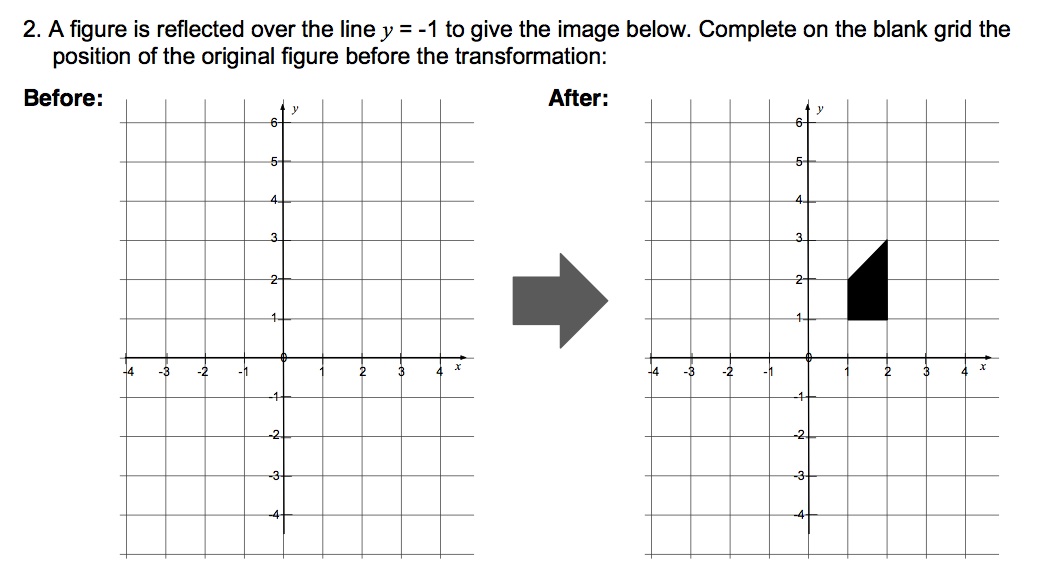
Before we proceeded, we had a class-wide discussion on grades. The only grades they students have thus far are from an initial diagnostic (not a grade, really), homework assignments, and our 2 Quadrantal Quizzes. Many of them are not satisfied with their averages at present (nor should they be). In a week’s time, however, we will have a traditional exam on transformations and a creative project – one of my favorites – the Coat of Arms project, originally shared with me by one of my pre-service professors, Sam Jovell. These will be the major contributors to their first marking period grades, and we hopefully allayed a lot of anxiety by discussing this.
The MARS task is a two day activity, which will be completed on Monday. After we collected the formative assessment (which will be reviewed, given comments, and returned for revision after Monday’s activity), we had some individual WhiteBoard Fun Time – perfect for a Friday. Each student had their own whiteboard, and this screen was displayed on the board.  The students needed to determine which terms on the right were associated with each term on the left. The Teachers Guide gives very specific ‘correct’ responses; for example, the correct term associated with Reflection is (1) A line. But the students came up with much broader associations, which I asked them to articulate. One student pointed out that a reflection was quite often done in an axis, and that if it was in the y-axis or any other vertical line, it was reflected some horizontal distance. Having the students justify their assertions was an empowering exercise in using mathematical vocabulary and reasoning. So the week finished on a positive (and colorful) note. The students were given homework to complete on Rotations on two levels of difficulty, and I appreciated the fact that the students carefully looked at which assignment they were given; some asked for the more introductory work if they felt they would be more successful with it, and others said, “I can do something harder than this.”
This class has me working harder than ever, but I really feel as if I am bringing my best game here – synthesizing a lot of what I have learned over the last eight years, and putting the differentiation, engagement, formative assessment and planning strategies into practice. I am fortunate to have a co-teacher; logistically, I don’t think it would be possible to manage this size class with this range of ability alone. Hey – wait a minute – that’s what I’ve tried to do before….
Thanks, Tina, for the challenge! Reflecting on one class for the whole week has been a powerful tool for me; I may even try doing it with a different class…next month.
Day in the Life – Days 1 and 2 of 5
 The inimitable Tina C (@crstn85) of Nix the Tricks fame threw out a challenge on Sunday to blog the life of a single class every day this week. I like the idea of being externally motivated to blog, because my internal inspirations come sporadically. I also tend to wax poetic about my emotional process rather than the classroom action, so this challenge is a good one for me to refocus my writing. Thanks, Tina!
I’m going to be brave here and write about the class where I have my greatest struggles – the inclusion Geometry class that I am co-teaching with a teacher new to our school as of February 1. This class, which I have written about before, is a slower track class filled with juniors and seniors whose mathematical abilities span a wide range. I am trying to address their many needs, challenge those students who are ready for it and support those students who need more success, all while learning how to work with another teacher with a different style than mine. A challenge for me as well as them.
Day 1
We are two days into a unit on Transformations. I have created guided notesheets to accompany the SmartBoard files which are a big help to those students whose note-taking skills are not well developed. I do this with trepidation, because I know that these can lead to a slippery co-dependent slope. But given what I know about these students and the classroom dynamic, I have decided the notesheet will help them focus on the content rather than each other, and create a written product to which they can refer later. Some students prefer to take their own notes, which is wonderful. As the students entered the room on Monday, my co-teacher greeted them at the door with the guided notesheet (which has their Do Now pre-printed on it) in an effort to get them to work quickly. The class was only about 5/8 full when the bell rang; getting them into the room on time and settled requires a lot of corraling. But finally everyone was looking at their worksheet, and we began to review it on the board.
My co-teacher and I have not had a lot of time to plan together; in fact, I have done all the planning thus far, and have shared the work with him at the beginning of each week. Being moved to our school midyear, and assigned a full Special Ed program (he is a math teacher), he was quite overwhelmed when the term began. The plan for Monday was a fairly direct lesson on translations on the coordinate plane (we covered reflections on Friday). He took the lead on the lesson on Friday while I ‘worked the room’, so on Monday I began the lesson. We had not explicitly discussed how we would share direct teaching (for the most part, I had been leading the room while he provided support for the first few weeks), but so far we had worked fairly well together. So I was a little surprised when he interrupted me while I was teaching and re-introduced the material differently. This happened a few times; I tried to keep things smooth (even though the control freak in me was jumping up and down and screaming, “My flow, my flow, you’re interrupting my flow!”) because he needs to establish more authority in the room. Unfortunately he leaves class a few minutes early in order to get to his next class in the basement, so we had no time to check in. The students were focused on the lesson throughout the class, however, so I am glad that my gut reaction was well managed, knowing that it came from a place in me that needs to do some constructive communicating.
The lesson took most of the period, leaving next to no time for practice; I assigned the classwork problems for homework. I realized that we had run out of practice time on Friday as well, after the lesson on reflections so I decided that today (Tuesday) would be a day of practicing what we had covered so far.
Day 2
My co-teacher popped in to visit me this morning before classes began; I shared with him my idea of spending class today with the students practicing in their homogeneous groups. (We have ‘A’ groups (homogeneous) and ‘B’ groups (heterogeneous, and created with student preferences accounted for.) He thought it would be helpful for some of the students to have a cut-out shape to use in practicing their transformations – a good idea for concrete learners – but seemed reluctant to prepare the materials for this. Mental note #2 regarding constructive communication requirement (more on this later).
When the students came in today, they were given Quadrantal Quiz #2. These quizzes, which will be given weekly, assess mastery at 4 different levels. I have several goals with these quizzes – the first to assess more frequently in order to gather relevant data and adapt instruction, the second to give the students more ownership over their own progress (we will be tracking the standards they have mastered in individual folders kept in the classroom), and finally help students overcome quiz and test anxiety by making it more routine. The brevity of the quizzes keeps them accessible to everyone, and I really like having fresh information on how they are processing the lessons.
After the quiz, I directed the students to move into their A groups to begin practicing transformations. I had prepared two different packets – one which contained straightforward exercises in translations and reflections, and a second packet comprised completely of Regents questions – both multiple choice and open-ended. The students got right to work. We circulated among the groups checking and correcting homework, and providing support for the classwork. I was very proud of how diligently everyone worked, and also that several students working on Regents packets felt safe enough to ask for the more introductory work. While this wasn’t the most exciting work, it was time well-invested in creating a uniform level of competency with which we can move forward to more conceptual material. And tomorrow we will spend the period doing some Patty Paper explorations of transformations – I can’t wait! – it’s my favorite manipulative.
A final note for the day regarding my co-teaching situation: I realize that this is an area in which I need to open more clear and explicit channels of communication for the good of the students, my co-teacher and myself. I think of myself as someone who collaborates well with others, but I may [definitely] suffer from the ‘don’t worry – I’ll take care of it’ syndrome that many competent people have. I have been working with a mentor at my school on the overall plan for this class, and asked her for some guidance here; she offered to sit down with the two of us later this week to establish some planning, preparation and teaching routines. I am looking forward to this; my mentor is similar to me in temperament, but has been observing the class and has a good feel for my co-teacher’s balancing strengths.
Whew! And it’s only Day 2 of #DITLife!
One final lovely thing that happened – my younger child who is a student at MICA, created a logo for our math team t-shirts, based on requests from the team members. Ze emailed it to me Monday night – and I can’t WAIT to wear this hoodie!

 Her Mathness