
Tagged: geometry
Auspicious Beginnings
On a break just 8 days into the Spring term (ironic as that denotation may be), I’m feeling more energized than my 7 a.m. start time would suggest. It’s a great relief after an angst-ridden fall term, and while I am not looking this gift horse too closely in the mouth, I am reflecting on how I managed to scale the wall that felt insurmountable just a few weeks ago.
 In Algebra 2, the term begins with an introduction to Trigonometry, which makes me unspeakably happy. We started out by discovering radians with paper plates, exploring arc length and special right triangles (I am not sure why they are so special, Dan Meyer, but the universality of those ratios resonating throughout math and design is, in some literal way, awesome. Call me crazy, or nerdy, or both.)

 Proving the Pythagorean Identities was also a wondrous exercise, even eliciting applause from a student who clearly has a future as a math teacher. I’ve got a better understanding of how to sequence the content this year while keeping pace with my department’s calendar, and I’m finding time to infuse class with discovery. Thanks to the generous assistance of Audrey McLaren and the thoroughly spot on webinar by Crystal Kirch, I’ve begun some forays into the flipped classroom. I started with a VoiceThread on reviewing the basic trigonometric functions, which met with a lot of student approval and enthusiasm. I wish there were a few more hours in the day to incorporate all the ideas I’ve got, but I’m committed to starting to build my own library of flipping resources. More to come.
 We’ve also gotten off to a great start in Geometry, due to several factors. The programming office shuffled the students between the sections of the course, and the resulting rosters are more balanced, with some of the more toxic behavioral combinations disassembled. There has been a 4th section of the class created – I was teaching three of them in the fall – and as a result, my BFF at work and I are planning together; he has been given one of the sections to teach solo, and we are co-teaching the ICT class (never mind that neither of us is a special educator – that’s a long story, and another blog post). This is the first time in a long while that I have had the opportunity to engage in true common planning with a like-minded colleague, and it has made a huge difference in alleviating the stress and isolation involved in creating a new course single-handedly. Mr. P and I have always shared ideas and experiences, but as c0-teachers, there is a true collaboration happening, which fosters more thoughtful planning. In trying to be always on the same page in a busy classroom (aka the 3-ringed circus of math), we have debated classroom decisions, pushing back on each other’s thinking, and in the process, crafting more authentically reflective policies and procedures.
 It was gratifying to see that the students who had been in the class last term, fell quickly back into the established routines of the Daily Quiz*, the Interactive Notebooks, and collaborative work at the tables. Bringing the new students up to speed on the Interactive Notebooks has been more of a challenge; we spent a lot of time setting them up and working on the intent of the notebooks in the fall. Again, the group at each table provides a support for the newbies.
We spent the first two weeks reviewing special quadrilaterals, completing a graphic organizer (link below), a chart in which the properties of the polygons were compared and sorted in a Venn diagram, and Lisa Bejarano’s Always, Sometimes, Never activity. When we return from break, we will begin working on equations of lines as a lead-in to Coordinate Geometry.
When I go so long between posts, there’s always too much to say – some very, very dear friends of mine are relocating – one to California for graduate school, another to Shanghai for an amazing career opportunity. This has, inevitably, got me reflecting and rethinking choices I’ve made, and continue to make. But my own children continue to pursue their own unique interests and education with passion and talent, reminding me that every child deserves that chance – and brings me back, once again, to why I teach.
Speaking of my amazing children, which I can’t help myself from doing, my younger one is involved in a project to produce animated films in collaboration with NASA scientists working on the Fermi telescope – how completely cool is that? Read about it here, on the Tumblr run by Geo.

*The Daily Quiz is a low stakes formative assessment used as a warm-up for class which sparked an interesting twitter conversation last night, and which I may write a separate post about later this week.
Hots N Lots Recap
 The dust has truly settled, and I have finished up my 8th school year. I escaped from NYC, and am ensconced in a cozy room at Exeter, where the Anja S. Greer Conference for Math, Science and Technology. So far, the experience has been everything I hoped for – a great road trip with a wonderful buddy, in which our stories seamlessly and tangentially flowed from one to the other for 6 hours straight, and a delicious locally sourced dinner at Blue Food Evolution, complete with a waiter who made math puns every time he visited our table. The weather is cool, dry and sunny. Perfect!
But this morning, before my head gets filled with the enrichment this conference will surely provide, I want to talk about the end of term project in my Geometry class – highlights and lessons learned. I am very proud of what happened in this class, the work many of the students did, and the opportunity it provided for them to demonstrate what they had learned in the three terms of Geometry they took. What needs to be improved stands out as well, glaringly so (to me).
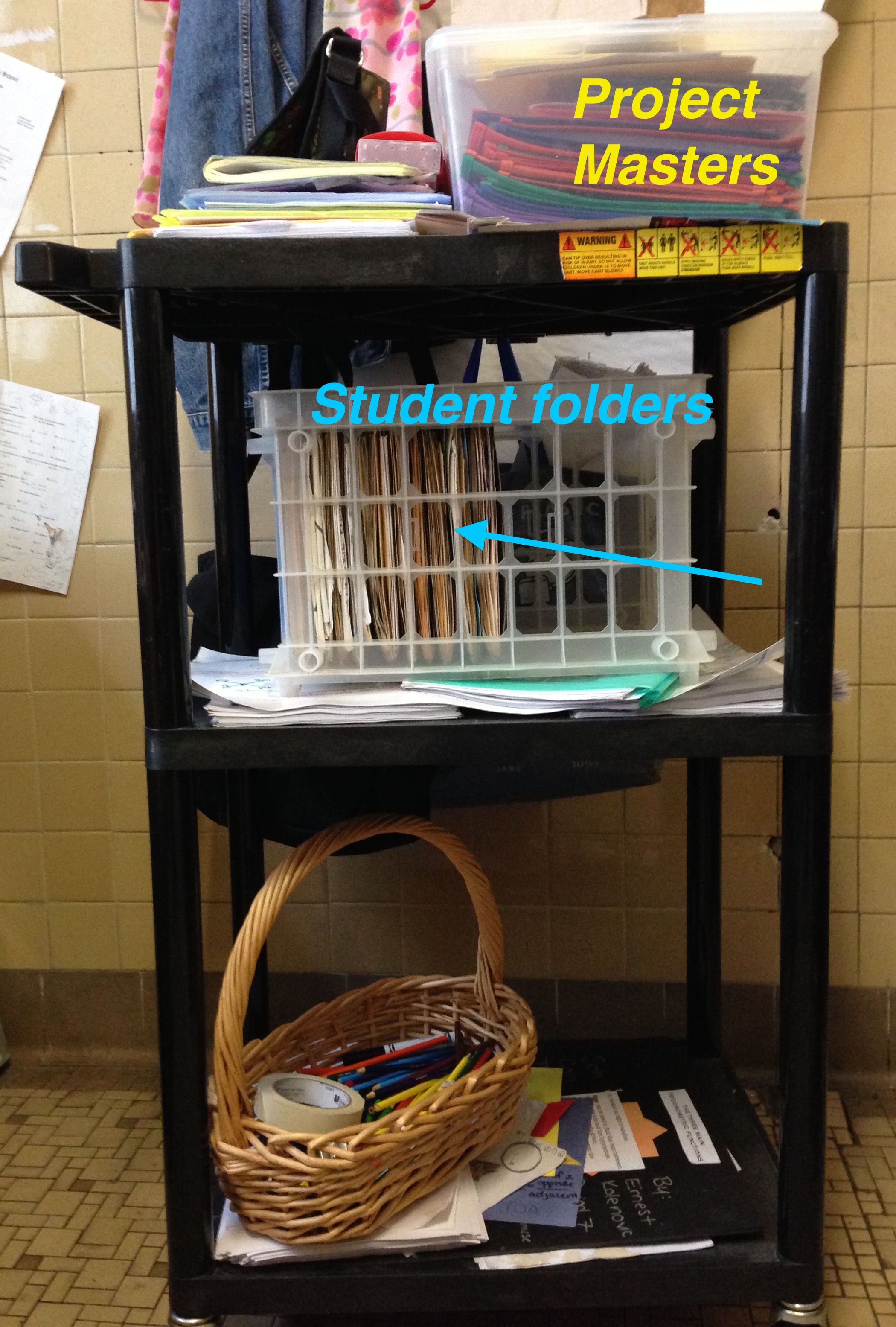 Most days the class was truly abuzz with math. The hard planning was finished once the students began working, but each day in class was an aerobic activity for me. Whatever math these children had learned was not accompanied by independence. Many of the students needed (demanded) reassurance and guidance and checking every step of the way. I provided them with as many resources besides myself that I could – I had three different textbooks they could use, made the iPads available every few days, and sat them in strategically chosen groups which I hoped would give them the opportunity to support – but not distract – one another. This worked for some but not nearly all. Basketball was discussed frequently across the room, at a volume which made it impossible to ignore. And phones – PHONES! The very bane of my existence during 4th period each day. Class time for me was filled with answering questions, checking in with those who weren’t asking for help, policing, and helping students choose new activities.
After a couple of weeks, I noticed that some students were engaged in creative assignments which permitted them to talk about other things (read NOT math) while working, whereas others required greater focus to complete content-heavy work. The resulting pockets of distraction grew less manageable, and I noticed a drop in the progress students were making in completing their assignments. The groups which were working on straight Regents prep seemed to be making more consistent progress. Keeping my eye on the desired outcome of this whole process – a portfolio of work which substantiated learning and growth over the entire Geometry course, I subdivided the room – one more time – so that the students working on individual assignments were working in rows at the front while the Regents prep groups were moved to the back of the room, where my co-teacher took over their supervision and instruction on the back blackboard. I also asked the Regents prep groups to take a  step back from their work to come up with a list of topics they were all having trouble with so we could specifically target some mini-lessons. Each morning I would prioritize which folders would be checked; giving regular feedback to each student was one of my biggest challenges.
At the start of the last week, I asked each student to self-assess their progress. Most of them were honest in their need to be more focused, and many said they needed more help. Getting them to work independently, and with more confidence, needs to be a priority next time around.


I debriefed the project with my collaborator and mentor, in which she focused on the overall success of the project (thank you, Veronica!) while I dissected the problems. The big issues with which I am not satisfied – mostly surrounding quality of work and feedback – are as follows:
|
Problem |
Possible Solution |
|
Keeping up with feedback was a huge issue. The students did not receive it often enough. |
Have the students select one item of work to be reviewed each day for a check-in; at least one assignment should receive a grade/formal feedback each week. Figure out exactly what logistics will make the process manageable for the teacher in advance. |
|
Quality of work wasn’t satisfactory in too many cases. |
Expectation needs to be explicit and specific. Students need to know what level of work is acceptable for final submission. Have students engage in on-going self-reflection after receiving feedback. |
|
How can I move students towards greater independence? |
On-going process throughout the term. |
|
How much feedback from teacher is fair in order for students to meet level of expectation? |
Again explicit examples of quality work as well as regular check-ins are required, particularly at outset of project. |
|
Copying of work |
Have final versions of work collected and removed from folders. |
But even with these bumps, I was very proud of how the classroom ran, how everyone was working through the last bell of the last day of school, and how each student had an individualized assignment in which they had significant input. As I graded the final submissions, I was impressed with how much work the students had actually completed, well aware that these were not normally high achieving students with impressive portfolios. And all but three students demonstrated a sufficient level of mastery of the course content to earn a passing grade, a result which was not at all predictable based on their performance in the first two marking periods. A lot of bumps in the road to be sure, but a huge learning process for everyone in the room. And a great way to finish my 23 year of teaching.

Day in the Life – Day 3

I am exhausted and it is getting late, but I have to write this post tonight. I wish I had been able to write it immediately after class, because I was having quite an adrenaline rush after our patty paper exploration. I prepped the materials for class early this morning, knowing that every second spent in dealing with logistics would geometrically cost minutes of refocusing in class. As I was counting out sheets of patty paper and clipping them into stacks for each group, I remembered the wonderful document camera I was given by iPevo last fall. I don’t use it often because of my peripatetic schedule, but I knew that it would be a huge support for this lesson, making it much easier for the students to create the transformations if they could actually see what I was doing with the patty paper because they have never worked with this material before. I had enough time before classes began to install the drivers and test the document camera, so the stage was appropriately set.
 When the students walked into the room, I had this wonderful photograph displayed on the board, courtesy of a tweet yesterday by Dan Meyer. The bulb in our SmartBoard is getting a little dim, so the lights were out. Following @ddmeyer’s instructions, I said nothing while the students began to question, argue, and debate. We took a vote before we began to discuss which calculator was displaying the correct answer – the class was evenly split. First we retraced the path of calculation of each calculator, and the corresponding order of operations that was being observed. And here was the most worthwhile part of the activity – just as Tina (@crstn85) decries in Nix the Tricks, the majority of the students swore that multiplication had higher priority as an operation than division. When I explained to them that the operations were evenly matched, and were to be performed in the order they appeared in any expression, they were skeptical. (I think they believed me in the end.) And then Jerrin, a rough and tough senior who secretly enjoys math, asked, “So if you were using that calculator on a test, and it gave you the wrong answer, you would lose points?”, which led to a conversation about when and how we should be using calculators. Truth be told, I don’t know why the calculator on the left is displaying the wrong answer, and how something like that could be prevented. I’d love to know.
We moved on to the transformations exploration. The students were intrigued and impressed by the document camera, and even more by my ability to write upside down. We talked about why patty paper was such a wonderful tool for exploring, how it enabled copying, tracing and measuring distance and right angles. Caroline, completely pre-empting part of the activity, pointed out that we could fold the paper and trace a figure, and create a reflection. She grinned every time I referred to her ‘instruction’ during class.
I walked through translations and rotations using the patty paper, demonstrating with the document camera and giving the students time to practice them in their groups (they had written instructions from Michael Serra’s Patty Paper Geometry as well). There was a lot of quiet talking during the activity, but I also heard a lot of patty paper rustling – a sure sign that they were working their way through the exercises, and helping each other to do it.
As I’ve said before, it is a large class with surprisingly good attendance (if not punctuality). Keeping a distractable group of kids focused while sitting in a corner in the dark with only a document camera and some tracing paper felt like a huge feat; I felt as if I had taken an aerobic class when the bell rang. But here’s my pre-assessment evidence that the activity was meaningful to the students: as we were winding down, I gave them some instructions for re-assembling the room at the end of the period. I told them that the patty paper they had used was theirs to keep, and in the event that they didn’t want it, I asked them to make sure it ended up in the trash by the door.
Guess what? When the class left, the wastebasket was empty. I hope there is some patty paper up on some refrigerator doors tonight!
 Her Mathness