DAX RX: native pw_stream source on Linux — 400ms → 200ms (#1008)#2312
Conversation
a18d51d to
f7de417
Compare
|
@RiskAndReward1337 Can you split the main window thread priority change into a separate PR for testing? I don't want to introduce instability in other non-Linux DAX / TCI use cases. |
)

Replaces module-pipe-source with a native libpipewire-0.3 pw_stream per DAX
channel.  This eliminates both the kernel FIFO and the pulseaudio-pipe
translation that the previous path relied on, getting WSJT-X DT from a
~400 ms baseline down to a steady ~200 ms.  See issue aethersdr#1008 comment thread
for measurement traces.

Architecture
------------
- PipeWireNativeContext (singleton) owns one pw_thread_loop + pw_context +
  pw_core, refcounted across the four RX channels.  Locked across pw_stream
  creation/destruction; the loop runs on its own dedicated thread.
- PipeWireNativeRxSource is one pw_stream per channel, registered as
  Audio/Source with PW_DIRECTION_OUTPUT.  Producer (Qt audio thread) and
  consumer (PipeWire RT thread) communicate via a fixed-size SPSC float ring
  with std::atomic head/tail indices — no locks, no allocations on the RT
  path.  Drops oldest samples on overflow so backlog cannot grow past ring
  size (~42 ms).

Stream is created with:
    PW_KEY_NODE_LATENCY        = 256/48000   (5.3 ms quantum request)
    PW_KEY_NODE_RATE           = 1/48000
    PW_KEY_NODE_FORCE_QUANTUM  = 256
    PW_KEY_NODE_FORCE_RATE     = 48000
    PW_KEY_NODE_ALWAYS_PROCESS = true

Verified live via pw-top: DAX nodes lock at QUANT=256, B/Q ~ 0, no xruns
once the ring is primed.  pw-cat (native PipeWire client) captures cleanly
from the source with ~5.3 ms latency end-to-end.

Bridge changes
--------------
- PipeWireAudioBridge::feedDaxAudio is now lock-free / atomic-only.  The
  audio fast path no longer touches Qt-thread-affine state, which is a
  prerequisite for an upcoming MainWindow connect-type change (split into
  a separate PR per maintainer request, so the connection-type change can
  be tested in isolation against non-Linux DAX/TCI use cases).
- m_open / m_channelGain / m_transmitting / m_lastAudioMs converted to
  std::atomic.
- Silence timer self-stops by observing m_lastAudioMs from the main thread
  rather than calling QTimer::stop() from the audio thread.
- Per-channel native source falls back to legacy module-pipe-source if the
  native open() fails, so non-PipeWire systems still work.
- Audio is float32 mono 48 kHz end-to-end.  Linear-interp upsample of the
  radio's 24 kHz stereo to 48 kHz mono runs in feedDaxAudio so the
  PipeWire graph does not have to insert a resampler.

Build
-----
- pkg_check_modules(PIPEWIRE_NATIVE libpipewire-0.3) gates the new path
  behind a HAVE_PIPEWIRE_NATIVE define.  When the dev headers are missing,
  the build silently falls back to the legacy module-pipe-source path
  (issue aethersdr#1008's PR aethersdr#1901 work, still present and used).
- libpipewire-0.3-dev added to .github/docker/Dockerfile for CI.

Remaining gap (~200 ms, consumer-side)
--------------------------------------
The remaining 200 ms is the libpulse fragment-pool buffer that pulse-compat
holds for clients using the PulseAudio API (WSJT-X via Qt PulseAudio
backend connects with pulse.attr.fragsize=4800 = 50 ms × ~4 fragments
queued).  Confirmed via pw-cat bypass test — native PipeWire clients get
sub-10 ms latency from the same source.  PipeWire 1.0.5 does not expose a
documented server-side mechanism to clamp pulse.attr.fragsize from the
source side; pulse.min.* keys are minimums (xrun protection), not maximums.
See issue aethersdr#1008 for full measurement trace and the failed pulse.rules
attempts.  Real fix paths are consumer-side (PULSE_LATENCY_MSEC env, Qt
native PipeWire backend) and tracked separately.

Co-Authored-By: Claude Opus 4.7 <noreply@anthropic.com>
f7de417 to
244f776
Compare
|
@jensenpat done — split into #2318. The MainWindow.cpp This PR has been rebased onto current Recommended merge order: this PR first (so |
|
Claude here on Jeremy's behalf — really nice writeup, and the architectural direction (native pw_stream + DirectConnection on the audio fast path) is sound. The 400 → 200 ms result with explicit identification of where the remaining latency lives (consumer-side libpulse fragsize, not in your pipeline) is exactly the level of rigor we love to see. Account checks out, no security concerns in the diff (Dockerfile / CMake / pactl call sites are all clean, no shell-injection surface introduced). A few items to address before merge — the first is a real (rare) data race; the rest are smaller: Must-fix:
Worth fixing while you're in there:
Nice-to-have, not blocking:
Once #1 and #2 are addressed I'd be happy to give a fresh pass and recommend merge. The latency win is meaningful and the rest of the work is genuinely careful — the upsampler's cross-packet 73, Jeremy KK7GWY & Claude (AI dev partner) |
…ex (aethersdr#1008)

Addresses the review on aethersdr#2312:

1. SPSC ring invariant.  feedAudio() previously advanced m_readIdx from
   the producer side on overflow ("drop oldest"), which is a real (rare)
   race against the consumer's in-flight memcpy when a wraparound write
   crosses the slot the consumer has already claimed.  Switch to
   drop-newest: clamp toCopy to the available space and bail if zero.
   m_readIdx is now consumer-only as documented.  The 42 ms latency cap
   is preserved; in steady state the ring is near-empty so the choice
   between drop-oldest and drop-newest only matters during consumer
   stalls (which in practice only occur under extreme system load).

2. Raw new for the listener hook.  pw_stream_add_listener was being
   handed a heap-allocated spa_hook that leaked on every open().  Make
   the hook a by-value member of PipeWireNativeRxSource so its lifetime
   is tied to the source itself — no raw new/delete, and zero leaks.

3. PipeWireNativeContext init/teardown race.  acquire() did
   m_refCount.fetch_add(1) and then read m_loop without serialisation,
   so a second thread arriving while the first was mid-init would see
   m_loop == nullptr and bail incorrectly.  Add a std::mutex around the
   init/teardown body in acquire()/release() so the documented "safe
   from any thread" contract is real instead of relying on incidental
   main-thread serialisation.  m_refCount no longer needs to be atomic
   under the lock; it is now a plain int.

4. reinterpret_cast on the state-changed callback.  Replace the cast of
   our int-arg static onStateChanged into pipewire's enum-arg slot with
   a small anonymous-namespace trampoline that has the correct C
   signature and forwards via static_cast<int>.  Header stays free of
   <pipewire/stream.h>.

5. Stale doc.  The feedAudio() comment still claimed "~170 ms" backlog
   from the earlier 8192 ring sizing.  RING_SIZE has been 2048 (~42 ms)
   for some time — fix the comment.

Co-Authored-By: Claude Opus 4.7 <noreply@anthropic.com>
|
@ten9876 Thanks Jeremy & Claude — that's a really sharp review, especially catching the SPSC violation. All five items addressed in Must-fix #1 — SPSC ring race. Switched to drop-newest in Must-fix #2 — raw Worth-fixing #3 — Worth-fixing #4 — Worth-fixing #5 — stale doc. Comment on CI. The previous push's CI run on this branch was green (#25286904608). The new push's run is currently in Builds clean locally on Qt 6.11.0 / RelWithDebInfo with no new warnings on the four touched files. Verified the binary still drives DAX correctly post-changes. Ready for a fresh pass whenever convenient. Thanks for the careful read — that ring race genuinely could have shipped. |
|
Claude here on Jeremy's behalf — merged via admin squash. All five review items cleanly addressed in 2cf2d15; the SPSC fix in particular landed exactly the way you described. Jeremy is going to run the hardware smoke test on his FLEX-8600 + Linux PipeWire setup against WSJT-X. We'll holler back here if the on-radio path surfaces anything — your fallback to legacy module-pipe-source on per-channel open() failure means worst case is "no latency improvement," not "DAX broken." Thanks for the careful workmanship and the well-reasoned writeup. The 400 → 200 ms result with explicit identification of the remaining consumer-side libpulse fragsize gap is the kind of detail that makes review easy. 73, Jeremy KK7GWY & Claude (AI dev partner) |
Mirrors the PipeWireAudioBridge thread-safety pattern (#2312) on the
macOS audio bridge so PanadapterStream::daxAudioReady → feedDaxAudio
can ship cross-platform under Qt::DirectConnection (unblocks #2318).

Changes:
* m_open, m_transmitting, m_channelGain converted to std::atomic so
  reads on PanadapterStream's network thread are correctly synchronised
  with GUI-thread writes (open/close, DaxApplet slider).
* Added m_lastAudioMs atomic flag; feedDaxAudio stores wall-clock now
  on every RX packet — no Qt API touched on the fast path.
* The silence-timer self-stop and ring-buffer readPos snap (originally
  done from feedDaxAudio, which would invoke QTimer::stop() across
  threads under DirectConnection) moved into feedSilenceToAllChannels,
  which runs on the GUI thread and observes m_lastAudioMs to decide
  when to self-stop. Matches PipeWireAudioBridge::feedSilenceToAllPipes
  field-for-field.
* m_rxTiming left as plain POD with a comment — only touched on the
  audio thread today; atomic-ify if a GUI-thread inspector is ever
  added.

Blast radius: codegraph does not index macOS-only VirtualAudioBridge
(Linux-built graph), so impact was checked manually. Callers go
through the `DaxBridge` typedef (`MainWindow.h:95`), and the
PanadapterStream → DaxBridge::feedDaxAudio connection at
MainWindow.cpp:13887 is the only invocation of the modified slot.
setChannelGain / setTransmitting / isOpen all stay on the GUI thread.
Scope is local to the two files touched.

Co-Authored-By: Claude Opus 4.7 <noreply@anthropic.com>
… (#2762)

## Summary

Fixes #2486

### What was changed

Mirrors the PipeWireAudioBridge thread-safety pattern (#2312) on the
macOS audio bridge so PanadapterStream::daxAudioReady → feedDaxAudio can
ship cross-platform under Qt::DirectConnection (unblocks #2318).

- `m_open`, `m_transmitting`, `m_channelGain` converted to `std::atomic`
so reads on PanadapterStream's network thread are correctly synchronised
with GUI-thread writes (open/close, DaxApplet slider)
- Cross-thread `QTimer::stop()` in `feedDaxAudio` replaced with an
atomic `m_lastAudioMs` flag
- Silence-stop / readPos-snap cleanup moved into the GUI-thread
`feedSilenceToAllChannels` tick

### Recovery note

This PR is being opened manually. The aetherclaude orchestrator (trace
5a19c310) pushed the signed commit at 15:18 PDT but was SIGTERM'd by a
deploy.sh race before it could create the PR. Root cause + fix shipped
as a follow-up to scripts/deploy.sh; this branch's commit is the
orchestrator's own work, unmodified.

---
Generated by AetherClaude (automated agent for AetherSDR) — PR creation
completed manually after orchestrator interrupt.

Co-authored-by: aethersdr-agent[bot] <273844287+aethersdr-agent[bot]@users.noreply.github.com>
Co-authored-by: Claude Opus 4.7 <noreply@anthropic.com>
…ive pipewire-pulse (#3438) fix(dax): quote pipe source/sink properties so node descriptions survive pipewire-pulse ## Summary On builds without `libpipewire-0.3` (native PipeWire off), DAX audio nodes are created through the legacy `pactl module-pipe-source` / `module-pipe-sink` path. That path passes the per-channel name as `source_properties=device.description="AetherSDR DAX N"`, but **pipewire-pulse's pulse-module argument parser splits the property value on unescaped whitespace and does not honor the embedded quotes for grouping.** The value is taken only up to the first space, so `device.description` collapses to `"AetherSDR"` for every DAX RX node and the TX node. `node.description` is derived from `device.description`, so qpwgraph, JACK patchbays, WSJT-X and FLDIGI all show an indistinguishable `"AetherSDR"` and operators must hand-route by guesswork. The same truncation also orphans the trailing `node.latency=256/48000` quantum hint (#1008), which never reaches the node. ## Fix Wrap the property value in single quotes so the spaced `device.description` (and the `node.latency` hint) survive the split. `node.description` is then derived correctly. 2 lines: ```diff - QStringLiteral("source_properties=device.description=\"%1\" node.latency=256/48000").arg(sourceDesc), + QStringLiteral("source_properties='device.description=\"%1\" node.latency=256/48000'").arg(sourceDesc), - QStringLiteral("sink_properties=device.description=\"%1\"").arg(sinkDesc), + QStringLiteral("sink_properties='device.description=\"%1\"'").arg(sinkDesc), ``` The native `pw_stream` path (`PipeWireNativeRxSource`) already sets `PW_KEY_NODE_DESCRIPTION` via the API and is unaffected — this aligns the legacy fallback (and TX, which always uses the legacy sink) with it. ## Why (quoting A/B) Exact argv the code emits, read back with `pw-cli` on pipewire-pulse: | `source_properties` value emitted | `node.description` | `node.latency` | |-------------------------------------------------------------------------|--------------------|----------------| | `device.description="AetherSDR DAX 1" node.latency=256/48000` (before) | `AetherSDR` | dropped | | `device.description=AetherSDR\ DAX\ 1` (backslash) | `AetherSDR` | n/a | | `'device.description="AetherSDR DAX 1" node.latency=256/48000'` (fix) | `AetherSDR DAX 1` | `256/48000` | ## Test plan - [x] Incremental `ninja -C build` clean (Nobara/FC43, Qt 6.10.3, gcc 15.2.1; native PipeWire off) - [x] Live against a FLEX-6700, DAX enabled — `pw-cli ls Node`: `aethersdr-dax-1..4` → `AetherSDR DAX 1..4`, `aethersdr-tx` → `AetherSDR TX` - [x] qpwgraph shows the named pipe nodes (screenshot) - [x] FLDIGI Soundcard/Devices (PortAudio): Capture lists `AetherSDR DAX 1..4`, Playback `AetherSDR TX` (screenshots) - [x] WSJT-X device list (maintainer/secondary — PulseAudio names follow the same `device.description`) ## Screenshots (patched build, live on a FLEX-6700, Linux/pipewire-pulse) FLDIGI → Soundcard/Devices — **Capture** lists each DAX channel by name: 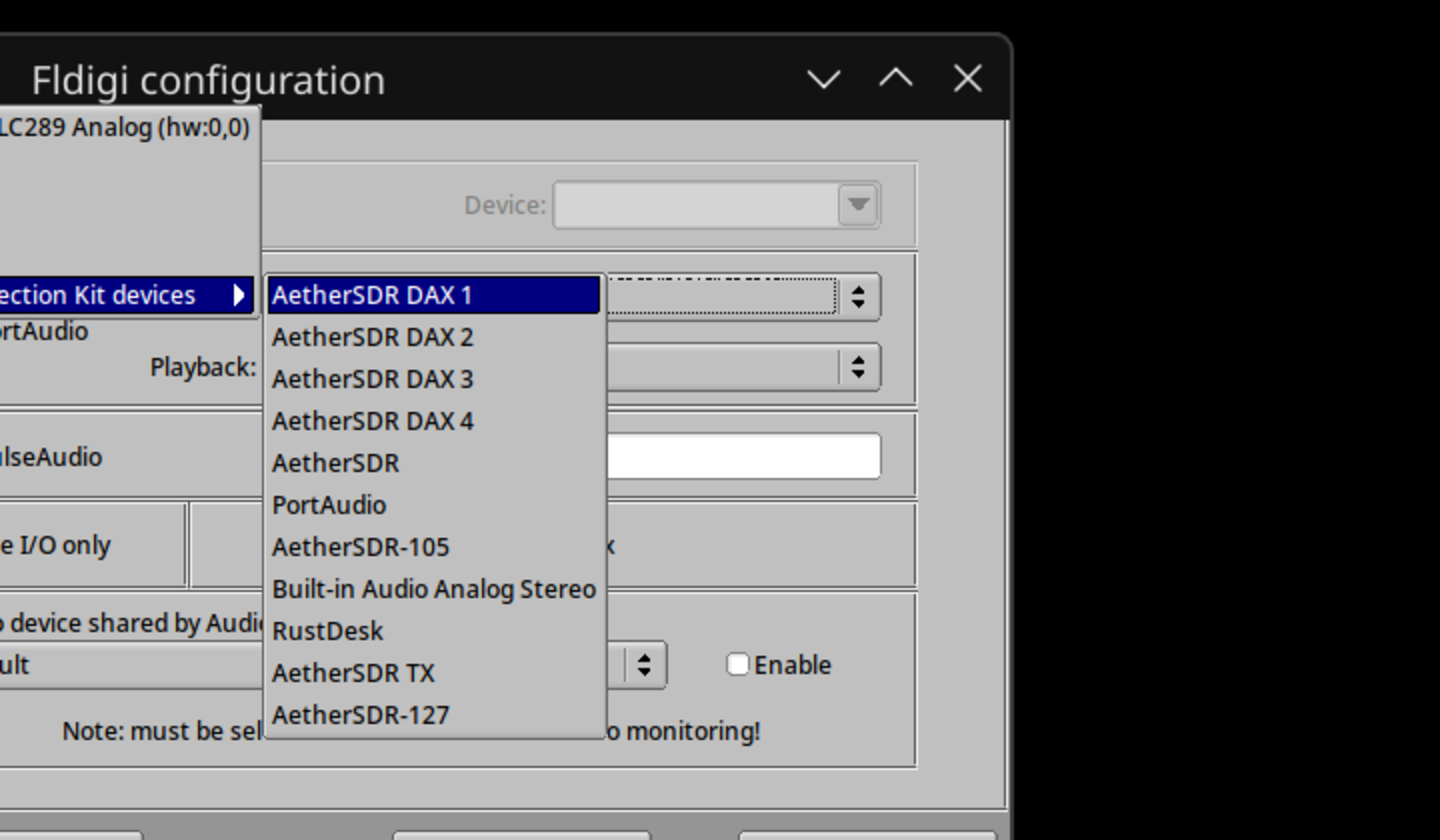 FLDIGI **Playback** — `AetherSDR TX` selectable by name: 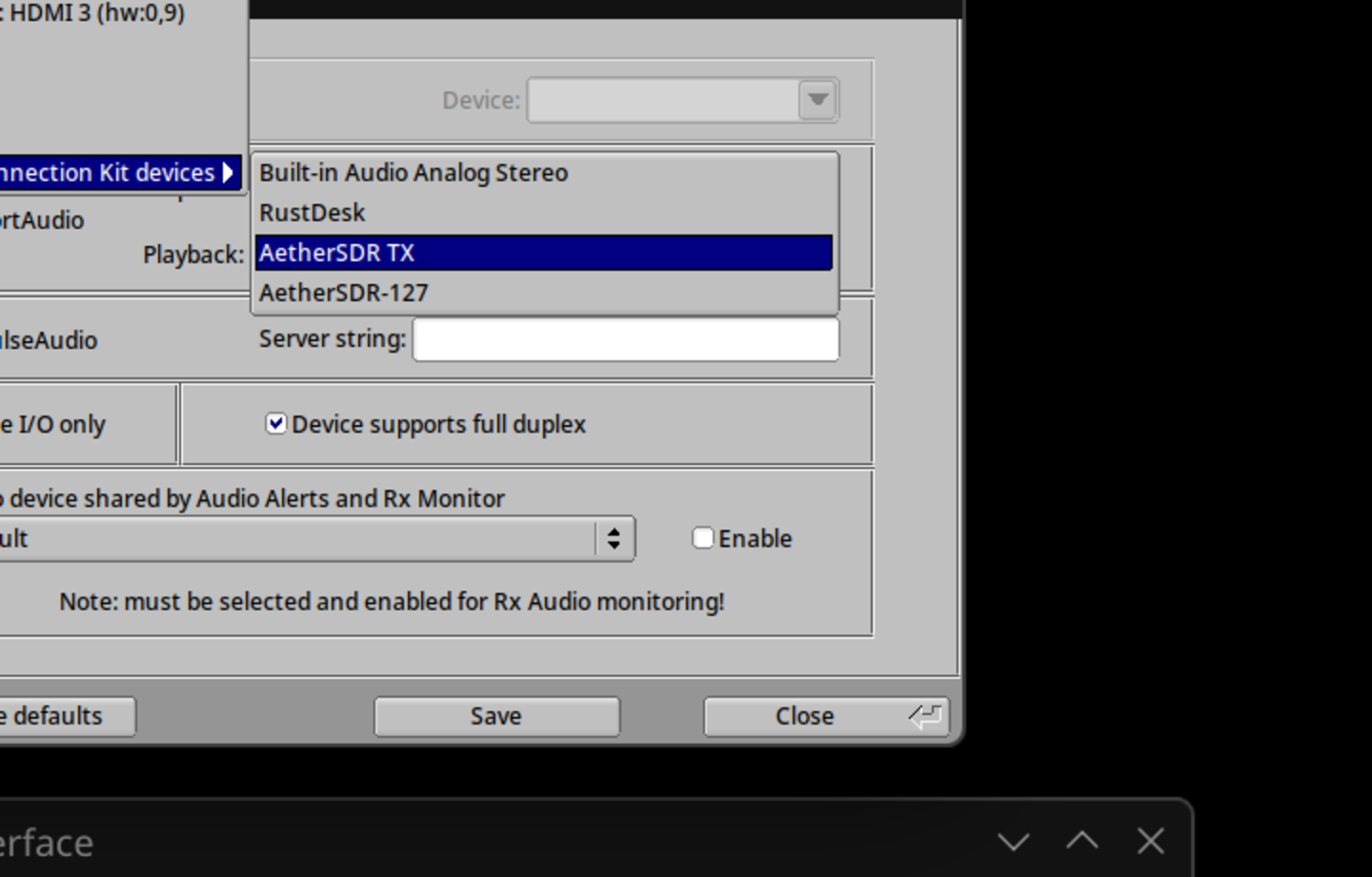 qpwgraph — named pipe nodes (`AetherSDR DAX 1/2/4`, `AetherSDR TX`; pre-fix all read `AetherSDR`): 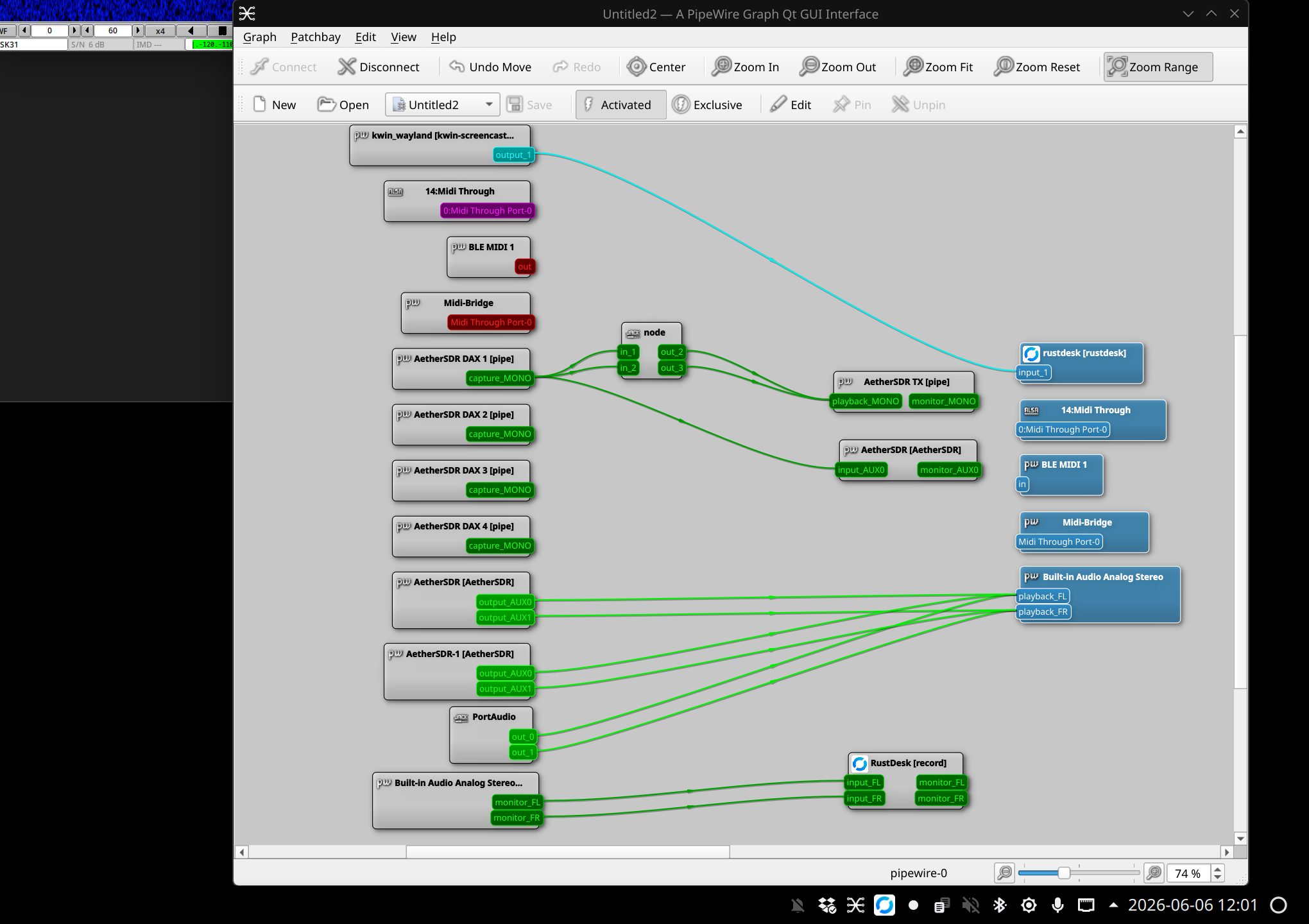 ## Related - #1008 — DAX RX latency; the `node.latency=256/48000` quantum hint this fix un-orphans. - #2312 — added the `node.latency=256/48000` token to this exact RX line (latency work) but left the value unquoted; this fix makes both that hint and the spaced `device.description` survive. It deliberately kept the legacy `module-pipe-source/sink` fallback that this patch repairs. ## Notes / out of scope - `node.nick` is intentionally not set (the native path doesn't set it either; `node.description` is what qpwgraph/JACK display). - Known related (separate follow-up): the app's own RX/TX audio streams (`media.class` `Stream/Output/Audio` / `Stream/Input/Audio`) still carry the generic `node.name="AetherSDR"` with no `node.description`, so they appear as `AetherSDR` / `AetherSDR-<id>` in device lists. Different code path (main audio engine, not the DAX bridge) — tracked in #3440. - `DaxIqModel.cpp` builds its `pactl` command with the same backslash-escaped-space form (via `bash -c`), so DAX-IQ descriptions are likely truncated the same way — separate follow-up. Closes #3437 --- 73, Ozy **K6OZY** AI compute partnership: [cloaked.agency](https://cloaked.agency) — drafted with Don, our VP of Engineering agent, on the Linux dev stack (`nobara-dell`: Nobara/FC43, KDE Plasma 6.6.4, Qt 6.10.3, kernel 7.0.9, Wayland; Dell Precision 5570).


…ive pipewire-pulse (aethersdr#3438) fix(dax): quote pipe source/sink properties so node descriptions survive pipewire-pulse ## Summary On builds without `libpipewire-0.3` (native PipeWire off), DAX audio nodes are created through the legacy `pactl module-pipe-source` / `module-pipe-sink` path. That path passes the per-channel name as `source_properties=device.description="AetherSDR DAX N"`, but **pipewire-pulse's pulse-module argument parser splits the property value on unescaped whitespace and does not honor the embedded quotes for grouping.** The value is taken only up to the first space, so `device.description` collapses to `"AetherSDR"` for every DAX RX node and the TX node. `node.description` is derived from `device.description`, so qpwgraph, JACK patchbays, WSJT-X and FLDIGI all show an indistinguishable `"AetherSDR"` and operators must hand-route by guesswork. The same truncation also orphans the trailing `node.latency=256/48000` quantum hint (aethersdr#1008), which never reaches the node. ## Fix Wrap the property value in single quotes so the spaced `device.description` (and the `node.latency` hint) survive the split. `node.description` is then derived correctly. 2 lines: ```diff - QStringLiteral("source_properties=device.description=\"%1\" node.latency=256/48000").arg(sourceDesc), + QStringLiteral("source_properties='device.description=\"%1\" node.latency=256/48000'").arg(sourceDesc), - QStringLiteral("sink_properties=device.description=\"%1\"").arg(sinkDesc), + QStringLiteral("sink_properties='device.description=\"%1\"'").arg(sinkDesc), ``` The native `pw_stream` path (`PipeWireNativeRxSource`) already sets `PW_KEY_NODE_DESCRIPTION` via the API and is unaffected — this aligns the legacy fallback (and TX, which always uses the legacy sink) with it. ## Why (quoting A/B) Exact argv the code emits, read back with `pw-cli` on pipewire-pulse: | `source_properties` value emitted | `node.description` | `node.latency` | |-------------------------------------------------------------------------|--------------------|----------------| | `device.description="AetherSDR DAX 1" node.latency=256/48000` (before) | `AetherSDR` | dropped | | `device.description=AetherSDR\ DAX\ 1` (backslash) | `AetherSDR` | n/a | | `'device.description="AetherSDR DAX 1" node.latency=256/48000'` (fix) | `AetherSDR DAX 1` | `256/48000` | ## Test plan - [x] Incremental `ninja -C build` clean (Nobara/FC43, Qt 6.10.3, gcc 15.2.1; native PipeWire off) - [x] Live against a FLEX-6700, DAX enabled — `pw-cli ls Node`: `aethersdr-dax-1..4` → `AetherSDR DAX 1..4`, `aethersdr-tx` → `AetherSDR TX` - [x] qpwgraph shows the named pipe nodes (screenshot) - [x] FLDIGI Soundcard/Devices (PortAudio): Capture lists `AetherSDR DAX 1..4`, Playback `AetherSDR TX` (screenshots) - [x] WSJT-X device list (maintainer/secondary — PulseAudio names follow the same `device.description`) ## Screenshots (patched build, live on a FLEX-6700, Linux/pipewire-pulse) FLDIGI → Soundcard/Devices — **Capture** lists each DAX channel by name:  FLDIGI **Playback** — `AetherSDR TX` selectable by name:  qpwgraph — named pipe nodes (`AetherSDR DAX 1/2/4`, `AetherSDR TX`; pre-fix all read `AetherSDR`):  ## Related - aethersdr#1008 — DAX RX latency; the `node.latency=256/48000` quantum hint this fix un-orphans. - aethersdr#2312 — added the `node.latency=256/48000` token to this exact RX line (latency work) but left the value unquoted; this fix makes both that hint and the spaced `device.description` survive. It deliberately kept the legacy `module-pipe-source/sink` fallback that this patch repairs. ## Notes / out of scope - `node.nick` is intentionally not set (the native path doesn't set it either; `node.description` is what qpwgraph/JACK display). - Known related (separate follow-up): the app's own RX/TX audio streams (`media.class` `Stream/Output/Audio` / `Stream/Input/Audio`) still carry the generic `node.name="AetherSDR"` with no `node.description`, so they appear as `AetherSDR` / `AetherSDR-<id>` in device lists. Different code path (main audio engine, not the DAX bridge) — tracked in aethersdr#3440. - `DaxIqModel.cpp` builds its `pactl` command with the same backslash-escaped-space form (via `bash -c`), so DAX-IQ descriptions are likely truncated the same way — separate follow-up. Closes aethersdr#3437 --- 73, Ozy **K6OZY** AI compute partnership: [cloaked.agency](https://cloaked.agency) — drafted with Don, our VP of Engineering agent, on the Linux dev stack (`nobara-dell`: Nobara/FC43, KDE Plasma 6.6.4, Qt 6.10.3, kernel 7.0.9, Wayland; Dell Precision 5570).
Summary
Replaces
module-pipe-sourcewith a native libpipewire-0.3pw_streamper DAX RX channel — the deferred Patch D from the #1008 triage thread. On my setup (FLEX-8600 fw 4.1.5, PipeWire 1.0.5, Qt 6.11.0, WSJT-X via Qt PulseAudio backend) this drops WSJT-X DT from a steady ~400 ms baseline down to a steady ~200 ms.Marked as draft. This branch is rebased off
bc47c3b(43 commits behindupstream/mainat time of push) and the diff againstupstream/mainwill look noisy because of that drift, not because of changes in this PR. Posting it draft so the upstream agents can review the architecture and decide whether to rebase + merge, or cherry-pick the new files onto a fresh branch.See issue #1008 comment for the full measurement trace, what failed pulse-side experiments were tried (so the next agent can skip them), and where the remaining 200 ms actually lives (consumer-side, not in our pipeline).
Architecture
src/core/PipeWireNativeContext.{h,cpp}— singleton owning a sharedpw_thread_loop+pw_context+pw_core, refcounted across the four DAX RX channels. Loop runs on its own dedicated RT thread.src/core/PipeWireNativeRxSource.{h,cpp}— onepw_streamper channel,Audio/Source+PW_DIRECTION_OUTPUT. Producer (Qt audio thread) ↔ consumer (PipeWire RT thread) via fixed-size SPSC float ring withstd::atomichead/tail. No locks, no allocations on the RT path. Drops oldest samples on overflow so backlog can never exceed ring size (~42 ms).Stream is created with
node.latency=256/48000,node.force-quantum=256,node.force-rate=48000,node.always-process=true. Verified viapw-topthat the DAX nodes actually lock at QUANT=256 with B/Q ≈ 0 once primed.Bridge changes
feedDaxAudio()is now fully lock-free and runs onPanadapterStream's network thread viaQt::DirectConnection(wired inMainWindow::startDax). Removes 10–50 ms of variable latency that the GUI thread was adding under waterfall paint load.m_open/m_channelGain[]/m_transmitting/m_lastAudioMsconverted tostd::atomicso the audio fast path never touches Qt-thread-affine state.m_lastAudioMsrather than callingQTimer::stop()cross-thread.PipeWireNativeRxSource::open()fails, that channel still uses the legacymodule-pipe-sourcepath. Non-PipeWire systems are unaffected.feedDaxAudioso PipeWire never inserts a resampler.Build
pkg_check_modules(PIPEWIRE_NATIVE libpipewire-0.3)gates the new path behindHAVE_PIPEWIRE_NATIVE. Build silently falls back to the existing pipe-source path when the dev headers aren't present.libpipewire-0.3-devadded to.github/docker/Dockerfilefor CI.What this does not fix
The remaining ~200 ms gap to macOS-equivalent is the libpulse fragment-pool buffer pulse-compat holds for libpulse clients (WSJT-X via Qt PA gets
pulse.attr.fragsize=4800× ~4 fragments queued). PipeWire 1.0.5 has no documented server-side mechanism to clamp this from our source —pulse.min.*keys are minimums (xrun protection), not maximums. Bypass-tested withpw-cat(native PipeWire client) which gets sub-10 ms from the same source. Real fix paths are consumer-side and tracked in the issue thread.Test plan
RelWithDebInfopw-dumpconfirms all four DAX nodes register withnode.latency=256/48000+node.force-quantum=256pw-topshows DAX nodes locked atQUANT=256,B/Q≈0, no xruns under loadpw-cat --record --target=aethersdr-dax-1captures clean float32 mono 48 kHz audiomodule-pipe-sourcepath verified by forcingopen()failurereadTxPipe, gain, RMS metering all unchanged)🤖 Generated with Claude Code