The Labyrinth of Knossos

Have you tried to talk to an operator these days? One thing is for sure, you need a lot of time and patience, the patience of Job at least. In fact, when the recorded voice starts to speak with that gentle, hypocrite tone of one who pretends to be of help, while, in truth, means only to confound and make you give up, you are well aware that a very long journey is about to begin.

Press 1, press 2, 3,4,5….9, the numerous options are only a way to distract from the only and real object of your search, which they know well to be: a flesh and blood operator. Instead, if you are lucky enough, you may end up attempting to make useless conversation with a virtual dog named Toby, which seems to have been created only with the purpose to make you feel dummy.  Yet, we know, we feel, that the flesh and blood operator of our dreams is somewhere there and we keep searching in that labyrinth of Knossos, made up by the alternatives that we are generously given, but no way. Heaven forbids, that you press the wrong number!  You’ll find yourself with only two options left: starting again from square 1 or giving up. I often give up, I have to confess.

It is the very same story whenever you need to talk with your bank, insurance, hospital, principal : you always find a wall in the form of a switchboard before you. No need to say, all categories but one: teachers.Teachers are required to be available 24 / 7. We must be ready to  inform, listen, reassure, pacify, advise ( even on fashion matters in my case) any time. This happens as  the norm that regulates our duties in this matter is ambiguous. It generically says that we must keep the lines of communication with parents open, but they end up to be so open that, eventually, we can be reached through meetings, mail, voice mail, WhatsApp,  phone calls, even stalking if necessary; festivity included, of course. If a parent believes to have an  urgent need to confer with a teacher, the latter is expected to be at the parent’s disposal.

The point is that since the advent of the electronic register the lines of communications should have been open enough to limit such pressing requests only to extraordinary events. Families would be constantly informed about grades, comments about grades, lesson topics, school attendance, homework, activities and more, if they read the electronic register. But they don’t. In fact, I always have an endless line of people who want to talk to me anyhow.

Hence, I believe there is only a way to put an end  to all this : a switchboard for us teachers too, after all, I don’t think we are less deserving than other categories. Once skimmed our agenda from the unnecessary meetings, we should be able to focus only on the situations that really require our attention and effort.  I figure it might work like this:

Voice mail: welcome to Mrs Tink’s parent-teacher communication area; if you want to be informed about your son’s grades, press 1.

Mrs Tink’s voice (after pressing 1): Dear parent, check the electronic register.😑

Voice mail: if you want to get information about your son’s school attendance, press 2.

Mrs Tink’s voice( after pressing2): Dear parent, check the electronic register.😑

Voice mail: if you want to get information about course books and syllabus, press 3.

Mrs Tink’s voice (after pressing 3): Dear parent, check the electronic register.😑

Voice mail: if you want to talk about teaching methods, personal experiences and suggestions, press 4.

Mrs Tink’s voice (after pressing 4): Dear parent, you can book an appointment through the electronic register.😑

Voice mail: if you want to book an appointment  with Mrs Tink, press 5.

Mrs Tink’s voice (after pressing 5): Dear parent, you can book an appointment with Mrs Tink through the electronic register.😑

Voice mail: if you do really want to talk to Mrs Tink, press 6.

The line goes dead.🤭

A Modest Proposal

There has always been  a lot of talking  about how to reform the school system  since……ever, and I understand  that this topic is a major issue worldwide. If there is a debate, it means that there is a problem. I am also sure that nobody has a clue of how to solve it – sometimes I suspect even the will -.  I have experienced  in years the most insane, pointless reforms –  usually at no cost – with the only result of systematically taking down the old educational system – which requires to be modernized, no need to say  – without adding anything worthwhile, sensible, effective. The consequence? At  first an imperceptible crack was heard (and ignored) , then  a tiny slit became visible (and ignored), till, in one fell swoop, an endless chasm opened before us, the chasm of ignorance.

I teach to students from 14 to 19 and whenever it is time to meet the new young classes , my  colleagues and I always end the first week in shock, as every year we believe to have seen the worst and every year we realize that the worst has yet to come.  It has now become customary to refer to students of 14 years of age, who have “ freely”  decided to join the family of the   “Liceo Scientifico” ( which is a high school whose main object should be to train for university) as “not schooled” yet. That is : a 14 year old scholar, after  8(!!!) years spent in the educational system circus, can barely know how to behave properly or develop any  learning method and, more recently, even produce an intelligible writing. You can imagine my amazement when few days ago I asked one boy  to write some words ordered in a column on the blackboard and to see that he was, actually, organizing them  in a sort of “cloud” rather than in a column. Words scattered here and there with no logic or any logic I could decipher, let alone his handwriting: cursive, capital and  small letters were all displayed before me in a hypnotic dance.😵

It seems, in fact,  that the latest generations are no longer used to holding a pen in their hands. They are so disoriented and naïve in a certain way, that dialogues as the one that will follow have  become routine:

Mario: but Teach… why did you mark this word?😕

Mrs Tink: because it is wrong. The correct word is “pet”.😏

Mario: This is what I have written.😇

Mrs Tink:  No Mario, you have written “cet”, the first  letter is something between a “c” or an “i”… but it is not a “p” for sure…🤔

Mario: but Teach, had it been an “i”,  I would have dotted the “i”!😐😇

Mrs Tink: Mario…..do you know what an alphabet is?🤨

Mario: Yes , of course,  a,b,c……….?😇

Mrs Tink:  Mario wait, I need to rephrase the question:   do you know what the function of an alphabet is?🤨

Mario: (no answer)…🙄

Mrs Tink: well, an alphabet is a sort of  convention, by which we agree that the sound at the beginning of these words, for example, like: “Pub, Police, Pop and Pet” , takes the form of this graphic sign: “P” in the written form. This sign cannot be changed at one’s pleasure or state of mind, otherwise,  we could not understand one another. In fact, if I rewrite those words with the sign you used, they might become : “Cub, Colice, Cop and Cet”, and this is what I assume. So, as long as I have to grade your tests, you’d better  make sure I understand what you  write……. because you want me to understand, don’t you?🤨

Mario: of course, I do!🥴🤕

Mrs Tink: good boy!😏

Assessment board (a child neuropsychiatrist , a psychologist  and a speech therapist in a reproaching tone) Mrs Tink ! Have you ever considered that Mario might be suffering from dyslexia or dysgraphia?🧐🧐🧐

Mrs Tink: (annoyed)😖😤 I have, and, if I may, it should be none of my concern at this stage, because,  as far as I know,  the assessment of graphic competence should be performed after the so called “ learning phase” which is usually at the end of the second grade and Mario attends the ninth grade. Hence, Mario could be either the victim of a system which has not been able to assess his learning needs or he is simply lazy, just like many of his peers, who are no longer used to seeing  neatness and correctness as a value, as it requires time and effort, effort they wish to direct somewhere else ( with the support of their families), of course.  When they get to the ninth grade in such conditions, it is almost a lost battle.😑

Assessment board: Mrs Tink, we believe it is urgent that you take a training course on learning disorders of 25 hours starting from tomorrow!😑😑😑

Mrs Tink:😭😭😭 if you think that yet another course will solve the question, all right, let’s take the course, but allow me to say a few words more. Don’t keep burying the school under loads of useless projects or “prodigious”” reforms,  if you cannot imagine beforehand  to what  those plans will take. As for now, their effect on teachers – on me – is only cultural frustration and paralysis of creativity. Before thinking of something grand, I would suggest you to start with something  apparently small, but more effective.  Any school reform should start from the beginning, that is, the “elementary “ school. It is in the first five years that you lay the foundations  of an effective  learning process even through the aforementioned diagnosis, which would have positive outcomes, as done in due time. Otherwise, if  we keep building on clay, we cannot but sink in that chasm and I am sure many – you?- would not be displeased about it.

456

What was that line like? “The man is the head of the family and the woman is the neck, so she can turn him wherever she wants”. Well, nothing is more fitting especially when it comes to stubborn Mr Run.  The man in time has developed a very interesting strategy  – which I am often satisfied with, I have to say –  that is, whenever I propose something he is not pleased with, he offers something in return, he is sure I would not say no:

Mrs Tink: “What about going with Mario and his wife to their friend’s  restaurant Saturday night?”

Mr Run: “Saturday? Oh, I’d thought about spending the week-end in Florence!”

Of course, he knows how much I adore Florence, hence, in this way,  he is able to skip what he believes to be an unpleasant night for him.  But it’s not always so easy to find a comfortable way out. He had been trying for weeks to ignore my wish to watch “Squid Game” on Netflix,  forcing himself to enjoy romantic series set in the Victorian Period in exchange. He was even open to watch all the six seasons of Downton Abbey plus the movie again. Since I didn’t mean to wait that much, I decided to act as the “neck” this time using my wild card:

Mrs Tink: “But Love, even Baricco says it is a remarkable series”

Mr Run: “Baricco?”

Mrs Tink: “Indeed”

It wasn’t Baricco, actually, but Gianluca Vacchi, a well-known billionaire , who has become famous for his crazy dances on Tik-Tok  and with over  20 million followers on Instagram.20 million! What is  Baricco  compared to Gianluca Vacchi, he can’t even reach 30 thousand on Instagram !  So, it happened that one day I came across one of his videos, whose theme was one of the games of the show and I was absolutely impressed:

Mrs Tink : “10 minutes, only 10 minutes and if you don’t like it , we’ll switch to something else!”

Mr Run: “Only 10 minutes!”

Mrs Tink: “Ok. Ah, I forgot……………..it’s in Korean”

Mr Run: “Korean!!!”

After those 10 minutes we were totally hooked and I couldn’t imagine but watching it in any other language but Korean.  Squid Game is about 456 people who choose “freely” to participate in a series of competitive games in which the alternative to winning a prize pool of 45.6 billion is “elimination”.

The last to be recruited is Seong Gi-hun,  a lazy but well-meaning man who’s living on the back of his elderly mother’s meagre income. Because of his betting habit, he loses his family, constantly disappoints his young daughter and  is even  forced to sign a physical contract promising his organs in case of any more delays in payment by some debt collectors.

All the other 455 contenders share stories of failure, desperation , exploitation, loneliness and they believe the game to be their ultimate  chance  of social redemption. They are taken to a distant island  and secluded in  a sort of alienating labyrinth  which has clearly  the form of Esher’s staircase. The  players always proceed in line, like Dante’s defeated souls of the Purgatory.

They are under the control of  workers/soldiers  who are dressed in red and wear black masks with 3 signature symbols: circle, square and triangle.  A circle means a straight forward worker, who is at the lowest level of the hierarchy, those with a  triangle are soldiers with weapons, while a square refers to managers with the most power. The presence of such a strict hierarchy  and the  idea of  identifying the rank  and the task of the workers through a symbol seems to be borrowed  by Edwin A. Abbot ‘s “Flatland”, which was, actually, meant to be a satire against the oppressive hierarchy of Victorian England which reduced lower classes and women into submission.

In fact Squid Game’s target  is  clearly the capitalistic system and  its rules . The contests are nothing but metaphors of our competitive society, which is unpredictable, unfair and deceptive.  No game is ever explained to the competitors before they may choose the means (or companions) to play with and  first time the protagonists of  Squid Game choose to take part into the competition,  they do not know the consequences of the defeat.

But the second time, even though they are no longer unaware, they feel “forced”  to go back to play.  Why? Because the labyrinth  of  their life has just one way out possible: that game. This is how they feel. Despite the organizers  do not miss an opportunity to point out that the competitors have “freely and consciously” joined the competition, we know that  that freedom  is just illusory. In fact,  are  we really “free” to choose when we have to accept an underpaid  job,  or to end up into debt, because we made an investment without knowing the conditions and consequences?

The awareness that only one of them will be destined to grab that chance makes the game more violent and ruthless. The competitive and selfish side of human nature  takes over  any form of cooperation and compassion.  Men turn  into those Hobbes’s wolves who move circumspectly  according to the saying “mors tua vita mea“.

In this moral downfall,  there are beautiful lyrical  moments when those half buried sentiments of piety, compassion, friendship,  brotherhood and love  surface  intensely  in a last desperate fight between hope and disappointment. It will fall on  Seong Gi-hun  – our picaresque hero, whose number 456 symbolizes, according to numerology,  the need to take steps forward to reach a new level – the task to take us to the that level offering a sparkle of hope.  I can say no more, otherwise I would reveal too much; but it is truly a great product and it is worth watching it. If don’t trust me, trust picky Mr Run.

Smashing Mr Thornton

I couldn’t believe my eyes  while I was reading a comment of one of my students to a post on Gaskell’s “North and South”. It was not a comment, actually, but rather, a deliberate attempt to pull apart piece after piece the romantic aura that surrounds Mr Thornton,  who actually shares the top step of the podium along with Mr Darcy for the most iconic and beloved male character of 19th century  English literature. He found faults in a man who has always been considered fault proof; he regarded weak the one who has always been the epitome of strength for any woman; he even found immoral traits in the uncontroverted  picture  and quintessence of  moral behaviour.

LADIES (angry): To the gallows!!!” “Blasphemy!!🤬🤬🤬

MRS TINK : “But, my dear ladies, calm down! I believe that even  this irreverent  young  man has the right to be tried first, so let’s hear what he has to say. He asserts that our minds have been clouded by the romantic charm of this character – well, that could be, especially since  Mr Thornton took the semblance of Richard Armitage, we must admit it –  and that, let me read, “the man appears systematically unable to take a single good decision in any field of his life”.

LADIES (super angry):To the gallooooows!!!🤬🤬🤬

MRS TINK : C’mon ladies, don’t rush into conclusion. He may have some good points! Let him speak his mind first and eventually we will decide what to do. Just cool down!(whispers) Ohhh, good ….so, he was just saying that some of Mr Thornton’s decisions were wrong…..

STUDENT (aside): All!😑

MRS TINK (To the student): Oh! Shut up! I’m m trying to save you from this angry bunch of ladies!🤨

STUDENT (boldly to the ladies): It is under everybody’s eye  that Mr Thornton’s business fails, can you prove the contrary?😏

MRS TINK and The Ladies: No, we can’t. But…..😧

STUDENT (more audaciously): Furthermore, he does not prevent the strike and hires the Irish in the mill provoking violent reactions.😏

MRS TINK🤨 : How could he have prevented the strike? He had no means to give the rise in salary the workers demanded and he was not alone in this, after all, there were other manufacturers.

STUDENT: “Yes,  but he was the most influent one, wasn’t he the magistrate of Milton? But, I have not finished yet. He proposes to Margaret even if he knows that she will probably refuse him and then he commits an abuse of power deciding not to investigate the same Margaret!😧

LADIES (in unison):  But he did it for love! He wanted to protect her! How insensitive!😮

STUDENT : I know, but that was actually a crime, or do you have another word to call it?😏

LADIES: We cannot listen to this nonsense any longer!😤😤😤

STUDENT (raising his voice): One more thing! He does not join his brother-in law’s speculation  and doing so, not only he loses all his wealth, but he also does not overcome the trauma of his father’s death. The very few good decisions such as hiring Higgins, for example, derive, directly or indirectly, from Margaret. Please forgive me ladies, but I did find hilarious seeing your romantic hero, the strong self-made man, the passionate lover with the endless sideburns, saved by a presumptuous 20-year-old girl from the South. Now I’m done. Thank you.😏😑😑😑

LADIES:(silence)😲😲😲

MRS TINK: (trying to break the silence). So you mean that Thornton is a loser .🤨

STUDENT: That’s what I mean.😑

MRS TINK: Well, I guess you should have thought about what makes Mr Thornton a loser first, in your eyes at least . To make you understand my point, I want to compare him to one of the greatest “losers” in world literature.

STUDENT: Who is it?🤔

MRS TINK: Hamlet. If you remember his story, we may say that Hamlet, to use your own words, appears “systematically unable to take a single good decision in any field of his life”: father, mother, Ophelia, the revenge plans etc.  He, actually, never truly acts, and if he does, it’s just because he cannot avoid it. Three seconds after talking to his father’s ghost, the initial flame of rage starts to put out and soon he feels unfit for his demand of revenge. Even in the last act, when he finally revenges his father’s death killing his uncle, he doesn’t even know how he found himself in that situation, as the duel with Laertes is actually his uncle’s trap in order to kill him. Have you ever considered Hamlet a loser?🤨

STUDENT: A victim maybe?🤔

MRS TINK: In a way he is a victim, but he is the victim of his conscience and conscience , he says, makes us all cowards, that is, unable to act freely, because we cannot avoid the burden of the moral implications of our actions. The ethical dilemma between what is right or wrong consumes our will, and thus “ the native hue of resolution, is sicklied o’er with the pale cast of thought”. Undoubtedly, the name of the comet star that guides Mr Thornton’s action is: ethics. He always tries to do what is right, even if he knows that it will not end up as he wishes, as in the case of Margaret’s rejection or when he hires the Irish. Had he been ruthless, he would have employed them much before, it is also because of this delay in taking this decision that he loses all. It’s in this constant search for the correct thing to do, his attempt to overcome the trauma of his father’s death.🤨

STUDENT(puzzled): So you mean that ethics and success cannot go hand in hand?🤔

MRS TINK: Correct.🙄

STUDENT: And that Mr Thornton‘s comet star is ethics.🤔

MRS TINK: Exactly.🙄

STUDENT: So, he is a loser.😑

MRS TINK😒: If you measure a man by means of his profits, yes, he is. But a man is more than the money he can make. I’m talking about other qualities such as sensibility, reliability, courage, sacrifice, the capacity to love; Mr Thornton is all this and more. Hence, he could never be a loser for us all, my dear. Never.😍😍😍

LADIES: To the gallows?😡😡😡

MRS TINK: No…….Student, stand up! You are sentenced to watch the BBC series again twice and read the book. You will produce then another comment on the topic and if we can spot some evidence of your redemption, we might even let you live. Off you go!

(Exeunt)

Progression or Regression?

I fell asleep. I fell asleep and for a couple of months I have been lulled by the sound of waves, sun kissed. I fell asleep and fluttered every single day on leisure-land where a pleasant and reinvigorating breeze weakened any attempt of the few sensible thoughts left hidden somewhere in a synapse of my dormant brain to make me quit that state of bliss. I would have slept even longer, in fact, but for that annoying bell, a school bell, actually , which forcibly brought me back to the dullness of the real world and duty. Good-bye leisure-land, I must go, uncertain of my fate.

When you have to start afresh, it is advisable to begin with baby-steps, something effortless and pleasant, if possible, at the same time, to break the ice, otherwise one always tends to postpone the initial effort, which is usually perceived as huge. I thought that filing all the works, projects, power points I had left scattered on the computer the year before would have been a good start and so I did. While watching the screen, I couldn’t help but wonder how technology had actually helped me beat my natural disorganization ( and laziness); in fact , all the school years with papers, tests etc. . were there, beautifully ordered before me. It is memory. Whatever I needed , with a click it was at my disposal.

And I clicked. I don’t know whether it was an evil school-elf or just curiosity which induced me to do so, but I clicked on year 2015 first, 2010 then to get to the early twenties and then I stopped, a bit puzzled. Evoking memories, even working memories can be cruel sometimes.  What remained of that summer state of bliss and dizziness definitely faded away as the facts were plainly before me and needed to be assessed.    

What facts? To make myself clear let’s take a class as example: the third year of high school , average age 16 and let’s follow how learning and expectations have changed in these last 25 years. I have always enjoyed reading Romeo & Juliet at this stage, as the theme of love is captivating and it is a good starting point to get to know Shakespeare, but how has the way I do it changed in time and why?

LATE NINETIES: in those years I was a devout reader of the Arden Shakespeare editions with all those beautiful notes and explanations, hence, I wanted all my students to have one. Despite it was not so easy to find it as we are in Italy and there was no Amazon then, they found a way to get one eventually, all of them . As far as I can remember they enjoyed the accurate study of lines and sources of Romeo and Juliet. How do I know? Well, the following year they asked me for more, so I infer, they liked it. But, did it really matter in the late nineties whether students really enjoyed or not a lesson?

EARLY 2000s: all of a sudden it seemed  it had become quite hard to find the Arden edition anywhere, hence, I told them to buy whatever edition they could find, I would have provided them with the missing information . Of course,  there were always two or three students in the class  who managed to find the Arden edition, but the decline was now inevitable.

LATE 2000s: As in the last years I had found hard managing to read the entire play by the end of the school-year, I decided that they could have used a bilingual edition. We would have read and analysed the most important parts in class in English, while the rest could have been done even in Italian if they wanted, and they wanted .  After all, the knowledge of the main themes of the play was what really mattered I said to myself. It seemed a good compromise to me.

EARLY 2010s: These where the years when school started to be overloaded with projects of any kind, hence, as I was always running out time I decided that the reading of Romeo and Juliet would have been limited to the “Balcony scene” and the end of the play. I also made them watch the catchy “Romeo and Juliet version”  with Di Caprio. It seemed they truly enjoyed it. I was satisfied.

LATE 2010s: I thought it was I good idea to make them act  the “Balcony Scene” and shoot a video. I chose 6 couples e six directors, one for each couple, and gave them the lines. They shot from the balconies of their homes and eventually the films were assembled together with soundtrack, titles, backstage funny moments etc. . It was creative, it was fun. I was proud of them – and myself.

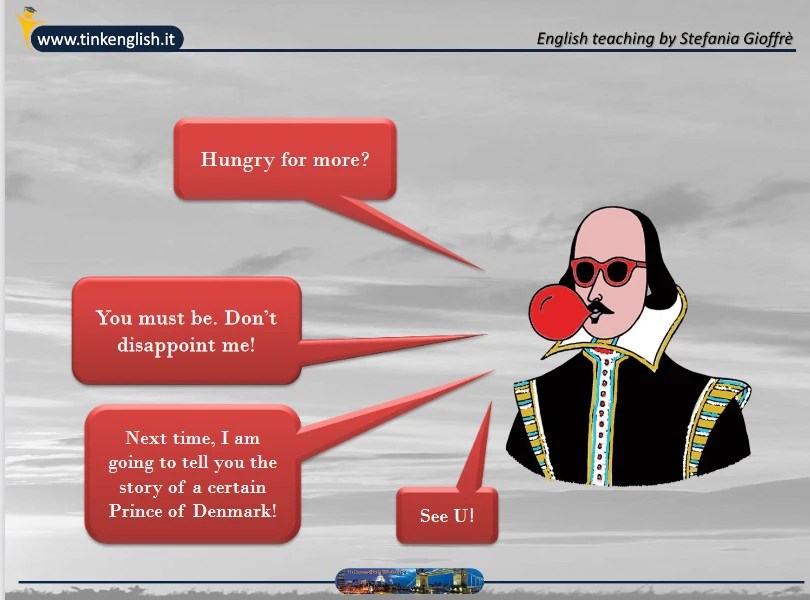
COVID YEARS: on-line learning has required a new way of communicating in order  to be effective. Words couldn’t but go hand in hand with images to be catchy. In this respect I have found useful GIMP,  a cross-platform image editor which I have adopted to embellish my power points. For Romeo and Juliet I decided to take and edit some shots from Di Caprio’s movie and create a sort of photo novel of the “the Balcony Scene” and make  William Shakespeare himself comment and explain the lines of the play:

It was fun, I have fun exploring the news frontiers of learning, I must admit it,  but looking back to what I used to do almost 30 years ago, I cannot help but wonder: what chances of success would my precious Arden edition of Romeo and Juliet have with today’s students? How should I consider all this process of continuous adaptation to new generations’ educational needs a progression or a regression in learning ? Are these needs real or I have simply surrendered, choosing the shortcut of light entertainment? Is it possible that eventually I am the one to be blamed?

Pizza Truce

In a comment of a previous post, where I “gently” showed all my happiness for the Italian victory at Euro 2020, I remarked  that no Italian would have ever sung a song such as “it’s coming home”, because being very superstitious, we would have considered it bad omen. By the ways, I have also learnt that in a certain way the English supporters had tried to build up a good karma practicing a national propitiatory act which took the form of topping pizzas with pineapple the days before the match, as they well know how much we dislike it (source Daily Star). The only reading about the blasphemous act performed by so many people should have put the Italian team off game. Well, it didn’t work, and you know why? Because it is blasphemous to put pineapple on a pizza.

The Daily Star did also some historical researches about it and found out that tourists struggle “to find the controversial toppings of ham, bacon and pineapple in Italy because it was not invented in the home of pizza but 4,000 miles away in Canada – by a Greek! Sam Panopoulos came up with the recipe at his restaurant in Ontario in 1962 inspired by his experience preparing Chinese dishes which mix sweet and savoury flavours”. Well, I’m sorry, if you put it that way, but it is not a matter of nationalism, only, it is not of our taste. That’s it. We are not even pineapple eaters, unless we are on a diet, let alone bacon. It’s just unusual and does not belong to our food tradition.

However, you should not believe that we keep eating the classic pizzas with tomato, mozzarella cheese, anchovies and basil only here. Pizzas come with a great variety of toppings or fillings and we have also many which are traditionally Italian despite a more international sweet-sour taste.

Let me suggest you my three favourite pizzas:

Number 1: Pizza, ham and figs.

This is a summer pizza as this is the season of figs. If possible, choose dark and ripe figs, because they are sweeter.  Just imagine: warm crunchy pizza, with sweet figs and Italian ( or Spanish) prosciutto on top. Taste it and you won’t allow any pineapple/bacon pizza ever cross your threshold. Never again.

Number 2: Pizza, mortadella and pistachio cream.

Mortadella is a large Italian sausage or luncheon meat made of finely hashed or ground heat-cured pork. It is pink, soft and delicious. It must be very thin sliced first, then you top the pizza with it, which had been previously spread with pistachio cream. Remember the pizza should be a little warm and crunchy to reach paradise.

These two pizzas belong to the Roman/Italian tradition, but the last and my favourite one,  has an English touch.

Number 3: Pizza, mozzarella cheese, Stilton and Porto reduction.

If you have a bottle of Porto, please spare a glass to make the reduction ( you can find the instruction here ). When the Porto has reached the consistency of a syrup,  pour it on the just baked pizza with mozzarella and Stilton. If you haven’t tasted it yet, try it and I am sure you will thank me.

Good food is always a matter of harmony of flavours. There is no such harmony in a pineapple and bacon pizza. Harmony always wins, remember.  

On Friendship and Solitude

I still remember a colleague of mine years ago, who boasted proudly that she had given as summer holiday read Joyce’s Ulysses to her students, Italian  students of about 17 years old, actually. “And….are you sure, they will read it?” was my dubious reply. “Of course”, she said. She had no doubts, good for her. I always envy such decided people. I moved to another school then, so I couldn’t check the outcome of that educational choice, but I would bet nobody had truly opened Joyce’s book. An easy win, I dare say. In fact,  how could half ignorant adolescents enjoy the read of such a bulky, complex novel, when I …………had not. It is time to confess that I skipped many parts of the masterpiece, read only the last pages of Molly Bloom’s famous monologue and that I have reserved the same destiny to Proust’s In Search of Lost time. Yes , I did it and I don’t mean to make amend for it. That does not mean, for sure, that both novels are not good enough for me, but rather, I am not good enough for them. The global literary knowledge I should have  – my edition of Ulysses came with  another book twice as big as the original to enlighten us mortals about the numerous literary references and interpretations – and the experimental syntax craft are just too much for my humble person.

Yet, when you allow yourself to be touched inadvertently and unprejudiced by their words, you can never be indifferent. Never. In fact, I was recently conquered by following the passage during a lecture,  before knowing it was actually Proust the source of the unexpected pleasure. I had to dive into the ocean of “In Search of Lost time” for a while, actually, before finding the passage I wanted to share with you, and here it is: so modern, so real, so thought provoking. This is how Proust deals with the theme of friendship:

“People who enjoy the capacity—it is true that such people are artists, and I had long been convinced that I should never be that—are also under an obligation to live for themselves.”

So far nothing exceptional. He was a decadent, so he shared the idea that the artist was the superior being whose talent should not be contaminated by the taste of vulgar masses, but he goes a little further here, as in those masses friends are included:

And friendship is a dispensation from this duty, an abdication of self.”

Hence,  we understand that it is  wrong for an artist to consider friendship as a dispensation from that duty, as friendship is a sort of partnership in which you self is not free to expand itself, but must “abdicate” for the sake of that friendship.

“ Even conversation, which is the mode of expression of friendship, is a superficial digression which gives us no new acquisition. We may talk for a lifetime with-out doing more than indefinitely repeat the vacuity of a minute,”

These words may induce you to believe that Proust was a snobbish, solitary man, but he was not. He was a man who enjoyed society and much. In fact, Proust began very young to frequent the refined circles of the upper middle class and the aristocracy, thanks to the social and economic position of his family. He met illustrious writers, like Paul Valéry and André Gide, nevertheless, he found all that time spent in the habit of conversation useless and vacuous, an unpardonable weakness especially  in an artist:

whereas the march of thought in the solitary travail of artistic creation proceeds downwards, into the depths, in the only direction that is not closed to us, along which we are free to advance—though with more effort, it is true—towards a goal of truth. And friendship is not merely devoid of virtue, like conversation, it is fatal to us as well.”

Only in the “bliss of solitude”  the artist can proceed into the depth of thought and avoid being kept at the surface by the  vacuity of light conversation and friendship works the same :

For the sense of boredom which it is impossible not to feel in a friend’s company (when, that is to say, we must remain ex-posed on the surface of our consciousness, instead of pursuing our voyage of discovery into the depths) for those of us in whom the law of development is purely internal….”

I was wondering, how often have you felt this sense of boredom at a dinner with your friends, for example,  even if you are not one for “whom the law of development in purely internal” or experienced that “vacuity of the minute” which repeats itself ? I am sure that you have and often. Hence:

that first impression of boredom our friendship impels us to correct when we are alone again, to recall with emotion the words uttered by our friend, to look upon them as a valuable addition to our substance, albeit…”

Here lies the danger, we tend to believe that  what a friend says, just because he is so, may in a way enrich “our substance”, but according to Proust this is impossible:

 “we are not like buildings to which stones can be added from without, but like trees which draw from their own sap the knot that duly appears on their trunks, the spreading roof of their foliage.”

No matter how clever, poignant or true the words spoken are, they are just like bricks and bricks cannot make a tree  grow. They are made of  different substances, after all. The living, creating sap may only come from within, and that must be the focus of an artist in particular and maybe men in general.

In short, the time used to cultivate friendships is not only useless but also unproductive. In the company of others we cannot be our real self  and constantly remain chained to what is superficial rather than go into the heart of things. It is a dynamic which does not allow the growth of a human being. I don’t fully agree with him, but if it is so, is  this monstrous society of “friends” connected worldwide in the never-ending practice of conversation allowing the growth of any sensible human being?

P.S. There is another question I would like to ask you and please don’t lie to me: “Is  there anyone out there who has truly read Ulysses from page one to page “too many” and enjoyed it?”

Courses and Recourses

The Grand Saint Antoine

On May 25 the The Grand Saint Antoine was in sight at the port of Marseille.The port authorities had been waiting for the ship feverishly for hours, till they eventually saw it approach slowly. Everything was ready. It was not the precious cargo of fine cotton, silk and other goods their main concern, but rather, the ghost of the bacteria Yersinia pestis the ship carried on-board.

The vessel had sailed from the Lebanon to reach  Smyrna, Tripoli and Cyprus months before collecting goods destined for a trade fair that took place each year in the commune of Beaucaire.  They had been informed that a Turkish passenger had been infected and died, but soon some crew members and even the ship’s surgeon had followed his destiny. Once in Livorno the ship was refused entry to the port and now there it was, in all its frightening aura. Yet, they knew they were ready this time. Everything had been prepared meticulously for decades.

Since the end of the plague of 1580, the people of  Marseille had taken important measures to attempt to control a future spread of the disease. It was not certainly the first time that the plague had made its devastating appearance in the continent. A sanitation board was established by the city council, and it was put in charge of the health of the city. Public infrastructures were built, like the public hospital of Marseille, furthermore, the sanitation board was responsible for the accreditation of local doctors too.

A control and quarantine system was also defined. Members of the board were to inspect all incoming ships and only the ships with no signs of disease were allowed to dock, but if the ship’s itinerary included a city with documented plague activity, it was sent to the lazarets (quarantine stations) for a minimum of 18 days. When The Grand Saint Antoine gently steered towards one of them, the members of the board couldn’t but smile with relief and satisfaction.

But, what about the fair? What about all those who had invested all their money on the goods kept on-board? Could such an important event like the fair be cancelled? You know the answer too well. It couldn’t. Powerful city merchants, in fact, wanted the silk and cotton cargo of the ship for the fair at Beaucaire and pressured authorities to lift the quarantine. The city’s primary municipal magistrate, Jean-Baptiste Estelle, who owned part of the ship as well as a large portion of its lucrative cargo used all his influence to organize the premature unloading of the cargo into the city’s warehouses, so that the goods could be sold soon at the trade fair.

What happened afterwards can be easily imagined: the number of infections and deaths began to climb within days exponentially. This pandemic had become a serious threat  to the entire economy, hence, instead of undertaking emergency measures to try to contain the infection, officials launched an elaborate campaign of disinformation, going as far as hiring doctors to diagnose the disease as only a malignant fever instead of the plague. Yet, the truth couldn’t be hidden for long as hospitals were quickly overwhelmed, residents carried the sick out of the city, mass graves were dug and the number of dead was so high that  thousands of corpses lay scattered  around the city. The tragedy was now visible.

It wasn’t until two months after the first cases of bubonic plague appeared in Marseille that appropriate measures were undertaken such as: trade embargoes, quarantines, the prompt burial of corpses, the distribution of food and aid, and disinfection campaigns using fire, smoke, vinegar, or herbs. At last the Grand Saint-Antoine was burned and sunk off the coast of Marseille.

The disease killed about 126.000 people. While economic activity took only a few years to recover, as trade expanded to the West Indies and Latin America, it was not until 1765 that the population returned to its pre-1720 level.

If we want to make a parallel with our equally “contaminated” times, nothing apparently seems to have changed, in the main dynamics at least: lies, the prevalence of economic interests over those of people, mystification, corruption, ignorance, disinformation.

As philosopher Giovanbattista Vico claimed, man’s attitude remains always the same, even if historical situations and behaviours change. What seems new in history is only comparable by analogy to what has already manifested itself as if in an eternal circular motion in which nations rise and fall. Nations eternally course and recourse through this cycle passing through these eras over and over again. So, if he is right, we are done.

Goodbyes

There is something moving when you see your students go right after the secondary high school examination. 5 years together, with ups and downs, for sure , 5 years during which you have seen boys and girls blossom and become adults . 5 years is too long to be indifferent. That is why I see what we call “Esame di Maturità” more like a ceremony, a rite of passage, rather than a real exam, where we, their teachers, let the students go to experience the world.

The “ceremony” usually ends with the final question: “ what are you plans for the future?”  That very moment we realize we belong to the past  and a sort melancholy clouds us . We would like to say one last word to the , something they can remember, a treasure to be kept.

We have discovered in time  that the language poetry on this purpose may be very effective. In fact, every end of the school year some of us enjoy playing the “Dead Poet Society” borrowing some touching lines from famous poets. Hence, poems are recited  with moved and broken voices to say the class goodbye, which sometimes for some student may sound quite disorienting,  especially if the day before they had seen you going nuts and turning into a yelling Cyclop eager not to spare even one of those rebel souls.

 I used to read a poem myself too, but I gave up as soon as I saw  everybody did it. I know, it is very snobbish of me, but if what you mean to be a magic moment turns into a habit, everybody’s habit, it cannot be magic any longer. By the ways , if you want to know it, I used  to read “George Gray”, from the anthology of “Spoon River” by Edgar Lee Master:

“I have studied many times
The marble which was chiseled for me—
A boat with a furled sail at rest in a harbor.
In truth it pictures not my destination
But my life.
For love was offered me and I shrank from its disillusionment;
Sorrow knocked at my door, but I was afraid;
Ambition called to me, but I dreaded the chances.
Yet all the while I hungered for meaning in my life.
And now I know that we must lift the sail
And catch the winds of destiny
Wherever they drive the boat.
To put meaning in one’s life may end in madness,
But life without meaning is the torture
Of restlessness and vague desire—
It is a boat longing for the sea and yet afraid.”

A  man, George Gray, is watching a tombstone, his tombstone . He is dead. On his gravestone there is a marble sailboat, a most befitting symbol for a life full of motion and adventure, which is a kind of ironic, as  his life had , actually,  been like a boat, but with its sails rolled in the harbour, under cover of the rough winds of Ambition, Sorrow and Love. He had always chosen the simplest and the safest route: no effort, no risk, but he couldn’t escape the uneasiness of such a life because each of us intimately “hungers” for meaning. To live is “lifting” the sails and “catching” the winds of destiny wherever they will take us, otherwise the sense of unrest will overwhelm and torture us. Only now he understands, now that it is too late, that he had never truly lived. My message for them , as adult woman, was to embrace life as it is, as Stephen Dedalus would say: “life is to live, to err, to fall, to triumph, to recreate life out of life!”, don’t be afraid to err, but rather learn from your mistakes and  move ahead . But I don’t read it any longer.

This year my colleague and writer Dario Pisano preferred the end of the exams as the appropriate moment to gift the students with a very poingnant poem:  “Ithaka” by Greek poet Constantine Cavafy:

As you set out for Ithaka

hope your road is a long one,

full of adventure, full of discovery.

Laistrygonians, Cyclops,

angry Poseidon—don’t be afraid of them:

you’ll never find things like that on your way

as long as you keep your thoughts raised high,

as long as a rare excitement

stirs your spirit and your body.

Laistrygonians, Cyclops,

wild Poseidon—you won’t encounter them

unless you bring them along inside your soul,

unless your soul sets them up in front of you.

Hope your road is a long one.

May there be many summer mornings when,

with what pleasure, what joy,

you enter harbors you’re seeing for the first time;

may you stop at Phoenician trading stations

to buy fine things,

mother of pearl and coral, amber and ebony,

sensual perfume of every kind—

as many sensual perfumes as you can;

and may you visit many Egyptian cities

to learn and go on learning from their scholars.

Keep Ithaka always in your mind.

Arriving there is what you’re destined for.

But don’t hurry the journey at all.

Better if it lasts for years,

so you’re old by the time you reach the island,

wealthy with all you’ve gained on the way,

not expecting Ithaka to make you rich.

Ithaka gave you the marvelous journey.

Without her you wouldn’t have set out.

She has nothing left to give you now.

And if you find her poor, Ithaka won’t have fooled you.

Wise as you will have become, so full of experience,

you’ll have understood by then what these Ithakas mean.

Cavafy chose the most iconic journey ever as pattern : Ulysses’. The poet says, that each of us  keeps looking for his own Ithaca, that is the achievement of his personal supreme goals, every single day of his life. Of course, there is nothing  wrong with it, but  eventually, it is not the goal but the journey that matters, because it is the  journey that  makes us wise and gives people the richest prizes: experience, knowledge and maturity.

Yet, the journey of our students has just begun, and while I see one of them politely, but carelessly,  take the poem and leave, I cannot help but wonder: isn’t this but our final attempt not to be forgotten in their journey?