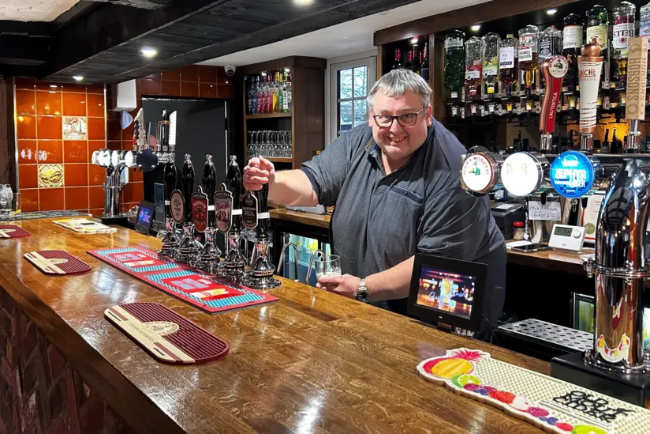
Brewery taprooms often feel in conflict with their industrial surroundings, but few so much as The Brewery of St Mars of the Desert (SMOD).
This is partly because Sheffield’s industrial hinterlands still feel wonderfully undeveloped and somewhat wild.
Similar landscapes in Bristol are now broken up with blocks of student flats, climbing centres, gyms, and hipsterish food and drink businesses.
Walking the route of the Sheffield and Tinsley canal, however, we saw the charmingly ugly backsides of many small factories and workshops that are still in use.
When we were diverted off the towpath, we walked streets lined with colossal sheds in various states of disrepair. The gutters were thick with litter and piles of fly-tipped waste covered muddy verges. The odd chunky rat scurried past.
The final approach to the brewery tap took us past busy car repair and tyre reconditioning firms whose business was spilling out onto oil-stained pavements. It felt like a part of the city that was hard at work.
The first sign that we were actually in the right place at all was the brewery gate which is decorated with various cute hand painted signs such as one that read: “SMOD is… open (hooray)”.
Taprooms exist on a spectrum. Some, like the one with the ducks in Bradford-on-Avon, feel temporary and makeshift, as if you’re drinking on a factory floor. Others feel more polished and permanent.
Crossing the yard at SMOD, we weren’t sure which we were about to get. It’s in an old industrial workshop and there aren’t many clues to be seen from outside, among the clutter of a working brewery.
Stepping through the red door (with more cute hand lettering) inevitably brings to mind the Tardis or the wardrobe that leads to Narnia. Wonders have been worked inside with light, paint, quirky ornamentation and something we’ve never seen in a taproom before: a wood burning stove.
As we said in our Golden Pints post, where we named this our favourite taproom of 2025 based on a single visit, we couldn’t decide if it made us feel as if we were in Belgium, or Bavaria, or some magical blend of the two.
Everywhere we looked there were Continental beer crates, tin plaques, posters or (unusual but effective) stripes of brewery-branded packing tape.

A table near the bar had an enormous standing sign declaring it a Stammtisch – that is, a table reserved for regulars. Other tables were marked as reserved from 4 or 5 pm.
We were initially a little disappointed by this, which felt at odds with the informal village pub vibe, but we needn’t have worried. At least one long table was designated as reserved for sharing and the co-founder of the brewery, Dann Paquette, was buzzing around helping people find seats. Why doesn’t this happen in more pubs?
We knew we’d be stuck there for a while when we saw the beer list which included ten or so beers in a range of styles from Rauchbier to grisette. Each was served in a stylish glass with considerable pride and ceremony. The Czech-style lager Laska, for example, came in a rotund handled mug with a thick head of smooth foam which, even before we’d tasted the beer, told us to expect something special.
The beer was delightful. Even those that were less to our taste (Urchin) were clearly well made, characterful, and interesting. And those we did like we really liked. Jess, who is not given to emotional hyperbole, said that Rotkäppchen, an homage to the red beers of Nuremberg, nearly made her cry.
How often does a taproom really have any kind of personality? Even the best of them are usually rather blank, minimalist spaces. They tend to feel cold, literally and figuratively, with acres of whitewash, bare concrete, or bare brick.
By contrast, every surface and corner of SMOD tells you that it is run by human beings. Even the toilet is covered with yet more handwritten signs pleading with customers not to steal the decorative plaques, and arguing for a reduction in beer duty.
It must help that the owners and founders of the brewery are both present and hands-on with the running of the place. With Martha Holley-Paquette greeting us and serving us at the bar, and her husband managing the floor, it felt as if we were guests in something close to a family home.
Perhaps this all sounds a bit gushing but we’re not prone to falling in line with hype or groupthink. If anything, miserable sods that we are, we resisted visiting SMOD for this long because everyone else seemed so excited about it.
They were right. We are idiots. You should go as soon as you get the chance.