I’ve finished the game (prior posts here).
It turned out I had one bottleneck (the wolf) which opened up the rest of the game, and “puzzles” I was spending time on (like the ghost and the lift) were complete red herrings. I’m unclear if they’re “intentional” or not; we’ve certainly had games before where I suspect the author just kept writing, ran out of disk space / motivation, and stopped with loose ends still left in. At least they became intentional, and I’ll explain what that means when I get to the end.

Games Computing, July 1984. Haunted House was renamed The House on the Misty Hill and re-purposed as a type-in for ZX Spectrum. More on that at the end as well.
Matt W. suggested using the generic “food” rather than the crisps with the wolf. Doing anything with the wolf that’s wrong will kill you so I hadn’t thoroughly tested all the items yet.
(The coffin contains a dead body; I tried carting the coffin over to the ghost in case they matched, but nothing happened. I didn’t know yet the ghost was a total red herring. I took the coffin back to the starting point and dropped it. Even though the wolf had left, this annoyed the wolf who came back and killed me. Whoops.)

Getting by the wolf opens up the graveyard, the only other section of the game. Heading directly north leads to a “shovel” next to a “newly dug grave” (shovel is total red herring, and I did waste time trying USE SHOVEL across the map a few places, ugh) and farther north you fall in the grave itself and get stuck unless you have the right item.

Specifically, this is where the rope is handy, although I spent some time trying to THROW ROPE and the like before realizing the game just let me CLIMB while holding the rope and the action after was implicit. The game is not consistent about this (implicit action while holding an item); this comes to give me trouble later.

Heading east from where the wolf was leads to a crossroads but also a vase of flowers.

I rather grumpily realized what was going on here, and took the flowers over to the princess who didn’t want to be rescued. I then dropped the vase of flowers on the ground, the customary romantic gesture.

She now is willing to tag along to be carted over to the front step of the house and dropped off. The vase of flowers incidentally stays in place and is left behind. It’s like the world’s worst dating simulator.
North of the crossroads you get shut into a shrine.

Having prayed earlier, it seemed the appropriate place; it was used to solve a puzzle, not just be a joke!

You are informed if you try to take the statue that you are not Superman. That’ll be the last treasure I get.
With that resolved I could head farther north in the shrine to find “an old rusty handcart” and a small alcove with a treasure.

It immediately occurred to me to take the cart over to the giant statue and try to take it, but I was still getting the same Superman message. It seemed fair that it’d be impossible to take the statue even with a handcart.

Leaving that behind for now, I checked to the east of the crossroads…

Complete red herring.
…and to the south.

Here my running gag finally paid off.

Coventry Live has a 2021 story about a dog who loves Quavers Crisps and eats them out of the bag, with a picture.
This leads, straightforwardly, to an “eerie tomb” with a CRUCIFIX. I nearly had all my treasures!


I still thought, perhaps, either the ghost or man in the stocks would help with the statue situation. It was an odd scenario where the game requires all treasures at a particular spot (at the front of the house) but given how close the statue was to the location it seemed almost ridiculous to require moving it.
I warned earlier about implicit actions being done with held items; this time, the action is not done while holding an item. I tried to use a handcart, but you’re supposed to drop it first, then GET STATUE, and the game will automatically load the cart from there.


I don’t necessarily have immediate issues with red herrings; they can add texture and atmosphere to an environment that can seem all too “neat” and like living in a cryptic crossword. However, the parser was so janky it was very hard to tell if I was supposed to, say, keep trying to move the lift, or keep trying to scare the ghost with the uniform; when a book is visible in one room while held but can’t be examined in another, pretty much anything is possible. Red herrings need to come along with a parser that the player trusts is working like they are expecting.
I tried a little bit of House on Misty Hill and it really is almost exactly the same; some rooms have a little more description (“a dirty kitchen is full of pots which haven’t been washed in years”) but the red herrings are “enhanced”. The man in the stocks cries for help, and the magazine is now a “monster gazette” which seems more likely to be helpful / not a red herring than the old magazine. Thus, Lucas was clearly happy solidifying the red herrings; that doesn’t mean they were introduced intentionally at first, especially given my suspicion this was the first game he wrote. There’s parser jank in Journey of a Space Traveller, but not nearly to the same level.
I checked his later books (or book, the Amstrad and MSX books about adventure programming merely convert the code) to look for comments on his philosophy on red herrings, and found two notes:
Ardent adventurers don’t like games where they lose their lives too often, so don’t go overboard with traps like this one and do try to keep the responses humorous.
Beware, however, of writing too many red herrings into your game as they can waste an enormous amount of RAM.
Death can represent a punch line of sorts; the issue here is that there is no punch line, just hanging puzzles that seem like they are bugs.
In addition to Misty Hill, the game has yet another remix (somewhat) in The Monster’s Final Hour which gets remade yet again into The Monster Returns. I only say kind of because what seems to have happened is two distinct rip-offs, both off the same game: John R. Olsen’s Frankenstein Adventure.

In Frankenstein Adventure, you need to revive the monster (and then kill the monster in the grand finale). Haunted House / Misty Hill instead grabs a few characters from the game, similar to what Peter Smith’s Hitch-Hiker did with the Supersoft Hitchhiker game. The wolf is in both games (with the same death-message, even); the bog you can fall in without a map is in.

The house structure is vaguely similar and there is a secret passage opened essentially the same way. Haunted House then veers course and has the monster already awake (and distracted by some electrodes); it’s like Lucas grabbed a couple themes to start and then went free-form from there.
Monster’s Final Hour (1985, see above) is much more directly a remake of Olsen’s Frankenstein, where the main goal (revive the monster) is maintained. You’ll also notice the verb list is quite different. So while it seems like Monster’s Final Hour might come from Haunted House, it’s really just that Lucas went back to the original source. A diagram to help:

Absolutely staggering. I can see why the games have been so hard to sort out.
We still have many Lucas games in the future, but coming up: another type-in, this one from the United States, followed by an Apple II game involving real buried treasure.
(Continued from my previous post.)
Just to recap from last time, here was the state of my map, with special rooms marked.

I also had access to a candle, a box of matches, a bottle of spirits, some food, a map (all used) as well as a book of ghost stories, a tray of drinks, a packet of crisps, a bar of soap, a knife, a uniform, a rope with hook, pots, a painting, some electrodes, and some tomatoes (all unused). I was facing a wolf by a coffin, a monster in a secret passage, a room getting locked with a princess, a lift that wasn’t moving, and a room blocked by a ghost (supposedly afraid of uniforms, but nothing I could do with uniform was triggering it!)
I went through my usual verb list with the catch this is generally a two-letter parser.
CL(IMB)
SW(IM)
RE(AD)
LI(GHT)
RU(B)
PR(AY)
PU(LL)
US(E)
EX(AMINE)
IN(SERT)
LE(AVE)
HI(T)
SH(OOT)
KI(LL)
HIT, SHOOT, and KILL all have a response about not being so violent, which suggests they don’t work at all. (It also explains when I tried KISS PRINCESS — it was required in Pillage Village, remember — that the response was “you’re not cruel.” It wasn’t trying to be progressive about kissing consent, the game thought that I was typing KILL PRINCESS.)
After multiple fruitless attempts and managing the uniform/ghost combo I started working on the monster instead. GIVE isn’t a verb but DROP is (drop is how I gave the spirits to the drunk) so I went through a variety of items just to test things out.

“But they’re Monster Munch! You don’t like them?”
I tried HELP out just in case this was the sort of game help is a required verb and the game informed me:
I suppose you could try praying!!
So I tried PRAY:
That didn’t seem to help!!
Maybe you didn’t try hard enough!!
Alas, PRAY HARDER gets no different reaction (I doubt the parser even looked at the second word, to be honest). I eventually hit upon dropping the electodes…

…which sort of makes sense if you squint, but not really.
Past the monster are two rooms.


With the antique my score was now safely 2 out of 7, and I thought it would become 3 out of 7 shortly with the keys. They do work in the princess room (USE KEYS)…

…but the princess refuses to move. This was the moment in Pillage Village where KISS was required. Princess, are you sure you want to hang out in the dungeon…?
The princess refuses.
With me befuddled, I tried more attempts at the ghost.

Maybe you’d prefer some Crispy Bacon Frazzles? I can’t eat them myself, there’s no EAT command.
The rest of my time was spent frustrated. I tried USE KEYS at the man the stocks and the tomatoes, no dice. I tried every verb on my list on the lift, again no dice. (“USE LIFT”: “You’re trying to confuse me!”) I am nearly guaranteed now to check either the walkthrough or at least the source code, but I wanted to report in on my progress here first. The main issue isn’t it doesn’t feel like I’m “stuck on a puzzle” as much as fighting against the system; I’m guessing at least once I’ve done the right thing, just expressed in the wrong way.

The wolf really doesn’t like crisps.
(Also, people picked up on last time there’s a certain other game from 1981 Lucas is “borrowing” from that is not by him, but I want to save getting into that for my final post.)
Writing an adventure game is very similar to writing a novel. Everybody can write a few unrelated sentences, but the novelist’s skill comes from stringing sentences together in such a way as to create a tale combining imagination, flair and ingenuity.
— From Steve Lucas, 1985, Adventure Programming on the Amstrad

Two relevant places for today marked: Kidsgrove in red, Burton-Upon-Trent in blue to the southeast.
The British company ICL (International Computers, Limited) has come up here before; their game called Quest by Urquhart, Sheppard and McCarthy came from their computers as an after-hours project. They were curiously formed as sort of a forced integration of multiple companies from the 1960s. ICT (International Computers and Tabulators) was already a merger of elements from BTM (British Tabulating Machines), Powers-Sampas, and the computer divisions of GEC, EMI, and Ferranti; English Electric had merged in Leo, Marconi, and Eliot (changing names each time).
In certain contexts a government might be concerned about monopoly power, but the Wilson government of the late 60s decided the opposite; there was concern that the British computer market was simply going to collapse under outside pressure (especially from IBM). So, the government invoked the Industrial Expansion Act which pushed together the two companies into one in 1968, keeping the name ICL.
The resulting mammoth had a disparate variety of incompatible products; ICL decided to “start fresh” (with government money assistance, 40 million pounds) and develop the 2900 series. (Their own 1900 series was ailing and outdated, using only 6 bit characters.) At Kidsgrove in particular (site originally built by English Electric in the 60s) they made printed circuit boards but also were one of the sites developing software for the new device, in particular the (now well-regarded, unstable at the start) VME/B operating system.
Early releases of VME/B were characterised by one word – late. At one stage VME/B was being produced in Kidsgrove, but top management and validation remained in Bracknell. As days turned into weeks, management became increasingly impatient. “We haven’t finished it yet” was the reason for a conspicuous delay in handover to system test. “Then just put what you have finished on a tape and send it down here so that we can make a start on validation”.
A couple of days later a tape arrived. It was put up on a tape deck and the machine was booted up. Nothing happened. Consternation ensued. Much diagnostic effort was expended in trying to get the new version of VME to load. Eventually it transpired that the tape contained only an end of file mark.
“That tape you sent us – its completely empty.”
“But that’s what you asked for.” came the reply. Somehow a week’s delay was bought.
— Andrew Mason from Another ICL Anthology
One of the people hired around this time was Andrew Espeland. I’m unfortunately just guessing he was at Kidsgrove but I have decent evidence, as he worked at ICL starting around 1973, had an address at Burton-on-Trent in 1983 and went to Burton Grammar School in the 60s, meaning there’s a fair chance he stayed locally in between. The nearest ICL location from Burton-on-Trent was at Kidsgrove. In the later part of his time there it is possible he did some telework, as we know Kidsgrove specifically was set up for that. You can see a demo below of a worker with Airbus connecting to an ICL terminal, circa 1982:
While ICL expanded all through the 70s (helped along by the government policy of buying homegrown computers) they were starting to be in trouble in the 1980s. They were intending to expand to a factory in Winsford (about an hour northwest of Kidsgrove) and the local government “bent over backwards” to aid in this, with 1,500 new houses built and “sterilising a major factory site” but ICL started to backtrack; from the floor of Parliament:
The matter is urgent because the loss of 1,500 jobs is in an area where unemployment is already at 11 per cent. The only other large employer, Metal Box, is due to close at Christmas with the loss of 500 jobs, many of them directly affecting my constituents, [it] would push unemployment up to 15 per cent by the spring.
This is a death blow to Winsford. I have just learnt that the men’s bitterness is such that they have today occupied the factory, and I submit that the House has a special responsibility to air their grievances as urgently as possible.
While the situation at Kidsgrove wasn’t quite as bad, they still went from 33,000 to 20,000 employees from 1981 to 1984. So it is possible Andrew Espeland was one of the redundancies; whatever happened, he decided to strike it out on his own as a software publisher in mid-1983 and founded Silverlind. He posted solicitations for authors during this time.
Esperland gave an interview to his local newspaper (Burton Mail) on November 23, 1983, featuring the Silverlind Master Diet Planner (written by Professor C. V. Brown and Dr. E. J. Levin of the University of Stirling)…

…although it was the sort of interview where he was starting from scratch with teaching how computers work, including explaining to the reporter “that software and hardware were not related to pornography.”
Silverlind is like a book publishing company, only we sell tapes instead of books. We offer the amateur a chance to turn professional. Everyone who has a computer thinks he’s great at coming up with programs, but not many people have the resources to market them if they’re good. That’s where we come in.
Please note that he went straight from ICL to personal computer tape distribution; this is different from the situation at Sumlock I wrote about recently where there was a branch computer store in the late 1970s that led to software publishing. Put another way, Sumlock’s ads and packaging come across as being sold by someone with product and consumer experience, while Silverland’s come across as being made by someone who came straight from writing operating systems to running a company. Silverlind did not last long, with ads starting by the end of the year and petering out by early 1985 with no increase in catalog size. The late 1983 ads include three adventure games.

All three are (probably) all by the same author, one we’ve encountered before: Steve W. Lucas. He is, as I explained earlier, sort of the British version of Peter Kirsch, writing a staggering number of type-ins starting in 1983, although many are repurposed ones he had already written.
The reason for the “(probably)” is we only have copies of two of the Silverlind adventures: Haunted House and Passport to Death. Gateway to the Stars (AKA Journey to the Stars) is lost, but assuming it is by Lucas we might see it again under a different name anyway. (I’m suspicious of “A Journey Through Space” which is in his Adventure Programming on the Amstrad book; there’s no tiger or lizard woman but Lucas often renamed things. The book game is allegedly “buggy and impossible to finish” which is another thing common amongst Lucas games.)

Via Everygamegoing.
While the previous Lucas game we played had versions for Amstrad and Oric, this one is for BBC Micro! Just like the other Lucas games this does have a clone-situation but I’m going to focus on the original for now and visit the duplicate situation at the end.

I have the full instructions from the inside of the tape, but they don’t give any context other than “you are standing in the doorway of an old mansion” and “you must recover the six treasures”.
You have a lamp which won’t work, a note and a gun when you start. As you visit the other locations you will find a variety of objects which may be of use – or are they red herrings?


Regarding the note:
The note is from my great grandfather ARNOLD J HARBUTHNOT. It reads:
As my sole living heir, I have sent you on this dangerous mission to find 6 treasures and rescue the princess. you must deposit these items on the doorstep.
Apparently there’s a princess too? In a haunted house? Wouldn’t be the first time that’s happened. (I will find the princess this session, but not rescue her yet.)
The overall structure of the complex has a house to the north, a path in the middle, and a castle to the south. Despite the Haunted House name the castle is more extensive than the house, but let’s start with the house first.

There’s no descriptions of rooms beyond their names, so you need to use your imagination.

Doing a grand tour, east of the hallway is a bedroom with a pair of slippers, and “an old four poster bed” with a pillow. North leads to a kitchen with a box of matches, a bottle of spirits, and some food, and going west after leads to a “large dining room full of cobwebs” that contains a candle.
West of the hallways is a library with a map and a “pen in a golden holder”. The map curiously says “not at the moment” when you try to read it; this is a game where items often only can be used in very specific cases, even if there is no logical reason to restrict them (like books). Trying to GET PEN reveals a secret passage…

…and going in is death.

Well, to be fair, the game did start by announcing we had a dead lamp. With the matches and the candle you can LIGHT CANDLE (…normally, one time it caused my game to crash…) and go into the secret passage safely. Not far in, you get stopped by a monster.

There’s a “sharp knife” you can find later but if you try to KILL MONSTER the game says “you’re a coward”, which is rude but fair for a standard adventurer who will likely rely on trickery or some gizmo instead to get by. Let’s turn to the middle path area…

…where off an “old footpath” to start there is a “snarling wolf” at a “coffin”.

Trying to OPEN COFFIN gets a blank response from the game (another thing that’s pretty common; 98% sure this game was written before Journey of a Space Traveller because it has more jank). I can get a reaction from the wolf by trying to GET WOLF…
That makes it mad. It attacks me. I am DEAD
…but that isn’t helpful so let’s move on! Further south is another split in the path where a signpost informs us that “FOOTPATH WEST IS DANGEROUS. YOU NEED A MAP” and this is the one and only spot the map can be READ successfully.

(I originally died while holding the map thinking it would be used passively. Not only can the map only be read in the right room, but you have to do the READ command before moving otherwise you’ll die.)
This leads to an Old Barn with a *PEWTER* trinket and a book of ghost stories, and just past is a tiny cave which appears to be empty. I tried to do SWEEP even though I had no appropriate item and the game told me I couldn’t swim. This is a two-letter parser. (On the BBC Micro, why!)

Reading the book only works in this room.
Moving on you can find a drawbridge (no puzzle, just PULL LEVER) followed by a “drunken man” in a Castle Courtyard that is blocking your way west (you can pass south unfettered). If you take the spirits from the kitchen and drop them he will helpfully pass out.

Go farther west and you’ll find the princess! Except now you are locked in, and typing HELP as the game suggests indicates that if you don’t have a key you should reset your game.

Ignoring the drunk man for the moment and going south into the castle…

…you can do a sweep down various rooms to the south and west and find a sharp knife in a kitchen, a tray of drinks in a restroom, a bar of soap in a bathroom, a packet of crisps in a dormitory, and a uniform in a changing room. (You might think to WEAR UNIFORM while in that room, but there is no response to this.) There is cryptically also a “magazine dated 1893” where READ MAGAZINE gets the message “I can’t make it out.”

35% chance this is a red herring, 30% chance I need an item, 30% chance I need to bring the magazine somewhere else, 5% chance this is a bug.
Heading east instead leads to a most curious room for a game called Haunted House.

You can THROW TOMATOES (as the screen shows me doing) but FREE MAN and RELEASE MAN are right out. Maybe this scene is here to be funny? Just south of here is a “hand-operated lift” with a “rope with a hook” inside but no apparent way to operate the lift.

To the far east you can find a “pair of electrodes” intended for ??? and a painting which the main character is actively offended by.

South is a pottery room with some pots (spooky?) and to the north is a ghost (spooky!)

You might think, ah, the book says the uniform will scare ghosts, but I have not been able to wear the uniform, nor does it get used “passively”. I tried SCARE GHOST and since the game has a two-letter parser it read the command as SCORE instead, telling me I had 1 out of 7 points possible.
There is a solution on CASA and my pain tolerance will not be high, but I admit there are things I haven’t tried like giving the crisps to the wolf, or stabbing the princess with a knife, or entertaining the man in stocks with a puppet show using slippers on my hands. I will also take suggestions in the comments for next time.
I’ve never spelunked, although I’ve been in a number of caves around the country as a tourist. Like Carlsbad Caverns, Lava River Cave here in Oregon, Cave of the Winds in Colorado and others I can’t recall. Most of my additions were suggested either by fantasy stories or the many geology texts I’ve read.
— David Long
I’ve finished the game. You should read my previous posts about Adventure 751 before this one.
Three parts I needed to check the walkthrough on. Two puzzles were sort of fair. The third was absolutely off the charts unfair and I don’t know how anyone ever solved it.

CompuServe in 1995, via The Columbus Dispatch. They had 3.6 million customers, but four years later they would be bought out by AOL. When moving to a new interface, their text-based games shut down.
To start with, a classic, me missing a room exit. This is at the now-defeated leprechaun:
You’re at the east portal of the Gothic Cathedral.
GO NORTHEAST
You’re at sham rock.
GO UP
You are on top of a flat black rock.
There is a small briar pipe here.
There is a suede pouch here.
Whoops! There were “smoke rings” coming up from the rock and there’s also suspicious items on the map picture.

What happens next took place for me later, and is one of the puzzles I needed to just look up the answer. It’s clearer for me to explain it now. I’m referring here to the boulder just north of the sham rock:
Although the boulder moves a fraction of an inch, it is too heavy for you to roll away.
We’ve already had a “get strong” puzzle multiple times along our journey, so the thought passed my mind that this might come up, but I was expecting to find a different kind of mushroom or special cream; getting by the boulder instead involves the food from the beginning of the game.
The food tastes bland, but is not unpalatable.
In Normal Adventure it gets fed to the bear to make it happy; we swapped in the honeycomb in this game as the food is described as “watercress sandwiches” when you try to give them to the bear. The “bland” part of the description is the key, as you’re supposed to use one of your treasures (!) on top of the food (!!) and then eat it (!!!).
PUT SPICES ON FOOD
All the food needed was a bit of spicing up: it smells delicious!
EAT FOOD
Zam! What a meal! Now we’re ready for anything!
This does not consume the rare spices (unlike the cakes you ate to get small). Which makes sense in a pragmatic sense, but the general rule of this sort of game has been that eating something means that thing goes away. It’s still not obvious from the description, but now the boulder can be moved.
Grunt…Pant…You have pushed the boulder to one side, enough to permit you to squeeze past it.
GO NORTH
You are at the bottom of a vertical shaft, apparently a dry well, whose cylindrical wall is lined with smooth stone. Far above your head, you can see daylight!
A heavy iron handle, slotted at one end and rounded at the other, lies at your feet.
At least I knew immediately what the handle goes to!

Back to the castle we go:
You’re in the Central Court.
PUT HANDLE IN WINCH
The iron bar, evidently the winch handle, slips easily into the winch mechanism.
TURN HANDLE
Turning the winch slowly lowers the great wooden drawbridge.
This also suggested another puzzle solution, as this landed me at the ravine area right next to the angry centipede.
You are at cliff by west end of moat.
MOVE VINES
Parting the vines reveals a dim recess in the cliff wall.

IN
You are in the lair of Ralph the Giant Centipede. The air reeks with the stench of rotting bits of flesh. Giant centipedes, in general, are not partial to visitors.
A golden fleece is lying nearby!
A giant centipede is eyeing you with a none-too-friendly look.
GET FLEECE
You have snatched the centipede’s very own security blanket!
Provoked beyond endurance (centipedes have none), the indignant insect lurches to all of its feet and starts towards you.
OUT
You are at cliff by west end of moat.
The cantankerous cootie is heading towards you, and he definitely harbors no goodwill towards you.
A dim alcove can be seen behind the vines.
GO EAST
You’re beside moat.
The angry arthropod is definitely gaining on you. You had better either sprout several more legs or find some way to evade him.
A wooden drawbridge spans the moat.
GO NORTH
You’re in the Central Court.
The incensed insect is in full gear now. If you don’t move quickly, his monstrous mandibles may masticate you into murky mush!
A heavy iron handle is inserted into the winch.
A wooden drawbridge spans the moat.
TURN HANDLE
With a great creaking and groaning, the winch raises the drawbridge to a vertical position against the stone wall.
You have raised the bridge just in time. The centipede stamps furiously up and down in front of the moat, but, finding no way to cross, finally gives up and lumbers back to his cave.
I love “cantankerous cootie”; Ralph is so vivid I wonder if he’s supposed to be some sort of University of Chicago reference (not Atari Centipede, which wasn’t out yet). Moving on to the castle interior…

…as a reminder I had found a tapestry (treasure) and a black bird statue (not) as well as a door with colored tiles. I did not disclose the answer to the tile puzzle, and Voltgloss managed to work it out in the comments.

The key is the word FNORD, being spelled by the initial words of the colors. As Aula observes in the comments, the color names are decidedly odd, which might suggest thinking of initial letters.
You are inside a large steel vault.
Nearby is an intricately-wrought bronze shield bearing the escutcheon of Duke Aldor.
The other two places of note are the Secret Garden and the kitchen with the dumbwaiter. I already suspected what to do with the dumbwaiter as the puzzle is more or less wholesale stolen from Zork (I’ll get into that later) but let me get into the Secret Garden. You don’t enter it here at all, but rather an exit at the third helicopter stop I missed last time.
(Also, the knapsack with the silk sheets lets you refer to it as a PARACHUTE, which made me much more confident the following sequence would work before I tried it.)
You’re on the south end of a high narrow ridge, which is bounded on its east side by a high mountain. Dug into the mountainside is a ramshackle old mine entrance. The ridge drops off to the west in a rocky cliff. You might be able to climb down the cliff, but you probably won’t be able to get back up.
A helicopter is waiting nearby.
GO NORTH
You are on a narrow N/S ridge high above a stone wall and wide moat.
GO NORTH
You are at the northwest end of a narrow ridge high above the castle’s inner courtyard.
WEAR PARACHUTE
Ok
JUMP
After a few seconds in freefall your parachute opens with a sudden “Pop!” Several moments later you land unhurt. The magic ‘chute then folds itself back into the knapsack.
You are in an idyllic garden hidden in an inner courtyard of, and surrounded on three sides by, the Castle Keep. The far end of the garden is bounded by a high cliff.
A wooden door leads into the castle.
Lying in one corner of the garden is a golden apple!
From a game design angle, what I’m frustrated by here is how this is the only place the parachute works; jump in any other high place and you won’t get a description at all. I know that “magic” can technically hand-wave away anything, but inconsistency in magic use is one of my main teeth-grinders, especially in that it’d be fun to jump off in other high places.
Note as far as I know this loses the helicopter (remember we left at the ledge) so I ended up shuffling my sequence around to do the golden apple part last. So let’s warp back a little and go inside the mine instead.
You are in a gloomy tunnel, the entrance to a long-abandoned mine. All around is fallen rock and rotted timbers. To your left, a small room adjoins the main tunnel.
Arthur O’Dwyer mentioned I had missed an exit here, but at least this time I had fair reason. Going DOWN goes into the mine, and none of the other compass directions work. You’re supposed to go LEFT, which is counter to everything else in the entirety of the game.
You are in the engineering room. On a control panel on the wall are four buttons, colored green, brown, red and yellow; and a digital gauge.
Going down into the mine reveals it is flooded by water. The gauge currently reads 5, which tells you the flood level; pressing the “red button” and waiting will cause the water to go down. The frustrating aspect is that reading the gauge does not pass time.
PUSH RED BUTTON
From somewhere in the distance comes the deep throbbing of a heavy engine.
READ GAUGE
The meter reads “5”.
READ GAUGE
The meter reads “5”.
READ GAUGE
The meter reads “5”.
READ GAUGE
The meter reads “5”.
I was deeply confused for a while, because I knew I had at one point seen the meter go down, and had even had the engine explode because I didn’t turn it off. However, you need to do some command other than READ, like LOOK, and then READ GAUGE afterwards.
You are in the engineering room. On a control panel on the wall are four buttons, colored green, brown, red and yellow; and a digital gauge.
The deep hum of heavy machinery fills the control room.
READ GAUGE
The meter reads “1”.
LOOK
You are in the engineering room. On a control panel on the wall are four buttons, colored green, brown, red and yellow; and a digital gauge.
The deep hum of heavy machinery fills the control room.
READ GAUGE
The meter reads zero.
With this taken care of you can go to the bottom of the mine. There’s a passage there that’s too narrow to go through while holding items (like the one at the emerald / dark room).
You are at the bottom of the mine’s main shaft. Several passages, now all blocked by cave-ins, used to lead off in all directions.
To the north, the one remaining tunnel is partially blocked.
GO NORTH
The tunnel is a real squeaker. You’ll be lucky to get through with your clothes on, let alone anything else.
You’re at bottom of mine.
If you drop everything and go through, the room is too dark to see. I already suspected taking the puzzle from Zork when I saw the dumbwaiter back at the castle; you’re supposed to put a light source in there (lighting the candle back from the cathedral works, the one that I had previously used to burn the thicket except burning it was wrong) and then lower the dumbwaiter.
You are in a dead-end shaft formerly used for temporary storage.
The dumbwaiter is at this level.
It contains:
wax candle
There is a pile of silver ingots here!
You can put the ingots in the dumbwaiter, leave, go back to the castle, and then pull up the dumbwaiter to find the ingots waiting for you.
The water didn’t just disappear! It filled up the ravine.
You’re in an open field on the south side of a flooded ravine. South and west the land merges into nearly impassible swamp. In the muck is a fresh footprint! Incredibly, it looks very much like that of a Giant Devonian Rat, long thought extinct.
This ravine had a statue. The setup was that you could go in or out of the ravine while not holding anything, but you couldn’t take that valuable statue at the bottom with you. By filling up the ravine with water, you have softlocked the game.
I was incredibly stumped because I was looking for alternate exits, when instead I should have been thinking about getting the statue to rise with the water. I was imagining the statue as extremely heavy, so that this wouldn’t work:
You are at the east end of a steep ravine, near where a drainage pipe emerges from a rock wall.
There is an ancient marble statue lying here!
PUT STATUE IN BOX
Ok
DROP BOX
Dropped.
You’ll find the box with the statue sitting at the muddy ravine when it fills. This isn’t the puzzle I consider outrageously unfair, as at least conceptually this was neat, and we are down to not too many items to fiddle with.
Speaking of fiddling with items, remember that “briar pipe” and “suede pouch” from the start of the post? The pouch has tobacco, and you can use a match from the matchbox to light tobacco in the pipe. It wasn’t obvious what it was for, but I remembered (barely) there were some mosquitos out in the salt flats (just a bit south of the ravine) that I had never been able to bypass.
The air ahead is filled with huge mosquitos, with stingers the size of icepicks! The mosquitos haven’t yet caught your scent.
Do you really want to proceed?
YES
Your pipe fumes have effectively fumigated your flying foes. The bothersome bugs beat it as you approach.
You are enveloped in a cloud of noxious-smelling tobacco fumes.
You are on a small dry patch of earth, surrounded by dank swamp.
There is an old cracked shaving mug here.
There is a large cloth bag lying nearby.
There is a smooth, white pebble lying nearby.
An old shiny button is lying here.
An ancient mystic amulet, somewhat tarnished by the dampness, is lying here!
I never used the amulet for anything; it counts as a treasure. (Briefly searching through the walkthrough, it looks like it could be used to teleport, but that’s optional.)

Donovan fit almost everything into the art, but I’m not seeing which spot in the swamp would be the rat nest.
From here this was nearly done! If you’re wondering about the rope that was frustrating me before, you can drop it at the bottom of the well and play the flute to cause it to rise, giving another way to get into the castle (again optional). However, there was one item I had done nothing with and did not count as a treasure and here is the part that went off the charts:
There is a clay statue of a black bird here.
I kept trying to invoke it for some kind of magic? Maybe it would turn into a real bird and do something? Unfortunately I already “used” essentially everything so backwards thinking from my object list was no help.
The bird is dirty, you’re just supposed to clean it.
POUR WATER ON BIRD
The liquid reacts oddly with the black substance covering the statue of the bird. After a few moments, the black coating dissolves completely, revealing a statue of solid gold encrusted with priceless gems of every description!
INVENTORY
You are currently holding the following:
brass lantern
official document
knapsack
maltese falcon
glass bottle
At least I didn’t have to go through a complicated endgame. The way Crowther/Woods works is that once you’ve placed all the treasures, you hang out in the underground enough and there will be an announcement that the cave is closing; wait longer and you’ll get tossed into the endgame. There’s no surprises here other than the item catalog is different than original Crowther/Woods:
The sepulchral voice entones, “The cave is now closed.” As the echoes fade, there is a blinding flash of light (and a small puff of orange smoke). . . . As your eyes refocus, you look around and find… You are at the northeast end of an immense room, even larger than the Giant Room. It appears to be a repository for the “ADVENTURE” program. Massive torches far overhead bathe the room with smokey yellow light. Scattered about you can be seen a pile of bottles (all of them empty), a nursery of young beanstalks murmuring quietly, a bed of oysters, a bundle of black rods with rusty stars on their ends, and a collection of brass lanterns. Off to one side a great many dwarves are sleeping on the floor, snoring loudly. A sign nearby reads: “Do not disturb the dwarves!” An immense mirror is hanging against one wall, and stretches to the other end of the room, where various other sundry objects can be glimpsed dimly in the distance. An unoccupied telephone booth stands against the north wall.
GO SOUTHWEST
You are at the southwest end of the repository. To one side is a pit full of fierce green snakes. On the other side is a row of small wicker cages, each of which contains a little sulking bird. In one corner is a bundle of black rods with rusty marks on their ends. A large number of velvet pillows are scattered about on the floor. Beside one of the pillows is a large, dusty, leather-bound volume with the title “History of Adventure” embossed in pure gold. A vast mirror stretches off to the northeast, almost reaching the phone booth. At your feet is a large steel grate, next to which is a sign which reads, “Treasure Vault. Keys in Main Office.”
The grate is locked.
Mind you, figuring out what to do was hard in Crowther/Woods, but here it’s an identical solution, so I was able to claim victory.
GET ROD
Taken.
GO NORTHEAST
You’re at NE end.
DROP ROD
Dropped.
GO SOUTHWEST
You’re at SW end.
The grate is locked.
BLAST
There is a loud explosion, and a twenty-foot hole appears in the far wall, burying the dwarves in the rubble. You march through the hole and find yourself in the Main Office, where a cheering band of friendly elves carry the conquering adventurer off into the sunset.
You scored 667 out of a possible 751, using 1726 turns.
Your score puts you in Master Adventurer Class B.
I have no idea where the missing points are. Maybe this is a game like the “2.0” version Woods wrote which accounts for your turn count? I absolutely did not optimize. (Optimize light, sure, but there’s a fair amount of aboveground parts to this game, and I never tried to be efficient when it came to sorting inventory at the building/safe.)

That’s still enough to close out the game for good. I’ve known about this one for ages and I can’t describe how gratifying it was to finally play. Some of the mainframes are finally getting tape dumps and there’s more lost content likely that will be unearthed (I’m sure Rob is about to show up and announce another 30-hour game suddenly landing), but because I’ve been able to look at the picture (even using it to annotate other variants of Adventure!) Long’s Adventure 751 had a sense of absence that other games did not.
As far as game quality goes, it was mixed; I think it started to get to the point where it was too big. The new sections were intrinsically clever but they felt like they were part of another realm entirely, even when, say, the rat was using similar mechanics as the pirate. I would have loved to see what Long would have done with an entirely different game.
It is faintly possible there’s a little bit more. In Arthur O’Dwyer’s writeup he discusses a version of the history text file in the game where “more than double” is instead “more than triple”.
But does this indicate any actual expansion of the cave? The unearthed game already includes all of the features mentioned here. Was Long just massaging his messaging?
It is possible Long was able to noodle with the program more while it was on CompuServe, and while I don’t know the details yet, Rob has mentioned in the comments here that the commercial version will be forthcoming so we’ll get a chance to take a look.
(Continued from my previous posts.)
The good news is I’m fully clear of the 501 content (1978) and now tangling directly with the 751 section (1980). The bad news is the author clearly thought going to the ’80 version that it was an opportune time to up the difficulty.
At the very least, the sheer combinatorial explosion of the number of items the game now has makes each step much rougher than it needs to be.

TODAY, March 1983. The poster artist is Gray Morrow who is most famous for the Tarzan comic strips (post 1983) but also did work for both Marvel and DC.
Starting simple, I was running over my map trying to figure out the best spot for my shovel when I decided on the beach (even Pillage Village had us randomly dig at the beach, with no shovel at all!)
You’re on sandy beach.
DIG
You’ve dug yourself into a three foot hole in the sand.
DIG
You’re up to your waist in sand.
DIG
You’re in a deep pit in the sand.
You have unearthed a delicate, multi-hued conch.
That doesn’t mean I’m necessarily done with the shovel! None of the other candidates I’ve tried have panned out, though.

While out at the beach, I should mention the flute. Or rather, specifically the rat it summons: the rat has been roaming around aboveground the whole time, essentially the outdoors version of the pirate. I realize it was swapping useless items for useful items, so that “pebble” I found really was an item swap; I’ve also gotten an old shiny button where a pirate chest used to be (I had dropped the chest thinking it would be heavy and “protected” but it isn’t). The occasional bad odor also is from the rat.
The upshot here is rather than the rat being useful (as I was first thinking) is that I needed to get rid of the rat. The flute’s reference to the “pied piper” is the key here.
You’re at blackened shoals.
GO UP
You’re at Ocean Vista.
LOOK
You are on a high cliff overlooking the sea. Far below the rolling breakers smash into a jumble of blackened shoals.
The thunder of the surf is deafening.
PLAY FLUTE
After playing the flute for a few moments, you become aware of stealthy footsteps behind you.
The big rat, entranced by the music, blindly lurches over the edge of the cliff, only to be pounded to smithereens on the rocks below.
With this done, it is safe to put items on the ground in the building now. I used the opportunity to mop up a lot of the items I needed, like the vase (which is highly breakable and goes on a cushion). I also finally ran across the Wumpus corpse I had been looking for back at the Lost River section.
You are standing on a large flat rock table at the western end of Lost River Canyon. Beneath your feet, the river disappears amidst foam and spray into a large sinkhole. A gentle path leads east along the river’s south shore. Another leads sharply upward along the river’s north side.
Nearby is the smashed body of a defunct Wumpus.
On the Wumpus’ finger is a small gold ring.
It was, of course, one of the last sections I checked, but I should have been suspicious sooner, just in a structural-solving sense: there was otherwise a decent chunk of map that wouldn’t be used.

Six rooms otherwise not used. Crowther would be fine with a section like this, but not Long (who was the one who made this part).
One other item from the area I’ll mention now, although in practice it came much later than my other finds:
You are in the Conservatory, whence the gnomes often repair to relax with a little music. On one side of the room is an old upright piano.
OPEN PIANO
Ok
LOOK
You are in the Conservatory, whence the gnomes often repair to relax with a little music. On one side of the room is an old upright piano.
It contains:
official document
Oof. I was mentally sorting it as some kind of already-open grand piano even though it explicitly says in the text it is an upright. (I wasn’t trying to visualize it, though. I know there’s the aphantasia condition where people aren’t able to visualize and so they keep things in their head more conceptually; I don’t have it, but just because I’m good at visualizing doesn’t means I store everything visually. This is a case where my brain abstractly stored a “piano”.)
More on the official document shortly.
With all that I was still stuck on the “sham rock”, the centipede, and the statue in the ravine. I’m still stuck on all of them, more or less, although I got a little past the rock. Let me do an aside on the rose in the thorns right before the sham rock, first…
A NE passage is blocked by an impenetrable thicket of sharp thorny brambles.
Deep within the brambles is growing a perfect, blood-red rose!
…I had been burning them to get them away but this destroys the rose. You’re supposed to use the sword (pulled from the stone while wearing the crown) instead.
Your elfin sword makes short work of the brambles. After a few minutes work, you hack a large hole through the tangle.
If you just try to take the rose now, it will shrivel. That vase that was previously used for the break-if-you-don’t-drop-on-a-pillow puzzle is now repurposed:
PUT ROSE IN VASE
As you place the rose into the vase, the rose opens in full bloom, revealing a sachet of rare perfume inside.
(This is one of those puzzles where I was starting to feel the burn of having so many items.)
Past the thicket, the leprechaun was wanting me to vanquish “one much larger than I”. Oddly, I knew that I had tried going by with the bear, dragon, and Wumpus all killed, but no luck. Arthur O’Dwyer hinted I was on the right track but I needed “proof”. That would be either the rug at the dragon or the gold ring at the Wumpus; the latter sounded more elegant.
As you approach the rock, the leprechaun (for indeed that is what he is) notices your shamrock *and* your ring, and with a muttered curse, disappears.
You’re in a large chamber. All around are massive skeletons of long-dead members of the order proboscidea ungulata, who evidently used this room as their final resting place. Passages exit north and south.
There is a huge ivory tusk here!
You have to be wearing the ring too — first time I didn’t do that and had to make another full circle to test with the ring on. Grr.

The elephant resting place just serves to dish out a treasure (the tusk) and just past that is a passage blocked by a boulder.
PUSH BOULDER
Although the boulder moves a fraction of an inch, it is too heavy for you to roll away.
So you may wonder if I barely made progress on those three things I named, how I did get farther in? Well, back to that official document:
READ OFFICIAL DOCUMENT
The document is written in an undecipherable script. However, it bears the official seal of the Orcan government.
I hadn’t talked about the helicopter strangely at the start because I knew what they were looking for (a letter of transit) so it didn’t seem like an “open puzzle” really until I found the right item.
You’re at end of road again.
GO EAST
You’re in a flat circular clearing surrounded by dense forest.
Not far away is a helicopter. Its engine is idling slowly. Several jac-booted Orcs are standing guard around the aircraft.
IN
After inspecting your letter of transit, the Orcs sullenly stand aside to let you board the aircraft.
You are in the helicopter’s cramped passenger cabin. The only visible feature is a silver button on the wall.
PUSH BUTTON
The door slams shut as soon as you hit the button, followed by the sound of the engine revving up. After many minutes of noise and vibration, the engine falls silent and the door slides open.
OUT
You are in the West Courtyard, a wide flat area bounded on the north by a high cliff and on the south and west by the curve of the castle wall.
A helicopter is waiting nearby.
Huzzah, the castle! (I could have made it here a lot earlier, the Conservatory isn’t gated by any puzzle, it’s just a matter of opening the piano and finding the document.)

At least it feels appropriate for now to be the time to arrive in a dramatic sense.

Just to the east of the landing place is a winch. I have been unable to turn the winch; it presumably connects to the drawbridge.
You are at the base of the central portion of the courtyard near what appears to be some sort of large wooden door in the stone wall.
Attached to the wall is a heavy winch.
Neither wooden pole nor rope have been helpful, and generally the winch has been resistant to verbs in general. The game feels like it is pounding against the edge of what’s possible in a standard Crowther/Woods world model (yes, the containers are fancier and you can use more than two words, but it still doesn’t work as smoothly as, say, Infocom).
Farther along is a door with a slot; that’s where the card from nearby the phone booth goes.
You are at the entrance to Lords’ Keep.
A massive door of solid oak guards the castle entrance. In the center of the door is a small slot.
PUT CARD IN SLOT
From behind the door there is a whirring sound and the card is sucked from your hand. A moment later, the great oaken door swings open.
GO NORTH
You are inside Lords’ Keep, at the south end of the Great Hall. The room is lit by smokey torches hung high overhead. Several passages lead off to connecting rooms.
A priceless tapestry is hanging on the wall!
Side passages have an “aviary” with a “clay statue of a black bird”, and a room overlooking a “secret garden” where there’s a “knapsack” with “silk sheets”. I assume the latter is a parachute (I tried jumping at the ravine with it on but just died). The same room has a barred wooden door.
You are in a small room off the east hallway. Through a heavily barred window you can look out on a lovely secret garden.
A wooden door leads out to the garden.
There is a bulging knapsack here.
Near here is the Kitchen which includes a dumbwaiter. You can put items inside and send them down; to where I don’t know. I also don’t know why you’d need to (I assume I’ll find out soon).
Finally, there’s a puzzle I managed to actually solve:
The short hallway ends at a heavy steel door inlaid with enamelled tiles, each of which is a different color. The tiles, nine in all, are arranged in a 3×3 grid, thusly:
Above the door, a green light is shining.
The stainless steel door is locked.
I am not going to give the solution here, because I’m curious if it’s possible to solve it normally. (Try in the comments!) I did it by getting most of the way through via brute force before realizing the pattern. You need to push tiles in a particular sequence, and you have enough information (assuming you’ve read my previous posts) to solve it with what you know. Brute force requires a lot of reloading save files:
PUSH WHITE TILE
You are obviously attempting to intrude into a section of the castle in which you have no business. Faster than you can spit, a trapdoor springs open beneath you, catapulting you into a deep pit at the bottom of which a number of sharp, upright spikes have been affixed.
I’m not quite done yet with new stuff, because hopping back in the helicopter takes you to a third area.
You’re on the south end of a high narrow ridge, which is bounded on its east side by a high mountain. Dug into the mountainside is a ramshackle old mine entrance. The ridge drops off to the west in a rocky cliff. You might be able to climb down the cliff, but you probably won’t be able to get back up.
A helicopter is waiting nearby.
However, the mine just leads to a flooded tunnel; I’m not sure what’s going on here. Going west down the cliff leads to the caterpillar area. (I guess you could softlock if you hadn’t cleared the quicksand by the time you got here?)
I have to be hovering near the end because I’ve now seen the entire poster map. Other than the obstacles at the castle I’m still dealing with the same three as before (just the boulder past the sham rock rather than the cursed little man saying “fnord”).
(Continued from my previous posts.)
Noble warriors of a distant age! Participate in the first-ever Nationwide Adventure Tournament on the CompuServe Information Service.
Beginning at 6 p.m. local time on Friday, September 4 through 5 a.m. on Tuesday, September 8, slay evil dragons, carry off precious treasures and be proclaimed “Grand Master” of Adventure!
Throughout the Labor Day Weekend, all entrants scoring the point total worthy of “Grand Master” status will be awarded two hours of free time and a CompuServe “Adventure” T-shirt. Runners-up will receive a T-shirt only, but still a prize worthy of the challenge!
Additionally, all entrants can receive on request a full size color version of the poster shown here. We’ll charge your account $1 for postage and handling. Check the “What’s New” section of Information Service prior to the contest for details and point total requirements.
Many will win the title “Grand Master.” Will your name be counted within their ranks?
— From TODAY magazine July 1981; the poster being referred to is the “sword and sandals” one I showed off previously
I don’t have a chunk of map to share this time; my progress has been filling in small holes of progress, enough to an extent that I can say I nearly have the 501 content wrapped up, just I’m having trouble making progress on the 751 content.

Ad from the first issue of CompuServe’s TODAY magazine, July 1981, offering the maps of both Adventure 350 and Adventure 751 for sale.
One bit of progress came just from idly checking the Adventure 751 map. I noticed there was an item that normally isn’t there on Adventure 350.

That box on the ground at the window is what I’m referring to. It connects to the Bedquilt room; I had tried earlier to go north at Bedquilt to get to there (as it specifies on my original Adv350 map) but I kept getting sent to the “Low room” instead so hadn’t really tested further. I already knew there was a “randomizing” effect with getting sent in a loop, but there’s some extra randomizing on top of that.
You are in Bedquilt, a long east/west passage with holes everywhere. To explore at random select north, south, up, or down.
GO NORTH
You have crawled around in some little holes and wound up back in the main passage.
You are in Bedquilt, a long east/west passage with holes everywhere. To explore at random select north, south, up, or down.
GO NORTH
You are in a large low room. Crawls lead north, NE, and SW.
The “large low room” isn’t the only possible destination (although it is the most frequent one). Raw persistence is the key, and I mean persistent: it took me about 50 tries to get to the right place.
You are in Bedquilt, a long east/west passage with holes everywhere. To explore at random select north, south, up, or down.
GO NORTH
You are in a secret canyon at a junction of three canyons, bearing north, south, and SE. The north one is as tall as the other two combined.
GO NORTH
You’re at a low window overlooking a huge pit, which extends up out of sight. A floor is indistinctly visible over 50 feet below. Traces of white mist cover the floor of the pit, becoming thicker to the left. Marks in the dust around the window would seem to indicate that someone has been here recently. Directly across the pit from you and 25 feet away there is a similar window looking into a lighted room. A shadowy figure can be seen there peering back at you.
There is a heavy, grey, metal cannister here.
The shadowy figure seems to be trying to attract your attention.
(The shadowy figure is just you in a mirror. I never understood this as a kid playing the game.)
I immediately recognized the canister, er, cannister, as the one I could put the radioactive rock into for safety.
You are at a high rock on the NE side of a watery chamber at the mouth of a small brook. An unknown gas bubbles up through the water from the chamber floor. A bluish light can be seen to the southwest.
Nearby, a strange, greenish stone is glowing brightly.
PUT STONE IN CANNISTER
Ok
CLOSE CANNISTER
Ok
Another puzzle I resolved is near here, so let’s get to that one next. Hop off the boat and head east and you’ll be at the Fairy Grotto.
You’re in Bubble Chamber.
There is a small wooden boat here.
GO EAST
It is now pitch dark. If you proceed you will likely fall into a pit.
LIGHT LAMP
Your lamp is now on.
You are in a sloping muddy defile, next to a tumbling brook.
GO EAST
You are in the Fairy Grotto. All around you innumerable stalactites, arranged in immense colonnades, form elegant arches. On every side you hear the dripping of water, like the footsteps of a thousand fairies. A small stream runs from the SW corner. A bright glow emanates from the south side of the grotto, and a steep passage descends to the east.
GO SOUTH
You go a short way down the bright passage, but the light grows to blinding intensity. You can’t continue.
You’re in the Fairy Grotto.
The game has the dark room in the middle because otherwise it would be easy to accidentally run into the solution: turn off the lamp. (The bright glow is already there, so we don’t need any other light!)
TURN OFF LAMP
Your lamp is now off.
GO SOUTH
You are in the Crystal Palace. An overhead vein of phosphorescent quartz casts a luminous glow which is reflected by countless chips of mica embedded in both walls, which consist of some sort of highly reflective glass, apparently of volcanic origin. A winding path of yellow sandstone leads west and rises steeply to the east.
There is a polished sphere of pure opal here!
The Crystal Palace connects the fairy room to the rainbow / lost river area…

…but before heading over there, I should return to the Fairy Grotto and mention I have the “cold corridor” problem resolved as well, and it was indeed how I guessed mid-post: the cloak is sufficient to protect you.
GO EAST
You’re in a steeply sloping passage. It is very cold here.
GO EAST
You are in the Hall of Ice, in the deepest part of the caverns. During winter, frigid outside air settles here, making this room extremely cold all year round. The walls and ceilings are covered with a thick coating of ice. An upward passage exits to the west.
There are diamonds here!

Now, about that Crystal Palace connection! It makes it easy to transport the cask down to the wine fountain and fill it up.

You are in the Winery, a cool dark room which extends some distance off to the east.
There is a fountain of sparkling vintage wine here!
FILL CASK WITH WINE
The cask is now full of wine.
(East from here are some “limestone pinnacles” and going up is where the cask is; you can take the cask straight back down over to the fountain, but there’s a chance that the cask will break. I spent longer than I needed to here as I assumed there was an extra gimmick, as it’s a “puzzle” that only has a certain percent chance of triggering and it gets bypassed merely by using a different route.)
Trudging past the “tongue of rock” back into the area with the phone booth…

The Conservatory is marked green because it’s in 751 only. It has the flute which is new for this game.
…I have the phone booth worked out, and the flute half-worked out. The phone booth had a gnome come in and use it; if you leave and come back, you can enter, and then get the item I believe was the whole intent of the scene.
You are standing in a telephone booth at the side of a large chamber. Hung on the wall is a banged-up pay telephone of ancient design.
The phone is ringing.
ANSWER PHONE
No one replies. The line goes dead with a faint “CLICK”.
HIT PHONE
A couple of lead slugs drop from the coinbox. (Gnomes are notoriously cheap….) But you’ve broken the phone beyond all hope.
The slugs can serve as a substitute for the coins in the machine that dispenses batteries for the lantern. The various remixes of Crowther/Woods have tended to be uncomfortable with the fact that the Maze of Twisty Passages, All Different doesn’t need to be entered at all because the only reward is the machine for extending battery life (and doing that burns one of your treasures, so you can’t get full points). Usually the resolution has been adding something extra (like hiding a passage behind the battery machine) but here the game slips in a way to use the machine as intended, just with something that isn’t a treasure.
(I still do not know what the plastic card outside the phone booth which says “Merkin Express” is for. It isn’t present in the 501 version.)
For the flute, trying PLAY FLUTE somewhere random gets you the message:
Sounds good. Are you in training to be the pied piper, or what?
If you instead use it at the salt flats (where we made concrete and fell into a bunch of quicksand):
PLAY FLUTE
After playing the flute for a few moments, you become aware of stealthy footsteps behind you.
PLAY FLUTE
You are being followed by a strangely docile giant Devonian rat!
Somehow this resulted in me getting a “smooth, white pebble” in the room just past the construction zone (I guess the rat brought it with them). I haven’t gotten any more use out of the rat; it doesn’t help with the mosquitoes (I thought maybe the bloodsuckers would focus on the critter and I’d be able to get through, no luck) and it doesn’t help with the centipede (ditto trying to make a distraction).
You are in the lair of Ralph the Giant Centipede. The air reeks with the stench of rotting bits of flesh. Giant centipedes, in general, are not partial to visitors.
A golden fleece is lying nearby!
A giant centipede is eyeing you with a none-too-friendly look.
PLAY FLUTE
After playing the flute for a few moments, you become aware of stealthy footsteps behind you.
PLAY FLUTE
You are being followed by a strangely docile giant Devonian rat!
One other quick puzzle, tracing to me still being confused as to what’s a treasure: the honey that you got from giving the flowers to the bees does not count as a treasure, but rather as food for the bear.
You are inside a barren room. The center of the room is completely empty except for some dust. Marks in the dust lead away toward the far end of the room. The only exit is the way you came in.
The bear is locked to the wall with a golden chain!
There is a ferocious cave bear eying you from the far end of the room!
THROW HONEYCOMB
The bear eagerly licks up the honeycomb, after which he seems to calm down considerably and even becomes rather friendly.
The bear not liking the lunch from the start building is the only change in this area.

From a totally different version of Adventure, Platt’s Adventure 551, which includes a new area past the Breathtaking View, the extra long volcano description that is there in Crowther/Woods just for scenery … and also in Adventure 751 just for scenery.
Finally, that leprechaun that was teleporting me with “fnord”: I made a little progress.

ENEMY NUMBER ONE.
I had found the four-leaf clover after the leprechaun and it seemed logical they’d go together, so I did item-juggling and made my way back. Unfortunately, it still doesn’t help:
You are in a dull N/S passage beside a tall black rock. On the rock is chisled the outline of a four-leafed clover, under which is the inscription: “Notice: This rock fabricated from ersatz materials.”
A sudden draft has extinguished your match.
Smoke rings curl upward from the rock.
INVENTORY
You are currently holding the following:
brass lantern
silver horn
ruby slippers
Holy Grail
shamrock
matchbox
wax candle
GO NORTH
As you approach the rock, the little man suddenly notices your shamrock. “Well, well,” says he, “you may be able to see me now, but you’ll never get by this place until you have vanquished one much larger than I! Fnord!”
You’re on grassy knoll.
I’ve tried defeating the dragon and bear but neither seem to satisfy. It could be the centipede?
Apologies about being so randomly scattered! That’s often how progress happens in one of these types of games. I’m left with, at least…
- a shovel which I haven’t used yet
- the centipede which chases the player up to a ravine
- the statue stuck in the ravine (I think I know what to do here, I just need to setup the items to test)
- still getting by the “ersatz rock”
…and one thing I remember from 501 that I haven’t done yet: finding the corpse of the Wumpus and getting a gold ring. I imagine this is just an exploration error, or rather, the fact I have a bunch of save games where progress hasn’t been consolidated (that is, the save file I explored on is not the same one I killed the Wumpus). I’m still under the feeling the final move count is going to be very tight, so when I realize a sequence could be better, I get the urge to redo it. It means I don’t even know how many points I could get maximum at this moment.
I’m stumped enough on the centipede and the rock I’m happy to get gentle rot13 hints. I suspect I’m about two posts away from a conclusion, although if the endgame is tough this might go out to three.
(Continued from my previous posts.)
I’ve taken off enough of a chunk of the game to give a report, including a brand-new-for-751 section, but I’m still not yet past the “fnord” rock.
(Incidentally, I’m not sure on the naming of LONG0500 above. There’s text in the November ’78 game which claims the max score is 500 yet typing SCORE says outright the max score is 501. Also, the commercial version of the game has been rescued off old CompuServe drives and likely should be added as another node off of LONG0751.)
I’ve picked up a few new readers recently, so now is a good time to re-explain my verb list. Verbs marked in green are understood by the game, unmarked verbs are not understood at all.

I don’t do this with every old game I play, but it helps with the particularly ornery ones. I typed every single verb in my standard list (see above) and checked if the verb was understood by the parser or not. (SWIM is understood only to say you aren’t able to swim, so I gave it a different color.)
The process looks like this:
STAB
Mumble? STAB?
HOLD
I don’t understand the word HOLD.
PLAY
Play what?
COOK
I don’t understand the word COOK.
Fortunately, there are two and only two well-defined “I don’t understand that word” prompts so there’s no ambiguity (I’ve played games where I’ve had to either outfox the parser or just give up).
For games with a low vocabulary count, this can help fish out the one unusual phrase a game might need early; even when the density is higher (like here) making the list can help suss out potential issues. For example, RUB is in even though it tends not to be used in Adventure variants (Scott Adams Adventureland, yes) so I need to remember to test it if an object seems like a magical candidate. BUILD is particularly worrisome because it means there’s likely some object that is not previously named that the player will be able to make out of parts (usually it’s a ladder or a bridge). FOLLOW is also fairly rare and not normally one I use; I can think of at least one game where the verb was required to solve a puzzle. CRAWL, KICK, and PUNCH are also worth noting.
The list can help in a “negative space” sense as well; I can tell we are not making much conversation, and SAY only serves to speak a particular word out-loud in the sense of a “magic word”.
While I was busy doing this I also realized something about the safe in the starting building.
GET POSTER
Hidden behind the poster is a steel safe, embedded in the wall.
OPEN SAFE
How?
TURN COMBINATION
I don’t understand the word COMBINATI.
TURN DIAL
I can’t make any sense out of that.
(Only the first nine letters are being used, hence COMBINATI.) I realized the way the safe operated was likely going to be by entering individual numbers on their own lines (like typing “42” just on its own). Because of this, I wondered: would it be possible to brute force the puzzle?
4
I don’t understand the word 4.
5
I don’t understand the word 5.
6
Mumble? 6?
7
“Click.”
With this method I was able to get that 7-22-34 causes the safe to open. This is not randomized. (I did find out how to find the combination properly, but only later; I’ll save it for the end of my post.)
The safe door smoothly swings open.
The safe includes a “rare book” which has a “HISTORY OF ADVENTURE (ABRIDGED)” which is long-ish and I have the entire thing as a text file here. This is the document in Adventure 501 that says the max score is 500; in this version, it adds:
Most recent additions include the great Castle of Aldor, the Elephants’ Burial Ground, Leprechaun Rock and more.
You’ll get to see the outside of the Castle in this post. In addition, I wanted to highlight:
Thanks are owed to Roger Matus and David Feldman, both of U. of C., for several suggestions, including the Rainbow Room, the telephone booth and the fearsome Wumpus.
This means the Wumpus puzzle I mentioned admiring in my last post was actually thought of by one of the people playing the game! Mainframe games were not produced in voids and often had multiple contributors; this includes Woods (of classic 350-point Adventure). In the interview with Woods made for Jason Scott’s documentary GET LAMP, he talks about this process, citing (for example) the passage that was too narrow to carry your lamp as something that was suggested by a player.
Back to the safe, it turns out to be useful to access because just like the thief in Zork (I assume he was the inspiration for this) you can have any objects you drop in the building noodled with. I don’t know if there’s a limit or a specific algorithm but the game is hard enough as it is without having to worry about items wandering from where you expect them. I blame the “tiny little green man” that kicks you while outside at the grassy knoll.
A tiny little man dressed all in green runs straight at you, shouts “Phuce!”, aims a kick squarely at your kneecap, misses, and disappears into the forest.
Speaking of “phuce”–
You’re at top of steps in back of Thunder Hole.
The only way past the wall is through a tiny locked door.
UNLOCK DOOR WITH KEY
The tiny door is now unlocked.
PHUCE
You feel dizzy…Everything around you is spinning, expanding, growing larger…. Dear me! Is the cave bigger or are you smaller?
You are on a wide ledge, bounded on one side by a rock wall, and on the other by a sheer cliff. The only way past is through a large wrought-iron door.
The door is open.
GO EAST
You are on the western shore of an underground sea. The way west is through a wrought-iron door.
A high wooden structure of vast proportions extends into the water.
The door is open.
PHUCE
You are again overcome by a sickening vertigo, but this time everything is shrinking… I mean, you are growing. This is terribly confusing!
You are at the western tip of the Blue Grotto. A large lake almost covers the cavern floor, except for where you are standing. Small holes high in the rock wall to the east admit a dim light. The reflection of the light from the water suffuses the cavern with a hazy bluish glow.
There is a small wooden boat here.
The only way past the wall is through a tiny open door.
This is back at the door where you start by growing with mushrooms, shrinking with cake, but then finding a small door to still deal with. No real logic: I was just trying all the magic words everywhere. This breaks into the grotto I dropped a picture of last time.

Manifested!
To move the boat around you need to be holding the wooden pole; I solved this puzzle “passively” by having the pole in my inventory by accident when I tried to move around in the boat. There is a hint — the wooden pole has the text “_ R O _ _ O” suggesting the word GROTTO.
ENTER BOAT
You are now sitting in a small boat.
GO EAST
You have poled your boat across the calm water.
You are on the eastern shore of the Blue Grotto. An ascending tunnel disappears into the darkness to the SE.
There is a jewel-encrusted trident here!
As I was remembering, this links together two distinct parts of the map, the outside section to the area with the “rainbow” room and the Lost River and the “too bright” corridor and the “tongue of rock” with the whiskbroom sitting there and the bat cave with the shovel. I’ve done my best to show a merging of the two sections:

In one case I simply missed an exit (near where the passage got too bright, you can go north to a ledge and find a wooden casket). The grotto connects with the shore with the trident, as already shown, plus you can go:
a.) South to a “gravel beach” where there is an “apiary” with bees; I was able to bring the flowers I found outside and distract them, revealing a treasure (a honeycomb).

You are in the Apiary. The walls are covered with colorful, intricate, flower-like patterns of crystallized gypsum.
There is an active beehive nearby. The bees hum protectively around the hive.
THROW FLOWERS
The bees swarm over the fresh flowers, leaving the hive unguarded and revealing a sweet honeycomb.
The flowers have a “!” mark but that apparently isn’t good enough to determine if something is a treasure. If you GET TREASURE and it picks the thing up then you know it counts for points.
b.) North to a “dark cove” where you can walk up a “basin” to eventually find a fountain of wine. You can climb up at the fountain to get to the place where you can find the cask. I haven’t experimented with this section and if you need to do some fancy shenanigans to safely get the cask to the wine yet.
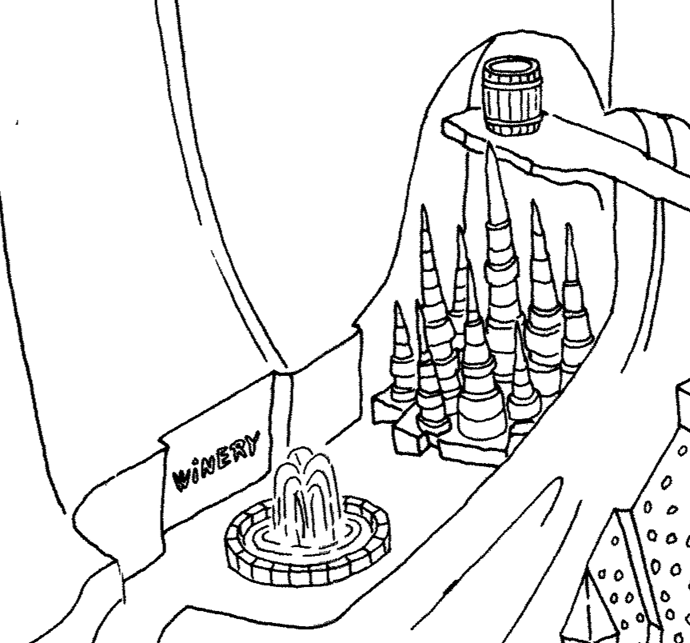
c.) North from the trident to a “Bubble Chamber” that has a green stone. Hang out at the green stone long enough and you’ll start to feel unhealthy.
You are at a high rock on the NE side of a watery chamber at the mouth of a small brook. An unknown gas bubbles up through the water from the chamber floor. A bluish light can be seen to the southwest.
Nearby, a strange, greenish stone is glowing brightly.
I remember (from 501) this is because the stone is radioactive and needed to be stored in a special container. I’m not sure if I’ve seen the container yet.
d.) Past the radioactive stone is a “Fairy Grotto”…
You are in the Fairy Grotto. All around you innumerable stalactites, arranged in immense colonnades, form elegant arches. On every side you hear the dripping of water, like the footsteps of a thousand fairies. A small stream runs from the SW corner. A bright glow emanates from the south side of the grotto, and a steep passage descends to the east.
…and if you try to keep going, you end up down a corridor that’s too cold to walk through. I think I have seen the right item for this elsewhere but I haven’t tested it yet (you’ll see later).

Going south from the Fairy Grotto you get stopped because it is “too bright”; a similar message happens elsewhere, so this is clearly the same place being linked two ways.
That’s enough of that section. Let’s hop up to the swamp. It relates to the cloth bag that was part of the “Witt Construction Company”.
You are at the edge of an open area of wet sand. The dense foliage appears to grow thinner towards the northeast. A small sign stuck in the muck reads: “Site of Proposed Municipal Parking Lot — D.M. Witt, Contractor.”
Foul smelling gasses bubble up through the wet sand.
I decided to put construction together with the construction site to see what would happen.
As the grey powder mixes with the bubbling quicksand, the whole mixture gradually thickens to a rocklike hardness.
This opens a brand new section; going north no longer sinks you in quicksand.

First comes a ravine:
You’re in an open field on the south side of a deep ravine. South and west the land is an almost impassible swamp. To the west the ravine merges with the swamp; some distance to the east it ends abruptly at the foot of a sheer granite cliff. A dry drainage pipe six inches in diameter emerges from the base of the cliff just above the floor of the ravine.
You can go in the ravine but you can’t get out again with anything being held. This is unfortunate since the ravine has a statue (a treasure).
You are at the east end of a steep ravine, near where a drainage pipe emerges from a rock wall.
There is an ancient marble statue lying here!
Following the ravine further leads to death; I don’t know if exit is about climbing up or about surviving the “wet and treacherous” area to the west.
Ignoring the ravine, you can also go east to find a “cliff” with vines; climbing the vines reveals a rope, and for a while I thought that was that. (Incidentally note: no TIE or UNTIE on the verb list. I tried playing the flute and that didn’t cause the rope to levitate, so I don’t know how to get it to work. I assume THROW makes it happen somewhere?)

I admit my next piece of insight came from the map, but given you could buy it from CompuServe to accompany your gameplay I just consider it a “supplement”. Notice there seems to be a hole/entrance next to the vines. It isn’t there in the regular description!
You are at the foot of a towering cliff. The sheer rock face is partially obscured by thick vines growing up the cliff.
MOVE VINES
Parting the vines reveals a narrow crack in the face of the cliff.
This allows winding around the ravine, getting a “four-leaf clover” on the other side. You can also walk farther and find a lair.
You are in the lair of Ralph the Giant Centipede. The air reeks with the stench of rotting bits of flesh. Giant centipedes, in general, are not partial to visitors.
A golden fleece is lying nearby!
A giant centipede is eyeing you with a none-too-friendly look.
You can take the fleece and it is rather like taking the cloak from the Wumpus. (Incidentally, I suspect either the cloak or fleece or both protect from cold — I just haven’t had a chance to test it yet.) The centipede starts to chase:
The incensed insect is in full gear now. If you don’t move quickly, his monstrous mandibles may masticate you into murky mush!
JUMP
You are at the bottom of the ravine with a broken head.
I’ll have to play around with this later. The game is large enough that it takes a while to get items together to test a theory. Since I had the boat access I grabbed the whiskbroom and shovel and tried using them in various places, getting a hit with the broom at the “dusty room” above the Complex Junction. (This is one of the standard Crowther/Woods rooms, just it has been repurposed. Adventure 448 had a similar puzzle.)
You are in a large room full of dusty rocks. There is a big hole in the floor. There are cracks everywhere, and a passage leading east.
BRUSH
Brushing the dust from one of the larger rocks reveals some carved characters.
In the rock is carved the inscription:
In Memoriam:
John Dillinger, Liberator of the Little Man.
Died: 7-22-34.
…and that’s how you figure out the safe code if you aren’t brute forcing it. Either that, or you take a wild jump based on the Dillinger Society poster and try the death date. I wonder if anyone did that to solve the puzzle!

I’m not really “stuck”, but I have a lot of moving parts to coordinate now and I’m trying to get through without burning too much lamp power. I have five theories about the area past the chapel (“fnord”) but I need to juggle objects to get them in the right spot in order to test any of them.
(Continued from my previous post.)
I’ve taken a fair chunk of the “501 content” down, although there’s a part that’s either different or I’m not remembering correctly. I’ve made a step into the 751-only-content but have only managed so far a step.
To continue from last time, I had explored the outside and found the usual lamp, food, keys, bottle, and keys, but also a yellow tablet, matchbox, leather sack (empty), cloth sack (with grey powder), large wooden box (empty), mushrooms, flowers, and a wooden pole. The treasures in the building go in a safe (which I don’t have the combination for) and I was stopped by a three-headed perfectly ordinary dog (which we’ll get by later), and a salt marsh/swamp area included one exit I neglected to mention last time guarded by mosquitos:
The air ahead is filled with huge mosquitos, with stingers the size of icepicks! The mosquitos haven’t yet caught your scent. Do you really want to proceed?
YES
Once the mosquitos catch your scent, it’s all over very quickly. Sheesh! You have more holes in you than a pincushion!
Arthur O’Dwyer pointed out in the comments EXAMINE works on some objects, although it doesn’t work on many of them and sometimes it works inconsistently. If you’ve opened the cloth bag at the grate, you at least see the grey powder without spilling it…
It contains:
grey powder
…but you miss out entirely on a helpful message if you don’t examine the bag while it is closed.
The label on the bag reads: “Mix with care. Property of Witt Construction Company”.
This bag is not in Adventure 501 and I have no idea how to mix it yet. Since it is a new item I presume it applies to one of the new puzzles.
At least some of the content is still identical; you can still unlock a grate to find yourself in a long west-east passage, where along the way you can pick up a cage and a rod. (The cage has a “soiled paper” this time around with a “useless” deed for a silver mine.) The bird is along the way who is spooked by the rod and you need to have dropped the rod in order to capture the bird.

The Donovan map includes the fact you can drop from the “all alike” maze which has the pirate treasure down to the bird room.
The bird then can be released to chase off the snake, making the rest of the cave wide open. This seems like a good moment to step back to the big picture.

Above is my current attempt at a “meta-map” where the “new for 501” rooms are marked in blue and the “new for 751” part is marked in green. (Please note directions are approximate, and general areas are compressed into single rooms.) For example, from the snake, there’s one small offshoot to the northeast where you can find a throne room with a crown.
You are in the private chamber of the Mountain King. Hewn into the solid rock of the east wall of the chamber is an intricately-wrought throne of elven design. There is an exit to the west.
GO EAST
You are on the east side of the throne room. On the arm of the throne has been hung a sign which reads “Gone for the day: visiting sick snake. –M.K.”
An ancient crown of elven kings lies here!
While wearing the crown in 501, there’s a sword in a stone you can pull out; you can find it by finding a “whirlpool” (it’s just past the rusty door, if you know Crowther/Woods) and diving in:
You are dragged down, down, into the depths of the whirlpool. Just as you can no longer hold your breath, you are shot out over a waterfall into the shallow end of a large reservoir. Gasping and sputtering, you crawl weakly towards the shore….
You are on a narrow promontory at the foot of a waterfall, which spurts from an overhead hole in the rock wall and splashes into a large reservoir, sending up clouds of mist and spray.
There is a narrow chimney on the east side of the promontory. Through the thick white mist looms a polished marble slab, to which is affixed an enormous rusty iron anvil. In golden letters are written the words: “Whoso Pulleth Out This Sword of This Stone and Anvil, is Rightwise King-Born of All This Mountain.”
A gleaming sword is stuck into the anvil!
Returning back to the Mountain King area:

Two of the treasures have been swapped; the “silver bars” to the north are now a “delicate lyre” and the “diamonds” found near the fissure (the same one you wave the rod to make a bridge) are now a “silver horn”. Both are used to solve puzzles I’ll show later. (I didn’t remember them straight off the bat from 501, but the fact they were treasures changed into tools gave me suspicion.) The magical bridge from Crowther/Woods is technically optional (you can reach the other side via walking a different way) but because of the addition of the Wumpus the bridge is now needed.
You are on the east bank of a fissure slicing clear across the hall.
The mist is quite thick here, and the fissure is too wide to jump.
WAVE ROD
A crystal bridge now spans the fissure.
GO WEST
You are on the west side of the fissure in the Hall of Mists.
There is a silver horn here!
A crystal bridge now spans the fissure.
The Wumpus was my favorite puzzle from 501 and I didn’t even put the solution when I wrote about the game last time.
You’re in the Cloakroom.
A lovely velvet cloak lies partially buried under a pile of loose rocks.
In the corner, a Wumpus is sleeping peacefully.
Specifically, the Wumpus doesn’t wake up until you nab the cloak, at which point it starts chasing you. You can reach a fair number of places on the map in time, but the one you want to aim for is the crystal bridge.

Normal map, not meta-map. Trying to enter the Wumpus area will sometimes randomly drop you in a dead end.
While waving the rod makes the bridge appear, waving the rod again will make the bridge disappear. A formerly “optional” puzzle is repurposed here to now be meaningful.
You’re at west end of Hall of Mists.
The Wumpus is still on your trail! And he’s getting closer!!
GO EAST
You are on the west side of the fissure in the Hall of Mists.
The Wumpus is only a few steps behind you! All this exercise is making him veerrrrry hungry!
There is a silver horn here!
A crystal bridge now spans the fissure.
GO EAST
You’re on east bank of fissure.
The Wumpus is only a few steps behind you! All this exercise is making him veerrrrry hungry!
A crystal bridge now spans the fissure.
WAVE ROD
The crystal bridge has vanished!
As the bridge disappears, the Wumpus scrambles frantically to reach your side of the fissure. He misses by inches, and with a horrible shriek plunges to his death in the depths of the fissure!
(If you aren’t familiar with the Wumpus, I give the history in my Before Adventure series. This is the most notable appearance of the Wumpus in a proper adventure game from this era.)
Some parts are near-identical but still with a change; for example, the long sequence with the troll-chasm-bear normally has the bear appeased with the food in Adventure 350, but this was changed for Adventure 501. This is one puzzle where I forgot what the solution is (I have a suspicion but I haven’t been able to test it yet).

Near the troll bridge entrance is a completely different branch which leads to new rooms starting with “Dante’s Rest”.
You’re at Dante’s Rest, on the north side of a yawning dark chasm. A passage continues west along the chasm’s edge. A decrepit natural bridge spans the chasm. A message scrawled into the rock wall reads: “Bridge out of repair. Maximum load: 35 Foonts.”
GO SOUTH
The bridge shakes as you cross. Large hunks of clay and rock near the edge break off and hurtle far down into the chasm. Several of the cracks on the bridge surface widen perceptibly.
You’re at the Devil’s Chair, a large crystallization shaped like a seat, at the edge of a black abyss. You can’t see the bottom.
An upward path leads away from the abyss.
A decrepit natural bridge spans the chasm. A message scrawled into the rock wall reads: “Bridge out of repair. Maximum load: 35 Foonts.”
I have not tested if there’s a number-of-passes through limit; there certainly is a weight limit. There’s a magic item that allows teleportation so I haven’t needed to pass through more than once.
Just up from the “Devil’s Chair” is a “Rotunda” with a telephone booth; the telephone is ringing. Try to go into the booth and a gnome will jump in before you. (I mentioned this puzzle in my writeup on 501, but I neglected to explain how it gets resolved and I don’t remember. D’oh. I used to do much more skipping around in ye olden days of the blog.) To the east of the rotunda is a brand new room (I think, at least it didn’t make my 501 map) with a Conservatory and a flute.
You’re in the Rotunda. Corridors radiate in all directions. There is a telephone booth standing against the north wall. The telephone booth is empty. The phone is ringing.
Nearby is a small plastic card.
GO EAST
You are in the Conservatory, whence the gnomes often repair to relax with a little music. On one side of the room is an old upright piano.
A delicate silver flute is lying nearby.
The card is a “MERKIN EXPRESS CARD” and does not count as a treasure and is new for 751 along with the flute. I don’t know what either is for yet. Just to compare, here’s the scene from 501:
You’re in Rotunda.
The telephone booth is empty. The phone is ringing.
ENTER BOOTH
You are standing in a telephone booth at the side of a large chamber. Hung on the wall is a banged-up pay telephone of ancient design.
The phone is ringing.
ANSWER PHONE
No one replies. The line goes dead with a faint “Click”.
I don’t know if the change in events suggests a change in how the phone operates (and if there’s a puzzle now that wasn’t here before).

The path leads farther past a “star sapphire” (just a treasure) and into an area I’ll call the Lost River section.

You land from the passage at a “Tongue of Rock” (the whiskbroom was in 501, but again I don’t remember what it was for)…
You are in a level E/W passage partially blocked by an overhanging tongue of rock. A steep scramble would take you up over the tongue, whence continues an upward crawl. There is a small hole in the north wall of the passage.
There is a small whiskbroom here.
….and to the west of here you can pass by a Bat Cave with a shovel, finally ending at a Blue Grotto with a trident; rather, the trident, the one that normally is placed elsewhere and is used to open a clam.
You are on the eastern shore of the Blue Grotto. An ascending tunnel disappears into the darkness to the SE.
There is a jewel-encrusted trident here!
From the Tongue of Rock you can proceed down to a colorfully described Green Lake Room…
You are in a low, wide room below another chamber. A small green pond fills the center of the room. The lake is apparently spring-fed. There is a narrow passage to the north.
A larger passage continues west.
…followed by a Rainbow Room; going any farther west results in it being too bright to make further progress.
You are in a very tall chamber whose walls are comprised of many different rock strata. Layers of red and yellow sandstone intertwine with bright bands of calcareous limestone in a rainbow-like profusion of color. The rainbow effect is so real, you are almost tempted to look for a pot of gold! Poised far over your head, a gigantic slab, wedged tightly between the north and south walls, forms a natural bridge across the roof of the chamber.
GO WEST
You are following a yellow sandstone path. There is a glow to the west.
GO WEST
You go a short way down the bright passage, but the light grows to blinding intensity. You can’t continue.
You can take one more passage north to the side of a river…
You are standing on a large flat rock table at the western end of Lost River Canyon. Beneath your feet, the river disappears amidst foam and spray into a large sinkhole. A gentle path leads east along the river’s south shore. Another leads sharply upward along the river’s north side.
…but let’s leave this area entirely, and jump back upstairs to show off getting by the dog.
You are in a dimly lit passage behind Thunder Hole. Etched into the rock wall are the ominous words:
You are approaching the River Styx.
Lasciate Ogni Speranza Voi Ch’Entrate.
A hideous black dog bares his teeth and growls at your approach.
PLAY LYRE
The air fills with beautiful music. The dog gradually becomes less fierce, and after a short while he lies down by the side of the cavern and falls into a deep sleep.
GO EAST
You are at the River Styx, a narrow little stream cutting directly across the passageway. The edge of the stream is littered with sticks and other debris washed in by a recent rainfall. On the far side of the river, the passage continues east.
I flailed a bit (“GO EAST: How do you propose to cross the river?”) before I realized I could just jump.
JUMP OVER RIVER
You’re on the east side of the river’s sticks.
GO EAST
You are at the top of some arched steps. On one side is a blank wall with a tiny door at the base and a shelf overhead. On the other side a westward passage leads to the sea.
The only way past the wall is through a tiny locked door.
Snrk. From here, thinking of an Alice in Wonderland reference with the tiny door, I tried EAT MUSHROOMS. (Previously, the mushrooms did nothing, but if they were going to work anywhere, here seemed like the place.)
You are growing taller, expanding like a telescope! Just before your head strikes the top of the chamber, the mysterious process stops as suddenly as it began.
You are in a low cramped chamber at the back of a small cave.
There is a shelf in the rock wall at about the height of your shoulder.
There is a tiny brass key on the shelf.
There are some tiny cakes on the shelf.
The tiny key unlocks the door, and the tiny cakes cause you to return to normal size, but the issue is the door remains tiny! So I’m not sure if I’m supposed to be adding another step to my sequence somehow so I can be not just super-grown and normal but also shrunk. (I’m pretty sure this puzzle is in 501 as-is, and I’m annoyed at my past self that I didn’t just explain the solution.)
That’s one instrument used! Let’s take care of the horn next. We’re going back to a scene that’s pretty familiar in Crowther/Woods, where you find a clam and then open it with the trident.

Rather than bothering with the clam at all, though, we’re going up:
You’re in a large room carved out of sedimentary rock. The floor and walls are littered with bits of shells imbedded in the stone. A shallow passage proceeds downward, and a somewhat steeper one leads up. A low hands and knees passage enters from the south.
There is an enormous clam here with its shell tightly closed.
GO UP
You are in an arched hall. A coral passage once continued up and east from here, but is now blocked by debris. The air smells of sea water. Your footsteps echo hollowly throughout the chamber.
BLOW HORN
As the blast of the horn reverberates through the chamber, the seemingly solid rock wall crumbles away, revealing another room just beyond. The wall was most likely worn thin by an ancient watercourse which dried up just before completely wearing away the rock.
You are in an arched hall. The remnants of a now-plugged coral passage lie to the east. The north wall has partially crumbled, exposing a large connecting hole to another room.
This is all still in 501 territory; it leads to a path down to a chapel which is a dead end.

There’s some “ruby slippers” near the church that can be worn and utilized to teleport between the rainbow room and the bridge above it (which adjoins the chapel).
You are standing on a natural bridge far above the floor of a circular chamber whose walls are a rainbow of multi-colored rock. The bridge was formed eons ago by a huge slab which fell from the ceiling and is now jammed between the north and south walls of the chamber. There is a pair of ruby slippers here.
GET SLIPPERS
Taken.
WEAR SLIPPERS
Ok
CLICK HEELS
You are in a very tall chamber whose walls are comprised of many different rock strata. Layers of red and yellow sandstone intertwine with bright bands of calcareous limestone in a rainbow-like profusion of color. The rainbow effect is so real, you are almost tempted to look for a pot of gold! Poised far over your head, a gigantic slab, wedged tightly between the north and south walls, forms a natural bridge across the roof of the chamber.
The new thing is that there are some “brambles” to the east blocking the area.

You can take a candle from the chapel and the matchbox from the start of the game (not present in 501) in order to make a fire.
You’re at the east portal of the Gothic Cathedral.
A sudden draft has extinguished your match.
A NE passage is blocked by an impenetrable thicket of sharp thorny brambles.
Deep within the brambles is growing a perfect, blood-red rose!
BURN THICKET WITH CANDLE
The dry brambles immediately catch fire and disappear in a roar of flame.
Finally this gets to the main new area of the game! The thing I’ve been waiting years to reach… except….
You are in a dull N/S passage beside a tall black rock. On the rock is chisled the outline of a four-leafed clover, under which is the inscription: “Notice: This rock fabricated from ersatz materials.”
Smoke rings curl upward from the rock.
GO NORTH
As you approach the rock, an indistinct muttering sound arises from the general area of the rock. The only word you can hear clearly is “Fnord!”
You’re on grassy knoll.
Agh! Trying to say FNORD here just gets a “snickering sound”. I don’t know if this is just a matter of repetition or finding a new magic word or blindly throwing the axe and hitting whatever is hiding behind the rock or what, exactly. It seemed like a good place to pause, though.
Just to be clear, my main obstacles going forward are:
a.) the tiny door, where I can grow to grab a key and shrink again to normal but I don’t have a way of shrinking to tiny-door size
b.) the mosquitoes at the swamp
c.) the “fnord” rock
d.) being able to rescue that “perfect, blood-red rose” before lighting the brambles (this may help resolve problem c)
There’s always the possibility of something hidden, though. I’m pretty much giving myself free use of the map and it does seem like almost everything left that’s from 751 is past that rock.
I know all this is past the tiny door and I visited it in 501, I just need to make it here.
COME WITH ME TO COLOSSAL CAVE. WHERE MAGIC ABOUNDS AND TREASURES ARE FOUND. BID YOUR FINGERS FOLLOW YOUR COMMANDS AND I WILL BE YOUR EYES AND HANDS. YET BEWARE THE FIERY DRAGON, FOR HE KNOWS NOT WHETHER YOU ARE WIZARD OR SIMPLE CHARLATAN!
HOW BEST TO CONQUER COLOSSAL CAVE? WITH DARING AND SKILL … OH CLEVER KNAVE!
— Early 80s Adventure poster, from the CompuServe Incorporated Information Service Division
Adventure 751 has been, by my reckoning, the most sought-after variation of Crowther/Woods Adventure. It was generally available on the online portal CompuServe from nearly the beginning of the service and it disappeared when they shut down their games in the 90s. Arthur O’Dwyer started a web page in 2016 (with semi-regular updates!) dedicated to hunting down a copy.
To finish off a wild 2025 in game preservation, Arthur O’Dwyer announced the game has been found (by LanHawk, a regular amongst the comments here) and is playable.

Via eBay. You could purchase this from CompuServe. I love how they tried to contextualize this like a swords-and-sandals epic, with a goblin-esque dwarf and the trident used as a weapon. It still includes the bird-in-cage, though!
In 1958, the Electrical Engineering Department of the University of Arizona in Tucson received a donation of equipment in order to form an Analog Computer Laboratory. Analog computers deal with full electrical signals rather than 0s and 1s (think music on record vs. on computer). These could do particular computations (like differential equations) faster than digital devices of the time.

An EAI TR-20 from eBay. $7,495.00 or best offer. As the ad copy notes, “It offers up to 20 amplifiers plus components for addition, subtraction, multiplication, division, integration and generation of powers, roots, logs, antilogs, sine, cosine and arbitrary functions — in one cabinet, and available to one patch panel.”
The University of Arizona’s lab was more cobbled-together than the for-sale-new device depicted above, as they made “two small but flexible computers complete with homemade removable patchboards” to start with but quite quickly changed mission to be a hybrid laboratory. By hybrid, I don’t mean just having digital and analog computers side-by-side, but trying to make computers that use both digital and analog components. Their name officially became The University of Arizona Analog/Hybrid Computer Laboratory. Designs included the “ASTRAC I”, a “iterative differential analyzer”, “APE 1”, a “teaching aid in statistics” that followed a similar design, and an “ASTRAC II” which was now “solid state” and “ultra-fast” and was supported by both the Air Force and NASA.

ASTRAC II. Source: “All analog computing elements other than coefficient potentiometers plug directly into the rear of the shielded analog patchbay.”
(Warning: My next three paragraphs consolidate three different accounts which differ somewhat.)
Three of the students in the 1969-1970 school year were Alexander B. Trevor, John Goltz and Jeff Wilkins. The trio were discussing the possibility of starting a time-sharing company. This was a little late to the game; Dartmouth with General Electric had developed the concept in the early 60s (where a large computer could have its time split into many parts allowing for multiple computers connected; including remote connections Dartmouth had thousands) and by the time Trevor, Goltz, and Wilkins came to the idea there were other companies like Tymshare and National CSS involved.

A PDP-15 mini-computer which the lab supposedly had. Trevor claims 1969 but the machine didn’t come out until 1970.
Jeff Wilkins’s father-in-law, Harry Gard, Sr., was a co-founder of Golden United Life Insurance; at the time the insurance company was still getting their computing via other companies, but Gard was keen on Golden United having a computer of their own. The original intent was to buy a mini-computer like the PDP-15 but Goltz (who was working with Wilkins and doing the purchase through DEC) got a call that he could have a KA-10 for just “a little more” (one of the PDP-10s, a full mainframe rather than minicomputer). While Goltz was an engineer and not a salesperson, John Goltz managed to persuade the board of Golden United to part with the money for the upgrade. This enabled the computer to more feasibly do time-sharing with many customers.
After graduating Wilkins moved to Columbus (followed by Goltz; Trevor was drafted to the Army so didn’t join them until ’71) to be at Golden United’s new spin-off, CompuServe; Wilkins at the age of 27 became President. Their first developed product was LIDIS (Life Insurance Data Information System); there were plenty of life insurance companies in Columbus to sell to.
The company had rapid success; by 1973 they moved to a new building, and by 1974 had not one but seven mainframes “and were using them not only to support a thriving time sharing business, but also to heat our office buildings.” CompuServe stayed with corporate clients, although Wilkins was alert to trends in personal computers; he hired his brother-in-law to track computer magazine news, given the fact most of the operations done by time-sharing could be done more easily with PCs.
One of those personal computers was the TRS-80, launching in 1977 as part of the “Trinity” with the Commodore PET and Apple II from the same year. The TRS-80 was sold through Radio Shack stores that were already well-established across the nation, but it was still difficult to move product when the concept of a personal computer was only a vague notion to many buyers. A Radio Shack manager in Columbus named Bill Louden bought one of the early models (serial model 10) as Radio Shack refused to give out demo units; his purchase became the only demo available in the Midwest and people wanting to experience a TRS-80 went specifically to Columbus, driving and even flying in.
Simultaneous to this, Wilkins was watching the new market for “modems” which connected personal computers to networks via the phone. He also had computers sitting idle by night (as businesses using them were running them during the day); since he already had the resources, it would be a straightforward matter to have a new commercial-facing venture.
Wilkins thus laid out in 1978 an idea for a new product based on European Videotex services. Videotex is its own rabbit hole that I’m not going to touch on much here; starting in the mid-70s there were experiments with turning televisions into networked services.
The important point here is that the “television as an appliance” thought process was being applied to make “computer as an appliance” and this would help interest computing to the masses. Wilkins launched a new service MicroNET (“to get microcomputer owners’ attention and suggest the power of the computer network”) and tapped the previously mentioned Midwest Computer Club for a “beta-test”.
The test service was launched for free; Bill Louden called it “a hacker’s dream” and a good way to sell modems (110 and 300 baud). Quoting Bill:
We had access to many of the DEC-10’s features, storage, and better processing power, but of most significance we had started using two programs: One was a store-and-forward messaging system, called Infoplex, which allowed us to share text message files with one another even if we were not online at the same time. The other was a modified version of a program that allowed a user to send a live one-line text message to the CompuServe system operator. Our version, modified by Russ Ranshaw of CompuServe, allowed us to send one-line live messages to each other if we saw one another online. We called it the SEND program.
It had all the regular offerings later associated with CompuServe, including games. Both Star Trek and Adventure were available (this is before Microsoft Adventure came out, so it was the original mainframe version). Eventually in the early 1979 a price structure was added: $9 startup, prime time use $12 per hour, non-prime time use $5 per hour, 300 baud more expensive as a “premium” service. Q2 revenues in 1979 were $4.2 million; this was almost a rounding error in the scheme of the business as a whole, but of course personal computers were about to hit the time-sharing companies with fatal blows.
A competitor, The Source, was launched in 1979 but “from scratch” by the entrepreneur William F. von Meister (that is, not piggybacking off an existing time-sharing business). Their main relevance to the story here is not only did they have games (the usual like Star Trek) they also tapped Dartmouth College to work on new games. (Remember these are being developed for mainframes or minicomputers, so we’re not talking about typical personal computer programmers! Hence work being drawn from colleges with access.)
I don’t have an official notice of solicitation — it may even have come via word of mouth — but CompuServe also must have had contact with mainframe/minicomputer sites in order to get their own games. A 1984 games catalog lists House of Banshi, which is simply Dungeon/Zork (“CompuServe’s rendition of the original game of ZORK.”) Dor Sageth from the catalog is another famous “lost game” which started life on an institutional computer (mentioned by Jason Scott back in 2011). Listed on page 2 is both “Original Adventure” (as the service launched with) and “New Adventure”.

In 1977, David Long went to the University of Chicago to work as a computer operator. The college had just bought two of the newest computers from DEC, the PDP-20. One was for general use by the college and the other was for specifically the Graduate School of Business; Long “tended to work 50-60 hours a week on GSB stuff”. 1977 was also the year the “standard” Crowther/Woods Adventure was finalized, and David Long was able to get a copy direct from the author:
Don was kind enough to transmit the source program to the present author in mid-1977.
As he notes, given his work schedule, and the time he spent with GSB affairs, “no one cared if I spent another 10-20 hours on Adventure”. He finished “Adventure 501” by November 1978:
You are inside a building, a well house for a large spring. Off to one side is a small pantry.
There is a shiny brass lamp nearby.
There is a leather sack here.
Taped to the wall is a faded poster.
READ POSTER
The poster has a picture of a thin man with a long white beard. He is wearing a high pointed cap embroidered with strange symbols, and he is pointing a finger at you. Below the picture are the words: “I want you!–To report all good ideas for extensions to this game to me without delay. Remember: ask not what ADVENTURE can do to you; ask what you can do for ADVENTURE.”
“A public service of the John Dillinger Died for You Society.”
A safe is hiding behind the poster. Found treasures get dropped in the safe rather than on the ground.

The John Dillinger Died For You Society was a spoof group made in 1966 at the University of Texas meant to parody Elvis fan groups and “Jesus Died For You” signs.
I’ve played Adventure 501 before; a version had been available for some time (with the mysterious addition of a spider, which isn’t Long’s). The archive LanHawk extracted also includes the authentic ’78 version of Adventure 501, so I was able to cross-check with what I already played.
Further expansions eventually led to a “version 6” in January of 1980, including a new area as well as an “improved syntax parser”. (More on the parser later.) An in game “billboard” gives version updates:
( 19-Jan-1980 ) Congratulations to Robert Silverman, the first adventurer to set foot in the Courtyard of Aldor’s Castle.
( 25-Feb-1980 ) Adventurers may now enter the Castle Keep, although construction continues within. Some scoring bugs have been fixed.
Who will be first to discover the secret of the black bird?
( 3-Mar-1980 ) There is a slight bug on the perfume. For full score, you must drop it somewhere, look, and take it again.
( 7-Mar-1980 ) 6.04 is released. Expansion of the castle continues — it is far from complete. Several unique new features and puzzles have recently been designed and are now being implemented.
The format of most hints has been altered. I hope you agree that the new hints are more in keeping with the flavor of the game.
The game I’m referring to as “Adventure 751” seems to have been entirely wrapped up by the end of the school year. Sometime before the end of the calendar year Long sold the game to CompuServe for “a thousand dollars”. (As they used the PDP-10/20 like Long did, no conversion work was needed and they could run the executable without compilation.) Long seems to have been somewhat protective of his source code so distribution past that point was relatively minimal, although he did give source copies of both 501 and 751 to the Illinois Institute of Technology. (See, comparatively: Woods and his regret freely sending out Adventure 350 to anyone who asked, making it so that when he wrote “v2.0” he was much more careful who had access.)
The parser is “improved” over both Adventure 350 and Adventure 501. There is some sense of trying to “outdo Zork”. (See relatedly: Warp bragging about its own system, and Synapse Software calling their system BTZ or “Better Than Zork”.) Quoting Long:
…Dungeon (Zork) and Adventure-6 were developed almost completely independently. The advanced parser, the object containment facility, and virtually all the game puzzles were designed and implemented prior to our receiving any version of Dungeon. With all due modesty (none), I will point out that Adventure’s containment facility is at least as powerful as Dungeon’s, if not more so, since Adventure’s facility permits searching for contained objects in open containers down to any desired level of containment. Further, the parser permits a few constructs not currently permitted in Dungeon (at least in the version we have at U.C.), such as permitting any number of objects (up to some limits imposed by compiled array sizes) to be specified following transitive verbs. In addition, Adventure’s parser can handle multiple verb constructs such as “GET AND THROW AXE” properly. Finally, Adventure’s parser is slightly better about doing the right things with the various applications of the group words “ALL” and “TREASURES”. A planned enhancement for Release 7 will permit such constructs as “PUSH ALL OF THE BUTTONS” or “TAKE BOTH SACKS”, etc.
GET AND THROW AXE is uncommon even in modern parsers. Trying to GET AND THROW BREAD in Savoir-Faire (2002) gets the response “You can’t see any such thing.”
Dennis Donovan (of CompuServe) made a map in November of 1980 which Arthur O’Dwyer scanned in high resolution with some image cleanup by James Lindell Dean, so I’m going to use it to illustrate the journey.

Arthur tested the build with a walkthrough that has been around for a while to confirm this is indeed the “real” Adventure 751; I’m going to play it normally. I am re-mapping the 501 content although I am allowing myself to look at my old posts if I need to; you can also squint at a blurry version of my 501 map where the blue rooms are extensions to Adventure 350.
You are standing at the end of a road before a small brick building. Around you is a forest. A small stream flows out of the building and down a gully.
GO EAST
You’re in a flat circular clearing surrounded by dense forest. Not far away is a helicopter. Its engine is idling slowly. Several jac-booted Orcs are standing guard around the aircraft.
Going east normally enters the building. Unexpected! Trying to enter gets a message about needing a flight pass.
The building is still there, but you need to use the command IN to enter, and then can go IN again to get in farther.
You are inside a building, a well house for a large spring. Off to one side is a small storeroom.
There is a shiny brass lamp nearby.
There is a leather sack here.
Taped to the wall is a faded poster.
There is a small matchbox here.
IN
You’re in the caretaker’s storeroom.
A yellow pill-shaped tablet, as large as a doughnut, lies nearby.
There are some keys on the ground here.
There is food here.
There is a bottle of water here.
Helpfully, the leather sack works as a container; keep in mind this is not a two-word parser so to operate it you need to use PUT X IN SACK. In fact, it works with multiple items at once. That is…
PUT TABLET AND KEYS AND FOOD AND BOTTLE IN SACK
…will take care of scooping up all four.

Other than the helicopter pad being different, and a slightly different building layout, there’s a new object at the grate that goes into the cave:
You are in a 20-foot depression floored with bare dirt. Set into the dirt is a strong steel grate mounted in concrete. A dry streambed leads into the depression.
There is a large cloth bag lying nearby.
The grate is locked.
The cloth bag is full of grey powder and if you EMPTY BAG it will scatter all over the place and you won’t be able to pick it up again: “Grey powder has been strewn all about.” I assume this is a softlock, simply from checking what’s inside the bag. (Crowther/Woods really was polite when it came to softlocks. It had the vase breaking when you dropped it, ruining a treasure, but the structure of the game was such that getting all the treasures was an aspirational goal rather than a requirement for having a satisfying playthrough. The various extensions, including the one from Woods himself, often were not so careful. You could eat the food early in Crowther/Woods rather than give it to the appropriate creature, but there’s a built in expectation that EAT FOOD is going to remove it from the object list; just checking what’s inside a container doesn’t suggest such a drastic change.)

I’m not going to go underground at all during this session but rather stay outside. The forest, rather than being a method to steer the player back to the caves, includes a “billboard” (as seen earlier, also in the image above) and a castle in the distance.
You are in open forest, with a deep valley to one side. Not far off is a large billboard.
GO NORTH
You are standing behind a large billboard on a ridge above a deep valley. To the north, the forest gives way to dense swamp and then to open flatlands. Far beyond, the land rises sharply towards the impassible Misty Mountains. Nestled at the base of a distant cliff are the stone turrets of a tall white castle.
The outdoors keeps going. At least some of this area I recognize from 501, although it goes a little farther than that game did.

Going west of the building leads to a “dense forest” with some mushrooms…
You are in dense forest, with a hill to one side. The trees appear to thin out towards the north and east.
There are some oddly-colored mushrooms here.
GO WEST
You are at the high point of a wide grassy knoll, partially surrounded by dense forest. The land rises to the south and east, and drops off sharply to the north and west. The air smells of sea water.
…and a sandy beach. The beach includes a “large wooden box” (the box is empty) where you can go up to find an Ocean Vista with some flowers, the first treasure I’ve found.
You’re on sandy beach.
A large wooden box has washed up on the shore.
GO NORTH
You are at a jumble of large broken rocks and blackened shoals.
A gentle path leads up to the top of the nearby cliffs. A narrow treacherous path disappears among the rocks at the foot of the cliff.
GO UP
You are on a high cliff overlooking the sea. Far below the rolling breakers smash into a jumble of blackened shoals. The thunder of the surf is deafening.
There are some beautiful flowers here!
The “blackened shoals” are incidentally a University of Chicago in-joke created by a friend of Long’s (Eric Weber); it refers to the professors Black and Scholes who made a famous mathematical model for financial markets. There’s an entire hour-long documentary called Trillion Dollar Bet about it (“this solved the ancient problem of risk and return in the stock market”); it is blamed for more than one market crash, including Black Monday from 1987.

This is also the location I remembered something very cruel from Adventure 501 that carries over here. Original Crowther/Woods had a limited number of “random” exits that could sometimes go somewhere else (north goes to a different forest than the normal exit, for instance); other authors basing their games off Adventure sometimes ran with this (even affecting home games, like in Phantom’s Revenge). Going north from the shoals will sometimes go to the cliff already seen, and sometimes it will go to a new room altogether. Back when I played 501 I only found the new room by referring to the CompuServe map!
You’re at blackened shoals.
GO NORTH
You are at Thunder Hole, a funnel shaped cavern opening onto the sea. The noise of the surf pounding against the outer rocks of the cave is amplified by the peculiar shape of the cave, causing a thunder-like booming sound to reverberate throughout the cave. Outside, a narrow path leads south towards some large rocks.
GO EAST
You are in a dimly lit passage behind Thunder Hole. Etched into the rock wall are the ominous words:
You are approaching the River Styx.
Lasciate Ogni Speranza Voi Ch’Entrate.
A hideous black dog bares his teeth and growls at your approach.
I do not remember the method for getting by the dog. I assume I need to go underground first. (I’m pretty sure all of this is 501 territory, though.)
If instead of heading west to the beach you head north from the mushrooms/grassy knoll, you arrive at some “salt flats”.
You’re on grassy knoll.
A tiny little man dressed all in green runs straight at you, shouts “Phuce!”, aims a kick squarely at your kneecap, misses, and disappears into the forest.
GO NORTH
You are at the edge of a trackless salt marsh. Tall reeds obscure the view. In the mud is the partial word “-RO–O”. The missing letters have been washed away by the tide.
A wooden pole has been stuck in the mud here.
I’m not sure what the tiny man is about, yet. Saying phuce gets the response “nothing happens.”

The salt flats are a maze that lead up to a swamp which is just a continuation of the maze.
Notice there’s a.) two “dead end” rooms which aren’t really dead ends and b.) one “death exit” from one of the swamp rooms which just kills you for going a particular direction (“You’ve wandered into a quicksand pit and drowned.”). Neither of these are polite and neither of these are used in Crowther/Woods (you could die walking in the dark by falling in a pit, but this was well-telegraphed by the game).
You are at the edge of an open area of wet sand. The dense foliage appears to grow thinner towards the northeast. A small sign stuck in the muck reads: “Site of Proposed Municipal Parking Lot — D.M. Witt, Contractor.”
Foul smelling gasses bubble up through the wet sand.
This room has multiple death-exits, which is obnoxious given the restore-a-save procedure (where you need to decline resurrection, leave the game, restart the game, decline instructions, RESUME to load as save, confirm you are loading a save game, and then finally type what you named the save). I think this is all a dead end although I haven’t checked every exit as of yet (see: obnoxious restore-a-save procedure).

I believe from here I’ll need to plunge underground, so this seems like a good place to pause for now since I know that’s going to open things wide up. Happy 2026!
(If you still haven’t read it, be sure to check out Arthur O’Dwyer’s post; he is planning a follow-up which hacks a bit more at the data. Also thanks to Ethan Johnson for some source assistance.)
Congrats, you survived 2025! (Mostly. As of this writing, still a little time left.)
I’ve already done a review roughly mid-year because I “finished” 1982; you can read about that at All the Adventures up to 1982 in Review.
For 2025 as a whole I managed to write about 85 games. This includes some older ones that I’ve been able to loop back to: Kim-Venture where an entire adventure somehow fits on a 6-character display (one that had been on my queue for a while but had been giving me technical difficulty). SVHA Adventure was newly-discovered by the efforts of Robert Robichaud (and is one game I might come back to, as the no-save-game aspect combined with extremely deadly dwarves made it too hard to finish).

I also looped back to 1980 for The Troll Hole Adventure, which was one of my most popular posts due to a combination of the funny title and the bizarro Interact computer.

1981 was re-visited with the unusual first person adventure The Maze, the designed-from-another-universe Tiny Adventure (with a very long historical backstory), the historical oddity Citadel (from a Danish author, but written in English) and the children’s game Deliver the Cake.

1982 is where things get out of hand. I’ll point to Arsène Larcin (a French game from Quebec) and The Hobbit (with a large slice of Australian history) as being popular before I broke to 1983, although after the break I also ended up getting to Skatte Jagt (first Danish adventure), Fairytale (a “children’s game” written for a competition), Takara Building Adventure Part 1 (one of the earliest Japanese adventures) and Pillage Village (an undocumented Apple II game that slipped the net where one of the authors went on to write for Origin).
(The reason I can miss a game varies a lot. In general I take the existing lists of games from Mobygames and CASA and then supplmenet them with a lot of research, but any games that aren’t on either of those sources at the time I start the year can easily go missing. For the games above, Skatte Jagt didn’t have a year attached until I puzzled it out, Fairytale I had on a different year due to the original being lost, Takara was a “lost game” only recently dumped, and Pillage Village simply slipped the net and is still only available in a “warez” version.)

Finally, I did get to a fair number of 1983 games, like the wildly ambitious Ring Quest which includes all of the Lord of the Rings on one giant map, The Palms which was the first Japanese adventure solely available on disk, Ringen which was another lost game (more Tolkien, but in Norwegian), The Dark Crystal which adapted the movie (and I give the history of the movie and game simultaneously), Puzzle Adventure which was all about Japanese wordplay combined with ancient poetry, Madhouse which was a “fangame” for the Deathmaze 5000/Asylum series nobody even remembered existed, and Valley of the Kings which was (again) thought long-lost.
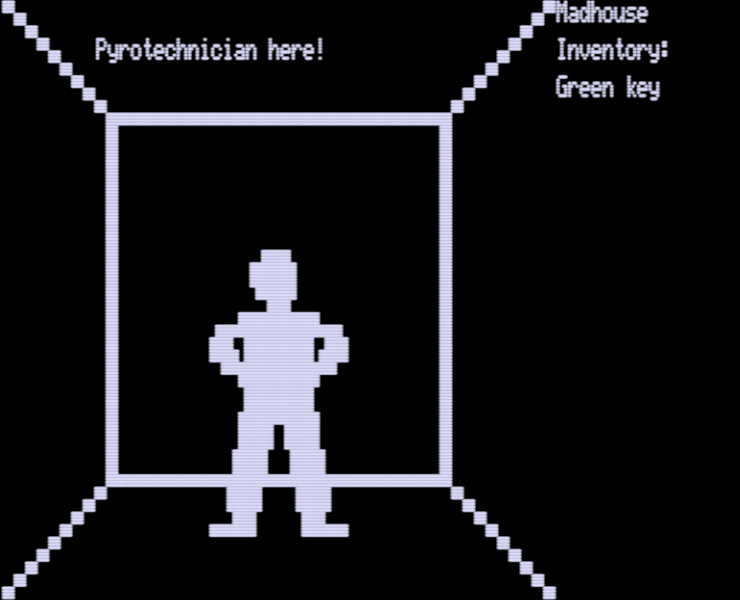
Happy New Year and all that.
There’s quite a few more games (and histories about the games) than that and I’d recommend checking the All the Adventures list if you’ve built up a reading backlog.
(Random survey question: how do people read my blog anyway? I test any new posts on both computer and on phone, and I also test things on Reader.)
As far as what’s coming up for 2026 goes, it’s hard to say with my schedule, as people keep discovering things. Loosely, I know I have (not in this order)
- a completely unknown and gigantic game recovered from a Data General drive with the scale/scope of Warp/Ferret
- another “contest” game like Krakit and Alkemstone, but this time where it’s real buried treasure and the treasure is still out there
- The Coveted Mirror
- Twin Kingdom Valley
- At least five Japanese games (I’m now up to ~50 for 1983 based on my research so I need to keep playing them regularly)
- And one thing I’m keeping under my hat until the time comes.
My deepest thanks to everyone who contributed comments and helped in other ways. The idea of the blog being a collaborative effort was baked into the very title, so I appreciate all of you.


 Renga in Blue

