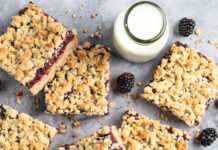
A commonly held criticism (should any even exist!) of baking is that it takes way too long. You spend hours in the kitchen, measuring, mixing, and baking, all for a final product that’s devoured in minutes. For many of us, that labor of love is worth it. It’s a time to lose yourself in a project with a result that will bring a smile to every face. But every baker hits a crunch time, and that’s where a trusty fast-fix recipe comes in.
What makes a recipe fast-fix? For Bake from Scratch, our frame of reference is recipes that take about two hours from start to finish, give or take some cooling time. Fast-fix recipes employ straightforward techniques and standard equipment and ingredients that are already in a well-stocked baker’s kitchen. When we develop fast-fix recipes in the test kitchen, we usually strive for a recipe that has minimal active time, so even if there is a long bake or cool time involved, you can still walk away for a moment. We also try to make it a stir-together recipe when possible, but some specialty equipment like a food processor can also be handy to speed things up.
Even though you might occasionally be short on time, you can still produce beautiful treats without toiling away in the kitchen. Here are some tips for making the most of a fast-fix recipe and how to be your most efficient self in the kitchen.
Mise en Place
You might be familiar with this French culinary term; it translates to “everything in its place,” and it’s a term most chefs use when referring to assembling all the parts of a recipe before starting to cook or bake. All equipment is gathered, all ingredients are measured and prepped, and the recipe is read thoroughly. This gets you organized, eliminates realizing at the last minute that you’re out of an ingredient, and keeps the recipe flowing as you’re putting everything together. Once you start a recipe with a good mise en place, you’ll wonder how you ever went without it.

Trust the Scale
In the Bake from Scratch test kitchen, we develop recipes by weight. Not only is measuring by weight more accurate than measuring by volume, giving a reliable result every time, but it’s also faster than using cups and spoons. Ingredients can be measured straight into a bowl atop a scale, and you won’t have extra utensils to clean up afterward. It’s a win-win.
We love the Zwiling Digital Kitchen Scale.
Temperature Matters
When our recipe states for an ingredient to be “softened” or “room temperature,” we mean it. But what if all your dairy is still in the fridge? You don’t have to wait around for it all to come to temperature. Place in-shell eggs in a bowl of warm (not hot) water for 10 to 15 minutes. For butter, measure it, cut it into cubes, and separate the pieces slightly; the smaller the pieces and the more surface area exposed, the faster it will soften. Most dairy ingredients can be gently heated in a small saucepan over low heat, swirling or stirring constantly, for about 1 minute. And be sure to preheat your oven first thing—you don’t want a time-sensitive dough or batter to stand and potentially suffer.
Grab our custom Bake from Scratch Termapen.