


Turn agent workflows into durable, production-ready systems. Gain reliability, visibility, and scale that unlock real business value from intelligent agents.
VAST AgentEngine
Build, Deploy, and Observe AI Agents at Enterprise Scale
Define, connect, and run AI agent fleets with enterprise-grade scheduling, fault tolerance, and full observability.
Legacy Challenges
Complex Agent Workflows Are Fragile and Hard to Scale
VAST AgentEngine improves your AI projects’ chance of success by removing the toil involved in building production-grade AI agents.

Disjointed Runtime Platform
Complexity creates fragility. VAST AgentEngine delivers enterprise robustness with autoscaling, identity isolation, a stateful memory scratch space and unified management.
See the Industry Perspective
Core Capabilities
VAST AgentEngine Makes it Possible
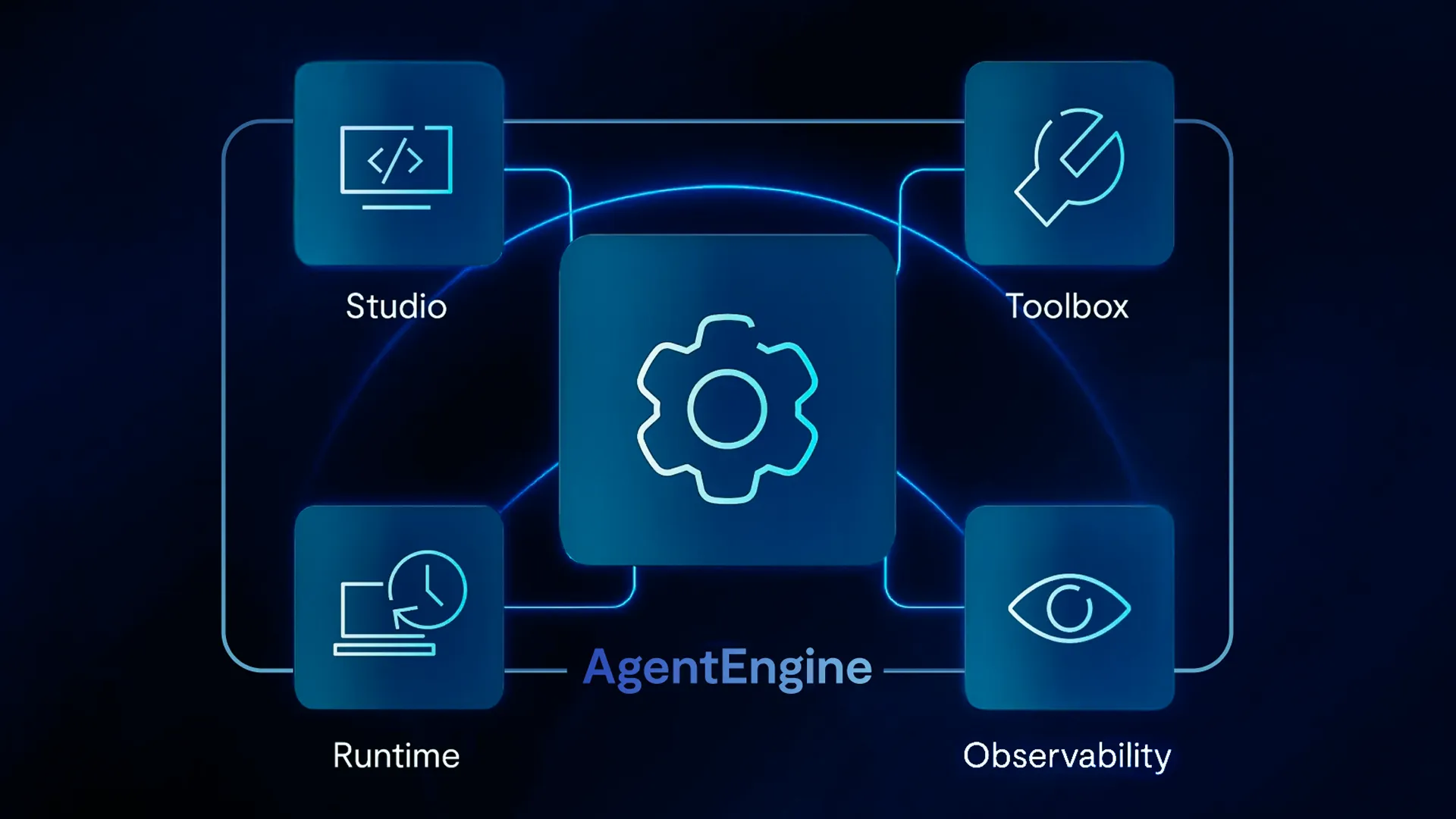
VAST AgentEngine provides the foundation for building, running, and improving intelligent agents. From execution to tools to observability, it delivers the core functions needed to move beyond prototypes.

Unified Agent Runtime
Leverage a single runtime where agents execute with built-in scaling, security, and persistence. VAST AgentEngine consolidates infrastructure into one layer, it reduces brittleness and makes agents production-ready.Learn About KV Cache
End-to-End Observability
Log and trace every agent action, tool call, and data access. End-to-end observability creates transparency for compliance, builds trust with stakeholders, and enables developers to refine performance. More on VAST’s Observability
Event-Driven Workflows
Trigger agents directly from data and system events such as file moves, updates, or deletions. VAST’s event-driven model links infrastructure activity to real-time AI actions and decisions. See Triggers in Action
Identity-Aware Security
Honor data access permissions. With VAST AgentEngine, each agent call is defined with the user's identities and permissions. This ensures tools and data are accessed responsibly, enabling multi-tenant operation with strong governance controls.Read About Unified Governance
Composable Agent Workflows
Enable agents to orchestrate multiple tools and services together, creating higher-order workflows. VAST’s composability lets teams quickly build complex applications without stitching together fragile systems.See Workflow BuildingProduct Benefits
From Fragile Experiments to Reliable Agents
Confidently Run Agents at Enterprise Scale
Reliable, resilient operations
Move beyond fragile prototypes and run agents in production with confidence. VAST AgentEngine delivers enterprise-grade stability through built-in scaling, security, and persistence, so intelligent agents remain robust even as workloads grow and evolve.
Gain Full Visibility Into Agent Behavior
Transparency and insight
See what happens inside your agents. With VAST AgentEngine, every action, tool call, and data path can be observed and analyzed. This visibility enables compliance reporting, faster debugging, and continuous refinement of agent workflows.

Accelerate Innovation With Reusable Tools
Standardized and shareable
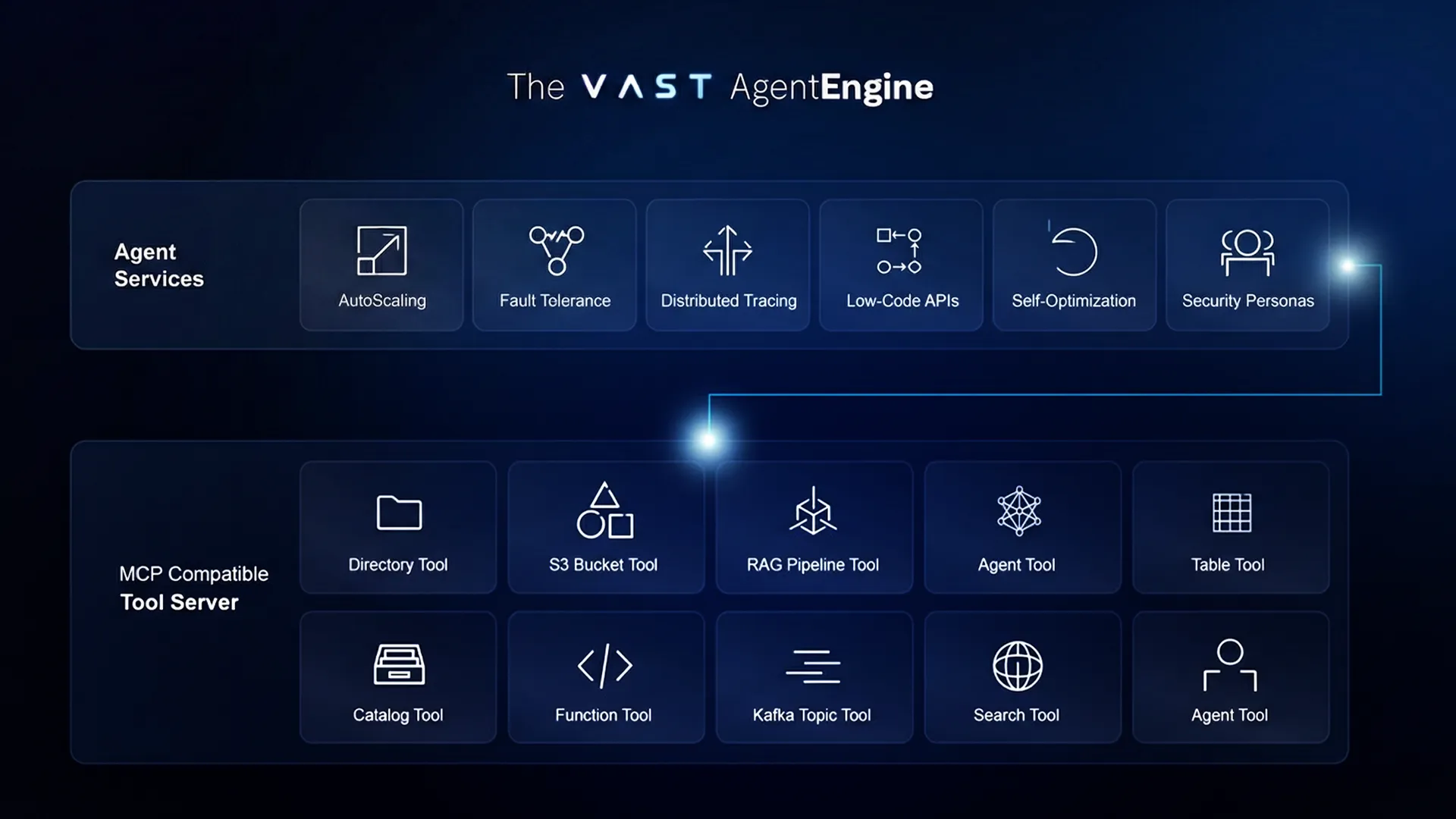
Stop rebuilding the same integrations over and over. With VAST AgentEngine’s registry of reusable MCP tools, teams compose new workflows quickly, share proven components across projects, and focus development time on innovation instead of plumbing.
Feature Details
Providing Runtime, Toolbox, and Observability for Agents
VAST AgentEngine provides the core infrastructure for building and operating intelligent agents: a Kubernetes-based runtime, a registry of MCP tools, and observability to secure, explain, and improve them.
Kubernetes-Based Runtime Platform
MCP Tools & Shared Registry
Observability & Continuous Insight
Knative Auto-Scaling
Leverage Kubernetes Knative to scale agents dynamically based on demand. VAST AgentEngine handles concurrency, resource allocation, and queuing natively. Ensure efficiency and reliability without manual workload tuning.
Identity-Bound RAG
Enable secure, user-aware retrieval-augmented generation while isolating multi-tenant workloads across the enterprise. With VAST AgentEngine agents inherit identity-scoped contexts from users, which define their permissions, data access, and tool usage.
Stateful Scratch Space
Provide robustness against failures while improving efficiency for ongoing operations and long-running tasks. With VAST AgentEngine agents write execution-scoped or persistent data into a stateful scratch space spanning files, objects, or tables.
Kafka-Based Queuing
Ensure reliable agent execution even during workload spikes or infrastructure failures with a fault-tolerant backbone. With VAST, workflows are orchestrated through a Kafka-backed queuing system that guarantees durability and ordering.
Storage Event Triggers
Tie data operations directly to Agentic AI actions in real time. With VAST DataEngine, every add, move, change, or delete in storage can emit an event, seamlessly feeding into agent workflows.
Parallel Scheduling
Maximize throughput while preserving execution order and priority where required.The runtime’s built-in scheduler dispatches tasks in parallel across distributed resources.
Resources
Resources to Keep You Moving Forward

ブログ投稿
Introducing AgentEngine
Discover how AgentEngine bridges the gap between AI agent prototypes and production-ready deployments with dedicated runtime infrastructure, integrated tooling, and unprecedented observability designed specifically for the agentic AI era.
May 21, 2025
動画
The VAST AI OS Demo & Walkthrough
Watch how AgentEngine transforms complex sales research from hours of manual work into minutes by building an AI agent that orchestrates data across CRM systems, support tickets, and internal documents with human-in-the-loop control and enterprise-grade security.
9:41
動画
Andrew Ng – The Rise of Agentic Workflows in AI
Hear AI pioneer Andrew Ng explain why agentic workflows represent the future of AI, enabling iterative reasoning and autonomous problem-solving that goes far beyond single-prompt responses to deliver dramatically better results for complex tasks.
4:59
FAQ
Learn More About VAST AgentEngine
Most teams stitch together orchestration tools, model APIs, and monitoring services, creating fragile and hard-to-maintain systems. VAST AgentEngine replaces that complexity with a unified runtime, shared tool registry, and built-in observability. It’s designed for production from day one—handling autoscaling, identity isolation, and persistent state automatically—so developers focus on behavior design, not infrastructure.
VAST AgentEngine enforces data security through identity-bound access, where data retrieval is bound to the identity of the person using the agent. When agents retrieve or reference data, they do so using the same permissions defined in the underlying storage system. This ensures RAG workflows always respect current access policies, eliminating the risk of privilege drift or stale permission models that can occur in other AI platforms. Governance and observability are built in, so access remains transparent and auditable.
VAST AgentEngine delivers comprehensive AI agent observability that extends beyond traditional infrastructure metrics to the reasoning behavior of agents themselves. Every agent action is logged, including detailed access logs, tool usage metrics, prompt and response history, and full chain-of-thought tracing. This transparency enables compliance reporting, streamlines debugging, and helps build user trust. The platform also captures feedback loops—both explicit signals like thumbs-up/down ratings and implicit reward cues—making this data immediately available for dynamic memory updates and future model refinement. For agent fleet management, this level of insight is critical for continuous improvement and production reliability.
Yes. VAST AgentEngine uses the Model Context Protocol (MCP), an open standard for agent-tool interaction, making integration straightforward. The platform includes a shared registry where you can publish custom tools alongside VAST's curated suite, creating reusable components accessible across your agent fleet. Tools are versioned, monitored, and discoverable through the Studio interface. Whether you're connecting to external APIs, internal workflows, or existing data pipelines, the MCP-based approach ensures standardization and portability. This composability lets teams build complex agent workflows without rebuilding integrations from scratch.
Unlike other frameworks, VAST AgentEngine is built for the demands of production AI agent deployment. It provides enterprise-grade capabilities including Kubernetes-based autoscaling via Knative, Kafka compatible message queuing for guaranteed durability and ordering, and stateful scratch space for resilience against failures.
The AI OS handles event-driven workflows, allowing agents to be triggered directly from storage events like file updates or deletions—connecting infrastructure activity to real-time AI actions.