
In microservices architecture, multiple instances of the same service are often deployed to improve scalability, availability, and fault tolerance. When several instances of a service are running, incoming requests must be distributed efficiently among them. Spring Cloud LoadBalancer provides a lightweight, reactive, and client-side load balancing solution for Spring Boot microservices.
- Distributes requests among multiple service instances.
- Improves scalability, availability, and fault tolerance.
- Replaces Netflix Ribbon in modern Spring Cloud applications.
Spring Cloud LoadBalancer
Spring Cloud LoadBalancer is a client-side load balancing library provided by Spring Cloud. It automatically distributes requests across multiple service instances discovered through service registries such as Eureka, Consul, or Kubernetes.
- Supports client-side load balancing.
- Integrates with service discovery platforms.
- Provides pluggable load balancing algorithms.
- Supports reactive and blocking applications.
NOTE: It was introduced as a replacement for Netflix Ribbon, which is now in maintenance mode.
What's the Problem?
Consider a microservices application containing two services:
- Employee Service
- Address Service
Suppose we have one instance of Employee Service running on port 8080, and two instances of Address Service running on ports 8081 and 8082.
Without a load balancer, Employee Service always sends requests to a single Address Service instance. As traffic increases, that instance becomes overloaded while other instances remain underutilized.
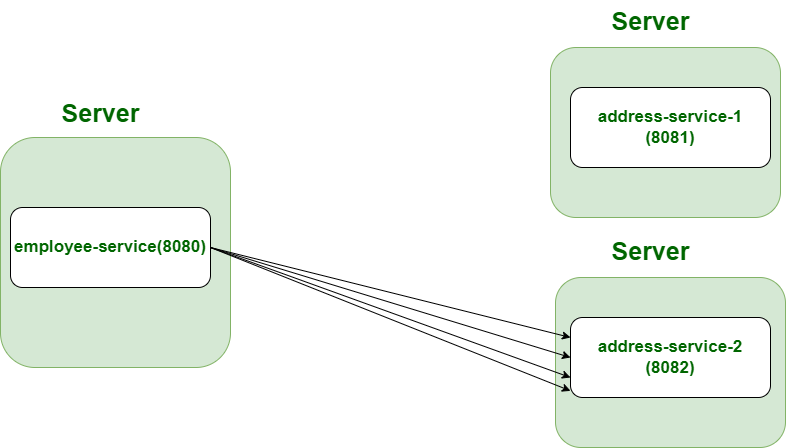
A load balancer solves this problem by distributing requests among all available service instances.

Working
- The client requests a service.
- Spring Cloud LoadBalancer retrieves available service instances.
- A load balancing algorithm selects one instance.
- The request is forwarded to the selected instance.
- The response is returned to the client.
Types of Load Balancer
Load balancing in microservices can be categorized into two types:
1. Client-Side Load Balancing
In client-side load balancing, the client application itself decides which service instance should handle the request. The client obtains the list of available instances from the service registry and selects one using a load balancing algorithm.
- Decision is made by the client.
- Provides better performance.
- Works closely with service discovery.
2. Server-Side Load Balancing
In server-side load balancing, a dedicated server or gateway receives requests and distributes them among service instances.
- Clients communicate with a single endpoint.
- Simplifies client implementation.
- Provides centralized traffic management.
Load Balancing Algorithms
Spring Cloud LoadBalancer supports various algorithms to distribute traffic.
- Round Robin: Requests are distributed sequentially among service instances.
- Random: A random service instance is selected for each request.
- Weighted Load Balancing: Requests are distributed according to predefined server weights.
- Custom Algorithm: Developers can implement custom load balancing strategies.
Spring Cloud LoadBalancer vs Netflix Ribbon
| Feature | Spring Cloud LoadBalancer | Netflix Ribbon |
|---|---|---|
| Status | Actively maintained | Deprecated |
| Reactive Support | Yes | No |
| Spring Boot Integration | Native | Legacy |
| Configuration | Simple | Complex |
| Performance | Lightweight | Heavy |