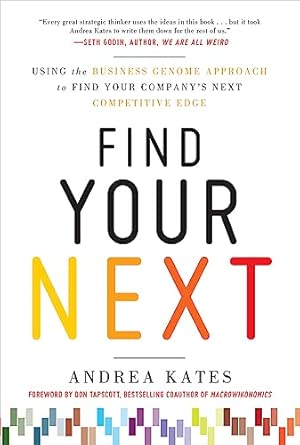
Find Your Next
USING the BUSINESS GENOME APPROACH to FIND YOUR COMPANY'S NEXT COMPETITIVE EDGE
By ANDREA KATESThe McGraw-Hill Companies, Inc.
Copyright © 2012 Andrea Kates
All rights reserved.
ISBN: 978-0-07-177852-7
Contents
Foreword by Don TapscottAcknowledgmentsIntroductionPart 1 The Business Genome ApproachChapter 1 The Business Genome: The Key to NextChapter 2 A New Outlook for BusinessChapter 3 Find Your Next ProcessPart 2 The Business Genome ElementsChapter 4 Product and Service InnovationChapter 5 Customer ImpactChapter 6 Talent, Leadership, and CultureChapter 7 Process DesignChapter 8 Secret SauceChapter 9 TrendabilityPart 3 Case StudiesP.F. Chang's China BistroSharp HealthCare + Hyatt Hotels and ResortsGeneral Electric Ecomagination / General Motors OnStar / EMC Corporation /
Korn/Ferry InternationalConclusionBibliographyIndex
Excerpt
CHAPTER 1
The Business Genome: The Key to Next
Before anything else happens, an idea is born.
Democratize the automobile. Naturalize cleaning. Give shoes to the needy. Smoothout ticket pricing. Crowd source creativity. Communalize coupons. Shelve bookson cell phones. Deliver the world overnight. Bring Napa Valley to wherever youare.
Then, a business emerges. Many do: Ford, Method, Toms Shoes, ScoreBig,IndieGoGo, Groupon, Coca Cola, Vook, FedEx, Cooper's Hawk.
Sometimes an organization—a brand—develops organically, inspiring agroup of people to naturally flock to it and engage with it with littlepersuasion necessary. Other companies show up ahead of the crowd that willeventually come to support it. In either case, as the idea evolves, so do theprocesses, systems, people, products, and modes of distribution that willsustain it. And the company carves out its niche in the competitive landscape.
Corporate growth continues down a path, creating silos of expertise in finance,accounting, product development, research, marketing, and talent, until theorganization defines its point of difference in a mushrooming world ofcustomers.
Then, one day, someone in the organization will have an idea, a hunch.
"I wonder if we could take this concept national."
"I think we could expand our product line."
"What if we could solve a bigger problem for our customers?"
"I bet we could tap into the economic trends much more powerfully."
"We're missing a big opportunity."
There the process begins: writing the company's next chapter, uncovering itsnext set of opportunities, realizing its next competitive edge, developing itsnext area for reinvention, locating its next group of customers. Or, for anentrepreneur, planting the seed of a brand new company altogether.
And, until now, that journey would have started with dissection. The companywould measure its current strengths, weigh its component parts, evaluate itspast results, and scrutinize its industry peers in search of its "next." Thesilos of capability that grew and developed to support complex businessrequirements now come to define the options for analysis. The range of potentialplaces of where to go next may look a lot like what a company has already done,but instead is actually bigger, better, or different.
The strength of the most powerful opportunities is born from the cohesion ofdisparate elements from multiple strategies, and an incorporation of trends thatcan drive business in the future. The best way to write the next chapter foryour organization is not to tweak each structural element individually but tocreate something bigger and all-inclusive—and then a game plan for how toget there.
1 + 1 + 1 = 5: The Value of a Systems Approach to Change
Matt Winter, CEO and President of Allstate Financial, believes in the value ofwhat he describes as the systems approach to the sale of financial services: amultifaceted, interdisciplinary process with which the contribution of anyindividual component—product, for example—is enhanced by the impactof the other parts of the overall capacity—price and people, for example.As Matt Winter sought to reinvent his company, he realized it was time torecalculate the entire equation of consumer satisfaction. He thought it through,eliminating the obvious: simplification of the policy issue process, offeringthe same products being sold online, or updating slogans and branding. Thatapproach would mitigate the true power of the change he envisioned. Winter knewthat simply changing individual components wouldn't get Allstate Financial toits next level. The power of the company's reinvention, Winter believed, onethat led to the development of an entirely new product set, customer experience,and distribution model and economic framework, had to come from the power of thecombined, synergistic effect of multiple components, and not the individualeffect of alterations to any single element.
Genomic Patterns Offer a Fresh Lens for Business
Learn from leaders of companies whose strategies reflect the Business Genomeapproach:
Groupon, dedicated to bundling discounts online, took the idea of newspapercoupons and mixed it with the power of community to create a business that made$500 million in revenue in its first two years.
OnStar matched the phone call home with GPS and the 911 emergency phone systemto invent a way to exit the dashboard and enter Best Buy, morphing from a GMfactory-installed service to an electronic device that can work on any vehicle.
Cooper's Hawk infused great food and a relaxing atmosphere with Napa Valleyvibe and added Facebook's viral sense of connection, community, and the power ofrecommendation to create a restaurant/winery that boasts the fastest-growingcommunity of club members of any restaurant "cult" in the country.
G.E. applied its desire of incorporating the new world of energy use andsustainability to its manufacturing powerhouse and invented its ecomaginationgeneration of manufacturing products and facilities.
Toms Shoes jumped on a growing philosophy to make a difference and defined anew space for shoes, in which the sense of community and social contributioncould be married with every purchase.
The Business Genome approach is designed to allow everyone in business to followtheir hunches, look at the world in a new way, and craft ideas for growth injust the ways that Groupon, OnStar, G.E., Toms Shoes, Cooper's Hawk, andAllstate Financial did. These ideas that became profitable organizations wereconceived not by comparing an existing industry to the restaurants, insurancecompanies, shoe companies, or manufacturers of the company's competition, but byfollowing a genomic process and finding patterns.
The Genomic Approach to Business
Businesses consist of components of great ideas that can be melded together tocreate and launch new business opportunities. When the higher-ups at Jiffy Lubestarted to suspect the value of selling oil had diminished in favor of a moreholistic approach to the oil change experience, they used a genomic process toborrow ideas from other industries. Who had a great waiting room experience thatcould be built into a new model for Jiffy Lube? How could that experience begrafted onto the existing interior of Jiffy Lube's stores to create a killerapp?
The genome mindset sparks new insights for translating the DNA of one businessto the growth challenges of another. It allows us to see through a new lens. Nowwe can read the facts and figures in a different way, and shift our focus towardresponse and away from prediction. What we'll need are ideas—novelideas—influenced by strategies that have worked successfully in otherarenas. The Find Your Next process can help us get there by offering asystematic way of sorting through those ideas to land on opportunities forbuilding up any company, whether a large, global enterprise or a local start-up.
The heritage for the genomic approach truly began in 1991, when the Human GenomeProject defined a new playing field for genetic scientists interested in thenext step of DNA analysis, thereby enabling people to trace their individualbiological inheritance. It was a huge project that started with gene mapping andled to new medical innovations, because, for the first time, scientists couldactually look at patterns of biological information and visualize connections.
But genomics had much further reach. Along came Pandora, an online music servicebased on the Music Genome Project and sparked by the imagination of TimWestergren, who, in 1999, decided that the time had come to organize music intonew genres that freed us from the notion of old music industry categories like"rock," "classical," "heavy metal," "rap," "country," and "rhythm and blues."
The Pandora model started with a lot of trained musical listeners writing morethan 600 descriptors of music. From there, Pandora.com launched as an Internetmusic service that combined the elements of music's DNA with a thumbs-up thumbs-downuser voting that trains the station to refine its next selection for you. Apersonal profile develops and two things happen: one, you find yourself exposedto new songs and new musicians because the Pandora engine helps you match thetaste of what you know you like (the Beatles) with music that has a similar"genomic" pattern (rock beat, good lyrics, lead guitar style), and two, youdiscover that your taste can't be categorized as simply "rock." You, and yourpreferences, are a little more complicated. The net result of listening to musicwith Pandora's music genome engine is that your musical taste expands to newgenres, new styles, and new possibilities.
The Find Your Next approach builds on that same genomic concept. It is based onthe idea that the possibilities for what a business leader can do next must comefrom somewhere other than what they did last. The Business Genome model isn'tdesigned to help business leaders predict what comes next but to arm them whenit happens. As was the case with Pandora's analysis of the world of music, allgenomes are intrinsically human. What can a cereal company learn about aclothing designer's experiences with teen purchasing trends? How can amanufacturer benefit from a defense contractor's insights into applications ofhydraulics? What can a medical equipment distributor learn from FedEx aboutglobal logistics innovations? Businesses are all about their customers, and thatmeans they're all about people.
Which combination of product innovation, talent deployment, process design,customer impact, secret sauce, and trendability can bring your company to a newlevel of opportunity? In that Business Genome vein, business leaders candiagnose where their businesses are in a way that goes beyond the traditionalstrength, weakness, opportunity, and threat (SWOT) tools. They can create a mapof their company's current genomic pattern. They can look across industries forexamples of companies that have tackled the same concern successfully. IDEO, afirm known for its innovation, especially in the area of product design, is oneexample. A few years ago, it was assigned the task of redesigning a hospitalemergency room. Rather than simply benchmarking its client's ER against otherhospitals, its management team studied another process that mirrored severalcomponents of a hospital's genome, one characterized by the need for precisionmovements when time was critical and the pressure of a potential dying patientloomed large. The answer for them was NASCAR pit crews, and IDEO grafted bestpractices onto the hospital's process redesign.
Taking a systems approach to business innovation requires some new skills. Butthat's the secret to discovery, to be able to shuffle elements to make a breakthrough. We all have the capacity to think this way once we tune into businesspatterns and think about our futures in a new way.
Every company is capable of injecting the new perspective of another industryinto its own DNA. The trick is to begin with a fresh mindset, founded on thebelief that the future should get at least equal billing with the past as acatalyst for our organization's growth path. The beauty of applying genomics tobusiness is that the business opportunities that emerge are part "art" orinstinct (what-if thinking and a sense of what could be), and part science(analyzing other processes in unrelated industries and looking for patterns ofopportunity). Only then, with a little of both, can companies get to a next withsuccess that will stick.
CHAPTER 2
A New Outlook for Business
Recognize Patterns and Learn from Those Patterns by Adapting Faster to theChange You See Ahead
Pattern recognition is the first required fundamental or skill in the genometransformation process. Business leaders must learn how to spot them within thebusiness universe, look beyond their company's own industries for insights intotheir company's future, and interpret what they see.
G.E.'s recent innovations in transforming the corporate culture offer powerfulillustrations of exactly that: how a company can go from recognizing genomicpatterns that could drive its strategic priorities to making an actual corporateshift. The process began a few years ago when Jeffrey Immelt, G.E.'s chairmanand chief executive, started exploring ways to retool for the future, lookingprimarily at companies in other industries for some inspiration. These companieshad much to teach him in the two components—innovation anddiscipline—that could best feed G.E.'s hunger for rapid improvement.Immelt found those essentials in Google's internal entrepreneurism and WestPoint's leadership culture of adaptability, and then he grafted them on to G.E.,which led to dramatic shifts in its corporate culture toward a more team-based,innovative structure.
Whether large or small, the take-home message is the same—looking attoday's patterns of success in multiple industries fuels tomorrow's ideas forwhat could be.
The Art and Science of Figuring Things Out
There is an art, and a science, to figuring out our next.
How do companies interpret the same facts that everyone sees but in differentways?
Before we can begin the process of sorting through our options, we must firstknow where we are and where we're going. It isn't just a matter of looking, butinterpreting. After all, we see what everyone else sees. And once we understandour observations, we can't stop there; we need to also teach ourselves to thinkdifferently about the data we analyze, the questions we ask ourselves, and theconclusions we draw as we imagine new future directions.
There is no science to prediction. You can sit down in a laboratory with ratsfor a month and track what you see. Even armed with data on how biologicalchange has occurred in the past for each rat, you wouldn't be able to figure outwhat changes will happen next. And why not? Because you have not been trained tosee the world of rats through the subtle clues and environmental shifts thatwould allow you to see ahead to the next phase. In other words, there's no wayto know for sure.
Business is not much different. Sit down with a mountain of forecasting data andyou would face the same problem. Because you're not trained in evaluating thepotential opportunities lurking behind new trends, it would be tough for you, asa person running a company or even a division of a company, to imagine whichmove would give you an edge in a changing competitive environment. You can'tknow all that lies in the periphery that puts things in motion, and placescertain companies ahead while knocking others behind. Most business leadershaven't focused on responsiveness or rapid adaptation; they've been wired toanalyze what was and what is. But companies that thrive today have developed anew skill: a talent for interpreting facts more insightfully and tapping intothe non-obvious. FedEx did exactly that when it transformed "speed" into a pointof difference in package delivery. Lululemon, too, did it when it saw a nationof decentralized yoga enthusiasts and gave them a brand to embrace.
If a snorkeler is swimming in warm waters, but, on the horizon, suddenly spotsan igloo floating on a slab of ice, what should he do? Should he take it as anillusion, or put it out of his mind? Or interpret it as he should, as a sign ofcolder waters ahead?
* * *
He can put on a wetsuit and move through it, or he can do nothing and freeze todeath.
Could it be that your company is luxuriating in today's warmer waters, andignoring opportunities—or risks—presented by the igloos of trendsjust ahead? We all need a basic reality check.
Your business needs a wetsuit if:
1. You're starting to see some disconnects between customer satisfaction scoresand sales. (They say that they still love you, but they've stopped buying.)
2. You're reading news about businesses that do something sort of like what youdo but are branching out (i.e., Blockbuster and Netflix).
3. Your pricing has become a commodity—people aren't willing to pay apremium for the same things they used to.
4. Your competition is innovating and you're not.
5. You introduced a price increase that led to higher top line revenues atfirst, but now customers are disappearing.
6. There's a new world order that could have a huge impact on your company(recession, globalization) and you haven't been hit with a wake-up call yet.
7. Everyone in the company culture is more committed to "that's how we've alwaysdone it" than "that's how we're keeping up."
Moving from Seeing to Doing: Being Nimble
Recognizing change on the horizon isn't the same as reacting to it—or eventhinking ahead of it. To drive our organizations toward the opportunities thatlie ahead, we need to take our existing businesses down a new path or tap intothe potential we envision. But that requires mastery of entirely new skills. Thekiller skill for today is nimbleness—not necessarily having the perfectmodel on Day One or the perfect read of every fact at the outset, but theability to change direction quickly when the path isn't leading to success, orwhen new competition, economic factors, or other forceful conditions get in theway.
When P.F. Chang's thought it wanted to expand a few years ago, the company firsttiptoed into an extension by introducing a sister concept, Taneko JapaneseTavern. It didn't work. What saved the company from suffering too dramaticallyfrom that decision was its corporate muscle for adaptation: it was nimble enoughto shift gears and try two others that did work (frozen meals and globalpartnership) and it was better off. If it had clung too emphatically to SWOTanalysis or forecasting models, it might have missed the boat while the otherboat sunk. Instead, it read the future quickly, recast its net into new waters,and accelerated toward better concepts. (Read more about how P.F. Chang's turnedthings around on page 145.)
(Continues...)
(Continues...)Excerpted from Find Your Next by ANDREA KATES. Copyright © 2012 by Andrea Kates. Excerpted by permission of The McGraw-Hill Companies, Inc..
All rights reserved. No part of this excerpt may be reproduced or reprinted without permission in writing from the publisher.
Excerpts are provided by Dial-A-Book Inc. solely for the personal use of visitors to this web site.




 Report an issue with this product or seller


