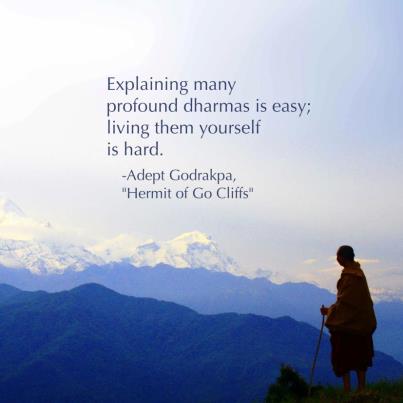
View and Conduct

living them

“Padmasambhava said: ‘Though the view should be as vast as the sky, keep your conduct as fine as barley flour.’ Don’t confuse one with the other. When training in the view, you can be as unbiased, as impartial, as vast, immense, and unlimited as the sky. Your behaviour, on the other hand, should be as careful as possible in discriminating what is beneficial or harmful, what is good or evil. One can combine the view and conduct, but don’t mix them or lose one in the other. That is very important.

View like the sky’ means that nothing is held onto in any way whatsoever. You are not stuck anywhere at all. In other words, there is no discrimination as to what to accept and what to reject; no line is drawn separating one thing from another. ‘Conduct as fine as barley flour’ means that there is good and evil, and one needs to differentiate between the two. Give up negative deeds; practice the Dharma. In your behaviour, in your conduct, it is necessary to accept and reject.”

~Tulku Urgyen Rinpoche


Padmasambhava, also known as the Second Buddha, was a sage who travelled from Pakistan to Tibet in the 8th century CE, where he is said to have transmitted Vajrayana Buddhism, a collection of esoteric methods aimed at liberating the aspirant from ignorance and its associated afflictions. What today is commonly considered to be Tibetan Buddhism is, for the most part, Vajrayana Buddhism (although elements of Vajrayana are also practiced in China and Japan under different names). Among many of the legendary accomplishments of Padmasambhava, he is regarded as the author of the famous Tibetan Book of the Dead, which is actually translated as “The Great Book of Natural Liberation through Understanding in the Between”.

In any event, his transmitted teachings were very clear in pointing out the two salient and complementary aspects of spiritual practice that necessarily must go hand in hand if one’s efforts are to bear fruit – right view and right conduct. The successful integration of these two qualities is essential for the realization of a true spiritual maturity in which the aspirant is liberated from the poisons of ignorance, envy, greed, hatred, arrogance, and emotional contraction.

Essentially, right view develops from the direct and stable realization of one’s own true nature (and thus the true nature of all phenomena), whereas right conduct entails the embodiment of such a transformative realization in all of one’s life and relations. Certainly, that sounds forthright enough, but problems arise for practitioners when one is lost in or conflated with the other.

When the view is lost in the conduct, for example, one is prone to go about accepting and rejecting, affirming and denying, grasping and avoiding — always conceptualizing the path in terms of good and evil, virtue and sin, desirable and undesirable, rather than appreciating the fundamental substratum or background of all phenomena – the essential emptiness that transcends all dualistic notions.

The Dzogchen master Chogyal Namkhai Norbu Rinpoche described the view succinctly when he said:

“Leave alone whatever arise in the mind. Do not seek to change or alter anything. It is all perfect as it stands.”

Rather than resting in the summary recognition that everything is perfect just as it is, losing the view in the conduct renders one perpetually invested in efforts to change and manipulate phenomena and relations in order to attain some idealized condition or result. However, relying on right conduct alone, though admirable from a certain perspective, will never yield true liberation.

If uninformed by right view, we will instead be motivated by a presumed internal division, a conflict at the core of our psyche necessitating a relentless struggle between dark and light elements. As it so happens, neither aspect can be victorious, since they both depend on each other to exist in the first place. With the benefit of right view, however, both positions are seen through and transcended. After all, when we try to find this self that is believed to be in need of improvement and salvation, what we discover instead is merely a bundle of thoughts and memories, sensations and conditioning, all strung together on an imaginary clothesline called “I”.

Nevertheless, losing the conduct in the view is even more troublesome. The problem with that error crops up far too often in spiritual communities these days (and perhaps it always has, it’s just that today news travels faster). The all-too-common scandals involving sexual improprieties, financial shenanigans, and oppressive power trips on the part of teachers, swamis, lamas, roshis, priests, and pastors are prominent though unfortunate examples of losing the conduct in the view. Even though some of these persons in positions of responsibility and authority may have experienced a profound insight regarding the true nature of things, that insight has not yet been integrated to the extent that their character has been freed from the afflictive passions, and so harm can be and often is perpetrated on their disciples, students, and parishioners.

The late Adept Dilgo Khyentse Rinpoche clarified the matter when he noted: “Your view can, and should be, as high as possible — there is no danger in this since enlightenment is the total realization of the absolute view. But at the same time your behavior should be as grounded as possible in an awareness of cause and effect. If you lose this basic attitude regarding actions, if you forget all common sense and use the loftiness of the view as an excuse for putting into action whatever comes into your mind, you are engaging in mundane activities contrary to the Dharma, just like ordinary worldly people.”

On a personal level, losing the conduct in the view means that one fails to discriminate in the objective world. Even though it is ultimately empty of any inherent solidity and duration, as long as we are in it, it is real enough, and our behavior matters. Every choice we make has consequences, felt not only in our emotional lives while involved in this current life adventure, but also in all future lives until all possible lessons have been learned and traumas resolved and healed.

By losing the conduct in the view, we might imagine that there is nothing to accept or reject – that whatever we do doesn’t really matter, and that there is no good and evil — it is all illusion, or alternately, it is all a divine manifestation of Source, so why bother addressing conventional issues and trying to do the “right thing”? As it so happens, that attitude is an even greater error in judgment and appreciation, primarily because of its effect on relations. For example, the great Tibetan adept Patrul Rinpoche remarked that, if one claims to have the view but doesn’t show loving kindness in their conduct, they should have their mouths stuffed with the excrement of a hundred villages.

The eminent sage Ramana Maharshi once asked:

“When we awaken from the dream, do we go searching for the characters in that dream, to awaken them?”

Such a comment, when taken out of the context of Ramana’s total teaching, could be presumed to indicate that awakening frees one from any further behavioral concerns. However, for those of us with less than complete transcendental knowledge of the way things really are, it’s easy to fall into a logical fallacy called “Category Error”. That is, we conflate the world of the absolute with the world of the relative, and because we fail to properly distinguish between these two, we often end up confusing ourselves and others.  This is why the great Buddhist sage Nagarjuna remarked:

Those who do not understand the division of these two realities (Absolute and Relative) do not understand the profound true reality of the Buddha’s teaching. Without reliance on conventions, the ultimate cannot be taught. Without realization of the ultimate, Nirvana will not be attained.”

Certainly, there is an ultimate truth indicated by the simile “like a dream,” wherein there is nothing whatsoever which is real, or independently existent, and yet we believe that there is something which is real, based on our conditioned and conditional interpretation. Upon awakening, we realize that there was nothing at all, just dependently arising phenomena that temporarily create the appearance of stable objectivity.

It is on account of the power of this sleepy ignorance that, in the midst of all manner of phenomena which do not ultimately exist, we nonetheless perceive them to exist: the so-called “self”, “persons”, “ice cream”, “countries”, and so forth.

Mysteriously, the unchanging Absolute appears to manifest in the midst of the relative, as the quicksilver play of consciousness, as energies and forms and functions to infinity. In the midst of it all, what we can re-cognize is the self-evident fact that we ARE. We don’t really know what we are, but it is undeniable that we are.

This awareness of our beingness is the only thing that doesn’t change, though worlds after worlds arise, thrive, and pass away. Our bodies change, our self-concepts change, our beliefs change, and our relations change, but we do not change, or rather, awareness does not change. That unchanging awareness is just another name for what we fundamentally are, and it as this awareness itself that Source plays in the fields of creation.

The relative is recognized as the relative because it is impermanent. It consists of everything that changes, and that includes everything perceivable or conceivable. Just so, if the absolute did not want to express itself in this dreamy density of transience, then we would not be incarnating as these bodies, in the midst of the changing circumstances in which we find ourselves appearing. Indeed, we are the absolute, expressing itself as the relative. As Shitou Xiqian noted in his famous Chan poem “Sandokai”:

“Each thing has its own intrinsic value and is related to everything else in function and position. Ordinary life fits the absolute as a box and its lid. The absolute works together with the relative like two arrows meeting in mid-air.”

By reflecting on our original identity to the point of gnosis, or re-cognition, we can realize that we are indivisible from Source, the Absolute. Moreover, we have never been separated, despite the transient illusionary flow of relative phenomenal existence. However, awakening to the totality of who and what we are does not mean that we somehow disappear. Rather, we discover that we are both ourselves and everything, simultaneously. The relative and absolute intermingle and interpenetrate — you are you and you are not separate from anything.

A critical by-product of such gnosis is the realization that the function of the absolute in manifestation is unconditional loving. Why is there anything, rather than nothing? Love. Since love must love, all beings must be served and even saved, despite the fact that there has never been a single independently existing being in need of saving, including ourselves. This is a great and marvelous mystery, and a humorous one too, though confounding to the discursive mind that would like to have everything filed and figured out.

Buddha’s concept of saving beings was to cause them all to enter into Nirvana. If one was to become a Bodhisattva, dedicated to saving all beings, the aim was just this, to cross all sentient beings over to Nirvana. However, in the Diamond Sutra, Buddha demonstrated his sense of humor by paradoxically noting:

“All types of beings, whether egg-born, womb-born, moisture-born, or transformationally-born, whether possessed of form or formless, whether possessed of thought or free of thought, whether neither possessed of thought nor free of thought — I cause them all to enter the nirvana without residue and thus cross them over to extinction. As I cross over to extinction in this manner an incalculable, innumerable and unbounded number of beings, in truth there are no beings whatsoever who succeed in being crossed over into extinction. Why is this so? Subhuti, If a bodhisattva retains the mark of a self, the mark of a person, the mark of a being or the mark of one with a life span, he is just a non-bodhisattva.”

The point of all this is: when we see someone in need of being served, we must serve them, even though it is a dream, a mirage, a hallucination of the mind. After all, we are love, and love must love. Because Love is all that really matters, our behavior really matters, regardless of any brilliant insight we may have experienced in terms of emptiness and dependent origination. Thus the wise do all sorts of foolish things, like lecturing on nothingness to nobody, teaching emptiness to empty chairs, and performing countless compassionate good deeds, even though there is no such thing as good or bad, absolutely speaking.

There is only Source, without a second, and so who is there to benefit from good deeds? Still, love must love. As long as there is the illusion of separation, the function of love comes into play, even though it may not even look like love to the mind that still clings to the divisive notions of “me and mine”. Nisargadatta Maharaj summed it up perfectly when he said,

“When I see I am nothing, that is wisdom. When I see I am everything, that is love. Between these two my life moves.”

This is no enigma to the Realized, but only to those of us who still see some difference between saved and unsaved, lost and found, plus and minus, sacred and profane. Paradoxically, that’s apparently the way the absolute would have it played, just so that It, Source, can discover Itself over and over again in the relative — in and through these humble and transparent forms of you and me and everyone.

“Without love, and will inspired by love, nothing can be done. Merely talking about Reality without doing anything about it is self-defeating. There must be love in the relation between the person who says “I am” and the observer of that “I am.” As long as the observer, the inner self, the ‘higher’ self, considers himself apart from the observed, the ‘lower’ self, despises it and condemns it, the situation is hopeless. It is only when the observer accepts the person as a projection or manifestation of himself, and, so to say, takes the self into the Self, the duality of ‘I’ and ‘this’ goes and in the identity of the outer and the inner the Supreme Reality manifests itself.

This union of the seer and the seen happens when the seer becomes conscious of himself as the seer; he is not merely interested in the seen, which he is anyhow, but also interested in being interested, giving attention to attention, aware of being aware. Affectionate awareness is the crucial factor that brings Reality into focus.”

~Nisargadatta Maharaj


http://www.lotsawahouse.org/tibetan-masters/patrul-rinpoche/two-truths-view-mahayana


Posted in Nonduality, Spiritual Practice | Tagged , | 28 Comments

Not Me

Monkey mind

“What is really your own, you are not conscious of. What you are conscious of is neither you nor yours. Yours is the power of perception, not what you perceive. It is a mistake to take the conscious to be the whole of man. Man is the unconscious, the conscious and the superconscious, but you are not the man. Yours is the cinema screen, the light as well as the seeing power, but the picture is not you.”

~Nisargadatta Maharaj

The common descriptions transmitted about Realization in many of the traditional spiritual paths and wisdom systems revolve around the affirmation of some essential, eternal, and transcendental Self behind all phenomena, hence the term “Self-Realization” or “God-Realization”. In that respect, the conscious process of recognition runs counter-intuitive to those traditional programs. In the conscious process of true inquiry, all identity descriptions and self or Self-images are seen through and recognized as mere conceptual designations. We realize that what we are cannot truly be described by human language except in terms of negation. As the Sage Nisargadatta notes succinctly, “You cannot know yourself through bliss alone, for bliss is your very nature. You must face the opposite, what you are not, to find enlightenment.”

In the silent equanimity resulting from such insight, we can observe our conditioned programs, our delusions, our human limitations and foibles, failings, and apparent faults, and yet not be compelled to frantically seek out and commit to some kind of remedial curriculum or self-improvement scheme designed to modify them. In a nutshell, we simply recognize that none of them amount to a “me”, are not my self, and are not what I am. In fact all we can really say is, “I am not this, I am not that.”

With the liberating benefit of such direct recognition (and not just intellectual agreement), the power of the binding, afflictive poisons such as greed, envy, hatred, pride, and ignorance is undermined. They no longer have a target, a landing place. No longer is there grounds and rationale for a perpetual war with oneself. No longer is there a call to divide oneself into conflicting camps of light and dark that in turn need to be reconciled by some prolonged and superhuman effort, just so that we might finally become what we already are. In fact, the more attention and energy that is expended in efforts to sculpt ourselves into some spiritually-correct version of ourselves, the further away we travel from our own true nature and being.

On the contrary, the process of conscious recognition involves the art and practice of “non-doing”, founded upon a genuine humility and surrender. It is important that this be clearly understood, because most of us tend to indulge some inflated or idealistic notion of what we are or want to be, complete with all sorts of provisional betterment projects and ascension goals, rather than simply relaxing and coming to rest in the timeless aware spaciousness of our true nature, the limitless unknown.

On a cautionary note, many seekers may tend, especially in the beginning of the conscious process, to engage analytical inquiry techniques such as “Neti, Neti” (Not this, Not this) purely at the level of the intellect, and that is to be expected. However, there is danger in lingering in the conceptual domain and concluding that the job is done, once there is some verbal conviction. This is why we might encounter certain people who can “talk the talk”, but are still afflicted by the passions and behaviors characteristic of the self-possessed.

Unless the inquiry penetrates deeper than the realm of mental formations and cuts off the root of all identification and self-positions, it will not ultimately be very transformative, and can even pose as an additional hindrance by fattening the “spiritual ego”. Indeed, clinging to an intellectual understanding of the emptiness of the self-complex can actually interfere with or impede its direct recognition (or clear seeing), which is something of an altogether different nature.

In any case, by directly recognizing the emptiness of all that we once took to be ourselves (both negative and positive), we can cease fixating on those obsolete stories. There is real wisdom in just being, although such wisdom is difficult for the usual seeker to allow in. As mentioned earlier, it is counter-intuitive to the spiritual self-improvement program, which is designed solely to create a more agreeable story. As it so happens, no story is true, because all stories are based on the false assumption of the existence of a separate and enduring person, a “me”. Every story, every appearance, is of the same nature as a daydream. What knows the daydream? That which knows the day dream is not the daydream.

Upon sincere and persistent inspection, we can recognize the utter impermanence of all our stories, all daydreams. With that realization, we will come to understand the futility of the various salvation schemes which we have been chronically employing. We observe in the process how such strategies have systematically superimposed notional programs of bondage and unhappiness on our natural, prior state of freedom. Such a liberating recognition blossoms by allowing one’s total energy and attention to relax from its fixations and compulsiveness, becoming less rigid and more receptive to the fact that nothing needs to be attained, modified, enhanced, redeemed, enlightened, or improved.

It has only been our angle of vision that required some adjustment. We have been so entranced by the illusion of a solid and independent self-sense that we have been unable to appreciate the spaciousness in which it and everything appears and disappears. However, when we return attention to that which is always already aware, the self-fixation naturally drops away.

There is a great relief in that revolutionary shift of perspective, allowing for the emergence of our natural spontaneity and playfulness. Moreover, as we relinquish the struggle to define ourselves as “this or that”, we are not only returned to our native innocence, but we also experience the arising of real compassion for others — those who may still be under the influence of the stressful conditioning programs that keep them enlisted in the divisive inner warfare.

Whatever we attach and cling to invariably becomes the source of our distress. Consequently, by seeing through and letting go at the root of such distress – the obsession with and absorption in the fiction of “me and mine” — we can instead relax and enjoy life for its own sake. The implanted motive to work on myself in order to get better, more luminous and holy, more profound and attractive, will cease motivating us.

After all, we may be dead before tomorrow! All we have is this moment now. If we are drawn, for example, to certain spiritual practices such as meditation, they need not be taken up in order to become someone else – some idealized version or religious fantasy of ourselves. Rather, they can instead just be appreciated as a natural enjoyment of the physical form which we are occupying, not unlike going for a walk or drinking a glass of cool water. Sitting still and not knowing, not dwelling on or grasping at the parade of passing thoughts, is one of life’s great pleasures, especially for those who are no longer subservient to artificial agendas!

With the loosening of the grip of fixed patterns of identity, we can gratefully come to recognize each experience in life as a gift, regardless of the form it arrives in. Each possesses its own beauty, particularly when we don’t expect or demand that it be anything other than what it is. Rather than assuming a victim mentality when things seem disagreeable, we can as co-creators inquire into our own responsibility. In such recognition, we become eminently present and “ordinary”, without the heavy and unwieldy baggage of either sorrowful regrets or idealistic projections holding us back and weighing us down.

Having allowed our true nature (which has been heretofore obscured beneath heaps of rationalizations, second-hand beliefs, and habitual reactivity spawned by hope and fear) to reveal itself, energy and attention are freed up to the point where we can simply live for the sake of life itself, doing whatever we do, purely for the sake of doing it. As it turns out, that is enough — to just do it, just live it.

Moreover, there is a curious but common assumption that, without holding on to a self-idea, one would be rendered dysfunctional or even incapacitated in the objective sphere, when in fact, it is actually the superimposition of the self-idea that more often than not complicates activity and impedes unfettered functioning.

The Thai Forest master Ajahn Chah put it perfectly when he said: “Once you understand non-self, then the burden of life is gone. You’ll be at peace with the world. When we see beyond self, we no longer cling to happiness and we can truly be happy. Learn to let go without struggle, simply let go, to be just as you are – no holding on, no attachment, free.”

Recognition is nothing other than the arrow of this understanding finally penetrating our mental and emotional armor, finding its mark at the heart, and really sinking in. It is not seeing a grand supernatural vision or bathing in special, blissful states; it is opening our eyes to how callous and arrogant and even silly we can be, how resistant and reluctant and fearful, and how (by trying to be knowers) we have gotten in our own way. As the mystic Angelus Silesius humorously noted: “God, whose love and joy are present everywhere, can’t come and visit you unless you aren’t there.”

Conventionally, we can know a lot about ourselves. After all, we’ve been working on that story all of our lives, featuring “me” as the central character. Nevertheless, the only valid self-knowledge for us in this realm is the recognition of what we are not, starting with the body-mind organism, and including everything we think and believe to be real. What we truly are can never be an object of perception, since whatever is perceived cannot itself perceive. As Nisargadatta clearly noted: “You cannot be witnessed by you; only what is other than you can be witnessed by you.”

Furthermore, even the discoveries in modern science are pointing out that nothing is what it appears to be. The eminent physicist Niels Bohr (echoing the Buddhist Law of Dependent Origination) noted: “If quantum mechanics hasn’t profoundly shocked you, you haven’t understood it yet. Everything we call real is made of things that cannot be regarded as real.” Indeed, as far back as the second century, the renowned Buddhist adept and scholar Nagarjuna (often designated as “the second Buddha”), taught that everything that exists does so dependently, and everything that is dependently existent necessarily lacks independent objective existence, or in other words, is empty of any real or inherent existence.

Interestingly, developments in modern neurology employing MRI brain scans have revealed that the “me-sense” is a neurological figment that occurs when nine different areas of the brain are active at the same time.  There is no actual personal “self” ever, just a neurological sensation of a “me”.

In any case, truth itself can never be an object of consciousness, since consciousness itself is transitory. Hence, it must be prior to consciousness, and thus ungraspable by the conceptual apparatus. One can only recognize that one lives in untruth, in a dreamy fantasy. U. G. Krishnamurti deftly summarized: “The body does not exist except as a thought. There is one thought. Everything exists in relationship to that one thought. That thought is ‘me’. Anything you experience based on thought is illusion.”

Likewise, liberation is not some reward granted by the universe for following the right doctrines, or aligning with superior religious sects or philosophies. It is not an attainment — nobody “attains freedom”. Such a make-believe story — that one can become something other than what they already are — only reinforces our perpetual sense of dissatisfaction (though it certainly keeps the preachers in business).

Indeed, the one who would be free is the one who has been obscuring real freedom, and it is that one who disappears in the light of true recognition. Otherwise, we will continue to cherish the belief that we can somehow acquire lasting happiness, if only we become more like this or less like that, while stubbornly insisting to ourselves that we exist as separate and enduring persons. We don’t.

“Thus, any body whatsoever . . . any feeling whatsoever . . . any perception whatsoever . . . any mental processes whatsoever . . . any consciousness whatsoever — past, future, or present; internal or external; blatant or subtle; common or sublime; far or near, is to be seen as it actually is with right discernment as: ‘This is not mine. This is not my self. This is not what I am.’ Seeing thus, one grows disenchanted with the body, disenchanted with feeling, disenchanted with perception, disenchanted with mental processes, and disenchanted with consciousness. Disenchanted, he becomes dispassionate. Through dispassion, he is released.”

~Anattalakkhana Sutta

self melt

See also: https://theconsciousprocess.wordpress.com/2013/05/11/i-am-sort-of/


Posted in Nonduality, Spiritual Practice | Tagged , | 17 Comments

You

Dudjom Rigpa


“Ignorance can be compared to a dark room in which you sleep. No matter how long the room has been dark, an hour or a million years, the moment the lamp of awareness is lit the entire room becomes luminous. You are that luminosity. You are that clear light.”

~ Tenzin Wangyal Rinpoche

Imagine what a “game-changer” it would be to suddenly realize that nothing we can see, feel, think, or know is actually real. From the revelatory angle of vision coincident with awake awareness, there’s neither birth nor death, appearance nor disappearance, creation nor destruction, bondage nor liberation, you or I. Those are all conceptual designations, empty of any inherent and independent existence other than that which mind bestows upon them. The wisest sages know that there’s neither unity nor plurality – the world is neither one nor many. Existence itself more like a virtual reality game, and we have taken our places here in these game bodies to test ourselves, to see what we are really made of deep down at the core, and to enjoy the infinite Mystery in all of its permutations.

Hearing that, some might imagine that there is something to “get”, some special state or permanent position to possess and make one’s own. However, wisdom reveals that we are not here to acquire some enlightenment that is not already true of us, progressing through various stages until we arrive at some exalted destination. We ourselves are the destination — we go nowhere. There’s never been a human being in need of salvation, redemption, protection, or freedom. Such concepts are merely props and stage sets for the game, the play of consciousness, the dream we call “our life”.

In fact, the external world has no existence independent of the consciousness which perceives it. This is not only the testimony of sages and mystics, but is now a cornerstone of quantum physics. Mere perception and practical utility cannot prove the reality of the world, for even in dreams there is perception and practical utility – water in a dream can quench the dream thirst as much as real water can quench real thirst. The waking state is on par with the dream state, and both are real within their own order — that’s important to recognize. But from the ultimate standpoint, both are unreal.

Reality is beyond human conception. It transcends the trinity of the knower, known and knowledge. Timeless and motionless, it’s “where” all the categories of the intellect are merged. All phenomena, subjective as well as objective, are by their nature serene from the beginning, unborn and merged in Source. They are nothing other than imaginative expressions of Source itself, figments of Source — an infinitely stable, self-luminous, conscious force perpetually and joyously manifesting its own awareness in the forms of everything and everyone.

The presumption of Duality is the product of the intellect, but when the intellect is transcended and all conditional mental and emotional fabrications are seen through and discarded, the trick of duality disappears. What’s left is pure aware spaciousness, devoid of all thought determinations and imagination. It is the serene eternal Light behind the mind. It is incomprehensible bliss, which transcends happiness and misery.

The Absolute is indescribable, unborn, changeless and non-dual. Although many names are devised by human wisdom systems to describe it, fundamentally, it’s You! As Kalu Rinpoche so clearly put it, “We live in illusion and the appearance of things. There is a reality. We are that reality. When you understand this, you see that you are nothing, and being nothing, you are everything. That is all.”

That being the case, how is it that we still seem to persist in ignorance of such a critical truth, and how can we awaken from such a trance? Well, we can begin by recognizing that the only thing we are ever trying to assert, protect, and defend is some conditional and conditioned image we have of ourselves – an ongoing story of a separate and independent “me” that serves as the perceptual matrix for our attitudes and experience.

Just so, rather than attempting to reify, justify, or eliminate that one, we can instead simply examine our assumption that such a one actually exists. In fact, maybe we have dreamed the whole story up in the first place, causing ourselves untold confusion and stress in the process! In that light, awakening is simply letting go of what we never actually had. Going even further, we realize that nobody actually lets go of anything. The illusion of a separate and independent self simply drops away in the light of Recognition. It happens, and yet only to the extent that anything happens in a dream or movie. In reality, there has never been anything other than the “True Self”, playing hide and seek with Itself.

Upon thorough inspection, we can begin to notice that there is something so simple about our own nature that it is routinely by-passed and even stubbornly avoided. It is an affront to the physical persona which fixates on the sense of its own individualized existence as a defense against the death timed into it. It is an affront to the emotional persona which seeks through feeling to grasp that in which feeling arises. It is an affront to the intellectual persona which relies on comparative mind for distraction and knowing as a defense against the unknown and unknowable. It is an affront to the spiritual persona which clings to “higher” states dependent on manipulative strategies fabricated to escape from that root contraction of embodiment clenching at the heart.

Omnipresent Spirit manifests an infinite display of personas, also known as the infinite masks of God, based on an immense curiosity to experience every possible projection of Itself. What is called “the soul” is a temporary embodiment of consciousness that Spirit wears in order to experience different vibrational frequencies. However, when the soul identifies exclusively with any of these arbitrary masks and forgets its immortal source, it becomes “confused” and starts looking for itself. To “return home”, it imagines all sorts of ways and means, from “love me” dreams, to yogic schemes at ashram scenes, or maybe just addictive sessions with Mr. Jim Beam.

The chronic belief that we have to jump through various socially or religiously prescribed hoops to arrive at what we actually Are is one of the confused mind’s classic ways of obstructing, or postponing, its own dethronement. There is the suspicion that, if the truth of our own original nature and identity as Spirit is allowed in, then there will be something that will not survive, and that is correct. What does not survive is the exclusivity of the independent self-sense — the complex structure of the separate and alienated ego/mind, assembled over many years and perpetually reinforced by conditioning-in-the-moment, and all based upon an innocent notion of mistaken identity.

We have come to assume that we are a separate and enduring “somebody”, divided from life and love, and in the hellish position of having to manipulate circumstance in order to carve out some little piece of fleeting happiness, when in fact we are Happiness Itself. Despairing of this, we imagine, we hope, that there must be some heaven elsewhere to which we might be transported from this “vale of tears”, once we have served our sentence of embodiment in the prison of wounded flesh and compounded suffering.

Religious “authorities”, who themselves secretly doubt the revelation of Loving Truth upon which their traditions are based, maintain their power and influence by blithely leading little children out of the wonder of their own pristine innocence and into the snake pit of guilt and shame with the indoctrination of the Lie — the lie that we are separated from the Great One, that we are tainted and diseased by sin or karma, and that their church, method, yoga, dharma, prayer, or practice is the cure.

When we begin to awaken from this nightmare, by the graceful power of divine Remembrance and Recognition, we can discover something very liberating: there is no cure, because this terrible malady and affliction is nothing but an imaginary disease. It does not exist! The truth is, we swim, unfettered, in a vast ocean of Spirit. Indeed, Spirit is our own true identity, functioning in time and space as Love Supreme. Everyone “knows” this in their own heart, everyone intuits the YES of all-embracing Divinity.

All we need do is Be it, rather than indulging in fantasy stories and pretending to be anything other than our own original nature. Nisargadatta Maharaj put it perfectly when he said: “You are the Supreme Reality beyond the world and its creator, beyond consciousness and its witness, beyond all assertions and denials. Remember it, think of it, act on it. Abandon all sense of separation, see yourself in all and act accordingly.”

Nevertheless, the fact remains that there is suffering and stress, boredom, doubt, and discomfort, spawning the motive and motion to alleviate it. Everything is seeking. Life and death are mere blips on the screen of seeking. Seeking is all about the sense we have of being a separate and vulnerable individual, and this sense manifests as the feelings of desire, conflict, and resistance, the endless loop of attraction and aversion, hope and fear, which dominates consciousness and reinforces the sense of self, the perpetual story of “me”.

The first step to breaking that cycle is learning to live in genuine humility, since without humility, all one’s efforts are worthless. The internal conflict, based on the struggle to have things be other than they are, melts away when acceptance and surrender become genuine. Somehow, the heart must be turned to the intuition of what waits, softly breathing, at the deepest core of its own yearning, pierced by the recognition of and utter submission to that which is prior to the fabricated sense of self and all its conflicted modifications.

In such surrender, the struggle of life force and consciousness is given up, laid down, like flowers at the feet of the Beloved. This is the true end of the “personal” life, and it is indeed not unlike a death. The artfulness of it resides in the obliteration of our egoic willfulness, which leads in turn to the restoration of the primal innocence, our true face before life and death commence their dance. This original face is radiant with loving compassion for all that appears, changes, and vanishes. How then can we not love life, with all its tender weaknesses?

At last comes a difficult chasm to cross: the breakthrough recognition that all of it — the whole story of “me and mine” — is simply a beaming projection of one’s own mind. To then turn around and plunge directly into the source of that mind — that’s what takes tremendous courage. It is most rare, most excellent.

It’s a huge leap — to relinquish the pretense of being a knower, to let go of that motive to maintain the defining thread of independence (even if that story is conceptually recognized as an illusion of control). Such a gesture is the essence of a living poetry, the sublime art of life. It awaits all of us, should we be willing to let go of the whole carefully-constructed narrative of “me and mine”, and lose ourselves to find our Self.

“[You must] discard all your experiences, your knowledge, and all the things and ideas that you think are the most reliable, most magnificent, and most real, even including your hope [to get free]. It is as if you were entering a sacred building. Before you do so, the guard tells you that you must not carry any weapon, that you must take off all your clothes, and that not only must you be completely naked you also have to leave your body and soul behind. Then you can enter.”

~ Sheng-yen

finger-pointing1


Posted in Nonduality, Spiritual Practice | Tagged , | 36 Comments

Emotions

“Self-arising wisdom is the base. The five negative emotions are manifested energy. Seeing emotions as mistaken is an error. Letting them be in their nature is the method to find the non-dual state of Liberation. Overcoming hope and fear is the result.”

~Tenzin Wangyal Rinpoche

Emotions are downloaded “software” programs that enable us to more fully enjoy the richness and complexity of the human incarnational experience. There is nothing wrong with them, and they certainly do not need to be eliminated. Far from representing some kind of enlightenment, a human life without emotional energy would be an impoverished one. The only problem (entanglement) with emotions comes when we cling to some and avoid others. That alternating cycle of craving and aversion establishes the sense of a separate and enduring self — a “me” — who wants this but shuns that.

Identification with this imaginary creation, complete with a narrative storyline about surviving and thriving in challenging world of other selves, invariably turns out to be a major source of suffering, which is why some spiritual teachers traditionally describe emotions in negative terms. For example, a respected Tibetan Buddhist, Dzongsar Khyentse, is quoted as saying: “All emotions are painful. This is something that only Buddhists would talk about. Many religions worship things like love with celebration and songs. Buddhists think, ‘This is all suffering.’”

In any case, emotions themselves are not the problem. We are not victims of emotions. When they arise as they will, we do not need to grant them any enduring reality, but simply recognize them for what they are — temporary modifications of consciousness, with no inherent substantiality. They are part of the play of life, to which they add spice and interest, but emotions are not us, they are not who we are, and they do not constitute a justification for establishing any solid and unassailable personal identity based on their arrival and elaboration. Nor do they require any measure of reactivity, which invariably serves to merely complicate and confuse. Rather, emotions can simply be acknowledged as fundamental aspects of the human experience, without the addition of subjective praise or blame.

The same goes for thought, perception, sensation, and even consciousness. We can see them for what they are, watch them rise and dissolve like waves on the ocean, and let them be just that, without trying to manipulate, add to, or subtract anything from them. In that way, they can be appreciated as gifts that life presents to us. They need not be clung to or avoided, but simply experienced. We are curious by nature, and so seek out the infinite variety of experiences the cosmos has to offer, for the purposes of self-discovery and enjoyment. Grasping at nothing and yet turning nothing away is ancient wisdom, but ever-fresh and potent.

One of the reasons that we as immortal spirit are attracted to this momentary human circumstance is to experience the richness and innocent rawness of emotions. Those who proclaim that our task is to suppress, renounce, or flee from them have got it backwards. Rather than promoting and prolonging an internal conflict — a war with ourselves that cannot be won — we can instead allow them to reveal their self-liberating potential.

For example, if we are to embark upon the conscious process of transmuting fear into love in our life and relations, we must really get to know ourselves by paying careful attention to our present condition. We can’t release impediments that we are unaware of, so we need to first get intimately familiar with our emotional fluctuations, see how they arise, how they change in response to conditions, and how they tend to rule us, without our conscious intent. This is what real spiritual practice entails, as opposed to sitting around trying to be peaceful and blissful while by-passing the emotional aspect of one’s being (as some might imagine).

As Nisargadatta Maharaj wisely suggests: “Think clearly and deeply, go into the entire structure of your desires and their ramifications. They are a most important part of your mental and emotional make-up and powerfully affect your actions. Remember, you cannot abandon what you do not know. To go beyond yourself, you must know yourself.”

Just so, emotions themselves can be transmuted into living wisdom if recognized as transitory and non-binding energetic movements inherent in the human experience. In such recognition, our attention can be restored to the unchanging background against which the fleeting movement of thoughts, emotions, and personal stories appear and disappear – our prior, natural state, Awareness itself.

Alternately, emotions can become sources of trauma and suffering, if clung to and used as plot devices for the “me-story”, or not fully experienced and released, but instead ignored and repressed. In that regard, Don Juan Matus (in Carlos Castaneda’s “The Teachings of Don Juan) shared a telling observation when he noted: “The remnants of pain left behind by every strong emotion that is not fully faced, accepted, and then let go of join together to form an energy field that lives in the very cells of your body.”

When we become emotionally invested in our self-images, the whole world can seem to represent a potential threat of emotional harm. Based on this dualistic view, we perceive the need to defend ourselves from possible danger by forging a kind of armor which we then wear into “battle”. Ironically, the more we fortify this armor in reaction to assumed emotional threats, the further we stray from our own inherent happiness. Rather than relaxing and resting in the care-free enjoyment of life and relationships, we must busy ourselves with strategies of ceaseless emotional warfare, marked by the struggle to protect and preserve the fictional person we have assembled out of bits of thoughts, emotions, and memories. What a nightmare, and yet it happens to be the usual conflicted condition with which most of us go through life.

One of the most powerful generators of emotional dysfunction is our habitual failure to maturely adapt to the sexual impulse. Sexual impulses arise naturally as part of a healthy human animal’s biological program. In other words, the impulse itself is what it is, but invariably we add something extra to it, superimposing emotionally reactive qualities on to that which is merely an innocent part of the human functioning. Indeed, upon inspection, we can see that a form of chronic emotional-sexual contraction is at the root of much of our personal and collective dis-ease, and as such is a big contributor to the presumption that we are the body.

Based on the mere presence of a sexual impulse, we mistakenly construe the sense of a concrete (and demanding) self through a process of ensuing identification with and consequent attachment to the body, thereby initiating and perpetuating the mechanics of suffering. In other words, by imagining that we are the body, we commit ourselves to the body’s fate – impermanence.

Now, whether or not one actually follows through on the sexual impulse from this point matters little, since a fictional but very realistic sense of self has already been assembled around the impulse. An internal division has been set in motion, a vicious cycle of desire and frustration that comes with the self-sense package, which then ripples on, even to the point of infecting the totality of our emotional life.

A powerful antidote to the contracting entanglement of that cycle is the practice of non-dwelling within the context of true meditation, which involves neither embracing the impulse nor turning it away. In fact, it entails doing exactly nothing about it — just letting it arise and dissolve as it naturally will, without using it as a platform to identify with the body and therefore establish a self-matrix, a “me-story”. It can be inspected, seen through, and released without creating the dramatic conditions which lead to the assumption of an independent and enduring self. Attention is simply returned again and again to the prior spaciousness of awake awareness itself.

Since what is not used or fueled becomes obsolete, so too do the afflictive poisons that characterize the usual human being’s emotional state, through the power of non-dwelling. Once freed up from the deluding influences of greed, envy, hatred, pride, and ignorance of one’s true nature and condition, the energy and attention that constitute the emotional and mental processes are naturally transmuted, becoming more and more characterized by spontaneity, wisdom, clarity, and above all, compassion.

Having recognized the ephemeral nature of all experience — whether it be in the form of emotion, thought, perception, sensation, or consciousness — we can relax. When we relax, we are freed of all associated binding emotional reactivity, such as fear, stress, annoyance, and moodiness. Having been thus liberated, we can say, “Released!”, and move on to enjoy the next scene in the panoramic movie entitled “The Play of Consciousness”.

“The method is directing attention upon attention or awareness. When any arising is experienced, especially thoughts, moods, emotions, or feeling of personal self identity, one simply notices one’s present naked awareness. By directing the attention back to awareness, the arising dissolves back into its origin and its essential nature, awareness. In doing this, the arising releases its formative energy in its dissolution as a surge of further clarity of Clear Light, the power and potency of awareness that energized the arising in the first place. Hence one’s Rigpa presence (Knowing Awareness) is enhanced in the collapse of the formative arising. Hence the Dzogchen comment that “The stronger the afflictive emotion upon dissolution, the stronger the enhancement to the clarity of presence.”

~ Longchenpa

see also:

https://theconsciousprocess.wordpress.com/2013/01/07/the-practice-of-non-dwelling/

True Meditation: Recognizing Basic Sanity


Posted in Nonduality, Spiritual Practice | Tagged , | 13 Comments

Joy of Unknowing

bird mirror

“To know that you do not know, that is true knowledge.”

~Sri Nisargadatta

If you want to enter knowledge of the Tao,

The entrance is called “Not Knowing”.

~Chuang Tzu


Mind cannot be used to grasp mind. The more we try to grasp mind, the more we realize that we are only grasping air. Actually, if we search for the mind, we will not find any such entity. All we will find are thoughts, and even if we try and fixate on a thought, it will be like trying to hold on to smoke. In fact, if we were not so attached to the concept of linear time and could achieve a birth-to-death overview, we would recognize that our attempts to hold on to any aspect of life — relations, possessions, dreams, ideals and beliefs, and even our self-images — are just as much of a futile endeavor as attempting to grab empty space.

Based upon various conditioning factors, we tend by habit to identify with thought energy. In the process, we develop the conviction that what we think is what we are. In this way, consciousness itself can seem like a limitation, contracting down into various afflicted self-images, such as “I am not worthy, I am too fat, I am not smart enough, or rich enough, or spiritual enough”, or the opposite, such as “I am better than my peers, I am prettier than the others, I am more enlightened”, and so on ad infinitum. All such manufactured images are based on thought energy with which we identify, and which become our prison cages as we do so.

birdcage

However, if we take a step back and just let thoughts come and go without attaching any personal significance to them, it becomes apparent that we are not the thoughts, but the witness of thoughts. We are not the passing traffic, but the space in which the traffic flows. This primordial space need not become anything other than itself, but simply abide as itself, regardless of the passing parade. Nor need we – we are complete just as we are, and need not be dependent on any temporary neural stream of thought energy to contract our infinite being and squeeze it into the cramped fictional narratives of “me and mine”.

Once we have been able to relax our attention to the point where we are no longer impulsively being drawn into our thought-stories, but stabilize instead in the position of pure witnessing, we can inquire even further. For instance, if we turn our attention around and try to cling to or grasp this witness, we discover that we can’t do that either, any more than we can grasp any other dreamy fabrication of consciousness. The witness cannot grasp the witness, just as the eye cannot see itself. In this direct recognition, the witness (which is still a form of mental construct) falls away too. It represents a slight grasping at an identity, a subtle obstruction. In reality, there is no separate “awareness” that is witnessing experiences.

Tao face

What remains when all grasping falls away is pure aware spaciousness, the motionless timeless background. It is our true nature — prior to, during, and after thoughts, memories, sensations, perceptions, and all transient self-images arise and dissolve. It is here where we can come to rest, in this ineffable stillness. The only “inner voice” now is silence. In silence, there is no need for some conceptual understanding. Indeed, when only awareness remains, who is there left to understand? Hence, the great Korean Zen master Chinul wrote: “Simply knowing that there is nothing you need to understand is in fact seeing the [true] nature.”

Just so, trying to “figure it all out” by using the analytical intellect may earn one a philosophy credential, but that is nothing like directly seeing one’s true nature. The best service that the intellect can render is to point to who and what we are, but we must leave all notional constructs behind if we are yearning for direct recognition/realization, in the same way we can appreciate and utilize a bread recipe, but we would never confuse the recipe for the bread itself. Facts and information will never amount to true intuitive wisdom, but merely create more hamster wheels.

wheel

This why the Zen sages, among other Realizers, recommend practicing with “don’t know mind”. Of course, this does not mean that one somehow refuses to discriminate in the objective world, indulging in blatant ignorance and confusion. The intellectual faculty is an amazing tool, and completely necessary for ordinary navigation in this psycho-physical realm, but the proper utilization of “don’t know mind” reaches beyond the domain of the story-making mind. In that sense, it is not anti-conceptual but trans-conceptual.

Practicing with “don’t know mind” simply entails the recognition that no conceptual understanding, regardless of how seemingly profound, amounts to truth. Indeed, in the spiritual process of awakening, the presumption of knowledge is more often a hindrance, a superimposed fantasy of interpretation on perception and experience, and ultimately constitutes just more excess baggage one needs to discard, if they are serious about waking up. This is also why the Advaita sage Nisargadatta says:

“Everybody is trying to understand the meaning of all this. You are not understanding because you have all the swaddling clothes of “I-am-this-or-that.” Remove them. The ultimate point of view is that there is nothing to understand, so when we try to understand, we are only indulging in the acrobatics of mind.”

Wuhan Acrobat Group - a new girl sculpture 1

Nevertheless, it is not enough to merely glimpse one’s true nature. The sincere aspirant must return again and again to the depths of direct insight and recognition until the effort itself becomes spontaneous. In the process, the transformed intellect can now serve in assisting us to integrate what we have learned, to the point where we are able to fully embody the awakened vision in all the ways we live and relate.

What we may discover in this process is that it is one thing to see our true nature, but another thing altogether when it comes to applying that recognition to all the afflictive states we have become habituated to (and not just from this life, but lives reaching back beyond memory, that nevertheless still impact and even afflict us with unresolved conflicts). Buried emotional traumas and old psychological wounds need to be brought into the light of the conscious process of recognition, where they can be dissolved by the grace of our awakened regard.

Beyond this process of insight into our true nature and progressive application in every nook and cranny of our lives, is there more to be discovered? Again, Sri Nisargadatta gives us a pointed clue when he notes:

“Whatever spiritual things you aspire to know are all happening in this objective world, in the illusion; all your activities, material and spiritual, are in this illusion; all your activities. All this is happening in the objective world, all is dishonesty, there is no truth is this fraud.”

Perhaps intuited in glimpses along the way, coming to terms with the illusionary nature of all phenomena can still prove to be a challenge. Once again, ordinary knowledge can usually only muddle things, adding more complication and contradiction. The western teacher Adyashanti put it succinctly when he said, “All true knowing arises out of the unknown and is an expression of the unknown.” Certainly, we have learned by now that resort to logic and human reason will not really serve us well in this passage. Only by once again letting go and falling into the unknown can we paradoxically find our footing on this journey. Here, mystics such as St. John of the Cross suggest: Beyond human knowledge and understanding, in order to come to union with the wisdom of God, the soul has to proceed rather by unknowing than by knowing.”

Rather than being some kind of negative experience (as the intellect might perceive it), living in the unknown can provide us with an extraordinary source of freedom and happiness. To really see things as they are, to recognize phenomena as empty of all solidity and yet luminous in its fragile beauty, is actually enormously blissful and satisfying. Really, to play in the dream, having recognized it as a dream, is true enjoyment! The magnificent medieval ecstatic Blessed Angela of Foligno expressed it perfectly when she wrote: “The joy of the saints is a joy of incomprehension; they understand that they cannot understand.”

True freedom from limitation only manifests when one is able to thoroughly inspect, see through, and discard the programmed descriptions or stories about reality that constitute the known, and not just for a moment’s respite, but continuously. This involves a letting go of all clinging to provisional meanings (that are typically second hand anyway), all fixation on conceptual identities that we take to be who and what we are, all solidified positions, and all conditioned filters on experience that keep us misdirected and entranced. If not, then our life will merely amount to a manifestation of what the mind thinks it knows – a circular game of self-confirmation, grasping at the false security of the known, the accepted, the expected, and always avoiding the unknown, the only “place” where real freedom has the spaciousness to awaken and thrive.

By stabilizing in such a liberating attitude, our entire life and being, with all its relationships and perceptions, is literally re-wired to accommodate more and more light. The potential, our potential, is limitless. This light energy is the natural inheritance we all share, but habitually tend to suppress, in favor of reliance on the duller consensus vision of the pack, which will always attribute the most import and value to the safety and security of the known. What most frightens us, it seems, is the unknown, and yet we are also a curious animal, and so there will always be those among us willing to take that step out of the crowd and head off into the rare atmosphere, on pilgrimage to parts unknown. As it so happens, those may very well be the regions that reveal our true nature and condition, in all of its incomprehensible majesty.


 Dizang asked, “Where do you go?”

Fayan replied, “I’m on a pilgrimage.”

Dizang said, “What is the point of your pilgrimage?”

Fayan said, “Don’t know.”

Dizang said, “Not knowing is the most intimate.”

~Record of Fayan Wenyi

the-journey

Posted in Nonduality, Spiritual Practice | Tagged , | 36 Comments

Pain and Spiritual Practice

“Pain is inevitable; suffering is optional.”

~Natalie Sudman

A common inquiry of spiritual aspirants revolves around the challenging matter of dealing with pain. Frequent comments on the issue include complaints that physical pain somehow interferes with the ability to meditate, or to pursue the prescribed activities and rituals that are presumed to constitute spiritual practice. The assumption is that, unless one is able to experience a state of physical well-being, their capacity to pursue spiritual goals will be impeded. Moreover, this attitude is sometimes reinforced by various teachers who emphasize the requirement of cultivating a healthy body prior to taking on various disciplines, if one is going to be able to practice properly and effectively.

The problem with such an attitude is that it separates so-called spiritual practice from life itself. Life rarely grants an ideal circumstance with which to pursue one’s aims, and in fact, more often than not will present tests that challenge us in various ways. Some of these tests are physical, and include varying degrees of bodily pain. The test is not about how to get over the pain so that we can start living, but to present us with a choice: can we appreciate our life, regardless of how it seems to be going, and perhaps learn to utilize the pain to transcend our previous dualistic conceptions about life and spiritual efforts, or will we collapse in defeat, bemoan our fate, and assume the role of victim?

In order for spirituality to be truly useful, it needs to be anchored in the very place and circumstance in which we find ourselves. If we imagine that we need to travel through India and become an accomplished yogi at the feet of some guru, or enter a Japanese Zen monastery and live on brown rice and daikon radishes in order to achieve some spiritual ideal, then we are living in a kind of fantasy land, and a dated one at that.

In reality, when we are involved in some athletic activity, then athletics is the practice. When we are doing the dishes, then doing dishes is the practice. When we are experiencing pain, then pain is the practice. We don’t need to try to meditate around or through the pain — the pain itself is the meditation, the ashram, the temple, the zendo.

True meditation is not an escape strategy, but a matter of clear recognition. Recognition of what? Recognition of what is. Recognition of this that we are. It is not a scheme or technique to become someone else, some glorified and holy version of ourselves. It is just about being ourselves, right where we are, and hence it involves seeing through and releasing all the fabricated images and masks which we have taken to be ourselves. In many ways, it is an exercise in disappointment — disappointment to the ambition of the ego-mind.

In his masterpiece, “Cutting Through Spiritual Materialism”, Chogyam Trungpa describes the real situation cogently:

All the promises we have heard are pure seduction. We expect the teachings to solve all our problems; we expect to be provided with magical means to deal with our depressions, our aggressions, our sexual hang-ups. But to our surprise we begin to realize that this is not going to happen. It is very disappointing to realize that we must work on ourselves and our suffering rather than depend upon a savior or the magical power of yogic techniques. It is disappointing to realize that we have to give up our expectations rather than build on the basis of our preconceptions.

We must allow ourselves to be disappointed, which means the surrendering of me-ness, my achievement. We would like to watch ourselves attain enlightenment, watch our disciples celebrating, worshipping, throwing flowers at us, with miracles and earthquakes occurring and gods and angels singing and so forth. This never happens. The attainment of enlightenment from ego’s point of view is extreme death, the death of self, the death of me and mine, the death of the watcher. It is the ultimate and final disappointment. Treading the spiritual path is painful. It is a constant unmasking, peeling off of layer after layer of masks. It involves insult after insult.”

Everything that comes to us in life is a gift, though it may not seem like it at the time. This is a difficult attitude to incorporate, and takes a lot of patience and insight to realize (especially when we are faced with disagreeable conditions, such as intractable pain). Many aspirants spend a lot of time running from one ashram to another, one sangha (spiritual group) to another, one teacher to another, trying to find the perfect place to practice. Consequently, they tend in that way to postpone ever actually awakening to the one and only perfect opportunity for practice — their own life, right where they are. They ignore the gifts that are unceasingly being offered to them, in order to find the gift they imagine is waiting for them somewhere else, in some other place than where they happen to be at the moment. John Lennon described this attitude perfectly when he sang: “Life is what happens to you while you’re busy making other plans.”

When confronted by great pain, it does help to first realize that everything changes. This will provide some perspective, because we know that the pain will eventually diminish. No pleasure or pain lasts forever, both are transient modifications of consciousness. Moreover, the unavoidable fact of this transiency is a very important teaching, because we can realize that no modification of consciousness has any enduring reality. This insight can then inspire us to inquire deeply into that which is actually the true reality, that which doesn’t change, even in the midst of problems and challenges — the timeless, motionless radiance of Awareness itself, our true and original nature.

In this regard, Suzuki Roshi links the truth of impermanence to the teaching of selflessness when he says:

“The basic teaching of Buddhism is the teaching of transiency, or change. That everything changes is the basic truth for each existence. No one can deny this truth, and all the teaching of Buddhism is condensed within it. This is the teaching for all of us. Wherever we go this teaching is true. This teaching is also understood as the teaching of selflessness. Because each existence is in constant change, there is no abiding self. In fact, the self-nature of each existence is nothing but change itself, the self-nature of all existence. There is no special, separate self-nature for each existence. This is also called the teaching of Nirvana. When we realize the everlasting truth of “everything changes” and find our composure within it, we find ourselves in Nirvana.”

From another perspective, we can also recognize that there are degrees or levels of pain, and so when the pain does lessen a bit from its extreme, we can find good reason for gratitude. Moreover, for any kindnesses from others that are bestowed on us in the midst of our pain, we can’t help but feel a deep appreciation. Sadly, victimhood is the default attitude for many, especially those who are fixed in a belief structure in which they perceive themselves as nothing more than the body they inhabit, at the mercy of forces that are continuously thwarting their desires and threatening their very survival.

However, what we can notice is that by putting our attention on the gratitude (even for small improvements in our sense of well being, or the little kindnesses of others), we are able to effect a real change in attitude. When attitude changes, experience follows suit. Fundamentally, we can begin to notice that, the more we find to be grateful about, the more we are given to be grateful about. Conversely, the more we complain and assign blame, the more we are given to complain about. It’s interesting how that rule seems to play out throughout our lives.

On a personal note, my Mate has suffered as much interminable debilitating physical pain as any person I’ve encountered, having contracted Juvenile Rheumatoid Arthritis at the age of 9 in a most pernicious form. It has eaten away a large portion of her bones, necessitating multiple hip replacements, knee surgeries, gnarled hands, and constant agonizing spasms. Nevertheless, she is also the happiest person I have met, and that includes many so-called saints and (purportedly) advanced practitioners I have been graced to meet along the way.

She is a very committed practitioner of the principle of finding joy in the midst of hell, by first recognizing directly, over the course of years of persistent inquiry, that she is not the body or its conditions. Secondly, she can track minute changes in the body’s pain, celebrating even a little relief when the pain diminishes somewhat. Thirdly, she uses the pain experience to develop deeper and deeper compassion for all suffering sentience, and in that way is able to recognize more and more that all of us are not separate, that one person’s joys and sorrows are everyone’s joys and sorrows, and in that light, her experiences become more universal than personal.

The wonderful Tibetan Buddhist Teacher, Garchen Rinpoche, who spent years imprisoned by the Chinese, speaks about this transformation in attitude quite eloquently:

“The main practice I did in prison was tong-len. Khenpo Munsel gave me many special oral instructions on tong-len that weren’t in the text. In tong-len, generally, we say that we are sending happiness out to others and taking others’ suffering in. But for the actual meaning of tong-len, you have to understand the inseparability of self and other. The ground of our minds is the same. We understand this from the View. In this context, even if there are many different types of suffering, there is really only one thing called “suffering”. There is only one suffering, he taught.

If there is really only one suffering, then at this time when you, yourself, have great suffering, you should think, “The minds of the sentient beings of the three realms and my mind have the same ground.” However, the essence of the suffering of the sentient beings of the three realms and the essence of our own suffering is the same. If you see them to be the same, if you see them as being non-dual, and then meditate on that suffering, in the mind’s natural state, that suffering goes away. At that moment, you have been able to lessen the suffering of all sentient beings of the three realms, all at once.

The “len” of tong-len means “taking.” First, take in this way. “Tong” means “giving.” If you understand your mind’s nature, then you recognize the essence of whatever suffering and afflictive emotions there may be to be emptiness. When suffering does not harm you anymore, the mind has great bliss. If at that time, you meditate, making self and others inseparable, then that bliss can diminish the self-grasping of all sentient beings. It can lessen the self-grasping. The happiness that is being given is the bliss that comes from the practice of giving and taking. This is how you should practice. This is very special.”

There is no question that prolonged and intense physical hardship presents a daunting challenge, but if we are able to inquire in the midst of it all, we will eventually be very thankful for having stayed the course, because true enlightenment is earned by throwing ourselves fully into the trenches, not by floating above them in some detached concept of meditative emptiness.

May we all find the grace to make the best use of the opportunity of pain when it comes our way!

“As long as one is conscious, there will be pain and pleasure. You cannot fight pain and pleasure on the level of consciousness. To go beyond them you must go beyond consciousness, which is possible only when you look at consciousness as something that happens to you and not in you, as something external, alien, superimposed. Then, suddenly you are free of consciousness, really alone, with nothing to intrude. And that is your true state. Consciousness is an itching rash that makes you scratch. Of course, you cannot step out of consciousness for the very idea of stepping out is in consciousness. But if you learn to look at your consciousness as a sort of fever, personal and private, in which you are enclosed like a chick in its shell, out of this very attitude will come the crisis which will break the shell.”

~Nisargadatta Maharaj


See also: https://theconsciousprocess.wordpress.com/2013/11/30/suffering/

Posted in Consciousness, Enlightenment, Meditation, Nonduality, Spiritual Practice | Tagged , , , , , | 17 Comments

Rafts

bamboo-raft-landscape-artist

“However, the path itself must eventually be abandoned, just as you abandon a boat when you reach the other shore. You must disembark once you have arrived. At the point of total realization, you must abandon Buddhism. The spiritual path is a temporary solution, a placebo to be used until emptiness is understood.”

 Dzongsar Khyentse Rinpoche

We each possess our very own custom-built raft. It’s that special vehicle we hope and believe will carry us across the ocean of our life to the “other shore”, a grace-filled place which we imagine will be different than where we are now — happier, more elegant, enlightened, and desirable, and certainly comfortably free from the pests, impediments, and tribulations which seem to constitute so much of our current circumstance.

Some rafts are material – an attractive and well-nourished physical form, a hefty bank account, the mini-mansion in the right neighborhood and a summer home out at the shore, several well-appointed automobiles, an exotic travelogue, a big screen tv in every room with 1000 satellite channels, an enviable collection of enviable collectibles, and plenty of bling to flash around and confirm that one’s raft is all about travelling in style.

Other rafts are relational – that promising new date or mate, those intimate friends with their own stylish rafts, or the cozy familial arrangement which promises to satisfy that ancient genetic mandate.

Some are political – the call of the herd, the song of the tribe, the nationalistic anthem, and jihad on all infidel rafts (be they Republicans, Democrats, Communists, Capitalists, Socialists, Greenies, Monarchists, Theocrats, or some modified version of any of the above rafting positions).

Other rafts are religious/spiritual – the deified redeemer raft, that promising new guru, pastor, master, or prophet, the potent meditation technique everyone’s talking about, the authoritative doctrinal belief, special mantra, perfect posture, secret initiation, hoped-for vision, kundalini shakitpat, or unexcelled Dharma teaching guaranteed to provide us with a stairway to Nirvana in one lifetime.

stairway to heaven

Regardless of their particular idiosyncratic quality, all of our rafts have one thing in common: they are assembled of the same materials and ingredients – hope and fear. Hope and fear are both mental projections about what’s to come, and being dependent on future outcomes (and past regrets), both preclude being present right here and now. Both hope and fear represent an avoidance of uncertainty, and yet the Unknown is actually our true home, if we really are serious about freedom.

Liberating ourselves from distracting concerns about success or failure, we become available, and much better able to focus our attention and intention on the present moment with clarity and freshness. Abandoning the false urgency that’s spawned by hope and fear, we can relax and enjoy the rare virtue of patience – at peace with our circumstance, and capable of true listening, listening to ourselves, our relations, and to the whole universe, just as it is.

bu

Does this mean we should discard any raft, any means, regardless of how expedient, that could serve us along the way? Certainly not – any vehicle which we might make temporary use of merely needs to be seen for what it is, with right discernment. Recognizing it in this manner, and also keeping in mind that we are not the raft, we can freely employ it as immediate circumstances may require, but we don’t need to tote it around on our back for the rest of our lives. Once it has served its purpose, it can be discarded, in the same way we would discard a thorn which we have used to remove another thorn.

A problem arises, however, when we are unwilling to let go of the raft, even if it is no longer serving us. We tend to cling to obsolete views, preconceptions, and beliefs about ourselves and the way life should be, because they give us a feeling of safety and security. By fixating on old patterns, schemes, and escape plans, we invariably stagnate. Only by our seeing through and letting go of all habitual reactivity and conditional strategies, does the Real have a chance to emerge from the background and reveal itself to us.

Nor is “It” on the other shore, awaiting us in some idealized future. This is the other shore, there is no other shore than this. This is the place right here and now where all of our rafts have delivered us, and so this is where the treasure awaits, this where we can awaken, and this is where we can let go and relax into the native happiness and radiant shine of our own true nature – hands free to give and heart wide open to receive.

“Don’t prolong the past,

don’t invite the future,

don’t be deceived by appearances,

just dwell in present awareness.”

~Patrul Rinpoche

Raft

Posted in Nonduality, Spiritual Practice | Tagged , | 13 Comments

Consciousness and Awareness

peeking in

“Consciousness does not shine by itself. It shines by a light beyond it. The mind must learn that beyond the moving mind there is a background of awareness which does not change. The mind must come to know the true self and respect it and cease covering it up, like the moon which obscures the sun during a solar eclipse.”

~Sri Nisargadatta

The Buddha made an eminently astute observation when he noted that what we are is the result of our thinking: “As ye think, so shall you be.” Indeed, it is consciousness — the power of thought-energy – which creates everything we take to be reality. Consciousness utilizes and inhabits form to express itself, and form in this sense also includes our bodies. Consequently, taking responsibility for our thoughts is a necessary step in our being able to function effectively in this realm.

One perennial obstacle in the consideration of consciousness, however, is that the terms “consciousness” and “awareness” are often used interchangeably, resulting in a lot of ensuing confusion and misunderstanding. Many a heated debate could be avoided if the two terms were used appropriately. Essentially, consciousness can be regarded as mind with objects, whereas awareness refers to mind without objects.

In our felt experience — given that everything which we can think, feel, or know is constantly changing, appearing and disappearing — clinging to and fixating on consciousness invariably creates a sense of dis-satisfaction, or stress. The ceaseless cycle of craving and aversion that characterizes the usual human activity consists of alternately grasping at objects of attention, or running away from them, and it is this very pattern which generates the conflicted experience of “me and mine”.

In various Buddhist texts, consciousness is designated as the fifth skandha, or aggregate. The five aggregates (form, sensation, perception, mental formations, and consciousness) together create the illusion of individual and independent personhood. Conversely, the recognition of their inherent emptiness is an indication of the dawn of awakening. Consequently, Buddha is often quoted in the literature depicting consciousness as stressful, transient, and not-self, in order to liberate the seeker from attachment to it. To illustrate, here is a bit of dialogue from the Anattalakkhana Sutta:

“How do you construe thus, monks — Is consciousness constant or inconstant?”

“Inconstant, lord.”

“And is that which is inconstant easeful or stressful?”

“Stressful, lord.”

“And is it fitting to regard what is inconstant, stressful, subject to change as: ‘This is mine. This is my self. This is what I am’?”

“No, lord.”

“Thus, monks, any consciousness whatsoever — past, future, or present; internal or external; blatant or subtle; common or sublime; far or near: every consciousness — is to be seen as it actually is with right discernment as: ‘This is not mine. This is not my self. This is not what I am’. Seeing thus, the instructed Noble disciple grows disenchanted with consciousness. Disenchanted, he becomes dispassionate. Through dispassion, he is released.”

bu

The non-dual sage Sri Nisargadatta Maharaj has been even more blunt, calling consciousness a “fraud and hallucination”, “an itching rash”, and comparing it metaphorically to “being stung by a scorpion”. He recommends that the aspirant diligently strive to understand consciousness directly through meditative inquiry, getting to know it inside and out, until it is summarily recognized as “useless and imperfect”, and then transcended. In his seminal text, the spiritual classic “I Am That”, he clarifies the difference between consciousness and awareness:

Q: You use the words ‘aware’ and ‘conscious’. Are they not the same?

M: Awareness is primordial; it is the original state, beginningless, endless, uncaused, unsupported, without parts, without change. Consciousness is on contact, a reflection against a surface, a state of duality. There can be no consciousness without awareness, but there can be awareness without consciousness, as in deep sleep. Awareness is absolute, consciousness is relative to its content; consciousness is always of something. Consciousness is partial and changeful, awareness is total, changeless, calm and silent. And it is the common matrix of every experience.

Q: How does one go beyond consciousness into awareness?

M: Since it is awareness that makes consciousness possible, there is awareness in every state of consciousness. Therefore the very consciousness of being conscious is already a movement in awareness. Interest in your stream of consciousness takes you to awareness. It is not a new state. It is at once recognised as the original, basic existence, which is life itself, and also love and joy.

Moreover, in response to the materialists who claim that consciousness arises in the brain, Nisargadatta teaches:

“I am not my body, nor do I need it. I am the witness only. I have no shape of my own. You are so accustomed to think of yourself as bodies having consciousness that you just cannot imagine consciousness as having bodies. Once you realize that bodily existence is but a state of mind, a movement in consciousness, that the ocean of consciousness is infinite and eternal, and that, when in touch with consciousness, you are the witness only, you will be able to withdraw beyond consciousness altogether.”

In this perspective, consciousness might be considered the relative nature of mind, since it is transitory and dependent on conditions, whereas awareness would be regarded as a reflection of the absolute nature of mind, since it is the unchanging background. Whatever is subject to change has no enduring reality. Since consciousness is always moving, it cannot comprehend the motionless, so it falls into silence. Just so, by dis-engaging from identification with the stream of thought objects, a space is created for awareness to shine forth unobstructed. This is the purpose of meditation, releasing attention from the passing neural parade by being aware of being aware. In this way, attention can penetrate the surface layers where it typically resides and fall back into its source – the silent and aware, transparent and spacious essence of mind’s true nature.

light of meditation

Ramana Maharshi put it this way: “You are awareness. Awareness is another name for you. Since you are awareness there is no need to attain or cultivate it. All that you have to do is to give up being aware of other things, that is, of the not-self. If one gives up being aware of them then pure awareness alone remains . . .”

Through repeated practice of detachment from “other things”, the power of the mind to abide in its source increases. Thus, the spiritual endeavor in its most fundamental form is a process of letting go, surrender. The sages are unanimous in their suggestion that we give up our obsessions with the past and future, our efforts at trying to force life into our idea of the way it should be, and simply relax into our natural state, which is peace.

In the beginning, there is effort involved, because the distracting power of our mental habits is strong, and the “monkey mind” will not willingly relinquish its throne, but with consistent practice, the effort becomes effortless, and a natural and relaxed spontaneity blossoms. We no longer need to mistake the body and its consciousness for who and what we are, because those errors in discernment and identification have been outshone by the clear recognition of our true nature — Awareness.

Despite the innumerable names that are tagged on to it,
Know that the real meaning is as follows:
Let your mind spontaneously relax and rest.

When left to itself, ordinary mind is fresh and naked.
If observed, it is a vivid clarity without anything to see,
A direct awareness, sharp and awake.
Possessing no existence, it is empty and pure,
A clear openness of nondual luminosity and emptiness.

It is not permanent, since it does not exist at all.
It is not nothingness, since it is vividly clear and awake.
It is not oneness, since many things are cognized and known.
It is not plurality, since the many things known are inseparable in one taste.
It is not somewhere else; it is your own awareness itself.

~Lama Shabkar, Tsogdruk Rangdrol

Heads Up  D Long

Posted in Consciousness, Nonduality, Spiritual Practice | Tagged , , | 39 Comments

Waking Up, Growing Up

Leo awake

“Consciousness is an itching rash that makes you scratch. Of course, you cannot step out of consciousness, for the very stepping out is in consciousness. But if you learn to look at your consciousness as a sort of fever, personal and private, in which you are enclosed like a chick in its shell, out of this very attitude will come the crisis which will break the shell.”

~ Sri Nisargadatta Maharaj

At a certain point in the conscious process of inquiry into our true nature and identity, we might begin to slip out of the mental prison of our own fabrication, especially when we come to suspect that the magic show of consciousness has some definite drawbacks. Upon inspection, we can observe that it is always up to something. It is always modifying itself, wanting something, attaching to some hopeful notion or promise, or else avoiding something. It is invariably prone to grasping at some “proof” that sustains the hope that it can survive and thrive in the current form it believes itself to be – an enduringly independent entity in a world of other separate entities.

Furthermore, as we awaken, we begin to understand how the mental judgments we habitually embrace, such as the belief that life is something we need to manipulate in order to get what we think we want, actually creates the sense of dissatisfaction and stress that characterizes our usual experience. For those who are awakening to the light of our original nature, prior to the play of hope and fear, such restless cycles of craving and aversion begin to give way to simply being lived by the effulgent Mystery which is always shining beyond the confines of the small mind.

However, there is a particular paradox about awakening. For one thing, it is not always the blissful experience that some expect it will be, based on the popular “enlightenment” lore. It certainly is not a consolation, much less some kind of badge of accomplishment. In fact, it often reveals to us in a stark and uncompromising fashion just why we chose to remain asleep for so long. That’s because true awakening involves ceasing to grant reality to that which is not real. Just so, the more we open our eyes, the more we recognize that the unreal includes all that we have thought, felt, and presumed to know – all that we cherished about the fictional character we took ourselves to be. That realization can come as quite a shock, often provoking an internal crisis, which is why a relationship with Spiritual Friends and an open-hearted community of fellow practitioners is often recommended to help the aspirant in passing through the fire of transformation.

Seekers are often laboring under many false preconceptions about the process of liberation. For those who are hoping that there will be something special waiting just for them upon awakening, Sri Nisargadatta counters: “If you expect any benefits from your search, material, mental or spiritual, you have missed the point. Truth gives no advantage. It gives you no higher status, no power over others; all you get is truth and the freedom from the false.”

Moreover, having recognized what we have been up to – pretending to be what we never were — there are no longer any excuses for behaving unconsciously. “Waking up” thus comes with the express mandate that such recognition must now be embodied, or incarnated, in the way we act and behave with each other in the world of space and time, otherwise it eventually will become just a vanishing memory. That is what “awakened functioning” is all about. Insight must be grounded in functioning, in relationship. In other words, we must allow the awakening to manifest as a love without condition or boundary, preference or bias.

All along we’ve been committed to some great escape, always wanting things to be other than they are, life to be other than it is, but now those plans are brought to a grinding halt. We realize that there is no escape, this is it. As we awaken, we recognize that there is nowhere to go. As St. Augustine famously noted, “God triumphs over the ruins of our plans.”

At the same time, “waking up” also yields the paradoxical recognition that there is nothing to do, or more to the point, there is no doer. This is the difficult part of realization — to discard the sense of doer-ship, let go, and “let God”. It’s the very sense of personal doer-ship that sabotages even profound “spiritual” experiences, where the mind adds a “me and mine” to the functioning, re-enforcing the sense of a separate and enduring self.

We are being called to the realization of an infinite Freedom beyond the reach of both knowledge and belief. This Freedom is what is actually most true of us. When one begins to catch some glimpse of this, inspecting the mind itself to the point of transparency, the reliance on words, scriptures, and all second-hand beliefs, no matter how profound and exalted, becomes obsolete. We are left with the stark realization that we simply Are, that what is, simply is, and in this innocent ordinariness of life we can move, dance, and play as Love without any need to fixate identity in transient self-images of borrowed certainty — no false landings, nothing but open eyes, open hands, open heart.

Such maturity begins to dawn when we are willing to question our most deep-seated beliefs, assumptions, and presumed identities, submitting them to the relentless fire of True Inquiry. When our love of the Real is such that even our most closely held notions and concepts about the nature of ourselves and existence can be subjected to honest and probing investigation, we are beginning to emerge from our spiritual infancy and grow up. Until then, we typically drift along in a dreamy trance of un-inspected security, at the mercy of whatever conditioning filters are operative in the body/mind organism. In effect, we are like sleep-walkers, attendant only to our human animal needs and desires. In Buddhism, this is called The Wheel, and it spins us inexorably through innumerable dreamy births and deaths until the fabric of the dream itself begins to wear thin, and then there is the possibility of Seeing.

However, for just about all of us, it is only when we have arrived at the point when there is no other option, that we are ready and willing to stop and question the dream. After all, in the dream there are limitless experiences to be sought and exploited, and so the wheel keeps on spinning, and the dreamer keeps dreaming. Who would, in the midst of the dream, be so bold as to pull aside the curtain and unveil the wizard of the ego-mind at last? Indeed, the nature of Oz is so seductive, and those poppy fields of borrowed beliefs and unchallenged self-images are so very potent, that the last thing anybody really wants to do is to awaken, despite all protests to the contrary. To truly awaken entails walking off the cliff of consensus reality and flinging oneself into the Unknown, and that is a daunting prospect indeed!

To support our awakening and maturation during the conscious process of inquiry into our true nature and condition, there have been countless helpful suggestions down through the centuries. One way that many have found effective and transformative was introduced by Shakyamuni Buddha, and is known as the Noble Eight-Fold Path. It is comprised of right view, right aspiration, right speech, right action, right livelihood, right effort, right mindfulness, and right concentration. In essence, it cumulatively amounts to a prescription for a life lived with integrity, wisdom, and compassion – in other words, growing up.

metta

Right view is born of humility. Without the foundation of genuine humility, all else is vanity. Such humility also entails the realization and acceptance of the fact that, regardless of our presumptions of knowledge, we really don’t know who or what we are. By allowing that recognition in, and totally relaxing into its implication, a space opens up, paradoxically, for the tacit but direct recognition of who we actually are, beyond the conceptual or comparative mind. With the dawning of humility, gratitude is also born.

Right aspiration is intention + attention for the best outcome in life and relations, not just for oneself, but for all sentient beings. A key component of right aspiration is both recognizing and then fully coming to terms with one’s core motivation for embarking on a spiritual adventure in the first place. Many seekers tend to affiliate themselves with some idealistic practice or method without first understanding what they really want – what their deepest yearning truly is. This in turn can lead to a lot of confusion, missteps, blind alleys, and dead ends along the way. For example, many seekers tend to start out with the belief that spirituality is all about the acquisition of exalted states and exotic powers, and hence their efforts only result in fueling the ambition of the ego-mind. Such expectations only add to the baggage that must eventually be surrendered, if one is to truly awaken beyond the need for having one’s existence confirmed and self-projections validated.

Right speech is speaking honestly – both to others and to ourselves. Moreover, right speech also precludes casting judgments about each other, because honestly, humans are the least qualified to judge each other. Consequently, more often than not, right speech is silence. This does not mean that we should refrain from speaking up in the face of injustice, or remain quiet when we see that harm is being done. It does, however, require a mature sense of discernment to gauge what manner of speech is appropriate or not in each situation. The great sage Shirdi Sai Baba summed up the essence of right speech when he suggested: “Before you speak ask yourself: Is it kind, is it necessary, is it true, does it improve upon the silence?”

Right action is “doing the right thing” with impeccable integrity, and each one knows what that consists of at any given moment. Nobody has to tell us, and we know in our heart when we miss the mark. To go even one step further, embodying the conscious principle of non-action – “doing nothing” – is true relaxation into one’s original freedom. As the Tao Te Ching wisely advises, “Do nothing, and everything is done.” This maxim should not be misunderstood as a call for avoidance, however. By grasping at nothing, but at the same time, turning nothing away, we can find the “middle way” in every situation we encounter. Alternately, many seekers tend to imagine and believe that right activity is a matter of pursuing various “spiritual” experiences. This can be a big trap, more often than not. Awakening is not adding something new, but letting go of all that obscures our true nature, including the craving for special experiences that end up only fattening the ego-mind.

Right livelihood has been poetically depicted by Rumi as “letting the beauty we love be what we do.” However, in today’s challenging world of shifting occupations, that might not be as easy as it sounds, and in fact, it probably has always been a struggle for most to find work in a field that most satisfies one’s heart. Of course, it would greatly help to gain some clarity and insight on what one’s purpose is for being here, but that knowledge requires a deep and persistent inquiry that few are willing to undertake. In any case, steering clear of any work which involves the exploitation and harm of one’s fellow beings is a good first step, as one strives to come to terms with a proper livelihood. The poet Kahil Gibran beautifully described what it entails to work from love when we wrote:
“It is to weave the cloth with threads drawn from your own heart, even as if your beloved were to wear that cloth.
It is to build a house with affection, even as if your beloved were to dwell in that house.
It is to sow seeds with tenderness and reap the harvest with joy, even as if your beloved were to eat the fruit.
It is to charge all things you fashion with a breath of your own spirit, And to know that all the blessed dead are standing about you and watching.”

Right effort is an art and a skill, requiring above all a finely honed sense of emotional intelligence. For more on this matter, see the consideration on the Brahma Viharas, here.

Although there is a state beyond both effort and effortlessness, until it is realized, some effort is necessary. However, this doesn’t have to imply some grim undertaking, but when embarked upon with the serenity and humor that derives from intuition of our native happiness, it can be an enjoyable journey indeed. Without a healthy sense of humor, even the most profound aspirations will become stale and dry. When we refrain from taking ourselves too seriously, our efforts will not be weighed down by the burden of belief in a separate and desperate person in need of saving.

Right mindfulness is stepping back and refusing to believe everything we think – all the chatter of the monkey mind. Moreover, once awakened from the trance of borrowed concepts and transient self-images, right mindfulness means not falling back to sleep, and indulging in old habits of reactivity, such as greed, envy, intolerance, hatred, pride, resentment, regret, arrogance, judgmentalism, or negativity. Right mindfulness goes hand-in-hand with Right concentration, which is unswerving inquiry into the essence of mind, original nature, primordial identity. In the course of implementing the principle of right concentration, one may become naturally disposed to the practice of non-dwelling, which is refraining from fixating one’s attention on any arising mental or emotional formations, while remaining totally present in relaxed and stable wakefulness. It also is supported by the discipline of silence, or stillness.

Our application of these fundamental principles will determine the quality our time spent here, as well as create the foundation for future development, in keeping with the maxim, “As ye sow, so shall ye reap.” Learning how to grow up and behave is the impetus for our evolution, both individually and as a species, and the supports proposed above, when engaged with heart-felt sincerity and resolve, will serve to propel our adaptation to increasingly mature levels of awake awareness.

waking up

Posted in Consciousness, Nonduality, Spiritual Practice | Tagged , , , | 19 Comments

Stop Pretending

“One day a six-year-old friend said to me, ‘Pretend you are surrounded by a thousand hungry tigers. What would you do?’ I visualized the situation as he had suggested and, coming up with no viable plan of action, said, ‘Wow, I don’t know. What would you do?’ And he replied, ‘I’d stop pretending.'”

~Catherine Ingram

tiger and pigs

Most of us will typically point to our body, and then to our family, our job, our religion, our political affiliation, and so forth, in order to confirm the solidity of our independent existence. However, the problem remains that all those things keep changing, and so how is one really going to pin down and validate their own existence? Indeed, upon thorough inspection, we can recognize that nothing which we can perceive or conceive has any enduring reality, and that includes the pretenses and self-images that we’ve worked so hard to accumulate, nourish, assert, and defend.

If none of that is real, what is? Only Reality is real. It has nothing to do with names, forms, or temporary states of mind. Since it is limitless itself, it underlies all these superficial conditions. It is what is, exactly as it is. It transcends words and concepts like “existence” or “non-existence”. When all the false assumptions and presumptions and mental constructs fall away, what remains is what’s real. It is our own native awareness itself, the only thing that doesn’t change. It is what we are, even while we might be busy pretending that we are this, that, or the other.

Moreover, we cannot attain this awareness. Any effort to acquire it will only push us farther away. Since we are awareness, there is no need to chase after it, trying to add it to the ego-mind’s collection of self-confirming assets. It can never be an object of consciousness, since it is always prior to consciousness. Rather than trying to grasp the Real, a wiser approach would be to simply cease investing our attention and belief in the unreal. The unreal includes everything that we can think, feel, know, or imagine. Only then can reality emerge from behind the curtain of our self-imposed ignorance, and only then can we truly enjoy this present circumstance, whatever or wherever it might be.

Ignorance and un-enjoyment consist of imputing reality to that which is not real. The more we grant reality to that which is not, the more confused and unhappy we will be, and the more we will run around seeking here and there, trying to alleviate ourselves of the ensuing imaginary dis-ease. In fact, the only cure for the imaginary disease is to stop granting it reality. Stop pretending that the story of “me & mine” is what life is about, that we are an independent and alienated person in the midst of dangerous waters, and that there is some reason to be fearful and anxious about our own fictional creations.

Of course, saying that is one thing, but directly realizing it, and then actualizing such a liberating recognition in our life and relations, is obviously another matter altogether. The question is, how do we stop pretending to be what we are not, and awaken to who and what we really are? Fortunately, we have some useful guidance passed down from illumined sages on how to proceed — guidance which has the benefit of being time-tested and proven effective, when applied with devotion and discipline. It entails embarking upon a conscious process of listening, contemplating, meditating, and then cultivating/stabilizing.

Listening: If we don’t listen, then we won’t learn. Consequently, listening is the first step in the process of awakening. The opportunity may come through a variety of avenues, such as reading a certain text, or hearing an exposition from a teacher, watching a video presentation, or receiving some counsel from a friend or associate. In any case, something that we hear strikes us, penetrating our habitual fog, and resonating deep down in our being.

As the great Sage Sri Nisargadatta noted, “What you hear must enter you like an arrow and hit something deep within you. There must be an internal reaction; without the reaction what you hear won’t do you any good. You should know it when the arrow reaches its mark.”

In the common vernacular, we’ve heard of “Aha moments”, indicating a defining moment of sudden clarity, realization, inspiration, insight, recognition, or comprehension. For example, we might encounter someone who tells us that we are not the body that we have heretofore taken ourselves to be – that in fact we are much more than the physical manifestation. Living as we do within a material culture, we may have never considered such a possibility before, but now our interest has been aroused, and we begin to pay attention and listen more carefully.

This may lead to us pursuing more study on the subject, in effect listening to what various teachers have to say in regard to who and what we really are. By granting our attention in this manner, we have begun the process of exploration and inquiry which can open the door to eventual self-realization.

Contemplation: Having first listened, the next step is contemplation. In other words, we begin the process of pondering over what we have heard. “Is it true, and if so, what are the implications?”

Here, we employ our intellect in a consideration on the meaning and import of our initial insights and encounters with what we have heard. The intellect is a fine tool, when properly applied to the task of discernment. It can aid us in distinguishing the significant from the superfluous, allowing us to focus more clearly and effectively on what we really need to learn and understand. We carry around with us a lot of uninspected assumptions about the nature of reality, and by employing our refined intelligence, we can see through and release a lot of useless baggage.

At best, our conceptual faculty can point to that which lies beyond the realm of concepts, which leads us to the next step in the conscious process of liberation. Beyond merely intellectualizing about reality, one must eventually come to the direct experience of one’s true nature, otherwise they will always remain “on the outside, looking in”. Hence, the next step is direct seeing, also called meditation.

Meditation: The topic of meditation has generated enough written materials to fill up a huge library, and there are certainly many diverse and illuminating presentations on the subject that one can access through the various media. Fundamentally, true meditation is a process of deepening surrender, or letting go of all that we are not – all of our self-images, our pretense, our beliefs, assumptions, and mental fabrications, and thus all the sources of our mis-identification and ensuing stress and dissatisfaction. It does not so much represent adding a new tool to the tool box, as it does emptying of the whole box itself. It’s letting go of what we never were.

True meditation begins (and ends) with the discipline of silence. Unless we are able to quiet our normally chattering minds, we won’t get very far in terms of realizing what we are (and aren’t). Helpful in this effort is the practice of non-dwelling, by which we refrain from attaching to our thoughts and projections, but simply persist in a relaxed and alert manner to witness the thought stream, without manipulation or identification. We embrace nothing, and turn nothing away. None of it is what we are. When we see nothing, we can relax into that. Such stillness is the womb of Remembrance. Moreover, we are not trying to create some new, fascinating, or sublime experience. We are simply ceasing granting reality to the unreal.

Since we come to recognize, in the midst of our meditative inquiry, that everything which we thought we knew is not so, we can let go of our reliance on limiting beliefs and fall into the Unknown. In such surrender, a space is opened up for the shine of pure awareness to emerge from the background. It is the light behind the mind, which grants the universe the power to exist. Some may call it Love, but no term or description can really be applied, since it is beyond name or form.

At first, we may simply catch a glimpse, and as powerful as that initial insight may be, the power of our old habitual way of living and thinking usually returns to its dominant position in our psyche. The ego-mind is not so easy to dethrone, having ruled the roost for so long. It is a rare soul indeed who, having opened their eyes, is able to keep them open from there on in. Typically, it takes a lot of cultivation to fully embody the realization and so transcend all limits and boundaries.

Cultivation/Stabilization: As mentioned, old habits die hard. Even in the midst of profound realization, ego-mind can usually still be found trying to co-opt and claim it as its own, thereby affirming and confirming its existence. The great Sage Ramana Maharshi noted that, even if one were able to absorb themselves in high states of concentrative bliss (Nirvikalpa samadhi), they would be no closer to true liberation, at least until they were able to “root out the vasanas” (afflictions). In other words, even though we may glimpse our true nature, the poisons of greed, hatred, envy, arrogance, and ignorance still must be eliminated if we are to realize our immortal freedom and peace at heart.

This is where proper cultivation applies, in order that we may come to stabilize in recognition of our true nature, and reflect it in the way we behave and relate. Living with full integrity is the art of life, and being so, it requires all of our life, intention, and attention. There are many aspirants who have had deep realizations, but nevertheless still fail to embody what they have learned, because they have not thoroughly used that recognition which they gained in moments of insight to correspondingly see through and release chronic fixations and dysfunctional positions.

This is why it is traditionally recommended that one seek out a relationship with a qualified living Guide – someone who has been down this road already and can help one see straight and avoid the various pitfalls which can obstruct the way. It is not absolutely necessary, but there are very few who can go it alone, without some assistance, especially at critical junctures and turning points. Ego-mind is clever, our capacity to fool ourselves is enormous, and we all have blind spots which obscure and impede, often without our conscious knowledge.

What remains after this process is the same as what pertained prior to its inception, and it has only been our ignorance which has ever obscured it from us at any point. Awareness has not changed, only our appreciation of our true condition, or identity, has. We can’t strive to be this Awareness, since we already are this Awareness, prior to any sense of individual consciousness. We cannot become what we already are, we can only be “it”.

In order to do so, as the Sages remind us, we need to stop mistaking ourselves for what we are not – these bodies, associations, memories, sensations, or even consciousness at last. Our listening, contemplation, meditation, and cultivation must mature and ripen into the natural and spontaneous recognition that we are the luminous and timeless spaciousness of Awareness — Reality Itself – no longer prone to fooling ourselves that we are anything but “That”. In other words, we can finally stop pretending, let go of the unreal, and simply enjoy being who and what we truly are – the Source, the vital life, the manifest fruit, and the unfathomable beauty of Love.

“The most important thing is to enjoy your life and not be fooled by things.”

~Shunryu Suzuki

vlcsnap-2011-09-05-18h43m54s120

See also:

Discipline of Silence

The Practice of Non-Dwelling

True Inquiry, Part 2

Posted in Consciousness, Nonduality, Spiritual Practice | Tagged , , | 35 Comments