My visit to Let’s Test 2015 – Day 2

My second morning under the Swedish sun went better and my alarm woke me up. At the breakfast table I was joined by some new and tired faces and had good chats with them. Again I got some info about sessions I missed the day before.

After breakfast I had a short but inspiring chat with Michael Bolton.

Guy Mason’s “Utilizing Automation Tools in a CDT environment”

The morning session I chose was “Utilizing Automation Tools in a CDT environment” with Guy Mason. A very interesting session, because it described the idea that Richard Bradshaw propagates about “automation in testing”, but coming from a bit different angle. Since this is a topic that I currently try to establish at work, I was all the more interested in this discussion, if all arguments and approaches I found so far, were confirmed and needed a new look on them. Guy’s message was to use automation everywhere it makes sense to make work easier, test coverage (how ever you define it) bigger, and showing results quicker. This is not necessarily said, to use automation to automate tests, but to facilitate them. And don’t shy away of creating disposable scripts. Together with everything I learned from Richard so far, this completed and confirmed most of my views on this topic, and gave me more aspects and arguments. I made lots of notes in this session, so there will be another post about this soon, I hope.

“Defense Against The Dark Arts” with Laurent Bossavit and Michael Bolton

After a short break the full-day workshop started that I had to decide already in January and was looking forward to a long time since. “Defense Against The Dark Arts” with Laurent Bossavit and Michael Bolton. One of multiple reasons for me to select this workshop was to experience Michael Bolton in action. Michael did a fair share of the workshop and it was very inspiring for me. But Laurent’s enthusiasm for the topic was fantastic. This workshop was build upon his book “Leprachauns of Software Engineering” and he led many discussion and approaches how to reveal information that let you confirm your bias towards a statement or not. There will definitley be a follow-up blog post on this later.

I worked together with Hannes (thanks for the reminder Hannes) and Kadri, my room neighbor, as we found out later, and also a joyful person. She is not shy to seek for help when stuck with the assignment, which is in my eyes an excellent skill, that too few people have, including myself. I am sorry that I forgot the name of the last fellow we worked with, because I really loved the outcome of our group, analyzing how to confirm a claim or not.


At lunchtime the strategy to choose an empty table and look who joins paid off again. I had a very interesting discussion with a project manager from Sydney. When we talked about the morning session from Guy he wondered why there is a need for that discussion. At his company they all call it automation and in the end it all helps generating a good product. What a pleasant view on that topic.

The workshop continued and we were discovering interesting degrees of information related to our initial statements. Laurent was very inspiring in leading this discussion. But I said that already.

It was time for dinner and catching up with Megan and others over a plate of fantastic reindeer shavings or two.

Julian Harty “If not you? Who? If not now? When?”

Already during lunch time it was anounced that we have additional tracks for the evening, and one of those additions won the race for me. I went to see Julian Harty to experience his inspirational topic about the schooling projects he supports in several second and third world countries. This intense and emotional session blew my mind. Julian described us all the problems he had to encounter in the past and how he solved them. Problems you don’t even think off when knowing only the first world. And I have to say I was very fond of helping our partner school in Madunda, Tansania, when I was in school. But I guess time let me forget most of the problems that needed to be challenged there, 25 years ago. And as Julian showed us, they were not that big different back then, as they are now. But he found solutions to master some of the problems. There will definitley be a post on this session. It was so mind-opening, frustrating, motivating, and more, I need to reflect on that session soon. My hat’s off to you, Julian. You’re doing an incredible job out there.

When checking twitter for some Let’s Test updates I found out that Michael Bolton was hosting the dice game in the Test Lab. Thankful to Julian for ending earlier I rushed over to the testlab. Playing/Learning the dice game was on top of my list for this conference, so I needed to take this chance immediatley. Two testers were already trying to find out the algorithm that Michael Bolton prepared for them. Observing their results I quickly discovered the algorithm and Michael confirmed it. Sadly I was not able to join from the beginning, so I had no chance for a retrospective from Michael and don’t know how to facilitate a dice game session. I guess I need to put this back on my list of things to do at the next conference.

In turn I simply turned around and joined Ruud in trying to solve the puzzle Alexandra prepared for us. We came, I guess pretty far, but then the next round of the murder game started and I wanted to continue observing. So solving the puzzle is on my list to complete later (and still is).

In the next round of the murder game I came pretty close to find the solution, but I had not enough information to solve it completely. But it was great fun, observing. The solution btw came out only the next day in the last session at lunchtime, which I missed sadly, but my conclusion was kind of right.

After that I grabbed Richard Bradshaw and picked his brains about parts of the automation puzzle that I currently try to conquer at work. Richard gave me some great input how to continue with my puzzle. When I told him my ideas that go a different way than his usual approach, he came up with hints where to find more. Lim joined in the conversation and also had some hints at hand. Thanks guys, this helped me a lot to continue.

When trying to get a beer for Richard, I was intercepted by Paul looking for people to join him with a round of StarFluxx. 5 Minutes later -Richard got his beer, and was already in the next discussion, so no worries- I ended up in the hallway playing StarFluxx with Huib, Tanja, Paul, Chris and I don’t know who else joined in. My biggest success besides winning actually one round, my only one in those 3 days, was to kill the cute fuzzy alien creature – TWICE!!! Yes, Huib, I killed it twice! And I am still proud that I did. 🙂

I went to bed around 0230, Let’s Test was slowly coming to an end.

Read more about day 3 here.
My visit to Let’s Test 2015 – Day 1

Welcome to the second part of my visit to Let’s Test 2015. You can find the arrival day here.

The bright Swedish sun woke me up around 0530 for the first time, and I panicked, because I thought I missed the alarm going off. After I checked the time I realized that I need to get used to Swedish “nights” quickly. With a sunrise before 5 am the early mornings are really bright and the curtains are not that useful at all.

At breakfast I finally met Dan Billing and had time for a chat with him. This guy has a lot of knowledge around security testing and more. And he is also one of the facilitators of Weekend Testing Europe. I also met Chris for the first time. Not my last encounter with this really nice Swiss fellow.
A fun moment at the table was meeting Nicola and both of us realizing who the person across the table was.

Ben Simo’s Keynote

I made one plan for Let’s Test, not to decide which session to go to beforehand, except of course the full-day workshop. The easy part about day 1 is, that it starts off with a keynote. So off to the big auditorium “Runöhallen” to finally hear Ben Simo talk about his experience with healthcare.gov. He told us his compelling story, why he needed to use healthcare.gov. Yes, use, not test. But when he encountered the many different problems with poor capacity management and bad application design, found the help desk not that helpful – “Keep trying” is an awesome answer from a helpdesk – he carefully started blogging about the flaws he found, all from a user perspective. Ben did a great job with his keynote. His story is a perfect example that you don’t need a specification to find design errors. I found the keynote very inspiring in many aspects, so I will dig deeper in those reflections. You can find a more detailed blog about the keynote here soon.

Emma Armstrong’s “Equipping you for the unexpected challenges of Testing”

As for every track, choosing the session to attend was hard, because all were featuring interesting topics. So for the first 2-hour workshop I went to hear Emma Armstrong about “Equipping you for the unexpected challenges of Testing”. Emma gave us some great examples how to use heuristics, especially useful for me were the two usability heuristics, and skills that you need to improve as a tester. Emma had lots to share in those two hours, and I will try to reflect more about it in an upcoming post, too.

At lunch I met Björn (I hope I got that right!) a really nice fellow who helped me along with Maria on Twitter a few weeks ago to express some problems I had. Thanks, man! Speaking of Maria, I had only the chance to say hi and hug her before the next workshop and found no time to follow up with her over the next days. I am very sorry for that missed opportunity.

Paul Holland’s “Bad idea! Bad idea! Good idea!”

Next up was the half-day workshop “Bad idea! Bad idea! Good idea!” with Paul Holland which was all about brainstorming. Paul showed us in 5 rounds of absurd brainstorming topics – yes we decided on them our own – how different parameters facilitating the brainstorming session can influence the fun and quality of results. My takeaways of that session were many and I hope to improve upcoming brainstorming sessions with my team to produce more and more creative results. The main idea that I keep from this session is, that having a safe environment and allowing fun to be part of the session nurtures creativity. You will find more retrospective thoughts here soon…

“Let’s Quiz” with Huib Schoots and Kristjan Uba

After another joyful meal and some nice sharing experiences of the day with Megan about the session she had, I went to “Let’s Quiz – Testing a Gameshow” with Huib Schoots and Kristjan Uba. This session did not end at 2130, because I was volunteered to judge one of six teams later in the evening when we were playing the Quiz in the game and party area. Huib and Kristjan brought us a rather complete game, but we still came up with some problems in the game flow and bad to judge answer heuristics, so we changed a couple of rules and added 10 more questions to the stack. Facilitating the table with Michael Bolton, Paul Holland, Lim Sim and Richard Bradshaw was an awesome experience and was so much fun.

Between the workshop part and playing the game show, I observed the first session of the murder game hosted by Ard. I did not want to participate actively but observe over the next few days how the participants engaged in the game and how it was facilitated. And I was not sure if I could join every time they met.

I then played a round of Fluxx, the board game with Paul and Erik and I am sorry I forgot the name of the fourth person in the round. Too many impressions and new people for my mind to remember.
Instead of going to bed after that, I joined the table with John Stevenson, Megan and Erik among others who were playing a round of Rexit. And after seeing the Dixit cards in the brainstorming session earlier I could not even closely imagine how that game was working. But now I can.

I finally reached my bed around 0200. Read more about day 2 here!


My visit to Let’s Test 2015 – Sunday

As I wrote before, I was both nervous and excited going to my first conference ever. I had a long list of things I wanted to achieve, that obviously did not fit in 3,5 days of conference.

The four articles of each day will be the outline of my visit describing everything outside of the sessions and with links leading to more detailed articles on my retrospectives of all sessions I went to. Don’t expect any of those in this article, it’s all about the arrival on Sunday.

Being part of the Twitter-side of the CDT-community for 2,5 years, I was excited to meet so many of the folks I know from tweets and discussions on Twitter and blogs, articles, videos, and more. But I was nervous how that would feel, if you go up to a person saying, “Hi, I’m Patrick and I follow you on twitter.” So I tried to avoid that term and go with “Hi, I’m Patrick”. Having badges around your neck with your twitter handle on it is doing the rest for others to recognize you or not.

The plan until Sunday morning was to share a cab with Helena and Aleksander from Arlanda to Runö. The plan changed frequently on Sunday morning when more folks joined in. So in the end I shared my cab with Aleksander and Iain McCowatt. With Iain I had a good chat at the airport waiting for Aleksander. The conference already had a good start for me with that.

Arriving in Runö, at this wonderful place where the conference would be held the next 3 days, fulfilled all expectations. That place is perfect to host an event of that size. After checking in and shaking a couple of hands, I had my first encounter with Henke, a wonderfully open and happy person. You can’t but smile when you talk with Henke. Well, Johan’s daughter thought other, but I really don’t know why.

After returning from my nice room, with everything I need for the next three nights – a bed and a shower – Aleksander showed me around the main building. Thank you, Aleksander. We found Ru, Martin, and Alexandra setting up the test lab. I felt like home – well home in the office – when I spotted the heuristic print outs on the wall, the same that are right next to my desk as well.

Back in the reception area I met Ben Simo and had a nice chat with him. I was really looking forward to his opening keynote. I shook several more hands, and I got my first hug from Meike, who did not realize at that time who I was.
The fun thing for me was, that there were people walking by, that I only know from their Twitter profile pics, but I recognized them immediately. And even more stunning for me was, that I got recognized as well.

Waiting for dinner I finally met Helena. She’s such a wonderful and open person. I really enjoyed the short conversations with her over the next couple of days. And I can’t even remember with how many other folks I talked in the reception area. Sorry, everyone whom I don’t name explicitly. It is not on purpose, it was pleasure to meet you all.

In the meantime I met the Let’s Test photo and video crew. I got caught immediatley on two pics by Martin and was interviewed by Duncan. Great job guys, the pictures of all days look really cool.

At dinner – a nice kick-off to a wonderful few days of great food – I joined the table with Ben, Erik and Megan. Erik is a really nice guy to have around and Megan is a wonderful person, with a lovely humor. It turned out that we have many things in common. Dinner with Megan became my only constant over the next days which was really great, because we were rarely in the same sessions, so I could get an idea of what else was going on.

After finishing dinner, Meike was looking for me via Twitter and finally found me. So there was more hugging and a good conversation about her background, that I only knew partially so far, and I was able to fill in some voids. Leo joined us, and I am sorry that I had no other chance to speak with him. He joined a really long list, because the 3 days went by like nothing.

After a short hike outside I went to the bar area and after shaking a few more hands I ended up at the game table, playing Fluxx for the first time. Tired but full of joy about the experiences of the first day I went to bed at 0130. And yes, I was prepared for long evenings and short nights, but did not realize until then how easy that is to accomplish.

Read more about Day 1 of Let’s Test 2015.

Looking forward to “Let’s Test”

My current feeling: panic.

It’s only 8 days until take-off to Let’s Test. You read in a tester’s blog and don’t know the Let’s Test Conference? Under which rock were you hiding the past years?

When I joined the CDT community on Twitter back in late 2012, I became aware of really cool testing conferences going on out there in the world of testing. In May 2013 I became aware of the second Let’s Test Conference in Runö, Sweden. For me it became THE tester conference to go to. To add here, I have never been to a tester conference until this day, and it will be another week until I do.
Following Let’s Test 2014 from home, thanks to several attendees via Twitter and blogs enforced my urge to attend this very conference. Thankfully, after a busy and stressful year so far, in October 2014 my boss asked me about the budget 2015, and I said I wanna attend a tester conference. He agreed and asked if there is one on my mind, and if I know what the cost is, so he can put it in the budget. So I made a few calculations and entered the amount for Let’s Test in the budget. When my boss asked me in January, if there is an early bird for the conference I chose, I was aware that the budget is nearly approved. I told him there is, but it’s only until the end of January. And end of that month I got the approval, 2 days before early bird ended. And I registered. One of the best moments so far in 2015.

But now reality is coming closer. I got the conference schedule up my office wall, frequently looking at it. I am following Twitter comments from presenters at Let’s Test getting their presentations together and on first trials. But having lots of tasks currently both at work and at home, my conference preparations are a bit behind.

There are so many folks on the schedule presenting, whom I want to meet in person, because I have discussed with them on Twitter, read their blogs and articles, helped reviewing the book they are writing, or working with them on the Software Testing World Cup judging team for Europe last year. Facing a 12h+ hour program per day, I hope to have the chance to talk with all of them. I am already sorry, that I will miss a lot of presentations that I would really love to see, because there are four awesome threads of presentations going on, and you can only participate at one. The first choice was already to be made when booking, choosing from EIGHT different work shops, of which I would spontaneasouly book 5 to 6, and the remaining 2 to 3 would be interesting, too. But one it is, and I am still happy with the decision.

For the rest of the conferenc I made the decision to decide nothing up front. I read in blogs and comments from last year, that too many people switched their minds over and over, so why make a plan in the first place, when there is no chance for a bad choice on the schedule.

Finally I started investing ways to go from the airport to Runö. The next week will be busy with preparations, that is guaranteed. Maybe that’s the reason for my panic. I hope, when I finally arrive at Munich airport next Sunday, that this will be over and the fun can begin.

Create a safe environment for your team

I haven’t blogged in quite a while. This thing here lay around 9 weeks till today.

Today, I learned to appreciate quite a few things from my hobbies, that are absolutely essential for my job, too. To have a chance on really focusing on your job, and have a chance to get in the zone, it’s important to prepare your work environment, so that you don’t have to care about things around you. As a team lead, it is – or at least should be – your job, to prepare and provide such a safe environment for your team members, especially the more unexperienced.

When turning wood, you have to prepare of course a block of wood, your lathe and a gouge or two and a skew chisel. But that is by far not enough. You have to prepare your environment. Are there things in my way when I move the tool, is there anything lying around loose, that might be rattled around. Switch on your air cleaning devices, clean up the floor around you, wear something that can get dirty, wear your safety gadgets, like visors, ear protection, and mouth protection. Then you can fully concentrate on your piece of wood. Wood chips flying around, dust in the air, a wider reach with your tool handle, nothing should distract you from turning that piece of wood into something round and beautiful.

When sewing this afternoon it was the same. Clean up everywhere, when ironing the cloth you don’t want to care about stuff on the board. When sewing some meters of cloth, you don’t want to think about needles falling down, where are my scissors, is there enough thread on the spindle, and so on. You just want to concentrate on that seam. So you need to prepare.

In testing it is the same. When preparing for a test session you should have everything prepared. Specifications are there, clear and precise, questions have been answered, test data is there as far as possible, the environment is in use exclusively by the test team, the latest build is deployed. All devices are there and in the condition you need them. Of course that sounds like preparation work that every tester needs to take care of by herself, but as a team lead you can prepare as much as possible for all of them.

But I tend to say, that there are more things to take care of, and it’s mostly the lead’s job to take care. Reducing the amount of distraction, try to be the point of contact for your team, while they are testing. Assist your team by taking care of and reducing administrational stuff where possible. If your company has lengthy general information meetings, try to keep them outta there and deliver them necessary information summarized. Make their jobs easier.

As a lead you should be used to distraction. SQUIRREL!!! So, take the extra tasks to cover your team’s back to give them the focus they need.

This is hard sometimes, especially when you are stuck in meetings, or want to test for yourself finally for half an hour. But in my opinion it is more important to keep the team concentrated and focused, because you won’t finish the half hour anyway without an email popping in or a colleague asking for something. So get used to it and be the concierge of the team.

Isn’t that a nice title: test concierge?

Testing a hospital, and a very short year 2014 review.

When I told my boss at the beginning of the year, that my only goal is to survive the year somehow, I did not thought of getting so many health problems until the end of the year. The reason for that “goal” was, that the budget for 2014 was not big enough to hire new people for my team, but there was more than enough work clearly visible on the horizon. I was not able to convince my managers, that there is really a need for more people. Sadly I was right and the work came and we were not enough people, ending up with bad quality testing and unhappy customers on all fronts.

Late summer I was struck with some sort of gastritis, which was underestimated by both me and my doctor. So it took 15 kilograms and ~10 weeks to be back to a closer to normal health condition again. Finally in October I changed managers and got approved a new person for the team. In November I even found a good candidate and can’t wait for January to work with him. End of November my only other colleague cleaned up her desk to take her year’s portion of vacation to fly home to India. So I was all alone, the year came slowly to an end, and with the help of my new boss I got some order in the remaining projects until the end of the year. I finally had time to do some higher quality testing again and take care of some achy back problems. Everything looked like a nice and cozy year-end. I was glad to have survived the year.

And then I got this strange feeling in my throat over and over again, feeling like a wrong hard beat. December 10th, that feeling came over and over again. After walking and talking with a colleague on the way to the underground it became more frequent and after a very short sprint to the train, I had it nearly all way home. Panic began to rise. Something was wrong with me. Since my doctor was already closed for the day and I was not patient enough to wait for the next day, I drove to the county hospital.

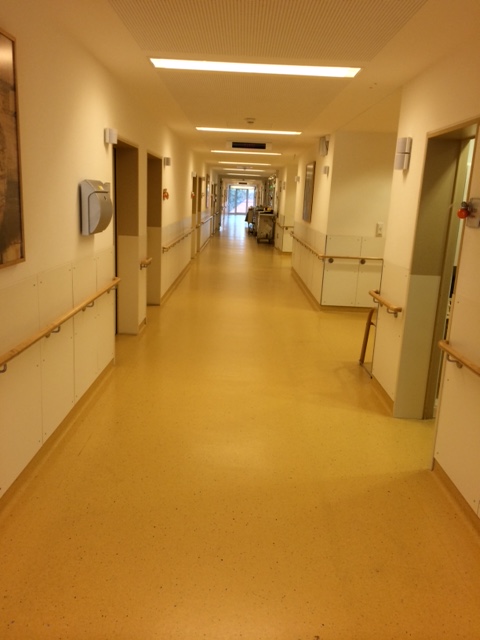
hallway
up and down I went, ~16.000 steps a day

Of course I stayed there for a couple of days and some examinations to find out what was wrong with my heart. I tried to stay calm, relax a bit, spend not too much thoughts on my work, and I stayed away from Twitter since that day. Get some rest and get that high blood pressure under control. Every now and then I had an examination and once a day (at least Thursday, Friday and Monday) I saw a doctor. I am not much of a TV guy, and I was not in the mood for reading all day, so I was walking up and down the ward’s hallway most of the day.

Now starts the testing of the hospital, well not the whole hospital only the ward for cardiology. I am a curious person and I am fascinated to try finding patterns and processes everywhere. I did not want to disturb anyone from doing their job, so I  was mostly watching what was happening around me. I was doing some basic checks, like how many steps long is the hallway. I found out that the nurses’ room was not exactly half way down the floor, especially since some rooms close to the stairway and elevators do not belong to the cardiology. Some checks of the windows showed, that there was one window that could be opened, even if it should not be.


heart monitor alarm
heart monitor alarm

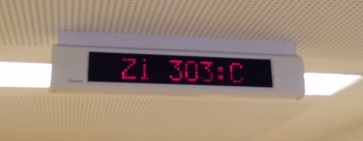
There is an alarm monitor in the hallway (two to be exact) showing usually the time, but also the bed number if an alarm was raised. And there were some additional markers. If the alarm was raised on the toilet of the room, if there is a technical problem with the alarm, if the heart monitor is raising the alarm, and sadly I also found out one night, when I had problems sleeping and was looking for someone to measure my blood pressure, there is an extra symbol for cardiac arrest.

normal alarm
normal alarm

There is a strict distinction between nurses’ and doctors’ responsibility. Well of course there is, but in several aspects it seems so absurd, especially from the view of a patient. I will not elaborate on this any more. Some discussions I had, and especially other patients were enough for me. And I don’t want to raise my blood pressure again.

I got a 24h ECG and for one night a heart monitor. And of course I didn’t want to check out all the buttons what they do and don’t do, because I did not want to corrupt my own medical information. But accidentally I found out that I can set a marker on the 24h ECG device, that I used, when experiencing the strange feeling in the throat again. Funny enough the software for analyzing the ECG seemed to be new, and the doctor checking my heart beats was not aware of the functionality, neither was the nurse handing me out or better wiring the device to my body. When I asked a ward’s nurse if I accidentally did something wrong with the device, nobody could help me. Come on, this is cardiology, there are several patients wearing these things every day.

The heart monitor was also an interesting device. It was sending the heart beat via WLAN to a monitor in the ward’s room to help check on the patients. Of course there was a limit on the reach, and the device began beeping. Sadly my neighbor seems to have had a bad device, and it lost contact even if he was lying in bed. More interesting for me was, walking by the ward’s room and looking on my own heart monitor. On the second evening I raised an alarm by simply walking down the hallway. Well, that was the start to an unpleasant night. Every now and then the device raised an alarm which led to a visit from a nurse, when trying to sleep.

In my 5 days and nights in the county hospital I collected lots of information how the cardiology and in some parts the hospital works. I can’t let go of testing, even if I try to.

Now I am getting some more rest to recover and get used to the medication and do some preparations for Christmas.

For 2015 I am looking happily forward to get at least one new colleague, visiting my first conference and doing better work than the last year. And of course I want to learn a lot, and not again about hospitals and doctors.

I wish all of you a very merry Christmas and a happy new year 2015!

Parallels between testing and wood turning

Kim Knup’s (@punkmik) blog about the parallels between climbing and testing inspired me to pull this draft out of the drawer and finally write it.

As a tester the performance of testing is usually the craft and your product is information. Information in form of test reports, bug reports, and knowledge to share is what you produce in your daily work. To have something more substantial at the end of the day I started woodworking about 10 years ago. Some day I found my love for wooden bowls, so I started interest in woodturning. And when we finally moved to our house 6 years ago I took wood turning training with a master of his art on the other side of Munich. He did not only show me bowl turning, but also pen turning. And now the fever for both was on.

I take this chance now to compare two of my fevers. Testing and Woodturning.

Simon Shrijver just wrote a nice article about testers being craftsman. And last year, someone on Twitter mentioned that good testing is also an art. I really liked that idea, but I came to the conclusion, that testers are not artists, but artisans. That fits in my eyes good to the craftmanship.
Woodturners are at first also craftsman. You learn the craft of woodturning and you need a lot of practice. The same is true for testers. There are a lot of basic techniques and tools that you need to learn and master. But same as for testing, also in woodturning there are multiple tools useful for different and overlapping situations. You like to use one better than the other for a situation where both would fit, while your colleague uses the other. There are of course the old school tools, that are around for some centuries now. But also new tools come to the market every now and then, improving or changing the way of reaching your goal. (Of course with the same ranting as everywhere from the “oldies” that real woodturning is only when using the old techniques.)
While for the customer the way doesn’t matter in both testing and woodturning, for the tester/woodturner, the way is the use of your crafts and describes what you do every day. Of course you can tell that you turn bowls, and everyone looks at the bowl. But nobody can imagine the work behind it. In testing you create test reports, bug reports and some even test cases. But testing is nothing of all those write-ups. But it’s what you do – hopefully – most time of the day.

To be productive in woodturning and getting the best result you need sharp tools. And you often have to resharpen often. Some wood needs more resharpening than others. Same is true for your testing and your tools. They need not to be sharp, but aligned to your needs. And if the context changes, you need to realign your tools to be effective.

To be effective in your daily work you need a lot of machines and jigs, same as a tester needs many tools and scripts. For pen-turning for example you can do nearly everything on your lathe. But you are more productive with a table saw, a drill press, a disc sander, several jigs and of course your lathe. For bowl turning you might add a bandsaw or a chainsaw, and a drill to help your sanding (yes, the drill is for sanding). And some techniques or products need several more tools and jigs.
In testing you can do everything manually, but to be honest, there are so many cool tools, templates and scripts to help, assist, improve and speed up your testing, that it would be a waste of time not to use them.

In woodturning you can also have a factory-approach, of course. You simply turn the form you want a couple hundred times. You mostly improve the way to turn it even faster, but the product rarely changes. But since the product is the goal, that approach is legitimate. The context-driven approach in woodturning is when you go from craftsmanship to artisan. The wood dictates the form you turn and the tool you use. There are those artisans who take a piece of wood and see the beauty in there and make it even more beautiful. The others know what they want to turn and select the wood accordingly.

But the most common thing between woodturning and testing is the community. At least the context-driven community is like the woodturning community. There a big forums in the internet to interact online and share information, knowledge, and of course pictures of the results (later is not so true for testing).

Then there are big meetings with international audience, and of course local meet-ups. You talk about turning and all the stuff around. You can watch tool builders present their tools, you can try some your own. And you meet a lot of other turners with whom to talk, discuss, exchange knowledge and of course drink beer.

And another thing that is true for both is, that you learn most by watching. In both worlds you can write up a lot of explicit knowledge of how to turn/test. But you learn more from watching someone actually turn/test. Like James Bach said it in his keynote at CAST 2014. About every second of testing you could talk like 30 seconds. Same is true for woodturning.

And as a last feature of both I want to say that the openess to share knowledge is the same. When visiting a woodturning show two years ago I watched two of the turners for several hours, and I asked lots of questions, and also others asked lots of questions. And they never were tired of answering or hiding anything. They wanted to share their knowledge and techniques. Same was true, when I approached a woodturner from the US around the same time via email. I was totally fascinated from his work that was presented in wood turning magazines, and art shows mostly in the US, but also all over the world. But I could not imagine how he did it. So I finally simply asked him. And he not only told me in words how to do it and gave me tips, he also sent me pictures of the jigs he used. And I experience the same openess in the context-driven community.

And I want to close with the same question that Kim asked in her blog:
Do you ever compare an everyday activity or hobby to testing?

Monitor your personal “test idea creation” process

At my job it was very busy the last year. Unfortunately that meant I had not much time to take good care of my team members when it comes to coaching and mentoring. One of the things that I am interested most in my colleagues is the way how they think while testing. How does their model look like, how do they approach the situation. If I know about that, I can adapt my language and my “public” model, I can help them to understand things better and faster. And that also gives me the opportunity to know what articles, books, webinars or courses to push forward to them to help improve their skills.

Lately I had some spare hours and I tried to improve their testing skills a bit further. My intention was that they actively think about the actions they take when they analyse a requirement document and create a test plan and strategy for approaching and testing that requirement. So I gave them the following instructions:

When you read and transfer an information from the BRD (business requirement document) to a test idea, try to find out some answers to the following questions for yourself:

  • how you came up with this idea?
  • why you came up with this idea?
  • was this the first thing that popped up?
  • are there other things to mention (ideas, information, etc.)?
  • will I write down other ideas as well?
    • if not, why not?
    • if yes, all of them?
      • if not, why not?
  • where does this thing fit in the existing picture/model?
  • what picture/model you ask?
    • if there is no picture/model, why not? Are you sure?
  • are there questions you want to ask?
    • to whom?
  • are there sources you want to use for more test ideas?
    • why did you not already use them?

Don’t answer them to me in the first place, answer them to yourself. Answer them for every single idea you come up with. If you start giving the same answers over and over again. Why is that? Would you like to change something? If yes, where and why? There is a good reason for all of those questions, so please take them serious and take your time to think about them.

I can give you several reasons for all of the above questions, can you too?

I know that this list of questions is not even close to complete. The intention was to start an active thinking process, what they are doing when and WHY. That way they might enable themselves to a more structured approach and get ideas where to improve themselves or find opportunities, where I can help them to improve or learn new things.

Bugs are like fruits

Just a short piece on a metapher I like to use, when someone tries to explain me how important bug metrics are.

“Bugs are like a piece of fruit!” But, every bug is a different piece of fruit, of different size, different degree of ripeness, and different amount of calories. Now give that fruit to a developer. How many fruits can a developer eat (fix bugs), before he is stuffed (end of the day). Do you know how the developer is eating the piece of fruit? Why not take a single grape, wash it, slice it up, remove the seeds, enjoy every bite and clean up afterwards. Or slice a watermelon, and eat a couple of bites of every slice in the same time. Leaving lots of water melon still to eat. Which means, the bug is not fully fixed, maybe to a certain acceptable degree, or not. So back to the slices and have more water melon. If the fruit is not ripe yet (bug not fully described), it needs to ripe some more. What if the developer grabs a bite, finds out he doesn’t like the taste and gives it to some other developer.

So, why do you count melons and apples and grapes with the same numbers and compare them. Or you try to get any additional information out of those numbers.

Without more information on the sort of bug, how long did it take to fix, what was the root cause, did the retest fail – maybe more than once. You just know there was a box full of fruit that development had to eat.

Just my 2 cents, why basic bug metrics are of no good use without additional information or even the story behind them.


Judging the Software Testing World Cup Preliminaries for Europe – Part 2

We are coming closer to announcing the winner. So here is my report of the hard part for the judges. Read here about the first part: the event.

The event itself went rather well. On Saturday around midnight Maik was finished with retrieving the results. So Sunday morning I had my first 28 Teams assigned for rating. I first retrieved all reports and prepared a sheet and spread them on all my devices, so I could do some judging whenever and wherever time allowed.

First I looked shortly through all 28 reports to see what expects me. I had set some expectations from my own experience and there were of course some guidelines for rating already there. Jackie sent a nice summary from her first round through her reports, what she liked and not liked. I fully agreed and had only one detail to add. So I knew I was on the right way for my expectations and that the other judges had a similar view.

The rating of the reports was very interesting. At first I thought I could do a fair rating by simply reading and rating. But details I saw later on reports I found essential, were missing on already rated. So back to start, preparing a spreadsheet with all essential things I want to see and off we went. But the first round of rating was rather good and fair. I had only to make two minor corrections, but with adding the info to a sheet it was easier to rate and better for future ratings. Because 28 won’t be the end.

The quality of the reports was widely spread. From some barely filled documents to 8 page reports I had a good selection of everything. My summary of the test reports from the first 28 teams: there was some good work there. I was not highly impressed nor really blown away, but I would not expect that from such small teams in 3 hours with no preparation of the SUT and so much to do. Except some teams who spent nearly no time on the report, it was a good and solid statement of work by most teams. Well done!

The bug reports were from a different quality. Also teams who did not so well on the test reports were quite good in finding and describing bugs. The main problem I have seen is, that some information were missing, to completely understand the bug and the motiviation behind it, and why development should fix this bug first. But from my list of individual findings, the first 8 teams found over 100 different bugs. So most teams were entering rather more bugs (most of “my” teams ~30), instead of really good described bugs. I think, the amount of bugs “available” had an impact on the quality of the bug reports.
One thing I saw, “there are four severities, so I have to use them all.” A couple of teams seem to have split their bugs and put something under each severity. That reminds me of my past life as a factory tester, when there were preferred / prescribed rates for the usage of test case priorities, bugs and who knows what. Just my feeling.

Regarding the bug descriptions I got the picture that most testers are good at that, which is nice to see, since bug reporting is a central part of a tester’s daily work. For all teams I have rated so far, there were at least several good bug descriptions per team. To excel in that category I was looking for a lot of ingredients. The title should have some prefix, the description should use some template, additional infos about reproduction, helping screen shots, explanations, why this bug deserves that severity and fixing at all. If it was an improvement, it should be clearly marked as such. And what I wanted to see is, that all team members use the same templates for title and description and show the same quality of bug description.

I have not seen many bugs where I would say, I don’t understand what the tester wants to say. So the rating is on a rather high level and looking for perfection. I see it in my daily work, especially when the deadline is coming closer, the bug counts are increasing, you should maintain a high level of bug report quality to help development and stakeholders to triage correctly and fix the right bugs in the available time and budget. So, even with 30+ bugs in 3 hours, you still have to keep a high level. Many teams were above average here, so well done again!

The final round of judging for Europe is just ongoing and I am through with nearly all my tasks and can’t wait for the winners to be announced.

At this point I want to congratulate all teams for participating in the contest and doing a very good job! Thank you all, judging was interesting and fun for me. I really enjoyed all the work.

Design a site like this with WordPress.com
Get started