

5 Technologies from Mars

5 Technologies from Mars 1. Closed-Loop Life Support Systems Originally developed to sustain astronauts in isolated environments, these systems recycle air, water, and waste and are now being adapted for disaster relief zones and remote communities on Earth. 2. Water Purification and Extraction Tools Technologies designed to mine and filter water from Martian ice are […]
Key Space Resource Treaties and Laws at a Glance

Key Space Resource Treaties and Laws at a Glance Outer Space Treaty (1967) Adopted by: 110+ nations (including U.S., Russia, China) Key Points: Space is the “province of all mankind” No national sovereignty over celestial bodies Exploration must benefit all countries Peaceful purposes only Limitations: Silent on commercial mining and private ownership of extracted resources […]
Fueling the Future

From launch pads to life support, methane may be the key ingredient that powers a permanent human presence on Mars. Fueling the Future: Methane on Mars As humanity prepares to establish a sustainable presence on Mars, one critical question emerges: how will we fuel the missions, habitats, and return journeys from the Red Planet? The […]
Mars: Why It’s Good for Earth and Humanity

What we learn on the journey to Mars is already transforming the way we live, work, and solve problems here on Earth. Mars: Why It’s Good for Earth and Humanity While the dream of reaching Mars captures global imagination, its practical value extends far beyond the Red Planet. The technologies, research, and international cooperation driving […]
Who Owns Mars?

Who Owns Mars? Policy, Law, and the Future of Martian Colonization As commercial entities become essential to making space exploration possible, their participation comes with cost and expectation. They bring innovation, speed, and private investment, but they will not do it for free. Launch providers, robotics firms, and life-support developers see Mars as more than […]
Sampling Mars

Image: NASA’s Perseverance captured this image of the tracks made by the rover during its climb up the rim of Jezero Crater CREDIT: NASA/JPL-Caltech Sampling Mars: How Rovers Are Leading the Way We need to understand what’s beneath the Martian surface, and that job has fallen to the rovers. NASA’s Perseverance and Curiosity rovers have […]
Unlocking Mars’ Secrets

Belva CraterCredit: NASA/JPL-Caltech/University Of Arizona Unlocking Mars’ Secrets Mars: The Next Great Laboratory Mars is more than a destination for human ambition, it is one of the most compelling scientific frontiers in the solar system. From its ancient riverbeds and vast volcanic plains to the potential signs of microbial life, Mars offers a natural laboratory for […]
What Is a Space Simulation Mission?

Before humans live and work on Mars, those missions must be tested on Earth. Analog and simulated space missions place crews in remote, controlled environments designed to mirror the conditions of space exploration. These missions allow scientists, engineers, and future astronauts to evaluate life support systems, habitat design, communication delays, and crew performance while operating under realistic mission constraints.
In this article, Morgan Kainu explores how analog missions serve as critical proving grounds for technologies, leadership skills, and operational strategies needed for long-duration spaceflight. With new facilities emerging and global collaborations such as the World’s Biggest Analog mission bringing together simulation habitats around the world, Earth-based missions are helping prepare humanity for sustainable exploration of the Moon, Mars, and beyond.
Building the Future on Mars
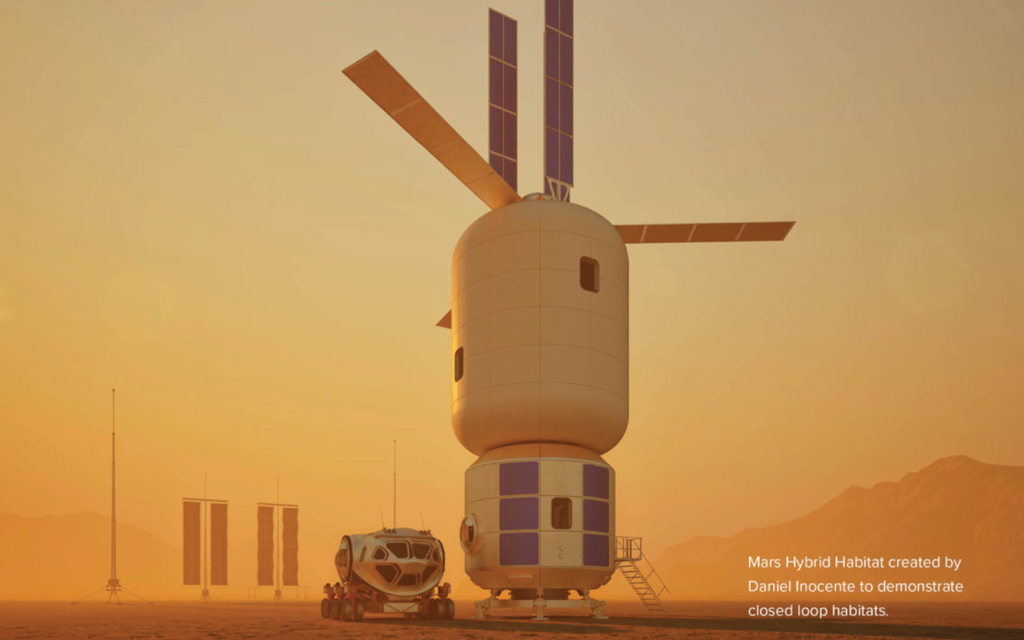
Building a sustainable presence on Mars will rely on lessons learned from cities and extreme environments on Earth. In this article, architect Daniel Inocente explores how future Mars settlements will evolve from temporary landing-vehicle habitats into modular, interconnected ecosystems that support life, science, and industry. Drawing parallels with Antarctic research stations and modern urban infrastructure, he explains how modular construction, resilient energy systems, and in-situ resource utilization will enable Mars bases to grow into thriving settlements. As Mars architecture advances beyond survival, the design of habitats will shape human well-being, community, and the foundations of a multi-planet civilization.
From Professional Football to Mars

Human missions to Mars will demand more than advanced spacecraft and life support systems. They will require exceptional mental resilience. In this article, Dr. Tommy Shavers draws on lessons from elite performance environments, including professional football and defense training, to explore how mindset conditioning and neural efficiency prepare individuals to perform under sustained pressure.
From the isolation of months-long transit to the demands of building a settlement on another world, astronauts will rely on cognitive endurance, adaptability, and team cohesion. By applying structured performance training methods such as NESTRE’s Assess-Customize-Train model, space agencies and mission planners can develop crews prepared to lead, adapt, and sustain high performance throughout humanity’s longest journey.