Unique and unnatural: modern warming from an historical viewpoint

A Roman altar with the Sun in its chariot on the left, and Vulcan, the god of fire and volcanoes on the right. The climate gods long favoured the Roman Empire, with wobbles in Earth's orbit credited for increasing the amount of solar energy falling on Earth at the time. Image copyright: Nick Thompson, used via Flickr Creative Commons License.

A Roman altar with the Sun in its chariot on the left, and Vulcan, the god of fire and volcanoes on the right. The climate gods long favoured the Roman Empire, with Earth’s orbital dance credited for increasing the amount of solar energy falling on Earth at the time. Image copyright: Nick Thompson, used via Flickr Creative Commons License.

Our climate has changed before. It’s something most of us realise and can agree on and, according to Skeptical Science, it’s currently the most used argument against human-caused warming. If such changes have happened naturally before, the argument goes, then surely today’s warming must also be natural. It’s an appealing idea, with an instinctively ‘right’ feel. Nature is so huge compared to us puny humans, how can we alter its course? The warming we’re measuring today must just be a natural fluctuation.

It’s such an appealing argument that at the beginning of the 20th century that’s just what many scientists thought – that humans couldn’t alter Earth’s climate. In the time since, our knowledge has come a long way. We’ve explored space, become able to build the electronics that are letting you read this, and climate science has likewise advanced and benefited from these advances.

So what do we know today that might convince the sceptical scientists of 115 years ago that we’re warming the planet? Recently, Richard Mallett, one of my Twitter friends who describes himself as sceptical about mainstream climate science, made a point that serves as an excellent test of our current knowledge:

Of the historical warmings he’s referring to, perhaps the least familiar is the Holocene, which is ironic, as the Holocene is now. It’s the current period of geological time that started at the end of the last ice age, 11,700 years ago. By 1900 scientists would have known the term, but they couldn’t explain why it wasn’t as icey as before.

Three variables of the Earth’s orbit—eccentricity, obliquity, and precession—affect global climate. Changes in eccentricity (the amount the orbit diverges from a perfect circle) vary the distance of Earth from the Sun. Changes in obliquity (tilt of Earth’s axis) vary the strength of the seasons. Precession (wobble in Earth’s axis) varies the timing of the seasons. For more complete descriptions, read Milutin Milankovitch: Orbital Variations Image credit: NASA/Robert Simmon.

Three variables of the Earth’s orbit—eccentricity, obliquity, and precession—affect global climate. Changes in eccentricity (the amount the orbit diverges from a perfect circle) vary the distance of Earth from the Sun. Changes in obliquity (tilt of Earth’s axis) vary the strength of the seasons. Precession (wobble in Earth’s axis) varies the timing of the seasons. For more complete descriptions, read Milutin Milankovitch: Orbital Variations. Image credit: NASA/Robert Simmon.

The explanation we have today comes thanks to the calculations Milutin Milanković worked out by hand between 1909 and 1941. Milutin showed that thanks to the gravitational pull of the Moon, Jupiter and Saturn, Earth’s orbit around the Sun varies in three ways. Over a cycle of roughly 96,000 years our path varies between more circular and more oval shapes. The other two ways come because Earth’s poles are slightly tilted relative to the Sun’s axis, which is why we have seasons. The angle of that tilt shifts over a roughly 41,000 year cycle. Earth also revolves around that tilted axis, like a spinning top does when it slows down, every 23,000 years.

Together these three cycles change how much of the Sun’s energy falls on and warms the Earth, in regular repeating patterns. Though that idea would be the subject of much controversy, by the 1960s data measured from cylinders of ancient ice and mud would resolve any doubt. The slow descent into ice ages and more abrupt warmings out of them – like the one that ushered in the Holocene – come from Earth’s shimmies in space. Read the rest of this entry »

Heavier people mean weightier vehicle emissions

Between 1970 and 2010 the average weight across all overweight and obese American men and women increased approximately 5 kg and 6 kg, respectively, and that has added to the fuel needed to transport them, and greenhouse gas emissions in turn. Image copyright Neil Hester, used unaltered via <a href="https://creativecommons.org/licenses/by-nc/2.0/">Flickr Creative Commons license</a>.

Between 1970 and 2010 the average weight across all overweight and obese American men and women increased approximately 5 kg and 6 kg, respectively, and that has added to the fuel needed to transport them, and greenhouse gas emissions in turn. Image copyright Neil Hester, used unaltered via Flickr Creative Commons license.

In case we needed any reasons other than health to watch our weight, a team at Carnegie Mellon University in Pittsburgh, Pennsylvania, has found some. Michelle Tom and her co-workers have looked at how our extra weight adds to the cost and carbon footprint of transport in the US. From 1970 to 2010, the extra fuel needed to carry overweight passengers’ ‘excess weight’ cost $103 billion in total. That in turn created extra greenhouse gas emissions over the 40-year period equivalent to half a billion tonnes of CO2. “Obesity is not just a public health issue, but also has implications for natural resource use and environmental degradation,” Michelle told me.

Weight is important in vehicle fuel use, with developing lighter cars playing a key role in recent efforts to make them more efficient. Working with PhD supervisor Chris Hendrickson, Michelle is studying the strain our heavier societies put on our resources, and therefore tackled the fuel burden from extra weight. “There have been headlines about the health issues associated with people being overweight and obese, but there has been very little analysis of what this means in terms of things like fuel use and calorie intake,” Chris noted.

Michelle pulled together data for personal vehicles, public transport and aircraft, including how many there are, how full they are, and how much fuel they’ve used. And thanks to efforts made to lighten vehicles, she also had access to good information on how weight affects fuel consumption. She could bring this together with records of the US population, how many of them drive, and how much they exceed the highest ‘normal’ body mass index. Combining all this with data on vehicle greenhouse gas emissions and fuel costs meant Michelle could calculate how heavy the impact of heavier people has been. Read the rest of this entry »

Can changing how we build simply dismantle CO2 emissions?

Fewer steel beams and using buildings for their whole design life could cut construction emissions by up to 80% suggest the University of Cambridge’s Muiris Moynihan and Julian Allwood. Image copyright Mark Kirchner, used via Flickr Creative Commons licence.

Fewer steel beams and using buildings for their whole design life could cut construction emissions by up to 80% suggest the University of Cambridge’s Muiris Moynihan and Julian Allwood. Image copyright Mark Kirchner, used via Flickr Creative Commons licence.

UK engineers have found a way to bulldoze the building industry’s emissions of the greenhouse gas CO2. The University of Cambridge’s Muiris Moynihan and Julian Allwood say that better use of steel could halve emissions without any impact on safety. ‘We’re using double the amount of steel that we actually need,’ Julian told me.

Julian is director of UK Indemand, one of six national centres the country’s government set up in 2013 to help reduce energy demand by boosting efficiency. Construction is one of the first areas it’s tackling in its mission to reduce industrial energy and material use, and in turn cut CO2 emissions.

Today builders use lots of steel because ‘the cost of materials is low, and the cost of structural engineers is high’ Julian said. “Rather than designing a building precisely it’s cheaper to focus on the heavily loaded areas of the building and design carefully there. Then you can copy and paste, in effect, that design out to other areas that are less well loaded because you know it’s going to be safe. It’s quicker to do that than to spend the professional time required to design the structure accurately.”

Steel-making has one of the largest carbon footprints of any industry, its factories coming fourth in the list of ‘stationary emitters’ behind electricity generation, cement production and oil refining. Every year over 1.5 billion tonnes of steel are produced, emitting around one-tenth of the CO2 from energy generation and industrial processes worldwide. Julian and his coworkers had previously forecast that steel use will double in the next 37 years. If reducing steel use is possible, it therefore looks an obvious move to help avoid dangerous climate change. Read the rest of this entry »

IPCC: Millions of words on climate change are not enough

The latest IPCC report has highlighted that it's dead certain that the world has warmed, and that it's extremely likely that humans are the main cause. Credit: IPCC

The latest IPCC report has highlighted that it’s dead certain that the world has warmed, and that it’s extremely likely that humans are the main cause. Credit: IPCC

The most recent UN Intergovernmental Panel on Climate Change (IPCC) report saw perhaps the most severe conflict between scientists and politicians in the organisation’s existence. As its name suggests, governments take an active part in the IPCC process, whose latest main findings appeared between September 2013 and May 2014. Debate over what information makes the high-profile ‘Summaries for Policymakers’ is usually intense, but this time three graphs were dropped on politicians’ insistence. I show these graphs later in this blog entry.

At the Transformational Climate Science conference in my home town, Exeter, UK, earlier this month, senior IPCC author Ottmar Edenhofer discussed the ‘battle’ with governments on his part of the report. Another scientist who worked on the report highlighted confidentially to me how unusual the omission was.

To me, it’s more surprising that this hasn’t happened more often, especially when you look more closely at the latest report’s findings. There’s concrete certainty that warming is happening, and it’s extremely likely that humans are the dominant cause, it says. Governments have even – in some cases, begrudgingly – already signed up to temperature and CO2 emission targets reflecting this fact.

The inadequacy of those words is becoming ever more starkly obvious. Ottmar stressed that the emissions levels agreed at the United Nations’ Climate Change Conference in Cancún, Mexico, in November 2010, would likely need later emissions cuts the likes of which we’ve never seen before to avoid dangerous climate change. The latest IPCC report shines a floodlight on that inertia, which understandably cranks up the tension between researchers and politicians.

Ottmar was one of two co-chairs who led the ‘working group three’ (WGIII) section of the IPCC report that looks at how to cut greenhouse gas emissions. He stressed that the need to make these cuts comes from a fundamental difference between the risks that come from climate change and the risks of mitigation. We can heal economic damage arising from cutting emissions – reversing sea level rise isn’t so easy.

Read the rest of this entry »
The urgent voice who refused to be silenced on climate danger

  • This is part three of this profile. Read part one here and part two here.
In response to the revelations of his ongoing research, NASA scientist Jim Hansen has become increasingly active in campaigning to halt climate change over the past decade. Image credit: Greenpeace

In response to the revelations of his ongoing research, NASA scientist Jim Hansen has become increasingly active in campaigning to halt climate change over the past decade. Image credit: Greenpeace

By December 6, 2005, NASA Goddard Institute of Space Studies’ (GISS) temperature record was already sending a clear message: worldwide, 2005 would likely be the warmest year so far. For GISS director Jim Hansen, speaking to the annual American Geophysical Union conference, arguably the world’s largest environmental research meeting, it seemed fair to reveal. For several listening journalists it was newsworthy enough for them to cover Jim’s talk. But it would anger some of Jim’s colleagues at NASA headquarters enough to try to stop him talking to the media. In the process they’d drag him outside the world of pure research he was most comfortable in. “The undue influence of special interests and government greenwash pose formidable barriers to a well-informed public,” Jim would later write about the situation. “Without a well-informed public, humanity itself and all species on the planet are threatened.”

The comments came during a lecture in honour of Dave Keeling, the CO2 tracking pioneer, who’d died of a heart attack in June that year. Soothing Jim’s hesitation, Dave’s son Ralph stressed he was continuing the work of his father, who had even been discussing one of Jim’s papers minutes before his death. And so Jim had brought together evidence showing that Earth’s climate was nearing a ‘tipping point’ beyond which it will be impossible to avoid dangerous changes. However, warming from 2000 onwards might still be kept below the 1°C level that Jim at that time considered hazardous if CO2 levels in the air were held at about 450 parts per million (ppm). Emissions of other greenhouse gases would also need to be significantly reduced. The message was clear: how we get our energy would must change, mainly by shifting away from coal and the vast volumes of CO2 burning it produces.

NASA headquarters was already reviewing all publicity on climate change research, but the latest coverage would force it into even more severe action. The following week it laid out new restrictions on Jim’s ability to comment publicly, and the global GISS temperature record was temporarily taken off the internet. Prominent amongst those setting the new conditions was NASA’s new head of public affairs, appointed by George Bush’s administration, David Mould. His previous jobs included a senior media relations role at the Southern Company of Atlanta, the second largest holding company of coal-burning power stations in the US. Only one company had donated more to the Republican Party than the Southern Company during George Bush’s 2000 election campaign: Enron. Read the rest of this entry »

The witness who collided with government on climate

  • This is part two of this profile. Read part one here.
Jim Hansen giving testimony at a US Congressional hearing in 1988, where he'd declare 99% certainty that humans are changing the climate. Image credit: NASA

Jim Hansen giving testimony at a US Congressional hearing in 1988, where he’d declare 99% certainty that humans are changing the climate. Image credit: NASA

“It’s time to stop waffling so much and say that the evidence is pretty strong that the greenhouse effect is here.” It’s a comment that wouldn’t sound out of place today, but Jim Hansen made it 26 years ago, on June 23, 1988, amid record 38°C temperatures in Washington DC. Jim said it to reporters after telling a Congressional hearing he was 99% certain the world is getting warmer thanks to human-made greenhouse gases.

Jim’s 1980s media bombshells led journalist Robert Pool to liken him to a religious ‘witness’, ‘someone who believes he has information so important that he cannot keep silent’. However, he still felt shy and awkward, preferring to immerse himself in pure science, and so would turn down almost all invitations to speak out for another decade. Jim’s efforts during that period would then help build even stronger evidence on global warming. But with extra motivation provided by clashes with the US government and the arrival of his grandchildren he would return to bear witness more forcefully than ever.

Before his self-imposed media ban Jim would make headlines one more time in 1989, after giving written evidence to a hearing convened by then US senator Al Gore. The testimony reaching the hearing had been altered by the White House to make his conclusions about the dangers of global warming seem less certain. When Jim sent the future vice-president a note telling him this, he alerted the media, turning their scheming into the lead story across all TV networks that evening. John Sununu, aide to then president George H. W. Bush, would then try to get Jim fired for his troubles. But Republican senator John Heinz intervened on Jim’s behalf, and he kept his job.

The reputation Jim had built up as a warming witness went ahead of him in December 1989, as he walked into a ‘roundtable’ meeting held by senators Al Gore and Barbara Mikulski. On the coldest day of the year, in a building whose heating system had failed, Al noticed Jim enter and said, “Hey, aren’t you the guy who…” Despite such jibes, Jim was becoming firmer in his convictions. In April 1990 he offered a group of climatologists an even money bet that one of the next three years would be the warmest in a century. He’d be proven right by the end of the year. Read the rest of this entry »

How lessons from space put the greenhouse effect on the front page

Normally during a total lunar eclipse, like this one on April 15, 2014, you can still see the moon, but in 1963 Normally during a total lunar eclipse, like this one on April 15, 2014, you can still see the moon, but in 1963

Normally during a total lunar eclipse, like this one on April 15, 2014, you can still see the moon, but in 1963 Jim Hansen saw it disappear completely. Explaining why would send him on a scientific journey to Venus, before coming back down to Earth. Image credit: NASA

Jim Hansen’s life changed on the evening the moon disappeared completely. In a building in a cornfield Jim and fellow University of Iowa students Andy Lacis and John Zink, and their professor Satoshi Matsushima, peered in surprise through a small telescope into the wintry sky. It was December 1963, and they had seen the moon replaced by a black, starless circle during a lunar eclipse. The moon always passes into Earth’s shadow during such eclipses, but usually you can still see it.

At first they were confused, but then they remembered that in March there had been a big volcanic eruption. Mount Agung in Indonesia had thrown tonnes of dust and chemicals into the air: perhaps that was blocking out the little light they’d normally have seen? With a spectrometer attached to their telescope they measured the moon’s brightness, data Jim would then base his first scientific research on. Using this record to work out the amount of ‘sulphate aerosol’ particles needed to make the moon disappear, Jim began a lifelong interest in planets’ atmospheres. That would lead him to become director of the NASA Goddard Institute of Space Studies (GISS), where he has led the way in exposing the threat from human CO2 emissions.

Jim was born in Iowa in 1941, the fifth of seven children of a farmer, who had left school at 14, and his wife. As he grew up they moved into the town of Denison, his father becoming a bartender and his mother a waitress, and Jim spending his time playing pool and basketball. Jim claims he wasn’t academic, but found maths and science the easiest subjects, always getting the best grades in them in his school. Though his parents divorced when he was young, public college wasn’t expensive at the time, meaning Jim could save enough money to go to the University of Iowa.

The university had an especially strong astronomy department, headed by James Van Allen, after whom brackets of space surrounding the Earth are named. These ‘Van Allen Belts’ are layers of particles that he discovered, held in place by the planet’s magnetic field. Satoshi Matsushima, a member of Van Allen’s department, could see Jim and Andy’s potential and convinced them to take exams to qualify for PhD degrees a year early. Both passed, with Jim getting one of the highest scores, and were offered NASA funding that covered all their costs.

A few months later, it was Satoshi who suggested measuring the eclipse’s brightness, feeding Jim’s interest in atmospheres on other planets. “Observing the lunar eclipse in 1963 forced me to think about aerosols in our atmosphere,” Jim told me. “That led to thinking about Venus aerosols.” In an undergraduate seminar course Jim had given a talk about the atmospheres of outer planets, which James Van Allen had attended. The elder scientist told him that recently measured data was suggesting Venus’ surface was very hot. Aerosols stopped light reaching the Earth during the eclipse – could they be warming up Venus by stopping heat escaping, Jim wondered? That would become the subject of his PhD, and Satoshi and James Van Allen would be his advisors. Read the rest of this entry »

Climate change-boosted disease could endanger China’s food supply

Wheat ear infected with Fusarium ear blight (FEB), giving the ear a pinkish color. The disease could be set to increase in countries like China and the UK with climate change, Bruce Fitt and his teammates have found, suggesting resistant varieties should be developed. Photo credit: CIMMYT.

Wheat ear infected with Fusarium ear blight (FEB), giving the ear a pinkish color. The disease could be set to increase in countries like China and the UK with climate change, Bruce Fitt and his teammates have found, suggesting resistant varieties should be developed. Photo credit: CIMMYT.

As the planet warms, China’s wheat crops will be threatened by more frequent epidemics of ‘fusarium ear blight’ (FEB), scientists in the UK and China have projected. Bruce Fitt from the University of Hertfordshire in Hatfield, UK, and his teammates forecast levels of the disease in the Anhui and Hubei provinces from 2021-2050. Whereas in the worst affected regions in 2001-2010 around one-sixth of all ears were infected, this was the lowest disease level the researchers found in their future scenario. In the worst-hit areas, FEB infected more than a third of all ears. “This has implications for crop breeding because it takes 10-15 years to breed a new cultivar,” Bruce told me. “If you know the disease is going to become more important then you need to get on and start breeding now rather than waiting until the disease hits you.”

Today, over a billion people don’t have enough to eat, and further population growth and climate change are set to put the world’s food supplies under even greater strain. To help ease that pressure, Bruce and other scientists are working to understand and help improve control of crop diseases like FEB. While some crop diseases will worsen in the future, not all will, he stressed. “For example, you might have a disease that is spread by rainsplash in summer and then it’s predicted that there will be far less rainfall in summer,” he explained. “Then you would expect that with climate change the importance of that disease would diminish.” If governments, farmers and seed suppliers know which diseases are likely to get worse, they can prioritise developing strategies to contol them, like breeding disease resistant varieties.

To make useful forecasts for which diseases will worsen, scientists build models that include weather data, how crops grow and how the disease pathogen spreads through the crop. “In this particular instance the wheat is susceptible only at flowering,” Bruce said. “It may be in flower for a few days. If it doesn’t get the pathogen inoculum and the right weather conditions at that time it will not get the disease.” Climate change can both alter flowering times and the chances of warm, wet weather that make infection more likely. When wheat gets infected, even if it can be harvested it is more likely to contain poisonous mycotoxins. “If it’s full of mycotoxins then it can’t be eaten by man or beast, so it’s just wasted,” Bruce added. Read the rest of this entry »

Results show quick CO2 ‘fix’ feasibility – but its future rests in government hands

The CarbFix project is trapping natural CO2 emissions underground as Iceland seeks to offset emissions from other sources. Image credit: Reykjavik Energy

The CarbFix project is trapping natural CO2 emissions underground as Iceland seeks to offset emissions from other sources. Image credit: Reykjavik Energy

Although CO2 can stay in the atmosphere, trapping heat, for thousands of years scientists think they have turned it into rock in just a few months. Juerg Matter from the University of Southampton, UK, and his colleagues in the CarbFix project have injected 170 tons of pure CO2 into the reactive basalt underneath Iceland. Their findings suggest around 85% of it reacted with the rock over the short distance between injection and monitoring boreholes in less than one year.

“We think that was because all that CO2 precipitated out as carbonate minerals in the reservoir,” Juerg, who’s also an adjunct scientist at Lamont-Doherty Earth Observatory in New York, told me. “To really prove it this summer we will drill a borehole into the injection reservoir to retrieve rock core samples.” But the CarbFix team has also emphasised this week that it will take higher carbon prices for this and other carbon capture and storage technology to fulfil their potential.

The latest UN Intergovernmental Panel on Climate Change (IPCC) says the cheapest way to avoid dangerous climate change is to stop using fossil fuels and switch to renewable energy. However time’s running out on that option, and the IPCC report therefore highlights the probable need to suck CO2 from the air. But before we capture CO2 straight out of the air, or even from the chimneys of power stations, we need somewhere to put it. Currently captured CO2 is simply pumped and stored underground as a gas, meaning care is needed to choose reservoirs that won’t leak. “Storage options right now are mainly in depleted gas and oil fields, in sedimentary rocks,” Juerg said.

In the air, CO2 eventually reacts with basalt naturally, but that process is far too slow to balance out what humans are emitting. Since 2007 the CarbFix team has been working to see if they can speed that process up by forcing CO2 underground. Not only would this quickly turn the gas into minerals and prevent leak worries, it would also greatly expand the number of places it could be stored. “The storage potential is just huge, there’s billions of tons of reservoir, because basically all the ocean floor is basalt,” Juerg highlighted. Read the rest of this entry »

Dump fossil fuels for the health of our hearts

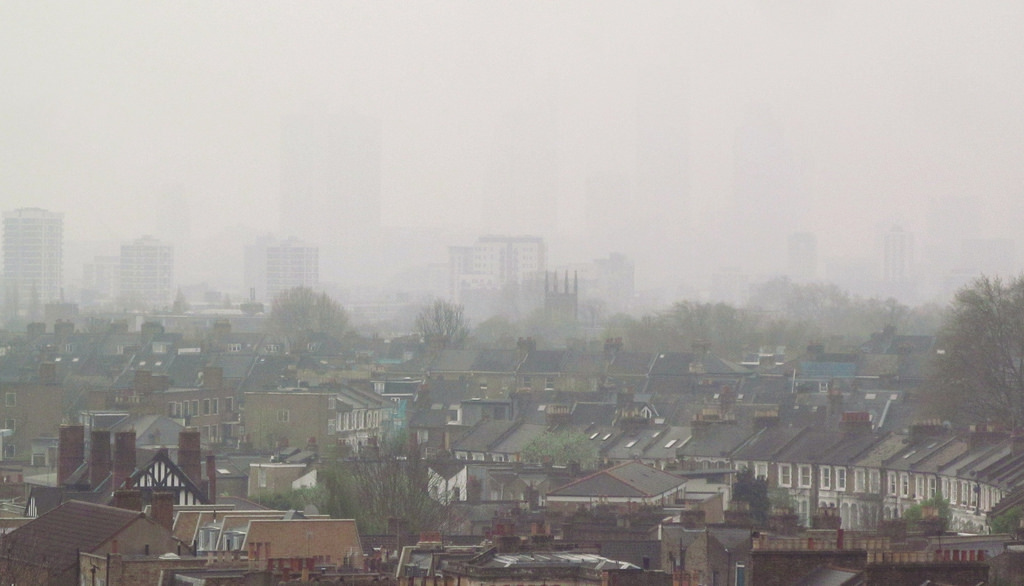
Air quality in London on April 3, 2014 fell to a level where it became hard to see normally-visible skyscrapers. Conditions hit a 9/10 risk ranking  thanks to a combination of pollution and dust blown in from the Sahara desert. Tackling such pollution could immediately improve people's health, stresses New York University's George Thurston. Image copyright David Holt, used via Flickr Creative Commons license.

Air quality in London on April 3, 2014 fell to a level where it became hard to see normally-visible skyscrapers. Conditions hit a 9/10 risk ranking thanks to a combination of pollution and dust blown in from the Sahara desert. Tackling such pollution could immediately improve people’s health, stresses New York University’s George Thurston. Image copyright David Holt, used via Flickr Creative Commons license.

Sometimes when I blow my nose and – inevitably – look into my handkerchief, I see that my snot is black. It doesn’t happen when I’m at home, in the small English city of Exeter, only when I’m in London. It’s a clear sign of the extra pollution I’m inhaling when I’m in the capital – one backed up by data published last week by Public Health England. Its striking report says that in 2010 73 deaths per thousand in the London borough of Waltham Forest, where my girlfriend’s sister lives, could be put down to grimy air. For Exeter, the figure was just 42 per 1000. Across the whole of England, pollution killed 25,002 people in 2010, or 56 of every 1000 deaths nationwide.

But wherever you live, air pollution will become even more important as the climate changes, while fighting this scourge could also help the world bring global warming under control. “There’s more than enough rationale for controlling emissions based on the health effects and the benefits that we get as a society from getting off of fossil fuels,” New York University’s George Thurston told me. “Those are the benefits that are going to accrue to the people who do the clean-up – locally and immediately, not fifty years from now.”

Public Health England is trying to draw attention to ‘particulate matter’, or dust, less than 2.5 micrometres in diameter, too small to see with our naked eye. You won’t find this ‘PM2.5’ pollution listed as people’s cause of death – it’s likely to be down as a heart attack or lung cancer. George has run huge studies in the US to help work out exactly how much such dust worsens people’s health. One study for the American Cancer Society followed 1.2 million men and women originally enrolled in 1982. Another, started in 1995, tracked over 500,000 US retirees over the following decade. And he was also a part of a worldwide project that last year showed ‘global particulate matter pollution is a major avoidable risk to the health of humankind’. Read the rest of this entry »

Design a site like this with WordPress.com
Get started