Skip to Content

Prompt Engineering Institute

Latest Posts

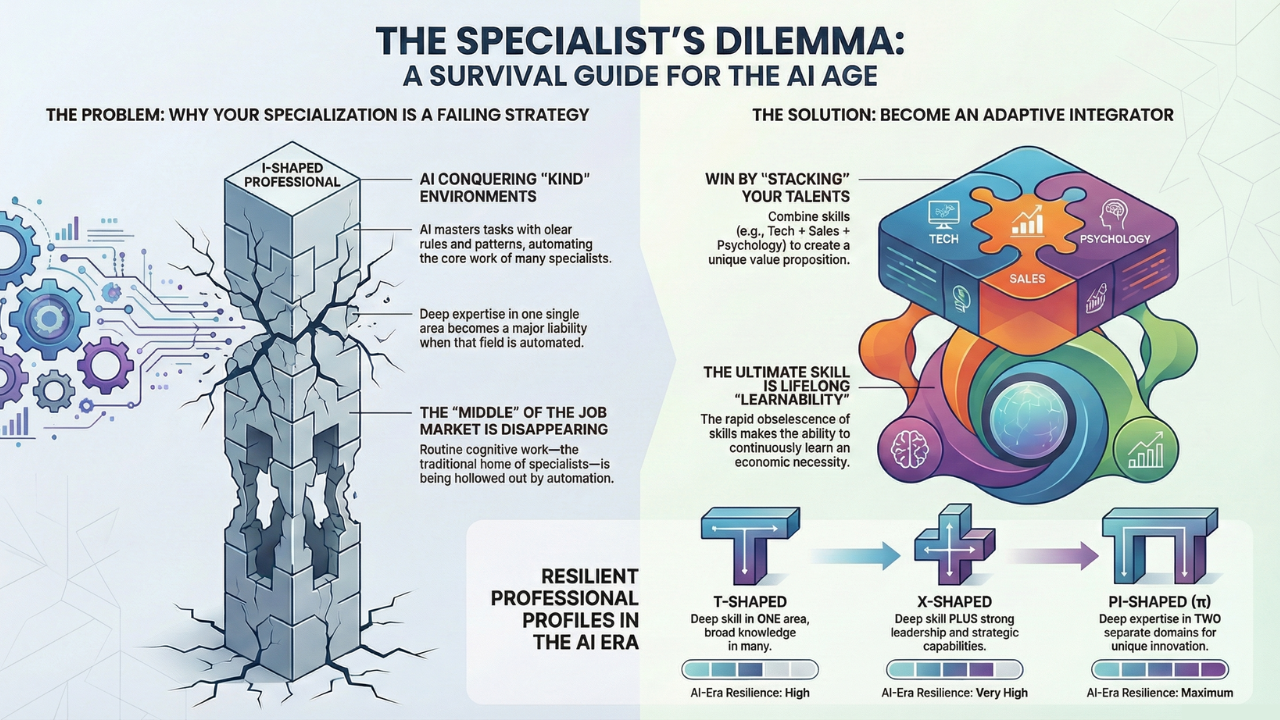
The Polymath’s Renaissance - Structural Labor Market Transformation, Cognitive Adaptability, and the Obsolescence of Narrow Specialization in the Algorithmic Age

The Polymath’s Renaissance - Structural Labor Market Transformation, Cognitive Adaptability, and the Obsolescence of Narrow Specialization in the Algorithmic Age

The Paradigmatic Shift in Value Creation

The global economic architecture is currently navigating a tectonic shift, comparable in magnitude to the Industrial Revolution, driven by the exponential maturation of Artificial Intelligence (AI) and the accelerating velocity of technological obsolescence. For the better part of the 20th and early 21st centuries, the dominant algorithm for professional success and economic stability was deep, narrow specialization—the creation of the "I-shaped" professional. This model, intellectually rooted in Adam Smith’s division of labor and Taylorist efficiency principles, predicated that hyper-efficiency in a specific, bounded domain yielded the highest marginal utility for both the

The Polymath’s Renaissance - Structural Labor Market Transformation, Cognitive Adaptability, and the Obsolescence of Narrow Specialization in the Algorithmic Age Read more

Stop Letting Automations Trip Over Themselves: The ACE Framework For Durable AI Workflows

A practical guide to the ACE framework for automation reliability. Learn how to split work into Aim, Coordinate, and Execute so you can move faster, cut MTTR, and keep audits and on-call simple.

Why ACE beats one-big-prompt automations

Complex automations often fail because one blob tries to do everything. The ACE framework separates responsibility into three layers so each piece can be designed, tested, and improved on its own:

  1. Aim defines the business intent in plain language.
  2. Coordinate decides who or what runs next and when.
  3. Execute performs the work via deterministic scripts and tools.

This separation echoes classic software guidance on modular design. If you have never read David Parnas on modularization, his landmark paper explains why clear interfaces and information hiding make systems easier to reason about and test, which is

Stop Letting Automations Trip Over Themselves: The ACE Framework For Durable AI Workflows Read more

Agents At Work: The 2026 Playbook for Building Reliable Agentic Workflows

A practical guide to agentic workflows: what agents really are, how to design them for speed and reliability, where they beat static automations, and how to make them production ready with structured outputs, guardrails, and verification.

1) What an agent is, and what it is not

Plain definition. An agent is a decision layer that takes a goal, makes a plan, calls tools or APIs, and adapts based on the results it inspects. That is different from a basic chatbot that only returns text. Modern platform docs show the mechanics behind this: OpenAI’s tool and function calling explains how models select tools and use results in the next step, and Structured Outputs shows how to enforce exact JSON schemas so downstream systems get clean data. These are the building blocks of agent behavior.

Not magic.

Agents At Work: The 2026 Playbook for Building Reliable Agentic Workflows Read more

From hype to revenue: 7 non-negotiables for a production-grade agentic workflow

Modern AI agents can demo beautifully and disappoint in production. If you want real customers and real revenue, your workflow needs real engineering. Here's seven non-negotiables we see in teams that ship agentic systems with confidence, plus concrete practices and links to credible guidance.

7 non-negotiables for a production-grade agentic workflow

1) Deterministic outputs: schemas, stable files, explicit acceptance criteria

Customers and downstream systems need predictable shapes, not vibes.

  • Enforce a schema at the boundary. JSON Schema is the industry standard for describing and validating structure. It defines both a Core and a Validation spec so machines and humans agree on what is acceptable. See the official JSON Schema specification for details, including the widely adopted 2020-12 draft that most tooling targets. This is the reference you can hand to auditors and integrators alike, not a blog post. Read the JSON Schema spec and
From hype to revenue: 7 non-negotiables for a production-grade agentic workflow Read more

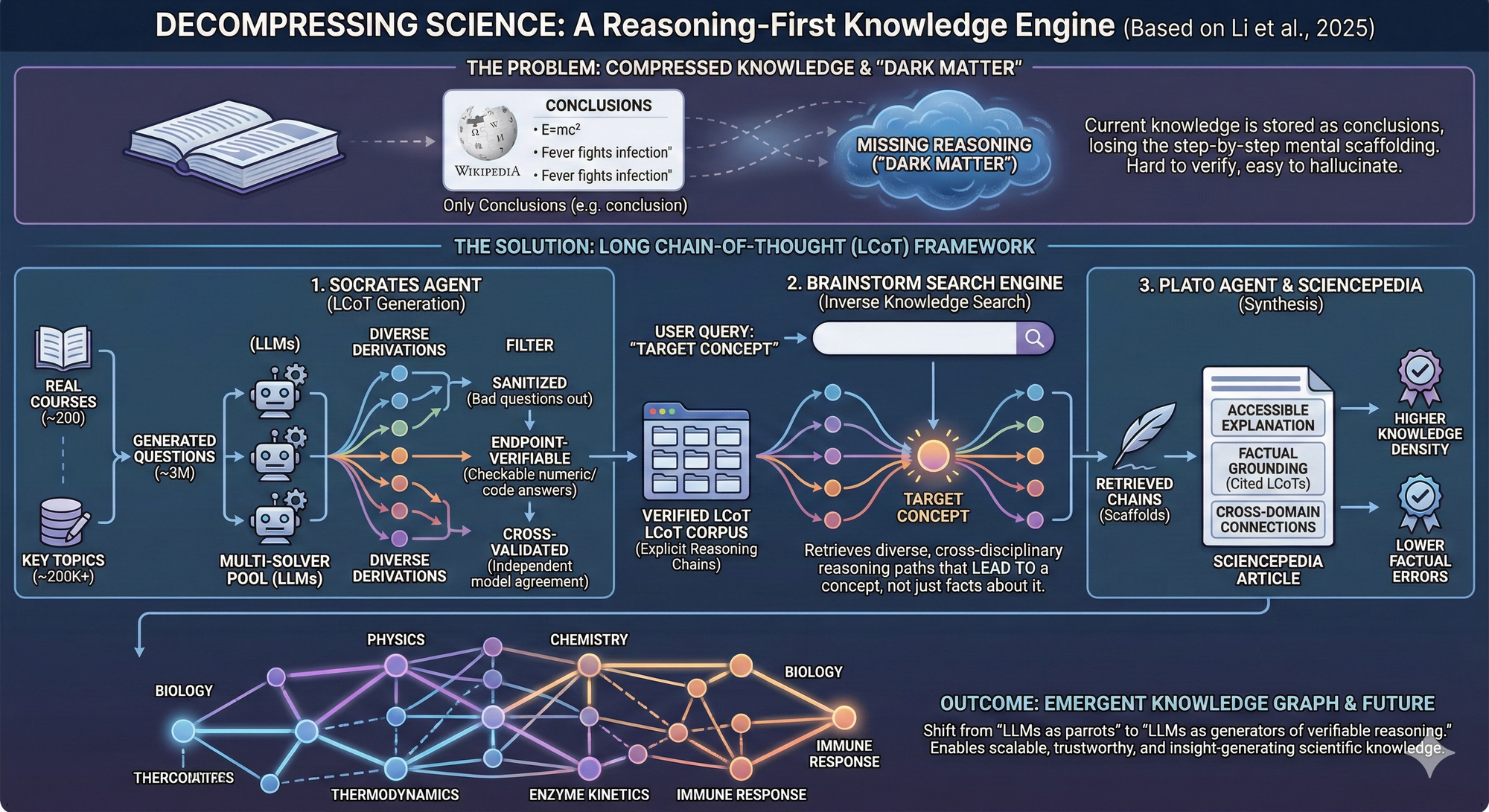
AI ‘Dark Matter’ - Using Verifiable Reasoning Chains and Inverse Search

Instead of using LLMs to regurgitate facts, what if we used them to reconstruct the reasoning behind the facts?

AI ‘Dark Matter’ - Using Verifiable Reasoning Chains and Inverse Search

The Overview

There’s something odd about scientific knowledge. Not that it's difficult, that's expected. What's odd is how flat it feels. Read a typical textbook or a Wikipedia article on any scientific topic, and you’ll see what I mean. There’s the definition, maybe a formula or two, a sentence or two about its applications.

But where’s the thinking? Where’s the step-by-step mental scaffolding that led there? It’s like seeing the top floor of a skyscraper, with no staircase underneath. We’re standing on the answer, but the path is missing.

This isn’t a

AI ‘Dark Matter’ - Using Verifiable Reasoning Chains and Inverse Search Read more

Client Zero to Industry Hero - Inside IBM’s Playbook for Automating HR and Scaling “Digital Workers”

How IBM automated 94% of transactional HR, cut HR spend by 40%, and removed $3.5B in cost, then turned internal experts into revenue. A step-by-step playbook you can adapt.

Introduction

Recently, I came across one of the most insightful podcasts on AI implementation that I’ve heard in a long time, a conversation with IBM’s ex-CEO and current head of consulting, Mohamad Ali. The discussion was a rare peek behind the curtain at how IBM, one of the world’s most iconic tech giants, has approached the daunting challenge of large-scale AI adoption.

What stood out wasn’t just the technology or the numbers, it was the clarity and practicality of their approach. Hearing directly from a leader who helped steer IBM’s transformation made me realize just

Client Zero to Industry Hero - Inside IBM’s Playbook for Automating HR and Scaling “Digital Workers” Read more