Email isn’t broken

I came across this article asking: Is email broken? Apparently many people and orgs think it is.

My answer is a resounding “No!”. Email is much less of a problem for me than it used to be say ten years ago. From the analysis the writer of that article,the BBC’s Rory Cellan-Jones, carried out on his inbox, it’s pretty clear that a lot of his problems are ultimately of his own making. I don’t experience most of the things he talks about, because I use email differently than he does.

  • As the article says, a lot fewer people are using email now. So how come there is still a problem of being overwhelmed with email? I get a lot fewer emails than I used to because a lot of communications have moved to other channels. Ten years ago I might have got family pics or other social chatter in email, now that’s more likely to come via Whatsapp.

  • I have several different email addresses for different purposes. That makes it easy to keep apart important emails from general bumpf. It also means I can set up the email software on my devices in such a way that msgs from critical people will ding me, but I’m not bothered by other stuff.

  • I rarely subscribe to email newsletters. In as much as I even want to keep up with news from some company or org, I’ll add them to a Twitter list. And before doing even that I’m conscious of the fact that I can only keep up with so much, and it’s a waste of time to add things of minor interest to my feeds.

  • Mention of Twitter brings me to this thought: moving to other platforms won’t help much if you carry on with the same behavior. All you’d succeed in achieving is replacing your email overwhelm with Twitter overwhelm, Yammer overwhelm or whatever.

  • Incidentally, remember when email spam used to be a huge thing? Nowadays the filters and other anti-spam measures have gotten so good I barely see any.

  • Another worthwhile habit is letting people know (when it happens) that I’d rather they didn’t send me viral videos, jokes, wild rumors etc. As per the last point, that goes for things sent on Whatsapp as much as by email.

Overall, if anything I find email is much more useful and much less problematic than it was ten years ago. Compared to other forms of communication, it’s more permanent, more easily searchable, more flexible, and better for back-and-forth conversations of substance.

A Smarter WordPress Blogroll

The Problem

A lot of us WordPress.com users have long envied Blogger’s very nice sidebar widget which does not just show a list of links, but useful info about the the latest post from each of the blogs, sorted by date. Here’s an example from Inventory Full:

Blogger Widget

This is useful for the blogger themselves as they can quickly see what’s new on blogs they like. It’s also useful for readers as it shows them posts on other blogs they could well be interested in. Most of all it is helpful to the included blogs, and sends a good number of visitors in their direction, unlike the static blogrolls available to WordPress.com users, which are seldom clicked on.

A Partial Solution

I’ve cobbled together a partial solution for my Thinking Play blog…

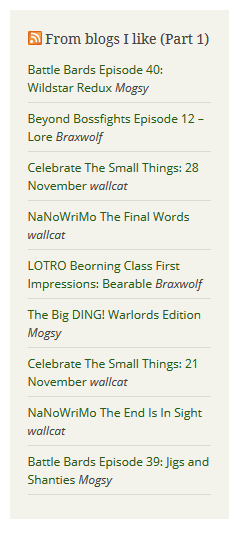
Wordpress RSS Widget

I used Chimpfeedr to bundle a set of RSS feeds into one, and then the normal WordPress RSS widget to show the combined feed in my sidebar.

I had to make two different feeds and use two separate RSS widgets in my sidebar, one for blogs that are frequently updated, and one for the less frequent writers. This was so that new posts from the less frequent posters don’t quickly disappear as those that publish daily fill up the top of the feed.

This is an improvement on a plain blogroll I think, but still has major limitations compared to the fantastic widget available on Blogger. Some that come to mind…

  • It’s not possible to edit a Chimpfeedr feed once you’ve made it, so adding any new blogs to your list is going to be a pain.

  • The Blogger widget includes just the latest post from every blog on the list, so everyone has one and one post only in the sidebar. This lets you show more blogs in a reasonable way, and gives good exposure to people who don’t write so regularly, who are probably the ones who can most benefit from wider exposure.

  • It just doesn’t look as nice or as readable. It would be nice to show the blog titles along with post titles, and do it in a different color and font as in the Blogger version.

I wrote this method up as I think it might be useful to other bloggers, and maybe for constructing a simple version of the Gaming Blog Nexus.

Do let me know if you try this out, and if you have any ideas for improving on this approach.

UPDATE:

It seems Chimpfeedr might not update the feed after it has been created. That’s according to Wilhelm who has worked on trying to make something like this for a long time. He does have a working solution on similar lines, but it seems to involve two paid services (Feedly Pro and Pinboard) which would be overkill for me.

But there are other RSS aggregators beside Chimpfeedr, so if we can find a decent one, not much has to change other than the feed URL we put in the RSS widget.

UPDATE #2:

Chimpfeedr does seem to update. Maybe it’s been fixed since Wilhelm tried it. Here’s the same widget as in the pic above, and it’s got some new items in it now…

WP RSS widget 2

I’ve also experimented with a version of Wilhelm’s more complex solution, and it seems to work in principle. This uses a free Newsblur account to organize the blog feeds, a free IFTTT account to trigger an action when a new item is added to Newsblur, which action can be set to add the item to a free Delicious account that bookmarks it. Each Delicious account and every tag in the account has its own RSS feed, for example like this one, so they can be used in the widgets like before.

Because of the way this works, it will take a while to compile a feed of items, because it will only notice when something new arrives, not do anything with the old posts that were already there. But in time it should be a better solution that will allow for easier organizing and updating of the blogs to be included.

Newsblur has a limit of 64 feeds on a free account, though as far as I know there is nothing to stop you making multiple accounts. 64 should be plenty for this use though, and even the premium sub with unlimited feeds is not too expensive, $24/yr.

It’s a shame that we have to resort to such a convoluted set up compared to the elegance of the Blogger widget!

Book Review: The House of Silk

If you’ve been reading my blogs, you’ve probably gathered that I read a fair number of books. I often mean to review them as well, but I seldom get around to actually doing that. Mostly that’s because I leave off reviewing a book until I have time to “do it properly”, with an in-depth and considered review. Well, maybe it’s better to write a short and not-too-deeply-considered review rather than none at all! So I’m going to give that a try with The House of Silk.

The_House_of_Silk

The House of Silk: A Sherlock Holmes Novel

I’m a great fan of the Sherlock Holmes stories, and I enjoy other writers’ attempts at creating new ones. Those attempts vary quite a lot in their style and quality. The House of Silk is a pretty good one in my opinion.

It’s by Anthony Horowitz, who has written a fair number of scripts for the Poirot TV series, and who created the Foyle’s War TV series, so has pretty good credentials with period mysteries. He was also approached and authorized by the Conan Doyle estate to write this novel, for what that’s worth.

The book is longer than the original Conan Doyle novels, and covers two interconnected cases, “The Man in the Flat Cap” and “The House of Silk”. That’s worth mentioning because it turned out that the “Flat Cap” part is very much along the lines of Conan Doyle stories, while the “House of Silk” has more in common with modern day crime stories.

All the usual elements of the Holmes world are present, and pretty nicely done. There’s Holmes and Watson in Baker Street, Lestrade, Mrs Hudson, Mycroft, the Baker Street Irregulars. The Irregulars play a pretty important part too.

For me the book’s biggest strength is how well it does the traditional Conan Doyle tropes. There are a few deductions that are as delightful and surprising as in the orignal stories, the voice of Watson is well captured, and the banter with Holmes is often very good too.

The biggest weakness is that Horowitz lets a lot of modern preoccupations into the book as well. His Watson has a lot more to say on the social conditions of Victorian London than the real Watson ever did, and seems pretty alien in doing it, like an outsider to his own time and place. The House of Silk mystery tries to be darker than the usual Conan Doyle stories, but in the end what is revealed is a pretty well-worn cliche in modern crime dramas, and I saw where that case was going a mile off.

Overall, this is well worth a read. Depending on why you read Holmes you might rate it anything from 3 stars to 5 stars. I like my Holmes traditional, and while I might be interested in social commentary if it had any new insights to offer, that didn’t apply here at all. So I feel I’m being on the generous side in rating it 4 stars. A solid effort, good overall, and excellent in parts.

Why did Kindle boost my reading?

I used to read a fair number of books all through my life, but that started declining sometime in the last ten or so years. Then I got a Kindle, and that seemed to kick start my reading again. It seems I’m far from alone in either the decline or the Kindle effect.

I’ve been pondering why getting a Kindle might have made such a difference. A couple of theories I’ve heard don’t fit the bill for me personally.

  • The theory put forward by Alan Jacobs that he’s got used to doing things with his thumbs on mobile devices and the Kindle gives him that same thumb-twiddling fix didn’t seem particularly convincing to me. It’s not like I felt an impatience to fiddle with my fingers when I did read a paper book or magazine.

  • Many people attribute their drop in reading to a craving for incessantly checking email, social media etc, and say that the great benefit of Kindle is that you can’t do anything else with it but read. I can see how that could apply to other people, but it doesn’t apply to me very much. I’ve long since had habits of organizing myself to not be continually interrupted. For example my email isn’t set to ding me, I just go check it at certain times of day. And my mobile devices don’t even have Twitter on them. I do now read a lot on an iPad Mini as well as a Kindle, and I don’t find all the apps I have on the iPad to be particularly a distraction from reading.

Nevertheless, my book reading had dropped sharply over the years, and was revived again when I got a Kindle. So why?

Here are my speculations…

  • The new toy effect. It’s a natural thing that when you get a new “toy” you want to play with it to the fullest, put it through its paces, explore what you can do with it. When you get a new Kindle, that means grabbing a lot of diverse reading materials, and reading some of them. If you’d fallen out of the habit of regular reading, getting a Kindle is likely to get you back into the rhythm of it.

  • The snowball effect. We all know that some new toys are played with for a few days and then forgotten, while others become perennial favorites. Kindle gave a kickstart to my reading, and through that I rediscovered how rewarding and enjoyable reading was, so I kept on reading. And that continued reading was not all that dependent on the Kindle itself, because as mentioned I read a lot on iPad now as well.

  • Super-convenience. Hit the power on button, you are right in your book, where you left off. No need to dig out reading glasses, the print is a comfortable size. Everything in sync on multiple devices, so I can use whatever is to hand or in my pocket, Kindle, iPad or Android phone. (Note – this is obviously not specific to Kindle devices themselves, though you only get the syncing with Kindle apps not any other readers I’ve found.) The light weight and small size is also important, making it easier to carry around than even a paperback.

  • The next book effect. Because it’s so quick and easy to get the next volume in the book series, get other books by the author you just enjoyed, or more books on the topic that’s got you intrigued, there is less chance of the out of sight, out of mind phenomenon. Being able to take action when something is on my mind leads to follow through and a steady chain of reading. If I had to remember and wait til I went to a bookshop, or even to order online and wait for delivery, that wouldn’t happen.

  • Talking of which…. whatever happened to bookshops? For one reason and another, wandering into bookshops is a much less frequent part of my life than it used to be.

  • The sunk cost effect. Having spent a chunk of money on a device, we feel like we should get our money’s worth from it. Perhaps we also feel like we need to justify the purchase to ourselves, or others. So we read, rather than whatever else we might have done instead.

  • Commitment and identity. Buying a dedicated reading device is in part making a commitment to reading, and declaring yourself to be a reader. Perhaps it is not that a Kindle magically makes reading easier again, but rather it’s that you’ve reached a point where you have decided you mean business about getting reading again, and buying a Kindle is symbolic of that.

Some of what I’ve said above would apply to all forms of e-reading, whether on tablet or dedicated e-readers. Some would apply to all e-ink readers, but not general purpose mobile devices. And one or two points only to the Kindle and its ecosystem.

So maybe there is no one overriding reason why Kindle or e-readers in general help resuscitate comatose reading habits. But one way and another, they did for me, and I’m glad of it.

Reading in an Age of Distraction

A video well-worth watching, esp if you feel like you don’t read enough or don’t read the right things. Makes a lot of interesting points that will make you feel better about your habits.

The Q&A are fascinating too, and help make sense of the talk.

Some of the topics that come up…

  • Some graduating students have an anxiety about not reading the right things after they leave college

  • Many older people say they can’t concentrate for sustained periods any more in the age of tech

  • He encourages people to read for the pleasure of it, not for some reason of virtue

  • When you think about what great art demands from you… clearly you are not up the challenge of reading that every day… it’s like eating a 7 course French meal every day… too much

  • Most of your reading should not be “great books”

  • A few years ago he found it was becoming difficult getting through books for the first time in his life, having always been a voracious reader before

  • What helped him get out of that was when he got a Kindle

  • That doesn’t work for everyone, but we should all be hopeful that it’s possible one way or another to recover our ability to concentrate and to get back the joy of reading

Points from the Q&A…

  • Writing non-fiction using approach of storytellers

  • Reading novels vs reading non-fiction or textbooks

  • Checking things off lists as a source of distraction

  • Reading for fun is more motivating than reading dutifully

  • Audiobooks vs reading

  • Ideas of what is “serious literature” change. Shakespeare and Dickens were popular entertainment in their own time.

  • People use books to try to signal what kind of person they are. Maybe even to themselves.

Personally I can relate to the part about getting a Kindle giving a big boost to my reading. Though his theory about why that helped him doesn’t apply to me at all.

Unlike him I can also get wrapped up in an audiobook, but it does have to be a great book and a great reader. Great readers are pretty rare, so a lot of them are quite hard to listen to.

Inner Adult, Inner Child

Over on Thinking Play I discussed the pros and cons of buying a certain game in a rational fashion. That’s the logic, but the emotion was a little different. The internal conversation was a bit like parent and child, and went something like this…

Little Pasduil: I want this game!!! Can I have this game???

Adult Pasduil: Oh, what do you like about this game?

Little Paduil: Umm... urr... I don't know... it's cool... and all my friends have it...

Adult Pasduil: But you have lots of games like that already, and you never play them.

Little Pasduil: This game's different. I will play this one! I really will.

Adult Pasduil: But that's what you said about those other games!

Little Pasduil: But this time I really will!

Adult Pasduil: Hmm.

Little Pasduil: ...

Adult Pasduil: Don't you have too much work to do right now to have time for more games?

Little Pasduil: I suppose. But it's a game that's really good for fitting in around work! I'll be able to work better that way, with nice breaks!

Adult Pasduil: laughs

Little Pasduil: That's not fair.

Adult Pasduil: If you still want it when the next sale comes around, we'll see. In the mean time be a good boy and get on with your work.

Apple…. Grr…

I’m planning a post called “From Apple Love to Apple Loathing”. It will take me a long time to write! Because of the long distance traveled over many years, the large number of annoyances to relate, and quite likely a large side order of fuming over monopolistic business strategies.

This has been brought on because I went ahead and bought that cable that lets me hook up my new microphone to my iPad. It’s basically a USB-OTG cable, but because it’s Apple it costs a small *”?$!* fortune. Also it doesn’t do as much as a real USB-OTG cable would, because God forbid people should be able to connect all and sundry USB devices to their iPad.

The Books Meme – A Compilation

As I mentioned the other day, there’s a popular meme which started on Facebook and has spread well beyond it in which people list books that have stayed with them. I find this meme fascinating, and I’d encourage everyone to take part.

I’m going to use this post to compile together interesting book lists, especially from people in my immediate online circles, together with links to some related articles.

Interpretations of the Meme

Not everyone interprets the meme in the same way. There are subtly different ways of looking at this, which could lead to different lists. For example I didn’t include books which had once meant a lot to me, but have since fallen off the radar. Nor did I list what I thought were the best books or the books that I’d enjoyed the most. My interpretation was more along the lines of “had something about it that means it remained with me over a lifetime”. And I’m old enough that I could have loved something for a decade, and yet it’s had time now to fall off that kind of a list.

Other people have slightly different interpretations, but that doesn’t greatly matter. I’m not interested in rule-lawyering about it, more interested in knowing what books have mattered to people, and how.

The List of Lists

Book Meme Blog Posts

Lists Added as Blog Comments

I’ll keep these lists updated as I find more posts.

Have Mic, Will Travel

Go Mic Pentax Pic

I have been tempted by all you podcasting types to go get myself my first microphone.

Having pondered all kinds of advice and reviews, not least from the esteemed Braxwolf, I went for the Samson Go Mic, a small portable condenser mic. (Before I read Brax’s post I didn’t know what that was, now I sound all technical!)

Amazon only delivered it today, and I’ve yet to do much beyond test that I can actually record with it. It’s small, feels solid and well made, and should be highly flexible. It did a decent job of recording me and not my PC fans in my quick test.

Looks like this will be a nice first mic for use at the desktop, and I’ll probably be able to get it to work with my iPad Mini and maybe my Android phone as well. Of course connecting to the iPad would require a cable that will cost almost as much as the mic itself. Because Apple.

For anyone that’s interested in learning more about the mic, there’s a useful review here, and a great guide to choosing a microphone here.

Those guys even have a nice little demo of various mics which helped convinced me the Go would be pretty good. I’ll try to embed the demo, but I don’t know how well WordPress will cope with it.