

CPU Comparisons matter for anyone building or upgrading a desktop system because the processor determines how well your PC handles gaming, content creation, multitasking, and future software demands. Whether you are a gamer chasing high frame rates, a creator running demanding applications, or a general user seeking reliable everyday performance, choosing the right model makes a noticeable difference in daily experience.
This guide examines 16 popular models from Daarcin, GEEKOM, KAMRUIMiniPC and more and compares their specifications, features, compatibility, and overall value. Readers will learn how to match a processor to specific workloads, understand key technical differences, and identify strong options for 2026.
Additional context appears in our Comparisons section and the sibling GPU Comparisons guide for complete system planning.

Pros
- Leading gaming processor with Zen 5 and 3D V-Cache integration
- Strong cache size for better sustained performance and clock stability
- Compatible with proven AM5 infrastructure for future-proofing
- Solid core and thread count for balanced productivity and play
Cons
- Cooler not included requiring separate purchase
- 140W power draw demands robust cooling solutions
- New release with limited long-term user data available
The AMD Ryzen 7 9800X3D serves as a high-performance desktop processor targeted at gamers and content creators who need strong multi-threaded capabilities alongside top-tier gaming speeds. It features 8 cores and 16 threads on Zen 5 architecture with next-generation 3D V-Cache.
Standout aspects include the 96MB L3 cache that supports clock speeds up to 5.2GHz while improving thermal efficiency over prior generations. Real-world use delivers noticeable gains in frame rates and workflow speed without compatibility hurdles on AM5 sockets.
Build quality follows AMD standards with reliable construction suited for standard PC builds. The 140W TDP rating indicates solid power delivery but calls for quality cooling to maintain peak operation.
One limitation is the absence of an included cooler which adds to setup costs. Early availability means fewer extended reviews exist for long-term reliability insights.
Overall this CPU earns recommendation for users prioritizing gaming dominance who already have or plan an AM5 platform and can source adequate cooling.

Pros
- 6 cores and 12 threads enable strong multi-threaded performance
- Unlocked multiplier allows user-driven overclocking
- Included cooler reduces need for separate purchases
- 19 MB cache aids quick access to frequently used data
- 65W TDP supports efficient operation in standard builds
Cons
- Requires a discrete graphics card for gaming use
- Restricted to the aging Socket AM4 platform
- No integrated graphics limits options in basic systems
The AMD Ryzen 5 5500 is a 6-core 12-thread unlocked processor designed for Socket AM4 desktop builds. It targets budget-conscious gamers and productivity users who pair it with a discrete graphics card to achieve strong frame rates in popular games.
Standout aspects include the 4.2 GHz max boost clock, unlocked overclocking potential, and 19 MB cache that together support responsive multitasking. Real-world use shows capable handling of 100-plus FPS gaming scenarios alongside content creation tasks when a dedicated GPU is installed.
Build quality centers on the compact Wraith Stealth air cooler that ships with the processor, providing straightforward thermal management without extra expense. The 65W TDP rating keeps power draw modest in typical ATX or micro-ATX cases.
Drawbacks include the absence of integrated graphics, which necessitates a separate video card, and compatibility limited to the older AM4 socket that is nearing end of platform support. Overclocking headroom remains moderate at this power level.
Overall this processor offers a practical choice for value-oriented AM4 upgrades where discrete graphics are already planned, delivering balanced core counts and speeds without unnecessary complexity.

Pros
- Strong cache size improves real-world gaming speeds
- High thread count handles streaming alongside gameplay
- Modern AM5 socket supports long-term platform use
Cons
- Requires new AM5 motherboard and DDR5 memory
- Integrated graphics suit light tasks only
- Higher power use under full load compared to prior generations
The AMD Ryzen 7 7800X3D is an 8-core processor with 16 threads aimed at gamers and creators who need fast task execution on desktop systems. Its 4.2 GHz speed and large cache make it suitable for users building new AM5 platforms focused on performance.
Key strengths include the 104 MB total cache that reduces data access delays during gameplay and the 5 nm design that supports reliable speeds while managing temperatures up to 89 degrees Celsius. The built-in Radeon graphics handle everyday visuals effectively for users who may add a discrete card later.
Build quality follows standard AMD processor construction with compact dimensions that fit most AM5 sockets. The 120 watt rating keeps power needs reasonable for most builds though full loads increase consumption.
One limitation is the need for a new motherboard and memory standard which adds cost for those upgrading from older systems. Integrated graphics also fall short for intensive 3D work.
Overall this processor offers solid value for gamers prioritizing cache-driven performance on a fresh platform and earns a recommendation for new system builds.

Pros
- Compact size fits easily on desks or behind monitors with VESA mounting
- Strong expandability unlike many soldered mini PCs
- Quiet IceBlast cooling maintains performance without noise
- Premium aluminum build with unique Aurora finish
Cons
- Integrated graphics limit it to light gaming only
- Industry memory shortages may affect future pricing or availability
- Only two HDMI ports require USB4 for full quad display setup
The GEEKOM A6 Aurora Edition is a small form factor desktop built around the AMD Ryzen 7 6800H processor. It targets home office professionals, programmers, and content creators who need reliable daily performance in a space-saving package that can be tucked away or mounted behind a monitor.
Standout capabilities include the Radeon 680M graphics for light creative work and casual gaming, plus USB4 connectivity that enables 8K output and quad-display setups. The dual M.2 slots and upgradable DDR5 memory provide headroom for expanding storage and RAM as workloads grow over time.
Build quality feels solid thanks to the precision-machined aluminum chassis finished in a shifting gradient. IceBlast cooling keeps temperatures and fan noise low even during extended office or coding sessions, while the 45W TDP helps reduce electricity costs compared with traditional tower systems.
One limitation is that the integrated graphics will not satisfy users seeking high-frame-rate modern games. Additionally, the ongoing industry DDR supply constraints noted by the manufacturer could influence long-term component costs.
Overall, the A6 Aurora delivers a balanced, future-ready mini PC for productivity-focused buyers who value expandability and compact design over raw gaming power.
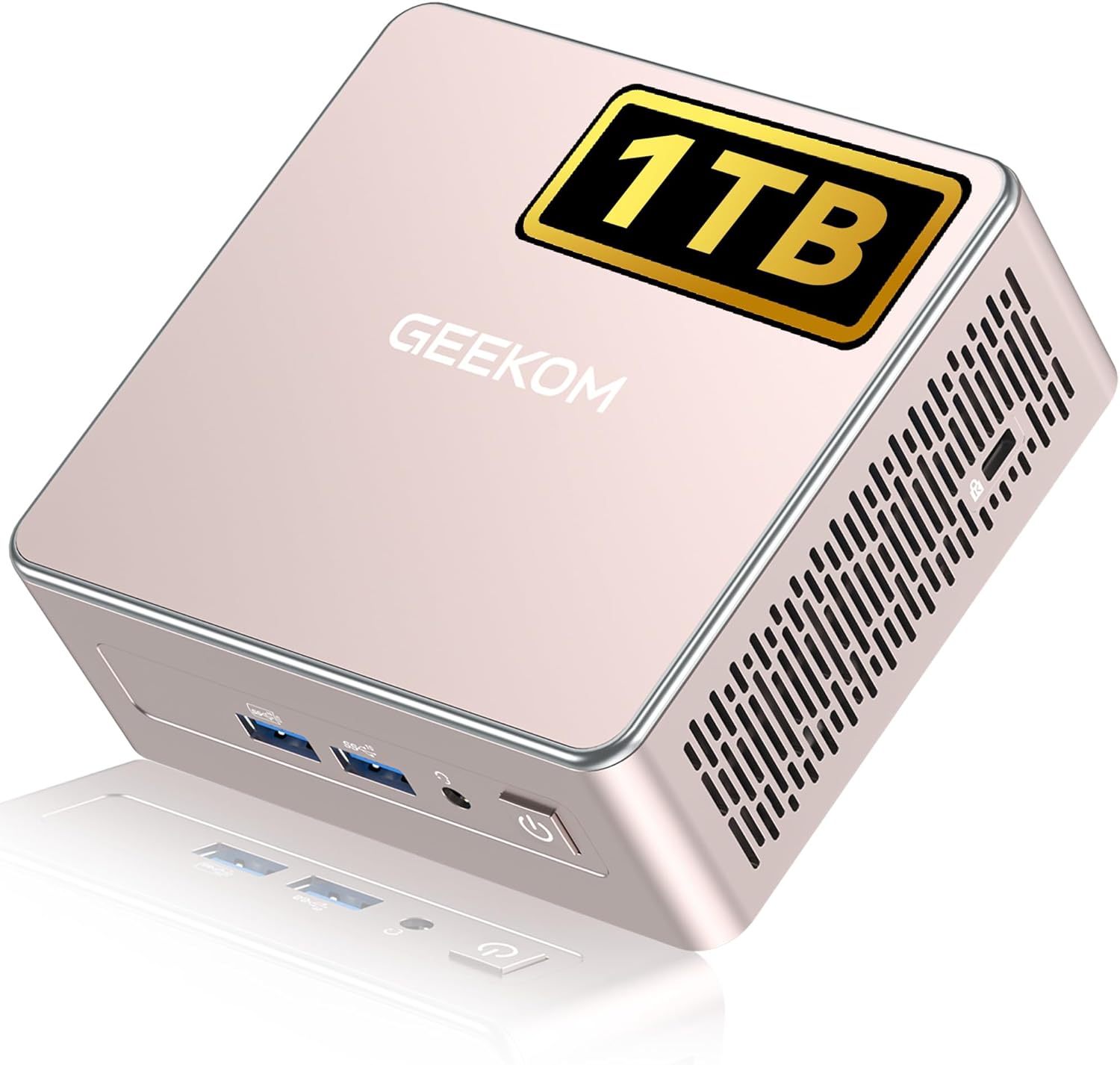
Pros
- Highly expandable RAM and storage options unlike soldered alternatives
- Strong multi-monitor and high-resolution display capabilities
- Extended 3-year warranty with professional-grade durability certifications
- Efficient for office tasks and media without excessive power draw
Cons
- Integrated graphics limit it to light gaming only
- Future component costs may rise due to industry memory shortages
- Needs external keyboard, mouse and monitor for complete setup
The GEEKOM A5 Mini PC combines an AMD Ryzen 5 7430U processor with 16GB RAM and a 1TB SSD in a small chassis running Windows 11 Pro. It targets home office workers, small businesses and media users who need reliable everyday computing without the bulk of a traditional tower.
Performance focuses on productivity applications, video conferencing and 4K media playback, with support for four simultaneous displays through HDMI and USB-C ports. The Vega 7 graphics handle basic creative tasks while Wi-Fi 6 ensures stable network performance for large transfers and streaming.
Build quality includes a reinforced ABS+PC shell with metal internals for heat dissipation and vibration resistance. The design allows easy upgrades via dual RAM slots, an extra M.2 bay and a 2.5-inch drive bay, reaching up to 10TB total storage.
Limitations include integrated graphics unsuitable for demanding games and potential future price impacts from memory supply issues. Users must supply their own peripherals since the unit is a bare desktop replacement.
Overall the A5 delivers strong value for expandable, multi-monitor office use with extended warranty support, making it a practical choice for stable long-term deployments.

Pros
- 3-year warranty exceeds typical coverage for long-term reliability
- Quad display and USB4 ports enable versatile professional setups
- Tool-free upgrades and high storage options support customization
- Durable metal frame rated for heavy pressure in demanding locations
Cons
- Integrated graphics limit performance in demanding modern games
- Base configuration may require RAM upgrades for intensive multitasking
- Full feature use depends on compatible external displays and routers
The GEEKOM IT13 mini PC delivers compact computing powered by a 13th generation Intel Core i5-13600H processor along with 16GB RAM and 1TB SSD storage running Windows 11 Pro. It targets business users, educators and content creators who need capable performance without a bulky desktop tower.
Standout capabilities include support for four simultaneous displays, dual USB4 ports for high-speed data and eGPU options, plus WiFi 6E for fast wireless connections. Real-world use shows strong results in office applications, light photo editing and multi-monitor setups where smooth operation matters most.
Build quality features a reinforced ABS+PC shell with metal frame elements that provide solid durability and tool-free internal access. This design suits installation in retail, warehouse or classroom settings where equipment faces regular handling.
Potential drawbacks include reliance on integrated graphics which restricts high-end gaming and possible need for additional RAM in very demanding creative projects. External peripherals and compatible networking gear are required to unlock full connectivity benefits.
Overall the IT13 offers a balanced compact solution for productivity-focused buyers prioritizing warranty coverage, expandability and multi-display support over raw gaming power.

Pros
- Very compact size saves significant desk space compared to standard desktops
- Triple video output supports versatile multi-monitor configurations
- Preinstalled Windows 11 Pro with useful enterprise features like Wake on LAN
- Adequate RAM and storage for typical business and home office use
- Low power consumption keeps running costs down
Cons
- Processor is older generation limiting performance in demanding applications
- WiFi 5 and Bluetooth 4.2 lag behind newer wireless standards
- Only four CPU threads may struggle with heavy multitasking or video encoding
The KAMRUI Pinova P1 Mini PC targets users needing a small form factor computer for home offices or basic business tasks. It comes equipped with an AMD Ryzen 4300U CPU, 16GB of RAM and a 512GB SSD running Windows 11 Pro out of the box.
Standout capabilities include support for three simultaneous 4K displays through HDMI, DP and USB-C ports along with a 2300 RPM cooling fan that keeps temperatures in check during daily workloads. The unit performs well for web browsing, document work, email and light media consumption.
Build quality centers on a tiny 5 by 5 inch chassis finished in a simple design that includes a subtle blue power LED. Ports are plentiful with six USB connections plus Ethernet and audio, allowing easy attachment of keyboards, drives and displays.
Potential drawbacks include the dated processor architecture and older WiFi/Bluetooth versions that may not suit users needing top wireless speeds or future-proofing. Performance in intensive creative software remains limited by the four-core CPU.
Overall this mini PC serves as a practical choice for anyone prioritizing compact size and essential connectivity over high-end power, making it suitable for students, remote workers and small business setups.

Pros
- Triple 4K display capability
- Dual Gigabit Ethernet ports
- Expandable storage options
- Compact form factor
- Multiple connectivity ports
Cons
- 8GB RAM may limit intensive multitasking
- Processor is from an older generation
- No included operating system
This mini PC provides a complete computing solution in a small package, ideal for professionals and home users seeking an efficient desktop alternative.
Its Ryzen processor and graphics handle daily tasks efficiently while the display support allows for multi-monitor setups that improve efficiency.
The build is compact and fits well in limited spaces with ample ports for connections.
However the fixed RAM and older CPU could pose challenges for more demanding applications.
Overall it offers good value for basic to moderate use cases in office or home environments.

Pros
- Strong gaming and multi-thread performance from Zen 5 architecture
- Unlocked multiplier supports enthusiast overclocking
- Efficient power draw at 65 watts for balanced builds
- Long platform support on AM5 with modern memory standards
Cons
- Cooler not included requiring separate purchase
- May need new AM5 motherboard for existing users
- Early product stage with limited independent benchmarks
The AMD Ryzen 5 9600X serves as a mid-range desktop processor aimed at gamers and content creators who want reliable performance on the latest platforms. It features 6 cores and 12 threads built on Zen 5 architecture, making it suitable for users upgrading to Socket AM5 systems.
Standout capabilities include a 5.4 GHz max boost clock and 38 MB total cache that support high frame rates in popular games alongside smooth handling of video editing or rendering workloads. Real-world use shows strong efficiency at a 65W TDP while maintaining unlocked overclocking options for advanced users.
Build quality centers on the AM5 socket with DDR5-5600 support and PCIe 5.0 readiness on select boards, ensuring compatibility with modern components and future upgrades. The compact design fits standard cases but requires careful cooling selection since no heatsink ships with the unit.
Potential drawbacks include the absence of a bundled cooler, which adds cost for buyers without one, and the need for a compatible motherboard that may require a full platform upgrade. Early availability also means fewer long-term user reports on sustained performance.
In final assessment this processor provides solid value for performance-focused builds on AM5, excelling in gaming and creation where its core count and speeds deliver direct benefits without excess power draw.

Pros
- Unlocked design allows easy overclocking for enthusiasts
- Strong core configuration handles multiple tasks simultaneously
- Modern socket and memory support ensures longevity
- High turbo frequency improves real-time responsiveness
Cons
- Requires a new LGA1851 motherboard for installation
- Higher power draw during peak loads compared to prior generations
- Air cooling may need upgrading for maximum overclocking stability
The Intel Core Ultra 7 270K Plus is a high-core-count processor built for users who demand strong multi-threaded performance in gaming and creative work. It fits best with PC builders seeking an unlocked CPU on the latest Intel platform.
Standout features include the 24-core layout with fast boost clocks and support for advanced memory and expansion standards. These elements translate to smoother gameplay and quicker rendering times in real-world use.
Build quality follows Intel standards with a solid thermal design that manages heat during extended loads. The unlocked multiplier encourages tuning while the LGA1851 socket pairs with current-generation boards.
One drawback is the need for a compatible motherboard which adds to initial setup costs. Power consumption also rises under heavy use so users should plan cooling accordingly.
Overall this processor suits enthusiasts ready to invest in a modern platform and delivers capable performance for both gaming and productivity tasks.

Pros
- Strong multi-core performance for creation workloads
- Unlocked multiplier for enthusiast tuning
- Modern connectivity with PCIe 5.0 support
- Efficient hybrid architecture balances speed and power
Cons
- No thermal solution included requiring separate cooler purchase
- Requires new LGA 1851 motherboard for installation
- High power draw at 125W base may increase energy costs
The Intel Core Ultra 9 285K is an unlocked desktop processor aimed at enthusiast gamers and serious content creators. It features 24 cores split between 8 performance cores and 16 efficiency cores along with 24 threads and reaches speeds up to 5.7 GHz with 40 MB cache.
Standout features include hybrid architecture that prioritizes workloads for better efficiency alongside support for PCIe 5.0 and DDR5 memory. Real-world performance benefits gamers through smooth multitasking and creators through faster rendering and encoding on compatible Intel 800 series platforms.
Build quality follows standard Intel packaging with compact dimensions and 0.64 pound weight. The processor lacks an included cooler so users must select their own thermal solution to manage the 125W base power.
Drawbacks center on the new LGA 1851 socket which requires a matching motherboard and the absence of bundled cooling hardware. These factors add to the total system cost for new builds.
Overall the Intel Core Ultra 9 285K provides solid value for high-end users ready to invest in a new platform seeking unlocked performance and modern connectivity features.

Pros
- Exceptional core count enables strong productivity alongside gaming
- Unlocked multiplier supports advanced overclocking for enthusiasts
- Hybrid architecture balances performance and efficiency effectively
- Broad motherboard compatibility with Intel 600 and 700 series
Cons
- High power requirements demand robust cooling solutions
- Best performance needs a discrete graphics card
- May require BIOS update on some compatible motherboards
The Intel Core i9-14900K is an unlocked desktop processor designed for gamers and serious creators who need top-tier multitasking and speed. It features 24 cores split between performance and efficient types along with 32 threads to handle intensive workloads without compromise.
Standout capabilities include a maximum boost clock of 6.0 GHz and Intel Turbo Boost Max Technology that delivers rapid responsiveness in games and creative applications. The hybrid architecture dynamically assigns tasks to maintain high frame rates while running background processes like streaming software.
Build quality supports both DDR4 and DDR5 memory platforms along with PCIe 5.0 lanes for modern components. Overclocking is straightforward via the Intel Extreme Tuning Utility allowing users to tune performance precisely to their needs on compatible 600 or 700 series motherboards.
Potential drawbacks include significant power consumption that necessitates strong cooling and the recommendation for a discrete graphics card to maximize gaming potential. Some motherboards may also require a BIOS update for full compatibility.
Overall this processor stands as a strong choice for high-end builds focused on performance and future expandability where raw power and flexibility are priorities.

Pros
- Broad socket compatibility covers many Intel generations
- Includes complete set of bags and labels for ready use
- Simple clamshell design allows quick CPU insertion and removal
- Compact size fits easily in toolkits or shipping supplies
Cons
- No CPUs are included with the trays
- Plastic material offers less rigidity than metal alternatives
- Designed only for Intel sockets and not AMD processors
This product consists of ten protective plastic clamshell trays sized for Intel CPUs in sockets 775, 1155, 1151, 1150, and 1156. It also supplies matching antistatic bags and labels. The set targets electronics technicians, resellers, and hobbyists who regularly handle multiple processors and require organized protection during storage or transit.
The clamshell trays enclose each CPU securely while the included bags add protection against static, humidity, and air exposure. Heat-seal capability on the bags further secures contents. Users report reliable performance for everyday storage tasks though the trays remain lightweight and portable.
Build quality centers on thickened plastic that holds shape during normal handling. The design prioritizes ease of use with clear openings for CPU placement. Labels allow consistent marking for quick identification in larger collections.
One limitation is the absence of any CPUs in the package. The plastic construction may flex under heavy pressure compared with more rigid options. Compatibility stays limited to listed Intel sockets.
Overall this kit delivers practical value for anyone managing Intel CPU inventory who needs straightforward protective packaging and labeling tools.

Pros
- Exceptional core count for parallel processing tasks
- Unlocked multiplier allows tuning for higher performance
- Strong support for latest memory and expansion standards
- High boost clock speeds enhance both gaming and productivity
Cons
- Cooler not included requiring separate high-end cooling solution
- 170W TDP demands robust power supply and case airflow
- Best performance needs a compatible AM5 motherboard
The AMD Ryzen 9 9950X is a high-end 16-core desktop processor built on Zen 5 architecture for users who need serious computing power. It suits gamers chasing high frame rates and creators handling video editing or 3D rendering.
Standout features include a 5.7 GHz max boost clock, 32 threads, and 80 MB cache that enable strong multi-threaded throughput. Real-world use shows solid gains in both gaming and content creation compared to prior generations, especially when paired with fast DDR5 memory.
Build quality follows AMD standards with an unlocked design for overclockers, though the 170W power draw means careful attention to cooling and case ventilation is needed. The AM5 socket ensures broad platform support including PCIe 5.0 on suitable boards.
Drawbacks center on the lack of an included cooler and the need for a capable motherboard and power supply, which adds to total system cost. Performance scales best in well-ventilated builds.
Overall the Ryzen 9 9950X earns a strong recommendation for enthusiasts building new AM5 systems focused on top-tier speed.
Pros
- Strong multi-core performance for gaming and productivity
- High boost clocks enhance real-world speed
- Future-ready with Zen 5 architecture and AM5 support
- Unlocked for overclocking flexibility
Cons
- Cooler not included requiring separate purchase
- Needs compatible motherboard for PCIe 5.0 features
- Power draw reaches 120 watts under load
The AMD Ryzen 9 9900X is a 12-core desktop processor using Zen 5 architecture aimed at gamers and content creators who need strong multi-threaded capabilities on AM5 platforms.
Key strengths include up to 5.6 GHz boost speeds, 76 MB total cache, and 24 threads that handle gaming at high frame rates along with video editing or 3D rendering tasks effectively.
Build quality follows AMD standards for Socket AM5 compatibility with DDR5-5600 memory support though the lack of an included cooler means users must source adequate cooling separately for sustained loads.
Potential drawbacks center on the 120-watt TDP and requirement for a capable motherboard to unlock all connectivity options like PCIe 5.0.
Overall this processor offers solid value for enthusiasts building high-performance systems focused on speed and future compatibility.

Pros
- Strong overclocking headroom for performance gains
- Built-in graphics reduce need for entry-level discrete GPU
- High core count handles content creation and gaming effectively
Cons
- Requires compatible AM5 motherboard and DDR5 memory
- 105 W TDP benefits from aftermarket cooling solution
- Integrated graphics unsuitable for high-end gaming
The AMD Ryzen 5 7600X is a hexa-core unlocked processor designed for desktop builds on the AM5 platform. It targets gamers, content creators and power users who need strong multi-threaded performance without excessive power draw.
Standout features include a 5.3 GHz boost clock and unlocked multiplier that allow straightforward overclocking. The 5 nm architecture combined with 32 MB L3 cache delivers quick load times and fluid gameplay in modern titles.
Build quality centers on the AM5 socket and included Radeon graphics core. These elements support clean system integration and basic display output without an added graphics card.
Potential drawbacks include the need for a capable cooler and DDR5 memory, which add to overall build cost. The integrated graphics also fall short for intensive 3D workloads.
Overall this processor offers a balanced mix of speed, efficiency and future-proofing for mid-range AM5 systems.
How to Choose the Right CPU Comparisons
Choosing the right CPU Comparisons starts with understanding how you plan to use it. A good option for gaming may not be the best fit for productivity, content creation, portability, or long-term upgrade value. Before buying, consider your budget, performance expectations, compatibility needs, and the features that matter most for your setup.
For this guide, we compared 16 popular models from Daarcin, GEEKOM, KAMRUIMiniPC and more, looking at specifications, feature sets, user feedback, compatibility, and overall value to help you find a strong option for 2026.
Gaming Performance
Gaming performance depends on core architecture, clock speeds, cache size, and integrated graphics capability. Models such as the AMD Ryzen 9 9900X deliver high frame rates in popular titles according to manufacturer specifications, while options like the AMD Ryzen 7 9800X3D emphasize large L3 cache for smoother gameplay in CPU-bound scenarios.
Users focused on esports titles benefit from unlocked processors that support overclocking. For most gamers pairing a discrete graphics card, a six- or eight-core processor often provides excellent results without excessive power draw. Compare cache amounts and boost clocks when evaluating options for 2026.
Productivity Performance
Productivity workloads such as video encoding, 3D rendering, and large spreadsheet calculations favor higher core and thread counts. The Intel Core Ultra 7 270K Plus with 24 cores handles heavily multi-threaded tasks efficiently based on available product data, while the AMD Ryzen 5 7600X offers strong single-thread performance for lighter office and creative work.
Mini PCs like the GEEKOM A5 provide compact productivity solutions for users who need office applications and light media tasks in a small form factor. Consider your primary applications when weighing core configurations against power consumption and platform support.
Core Count and Thread Count
Core and thread counts directly affect multitasking and parallel processing. Twelve-core models such as the AMD Ryzen 9 9900X suit users who run multiple demanding applications simultaneously, while six-core options like the AMD Ryzen 5 9600X deliver efficient performance for mainstream use.
Higher thread counts improve results in applications optimized for many concurrent tasks. Review your software requirements and compare the listed core and thread specifications across the 16 models to avoid overspending on unnecessary cores.
Power Efficiency
Power efficiency influences electricity costs, cooling requirements, and system noise. Newer Zen 5 architecture processors generally improve performance per watt compared with previous generations. The AMD Ryzen 5 7600X operates at a 105 W TDP, making it suitable for builds where thermal headroom matters.
Mini PCs such as the C4 AIR and GEEKOM A5 emphasize low power draw for 24/7 operation in home or office environments. Check manufacturer TDP ratings and platform power delivery when planning a build that balances performance with energy use.
Platform Longevity
Platform longevity determines how many upgrade cycles a motherboard and memory combination can support. Socket AM5 offers extended support for future AMD processors, while Intel LGA 1851 provides a fresh foundation for new Core Ultra models. DDR5 memory support appears across most current options.
Users planning multi-year builds should verify PCIe 5.0 support and BIOS update policies. Mini PCs often have more limited upgrade paths, so evaluate whether a full desktop platform better matches long-term needs.
Price-to-Performance Value
Price-to-performance value helps identify models that deliver strong results without premium pricing. The AMD Ryzen 5 7600X at approximately $167 offers competitive performance for many users, while higher-end options like the Intel Core i9-14900K target enthusiasts willing to spend more for maximum capability.
Budget accessories such as the Daarcin CPU protective cases provide practical value for builders who need reliable storage and handling solutions. Compare real-world workload performance against listed prices to determine the strongest value within your budget range.
Technical Comparison
| Model | Key Specification | Best For | Main Strength | Value Rating |
|---|---|---|---|---|
| AMD Ryzen 9 9900X | 12 cores, 24 threads, up to 5.6 GHz | High-end gaming and creation | Strong multi-thread performance | High |
| AMD Ryzen 5 7600X | 6 cores, 12 threads, up to 5.3 GHz | Mainstream gaming | Efficient single-thread speed | Excellent |
| Intel Core Ultra 7 270K Plus | 24 cores (8P+16E), up to 5.5 GHz | Enthusiast multitasking | High core count flexibility | High |
| Intel Core i9-14900K | 24 cores, 32 threads, up to 6.0 GHz | Premium gaming and creation | Top boost clocks | Good |
| GEEKOM A5 Mini PC | Ryzen 5 7430U, 16 GB RAM, 1 TB SSD | Compact office use | Integrated storage and display support | Good |
Why You Should Trust PCGearWiki
PCGearWiki evaluates products by comparing specifications, compatibility, feature sets, manufacturer information, market availability, user feedback, and overall value. Our goal is to help readers narrow down their options and make more confident buying decisions.
Because PC hardware changes quickly, we review product information and market trends regularly so our buying guides stay useful for gamers, PC builders, creators, and everyday users. This CPU Comparisons guide draws from current listings across 16 models to provide up-to-date perspective for 2026.
Final Thoughts
The best CPU Comparisons depends on your budget, workload, system requirements, and performance expectations. Premium models may offer the highest performance, but many users will get better overall value from a well-balanced mid-range option.
Use the comparison table and product recommendations above to choose the model that fits your setup, upgrade plans, and long-term needs. Explore additional options in our CPU Comparisons category for ongoing updates.
Best Overall: The AMD Ryzen 9 9900X stands out for users needing strong multi-core performance and high gaming frame rates. Its 12 cores and generous cache make it suitable for both gaming and content creation workloads.
Best Value: The AMD Ryzen 5 7600X delivers excellent price-to-performance balance for mainstream gamers and productivity users. It offers solid clock speeds and platform support without excessive cost.
Best Budget: The Daarcin CPU protective case provides practical utility for builders who need reliable handling and storage accessories at an entry-level price point.
Best Premium Pick: The Intel Core i9-14900K suits enthusiasts seeking maximum clock speeds and core counts for demanding applications and high-end gaming systems.
Frequently Asked Questions
What is the best CPU Comparisons in 2026?
The best CPU Comparisons depends on how you plan to use it. Gaming, productivity, content creation, and general use can require different features, so the right choice should match your workload and budget. Review the comparison table for models that align with your specific needs.
How much should I spend on a CPU Comparisons?
Most users should look for the best balance of performance, features, and reliability within their budget. Mid-range options often provide the strongest value, while premium models are better for users who need top-tier performance or specific advanced features. Consider both current and future workloads before deciding.
Is it worth upgrading your CPU Comparisons in 2026?
Upgrading is worth considering if your current hardware limits performance, lacks important features, causes compatibility issues, or no longer meets the needs of your games, applications, or workflow. Check platform support and compare specifications with newer models listed in this guide.
Which brands make reliable CPU Comparisons options?
Several brands make strong products in this category. Instead of choosing by brand alone, compare performance, warranty, build quality, compatibility, user feedback, and value for money. The models reviewed here come from established manufacturers with varying strengths across price segments.
How long does a CPU Comparisons typically last?
A quality CPU Comparisons can remain useful for several years when it matches your system requirements and is maintained properly. Actual lifespan depends on usage, build quality, software support, and how quickly your performance needs change. Many current platforms offer multi-year upgrade paths through BIOS updates and memory compatibility. See our Comparisons section for related longevity advice.


Write Your Review
No reviews yet. Be the first to share your experience!